

|
시장보고서
상품코드
2065553
정부 전사적 자원 계획(ERP) : 시장 점유율 분석, 산업 동향 및 통계 데이터, 성장 예측(2026-2031년)Government Enterprise Resource Planning - Market Share Analysis, Industry Trends & Statistics, Growth Forecasts (2026 - 2031) |
||||||
 Mordor Intelligence
Mordor Intelligence에 의하면, 정부 전사적 자원 계획(ERP) 시장 규모는 2025년 51억 7,000만 달러로 평가되었습니다. 2026년에는 56억 8,000만 달러로 확대되어 2031년까지 101억 3,000만 달러에 이를 것으로 예상되며 2026년부터 2031년에 걸쳐 CAGR 12.24%로 성장할 전망입니다.
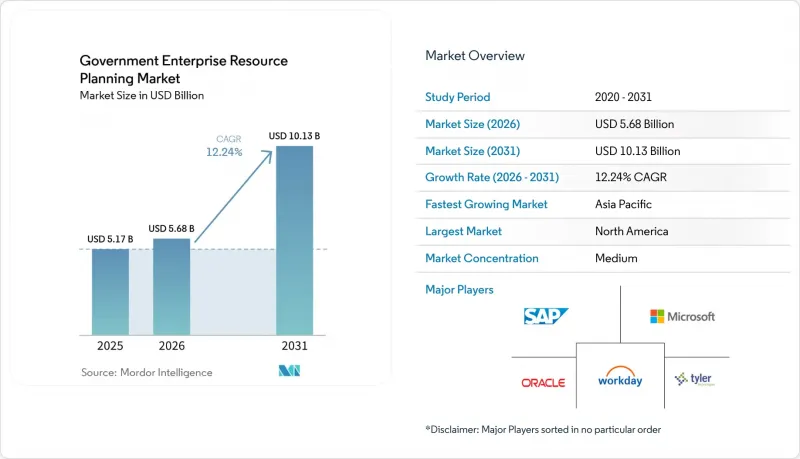
본 보고서는 배포 방식(On-Premise형 ERP, 클라우드 기반 ERP, 하이브리드형 ERP), 모듈(재무 관리, 인사 관리, 기타 모듈), 행정 수준(연방/국가, 주, 지방/지자체), 구성 요소(소프트웨어, 서비스), 지역별로 분류되어 있습니다. 시장 전망은 금액(달러) 기준으로 제시되어 있습니다.
세계의 정부 전사적 자원 계획(ERP) 시장 동향 및 인사이트
정부 차원의 디지털 전환 의무화
‘클라우드 우선’을 의무화하는 지침에 따라, 수십 년간 사용되어 온 메인프레임을 교체하는 것이 시급한 과제가 되고 있습니다. 오클라호마주의 2026-2028년 계획에 따르면, 모든 기관은 2028 회계연도까지 클라우드 아키텍처를 도입해야 하며, 테네시주는 2026 회계연도에 레거시 ERP 폐지를 위해 4,700만 달러를 예산에 편성했습니다. 버몬트주는 14개의 서로 다른 장부를 통합하고 있는데, 이는 COBOL 시스템의 폐지가 인력 채용 속도를 앞지르고 있는 미국의 수십 개 주와 유사한 상황입니다. 호주는 2026년 2월에 사전 인증 공급업체 패널을 출범시켜 조달 리드타임을 36개월에서 12개월로 단축하고, 지연되었던 프로젝트를 재개했습니다. 이러한 의무화 조치에는 기한과 감사상의 제재가 결합되어 있기 때문에 예산 배정이 엄격하게 확보되어 있으며, 내부 IT 자원이 제한적인 경우에도 안정적인 수요가 보장됩니다.
클라우드 전환을 통한 비용 절감
재무 모델에 따르면, On-Premise와 비교했을 때 5년간의 총 소유 비용(TCO)이 30-40% 감소하는 것으로 나타나, 예산이 빠듯한 재무부에게 클라우드는 매력적인 선택지가 되고 있습니다. 영국은 2025년, Rackspace Technology 및 Rubrik과 제휴하여 하이퍼스케일 수준의 확장성을 저해하지 않으면서도 데이터 상주 규정을 충족하는 소버린 클라우드를 구축했습니다. SAP는 2025년, 유럽의 개인정보 보호법을 준수하면서도 전 세계적인 지원을 유지할 수 있는 프랑스에 호스팅되는 소버린 클라우드를 도입했습니다. 로드아일랜드주는 구독료가 기존의 PeopleSoft 스택을 유지할 때보다 35% 낮아질 것으로 추산한 결과, Workday를 도입했습니다. 이를 통해 절약된 자금을 시민용 포털 개발에 투입함으로써, 만족도를 높이는 동시에 콜센터 비용을 절감할 수 있었습니다.
장기화되는 정부 조달 주기
24-48개월에 달하는 계약 체결까지의 일정은 현대화 사업 타당성을 저해하는 요인이 되고 있습니다. 미국 국방부는 2025년에 CIO-SP4 계약을 종료함으로써 각 기관이 IT 서비스에 대한 재입찰을 실시하도록 강요했고, 이로 인해 일정에 최대 18개월의 지연이 발생했습니다. 노스캐롤라이나주 유니온 카운티에서는 2025년에 2단계 RFP(제안 요청서)를 발간한 후, 2026년 하반기까지 공급업체 선정이 이루어지지 않을 전망입니다. 영국 공회계위원회는 예산 초과와 가동 개시 지연을 초래하는 기능상의 격차를 보고하고 있습니다. 이러한 정체는 기존 사업자에게 유리하게 작용하여 신규 진입을 가로막고, 그로 인해 시장 전체의 활기를 꺾고 있습니다.
부문별 분석
하이브리드 ERP는 연평균 성장률(CAGR) 14.80%로 확대되고 있으며, 도입 형태 중 가장 빠른 성장률을 보이고 있습니다. 이는 각 기관이 기밀성이 높은 원장을 On-Premise에서 분리해 두면서도, 분석 시에는 클라우드의 확장성을 활용할 수 있기 때문입니다. 2025년, 클라우드 ERP는 정부 전사적 자원 계획(ERP) 시장 규모의 42%를 차지했으며, 이는 데이터센터 인프라가 부족한 지방 자치단체들이 주도하고 있습니다. 워싱턴주의 5억 1,800만 달러 규모의 ‘One Washington’ 프로그램이 그 대표적인 예로, 급여 계산은 주 정부 서버에서 조달 업무는 Microsoft Azure Government에서 호스팅하고 있습니다. SAP의 프랑스용 소버린 클라우드는 이와 유사한 모델이 유럽의 슈레姆斯 II 판결의 요건을 충족하고 있음을 보여줍니다. 과거에는 오케스트레이션의 복잡성이 하이브리드 도입의 걸림돌이 되었지만, 현재는 각 벤더사가 서브 원장을 동기화하는 저지연 커넥터를 탑재하고 있습니다. 에어 갭 방식의 정부용 클라우드 리전이 증가함에 따라, 엄격한 보안 기준을 준수해야 하는 국방 기관 및 세무 기관을 제외하고는 On-Premise 도입이 감소하는 추세입니다.
벤더 통합이 가속화되고 있습니다. 이는 듀얼 코드베이스를 보유한 제공업체만이 대규모 입찰에서 승리할 수 있기 때문입니다. 로드아일랜드주의 Workday 계약에는 개인정보 보호 규제가 강화될 경우 데이터를 본국으로 이전할 수 있는 옵션이 포함되어 있어, ‘클라우드 우선’ 전략을 추구하는 구매자들조차도 철회할 수 있는 유연성을 원하고 있음을 보여줍니다. 호주의 2026년 정책에서는 연방 정부 부처에서 하이브리드 방식을 기본으로 삼는 방침이 제시되었으며, 이에 따라 각 하이퍼스케일러 기업들은 현지 데이터센터 사업자들과의 제휴를 모색해야 하는 상황에 놓여 있습니다. 북미의 정부 기관들은 FedRAMP 인증을 새로 획득한 12개 플랫폼을 활용함으로써 평가 비용 절감이라는 혜택을 누리고 있습니다. 경쟁의 초점은 순수한 기능성에서 아키텍처 선택으로 옮겨가고 있으며, 다양한 환경을 넘나들며 원활한 워크로드 이동을 실현하는 공급업체가 높이 평가받고 있습니다.
보조금 관리 시장은 2031년까지 연평균 성장률(CAGR) 15.20%를 나타낼 것으로 예측되며, 정부 기관이 확대되는 경제 부양책과 인프라 지출을 관리함에 따라 다른 모든 기능 분야를 앞지를 전망입니다. 재무 관리는 2025년 기준 정부 전사적 자원 계획(ERP) 시장 점유율의 34%를 차지하며 핵심 원장을 뒷받침했지만, 시스템 갱신 수요는 정체 상태에 있습니다. HHS Grantsolutions는 연간 1,000억 달러 이상을 처리하며, 간접비 검증 및 실적 감사 분야에서 규정 준수 기준을 확립하고 있습니다. REI Systems의 AI 평가 기능은 보조금 지급 전에 부적절한 지출을 줄여주며, OpenGov 및 GrantWorks와 같은 벤더들은 2025년에 마일스톤 기반 자금 지급 기능을 추가했습니다. 투명성 확보 의무화에 따라, 신청자가 직원의 개입 없이 보조금 지급 현황을 확인할 수 있는 시민용 포털 사이트가 추진되고 있습니다.
베이비붐 세대의 은퇴로 인해 공공 부문의 인재 채용 파이프라인이逼迫하는 가운데, 인적 자본 관리 모듈은 또 다른 수요의 물결을 타고 있습니다. 이 조달 솔루션에는 프랑스, 벨기에, 폴란드가 2026년까지 단계적으로 도입할 전자 청구서 의무화 제도가 통합되어 있어, PEPPOL 지원이 필수적입니다. 예측 유지보수를 통해 수명 주기 비용이 절감됨에 따라, 도로, 상수도 시스템, 공공 건축물을 유지 관리하는 지자체에서 자산 관리 모듈이 점차 보급되고 있습니다. 각 벤더사가 기능을 번들로 제공함에 따라, 시민 서비스 포털과 사례 관리 도구가 핵심 ERP에 통합되면서 별도의 조달 절차 없이 정부 전사적 자원 계획(ERP) 시장 규모가 확대되고 있습니다.
지역별 분석
2025년, 북미는 정부 전사적 자원 계획(ERP) 시장을 주도하며 매출 점유율 37%를 차지했습니다. 이는 ‘기술 현대화 기금’이 연방 정부의 시스템 개편에 자금을 지원한 데다, 워싱턴주 등 여러 주가 40년이나 된 시스템을 개편하는 데 5억 1,800만 달러를 투자한 것이 주된 이유입니다. 마이애미시의 Oracle OPAL 도입 등 지방 자치단체의 도입 사례는 투명성이 높은 대시보드가 신용 등급을 향상시킨다는 사실을 입증하고 있습니다. 캐나다의 ‘디지털 도입 프로그램’에서는 소규모 지자체의 클라우드 전환을 가속화하기 위해 1만 5,000캐나다달러(1만 1,700미국달러)의 보조금과 10만 캐나다달러(7만 8,000미국달러)의 대출이 제공되었습니다. FedRAMP는 2025년에 12개의 인증 플랫폼을 추가함으로써 보안 평가 비용을 대폭 절감하는 동시에 공급업체의 선택 폭을 넓혔습니다.
아시아태평양은 인도의 ‘디지털 인디아 2.0’ 로드맵, 중국의 통합형 정부 서비스 플랫폼, 그리고 조달 기간을 12개월로 단축하는 호주의 벤더 패널에 힘입어 2031년까지 연평균 성장률(CAGR) 12.80%라는 가장 높은 성장률을 보이고 있습니다. 주권법에 따라 국내 호스팅이 의무화되어 있으며, 이로 인해 전 세계 공급업체들이 현지 데이터센터에 투자하는 데 박차를 가하고 있습니다. 태국과 말레이시아는 호주의 CPS 230을 모델로 한 지침을 발표했으며, 이와 유사한 복원력 시험을 실시할 예정입니다. 인도네시아와 필리핀의 지방 자치단체 디지털화로 인해, 광대역 보급률이 70% 이상의 정부 전사적 자원 계획(ERP) 시장의 잠재 규모가 확대되고 있습니다.
유럽에서는 비즈니스 기회와 규제상의 마찰 간에 균형이 잡혀 있습니다. ‘슈렘스 II’ 판결, GDPR(EU 개인정보보호규정) 및 각국 고유의 전자 청구서 발행 의무로 인해 정부 기관들은 소버린 클라우드로의 전환을 강요받고 있습니다. 프랑스와 독일은 Mistral AI 및 SAP와 컨소시엄을 구성하여 2026년부터 AI 지원 ERP를 도입할 계획이지만, 여기에는 미국의 하이퍼스케일러는 제외되어 있습니다. 벨기에는 2026년 1월부터 PEPPOL 준수를 의무화하고, 폴란드의 KSeF 시스템은 2026년 2월부터 단계적으로 운영을 시작함에 따라, ERP 공급업체들은 각국의 게이트웨이와의 통합을 피할 수 없게 되었습니다. 영국은 내무부의 전환을 완료했으나, 국가감사원은 공급업체에 대한 거버넌스를 강화하지 않으면 비용 절감을 실현하기 어렵다고 경고하고 있습니다.
기타 혜택 :
- 엑셀 형식 시장 예측(ME) 시트
- 3개월간의 애널리스트 지원
자주 묻는 질문
목차
제1장 서론
제2장 분석 방법
제3장 주요 요약
제4장 시장 구도
제5장 시장 규모 및 성장률 예측
제6장 경쟁 구도
제7장 시장 기회 및 향후 전망
KTH 26.06.29According to Mordor Intelligence, the government eRP market size is expected to increase from USD 5.17 billion in 2025 to USD 5.68 billion in 2026 and reach USD 10.13 billion by 2031, growing at a CAGR of 12.24% over 2026-2031.
This report is Segmented by Deployment Mode (On-Premises ERP, Cloud ERP, and Hybrid ERP), Module (Financial Management, Human Capital Management, and Other Modules), Government Level (Federal/National, State/Provincial, and Local/Municipal), Component (Software and Services), and Geography. Market Forecasts are Provided in Terms of Value (USD).
Global Government Enterprise Resource Planning Market Trends and Insights
Digital Transformation Mandates In Government
Mandatory cloud-first directives are making decades-old mainframes prime candidates for replacement. Oklahoma's 2026-2028 plan requires every agency to adopt cloud architectures by fiscal 2028, and Tennessee earmarked USD 47 million for legacy ERP retirement in FY2026. Vermont is consolidating 14 disparate ledgers, mirroring dozens of U.S. states where COBOL retirements outpace hiring pipelines. Australia shortened procurement lead times from 36 to 12 months by launching a pre-qualified vendor panel in February 2026, unlocking backlogged projects. Because these mandates couple deadlines with audit penalties, budget allocations are ring-fenced, ensuring consistent demand even where internal IT capacity is thin.
Cost Savings From Cloud Migration
Financial models show 30-40% lower five-year total cost of ownership versus on-premises, making cloud attractive for budget-pressed treasuries. The United Kingdom partnered with Rackspace Technology and Rubrik in 2025 to build a sovereign cloud that meets data-residency rules without sacrificing hyperscale elasticity. SAP introduced a France-hosted sovereign cloud in 2025 that satisfies European privacy laws while preserving global support. Rhode Island selected Workday after calculating that subscription fees would be 35% lower than maintaining its legacy PeopleSoft stack. Savings free funds to develop citizen-facing portals, enhancing satisfaction scores, and cutting call-center costs.
Lengthy Government Procurement Cycles
Award schedules of 24-48 months erode modernization business cases. The U.S. Department of Defense cancelled the CIO-SP4 vehicle in 2025, forcing agencies to re-compete IT services and adding up to 18 months to timelines. Union County, North Carolina, expects no vendor decision until late 2026, following a two-stage RFP issued in 2025. The U.K. Public Accounts Committee reported capability gaps that fuel overruns and delay go-lives. Such inertia favors incumbents and dissuades new entrants, slowing overall market momentum.
Other drivers and restraints analyzed in the detailed report include:
- Need For Enhanced Transparency And Accountability
- Integration Of AI And Analytics For Decision Support
- Data Security And Sovereignty Concerns
For complete list of drivers and restraints, kindly check the Table Of Contents.
Segment Analysis
Hybrid ERP is advancing at a 14.80% CAGR, the fastest among deployment modes, because agencies can partition sensitive ledgers on-premises while exploiting cloud elasticity for analytics. Cloud ERP held 42% of the government ERP market size in 2025, driven by municipalities that lack data-center infrastructure. Washington State's USD 518 million One Washington program illustrates the approach, hosting payroll on state servers and procurement on Microsoft Azure Government. SAP's France sovereign cloud shows that similar models satisfy European Schrems II rulings. Orchestration complexity once discouraged hybrid rollouts, but vendors now embed low-latency connectors that keep sub-ledgers synchronized. As air-gapped government cloud regions proliferate, on-premises deployments decline except in defense and revenue agencies bound by high-security baselines.
Vendor consolidation is accelerating because only providers with dual codebases can win large solicitations. Rhode Island's Workday contract contains repatriation options if privacy regulations tighten, proof that even cloud-first buyers want exit flexibility. Australia's 2026 policy makes hybrid the default for federal departments, pushing hyperscalers to partner with local data-center operators. North American agencies benefit from 12 newly FedRAMP-authorized platforms that reduce assessment costs. The competitive lens has shifted from pure functionality to architectural optionality, rewarding suppliers that deliver seamless workload mobility across environments.
Grant management is forecast to grow at a 15.20% CAGR through 2031, eclipsing every other functional pillar as agencies administer escalating stimulus and infrastructure disbursements. Financial management retained 34% of the government ERP market share in 2025, anchoring core ledgers, yet replacement demand has plateaued. HHS Grantsolutions handles more than USD 100 billion annually, setting the compliance bar for indirect-cost validation and performance audits. REI Systems' AI scoring cuts improper payments before awards are issued, and vendors such as OpenGov and GrantWorks added milestone-based disbursement features in 2025. Transparency mandates propel citizen portals that let applicants track award status without staff intervention.
Human-capital modules ride a separate wave of demand as baby-boomer retirements squeeze public-sector recruiting pipelines. Procurement suites integrate e-invoicing mandates that France, Belgium, and Poland phase in by 2026, making PEPPOL compatibility non-negotiable. Asset-management modules are gaining traction in cities that maintain roads, water systems, and public buildings, as predictive maintenance lowers lifecycle costs. Citizen-service portals and case-management tools are blending into core ERP as vendors bundle capabilities, expanding the addressable government ERP market size without requiring separate procurement.
Geography Analysis
North America led the government ERP market with a 37% revenue share in 2025, as the Technology Modernization Fund funded federal upgrades and states such as Washington committed USD 518 million to replace 40-year-old systems. Municipal deployments, such as Miami's Oracle OPAL roll-out, underscore how transparent dashboards enhance credit ratings. Canada's Digital Adoption Program issued CAD 15,000 (USD 11,700) grants and CAD 100,000 (USD 78,000) loans to accelerate cloud migration for small governments. FedRAMP added 12 authorized platforms in 2025, slashing security assessment costs and widening supplier pools.
Asia-Pacific exhibits the fastest 12.80% CAGR through 2031, driven by India's Digital India 2.0 roadmap, China's unifying Government Service Platform, and Australia's vendor panel that cuts procurement to 12 months. Sovereignty laws require in-country hosting, spurring local data-center investment by global vendors. Thailand and Malaysia issue guidelines modeled on Australia's CPS 230, anticipating similar resilience tests. Municipal digitization in Indonesia and the Philippines is expanding the addressable government ERP market, where broadband penetration exceeds 70%.
Europe balances opportunity with regulatory friction. Schrems II, GDPR and country-specific e-invoicing mandates push agencies toward sovereign clouds. France and Germany formed a consortium with Mistral AI and SAP to deploy AI-ready ERP starting 2026, excluding U.S. hyperscalers. Belgium enforced PEPPOL compliance in January 2026, and Poland's KSeF system entered phased go-live in February 2026, compelling ERP vendors to integrate national gateways. The U.K. completed its Home Office migration yet the National Audit Office warns savings remain elusive without stronger vendor governance.
- Tyler Technologies, Inc.
- Infor, Inc.
- Oracle Corporation
- SAP SE
- Microsoft Corporation
- Workday, Inc.
- CGI Inc.
- Unit4 N.V.
- Accela, Inc.
- Deltek, Inc.
- Axelor S.A.S.
- Adeaca Corp.
- OpenGov, Inc.
- IFS AB
- AccuFund, Inc.
- Appian Corporation
- ECOSIRE Global Solutions Limited
- Strada Global, LLC
- Zoho Corporation Pvt. Ltd.
- Unanet, Inc.
Additional Benefits:
- The market estimate (ME) sheet in Excel format
- 3 months of analyst support
TABLE OF CONTENTS
1 INTRODUCTION
- 1.1 Study Assumptions & Market Definition
- 1.2 Scope of the Study
2 RESEARCH METHODOLOGY
3 EXECUTIVE SUMMARY
4 MARKET LANDSCAPE
- 4.1 Market Overview
- 4.2 Market Drivers
- 4.2.1 Digital Transformation Mandates in Government
- 4.2.2 Cost Savings from Cloud Migration
- 4.2.3 Need for Enhanced Transparency and Accountability
- 4.2.4 Integration of AI and Analytics for Decision Support
- 4.2.5 Zero-Trust Security Requirements Driving ERP Upgrades
- 4.2.6 Stimulus-Funded Green Ledger Tracking for Sustainability Reporting
- 4.3 Market Restraints
- 4.3.1 Lengthy Government Procurement Cycles
- 4.3.2 Data Security and Sovereignty Concerns
- 4.3.3 Shortage of Public-Sector ERP Skillsets
- 4.3.4 Political Turnover Disrupting Long-Term ERP Projects
- 4.4 Impact of Macroeconomic Factors on the Market
- 4.5 Industry Value Chain Analysis
- 4.6 Regulatory Landscape
- 4.7 Technological Outlook
- 4.8 Porter's Five Forces Analysis
- 4.8.1 Bargaining Power of Suppliers
- 4.8.2 Bargaining Power of Buyers
- 4.8.3 Threat of New Entrants
- 4.8.4 Threat of Substitutes
- 4.8.5 Competitive Rivalry
5 MARKET SIZE AND GROWTH FORECASTS (VALUE)
- 5.1 By Deployment Mode
- 5.1.1 On-Premises ERP
- 5.1.2 Cloud ERP
- 5.1.3 Hybrid ERP
- 5.2 By Module
- 5.2.1 Financial Management
- 5.2.2 Human Capital Management
- 5.2.3 Procurement and Supply Chain
- 5.2.4 Asset and Infrastructure Management
- 5.2.5 Grant Management
- 5.2.6 Other Modules
- 5.3 By Government Level
- 5.3.1 Federal / National Government
- 5.3.2 State / Provincial Government
- 5.3.3 Local / Municipal Government
- 5.4 By Component
- 5.4.1 Software
- 5.4.2 Services
- 5.5 By Geography
- 5.5.1 North America
- 5.5.1.1 United States
- 5.5.1.2 Canada
- 5.5.1.3 Rest of North America
- 5.5.2 South America
- 5.5.2.1 Brazil
- 5.5.2.2 Argentina
- 5.5.2.3 Rest of South America
- 5.5.3 Europe
- 5.5.3.1 Germany
- 5.5.3.2 United Kingdom
- 5.5.3.3 France
- 5.5.3.4 Italy
- 5.5.3.5 Spain
- 5.5.3.6 Russia
- 5.5.3.7 Rest of Europe
- 5.5.4 Asia-Pacific
- 5.5.4.1 China
- 5.5.4.2 Japan
- 5.5.4.3 India
- 5.5.4.4 South Korea
- 5.5.4.5 Australia
- 5.5.4.6 Rest of Asia-Pacific
- 5.5.5 Middle East
- 5.5.5.1 Saudi Arabia
- 5.5.5.2 United Arab Emirates
- 5.5.5.3 Turkey
- 5.5.5.4 Rest of Middle East
- 5.5.6 Africa
- 5.5.6.1 South Africa
- 5.5.6.2 Nigeria
- 5.5.6.3 Kenya
- 5.5.6.4 Rest of Africa
- 5.5.1 North America
6 COMPETITIVE LANDSCAPE
- 6.1 Market Concentration
- 6.2 Strategic Moves
- 6.3 Market Share Analysis
- 6.4 Company Profiles (includes Global Level Overview, Market Level Overview, Core Segments, Financials as available, Strategic Information, Market Rank/Share, Products and Services, Recent Developments)
- 6.4.1 Tyler Technologies, Inc.
- 6.4.2 Infor, Inc.
- 6.4.3 Oracle Corporation
- 6.4.4 SAP SE
- 6.4.5 Microsoft Corporation
- 6.4.6 Workday, Inc.
- 6.4.7 CGI Inc.
- 6.4.8 Unit4 N.V.
- 6.4.9 Accela, Inc.
- 6.4.10 Deltek, Inc.
- 6.4.11 Axelor S.A.S.
- 6.4.12 Adeaca Corp.
- 6.4.13 OpenGov, Inc.
- 6.4.14 IFS AB
- 6.4.15 AccuFund, Inc.
- 6.4.16 Appian Corporation
- 6.4.17 ECOSIRE Global Solutions Limited
- 6.4.18 Strada Global, LLC
- 6.4.19 Zoho Corporation Pvt. Ltd.
- 6.4.20 Unanet, Inc.
7 MARKET OPPORTUNITIES AND FUTURE OUTLOOK
- 7.1 White-space and Unmet-Need Assessment


