

|
시장보고서
상품코드
2065561
ERP 업그레이드 및 마이그레이션 서비스 시장 : 시장 점유율 분석, 업계 동향 및 통계, 성장 예측(2026-2031년)Enterprise Resource Planning Upgrade And Migration Services - Market Share Analysis, Industry Trends & Statistics, Growth Forecasts (2026 - 2031) |
||||||
 Mordor Intelligence
Mordor Intelligence에 의하면, ERP 업그레이드 및 마이그레이션 서비스 시장 규모는 2025년에 54억 8,000만 달러로 평가되었고, 2026년에 59억 7,000만 달러로 추정되고, 2031년까지 100억 4,000만 달러에 이를 것으로 예측되며, 2026-2031년 CAGR 10.98%로 성장할 전망입니다.
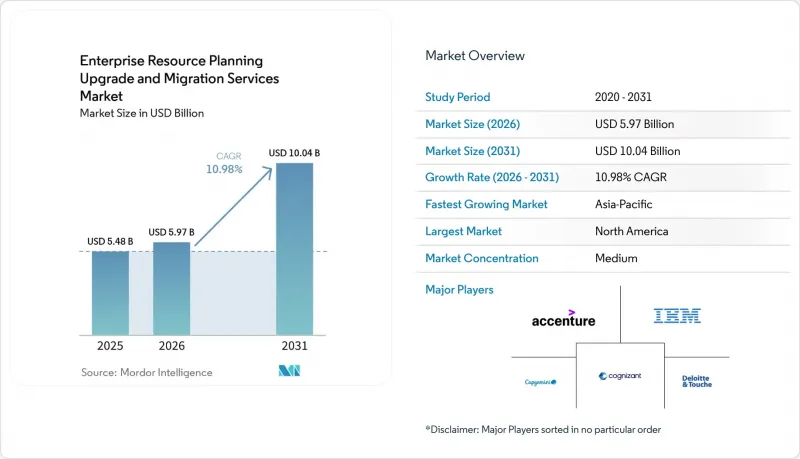
본 보고서는 배포 모델별(온프레미스, 클라우드 기반, 하이브리드), 조직 규모별(중소기업, 대기업), 업종별(제조업, 은행 및 금융 서비스·보험(BFSI), 의료, IT 및 통신, 정부·공공 부문 등), 지역별로 분류되어 있습니다. 시장 전망치는 금액(달러)으로 표시되어 있습니다.
세계의 ERP 업그레이드 및 마이그레이션 서비스 시장 동향과 인사이트
팬데믹 이후 디지털 회복력에 대한 수요 증가
2020-2023년 공급망 혼란과 장기화된 재택근무를 경험한 조직들은 온프레미스형 ERP에는 신속한 재구성에 필요한 유연성이 부족하다는 결론에 도달했습니다. 복원력 확보가 시급한 과제로 대두되면서 클라우드 도입이 가속화되고 있으며, 2024년까지 도입 사례의 70.4%가 이미 클라우드 기반이 될 것으로 전망됩니다. 제조 기업들은 유지보수의 필요성을 예측하기 위해 S/4HANA에 IoT 센서를 통합하고 있으며, 소매업체들은 실시간 재고 분석을 활용하여 품절률을 20-30% 줄이고 있습니다. 금융 기관들은 결제 게이트웨이와 원활하게 통합되는 클라우드 네이티브 핵심 시스템으로 유동성 대시보드를 이전하고 있습니다. 북미와 유럽이 도입을 주도하고 있지만, 정부의 인센티브 프로그램이 인프라 비용을 상쇄하고 있어 아시아태평양도 그 격차를 좁혀가고 있습니다.
클라우드 우선 ERP 아키텍처로의 전환이 가속화되고 있습니다.
하드웨어 업데이트, 데이터베이스 라이선스, 사내 인건비를 고려할 때, 클라우드 ERP의 5년간 총 소유 비용(TCO)은 동등한 온프레미스 환경보다 30-40% 저렴합니다. 중소기업의 관심도 높으며, 70%가 클라우드 솔루션을 선호하고 있어, Odoo와 같은 플랫폼은 2025년에 월간 1만 3,000개의 신규 고객을 확보했습니다. 위험 회피 성향이 강한 업계에서는 하이브리드 설계가 여전히 남아 있지만, 주로 전환 단계의 아키텍처로서 기능하고 있습니다. 아시아태평양에서의 성장세는 일본 내 사용자에게 10밀리초 미만의 지연 시간을 보장하는 80억 달러 규모의 Oracle 데이터센터 확장에 힘입어 이루어지고 있습니다. GDPR(EU 개인정보보호규정)이나 PDPL과 같은 데이터 주권 관련 법규에 따라, 규제 대상 워크로드에는 국내 클라우드 존이 필수 조건으로 지정되어 있으며, 이는 이러한 장기적인 전환 추세를 뒷받침하고 있습니다.
대규모 업그레이드에 따른 막대한 초기 설비 투자
프로젝트 예산은 여전히 초기 단계에 집중되어 있습니다. 중규모 전환에는 15만-75만 달러가 소요되며, 엔터프라이즈 규모의 프로그램의 경우 5,000만 달러를 초과하는 경우도 있습니다. 데이터 품질이나 사용자 정의 코드와 관련된 예상치 못한 비용 초과로 인해 총 비용이 30% 증가할 가능성이 있습니다. 중소기업은 단계적인 도입이나 5만 달러 미만부터 이용할 수 있는 모듈형 클라우드 제품군을 활용함으로써 비용 부담을 줄이고 있습니다. 아프리카와 남미의 환율 변동과 자금 조달 수단의 제한이 도입을 더욱 어렵게 만들고 있습니다. 규정 준수 관련 추가 기능(GDPR(EU 개인정보보호규정) 준수 호스팅, HIPAA 규정 준수 등)은 예산의 10-15%를 추가로 소요합니다.
부문별 분석
2025년에는 클라우드 도입이 ERP 업그레이드 및 마이그레이션 서비스 시장 점유율의 51%를 차지한 것으로 평가되었고, 이 부문은 2031년까지 연평균 성장률(CAGR) 18.4%로 확대될 전망이며, ERP 업그레이드 및 마이그레이션 서비스 시장의 구조적인 성장 동력이 되고 있습니다. 구독형 가격 책정 방식 덕분에 데이터센터에 대한 설비 투자가 필요 없어졌으며, 공급업체의 분기별 릴리스가 고비용의 버전 업그레이드 프로젝트를 대체함에 따라 지출은 부가가치가 높은 확장 기능으로 전환되고 있습니다. 중소기업은 6개월 이내에 가동을 시작할 수 있는 순수 클라우드 제품군을 도입하는 반면, 대기업은 대개 클라우드 네이티브 설계로 리팩토링을 진행하기 전에 IaaS(Infrastructure-as-a-Service)를 활용한 ‘리프트 앤 시프트’ 방식부터 시작합니다.
하이브리드 모델은 리스크 회피 성향이 강한 조직이 클라우드로 전환할 수 있는 가교 역할을 하며, 재무 핵심 시스템을 온프레미스에 유지하면서 분석 및 인사 관리(HCM) 모듈을 클라우드로 이전합니다. 이 듀얼 스테이트 아키텍처는 데이터 동기화를 복잡하게 만들고 지원 비용을 10-15% 증가시키지만, 업무에 지장을 주는 ‘리핑 앤 리플레이스’ 방식보다는 여전히 바람직한 선택지입니다. 현재 온프레미스 환경은 지연 시간이나 주권 문제가 경제성을 능가하는 국방 및 중요 인프라 등의 분야에서 레거시 시스템이 여전히 남아 있는 사례로 남아 있습니다. ERP 업그레이드 및 마이그레이션 서비스 시장에서는 전환 시 생산 환경의 가동 시간을 확보해 주는 ‘다운타임 제로’ 마이그레이션 도구와 자동화된 회귀 테스트를 제공하는 벤더들이 계속해서 높은 평가를 받고 있습니다.
지역별 분석
북미는 세계에서 가장 밀집된 레거시 SAP·Oracle 환경과 성숙한 컨설팅 생태계 덕분에 2025년 매출의 34.5%를 계속 차지했습니다. 이러한 성장을 주도하고 있는 요인은 2027년 SAP ECC 지원 종료 시한이 다가오고 있는 점, 제조업 분야의 리쇼어링 움직임, 그리고 의료 업계의 재임베디드니다. 캐나다와 멕시코에서는 USMCA(미국·멕시코·캐나다 협정)공급망과 관련된 수요가 증가하고 있으며, 특히 자동차 및 농업 관련 분야에서 두드러지게 나타나고 있습니다.
아시아태평양은 2031년까지 연평균 성장률(CAGR)이 13.9%로 가장 빠르게 성장하는 지역이며, 그 원동력은 ‘디지털 인디아’, ‘중국 제조 2025’, 그리고 지자체의 클라우드 ERP 전환을 지원하는 일본의 ‘디지털 가든 시티 네이션’ 사업입니다. Oracle이 일본에서 80억 달러 규모의 인프라 투자를 약속한 것과, SAP와 NTT 데이터·후지쯔간의 제휴를 통해, 일본의 개인정보 보호 관련 법규에서 전제조건으로 규정하는 로컬 데이터 레지던시가 확보되었습니다. 중국의 국영 기업들은 주권상의 이유로 국내 공급업체를 선택하는 경우가 많은 반면, 다국적 기업들은 전 세계적인 프로세스 통합을 위해 SAP나 Oracle에 의존하고 있습니다.
유럽의 동향은 GDPR(EU 개인정보보호규정), MiFID II, 그리고 규정 준수 요건을 충족하는 템플릿을 권장하는 의료기기 규제에 의해 형성되고 있습니다. 독일이 미텔슈탄트(중견 기업)의 제조업 분야 지출에서 선두를 달리고 있으며, 그 뒤를 영국과 프랑스가 따르고 있습니다. 중동에서는 사우디아라비아와 아랍에미리트연합을 필두로, 석유 의존에서 벗어나기 위한 자금이 대규모 ERP 현대화에 투입되고 있습니다. 또한, PDPL의 데이터 현지화 규정이 현지 클라우드 존의 발전을 뒷받침하고 있습니다. 아프리카와 남미는 규모는 작지만, 광대역 보급 확대와 경쟁사들의 하이퍼스케일 가격 정책에 힘입어 핀테크 및 농업 분야에서 ‘모바일 퍼스트’ 클라우드 ERP를 도입함으로써 온프레미스 단계를 건너뛰는 형태로 발전하고 있습니다.
기타 혜택 :
- 엑셀 형식 시장 예측(ME) 시트
- 3개월간의 애널리스트 지원
자주 묻는 질문
목차
제1장 서론
제2장 조사 방법
제3장 주요 요약
제4장 시장 구도
제5장 시장 규모 및 성장 예측
제6장 경쟁 구도
제7장 시장 기회 및 향후 전망
AJY 26.06.26According to Mordor Intelligence, the eRP upgrade and migration services market size is projected to be USD 5.48 billion in 2025, USD 5.97 billion in 2026, and reach USD 10.04 billion by 2031, growing at a CAGR of 10.98% from 2026 to 2031.
This report is Segmented by Deployment Model (On-Premises, Cloud-Based, and Hybrid), Organization Size (Small and Medium Enterprises and Large Enterprises), Industry Vertical (Manufacturing, Banking, Financial Services and Insurance (BFSI), Healthcare, IT and Telecom, Government and Public Sector, and More), and Geography. Market Forecasts are in Value (USD).
Global Enterprise Resource Planning Upgrade And Migration Services Market Trends and Insights
Rising Demand for Post-Pandemic Digital Resilience
Organizations that endured supply-chain shocks and prolonged remote work between 2020 and 2023 concluded that on-premises ERP lacked the elasticity required for rapid reconfiguration. The imperative for resilience is accelerating cloud uptake, with 70.4% of deployments already cloud-based by 2024. Manufacturing firms are embedding IoT sensors in S/4HANA to predict maintenance needs, while retailers use real-time stock analytics to cut stockouts by 20-30%. Financial institutions are shifting liquidity dashboards to cloud-native cores that integrate seamlessly with payment gateways. North America and Europe lead adoption, yet Asia-Pacific is closing the gap as government incentive programs offset infrastructure costs.
Accelerated Shift to Cloud-First ERP Architectures
Cloud ERP's five-year total cost of ownership is 30-40% lower than comparable on-premises estates when hardware refreshes, database licenses, and internal labor are factored in. SME enthusiasm is high, 70% prefer cloud solutions, and platforms such as Odoo added 13,000 clients per month in 2025. Hybrid designs persist in risk-averse sectors but mainly serve as transition architectures. Asia-Pacific momentum is underpinned by a USD 8 billion Oracle data-center buildout in Japan that guarantees sub-10-millisecond latency for domestic users. Data-sovereignty statutes like GDPR and PDPL make in-country cloud zones a prerequisite for regulated workloads, reinforcing the long-term shift.
High Upfront Capital Expenditure for Large-Scale Upgrades
Project budgets remain front-loaded: midsized migrations cost USD 150,000-USD 750,000 and enterprise programs can exceed USD 50 million. Hidden overruns in data quality and custom code can inflate totals by 30%. SMEs mitigate shock with phased rollouts or modular cloud suites starting below USD 50,000. Currency volatility and limited financing options in Africa and South America further constrain uptake. Compliance add-ons-GDPR hosting, HIPAA controls-consume an extra 10-15% of budgets.
Other drivers and restraints analyzed in the detailed report include:
- Vendor-Induced End-of-Support Deadlines
- Increasing Adoption of Industry-Specific ERP Templates
- Shortage of Certified ERP Migration Specialists
For complete list of drivers and restraints, kindly check the Table Of Contents.
Segment Analysis
Cloud deployments captured 51% of the ERP upgrade and migration services market share in 2025, and this segment is advancing at a 18.4% CAGR through 2031, making it the structural growth engine of the ERP upgrade and migration services market. Subscription pricing removes data-center capital outlays, and quarterly vendor releases replace costly version-upgrade projects, shifting spend toward value-added extensions. SMEs embrace pure-cloud suites that go live within six months, while large enterprises often start with infrastructure-as-a-service "lift and shift" moves before refactoring to cloud-native designs.
Hybrid models bridge risk-averse organizations to the cloud, keeping finance cores on-premises while offloading analytics or HCM modules. This dual-state architecture complicates data synchronization and raises support costs by 10-15%, but remains preferable to disruptive rip-and-replace tactics. On-premises estates now represent legacy holdouts in sectors such as defense and critical infrastructure, where latency or sovereignty overrides economics. The ERP upgrade and migration services market continues to reward vendors that provide zero-downtime migration tooling and automated regression testing that protect production uptime during cutovers.
Geography Analysis
North America retained 34.5% of 2025 revenue thanks to the world's densest population of legacy SAP and Oracle estates and a mature consulting ecosystem. Growth is propelled by the approaching 2027 SAP ECC deadline, reshoring initiatives in manufacturing, and healthcare consolidation. Canada and Mexico add incremental demand tied to USMCA supply chains, particularly in automotive and agribusiness.
Asia-Pacific is the fastest-growing region at 13.9% CAGR through 2031, driven by Digital India, Made in China 2025, and Japan's Digital Garden City Nation funding that subsidizes municipal cloud ERP upgrades. Oracle's USD 8 billion infrastructure pledge in Japan and SAP partnerships with NTT Data and Fujitsu ensure local data residency, a prerequisite under Japan's privacy statutes. Although state-owned Chinese firms often select domestic vendors for sovereignty reasons, multinationals rely on SAP and Oracle for harmonized global processes.
Europe's trajectory is shaped by GDPR, MiFID II, and medical-device regulations that favor compliance-ready templates. Germany leads spend among Mittelstand manufacturers, followed by the United Kingdom and France. The Middle East, led by Saudi Arabia and the United Arab Emirates, channels oil-diversification funds into large-scale ERP modernization; PDPL data-localization rules stimulate local cloud zones. Africa and South America, though smaller, are leapfrogging on-premises stages by adopting mobile-first cloud ERP in fintech and agriculture, aided by improving broadband coverage and competitive hyperscale pricing.
- Accenture plc
- Deloitte Touche Tohmatsu Limited
- Capgemini SE
- Tata Consultancy Services Limited
- Infosys Limited
- International Business Machines Corporation
- Cognizant Technology Solutions Corporation
- Wipro Limited
- HCL Technologies Limited
- Atos SE
- DXC Technology Company
- Tech Mahindra Limited
- NTT DATA Corporation
- CGI Inc.
- Larsen and Toubro Infotech Ltd (LTI Mindtree)
- EPAM Systems Inc.
- Rackspace Technology Inc.
- Hitachi Consulting Co., Ltd.
- Syntax Systems Ltd.
- Vision33 Inc.
Additional Benefits:
- The market estimate (ME) sheet in Excel format
- 3 months of analyst support
TABLE OF CONTENTS
1 INTRODUCTION
- 1.1 Study Assumptions and Market Definition
- 1.2 Scope of the Study
2 RESEARCH METHODOLOGY
3 EXECUTIVE SUMMARY
4 MARKET LANDSCAPE
- 4.1 Market Overview
- 4.2 Market Drivers
- 4.2.1 Rising Demand for Industry-Specific ERP Modules
- 4.2.2 Acceleration of Cloud-First Digital Transformation Strategies
- 4.2.3 Growing SME Adoption of Subscription-Based ERP Suites
- 4.2.4 Demand for Post-Implementation Hyper-Care Services (Under-the-Radar)
- 4.2.5 Shift Toward Composable ERP Architecture (Under-the-Radar)
- 4.2.6 Increasing Use of Low-Code Platforms for Tailored Workflows (Under-the-Radar)
- 4.3 Market Restraints
- 4.3.1 High Switching Costs Limiting Vendor Migration
- 4.3.2 Shortage of Certified ERP Functional Consultants
- 4.3.3 Rising Concerns Around Data Residency Compliance (Under-the-Radar)
- 4.3.4 Technical Debt From Legacy Customizations (Under-the-Radar)
- 4.4 Industry Value Chain Analysis
- 4.5 Regulatory Landscape
- 4.6 Technological Outlook
- 4.7 Impact of Macroeconomic Factors on the Market
- 4.8 Porter's Five Forces Analysis
- 4.8.1 Threat of New Entrants
- 4.8.2 Bargaining Power of Suppliers
- 4.8.3 Bargaining Power of Buyers
- 4.8.4 Threat of Substitutes
- 4.8.5 Competitive Rivalry
5 MARKET SIZE AND GROWTH FORECASTS (VALUE)
- 5.1 By Deployment Mode
- 5.1.1 On-Premise
- 5.1.2 Cloud
- 5.1.3 Hybrid
- 5.2 By Enterprise Size
- 5.2.1 Large Enterprises
- 5.2.2 Small and Medium Enterprises
- 5.3 By End-Use Industry
- 5.3.1 Manufacturing
- 5.3.2 Retail and E-Commerce
- 5.3.3 Banking, Financial Services and Insurance (BFSI)
- 5.3.4 Healthcare
- 5.3.5 Information Technology and Telecom
- 5.3.6 Government and Public Sector
- 5.3.7 Other End-Use Industries
- 5.4 By Geography
- 5.4.1 North America
- 5.4.1.1 United States
- 5.4.1.2 Canada
- 5.4.1.3 Mexico
- 5.4.2 South America
- 5.4.2.1 Brazil
- 5.4.2.2 Argentina
- 5.4.2.3 Rest of South America
- 5.4.3 Europe
- 5.4.3.1 Germany
- 5.4.3.2 United Kingdom
- 5.4.3.3 France
- 5.4.3.4 Italy
- 5.4.3.5 Spain
- 5.4.3.6 Russia
- 5.4.3.7 Rest of Europe
- 5.4.4 Asia-Pacific
- 5.4.4.1 China
- 5.4.4.2 India
- 5.4.4.3 Japan
- 5.4.4.4 South Korea
- 5.4.4.5 Australia
- 5.4.4.6 Rest of Asia-Pacific
- 5.4.5 Middle East
- 5.4.5.1 Saudi Arabia
- 5.4.5.2 United Arab Emirates
- 5.4.5.3 Turkey
- 5.4.5.4 Rest of Middle East
- 5.4.6 Africa
- 5.4.6.1 South Africa
- 5.4.6.2 Nigeria
- 5.4.6.3 Kenya
- 5.4.6.4 Rest of Africa
- 5.4.1 North America
6 COMPETITIVE LANDSCAPE
- 6.1 Market Concentration
- 6.2 Strategic Moves
- 6.3 Market Share Analysis
- 6.4 Company Profiles (includes Global Level Overview, Market Level Overview, Core Segments, Financials as available, Strategic Information, Market Rank/Share, Products and Services, Recent Developments)
- 6.4.1 Accenture plc
- 6.4.2 Deloitte Touche Tohmatsu Limited
- 6.4.3 Capgemini SE
- 6.4.4 Tata Consultancy Services Limited
- 6.4.5 Infosys Limited
- 6.4.6 International Business Machines Corporation
- 6.4.7 Cognizant Technology Solutions Corporation
- 6.4.8 Wipro Limited
- 6.4.9 HCL Technologies Limited
- 6.4.10 Atos SE
- 6.4.11 DXC Technology Company
- 6.4.12 Tech Mahindra Limited
- 6.4.13 NTT DATA Corporation
- 6.4.14 CGI Inc.
- 6.4.15 Larsen and Toubro Infotech Ltd (LTI Mindtree)
- 6.4.16 EPAM Systems Inc.
- 6.4.17 Rackspace Technology Inc.
- 6.4.18 Hitachi Consulting Co., Ltd.
- 6.4.19 Syntax Systems Ltd.
- 6.4.20 Vision33 Inc.
7 MARKET OPPORTUNITIES AND FUTURE OUTLOOK
- 7.1 White-Space and Unmet-Need Assessment


