

|
시장보고서
상품코드
2065574
ERP 도입 서비스 시장 : 시장 점유율 분석, 업계 동향 및 통계, 성장 예측(2026-2031년)ERP Implementation Services - Market Share Analysis, Industry Trends & Statistics, Growth Forecasts (2026 - 2031) |
||||||
 Mordor Intelligence
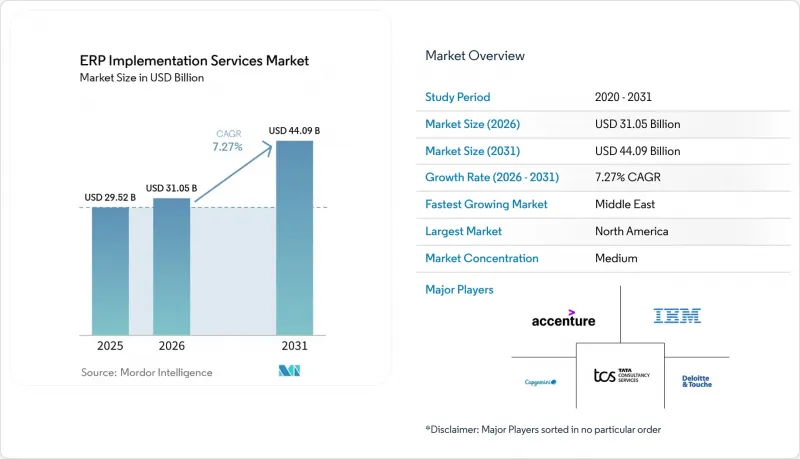
Mordor Intelligence에 의하면, ERP 도입 서비스 시장 규모는 2025년 295억 2,000만 달러로 평가되었고, 2026년에는 310억 5,000만 달러로 추정되고, 2031년까지 440억 9,000만 달러에 이를 것으로 예측되며, 2026-2031년 CAGR 7.27%를 기록할 전망입니다.
본 보고서는 도입 모델별(온프레미스, 클라우드, 하이브리드), 조직 규모별(중소기업 및 대기업), 최종 이용 산업별(제조업, 소매 및 전자상거래, 은행 및 금융 서비스, 보험, 의료, 정부 및 공공 부문, IT 및 통신, 기타) 및 지역별로 분류되어 있습니다. 시장 전망은 금액(달러) 기준으로 제시되어 있습니다.
세계의 ERP 도입 서비스 시장 동향 및 인사이트
‘클라우드 퍼스트’ 디지털 전환 추진
각국 정부는 현대화 예산을 승인받은 클라우드 도입과 연계함으로써 구매 주기를 단축하고, 공공 부문의 지출을 하이퍼스케일러가 호스팅하는 ERP로 유도하고 있습니다. 미국 행정관리예산국(OMB)의 2024년 클라우드 지침과 유럽연합(EU)의 ‘디지털 데케이드’ 프로그램이 이러한 전환을 뒷받침하고 있는 반면, 사우디아라비아의 ‘2025년 국가 클라우드 컴퓨팅 프레임워크’에서는 온프레미스형 ERP의 신규 구매가 금지되어 있습니다. 각 통합 업체들은 컨설턴트의 40%가 여전히 멀티테넌트 SaaS에 대한 전문 지식이 부족하기 때문에 기술 격차 문제로 어려움을 겪고 있습니다.
실시간 데이터 기반 의사결정의 급증
제조업체들은 현재 공급망에 이상이 발생하는 즉시 생산 계획을 재수립할 수 있도록 ERP 시스템을 운영 기술(OT) 네트워크에 통합하고 있습니다. 지멘스는 2025년, 15개 공장에서 SAP S/4HANA를 자사의 MindSphere IoT 제품군과 통합하여 재고 보유 비용을 18% 절감했습니다. 자동차 제조업체와 대형 소매업체들도 이 모델을 따르며, 수요 예측을 각 공급업체의 생산 라인 및 POS 데이터와 연동함으로써 월별 결산 주기를 10일에서 3일로 단축하고 있습니다.
브라운필드 통합에 따른 높은 총소유비용
조사에 따르면, SAP ECC 사용자의 68%가 500개 이상의 사용자 정의 객체를 보유하고 있으며, S/4HANA로 전환할 때 리팩토링 예산이 40-60%나 급증하고 있습니다. 이와 유사한 과제는 Oracle E-Business Suite 고객들에게서도 발견됩니다. 이러한 고객들은 맞춤형 양식이 Oracle Cloud ERP로 직접 업그레이드할 수 있는 경로를 제공하지 않기 때문입니다. 수십 개에 달하는 애드온 용도를 통합하는 데 프로젝트 비용의 30-40%가 소요되는 경우가 많으며, 중견 제조업체의 34%는 클라우드로의 전환 대신 온프레미스 지원 계약을 연장하는 쪽을 선택하고 있습니다.
부문별 분석
하이브리드 모델 시장 확대는 2026-2031년 연평균 성장률(CAGR) 17.8%를 기록할 전망이며, 각 모델 중 가장 빠른 속도로 성장했습니다. 이는 은행, 의료 체인, 방위 관련 기업들이 마스터 데이터를 방화벽 내부에 보관하면서 분석 처리는 퍼블릭 클라우드로 전송하고 있기 때문입니다. 2025년 매출의 58%는 여전히 클라우드 부문이 차지하고 있으며, 그 주된 요인은 인프라를 유틸리티로 활용하는 디지털 네이티브 기업과 중소기업 때문입니다. 한편, 온프레미스 환경은 축소되었지만, 에어갭 방식의 방어 네트워크에서는 여전히 유지되고 있습니다. 2025년에 SAP와 Oracle이 도입한 소버린 클라우드의 변형은 데이터를 국경 내에 보관하며 25-35%의 가격 프리미엄을 부과하고 있는데, 이는 주권이 복잡성을 더하는 동시에 가치를 창출한다는 점을 보여줍니다. 시스템 통합사업자는 가동 후 발생하는 사고를 40% 줄여주는 거버넌스 프레임워크를 판매함으로써 이러한 복잡성을 수익원으로 전환하고 있으며, 이를 통해 매니지드 서비스와 연계된 지속적인 수익원을 강화하고 있습니다.
하이브리드 모델에 의존하는 기업들은 이벤트 스트리밍 플랫폼과 ERP 코어를 점점 더 긴밀하게 통합하고 있으며, 이를 통해 제조 공장에서 텔레메트리 데이터를 로컬에서 처리하는 동시에, 집계된 인사이트를 클라우드 레이크로 전송하여 심층적인 분석을 수행할 수 있게 됩니다. 이러한 듀얼 스택 접근 방식에 따라 시스템 통합사업자는 보안이 강화된 네트워크 오버레이, 지연 시간을 고려한 데이터 파이프라인, 그리고 표준화된 통합 패턴을 설계해야 하므로 ERP 도입 서비스 시장이 확대되고 있습니다. 2031년까지 하이브리드 아키텍처는 개인 식별 정보, 국가 안보 데이터, 규제 대상 재무 기록을 다루는 업계에서 규정 준수(컴플라이언스)의 기반이 될 것으로 예상되며, 레거시 시스템에 대한 투자와 완전한 클라우드 전환을 장기적으로 연결하는 역할을 더욱 강화할 것입니다.
지역별 분석
북미는 2025년 매출의 37%를 차지했습니다. 이는 금융 서비스 및 의료 분야의 규정 준수 중심 시스템 업데이트 주기에 더해, 2024년 미국 연방 정부가 연간 35억 달러를 클라우드 ERP에 투자하며 클라우드 도입을 의무화한 조치에 힘입은 것입니다. 캐나다에서는 운영 비용 절감을 위해 주 차원의 시스템 통합이 진행되고 있으며, 멕시코의 자동차 수출 기업들은 미국·멕시코·캐나다 협정(USMCA)의 추적성 요건을 충족하기 위해 ERP 현대화를 추진하고 있습니다. FedRAMP 인증을 취득한 도입 파트너는 연방 정부 관련 프로젝트를 주도할 뿐만 아니라, 규제 대상인 민간 부문에도 동일한 거버넌스 프레임워크를 교차 판매하고 있습니다.
중동은 가장 빠르게 성장하고 있는 지역으로, 2026-2031년 연평균 성장률(CAGR) 16%를 나타낼 것으로 전망됩니다. 사우디아라비아의 ‘비전 2030’ 및 UAE의 ‘클라우드 퍼스트’ 연방 정책에 따라, 정부 기관의 온프레미스형 ERP 신규 구매가 금지됨에 따라 연간 12억 달러가 현지 하이퍼스케일러 시장에 유입되고 있습니다. NEOM과 같은 프로젝트에서는 향후 100만 명의 인구를 염두에 두고, 건설, 유틸리티, 시정 서비스를 관리하는 통합 ERP 플랫폼이 도입되어 있으며, 이는 걸프협력회의(GCC)의 스마트시티 구상에 있어 주목할 만한 참고 사례가 되고 있습니다.
아시아태평양은 양극화되어 있습니다. 중국의 ‘데이터 보안법’에 따라 국영 제조업체들은 국내 ERP 스택을 사용해야만 하는 상황에 놓여 있어 통합의 복잡성과 비용이 증가하고 있는 반면, 인도의 ‘디지털 인디아’ 정책에 따른 보조금 제도는 중소기업들이 세계 클라우드 플랫폼을 도입하도록 뒷받침하고 있습니다. 일본은 노동력 부족을 해소하기 위해 ERP와 IoT의 융합을 활용하고 있으며, 호주의 공공 부문은 투명성을 높이기 위해 클라우드 ERP 도입을 추진하고 있습니다. 유럽에서는 ‘기업 지속가능성 보고 지침(CSRD)’ 준수를 위해 ERP 시스템에 지속가능성 및 사이버 복원력 지표를 통합하는 데 주력하고 있습니다. 남미와 아프리카에서는 아직 발전 단계에 있지만, 브라질, 아르헨티나, 남아프리카공화국, 나이지리아에서는 전자 청구서 및 코어 뱅킹 시스템의 업그레이드가 수요의 기반이 되어, 국지적인 움직임이 나타나고 있습니다.
기타 혜택 :
- 엑셀 형식 시장 예측(ME) 시트
- 3개월간의 애널리스트 지원
자주 묻는 질문
목차
제1장 서론
제2장 조사 방법
제3장 주요 요약
제4장 시장 구도
제5장 시장 규모 및 성장 예측
제6장 경쟁 구도
제7장 시장 기회 및 향후 전망
LSH 26.06.24According to Mordor Intelligence, the eRP implementation services market size expanded from USD 29.52 billion in 2025 to USD 31.05 billion in 2026 and is projected to reach USD 44.09 billion by 2031, registering a 7.27% CAGR over 2026-2031.
This report is Segmented by Deployment Model (On-Premises, Cloud, and Hybrid), Organization Size (Small and Medium Enterprises and Large Enterprises), End-Use Industry (Manufacturing, Retail and E-Commerce, Banking, Financial Services, and Insurance, Healthcare, Government and Public Sector, IT and Telecom, and More), and Geography. The Market Forecasts are Provided in Terms of Value (USD).
Global ERP Implementation Services Market Trends and Insights
Cloud-First Digital Transformation Mandates
Governments have tied modernization budgets to certified cloud adoption, compressing purchasing cycles and steering public-sector spending toward hyperscaler-hosted ERP. The United States Office of Management and Budget's 2024 cloud directive and the European Union's Digital Decade program are propelling migrations, while Saudi Arabia's 2025 National Cloud Computing Framework bans new on-premises ERP purchases. Integrators are grappling with a skills gap because 40% of consultants still lack multi-tenant SaaS expertise.
Surge in Real-Time Data-Driven Decision Making
Manufacturers now embed ERP systems within operational technology networks to re-plan production the moment supply-chain anomalies surface. Siemens integrated SAP S/4HANA with its MindSphere IoT suite across 15 factories in 2025, reducing inventory holding costs by 18%. Automotive OEMs and large retailers are echoing the model, linking demand forecasts to supplier lines and point-of-sale feeds, respectively, thereby reducing monthly close cycles from 10 days to 3 days.
High Total Cost of Ownership for Brownfield Integrations
Surveys show that 68% of SAP ECC customers have more than 500 custom objects, ballooning refactoring budgets by 40-60% during migration to S/4HANA. Similar challenges plague Oracle E-Business Suite customers whose bespoke forms lack direct upgrade paths to Oracle Cloud ERP. Integration of dozens of bolt-on applications often consumes 30-40% of project spend, prompting 34% of mid-market manufacturers to extend on-premises support contracts instead of moving to the cloud.
Other drivers and restraints analyzed in the detailed report include:
- Rapid Subscription-Based ERP Uptake Among SMEs
- Compliance-Induced ERP Modernization in Regulated Sectors
- Shortage of Skilled ERP Functional Consultants
For complete list of drivers and restraints, kindly check the Table Of Contents.
Segment Analysis
Hybrid deployments captured 17.8% CAGR during 2026-2031, the fastest pace among models, as banks, healthcare chains, and defense contractors hold master data behind the firewall while routing analytics to public cloud. Cloud configurations still accounted for 58% of 2025 revenue, primarily from digital-native firms and SMEs that treat infrastructure as a utility, whereas on-premises estates contracted but persisted in air-gapped defense networks. Sovereign cloud variants introduced by SAP and Oracle in 2025 keep data within national borders and command 25-35% price premiums, illustrating how sovereignty adds complexity but also value. Integrators monetize the intricacy by selling governance frameworks that trim post-go-live incidents 40%, thereby reinforcing recurring revenue streams tied to managed services.
Enterprises that lean on hybrid models increasingly blend event-streaming platforms with ERP cores, enabling manufacturing plants to process telemetry locally while still pushing aggregated insights to cloud lakes for advanced analytics. The dual-stack approach expands the ERP implementation services market by requiring system integrators to design secure network overlays, latency-aware data pipelines, and standardized integration patterns. By 2031, hybrid architectures are expected to underpin compliance in sectors dealing with personally identifiable information, national security data, and regulated financial records, reinforcing their role as a long-term bridge between legacy investments and full-cloud aspirations.
Geography Analysis
North America generated 37% of 2025 revenue, supported by compliance-driven refresh cycles in financial services and healthcare, and by the 2024 U.S. federal cloud mandate, which channels USD 3.5 billion per year into cloud ERP. Canada is consolidating provincial systems to cut operating costs, and Mexico's automotive exporters are modernizing their ERPs to meet United States-Mexico-Canada Agreement traceability requirements. Implementation partners with FedRAMP accreditation both dominate federal work and cross-sell similar governance frameworks to regulated private sectors.
The Middle East is the fastest-growing region, charting a 16% CAGR over 2026-2031. Saudi Arabia's Vision 2030 and the UAE's cloud-first federal policy have banned fresh on-premises ERP purchases for government agencies, funneling USD 1.2 billion annually into local hyperscaler regions. Projects such as NEOM showcase integrated ERP platforms managing construction, utilities, and municipal services for an eventual population of 1 million, providing a marquee reference for Gulf Cooperation Council smart-city initiatives.
Asia-Pacific is bifurcated. China's Data Security Law forces state-owned manufacturers onto domestic ERP stacks, raising integration complexity and cost, while India's Digital India subsidies encourage SMEs to adopt global cloud platforms. Japan leverages ERP-IoT fusion to offset labor shortages, and Australia's public sector pursues cloud ERP to bolster transparency. Europe is focusing on embedding sustainability and cyber-resilience metrics into ERP systems to comply with the Corporate Sustainability Reporting Directive. South America and Africa remain nascent but show pockets of activity in Brazil, Argentina, South Africa, and Nigeria, where electronic invoicing and core banking upgrades anchor demand.
- Accenture plc
- Deloitte Touche Tohmatsu Limited
- International Business Machines Corporation
- Capgemini SE
- Infosys Limited
- Tata Consultancy Services Limited
- Wipro Limited
- Cognizant Technology Solutions Corporation
- SAP SE
- Oracle Corporation
- Tech Mahindra Limited
- HCL Technologies Limited
- DXC Technology Company
- CGI Inc.
- NTT DATA Corporation
- Atos SE
- PricewaterhouseCoopers International Limited
- KPMG International Limited
- Fujitsu Limited
- Hitachi Ltd.
Additional Benefits:
- The market estimate (ME) sheet in Excel format
- 3 months of analyst support
TABLE OF CONTENTS
1 INTRODUCTION
- 1.1 Study Assumptions and Market Definition * Scope of the Study
2 RESEARCH METHODOLOGY
3 EXECUTIVE SUMMARY
4 MARKET LANDSCAPE
- 4.1 Market Overview
- 4.2 Market Drivers
- 4.2.1 Cloud-First Digital Transformation Mandates
- 4.2.2 Surge in Real-Time Data-Driven Decision Making
- 4.2.3 Rapid Subscription-Based ERP Uptake Among SMEs
- 4.2.4 Compliance-Induced ERP Modernisation in Regulated Sectors
- 4.2.5 AI-Enabled Automated Configuration and Testing (under-reported)
- 4.2.6 Vertical-Specific Composable Micro-Service Frameworks (under-reported)
- 4.3 Market Restraints
- 4.3.1 High Total Cost of Ownership for Brownfield Integrations
- 4.3.2 Shortage of Skilled ERP Functional Consultants
- 4.3.3 Data Sovereignty Barriers in Multi-Tenant Environments (under-reported)
- 4.3.4 Vendor Lock-In Risks with Low-Code Extension Platforms (under-reported)
- 4.4 Industry Value Chain Analysis
- 4.5 Regulatory Landscape
- 4.6 Technological Outlook
- 4.7 Impact of Macroeconomic Factors on the Market
- 4.8 Porter's Five Forces Analysis
- 4.8.1 Bargaining Power of Suppliers
- 4.8.2 Bargaining Power of Buyers
- 4.8.3 Threat of New Entrants
- 4.8.4 Threat of Substitutes
- 4.8.5 Competitive Rivalry
5 MARKET SIZE AND GROWTH FORECASTS (VALUE)
- 5.1 By Deployment Model
- 5.1.1 On-Premises
- 5.1.2 Cloud
- 5.1.3 Hybrid
- 5.2 By Organization Size
- 5.2.1 Small and Medium Enterprises
- 5.2.2 Large Enterprises
- 5.3 By End-Use Industry
- 5.3.1 Manufacturing
- 5.3.2 Retail and E-Commerce
- 5.3.3 Banking, Financial Services and Insurance
- 5.3.4 Healthcare
- 5.3.5 Government and Public Sector
- 5.3.6 IT and Telecom
- 5.3.7 Other End-Use Industries
- 5.4 By Geography
- 5.4.1 North America
- 5.4.1.1 United States
- 5.4.1.2 Canada
- 5.4.1.3 Mexico
- 5.4.2 South America
- 5.4.2.1 Brazil
- 5.4.2.2 Argentina
- 5.4.2.3 Chile
- 5.4.2.4 Rest of South America
- 5.4.3 Europe
- 5.4.3.1 Germany
- 5.4.3.2 United Kingdom
- 5.4.3.3 France
- 5.4.3.4 Italy
- 5.4.3.5 Spain
- 5.4.3.6 Russia
- 5.4.3.7 Rest of Europe
- 5.4.4 Asia-Pacific
- 5.4.4.1 China
- 5.4.4.2 Japan
- 5.4.4.3 India
- 5.4.4.4 South Korea
- 5.4.4.5 Australia
- 5.4.4.6 Rest of Asia-Pacific
- 5.4.5 Middle East
- 5.4.5.1 Saudi Arabia
- 5.4.5.2 United Arab Emirates
- 5.4.5.3 Turkey
- 5.4.5.4 Rest of Middle East
- 5.4.6 Africa
- 5.4.6.1 South Africa
- 5.4.6.2 Egypt
- 5.4.6.3 Nigeria
- 5.4.6.4 Rest of Africa
- 5.4.1 North America
6 COMPETITIVE LANDSCAPE
- 6.1 Market Concentration
- 6.2 Strategic Moves
- 6.3 Market Share Analysis
- 6.4 Company Profiles (includes Global Level Overview, Market Level Overview, Core Segments, Financials as available, Strategic Information, Market Rank/Share, Products and Services, Recent Developments)
- 6.4.1 Accenture plc
- 6.4.2 Deloitte Touche Tohmatsu Limited
- 6.4.3 International Business Machines Corporation
- 6.4.4 Capgemini SE
- 6.4.5 Infosys Limited
- 6.4.6 Tata Consultancy Services Limited
- 6.4.7 Wipro Limited
- 6.4.8 Cognizant Technology Solutions Corporation
- 6.4.9 SAP SE
- 6.4.10 Oracle Corporation
- 6.4.11 Tech Mahindra Limited
- 6.4.12 HCL Technologies Limited
- 6.4.13 DXC Technology Company
- 6.4.14 CGI Inc.
- 6.4.15 NTT DATA Corporation
- 6.4.16 Atos SE
- 6.4.17 PricewaterhouseCoopers International Limited
- 6.4.18 KPMG International Limited
- 6.4.19 Fujitsu Limited
- 6.4.20 Hitachi Ltd.
7 MARKET OPPORTUNITIES AND FUTURE OUTLOOK
- 7.1 White-Space and Unmet-Need Assessment


