

|
시장보고서
상품코드
2065733
철물점 소매 시장 : 점유율 분석, 업계 동향과 통계, 성장 예측(2026-2031년)Hardware Stores Retail - Market Share Analysis, Industry Trends & Statistics, Growth Forecasts (2026 - 2031) |
||||||
 Mordor Intelligence
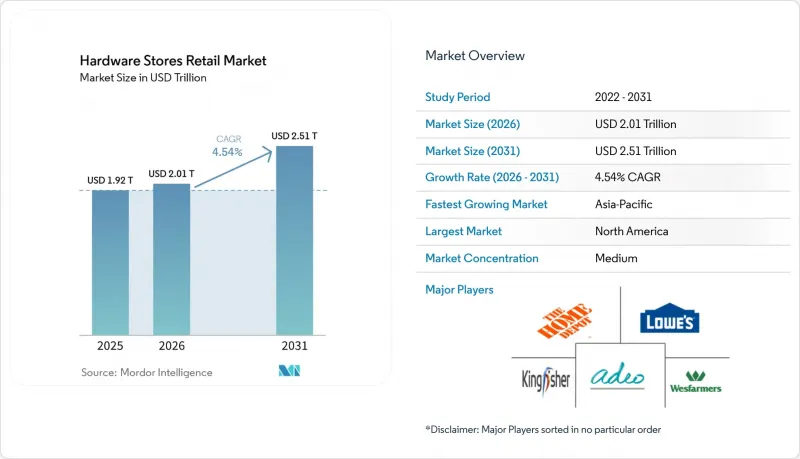
Mordor Intelligence에 의하면, 철물점 소매 시장 규모는 2025년에 1조 9,200억 달러, 2026년에 2조 100억 달러, 2031년까지 2조 5,100억 달러에 이를 것으로 예측되며, 2026년부터 2031년까지 CAGR 4.54%로 성장할 전망입니다.
본 보고서는 제품 카테고리(공구·철물, 건축자재, 배관·전기, 도료·접착제 등), 고객 유형(DIY, 전문 시공업체, 기관·MRO), 매장 형태(대형 할인점, 기존 철물점 등), 지역(북미, 남미, 유럽, 아시아태평양, 중동 및 아프리카)별로 분류되어 있습니다. 시장 전망은 금액(달러) 기준으로 제시되어 있습니다.
세계 철물점 소매 시장 동향과 인사이트
“이사보다 리모델링”이라는 추세가 확산되고 있습니다.
2026년에도 ‘이사보다 리모델링’이라는 경향이 철물점 소매 시장에서 가장 뚜렷한 수요 기반으로 자리 잡고 있습니다. 2026년 1월 미국의 기존 주택 판매 건수는 연율 391만 건의 추세를 보인 반면, 2025년 단독주택 건축 허가 건수는 7년 만에 최저 수준으로 떨어졌으며, 이로 인해 이사를 가는 것보다 현재 주택을 리모델링하는 가구가 증가하고 있습니다. HIRI의 보고서에 따르면, 2025년에는 전문가용 시장의 매출이 일반 소비자용 시장의 매출을 추월하는 속도로 성장할 것으로 예측되며, 이는 규모가 크고 기술적 요소가 강한 프로젝트가 숙련된 시공 단계로 넘어가고 있음을 시사합니다. 이러한 구성의 변화로 인해 매장 방문 빈도를 예측하기 어려워졌음에도 불구하고, 철물점 소매 시장의 평균 고객 단가는 상승하고 있습니다. 프로젝트용 상품 구색이 풍부하고, 설치 판매와의 연계가 탄탄하며, 도급업체용 재고를 갖춘 소매업체는 소비를 확보하는 데 유리한 입장에 있습니다. 동시에, 예측 기간 동안 주택 시장의 ‘락인 효과’는 지속될 것으로 예측됩니다.
소셜 미디어 주도의 DIY 학습의 확산
소셜 미디어는 프로젝트를 처음 시작할 때의 심리적 장벽을 낮추고 있으며, 철물점 시장에 있어 소규모 수리나 개보수 공사에 진출할 수 있는 길을 넓혀주고 있습니다. 짧은 동영상을 통한 프로젝트 시연은 소비자가 매장을 방문하거나 온라인으로 주문하기 전에 공구 선택 방법, 필요한 자재, 작업 과정을 이해하는 데 도움이 되고 있습니다. 이러한 행동은 도료, 접착제, 수납용품, 원예용품, 초보용 공구와 같은 카테고리에서 특히 중요한데, 이러한 카테고리의 경우 계획적인 교체 주기가 아니라 간단한 프로젝트 아이디어에서 상품 찾기가 시작되는 경우가 많기 때문입니다. 따라서 철물점 소매 시장은 검색, 디지털 머천다이징, 당일 수령을 통해 구매로 이어지는 영감에 기반한 폭넓은 구매 행동의 혜택을 누리고 있습니다. 이러한 효과는 단기적으로 가장 두드러지며, 비록 보다 고도의 작업은 여전히 전문 업체에 의뢰하는 쪽으로 전환되고 있더라도, 소비자의 참여와 제품 체험을 촉진하기 때문입니다.
DIY에서 DIFM 서비스로의 전환
DIY에서 DIFM(대신 해 주는 서비스)로의 전환에 따라, 철물점 소매 시장의 일부에서 일반 소비자를 대상으로 한 비즈니스 기회는 점차 줄어들고 있습니다. HIRI의 보고서에 따르면, 2025년에는 전문가용 시장의 매출이 일반 소비자용 시장의 매출을 추월하는 속도로 성장할 것으로 예측되며, 이는 많은 프로젝트가 숙련된 전문 업체에 의한 시공으로 전환되고 있음을 보여줍니다. 또한 Wickes사의 보고서에 따르면, TradePro의 회원 수는 2025 회계연도에 64만 3,000명에 달하고, 2024년의 58만 1,000명 대비 10.7% 증가했습니다. 이는 업체 대상 로열티 제도를 통해 이러한 지출을 유지하려는 소매업체의 노력을 여실히 보여주고 있습니다. 철물점 소매 시장에서 문제는 수요의 감소라기보다는 판매 현장에서의 조달을 누가 통제하느냐는 점에 있습니다. 동일한 생태계 내에서 소비자와 도급업체 양측의 요구를 충족시키지 못하는 소매업체는 전문 도매업체나 전문 판매 채널에 판매량을 빼앗길 위험이 있습니다.
부문별 분석
2025년, 건축자재는 총 매출의 28.73%를 차지하며 철물점 소매 시장에서 가장 큰 제품 부문이 되었습니다. 그 규모는 특히 가구가 이사를 하지 않고 기존 주택의 개보수를 선택할 경우, 외장재, 단열재, 골조용 목재, 지붕재에 대한 꾸준한 리모델링 수요와 밀접한 관련이 있습니다. 이 부문은 신축 주택공급 회전율보다 프로젝트 규모가 더 중요시되는 노후화된 주택 시장에서 수선, 개보수, 구조 보강 공사의 혜택을 지속적으로 누리고 있습니다. 배관 및 전기 제품은 2031년까지 연평균 성장률(CAGR) 5.46%를 나타낼 것으로 예측되며, 현재 전망에 따르면 철물점 소매 시장에서 가장 빠르게 성장하는 제품군이 될 것으로 보입니다. 이러한 성장 추세는 전기화 프로그램과 에너지 효율 향상 노력이 확대됨에 따라 전기 제어반, 배선, 제어 기기, 히트펌프 부품에 대한 수요가 증가하고 있음을 반영하고 있습니다.
이러한 상품 구성의 변화가 중요하게 여겨지는 이유는 철물점 소매 업계가 더 이상 저가 공구나 일상적인 소모품만으로 이끌리고 있는 것이 아니기 때문입니다. ‘배관·전기’ 분야는 구성 수요가 더 많고, 부가가치 창출 기회가 많으며, 자격을 갖춘 전문 인력에 의한 설치 공사와의 연계성이 강한 고부가가치 카테고리로서 전략적 중요성이 높아지고 있습니다. ‘건축자재’는 필수적인 보수 비용과 구조 개보수 비용을 모두 충당하고 있기 때문에 여전히 판매량의 기반을 이루고 있으며, 소비자와 건설업체 양측 수요에서 폭넓은 역할을 수행하고 있습니다. NHPA의 2026년 조사에 따르면, 철물점 소매업체의 48%는 도료 및 잡화에, 43%는 잔디·정원 용품에 투자하고 있으며, 이는 소매업체들이 기존의 주력 카테고리를 중심으로 카테고리 구성의 균형을 적극적으로 확대하고 있음을 보여줍니다. 대규모 프로젝트에 대한 접근이 더욱 선별적으로 이루어지는 상황에서도, 도료, 접착제, 아웃도어 용품, 그리고 고급 주방·욕실 용품은 재구매, 계절적 방문객 증가, 이익률 확대를 뒷받침하기 위해 여전히 중요한 위치를 차지하고 있습니다.
지역별 분석
2025년, 북미는 전 세계 시장 규모의 37.95%를 차지하며, 철물점 소매 업계에서 가장 규모가 큰 지역 시장이 되었습니다. 이 지역은 대규모 주택 개보수 시장, 광범위하게 구축된 체계적인 소매 네트워크, 그리고 수리 및 리모델링에 대한 가계 투자가 뿌리 깊은 문화라는 이점을 누리고 있습니다. HIRI의 보고서에 따르면, 2025년 단독주택 건축 허가 건수는 90만 9,600건으로 감소했으나, 2026년 1분기에도 미국 주택 소유자의 80% 가까이가 여전히 유지보수나 개보수 공사를 계획하고 있으며, 이는 리모델링 수요가 여전히 주요 버팀목이 되고 있는 이유를 보여줍니다. 또한, 북미는 옴니채널 전략의 실행, 계약업체 대상 계정 개발, 디지털 기술을 활용한 주문 처리 모델의 주요 시험장으로서의 위상을 유지하고 있습니다. 주 차원의 전기화 리베이트 및 산불 대책 요건은 지역별 수요 변동에 더욱 복잡성을 더하고 있으며, 이로 인해 철물점 소매 시장 전체에서 지역별 재고 계획의 중요성이 더욱 커지고 있습니다.
아시아태평양은 2031년까지 연평균 성장률(CAGR) 5.69%를 나타낼 것으로 예측되며, 철물점 소매 시장에서 가장 빠르게 성장하고 있는 지역입니다. 이러한 성장은 급속한 도시화, 주택 소유율의 상승, 그리고 인도와 동남아시아에서 조직화된 철물점 소매 구조의 지속적인 발전에 힘입어 이루어지고 있습니다. 이러한 현상은 여전히 분산된 지역 업체들의 거래가 조달 시장을 주도하고, 현대적인 체인점의 진출이 제한적인 시장에서 특히 두드러집니다. 이러한 확산의 지연으로 인해 대형 체인점, 지역 네트워크 및 하이브리드형 소매 모델은 시간이 지남에 따라 점포 수, 서비스 제공 범위 및 상품 카테고리의 고도화를 확대할 여지가 생기고 있습니다. 동 지역의 보다 성숙한 시장에서는 에너지 효율 향상, 스마트 홈과의 통합, 노후 주택 리모델링이 네트워크 확장보다는 상품 구성에 중점을 둔, 또 다른 성장 경로를 제공합니다.
유럽의 철물점 소매 시장은 성숙한 수요 환경과 국가별 실적 편차 사이에서 균형을 잡고 있습니다. 이 지역에서는 주택 정책, 소비자 심리, 판매 채널의 구조가 국가마다 크게 다르기 때문에 동일한 거시적 압력이 가해지더라도 결과가 반드시 동일하지는 않다는 사실이 밝혀졌습니다. 유럽의 오프라인 소매업체들은 프로젝트 수요가 더욱 선별적으로 변하고 온라인 조사의 중요성이 커짐에 따라, 디지털 접근성 개선, 상품 수령 속도 향상, 그리고 거래처에 대한 고객 서비스 향상을 요구받는 압박에 직면해 있습니다. 남미, 중동 및 아프리카는 절대적인 규모로 볼 때 여전히 작지만, 도시 개발, 보수 수요 및 하드웨어 구매의 점진적인 정상화를 통해 수요가 증가할 것으로 전망됩니다. 이 모든 지역에서 철물점 소매 시장은 지역 내 매장 밀도, 리모델링 수요, 그리고 조직화된 소매업이 편의성과 상품 접근성을 향상시키는 속도의 균형에 따라 형성되고 있습니다.
기타 혜택:
- 엑셀 형식 시장 예측(ME) 시트
- 3개월간의 애널리스트 지원
자주 묻는 질문
목차
제1장 서론
제2장 조사 방법
제3장 주요 요약
제4장 시장 구도
제5장 시장 규모와 성장 예측
제6장 경쟁 구도
제7장 시장 기회와 향후 전망
JHS 26.06.29According to Mordor Intelligence, the hardware stores retail market size is projected to be USD 1.92 trillion in 2025, USD 2.01 trillion in 2026, and reach USD 2.51 trillion by 2031, growing at a CAGR of 4.54% from 2026 to 2031.
This report is Segmented by Product Category (Tools & Hardware, Building Materials, Plumbing & Electrical, Paint & Adhesives, and More), by Customer Type (DIY, Professional Contractors, Institutional & MRO), by Store Format (Big-Box, Traditional Hardware, and More), and by Geography (North America, South America, Europe, Asia-Pacific, and MEA). The Market Forecasts are Provided in Terms of Value (USD).
Global Hardware Stores Retail Market Trends and Insights
Rising Renovation Over Relocation Trend
The renovation-over-relocation pattern remains the clearest demand base for the hardware retail market in 2026. U.S. existing home sales were running at a 3.91 million annual rate in January 2026, while single-family permits fell to a seven-year low in 2025, prompting more households to improve their current homes rather than move. HIRI reported that professional market sales are projected to grow faster than consumer market sales in 2025, pointing to larger and more technical projects moving toward skilled execution. This mix is lifting average ticket values in the hardware retail market, even when store visit frequency becomes less predictable. Retailers with deeper project assortments, stronger installed-sales links, and contractor-ready inventory are better placed to capture spending. At the same time, the housing lock-in effect stays in place through the forecast period.
Social Media Driven DIY Learning Adoption
Social media is lowering the confidence barrier to first-time project work, giving the hardware retail market a wider entry funnel for smaller repair and improvement jobs. Short-form project demonstrations are helping consumers understand tool selection, material needs, and sequencing before they visit a store or place an online order. That behavior matters most in categories such as paint, adhesives, storage, garden products, and entry-level tools, where product discovery often starts with simple project ideas rather than planned replacement cycles. The hardware retail market is therefore benefiting from a broader set of inspiration-led purchases that can be converted through search, digital merchandising, and same-day pickup. The effect is strongest in the short term because it encourages participation and product trial, even if more advanced work still shifts toward professional execution.
Shift From DIY to DIFM Services
The shift from do-it-yourself to do-it-for-me activity is narrowing the direct consumer opportunity in parts of the hardware retail market. HIRI reported that professional market sales are projected to grow faster than consumer market sales in 2025, which shows that more project volume is moving toward skilled execution. Wickes also reported that TradePro membership reached 643,000 in FY2025, up 10.7% from 581,000 in 2024, highlighting retailers' efforts to retain this spend through trade-focused loyalty systems. For the hardware retail market, the issue is less about demand disappearance and more about who controls procurement at the point of sale. Retailers that fail to serve both consumer and contractor missions in the same ecosystem risk losing volume to trade distributors and specialist merchant channels.
Other drivers and restraints analyzed in the detailed report include:
- Growing Omnichannel Click-and-Collect Demand
- Increasing Energy Efficiency Retrofit Upgrades
- Housing Affordability Limiting Projects
For complete list of drivers and restraints, kindly check the Table Of Contents.
Segment Analysis
Building Materials accounted for 28.73% of the total value in 2025, making it the largest product segment in the hardware retail market. Its scale is tied to steady renovation demand for sheathing, insulation, framing lumber, and roofing products, especially when households choose to improve existing homes rather than relocate. This category continues to benefit from repair, rehabilitation, and structural retrofit work in aging housing markets, where project depth matters more than new-home turnover. Plumbing & Electrical is projected to grow at a 5.46% CAGR through 2031, making it the fastest-growing product line in the hardware retail market under the current forecast. That trajectory reflects stronger demand for electrical panels, wiring, controls, and heat pump components as electrification programs and efficiency upgrades expand.
The product mix shift matters because the hardware retail industry is no longer driven only by low-ticket tools and routine consumables. Plumbing & Electrical is gaining strategic weight as a higher-value category with more configuration needs, better attachment opportunities, and stronger links to licensed installation work. Building Materials still anchors volume because it captures both essential repair spend and structural renovation outlays, which gives it a broad role across consumer and contractor demand. The NHPA's 2026 survey found that 48% of hardware retailers were investing in paint and sundries, while 43% were investing in lawn and garden, which shows that merchants are actively widening category balance around the traditional core. Paint, adhesives, outdoor products, and premium kitchen and bath lines remain important because they support repeat purchases, seasonal traffic, and margin expansion even as large project work becomes more selective.
Geography Analysis
North America accounted for 37.95% of the global value in 2025, making it the largest regional market in hardware retail. The region benefits from a large home-improvement base, widespread organized retail networks, and a durable culture of household investment in repair and renovation. HIRI reported that single-family permits fell to 909,600 in 2025, yet nearly 80% of U.S. homeowners were still planning maintenance or improvement work in Q1 2026, which shows why renovation demand remains the main support line. North America also remains the main test bed for omnichannel execution, contractor account development, and digitally supported fulfillment models. State-level electrification rebates and wildfire-hardening requirements add another layer of local demand variation, which makes regional inventory planning more important across the hardware retail market.
Asia-Pacific is projected to grow at a 5.69% CAGR through 2031, which makes it the fastest-expanding geography in the hardware retail market. Growth is being supported by rapid urbanization, rising homeownership, and the continued development of organized hardware retail structures in India and Southeast Asia. The opportunity is especially notable in markets where fragmented local trade still dominates procurement and modern chain penetration remains limited. That underpenetration gives large-format chains, local networks, and hybrid retail models room to expand store count, service coverage, and category sophistication over time. In more mature parts of the region, energy-efficiency upgrades, smart-home integration, and aging-home renovation offer a different growth path, less dependent on network expansion and more on product mix.
Europe sits between mature demand conditions and uneven country-level performance in the hardware retail market. The region shows that the same macro pressure does not yield identical outcomes because housing policy, consumer sentiment, and channel structure differ widely across countries. Store-based players in Europe are under pressure to improve digital access, pickup speed, and trade-customer service as project demand becomes more selective and online research becomes more important. South America, the Middle East, and Africa remain smaller in absolute terms, but they still offer incremental demand through urban development, repair activity, and the gradual formalization of hardware buying. Across all these regions, the hardware retail market is being shaped by the balance between local store density, renovation demand, and the pace at which organized retail can improve convenience and product access.
- The Home Depot, Inc.
- Lowe's Companies, Inc.
- Ace Hardware Corporation
- Menard, Inc.
- Do it Best Group
- True Value Company
- Wesfarmers Limited (Bunnings Group)
- ADEO
- Kingfisher plc
- OBI Group Holding SE & Co. KGaA
- HORNBACH Holding AG & Co. KGaA
- BAUHAUS AG
- hagebau Handelsgesellschaft fur Baustoffe mbH & Co. KG
- Travis Perkins plc
- Wickes Group plc
- Grafton Group plc
- Kesko Corporation
- Mr. D.I.Y. Group (M) Berhad
- Canadian Tire Corporation, Limited
- Metcash Limited (Mitre 10 / Total Tools)
Additional Benefits:
- The market estimate (ME) sheet in Excel format
- 3 months of analyst support
TABLE OF CONTENTS
1 Introduction
- 1.1 Study Assumptions & Market Definition
- 1.1.1 Scope of the Study
2 Research Methodology
3 Executive Summary
4 Market Landscape
- 4.1 Market Overview
- 4.2 Market Drivers
- 4.2.1 Rising renovation over relocation trend
- 4.2.2 Social media driven DIY learning adoption
- 4.2.3 Growing omnichannel click-and-collect demand
- 4.2.4 Increasing energy efficiency retrofit upgrades
- 4.2.5 Expansion of state rebate electrification programs
- 4.2.6 Rising wildfire hardening retrofit initiatives
- 4.3 Market Restraints
- 4.3.1 Shift from DIY to DIFM services
- 4.3.2 Housing affordability limiting projects
- 4.3.3 Rising organized retail crime incidents
- 4.3.4 Policy volatility in rebates and tariffs
- 4.4 Value / Supply-Chain Analysis
- 4.5 Regulatory Landscape
- 4.6 Technological Outlook
- 4.7 Porter's Five Forces
- 4.7.1 Bargaining Power of Suppliers
- 4.7.2 Bargaining Power of Buyers
- 4.7.3 Threat of New Entrants
- 4.7.4 Threat of Substitutes
- 4.7.5 Intensity of Competitive Rivalry
5 Market Size & Growth Forecasts (Value)
- 5.1 By Product Category
- 5.1.1 Tools & Hardware
- 5.1.2 Building Materials
- 5.1.3 Plumbing & Electrical
- 5.1.4 Paint, Adhesives & Home Improvement Consumables
- 5.1.5 Outdoor & Garden
- 5.1.6 Kitchen, Bath & Storage
- 5.2 By Customer Type
- 5.2.1 DIY Consumers
- 5.2.2 Professional Contractors & Tradespeople
- 5.2.3 Institutional & MRO Buyers
- 5.3 By Store Format
- 5.3.1 Big-Box Home Centers
- 5.3.2 Traditional Hardware Stores
- 5.3.3 Lumber & Building Material Yards
- 5.3.4 Farm & Ranch Supply Stores
- 5.3.5 Online-Only Platforms
- 5.4 By Geography
- 5.4.1 North America
- 5.4.1.1 United States
- 5.4.1.2 Canada
- 5.4.1.3 Mexico
- 5.4.2 South America
- 5.4.2.1 Brazil
- 5.4.2.2 Peru
- 5.4.2.3 Chile
- 5.4.2.4 Argentina
- 5.4.2.5 Rest of South America
- 5.4.3 Europe
- 5.4.3.1 United Kingdom
- 5.4.3.2 Germany
- 5.4.3.3 France
- 5.4.3.4 Spain
- 5.4.3.5 Italy
- 5.4.3.6 BENELUX (Belgium, Netherlands, and Luxembourg)
- 5.4.3.7 NORDICS (Denmark, Finland, Iceland, Norway, and Sweden)
- 5.4.3.8 Rest of Europe
- 5.4.4 Asia-Pacific
- 5.4.4.1 India
- 5.4.4.2 China
- 5.4.4.3 Japan
- 5.4.4.4 Australia
- 5.4.4.5 South Korea
- 5.4.4.6 South East Asia (Singapore, Malaysia, Thailand, Indonesia, Vietnam, and Philippines)
- 5.4.4.7 Rest of Asia-Pacific
- 5.4.5 Middle East And Africa
- 5.4.5.1 United Arab Emirates
- 5.4.5.2 Saudi Arabia
- 5.4.5.3 South Africa
- 5.4.5.4 Nigeria
- 5.4.5.5 Rest of Middle East And Africa
- 5.4.1 North America
6 Competitive Landscape
- 6.1 Market Concentration
- 6.2 Strategic Moves
- 6.3 Market Share Analysis
- 6.4 Company Profiles {(includes Global level Overview, Market level overview, Core Segments, Financials as available, Strategic Information, Market Rank/Share for key companies, Products & Services, and Recent Developments)}
- 6.4.1 The Home Depot, Inc.
- 6.4.2 Lowe's Companies, Inc.
- 6.4.3 Ace Hardware Corporation
- 6.4.4 Menard, Inc.
- 6.4.5 Do it Best Group
- 6.4.6 True Value Company
- 6.4.7 Wesfarmers Limited (Bunnings Group)
- 6.4.8 ADEO
- 6.4.9 Kingfisher plc
- 6.4.10 OBI Group Holding SE & Co. KGaA
- 6.4.11 HORNBACH Holding AG & Co. KGaA
- 6.4.12 BAUHAUS AG
- 6.4.13 hagebau Handelsgesellschaft fur Baustoffe mbH & Co. KG
- 6.4.14 Travis Perkins plc
- 6.4.15 Wickes Group plc
- 6.4.16 Grafton Group plc
- 6.4.17 Kesko Corporation
- 6.4.18 Mr. D.I.Y. Group (M) Berhad
- 6.4.19 Canadian Tire Corporation, Limited
- 6.4.20 Metcash Limited (Mitre 10 / Total Tools)
7 Market Opportunities & Future Outlook
- 7.1 White-space & unmet-need assessment
- 7.2 Expansion of Smart Home and Energy-Efficient Retrofit Products
- 7.3 Growth of Pro-Contractor Loyalty and Omnichannel Retail Platforms


