

|
시장보고서
상품코드
2066387
음주측정기 시장 : 점유율 분석, 업계 동향과 통계, 성장 예측(2026-2031년)Breathalyzers - Market Share Analysis, Industry Trends & Statistics, Growth Forecasts (2026 - 2031) |
||||||
 Mordor Intelligence
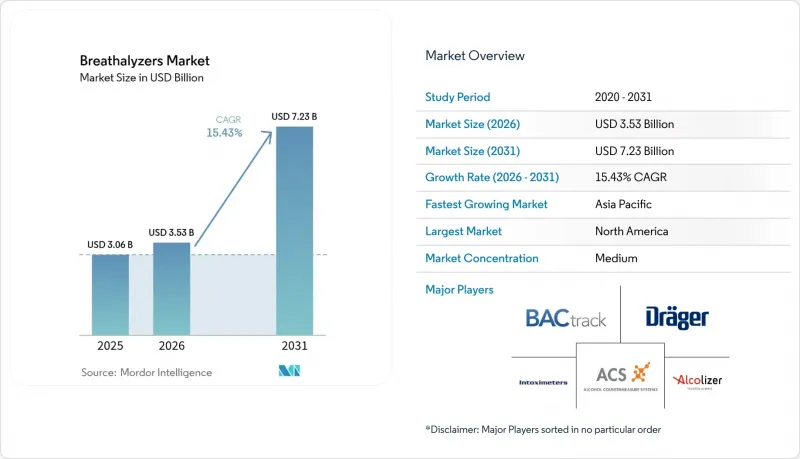
Mordor Intelligence에 의하면, 2026년 음주측정기 시장 규모는 35억 3,000만 달러로 추정되고 있어 2025년 30억 6,000만 달러에서 확대해, 2031년에는 72억 3,000만 달러에 이를 것으로 예측됩니다.
2026년부터 2031년까지의 연평균 성장률(CAGR)은 15.43%가 될 것으로 전망됩니다.
본 보고서는 기술별(연료전지, 반도체 산화물 센서 등), 제품 유형별(핸드헬드/휴대용 등), 유통 채널별(직접 입찰/계약 등), 용도별(알코올 감지 등), 최종 사용자별(법 집행 기관 등), 지역별(북미, 유럽, 아시아태평양 등)로 분류되어 있습니다. 시장 전망은 금액(달러) 기준으로 제시되어 있습니다.
전 세계 음주측정기 시장 동향 및 인사이트
음주운전 규제 강화 및 시동 잠금 장치 의무화 확대
각국 및 지방 자치 단체는 허용 혈중 알코올 농도(BAC) 기준치를 지속적으로 낮추고 있어, 음주측정기 시장의 기기 수요 증가세를 유지하고 있습니다. 미국 31개 주에서 점화 잠금 장치의 의무화 확대는 해당 기기의 정기적인 교체 주기를 확고히 하고 있으며, 한편 한국 및 유럽 일부 지역에서 유사한 법규가 강화됨에 따라 안정적인 수주 파이프라인이 뒷받침되고 있습니다. 유타주의 0.05%라는 기준치나 한국에서 개정된 ‘도로교통법’은 보다 광범위한 정책 전환을 여실히 보여주고 있습니다. 법적 체계가 ‘모든 위반자’를 대상으로 하는 시동 잠금 장치 제도로 통합됨에 따라, 위반자 1인당 장치 설치 대수가 증가하고 있으며, 이러한 추세는 교정 프로그램을 통한 서비스 수익을 간접적으로 끌어올리고 있습니다. 실제로, 이동식 현장 서비스 차량을 제공하는 업체들은 보호관찰 대상자의 이용 불가 시간을 단축하고 있으며, 이는 법원과 위반자 모두에게 매력적인 요소입니다. 이러한 추세는 특히 위반자가 면허 재발급 전에 준수 여부를 증명해야 하는 지역에서 탄탄한 사후 서비스 네트워크를 갖춘 유통업체이 음주측정기 시장에서 타사를 압도하는 시장 점유율을 확보할 수 있음을 시사합니다.
기술 발전과 자금 조달 확대
블루투스와 결합된 소형 연료전지 센서는 손바닥 크기의 케이스임에도 실험실 수준의 정확도를 구현하여, 기술에 익숙하지 않은 소비자들도 반복적으로 사용할 수 있도록 하고 있습니다. 동시에, 호흡 기반 암 선별 검사에 대한 벤처 투자가 급증하고 있으며, 이는 알코올 검사에서 발생하는 흐름으로 연구비를 상호 보전할 수 있는 방안을 시사하고 있습니다. 따라서, 진단용 지적재산권(IP) 라이선싱을 진행하는 제조업체는 음주측정기 업계에서의 입지를 훼손하지 않으면서도, 인접한 헬스케어 시장에서 조기에 입지를 확보할 수 있습니다. 투자 애널리스트들은 이러한 다각화를 통해 음주운전 단속 예산에 좌우되던 수익의 주기성이 완화되어, 상장 공급업체가 기관 투자자들에게 더욱 매력적인 존재가 될 것이라고 지적하고 있습니다.
전체 수명 주기에 걸친 교정 및 소모품 비용
연간 교정 비용과 교체용 마우스피스 비용은 여전히 소규모 차량 보유 사업자들에게 업무용 등급의 장비로 업그레이드하는 것을 주저하게 만드는 요인으로 작용하고 있습니다. 그러나 루이지애나주에서 최근 도입된, 시동 잠금 장치 비용의 최대 50%를 지원하는 주 정부 보조금은 공공 자금을 통해 이러한 장벽을 해소할 수 있음을 보여주고 있습니다. 그 결과, 유지보수 비용을월정액 요금에 포함시킨 ‘서비스형(As-a-Service)’ 모델에 대한 관심이 높아지고 있으며, 가격에 민감한 구매자들에게는 현금 흐름이 안정화되고 있습니다. 현재 일부 공급업체에서는 허용 범위를 벗어날 가능성이 있는 센서를 식별하는 예측 유지보수 알고리즘을 도입하고 있으며, 이를 통해 선제적인 재교정이 가능해져 비용이 많이 드는 증거 관련 분쟁을 줄일 수 있습니다.
부문별 분석
2025년, 연료전지식 센서는 음주측정기 시장 점유율의 62.54%를 차지하며, 경찰 및 사법 제도에서 증거 기준으로서의 위상을 확고히 하고 있습니다. 각 기관은 연료전지식 장치가 아세톤과의 교차 반응을 최소화한다는 사실을 확인했으며, 이러한 연구 결과는 법적 절차에서 증거 채택의 타당성을 직접 뒷받침하고 있습니다. 주목할 만한 결과로, 예산 삭감이 이 특정 기술의 교체 주기에 미치는 영향은 거의 없으며, 경기 침체기에도 공급업체의 수익원이 보호되고 있습니다. 한편, 반도체 산화물 센서는 초보 사용자들이 최고의 정밀도보다 저렴한 가격을 더 중요하게 여기기 때문에 여전히 그 중요성을 유지하고 있으며, 이 부문은 소비자 소매 시장에서 수익성을 유지하고 있습니다.
적외선 분광법 시장 규모는 2026년부터 2031년까지 연평균 성장률(CAGR) 18.92%로 확대될 것으로 예상되며, 연료전지 솔루션과의 기존 격차가 좁혀질 전망입니다. 최근의 비냉각형 마이크로볼로미터 어레이는 전력 소비를 줄였으며, 제조업체들은 5년 전만 해도 상업적으로 실현 불가능했던 배터리 구동식 휴대용 적외선 기기를 설계할 수 있게 되었습니다. 이러한 변화로 인해 여러 물질을 동시에 검출할 수 있게 되었으며, 향후 한 번의 검사로 알코올과 규제 약물을 모두 검출할 수 있는 장치가 등장할 가능성이 있습니다. 탄소나노튜브 코팅 연구를 진행 중인 이 스타트업은 빈번한 보정이 필요 없이 미량 수준의 감도를 실현함으로써 기존의 두 기술을 뛰어넘을 가능성이 있으며, 개발 중인 프로토타입은 이미 12개월간의 시험 기간 동안 유망한 기준선 안정성을 입증했습니다.
휴대용 음주측정기 시장은 도로 상의 검문 현장에서 사용하기 편리하다는 점 덕분에 2025년에는 매출의 53.76%를 차지했습니다. 경찰관들 사이에서는 경량화된 본체 덕분에 교통 검문 처리 속도가 향상되어, 간접적으로 순찰 인력을 다른 업무에 투입할 수 있게 되었습니다는 의견이 나오고 있습니다. 소비자들에게는 키홀더형 모델이 사교 모임에서 화제거리가 되기도 하며, 소셜 미디어 플랫폼을 통해 입소문이 퍼지고 있습니다. USB-C 충전의 표준화로 인해 사용자 만족도는 더욱 높아지고 있으며, 하드웨어의 보급에 따라 관련 액세서리(케이블, 휴대용 배터리)의 판매도 확대될 것으로 예측됩니다.
스마트폰 연동형 기기는 연평균 성장률(CAGR) 21.02%를 나타낼 것으로 예측되며, 이는 음주측정기 업계의 매출 구도를 완전히 바꿀 것으로 보입니다. 웰니스 앱과의 연동을 통해, 한 번의 측정 결과가 종합적인 건강 대시보드에 반영되며, 알코올 데이터가 일상의 피트니스 루틴에 통합됩니다. 데스크톱형 기기는 빈번한 사용을 견딜 수 있고 안전한 데이터베이스에 연결할 수 있기 때문에 검문소에서는 여전히 필수적이지만, 그 성장은 본질적으로 공공 부문의 예산 주기에 좌우됩니다. 경피형 팔찌와 같은 상시 착용형 바이오센서는 수동적인 대안을 제시하지만, 규제 측면에서 익숙함이라는 이유로 얼리 어답터들은 여전히 검증용 예비 수단으로 기존의 측정 장치를 구매하고 있습니다.
지역별 분석
북미는 자동차 제조업체에 음주운전 방지 기술 탑재를 의무화하는 연방 인프라 법안의 뒷받침을 받아, 2025년에는 41.25%의 점유율을 기록하며 음주측정기 시장 규모에서 여전히 가장 중요한 지역으로서의 위상을 유지했습니다. 이 의무화는 주로 차량에 초점을 맞추고 있지만, 알코올 관련 안전 문제가 공론의 초점이 되면서 애프터마켓에서 호흡식 알코올 감지기의 판매를 간접적으로 촉진하고 있습니다. 캐나다가 연구 개발(R&D)의 거점으로 부상함에 따라 파급 효과가 나타나고 있습니다. 국내 공급업체들은 얼리 어답터들을 통해 시범 도입을 확보하고, 이것이 나중에 수출 주문으로 이어짐으로써 혁신과 상용화 사이의 지역적 피드백 루프가 강화되고 있습니다. 양국의 보험사들이 텔레매틱스와 연계한 ‘음주운전 방지 할인’ 시범 사업을 진행하고 있다는 증거가 있으며, 이러한 움직임은 소비자 부문의 성장을 유지하고 데이터 분석에 대한 수요를 높일 가능성이 높다고 볼 수 있습니다.
유럽은 음주측정기 업계 매출액에서 2위를 차지하고 있으며, 프랑스에서 운전자에게 일회용 감지기 휴대가 의무화되어 있다는 사실은 정책의 미묘한 차이가 판매 대수에 어떤 영향을 미치는지를 여실히 보여주고 있습니다. GDPR(EU 개인정보보호규정)(일반 데이터 보호 규정) 준수에 따라 공급업체들은 연결형 기기에 고도화된 익명화 프로토콜을 탑재해야만 하며, 그 결과 의도치 않게 전 세계 제품 기준이 향상되고 있습니다. 새로운 추세로, 국경을 넘어 운행하는 트럭 차량들이 물류 혼란을 피하기 위해 범유럽적인 검사 지침을 채택함에 따라, 다국어 지원 소프트웨어 인터페이스를 갖춘 제조업체에 유리한, 여러 국가에 걸친 대량 주문이 발생하고 있습니다. 또한, 해당 지역의 고령화가 진행됨에 따라 의료용 호기 진단에 대한 수요도 증가하고 있습니다. 조기 발견은 장기적인 의료비를 억제한다는 예방의료 정책의 목표와 부합하기 때문입니다.
아시아태평양은 가처분 소득 증가와 교통 단속 강화가 맞물리면서, 2031년까지의 예상 연평균 성장률(CAGR)이 17.12%로 가장 높은 성장률을 기록하고 있습니다. 중국에서 주목받고 있는 음주운전 근절 캠페인으로 인해, 도로 위 단속이 산발적인 수준에서 일상적인 수준으로 바뀌면서 공공 부문의 발주가 급증하고 있습니다. 일본의 ‘제로 톨러런스’ 정책은 기술적 시도를 촉진하고 있습니다. 현지 기업은 알코올이 감지될 경우 자동으로 시동을 차단하는 차량 내부에 장착된 센서의 시범 운영을 진행하고 있습니다. 인도에서는 직장 안전 측면에서 잠재적인 수요가 나타나고 있습니다. 다국적 기업은 현지 법정 최저 기준을 상회하는 통일된 세계 정책을 적용하고 있습니다. 또한, 해당 지역에서는 저비용 센서 기술 혁신에 대한 정부의 지원도 활발히 이루어지고 있으며, 이로 인해 현지 공급업체들이 정확도를 저하시키지 않으면서도 가격 면에서 조만간 유럽 및 미국의 기존 기업들에 도전장을 내밀어 경쟁 구도를 완전히 바꿀 가능성이 시사되고 있습니다.
기타 혜택:
- 엑셀 형식 시장 예측(ME) 시트
- 3개월간의 애널리스트 지원
자주 묻는 질문
목차
제1장 서론
제2장 조사 방법
제3장 주요 요약
제4장 시장 구도
제5장 시장 규모와 성장 예측
제6장 경쟁 구도
제7장 시장 기회와 향후 전망
JHS 26.06.29According to Mordor Intelligence, breathalyzers market size in 2026 is estimated at USD 3.53 billion, growing from 2025 value of USD 3.06 billion with 2031 projections showing USD 7.23 billion, growing at 15.43% CAGR over 2026-2031.
This report is Segmented by Technology (Fuel Cell, Semiconductor Oxide Sensor, and More), Product Type (Hand-Held / Portable and More), Distribution Channel (Direct Tender / Contracts and More), Application (Alcohol Detection and More), End-User (Law-Enforcement Agencies and More), and Geography (North America, Europe, Asia-Pacific, and More). The Market Forecasts are Provided in Terms of Value (USD).
Global Breathalyzers Market Trends and Insights
Tightening DUI Legislation and Expansion of Ignition-Interlock Mandates
National and sub-national authorities continue to lower acceptable blood-alcohol content (BAC) thresholds, sustaining demand momentum for evidential Breathalyzer market equipment. Expansion of ignition-interlock mandates in 31 US states ensures a recurring equipment replacement cycle, while similar legal tightening in South Korea and parts of Europe reinforces a dependable order pipeline. Utah's 0.05% limit and South Korea's revised Road Traffic Act illustrate a wider policy pivot. As legal frameworks converge on "all-offender" ignition-interlock schemes, device volume per offender rises, a dynamic that indirectly elevates service revenues from calibration programs. In practice, suppliers that offer mobile field-service vans cut downtime for probationers, which both courts and offenders find appealing. The trend implies that distributors with robust after-sales networks could capture disproportionate breathalyzers market share, especially where offenders must prove compliance before license reinstatement.
Rising Technological Advancements and Increasing Funding
Miniaturized fuel-cell sensors coupled with Bluetooth deliver laboratory-grade accuracy in palm-sized housings, encouraging repeat use by non-technical consumers. Concurrently, venture investment in breath-based oncology screening has surged, signalling a path for cross-subsidizing research costs with alcohol-testing cash flow. Manufacturers that license diagnostic IP therefore secure early optionality in adjacent health markets without diluting their breathalyzer industry identity. Investment analysts note that this diversification reduces revenue cyclicality tied to DUI enforcement budgets, making publicly traded suppliers more attractive to institutional investors.
High Life-Cycle Calibration and Consumable Costs
Annual calibration charges and replaceable mouthpieces still deter small fleets from upgrading to professional-grade units. However, recent state subsidies covering up to 50% of ignition-interlock fees in Louisiana demonstrate that public funding can neutralize this barrier. An observable outcome is rising interest in "as-a-service" models that bundle maintenance into a flat monthly rate, smoothing cash flow for price-sensitive buyers. Some vendors now employ predictive maintenance algorithms that flag sensors likely to drift out of tolerance, allowing proactive recalibration and reducing costly evidence disputes.
Other drivers and restraints analyzed in the detailed report include:
- Corporate Zero-Alcohol Workplace Policies
- Usage-Based-Insurance Sober-Driving Programs
- Competition from Camera / Wearable Impairment Tech
For complete list of drivers and restraints, kindly check the Table Of Contents.
Segment Analysis
Fuel cell sensors held 62.54% of the breathalyzers market share in 2025, underscoring their status as the evidential benchmark for police and court systems. Agencies confirm that fuel-cell units show minimal cross-reactivity with acetone, a finding that directly underpins admissibility in legal proceedings. A notable consequence is that budget cuts rarely affect replacement cycles for this specific technology, safeguarding vendor revenue streams even during downturns. Meanwhile, semiconductor oxide sensors retain relevance because novice users value low sticker prices over ultimate precision, keeping this category profitable in consumer retail.
Infrared spectroscopy's market size is forecast to expand by a 18.92% CAGR between 2026-2031, narrowing the historical gap with fuel-cell solutions. Recent uncooled micro-bolometer arrays reduce power draw, letting manufacturers design battery-operated infrared handhelds that were not commercially feasible five years ago. This shift enables multi-substance detection, suggesting future devices may scan for both alcohol and controlled drugs in a single breath. Start-ups exploring carbon-nanotube coatings could leapfrog both incumbent technologies by offering trace-level sensitivity without frequent calibration, and developmental prototypes already demonstrate promising baseline stability over 12-month test horizons.
Hand-held breathalyzers market size accounted for 53.76% of revenue in 2025, thanks to ease of use in roadside scenarios. Police officers note that lightweight casings accelerate traffic-stop throughput, indirectly freeing patrol resources for other duties. For consumers, keychain models double as novelty items at social events, creating viral word-of-mouth that free-rides on social media platforms. Standardization around USB-C charging further lifts user satisfaction, suggesting that ancillary accessory sales (cables, power banks) will follow hardware adoption.
Smartphone plug-in devices are projected to secure a 21.02% CAGR, rewriting the breathalyzers industry revenue mix. Integration with wellness apps means a single reading feeds into broader health dashboards, weaving alcohol data into daily fitness routines. Desktop units remain indispensable in booking stations because they withstand heavy use and connect to secure databases, but their growth is inherently tied to public-sector budget cycles. Continuous-wear biosensors like transdermal wristbands introduce a passive alternative, yet early adopters still purchase traditional breath devices as a verification fallback given regulatory familiarity.
Geography Analysis
North America remained the most significant regional contributor to the breathalyzer market size with 41.25% share in 2025, catalyzed by federal infrastructure legislation that obliges automakers to integrate impaired-driving prevention technologies. That mandate, while vehicle-centric, indirectly stimulates aftermarket breathalyzer sales as public discourse spotlights alcohol safety. Canada's emergence as an R&D hub creates spill-over effects: domestic suppliers secure early-adopter trials that later translate to export orders, tightening the regional feedback loop between innovation and commercialization. Evidence suggests that insurers in both countries are experimenting with telematics-linked sober-driving discounts, a move likely to sustain consumer segment growth and elevate data-analytics demand.
Europe ranks second in breathalyzer industry revenue, with France's requirement for motorists to carry disposable testers illustrating how policy nuances influence unit volumes. GDPR compliance pushes vendors to embed advanced anonymization protocols into connected devices, inadvertently upgrading global product standards. A new observation is that cross-border truck fleets adopt pan-European testing guidelines to avoid logistical confusion, creating multi-country bulk orders that favor manufacturers with multilingual software interfaces. The region's aging demographic also elevates medical breath-diagnostics demand, as early detection aligns with preventive-health policy goals that curb long-term healthcare costs.
Asia-Pacific records the fastest forecast CAGR with 17.12% to 2031, as rising disposable incomes intersect with stricter traffic enforcement. China's high-profile anti-drunk-driving campaigns have moved roadside testing from sporadic to routine, swelling public-sector orders. Japan's zero-tolerance stance stimulates technological experimentation; local firms are piloting cabin-embedded sensors that auto-lock ignition if alcohol is detected. India shows latent demand in workplace safety, where multinational corporations apply uniform global policies that exceed local legal minimums. The region is also witnessing government encouragement for low-cost sensor innovation, suggesting that home-grown suppliers may soon challenge Western incumbents on price without sacrificing core accuracy, thereby reshaping competitive equations.
- Abbott Laboratories
- Alcohol Countermeasure Systems Corp.
- Alcolizer Technology
- Andatech
- BACtrack (KHN Solutions)
- Bedfont Scientific
- CMI, Inc.
- Dragerwerk
- Giner Labs
- Guardian Interlock Systems
- Hanwei Electronics Group
- Honeywell International (EnviteC)
- Intoximeters
- Lifeloc Technologies Inc.
- LifeSafer, Inc.
- Lion Laboratories Ltd
- Quest Diagnostics
- Shenzhen Well Electric Co.
- Smart Start Inc.
- Tokai Denshi Co.
Additional Benefits:
- The market estimate (ME) sheet in Excel format
- 3 months of analyst support
TABLE OF CONTENTS
1 Introduction
- 1.1 Study Assumptions & Market Definition
- 1.2 Scope of the Study
2 Research Methodology
3 Executive Summary
4 Market Landscape
- 4.1 Market Overview
- 4.2 Market Drivers
- 4.2.1 Tightening DUI legislation and expansion of ignition-interlock mandates
- 4.2.2 Rising technological advancements and increasing funding
- 4.2.3 Miniaturized smartphone-connected devices
- 4.2.4 Corporate zero-alcohol workplace policies
- 4.2.5 Breath-based disease-diagnostics funding
- 4.2.6 Usage-based-insurance sober-driving programs
- 4.3 Market Restraints
- 4.3.1 Accuracy variability in low-cost sensors
- 4.3.2 High life-cycle calibration/consumable cost
- 4.3.3 Data-privacy & liability concerns (GDPR, HIPAA)
- 4.3.4 Competition from camera / wearable impairment tech
- 4.4 Supply Chain Analysis
- 4.5 Technological Outlook
- 4.6 Porter's Five Forces Analysis
- 4.6.1 Threat of New Entrants
- 4.6.2 Bargaining Power of Buyers
- 4.6.3 Bargaining Power of Suppliers
- 4.6.4 Threat of Substitute Products
- 4.6.5 Intensity of Competitive Rivalry
5 Market Size & Growth Forecasts (Value)
- 5.1 By Technology
- 5.1.1 Fuel Cell
- 5.1.2 Semiconductor Oxide Sensor
- 5.1.3 Infrared Spectroscopy
- 5.1.4 Others
- 5.2 By Product Type
- 5.2.1 Hand-held / Portable
- 5.2.2 Desktop / Stationary
- 5.2.3 Others
- 5.3 By Distribution Channel
- 5.3.1 Direct Tender / Contracts
- 5.3.2 Retail & Specialty Stores
- 5.3.3 Online Stores & E-commerce
- 5.4 By Application
- 5.4.1 Alcohol Detection
- 5.4.2 Drug-abuse Detection
- 5.4.3 Disease Diagnostics
- 5.5 By End-User
- 5.5.1 Law-Enforcement Agencies
- 5.5.2 Hospitals & Clinics
- 5.5.3 Workplace / Industrial
- 5.5.4 Personal Consumers
- 5.5.5 Other End-Users
- 5.6 By Geography (Value)
- 5.6.1 North America
- 5.6.1.1 United States
- 5.6.1.2 Canada
- 5.6.1.3 Mexico
- 5.6.2 Europe
- 5.6.2.1 Germany
- 5.6.2.2 United Kingdom
- 5.6.2.3 France
- 5.6.2.4 Italy
- 5.6.2.5 Spain
- 5.6.2.6 Rest of Europe
- 5.6.3 Asia-Pacific
- 5.6.3.1 China
- 5.6.3.2 India
- 5.6.3.3 Japan
- 5.6.3.4 Australia
- 5.6.3.5 South Korea
- 5.6.3.6 Rest of Asia-Pacific
- 5.6.4 Middle East & Africa
- 5.6.4.1 GCC
- 5.6.4.2 South Africa
- 5.6.4.3 Rest of Middle East & Africa
- 5.6.5 South America
- 5.6.5.1 Brazil
- 5.6.5.2 Argentina
- 5.6.5.3 Rest of South America
- 5.6.1 North America
6 Competitive Landscape
- 6.1 Market Concentration
- 6.2 Competitive Benchmarking
- 6.3 Market Share Analysis
- 6.4 Company Profiles (includes Global level Overview, Market level overview, Core Segments, Financials as available, Strategic Information, Market Rank/Share for key companies, Products & Services, and Recent Developments)
- 6.4.1 Abbott Laboratories
- 6.4.2 Alcohol Countermeasure Systems Corp.
- 6.4.3 Alcolizer Technology Pty Ltd
- 6.4.4 Andatech Pty Ltd
- 6.4.5 BACtrack (KHN Solutions)
- 6.4.6 Bedfont Scientific Ltd
- 6.4.7 CMI, Inc.
- 6.4.8 Dragerwerk AG & Co. KGaA
- 6.4.9 Giner Labs
- 6.4.10 Guardian Interlock Systems
- 6.4.11 Hanwei Electronics Group
- 6.4.12 Honeywell International (EnviteC)
- 6.4.13 Intoximeters Inc.
- 6.4.14 Lifeloc Technologies Inc.
- 6.4.15 LifeSafer, Inc.
- 6.4.16 Lion Laboratories Ltd
- 6.4.17 Quest Diagnostics Inc.
- 6.4.18 Shenzhen Well Electric Co.
- 6.4.19 Smart Start Inc.
- 6.4.20 Tokai Denshi Co.
7 Market Opportunities & Future Outlook
- 7.1 White-space & Unmet-need Assessment


