

|
시장보고서
상품코드
2066430
북미의 액체 비료 시장 : 시장 점유율 분석, 업계 동향 및 통계, 성장 예측(2026-2031년)North America Liquid Fertilizers - Market Share Analysis, Industry Trends & Statistics, Growth Forecasts (2026 - 2031) |
||||||
 Mordor Intelligence
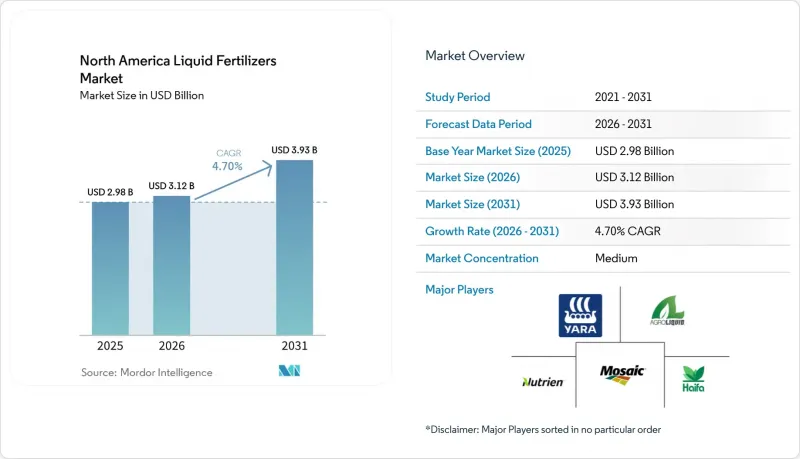
Mordor Intelligence에 의하면, 북미의 액체 비료 시장 규모는 2025년 29억 8,000만 달러로 평가되었고, 2026년 31억 2,000만 달러로 추정되고, 2031년까지 39억 3,000만 달러로 확대될 전망이며, 2026-2031년 CAGR 4.70%를 기록할 전망입니다.
본 보고서는 영양소 유형별(질소, 칼륨, 인산염, 미량 영양소), 성분 유형별(유기 및 합성), 시비 방법별(스타터 용액, 엽면 시비, 시비 관개 등), 작물 유형별(곡물, 콩류 및 지방종자 등), 지역별(미국, 캐나다 등)로 분류되어 있습니다. 시장 전망은 금액(달러) 기준으로 제시되어 있습니다.
북미의 액체 비료 시장 동향 및 인사이트
정밀 농업의 도입 확대가 액체 비료 수요를 촉진하고 있습니다.
옥수수 벨트와 프레리 지역의 대규모 농장 중 약 40%에서 가변 시비 장치가 도입되어, 이를 통해 입상 비료보다 더 정밀하게 액체 비료를 계량할 수 있게 되었습니다. 과일, 채소, 특수 곡물 등 고부가가치 작물에 대한 비료 및 관개 기술 도입이 진행되고 있으며, 특히 미국과 캐나다의 수자원 관리가 이루어지고 있는 지역에서 두드러지게 나타나고 있습니다. 액체 비료는 점적 관개 및 피벗식 관개 시스템과 호환되며, 관개와 영양분 공급을 동시에 수행할 수 있습니다. 이러한 접근 방식을 통해 영양분 이용 효율이 향상될 뿐만 아니라, 살포 횟수를 줄이고 이에 따른 연료비 절감 효과도 얻을 수 있습니다.
물 부족 대책 프로그램에서 비료 시비 및 관개 방식으로의 전환
캘리포니아주의 지하수법 및 애리조나주와 텍사스주의 유사한 규제로 인해, 생산자들은 수용성 액체 비료에 의존하는 점적 관개나 미세 관개로 전환해야 하는 상황에 놓여 있습니다. 작물의 흡수 곡선에 맞추어 소량의 비료를 여러 번 시비함으로써, 침출로 인한 손실이나 휘발을 줄일 수 있습니다. 텍사스주 하이플레인스 지역의 전환에 힘입어, 2024-2025년 해당 지역의 액체 비료 판매량은 두 자릿수 성장률을 기록했습니다. 애리조나주의 채소 농장에서는 살포용 입상 비료에서 다른 비료로 전환한 후, 질소 사용량을 25%에서 30%까지 줄일 수 있었던 것으로 확인되었습니다. 규정 준수 기한으로 인해, 많은 생산자들에게 비료 시비 및 관개로 전환하는 것이 필수적입니다. 미국 농무부 자연자원보전국(USDA NRCS) 등의 기관이 지원하는 주 및 연방 보전 프로그램에서는 점적 관개 및 미세 관개 인프라 구축에 대한 재정 지원이 이루어지고 있습니다. 이러한 보조금은 생산자의 초기 설비 투자 비용을 절감하고, 비료 및 관개 시스템과 관련 액체 비료의 비용 대비 효과를 높이는 한편, 물 이용 효율 향상 및 영양 관리 규정 준수라는 목표 달성을 지원합니다.
부식성 물질의 취급 및 저장 인프라 비용
요소-암모니아-질산염(UAN)이나 폴리인산암모늄을 취급하려면 스테인리스 탱크와 내식성 펌프가 필요하며, 이로 인해 건조 저장 솔루션에 비해 설비 투자 비용이 약 2배가 됩니다. 2차 격리 설비는 추가 비용이 들기 때문에 소규모 판매업자들이 액체 비료를 재고로 보유하는 것을 주저하게 만들고, 지방 지역의 서비스 제공 밀도를 제한하는 요인이 되고 있습니다. 액체 비료 시스템, 특히 요소-암모니아-질산염(UAN)을 사용하는 시스템에서는 그 부식성으로 인해 씰, 밸브, 호스, 펌프 부품의 마모가 가속화됩니다. 그 결과, 건조 비료 취급 시스템에 비해 교체 빈도가 높아지고, 중요한 시비 기간 동안의 가동 중단 시간이 길어지며, 운영 비용도 증가합니다.
부문별 분석
2025년, 질소계 비료가 북미 액체 비료 시장 점유율의 54%를 차지하며 해당 부문을 주도했습니다. 이는 추비로 우레아-암모니아-질산염(UAN)을 사용하기에 적합한, 광대한 옥수수 및 밀 재배 면적에 힘입은 결과입니다. 미국과 캐나다의 옥수수, 밀, 대두 재배 면적은 토양에 빠르게 흡수되고 가변 시비량 시스템 및 시비 관개 시스템과의 호환성이 높기 때문에 질소 비료, 특히 액체 비료에 대한 큰 수요를 지속적으로 견인하고 있습니다.
미량 영양소 시장은 중서부 북부 지역의 석회질 토양에서 발생하는 철분 및 아연 결핍을 배경으로, 2031년까지 연평균 성장률(CAGR) 7.1%를 기록하며 성장할 것으로 전망됩니다. 농가들이 디지털 농업 도구와 토양 검사 플랫폼을 도입함에 따라, 아연, 철, 망간, 붕소 등 특정 미량 영양소의 시비에 대한 수요가 증가하고 있습니다. 일반 질소 비료와 달리, 미량 영양소나 맞춤형 액상 혼합 비료는 갤런당 가격이 높기 때문에 공급업체의 수익성이 향상되고, 연구 개발 및 맞춤형 배합에 대한 투자가 촉진되고 있습니다.
2025년에는 합성 복합 비료가 북미 액체 비료 시장 규모의 72%를 차지하며 최대 부문으로 부상했으나, 범용 비료가 재배 면적에 이미 널리 보급되어 있었기 때문에 그 성장폭은 완만한 수준에 그쳤습니다. 요소·질산암모늄(UAN), 폴리인산암모늄, 질산칼륨 등의 합성 액체 비료는 고농도의 영양소를 용해하기 쉬운 형태로 공급할 수 있기 때문에 널리 사용되고 있습니다. 그 영양 성분이 예측 가능하기 때문에 생산자는 작물의 요구 사항에 맞추어 시비량을 정확하게 조절할 수 있어, 대규모 곡물 및 시리얼 생산에 특히 적합합니다. 또한, 합성 액체 비료는 가변 시비율 시스템 및 시비 관개 시스템과 효과적으로 연계되기 때문에 현대 북미 농업에서 그 역할은 더욱 확고해지고 있습니다.
유기 액체 비료는 인증 시설 및 ‘전미 유기농 프로그램(NOP)’ 준수가 요구되는 온실 채소 분야 수요에 힘입어 2031년까지 연평균 성장률(CAGR) 8.1%로 확대될 전망입니다. 식물, 동물 또는 미생물에서 유래한 유기 액체 비료는 과일, 채소 및 특산 작물의 재배에 점점 더 널리 사용되고 있습니다. 이러한 비료는 규제 및 소비자가 추구하는 지속가능성 목표에 부합하면서, 토양의 건강과 미생물의 활성을 높여줍니다. 고부가가치 작물 생산자들은 합성 잔류물을 남기지 않으면서 필요한 영양소를 정확하게 공급할 수 있다는 점에서 유기 액체 비료에 특히 매력을 느끼고 있으며, 이를 통해 제품의 품질과 환경의 지속가능성 모두를 뒷받침하고 있습니다.
기타 혜택 :
- 엑셀 형식 시장 예측(ME) 시트
- 3개월간의 애널리스트 지원
자주 묻는 질문
목차
제1장 서론
제2장 조사 방법
제3장 주요 요약
제4장 시장 구도
제5장 시장 규모 및 성장 예측
제6장 경쟁 구도
제7장 시장 기회 및 향후 전망
AJY 26.06.24According to Mordor Intelligence, the north america liquid fertilizers market size is projected to expand from USD 2.98 billion in 2025 and USD 3.12 billion in 2026 to USD 3.93 billion by 2031, registering a 4.70% CAGR between 2026 and 2031.
This report is Segmented by Nutrient Type (Nitrogen, Potassium, Phosphate, and Micronutrients), by Ingredient Type (Organic and Synthetic), by Mode of Application (Starter Solution, Foliar Application, Fertigation, and More), by Crop Type (Grains and Cereals, Pulses and Oilseeds, and More), and by Geography (United States, Canada, and More). The Market Forecasts are Provided in Terms of Value (USD).
North America Liquid Fertilizers Market Trends and Insights
Precision-Agriculture Adoption Accelerates Demand for Liquid Nutrients
Variable-rate equipment covers around 40% of large farms across the Corn Belt and Prairie Provinces, allowing liquids to be metered more precisely than granules. The adoption of fertigation in high-value crops, such as fruits, vegetables, and specialty grains, is rising, particularly in water-managed regions of the United States and Canada. Liquid fertilizers are compatible with drip and pivot irrigation systems, allowing for simultaneous irrigation and nutrient delivery. This approach enhances nutrient-use efficiency while reducing the number of application passes and associated fuel costs.
Shift to Fertigation Under Water-Scarcity Programs
California's groundwater law and similar rules in Arizona and Texas push growers toward drip and micro-irrigation that rely on soluble liquids. Multiple small fertigation doses follow crop uptake curves, cutting leaching losses and volatilization. Texas High Plains conversions lifted regional liquid sales by double digits in 2024-2025. Arizona vegetable farms documented nitrogen savings of 25% to 30% after switching from broadcast granules. Compliance deadlines make fertigation a non-negotiable transition for many producers. State and federal conservation programs, supported by agencies such as the United States Department of Agriculture Natural Resources Conservation Service (USDA NRCS), offer financial assistance for drip and micro-irrigation infrastructure. These subsidies help lower initial capital costs for growers, making fertigation systems and their associated liquid fertilizers more cost-effective while supporting objectives for water-use efficiency and nutrient management compliance.
Corrosive Handling and Storage Infrastructure Costs
Urea Ammonium Nitrate (UAN) and ammonium polyphosphate require stainless tanks and corrosion-resistant pumps, which roughly doubles capex compared to dry storage solutions. Secondary containment adds further expense, discouraging small dealers from stocking liquids and limiting rural service density. Liquid fertilizer systems, particularly those using Urea Ammonium Nitrate (UAN), accelerate wear on seals, valves, hoses, and pump components due to their corrosive properties. This results in more frequent replacements, increased downtime during critical application periods, and higher operating costs compared to dry fertilizer handling systems.
Other drivers and restraints analyzed in the detailed report include:
- Crop-Specific Liquid Blends Launched by Tier 1 Suppliers
- Adoption of Aerial and Drone Foliar Spraying
- Cold-Chain Constraints for Biologically Enhanced Liquids
For complete list of drivers and restraints, kindly check the Table Of Contents.
Segment Analysis
Nitrogen led the segment with 54% of the North America liquid fertilizers market share in 2025, supported by large corn and wheat acreages that favor sidedress Urea Ammonium Nitrate (UAN) . Corn, wheat, and soybean acreage in the United States and Canada continues to drive significant demand for nitrogen fertilizers, particularly in liquid form, due to their quick soil absorption and compatibility with variable-rate application and fertigation systems.
Micronutrients are forecast to grow at a 7.1% CAGR through 2031, spurred by iron and zinc deficiencies across calcareous soils in the upper Midwest. The adoption of digital agronomy tools and soil-testing platforms by growers has increased demand for targeted micronutrient applications, such as zinc, iron, manganese, and boron. Unlike commodity nitrogen fertilizers, micronutrients and custom liquid blends are priced higher per gallon, providing suppliers with improved profitability and encouraging investment in research and development as well as customized formulations.
Synthetic formulations held the largest segment, 72% of the North America liquid fertilizers market size in 2025, but expanded modestly as commodity acreage is already well penetrated. Synthetic liquid fertilizers, such as urea-ammonium nitrate (UAN), ammonium polyphosphate, and potassium nitrate, are widely used because they deliver highly concentrated nutrients in readily soluble forms. Their predictable nutrient composition enables growers to precisely match application rates to crop requirements, making them particularly suitable for large-scale grain and cereal production. Additionally, synthetic liquid fertilizers integrate effectively with variable-rate and fertigation systems, further solidifying their role in modern North American agricultural practices.
Organic liquids are advancing at a 8.1% CAGR to 2031, driven by demand from certified facilities and greenhouse vegetables that require National Organic Program compliance. Organic liquid fertilizers, derived from plant, animal, or microbial sources, are increasingly adopted for fruits, vegetables, and specialty crops. These fertilizers enhance soil health and microbial activity while aligning with regulatory and consumer-driven sustainability objectives. High-value crop growers are particularly drawn to organic liquids for their ability to deliver targeted nutrients without synthetic residues, thereby supporting both product quality and environmental sustainability.
List of Companies Covered in this Report:
- The Mosaic Company
- CF Industries Holdings Inc.
- AgroLiquid
- Haifa Group
- Kugler Company
- Sociedad Quimica y Minera de Chile SA
- EuroChem Group AG
- K+S Aktiengesellschaft
- Triangle C. C.
- Yara International ASA
- Helena Agri-Enterprises
- Tessenderlo Group
- Brandt Consolidated Inc.
- Grupa Azoty SA
- Nufarm Limited
Additional Benefits:
- The market estimate (ME) sheet in Excel format
- 3 months of analyst support
TABLE OF CONTENTS
1 Introduction
- 1.1 Study Assumptions and Market Definition
- 1.2 Scope of the Study
2 Research Methodology
3 Executive Summary
4 Market Landscape
- 4.1 Market Overview
- 4.2 Market Drivers
- 4.2.1 Precision-agriculture adoption accelerates demand for liquid nutrients
- 4.2.2 Shift to fertigation under water-scarcity programs
- 4.2.3 Crop-specific liquid blends launched by Tier-1 suppliers
- 4.2.4 Government incentives for domestic fertilizer capacity
- 4.2.5 Adoption of aerial and drone foliar spraying
- 4.2.6 Growth of controlled-environment agriculture hubs
- 4.3 Market Restraints
- 4.3.1 Corrosive handling and storage infrastructure costs
- 4.3.2 Volatility of natural-gas feedstock prices
- 4.3.3 Per- and polyfluoroalkyl substances (PFAS) and emerging contaminant regulation pressure
- 4.3.4 Cold-chain constraints for biologically enhanced liquids
- 4.4 Regulatory Landscape
- 4.5 Technological Outlook
- 4.6 Porter's Five Forces Analysis
- 4.6.1 Bargaining Power of Suppliers
- 4.6.2 Bargaining Power of Buyers
- 4.6.3 Threat of New Entrants
- 4.6.4 Threat of Substitute Products
- 4.6.5 Intensity of Competitive Rivalry
5 Market Size and Growth Forecasts (Value)
- 5.1 By Nutrient Type
- 5.1.1 Nitrogen
- 5.1.2 Potassium
- 5.1.3 Phosphate
- 5.1.4 Micronutrients
- 5.2 By Ingredient Type
- 5.2.1 Organic
- 5.2.2 Synthetic
- 5.3 By Mode of Application
- 5.3.1 Starter Solution
- 5.3.2 Foliar Application
- 5.3.3 Fertigation
- 5.3.4 Injection into Soil
- 5.3.5 Aerial and Drone Application
- 5.4 By Crop Type
- 5.4.1 Grains and Cereals
- 5.4.2 Pulses and Oilseeds
- 5.4.3 Commercial Crops
- 5.4.4 Fruits and Vegetables
- 5.4.5 Turf and Ornamentals
- 5.5 By Geography
- 5.5.1 United States
- 5.5.2 Canada
- 5.5.3 Mexico
- 5.5.4 Rest of North America
6 Competitive Landscape
- 6.1 Market Concentration
- 6.2 Strategic Moves
- 6.3 Market Share Analysis
- 6.4 Company Profiles (Includes Global level Overview, Market-level Overview, Core Segments, Financials as Available, Strategic Information, Market Rank/Share for key Companies, Products and Services, and Recent Developments)
- 6.4.1 The Mosaic Company
- 6.4.2 CF Industries Holdings Inc.
- 6.4.3 AgroLiquid
- 6.4.4 Haifa Group
- 6.4.5 Kugler Company
- 6.4.6 Sociedad Quimica y Minera de Chile SA
- 6.4.7 EuroChem Group AG
- 6.4.8 K+S Aktiengesellschaft
- 6.4.9 Triangle C. C.
- 6.4.10 Yara International ASA
- 6.4.11 Helena Agri-Enterprises
- 6.4.12 Tessenderlo Group
- 6.4.13 Brandt Consolidated Inc.
- 6.4.14 Grupa Azoty SA
- 6.4.15 Nufarm Limited


