|
시장보고서
상품코드
2120657
유럽의 액체 비료 : 시장 점유율 분석, 업계 동향과 통계, 성장 예측(2026-2031년)Europe Liquid Fertilizers - Market Share Analysis, Industry Trends & Statistics, Growth Forecasts (2026 - 2031) |
||||||
 Mordor Intelligence
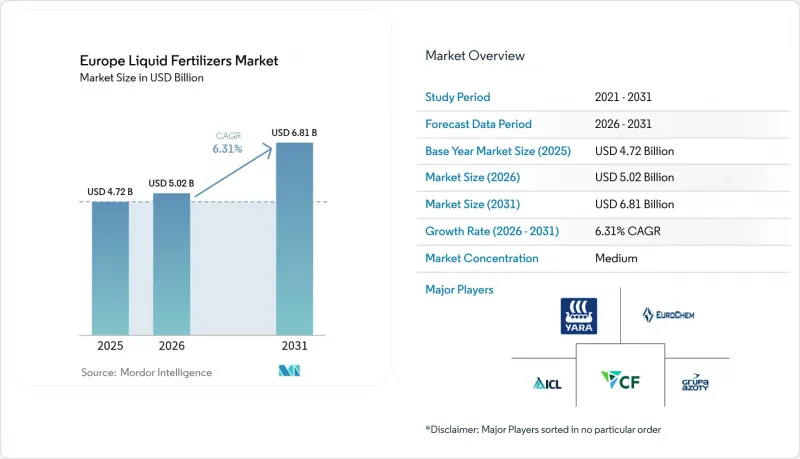
Mordor Intelligence에 의하면, 2026년 유럽의 액체 비료 시장 규모는 50억 2,000만 달러로 추정되며, 2025년 47억 2,000만 달러에서 2031년에는 68억 1,000만 달러에 달할 것으로 예측됩니다.
또한 2026-2031년 연평균 성장률(CAGR)은 6.31%를 기록할 전망입니다.
본 보고서에서는 비료의 유형(복합비료 및 단일비료), 시비 방법(시비 관개, 엽면 시비 및 살포), 작물의 유형(밭작물, 원예작물, 잔디 및 관상용 작물), 그리고 지역(프랑스, 독일, 이탈리아, 네덜란드, 러시아,스페인, 영국, 우크라이나 및 기타 유럽)별로 세분화되어 있습니다. 시장 전망은 금액(달러) 기준으로 제시되어 있습니다.
유럽의 액체 비료 시장 동향 및 인사이트
정밀 농업을 통한 수확량 최적화
가변 비율 액체 비료 시비 시스템은 유럽의 정밀 농업에 혁신을 가져오고 있으며, 고형 비료의 전면 살포와 비교하여 질소 이용 효율을 15-20% 향상시키고 있습니다. GPS 유도식 살포기와 실시간 토양 감지 기술을 결합함으로써 작물의 흡수 패턴에 맞춘 밭별 영양분 시비가 가능해졌으며, 생산성이 낮은 구역에서의 과다 시비를 최소화하는 한편, 고수확 구역에서는 최적의 영양 공급을 유지하고 있습니다. 네덜란드는 정밀 농업 도입에 있어 선구적인 역할을 하고 있으며, 토지 제약과 영양분 유출에 관한 엄격한 환경 규제로 인해 상업 농가의 60% 이상이 이러한 기술을 도입하고 있습니다. 유럽연합 집행위원회의 ‘디지털 유럽 프로그램’은 2024년 디지털 전환(DX) 이니셔티브에 13억 유로(14억 달러)를 배정했으며, 그 자금의 상당 부분이 정밀 비료 관리를 지원하는 농업 디지털화 프로젝트에 할당되고 있습니다.
1인당 경작지 감소
도시화와 기후 변화에 따른 생산성 저하로 인해 유럽의 농지는 연간 0.3%의 속도로 감소하고 있으며, 헥타르당 영양분 공급량을 극대화하기 위한 고농도 액체 비료에 대한 수요가 증가하고 있습니다. 스페인에서는 1인당 경작 가능 면적이 2020년 0.24헥타르에서 2024년에는 0.25헥타르로 감소하고 있어, 농가들은 집중적인 액체 비료 시비 프로그램을 통해 생산성을 최적화할 수밖에 없는 상황입니다. 이러한 토지 제약으로 인해 1세제곱미터당 400kg 이상의 N+P₂O?+K₂O를 함유한 고농도 액체 제제의 도입이 확대되고 있으며, 이를 통해 저장 공간을 줄이면서도 시비 시의 유연성을 유지할 수 있게 되었습니다. 2024년, 벨기에의 보호 재배 부문에서는 생산자들이 액체 양액에 의존하는 무토양 재배 시스템으로 전환함에 따라 액체 비료 소비량이 18% 증가했습니다. 단위 면적당 수익을 극대화해야 할 필요성으로 인해, 집약적인 재배 시스템과 연중 생산을 뒷받침하는 고성능 액상 제제에 대한 수요가 계속해서 발생하고 있습니다.
유기농업 재배 면적 목표
유럽연합(EU)의 ‘농장에서 식탁까지(Farm to Fork)’ 전략에 따라, 유기농 경지 비율을 2022년 10.5%에서 2030년까지 25%로 높이는 것이 목표로 설정되어 있습니다. 유기농 생산자들이 생물 유래 또는 광물 유래 영양원으로 전환함에 따라, 이러한 변화는 합성 액체 비료 수요에 있어 과제가 되고 있습니다. 오스트리아는 2024년에 유기농지 비율 26.5%를 달성하며 이러한 전환을 주도하고 있으며, 그 뒤를 이어 스웨덴이 20.8%로 성장을 지속하고, 있습니다. 이는 합성 비료 소비를 줄이는 대규모 유기농업 전환이 실현 가능함을 보여줍니다. 유기농업으로의 전환 과정에는 일반적으로 3년의 전환 기간이 설정되어 있으며, 이 기간 동안 농가는 토양의 생물 활성을 높이는 동시에 합성 비료 사용을 단계적으로 줄이기 때문에 전환이 진행되는 지역에서는 액체 비료 수요가 일시적으로 감소합니다. 시장에 미치는 순 영향은 지역에 따라 다르며, 스페인, 프랑스, 독일, 이탈리아, 영국 등 집약형 농업 지역에서는 유기농업의 확대에도 불구하고 액체 비료 수요가 견조한 추세를 보이는 반면, 방목형 농업 지역에서는 수요 감소가 더욱 두드러지게 나타나고 있습니다.
부문 분석
질소계 제품은 2025년 유럽의 액체 비료 시장에서 44.05%의 시장 점유율을 유지하고 있으며, 이는 곡물 및 유채 생산에서 질소 관리가 얼마나 중요한지를 여실히 보여줍니다. 가변 시비 컨트롤러와의 폭넓은 호환성 덕분에, 공동 농업 정책(CAP) 개정으로 암모니아 배출 상한선이 강화되더라도 시장 점유율은 안정적으로 유지될 전망입니다. 복합 비료는 한 번의 시비로 영양분을 공급하고자 하는 혼합 농업 경영자들에게 지지를 받고 있는 반면, 단일 미량 영양소 혼합물은 국소적인 미량 원소 결핍을 해결하고 있습니다.
토양 검사를 통해 곡물 품질을 위협하는 아연 및 붕소 결핍이 점점 더 명확해짐에 따라, 연평균 성장률(CAGR) 8.22%로 성장하고 있는 미량 영양소 틈새 시장은 더욱 확대될 것으로 예측됩니다. 각 제조업체들은 범용 등급에 비해 15-20%의 가격 프리미엄이 붙는 킬레이트 철 및 에틸렌디아민테트라아세트산(EDTA) 아연을 함유한 액체 비료를 잇달아 출시하고 있으며, 이는 유럽의 액체 비료 시장 규모에서 가치 성장을 뒷받침하고 있습니다. 마찬가지로, 특수 인산칼륨 제품군은 뿌리 병해 억제를 목적으로 하며, 단순한 영양 공급에 그치지 않는 기능적인 농업적 이점을 더함으로써 시장 범위를 확대되고 있습니다. 이러한 발전들이 맞물리면서, 비료 유형 부문은 유럽의 액체 비료 시장을 확대하는 프리미엄화 전략의 주요 무대로서의 입지를 공고히 하고 있습니다.
기타 혜택:
- 엑셀 형식 시장 예측(ME) 시트
- 3개월간의 애널리스트 지원
자주 묻는 질문
목차
제1장 서론
제2장 조사 방법
제3장 주요 요약
제4장 시장 구도
제5장 시장 규모와 성장 예측
제6장 경쟁 구도
제7장 비료 업계 CEO가 직면하는 중요 전략적 과제
LSH 26.09.08According to Mordor Intelligence, Europe liquid fertilizers market size in 2026 is estimated at USD 5.02 billion, growing from 2025 value of USD 4.72 billion with 2031 projections showing USD 6.81 billion, growing at 6.31% CAGR over 2026-2031.
This report Segments by Fertilizer Type (Complex and Straight), by Mode of Application (Fertigation, Foliar and Application), by Crop Type (Field Crops, Horticultural Crops, Turf and Ornamental Crops), and by Geography (France, Germany, Italy, Netherlands, Russia, Spain, United Kingdom, Ukraine, and Rest of Europe). The Market Forecasts are Provided in Terms of Value (USD).
Europe Liquid Fertilizers Market Trends and Insights
Precision-Farming Yield Optimization
Variable-rate liquid fertilizer application systems are transforming European precision agriculture, delivering nitrogen use efficiency improvements of 15-20% compared to broadcast solid applications. The combination of GPS-guided sprayers with real-time soil sensing technology enables field-specific nutrient application that aligns with crop uptake patterns, minimizing over-application in low-productivity zones while maintaining optimal nutrition in high-yield areas. The Netherlands leads in precision farming adoption, with over 60% of commercial growers implementing these technologies due to land constraints and strict environmental regulations on nutrient losses. The European Commission's Digital Europe Programme has allocated EUR 1.3 billion (USD 1.4 billion) for digital transformation initiatives in 2024, with substantial funding directed toward agricultural digitalization projects supporting precision fertilizer management.
Shrinking Arable Land Per Capita
The European agricultural land base is declining by 0.3% annually due to urbanization and climate-related productivity losses, increasing the demand for high-analysis liquid fertilizers to maximize nutrient delivery per hectare. In Spain, arable land per capita decreased from 0.24 hectares in 2020 to 0.25 hectares in 2024, compelling farmers to optimize productivity through intensive liquid fertilization programs. These land constraints drive the adoption of concentrated liquid formulations containing over 400 kg N+P2O5+K2O per cubic meter, which reduces storage needs while maintaining application flexibility. In 2024, Belgium's protected horticulture sector increased its liquid fertilizer consumption by 18% as growers transitioned to soilless production systems that depend on liquid nutrient solutions. The need to maximize returns per unit area continues to generate demand for high-performance liquid formulations that support intensive cropping systems and year-round production.
Organic-Farming Acreage Targets
Under the European Union's Farm to Fork Strategy, the target for organic farmland has been set to rise from 10.5% in 2022 to 25% by 2030. This shift poses challenges for the demand for synthetic liquid fertilizers, as organic producers turn to biological and mineral-based nutrition sources. Austria leads this transition with 26.5% organic acreage in 2024, followed by Sweden at 20.8%, demonstrating the feasibility of large-scale organic conversion that reduces synthetic fertilizer consumption. The organic transition process typically involves a 3-year conversion period during which farmers gradually reduce synthetic inputs while building soil biological activity, creating temporary demand destruction for liquid fertilizers in converting regions. The net market impact varies by region, with intensive agricultural areas like Spain, France, Germany, Italy, and the United Kingdom maintaining strong liquid fertilizer demand despite organic expansion, while extensive farming regions experience more pronounced demand reduction.
Other drivers and restraints analyzed in the detailed report include:
- Government Common Agriculture Practices (CAP) Reform Incentives
- Surge In Controlled-Release Micro-Dosing Systems
- High Logistics Costs for Bulk Liquids
For complete list of drivers and restraints, kindly check the Table Of Contents.
Segment Analysis
The nitrogenous category retained 44.05% of the 2025 market share within the Europe liquid fertilizers market, underscoring the centrality of nitrogen management to cereal and rapeseed output. Extensive compatibility with variable-rate controllers assures ongoing share stability even as CAP (Common Agricultural Policy) revisions tighten ammonia-emission caps. Complex liquids appeal to mixed farms looking for one-pass nutrient delivery, while straight micronutrient blends tackle localized trace-element gaps.
As soil tests increasingly reveal zinc and boron deficiencies threatening grain quality, the micronutrient niche, growing at an 8.22% CAGR, stands to gain. Producers are rolling out chelated iron and Ethylenediaminetetraacetic acid (EDTA)-zinc liquids that command 15-20% price premiums over commodity grades, buoying value growth within the Europe liquid fertilizers market size. Specialty potassium phosphite lines are similarly targeting root-disease suppression, adding functional agronomy benefits that extend market reach beyond nutrition alone. Collectively, these advances cement the fertilizer-type segment as a prime arena for premiumization strategies that enlarge the Europe liquid fertilizers market.
Complete Report Scope:
- By Fertilizer Type
- Complex
- Straight
- Micronutrients
- Nitrogenous
- Phosphatic
- Potassic
- Secondary Macronutrients
- By Mode of Application
- Fertigation
- Foliar Application
- By Crop Type
- Field Crops
- Horticultural Crops
- Turf and Ornamental Crops
- By Geography
- France
- Germany
- Italy
- Netherlands
- Russia
- Spain
- United Kingdom
- Ukraine
- Rest of Europe
List of Companies Covered in this Report:
- Yara International ASA
- EuroChem Group AG
- ICL Group Ltd
- CF Industries Holdings Inc.
- Grupa Azoty S.A.
- Haifa Chemicals Ltd.
- COMPO Expert GmbH
- SQM S.A.
- Timac Agro SAS
- OCI Global N.V.
- Haifa Group
- Tessenderlo Group NV
- Borealis L.A.T. GmbH
- Nutrien Ltd.
- COMPO Expert GmbH
Additional Benefits:
- The market estimate (ME) sheet in Excel format
- 3 months of analyst support
TABLE OF CONTENTS
1 Introduction
- 1.1 Study Assumptions and Market Definition
- 1.2 Scope of the Study
2 Research Methodology
3 Executive Summary
4 Market Landscape
- 4.1 Market Overview
- 4.2 Market Drivers
- 4.2.1 Precision-farming yield optimization
- 4.2.2 Shrinking arable land per capita
- 4.2.3 Government CAP (Common Agricultural Policy) reform incentives
- 4.2.4 Surge in controlled-release micro-dosing systems
- 4.2.5 Pivot to low-salt greenhouse nutrition
- 4.2.6 Corporate net-zero fertilizer road-maps
- 4.3 Market Restraints
- 4.3.1 Organic-farming acreage targets
- 4.3.2 High logistics costs for bulk liquids
- 4.3.3 European Union carbon-border adjustment levy risk
- 4.3.4 Emerging biologic foliar alternatives
- 4.4 Regulatory Landscape
- 4.5 Technological Outlook
- 4.6 Porter's Five Forces Analysis
- 4.6.1 Bargaining Power of Suppliers
- 4.6.2 Bargaining Power of Buyers
- 4.6.3 Threat of New Entrants
- 4.6.4 Threat of Substitute Products
- 4.6.5 Intensity of Competitive Rivalry
5 Market Size and Growth Forecasts (Value)
- 5.1 By Fertilizer Type
- 5.1.1 Complex
- 5.1.2 Straight
- 5.1.2.1 Micronutrients
- 5.1.2.2 Nitrogenous
- 5.1.2.3 Phosphatic
- 5.1.2.4 Potassic
- 5.1.2.5 Secondary Macronutrients
- 5.2 By Mode of Application
- 5.2.1 Fertigation
- 5.2.2 Foliar Application
- 5.3 By Crop Type
- 5.3.1 Field Crops
- 5.3.2 Horticultural Crops
- 5.3.3 Turf and Ornamental Crops
- 5.4 By Geography
- 5.4.1 France
- 5.4.2 Germany
- 5.4.3 Italy
- 5.4.4 Netherlands
- 5.4.5 Russia
- 5.4.6 Spain
- 5.4.7 United Kingdom
- 5.4.8 Ukraine
- 5.4.9 Rest of Europe
6 Competitive Landscape
- 6.1 Market Concentration
- 6.2 Strategic Moves
- 6.3 Market Share Analysis
- 6.4 Company Profiles (includes Global level Overview, Market Level Overview, Core Segments, Financials As Available, Strategic Information, Market Rank/Share for Key Companies, Products and Services, and Recent Developments)
- 6.4.1 Yara International ASA
- 6.4.2 EuroChem Group AG
- 6.4.3 ICL Group Ltd
- 6.4.4 CF Industries Holdings Inc.
- 6.4.5 Grupa Azoty S.A.
- 6.4.6 Haifa Chemicals Ltd.
- 6.4.7 COMPO Expert GmbH
- 6.4.8 SQM S.A.
- 6.4.9 Timac Agro SAS
- 6.4.10 OCI Global N.V.
- 6.4.11 Haifa Group
- 6.4.12 Tessenderlo Group NV
- 6.4.13 Borealis L.A.T. GmbH
- 6.4.14 Nutrien Ltd.
- 6.4.15 COMPO Expert GmbH