

|
시장보고서
상품코드
2066452
항비만제 시장 : 시장 점유율 분석, 업계 동향 및 통계, 성장 예측(2026-2031년)Anti-obesity Drugs - Market Share Analysis, Industry Trends & Statistics, Growth Forecasts (2026 - 2031) |
||||||
 Mordor Intelligence
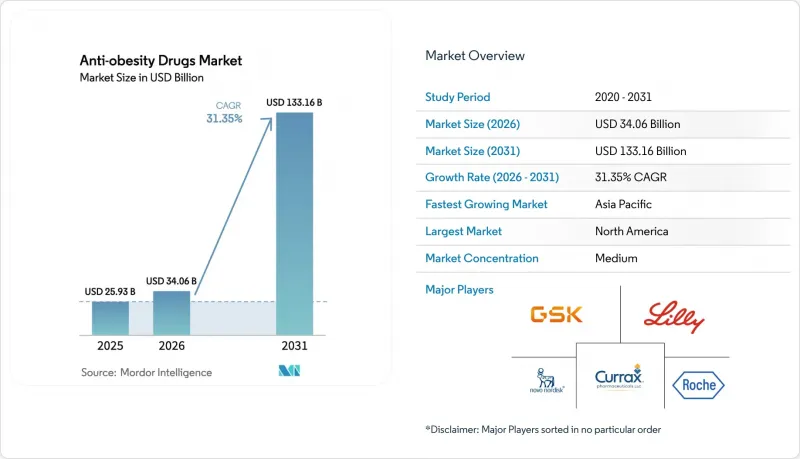
Mordor Intelligence에 의하면, 항비만제 시장 규모는 2025년에 259억 3,000만 달러로 평가되었고, 2026년에 340억 6,000만 달러로 추정되고, 2031년까지 1,331억 6,000만 달러에 이를 것으로 예측되며, 2026-2031년 CAGR 31.35%로 성장할 전망입니다.
본 보고서는 작용기전별(말초 작용형 리파아제 억제제, 중추 작용형 교감신경 자극제 등), 약제 유형별(처방약 및 일반의약품), 투여 경로별(경구 정제 및 주사제), 유통 채널별(병원 약국 등), 지역별(북미, 유럽 등)로 분류되어 있습니다. 시장 규모 및 전망은 금액(달러) 기준으로 제시되어 있습니다.
세계의 항비만제 시장 동향 및 인사이트
증가하는 심장 대사 합병증이 조기 약물 치료를 촉진하고 있습니다.
미국심장협회(AHA)가 2024년에 비만의 재분류를 단행했다는 성명에 따라, 현재 순환기 전문의와 1차 진료 의사들은 비만을 흡연과 동등한 심혈관 위험 요인으로 간주하고 있습니다. 그 후, 세마글루티드의 FLOW 임상시험에서 신장 질환의 진행이 24% 감소한 것으로 나타났으며, 이에 따라 보험사는 당뇨병성 신증 환자에 대한 사전 승인 요건을 면제하게 되었습니다. 2024년 미국 성인의 41.9%가 비만 상태였던 점을 감안하여, 임상 지침에서는 생활습관 요법이 실패한 후가 아니라 진단 후 6개월 이내에 GLP-1 요법을 시작할 것을 권장하게 되었습니다. 기업 건강보험 플랜은 이러한 지침에 맞추어 급여 내용을 신속하게 조정함으로써, 1순위 처방약의 처방 건수가 급증하는 데 기여했습니다. 이러한 치료 과정의 단축은 현재 유럽과 일본에서도 비슷한 추세를 보이고 있으며, 진단부터 약물 치료 시작까지의 기간이 단축되고, 대상 환자층이 대폭 확대되고 있습니다.
장기적인 의료비 위험을 헤지하기 위해, 고용주에 의한 GLP-1 보험 적용이 급속히 확대되고 있습니다.
2024년 직원 복리후생 연구소(EBRI)의 조사에 따르면, 세마글루타이드 또는 틸제파티드를 급여 대상으로 하는 자체 보험형 고용주의 경우, 18개월 이내에 당뇨병 관련 보험금 청구 건수가 12% 감소했으며, 심혈관 질환으로 인한 입원이 9% 감소했으며, 연간 12,000-1만 6,000달러의 약제비가 상쇄된 것으로 밝혀졌습니다. 그 결과, 미국 대기업의 44%가 2024년에 GLP-1 제제를 처방약 목록에 추가했으나, 2023년에는 25%에 그쳤습니다. 지속적인 체중 감소나 HbA1c 수치 저하에 리베이트를 연계하는 성과 연계형 계약이 보급되면서, 위험을 제약사로 전가하는 동시에 복약 순응도 프로그램의 추진으로 이어지고 있습니다. 처방전과 함께 제공되는 디지털 코칭을 통해 12개월간의 복약 지속률이 40%에서 65%로 향상되었으며, 통합형 모델이 전반적인 비용 상승을 억제할 수 있음이 입증되었습니다. 캐나다와 호주에서도 유사한 움직임이 나타나고 있으며, 전 세계의 고용주들이 만성 질환으로 인한 재정적 부담을 관리하기 위해 이 가치 기반 모델을 따르고 있는 것으로 나타났습니다.
복잡한 펩타이드 원료의 제조 능력에서 발생하는 병목 현상
고상 펩타이드 합성, HPLC 정제, 동결건조와 같은 공정으로 인해 사이클 시간이 길어지며, 처리 능력이 제한되고 있습니다. 2024년에 발표된 노보노르디스크사의 60억 달러 규모의 생산 능력 확충 계획과, 릴리사가 53억 달러를 투자한 인디애나주 공장도 2027년까지는 완전 가동 단계에 이르지 못할 것으로 보여, 공급 부족 현상이 지속될 것으로 전망됩니다. 전 세계에서 GLP-1 펩타이드를 대규모로 생산할 수 있는 FDA 승인 시설은 단 8곳에 불과하기 때문에 2024년 덴마크 공급업체에서 발생한 화재와 같은 혼란이 발생하면 즉시 전 세계적인 공급 부족을 초래하게 됩니다. 유럽의약품청(EMA)은 반복되는 공급 부족에 대응하여 처방 의사들에게 심혈관 질환 환자를 우선적으로 치료할 것을 권고함으로써, 사실상 치료에 대한 배급제를 도입했습니다. CDMO 시설 확충이 진행 중이지만, 복잡한 펩타이드의 규제 당국 승인을 받는 데 평균 18-24개월이 소요되기 때문에 당분간 공급 부족 현상이 지속될 것이 확실합니다.
부문별 분석
2025년, 이 부문 시장 규모는 131억 달러에 달했으며, GLP-1 단독 요법이 38.55%의 점유율을 차지했습니다. 2024년 12월에 발표된 레타톨티드의 24.2% 체중 감량 효과는 트리플 작용제가 2031년까지 연평균 성장률(CAGR) 32.25%를 나타낼 것으로 예측되는 근거를 뒷받침하고 있습니다. 향후 5년 동안, 임상의들이 고용량 GLP-1 단독 요법에서 나타나는 내약성의 한계를 피하고자 함에 따라, GIP/GLP-1 이중 작용제는 2차 치료에서 1차 치료로 전환될 것으로 예측됩니다. 글루카곤 수용체 작용이 더해짐에 따라, 지방량의 추가적인 감소와 대사 유연성이 기대되며, 내분비·순환기·간 전문의들에게 그 매력이 더욱 확대될 것입니다. 한편, 중추 작용형 교감신경 자극제나 리파아제 억제제는 그 효과가 제한적이며, 안전성과의 상충 관계도 존재하기 때문에 시장 규모가 작은 틈새 시장으로 점차 이동하고 있습니다.
보험사는 심혈관계 및 신장에 대한 유익성이 입증될 경우, 고가의 멀티아고니스트에 대한 보험 적용에 긍정적인 태도를 보이고 있으며, 이러한 가능성에 대해서는 현재 진행 중인 SURMOUNT-5 및 TRIUMPH-2 결과 연구를 통해 검증이 진행되고 있습니다. 뛰어난 체중 감량 효과와 동반 질환에 미치는 영향을 고려할 때, 분석가들은 2031년까지 멀티아고니스트가 항비만제 시장의 45% 이상을 차지할 것으로 전망하고 있습니다. 암젠의 ‘MariTide’나 바이킹 테라퓨틱스의 ‘VK2735’와 같은 신규 진입 제품들은 독자적인 투여 간격과 위장 내약성 향상을 강점으로 내세우며 시장 점유율 확보를 목표로 하고 있습니다. 작용기전의 복잡화에 따라 제조 비용은 상승하지만, 그와 동시에 효능도 높아져 결과적으로 가치에 기반한 가격 상한선도 상향 조정됩니다.
2025년 기준으로 처방약은 항비만제 시장의 64.53%를 차지하고 있으며, 이 분야는 2031년까지 연평균 성장률(CAGR) 32.85%로 성장할 전망입니다. 2024년 메타분석에 따르면, 오르리스타트와 같은 일반의약품 대체제의 체중 감소 효과는 고작 2-3%만 향상된 것으로 나타났으며, 이로 인해 처방 의사들이 더 효능이 높은 치료법에 의존하는 경향이 더욱 강해지고 있습니다. 보험 적용 환자의 경우, 처방약 비용의 최대 90%가 보험으로 충당되지만, 일반의약품은 전액 본인 부담이 되므로, 그 이용은 경제적으로 여유가 있는 본인 부담 환자로 제한되어 있습니다. 또한, 2024년 FDA 지침에서는 만성 질환의 자가 선별과 관련된 바이오마커 제시를 의무화함으로써 처방약에서 일반의약품(OTC)으로의 전환 요건이 강화되었고, 소비자를 대상으로 한 GLP-1 제제의 출시 길은 사실상 막혔습니다.
앞으로 두 자릿수 체중 감량 효과나 심혈관 대사 관련 평가 지표를 보이는 약물의 경우, 처방약으로서의 지위가 계속해서 기본으로 유지될 전망입니다. 리듬 파마슈티컬스(Rhythm Pharmaceuticals)의 세토메라노티드는 REMS(위험 평가 및 완화 전략)와 유전자 검사를 통해 규제되고 있으며, 이는 복잡한 안전성 프로파일을 가진 차세대 치료제에 대해 규제 당국이 어떻게 대응할지를 시사하고 있습니다. OTC(일반의약품) 제조업체들에게 있어 현실적인 경제적 틈새 시장은 브랜드 의약품의 사업 기반을 위협하지 않는 식이섬유를 기반으로 한 식욕억제제 등의 보조 제품으로 점차 좁혀지고 있습니다.
지역별 분석
2025년, 북미는 항비만제 시장의 39.53%를 차지하며 시장을 주도했습니다. 이는 성인의 비만 유병률이 41%를 넘어섰고, 메디케어 파트 D의 적용 범위가 확대됨에 따라 해당 수혜자가 1,500만 명 증가한 데 기인합니다. 그럼에도 불구하고, 지불자 측의 비용 부담은 여전히 심각합니다. 임상경제평가연구소(ICER)는 현재 GLP-1 제제의 가격이 연간 7,000달러 미만일 경우에만 비용 대비 효과가 있다고 판단하고 있으며, 이에 따라 보험사들은 대폭적인 리베이트를 요구하고 있습니다. 캐나다는 미국에 비해 뒤처져 있으며, 3개 주에서만 공적 보험 제도를 통해 항비만제 비용을 보상하고 있어, 환자 본인 부담이나 고용주의 보험 적용에 의존할 수밖에 없는 상황이 발생하고 있습니다. 멕시코 시장은 본인부담금 제한을 받고 있지만, 노보노르디스크가 2024년부터 미국 가격보다 40% 저렴한 저용량 세마글루티드를 판매하기 시작하면서 접근성이 확대되기 시작했습니다. 전반적으로 볼 때, 북미 시장의 성장은 임상적 수요와 지불 주체의 부담 능력 간의 균형에 달려 있습니다.
아시아태평양은 중국, 일본, 인도의 규제 당국 승인에 더해 중산층의 급속한 확대에 힘입어, 2031년까지 연평균 성장률(CAGR)이 35.21%를 기록하며 전 지역 중 가장 높은 성장세를 보일 것으로 전망됩니다. 중국에는 1억 8,000만 명의 비만 성인이 있어 거대한 잠재 시장을 형성하고 있지만, 보험 적용은 1선 도시 및 민간 보험 상품으로 제한되어 있습니다. 일본에서는 6개월간의 보험 급여 상한선이 설정되어 있으며, 치료를 계속하기 위해서는 체중이 5% 감소했음을 입증해야 하므로, 복약 순응도가 높은 치료법이 권장되고 있습니다. 인도에서는 브랜드 주사제보다 60% 저렴한 제네릭 정제가 빠르게 시장 점유율을 확대하고 있어, 비용 중심의 도입 경로가 시사되고 있습니다. 한국과 호주에서는 국내산 또는 수입산 GLP-1 제제가 승인되어 있지만, 공공 자금을 통한 접근에는 엄격한 BMI 기준이 적용되어 초기 보급이 제한되고 있습니다. 경구용 제제나 향후 출시될 바이오시밀러는 이 지역 전체에서 2·3급 도시로 시장 침투를 도모하는 데 있어 필수적입니다.
2025년 기준으로 유럽은 항비만제 시장의 약 25%를 차지했으나, 보험 급여 심사 기준이 판매량 증가를 억제하고 있습니다. NICE(영국 국립의료기술평가기구)는 세마글루티드의 적용 대상을 BMI 35 kg/m² 이상으로 제한하고 있으며, 이로 인해 FDA 기준에 비해 대상 인구가 60% 감소했습니다. 독일에서는 12개월간의 보험 보상 상한선이 정해져 있으며, 그 이후에는 본인 부담금이 발생합니다. 한편, 프랑스에서는 당뇨병성 비만의 경우에만 보험 적용이 승인되어 있습니다. 2024년 3월에는 공급 부족으로 인해 EMA가 경보를 발령했고, 심혈관계 동반 질환이 있는 환자를 우선으로 하는 배급 프로토콜이 도입되었습니다. 중동 및 아프리카은 여전히 개발도상국이지만, 걸프협력회의(GCC) 회원국 중 일부에서는 민간 부문 수요 증가가 나타나고 있습니다. 라틴아메리카에서는 브라질이 주도적인 역할을 하고 있으며, 주민의 25%를 대상으로 하는 민간 보험이 세마글루티드의 비용을 부담하고 있지만, 공적 의료 제도에서는 아직 우선적으로 적용되지 않고 있습니다. 지역별 이러한 차이는 의료 기술 평가와 예산상의 제약이 임상 현장의 열의를 어떻게 서로 다른 도입 곡선으로 이끌고 있는지를 여실히 보여주고 있습니다.
기타 혜택 :
- 엑셀 형식 시장 예측(ME) 시트
- 3개월간의 애널리스트 지원
자주 묻는 질문
목차
제1장 서론
제2장 조사 방법
제3장 주요 요약
제4장 시장 구도
제5장 시장 규모 및 성장 예측
제6장 경쟁 구도
제7장 시장 기회 및 향후 전망
AJY 26.06.24According to Mordor Intelligence, the anti-obesity drugs market size is projected to be USD 25.93 billion in 2025, USD 34.06 billion in 2026, and reach USD 133.16 billion by 2031, growing at a CAGR of 31.35% from 2026 to 2031.
This report is Segmented by Mechanism of Action (Peripherally Acting Lipase Inhibitors, Centrally Acting Sympathomimetics, and More), Drug Type (Prescription Drugs and OTC Drugs), Route of Administration (Oral Daily Pills and Injectable), Distribution Channel (Hospital Pharmacies, and More), and Geography (North America, Europe, and More). The Market and Forecasts are Provided in Terms of Value (USD).
Global Anti-obesity Drugs Market Trends and Insights
Escalating Cardiometabolic Complications Driving Early Pharmacologic Intervention
Cardiologists and primary-care physicians now regard obesity as a cardiovascular risk factor comparable to smoking, following the American Heart Association's 2024 statement that reclassified the condition. Semaglutide's FLOW trial subsequently showed a 24% reduction in kidney-disease progression, prompting payers to waive prior authorizations for diabetic nephropathy cases. As 41.9% of U.S. adults were living with obesity in 2024, clinical guidelines began recommending GLP-1 initiation within six months of diagnosis rather than after lifestyle failure. Employer health plans quickly aligned benefit designs with these guidelines, fueling a surge in first-line prescriptions. This compressed treatment pathway is now mirrored in Europe and Japan, shrinking the time from diagnosis to pharmacologic therapy and expanding the eligible population at scale.
Rapid Employer Adoption of GLP-1 Coverage as a Hedge Against Long-Term Healthcare Costs
A 2024 Employee Benefit Research Institute analysis found that self-insured employers covering semaglutide or tirzepatide cut diabetes-related claims by 12% and cardiovascular hospitalizations by 9% within 18 months, offsetting annual drug costs in the USD 12,000-16,000 range. As a result, 44% of large U.S. employers added GLP-1s to formularies in 2024 versus 25% in 2023. Outcomes-based contracts that peg rebates to sustained weight loss or HbA1c reduction are spreading, shifting risk to manufacturers and motivating adherence programs. Digital coaching bundled with prescriptions improved 12-month persistence rates from 40% to 65%, demonstrating that integrated models can blunt overall cost growth. Parallel moves in Canada and Australia indicate that employers worldwide are replicating the value-based blueprint to manage chronic-disease liability.
Manufacturing-Capacity Bottlenecks for Complex Peptide APIs
Solid-phase peptide synthesis, HPLC purification, and lyophilization create long cycle times that cap throughput. Novo Nordisk's USD 6 billion capacity build announced in 2024 and Lilly's USD 5.3 billion Indiana plant will not reach full output until 2027, keeping supply constrained. Only eight FDA-approved facilities worldwide can produce GLP-1 peptides at scale, so any disruption, such as the 2024 fire at a Danish supplier, quickly triggers global shortages. The European Medicines Agency responded to recurring deficits by advising prescribers to prioritize cardiovascular patients, effectively rationing therapy. CDMO expansions are underway, but regulatory qualification for complex peptides averages 18-24 months, ensuring that tightness persists in the near term.
Other drivers and restraints analyzed in the detailed report include:
- Breakthrough Cardiovascular-Outcome Data Expanding Prescriber Comfort and Payer Mandates
- Next-Generation Oral Small-Molecule GLP-1s Unlocking Primary-Care and Emerging-Market Volume
- Escalating Payer Budget-Impact Controls and Step-Therapy Barriers
For complete list of drivers and restraints, kindly check the Table Of Contents.
Segment Analysis
The segment generated USD 13.1 billion in 2025, when GLP-1 monotherapies held 38.55% share. Retatrutide's 24.2% weight-loss profile, disclosed in December 2024, underscores why triple-agonists are expected to expand at a 32.25% CAGR through 2031. Over the next five years, dual GIP/GLP-1 agents should migrate from second-line to first-line therapy as clinicians aim to avert tolerability limits seen with higher-dose GLP-1 monotherapy. The addition of glucagon-receptor activity promises incremental fat-mass reduction and metabolic flexibility, broadening appeal to endocrine, cardiology, and hepatology specialists. Meanwhile, centrally acting sympathomimetics and lipase inhibitors are sliding toward low-volume niches, constrained by modest efficacy and safety trade-offs.
Payers are signaling willingness to reimburse premium-priced multi-agonists if cardiovascular or renal benefits materialize, a possibility under investigation in ongoing SURMOUNT-5 and TRIUMPH-2 outcome studies. Given superior weight loss and comorbidity impact, analysts expect multi-agonists to exceed 45% of the anti-obesity drugs market by 2031. New entrants such as Amgen's MariTide and Viking Therapeutics' VK2735 target differentiated dosing intervals or improved GI tolerability to carve share. The escalation in mechanism complexity heightens manufacturing cost but also raises efficacy and, by extension, value-based price ceilings.
Prescription products represented 64.53% of the anti-obesity drugs market in 2025, and the cohort is on track for a 32.85% CAGR through 2031. Over-the-counter alternatives like orlistat delivered only 2-3% incremental weight loss in 2024 meta-analyses, reinforcing prescriber reliance on higher-efficacy options. Payer formularies absorb up to 90% of prescription costs for eligible patients, whereas OTC products are fully out-of-pocket, limiting their reach to affluent self-payers. FDA guidance in 2024 also tightened the path for Rx-to-OTC switches by requiring biomarkers for chronic-disease self-selection, effectively closing the door to consumerized GLP-1s.
Going forward, prescription status will likely remain the default for any agent demonstrating double-digit weight loss or cardiometabolic endpoints. Rhythm Pharmaceuticals' setmelanotide, gated by a REMS and genetic testing, signals how regulators may handle next-generation therapies with complex safety profiles. For OTC players, the viable economic niche is slimming down to adjunctive products such as fiber-based appetite suppressants, which do not threaten branded franchises.
Geography Analysis
North America dominated with 39.53% of the anti-obesity drugs market in 2025, buoyed by obesity prevalence surpassing 41% of adults and expanding Medicare Part D coverage that raised the eligible pool by 15 million beneficiaries. Still, payer cost pressures remain acute; the Institute for Clinical and Economic Review deemed current GLP-1 prices cost-effective only below USD 7,000 annually, prompting insurers to demand steep rebates. Canada lags the United States, as public plans in only three provinces reimburse obesity drugs, creating reliance on private pay or employer coverage. Mexico's market is limited by out-of-pocket spend, but Novo Nordisk's lower-dose semaglutide at 40% below U.S. pricing began expanding access in 2024. Overall, North American growth will hinge on balancing clinical demand with payer affordability thresholds.
Asia-Pacific is forecast to post a 35.21% CAGR through 2031, the fastest among all regions, aided by regulatory approvals in China, Japan, and India alongside rapid middle-class expansion. China's 180 million adults with obesity constitute a massive addressable population, though reimbursement is confined to tier-1 cities and private plans. Japan's six-month reimbursement cap mandates demonstrable 5% weight loss for continuation, incentivizing high-adherence regimens. In India, a generic tablet priced 60% below the branded injectable quickly captured share, signaling cost-sensitive adoption pathways. South Korea and Australia approved local or imported GLP-1s but apply stringent BMI thresholds for publicly funded access, tempering early uptake. Oral formulations and forthcoming biosimilars are essential to unlocking second- and third-tier city penetration across the region.
Europe controlled roughly 25% of the anti-obesity drugs market in 2025, yet reimbursement gatekeeping restrains volume growth. NICE restricts semaglutide to BMI >= 35 kg/m2, shrinking the eligible population by 60% relative to FDA criteria. Germany enforces a 12-month reimbursement cap, requiring self-pay thereafter, while France approves coverage only for diabetic obesity. Shortages prompted an EMA alert in March 2024, leading to rationing protocols prioritizing cardiovascular co-morbid patients. Middle East and Africa remain nascent but show pockets of private-pay demand in Gulf Cooperation Council states. Latin America is led by Brazil, where private insurance, covering 25% of residents, funds semaglutide, but public systems have not prioritized coverage. Overall regional variability highlights how health-technology assessments and budget constraints filter clinical enthusiasm into disparate adoption curves.
- Altimmune Inc.
- Amgen
- AstraZeneca
- Bayer
- Boehringer Ingelheim Intl. GmbH
- Eli Lilly and Company
- Roche
- GlaxoSmithKline
- Hanmi Pharm. Co., Ltd.
- Innovent Biologics Inc.
- Merck
- Novo Nordisk
- Pfizer
- Rhythm Pharmaceuticals, Inc.
- Structure Therapeutics Inc.
- Takeda Pharmaceuticals
- Teva Pharmaceutical Industries
- Viking Therapeutics Inc.
- Zealand Pharma
- Zydus Lifesciences Ltd.
- Currax Pharmaceuticals
Additional Benefits:
- The market estimate (ME) sheet in Excel format
- 3 months of analyst support
TABLE OF CONTENTS
1 Introduction
- 1.1 Study Assumptions & Market Definition
- 1.2 Scope of the Study
2 Research Methodology
3 Executive Summary
4 Market Landscape
- 4.1 Market Overview
- 4.2 Market Drivers
- 4.2.1 Escalating cardiometabolic complications driving early pharmacologic intervention
- 4.2.2 Rapid employer adoption of GLP-1 coverage as a hedge against long-term healthcare costs
- 4.2.3 Breakthrough cardiovascular-outcome data expanding prescriber comfort and payer mandates
- 4.2.4 Next-generation oral small-molecule GLP-1s unlocking primary-care and emerging-market volume
- 4.2.5 Chronic kidney-disease risk-reduction labeling creating multi-specialty pull-through
- 4.2.6 AI-enabled drug-discovery platforms accelerating multi-agonist pipeline productivity
- 4.3 Market Restraints
- 4.3.1 Manufacturing-capacity bottlenecks for complex peptide APIs
- 4.3.2 Regulatory safety surveillance around rare ophthalmic adverse events
- 4.3.3 Escalating payer budget-impact controls and step-therapy barriers
- 4.3.4 Grey-market compounding eroding branded-drug economics
- 4.4 Supply-Chain Analysis
- 4.5 Regulatory Landscape
- 4.6 Technological Outlook
- 4.7 Porter's Five Forces
- 4.7.1 Threat of New Entrants
- 4.7.2 Bargaining Power of Buyers
- 4.7.3 Bargaining Power of Suppliers
- 4.7.4 Threat of Substitute Products
- 4.7.5 Intensity of Competitive Rivalry
5 Market Size & Growth Forecasts (Value, USD)
- 5.1 By Mechanism of Action
- 5.1.1 GLP-1 Receptor Agonists
- 5.1.2 Dual GIP/GLP-1 Agonists
- 5.1.3 Triple or Multi-Receptor Agonists
- 5.1.4 Centrally Acting Sympathomimetics
- 5.1.5 Peripherally Acting Lipase Inhibitors
- 5.2 By Drug Type
- 5.2.1 Prescription Drugs
- 5.2.2 OTC Drugs
- 5.3 By Route of Administration
- 5.3.1 Injectable (Weekly / Monthly)
- 5.3.2 Oral Daily Pills
- 5.4 By Distribution Channel
- 5.4.1 Hospital Pharmacies
- 5.4.2 Retail Pharmacies
- 5.4.3 Online Pharmacies & Tele-health Platforms
- 5.4.4 Weight-Loss Clinics
- 5.5 Geography
- 5.5.1 North America
- 5.5.1.1 United States
- 5.5.1.2 Canada
- 5.5.1.3 Mexico
- 5.5.2 Europe
- 5.5.2.1 Germany
- 5.5.2.2 United Kingdom
- 5.5.2.3 France
- 5.5.2.4 Italy
- 5.5.2.5 Spain
- 5.5.2.6 Rest of Europe
- 5.5.3 Asia-Pacific
- 5.5.3.1 China
- 5.5.3.2 Japan
- 5.5.3.3 India
- 5.5.3.4 South Korea
- 5.5.3.5 Australia
- 5.5.3.6 Rest of Asia-Pacific
- 5.5.4 Middle East and Africa
- 5.5.4.1 GCC
- 5.5.4.2 South Africa
- 5.5.4.3 Rest of Middle East and Africa
- 5.5.5 South America
- 5.5.5.1 Brazil
- 5.5.5.2 Argentina
- 5.5.5.3 Rest of South America
- 5.5.1 North America
6 Competitive Landscape
- 6.1 Market Concentration
- 6.2 Market Share Analysis
- 6.3 Company Profiles (includes Global level Overview, Market level overview, Core Segments, Financials as available, Strategic Information, Market Rank/Share for key companies, Products & Services, and Recent Developments)
- 6.3.1 Altimmune Inc.
- 6.3.2 Amgen Inc.
- 6.3.3 AstraZeneca plc
- 6.3.4 Bayer AG
- 6.3.5 Boehringer Ingelheim Intl. GmbH
- 6.3.6 Eli Lilly and Company
- 6.3.7 F. Hoffmann-La Roche AG
- 6.3.8 GSK plc
- 6.3.9 Hanmi Pharm. Co., Ltd.
- 6.3.10 Innovent Biologics Inc.
- 6.3.11 Merck & Co., Inc.
- 6.3.12 Novo Nordisk A/S
- 6.3.13 Pfizer Inc.
- 6.3.14 Rhythm Pharmaceuticals, Inc.
- 6.3.15 Structure Therapeutics Inc.
- 6.3.16 Takeda Pharmaceutical Co. Ltd
- 6.3.17 Teva Pharmaceutical Industries Ltd.
- 6.3.18 Viking Therapeutics Inc.
- 6.3.19 Zealand Pharma A/S
- 6.3.20 Zydus Lifesciences Ltd.
- 6.3.21 Currax Pharmaceuticals LLC
7 Market Opportunities & Future Outlook
- 7.1 White-space & Unmet-Need Assessment


