|
시장보고서
상품코드
2066469
음향 센서 : 시장 점유율 분석, 업계 동향 및 통계, 성장 예측(2026-2031년)Sound Sensors - Market Share Analysis, Industry Trends & Statistics, Growth Forecasts (2026 - 2031) |
||||||
 Mordor Intelligence
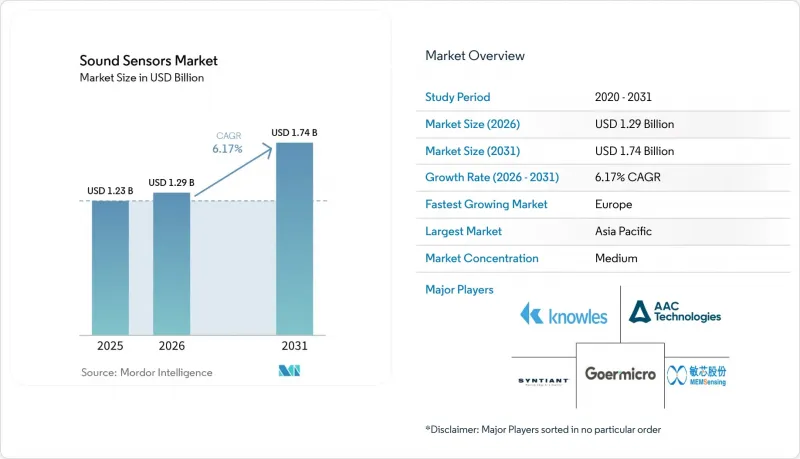
Mordor Intelligence에 의하면, 음향 센서 시장 규모는 2025년에 12억 3,000만 달러로 평가되었습니다. 2026년 12억 9,000만 달러에서 2031년까지 17억 4,000만 달러에 이를 것으로 예상되며, 예측 기간(2026-2031년) CAGR은 6.17%를 나타낼 전망입니다.
본 보고서는 센서 유형(MEMS(마이크로 전자 기계 시스템) 마이크 등), 주파수(저주파음, 가청음 등), 용도(음성 인식 및 음성 처리 등), 최종 사용자 산업(가정용 전자기기, 스마트폰 및 태블릿, 완전 무선 스테레오 이어폰 및 헤드셋, 스마트 스피커 등) 및 지역별로 분류되어 있습니다. 시장 규모 및 전망은 금액(달러) 기준으로 표시되어 있습니다.
세계의 음향 센서 시장 동향 및 인사이트
‘보이스 퍼스트’형 소비자용 기기의 확대
음향 센서 시장에서 단기적으로는 스마트폰, TWS 이어폰, 스마트 스피커, AI 탑재 웨어러블 기기에 탑재된 상시 작동형 음성 인터페이스가 가장 강력한 견인력으로 작용하고 있습니다. 디바이스 업그레이드는 더 이상 웨이크 워드 감지에만 초점을 맞춘 것이 아니라, 로컬 추론 워크로드에서 음향 프론트엔드에 대해 더 낮은 자체 노이즈와 더 넓은 주파수 응답이 요구되기 때문입니다. Syntiant사는 2025년 12월, eWLB 및 초박형 패키지를 채택한 NDP115 제품군을 확대하며, 소형 디바이스를 위해 추론용 실리콘과 프런트엔드 음향 기술이 얼마나 긴밀하게 공동 설계되었는지를 입증했습니다. 이러한 설계 동향에 따라, 각 OEM 업체들이 공급업체 수를 줄이고 더욱 통합된 오디오·AI 스택을 요구함에 따라, 음향 센서 시장의 인증 절차가 점차 간소화되고 있습니다. 또한, 이로 인해 여전히 주로 패키징 및 조립 규모에 의존하고 있는 기업에 비해, MEMS 공정 제어 및 신호 처리 IP를 보유한 공급업체의 우위가 더욱 커지고 있습니다.
산업용 예측 유지보수 도입
소음 센서 시장은 회전 장비 및 왕복 운동 장비의 음향 모니터링을 정기 점검에서 연속 감지로 전환하고 있는 산업 운영자들로부터 지속적인 지지를 얻고 있습니다. 2025년 6월 조사에 따르면, MEMS 음향 방출 센서는 네트워크 에지에 위치한 행성 기어박스에서 90% 이상의 고장 분류 정확도를 달성하여, 클라우드 의존도가 과제로 대두되는 가혹한 환경에서 신속한 도입을 뒷받침하고 있습니다. 이러한 시스템이 기업 아키텍처에 통합됨에 따라, 가치의 상당 부분은 트랜스듀서 자체보다는 센서, ASIC 및 분석 기술의 조합으로 이동하고 있습니다. 이로 인해 음향 센서 시장에서 공동 통합 처리 기능을 갖추지 못한 독립형 부품 공급업체들은 압박을 받고 있습니다. 노울즈사가 소비자용 MEMS 마이크로폰 사업을 매각한 후의 사업 재편 역시, 공급업체들이 산업용 음향 분야에서 보다 안정적인 이익률과 더 긴 설비 수명을 기대하고 있음을 시사합니다.
소음 환경에서 정확도의 저하
음향 센서 시장은 여전히 잔향이 많은 공간, 소음이 심한 산업 현장, 그리고 야외의 밀집된 환경에서 생음향 성능이 급격히 저하된다는 명백한 기술적 한계에 직면해 있습니다. 2025년 5월에 발표된 조사에 따르면, 딥러닝을 활용한 소음 대책형 마찰 발전식 음향 센서는 -10 dB라는 낮은 신호 대 잡음비(SNR)에서도 성능을 유지할 수 있는 것으로 나타났으나, 그 이득은 센서에 추가된 신경망 처리에 의존하고 있어 이로 인해 실리콘 면적과 시스템 비용이 증가합니다. 이에 따라 조달 방침도 변화하고 있습니다. 구매자들은 마이크 자체뿐만 아니라 음향 노드의 총 비용을 평가하는 경향이 점점 더 강해지고 있기 때문입니다. 실제 도입에 있어서는 음향 센서 시장의 일부 음성 및 모니터링 이용 사례에서 실제 운영 조건 하에서 필요한 정확도 기준을 충족하는 데 여전히 어려움을 겪고 있음을 의미합니다. 상용화된 노이즈 대책 아키텍처는 그 기반이 되는 수요 파이프라인에 비해 아직 성숙도가 낮기 때문에 이러한 제약은 단기적으로 특히 두드러지게 나타나고 있습니다.
부문별 분석
2025년, MEMS 마이크로폰은 음향 센서 시장 점유율의 41.35%를 차지하며, 다른 모든 센서 부문을 확고하게 앞섰습니다. 이 리드는 소형 패키지, 저전력 소비, 안정적인 음향 성능이 표준 요구 사항으로 여겨지는 스마트폰, TWS 이어폰, 스마트 스피커에 잇달아 설계에 채택된 점을 반영한 것입니다. 일렉트릿 커패시터형 마이크는 비용 효율을 중시하는 인터콤이나 기본적인 산업용 음성 용도 분야에서 여전히 일정한 위치를 차지하고 있지만, OEM 사양이 고도화됨에 따라 그 시장 점유율은 계속해서 줄어들고 있습니다. 다이나믹형(무빙 코일) 마이크는 라이브 오디오 및 방송 현장에서 여전히 널리 사용되고 있지만, 액체 결합형 및 공기 결합형 초음파 장치는 보다 제한적인 검사 및 측정 용도에 계속 초점을 맞추었습니다. 음향 센서 시장 중에서 가장 높은 성장세를 보이고 있는 것은 음향 방출 센서이며, 2031년까지 연평균 성장률(CAGR) 7.77%를 나타낼 것으로 전망됩니다.
이러한 성장은 시설 내 설비의 건전성 관리 방식에 대한 구조적 변화와 밀접한 관련이 있습니다. 운영 담당자들은 정기적인 수동 점검에 의존하기보다는 지속적인 IIoT 데이터 스트림을 구축하고 있기 때문입니다. 따라서 음향 센서 업계에서는 네트워크 기반 진단, 긴 수명, 그리고 플랜트 분석 시스템과의 통합을 지원하는 음향 방출 플랫폼이 더욱 중요시되고 있습니다. 2025년 6월에 실시된 행성 기어 시스템의 고장 진단에 관한 연구에서는 MEMS 음향 방출 감지 기술이 산업 환경에서 고정밀 에지 분류를 지원할 수 있음이 밝혀졌으며, 이는 이러한 방향성을 뒷받침하는 결과가 되었습니다. XARION 및 이와 유사한 광학식 방식 역시, 기존의 접촉식 센싱 방식으로는 성능이 저하되기 쉬운 고온·고압 환경에서 경쟁력을 발휘하며, 차별화된 기술로서 그 활용 영역이 확대되고 있습니다. 시장 규모 측면에서 AAC Technologies에 따르면, 이 회사의 MEMS 마이크로폰 매출액은 2025년에 50% 이상 증가하여 2025 회계연도 총 매출액은 318억 2,000만 위안(44억 3,000만 달러)에 달했습니다. 이는 음향 센서 시장의 최상위권에서 기록된 막대한 판매량을 뒷받침하는 것입니다.
2025년에는 가청 대역이 매출의 69.24%를 차지하며, 음향 센서 시장에서 압도적인 점유율을 자랑하는 주파수 대역이 되었습니다. 이러한 위상은 20 Hz-20 kHz 범위에서 작동하는 스마트폰, 이어폰, 스마트 스피커, 웨어러블 기기의 대량 출하에 기인합니다. 초저주파 대역은 지진 관측, 구조물 건전성 감시, 군사 감시 분야에서 여전히 중요하지만, 그 수요 기반은 훨씬 작고 판매량도 적은 상황입니다. 초음파 대역은 가장 빠르게 성장하고 있는 주파수 부문이며, 초음파 센서 시장은 2031년까지 연평균 성장률(CAGR) 6.58%로 확대될 것으로 전망됩니다. 이러한 수요는 가청 대역보다 더 다양하며, 의료용 영상 진단, 소나, 전기자동차 배터리 시험, 로봇 공학, 산업용 계측 등 다양한 분야에 걸쳐 있습니다.
초음파 분야의 성장은 단일 최종 시장이 아닌, 여러 조달 주기에 의해 주도되고 있습니다. 선라이즈 윈드 프로젝트와 관련된 미국 해양대기청(NOAA)의 문서에 따르면, 수동형 음향 모니터링이 해상 개발 및 규정 준수 프로그램의 일부로 자리 잡고 있으며, 이는 해저 및 수중 음향 시스템에 대한 장기적인 수요를 뒷받침하고 있습니다. 2025년 5월 『Scientific Data』지에 게재된 연구에서는 광섬유를 따라 가청 스펙트럼 내의 음성을 포착한 분산형 음향 센싱 데이터셋도 소개되었으며, 이를 통해 인프라 센싱이 음향 기술의 활용 범위를 얼마나 확대하고 있는지가 드러났습니다. 따라서 음향 센서 시장에서는 매출의 중심이 여전히 가청 대역에 있지만, 최고 주파수 대역에서의 비즈니스 기회는 초음파 분야에 있습니다. 이는 가격의 상품화가 진행되지 않았고, 응용 범위가 넓기 때문입니다. 저주파 소음은 규모는 작지만 안정적인 역할을 유지하고 있으며, 공공 부문 및 국방 분야의 조달이 수요를 뒷받침하고 있습니다.
지역별 분석
2025년, 북미는 음향 센서 시장 점유율의 29.91%를 차지하며, 지역별로는 가장 큰 기여도를 보였습니다. 미국은 하이퍼스케일러의 음성 플랫폼, 자동차 관련 프로그램, 산업용 모니터링, 방위 음향 분야를 통해 수요를 주도하고 있습니다. 캐나다는 2026년 3월 Ocean Sonics사가 410만 달러 규모의 ‘캐나다 오션 슈퍼클러스터’ 프로젝트에 참여한 것을 계기로, 해양 및 해저 음향 분야에 기여하고 있습니다. 멕시코는 자동차 관련 음향 공급망에서 해안가 조립 거점으로 부상하고 있습니다. FCC 파트 15 및 OSHA의 소음 관련 요건을 포함한 규제된 조달 경로가 북미 시장을 더욱 뒷받침하고 있습니다.
아시아태평양은 가장 빠르게 성장하고 있는 지역이며, 음향 센서 시장은 2031년까지 연평균 성장률(CAGR) 7.17%로 확대될 것으로 전망됩니다. 중국은 신에너지차(NEV) 생산, MEMS 생산 능력, 그리고 도시 소음 관리 시행 분야에서 주도적인 역할을 하고 있습니다. 상하이시가 수립한 소음 대책 계획은 환경 소음에 대한 거버넌스 강화를 강조하고 있습니다. Goertek Microelectronics사는 2025년 7월 홍콩 상장 설명서에서 2024년 기준 음향 센서 세계 시장 점유율이 43%에 달했다고 보고했으며, 이는 해당 지역 내 제조의 집중 현상을 반영하고 있습니다. 일본과 한국은 정밀 부품과 고급 웨어러블 오디오 제품을 통해 세계 표준에 영향을 미치고 있는 반면, 인도와 동남아시아는 사업 전개 및 조립 거점으로 그 입지를 확대되고 있습니다.
유럽 역시 여전히 중요한 시장이며, 독일, 영국, 프랑스가 산업 자동화, 의료 진단, 고급 자동차 부문 수요를 주도하고 있습니다. EU의 환경 소음 지침은 지자체 및 교통 회랑에서의 소음 모니터링 프로그램을 지원하고 있으며, 이를 통해 안정적인 공공 조달 기반이 확보되고 있습니다. 해상 풍력 발전과 수동적 음향 감시는 특히 북해에서의 활동에서 해저 모니터링에 대한 수요를 더욱 촉진하고 있습니다. 남미, 중동 및 아프리카는 여전히 소규모 시장이지만, 광업, 석유 및 가스, 스마트 시티의 디지털화, 환경 규제 대응이 이들 지역에서 선택적인 성장을 주도하고 있습니다.
기타 혜택 :
- 엑셀 형식 시장 예측(ME) 시트
- 3개월간의 애널리스트 지원
자주 묻는 질문
목차
제1장 서론
제2장 조사 방법
제3장 주요 요약
제4장 시장 구도
제5장 시장 규모 및 성장 예측
제6장 경쟁 구도
제7장 시장 기회 및 향후 전망
KTH 26.06.29According to Mordor Intelligence, the sound sensors market size was valued at USD 1.23 billion in 2025 and estimated to grow from USD 1.29 billion in 2026 to reach USD 1.74 billion by 2031, at a CAGR of 6.17% during the forecast period (2026-2031).
This report is Segmented by Sensor Type (Microelectromechanical (MEMS) System Microphones, and More), Frequency (Infrasound, Audible, and More), Application (Voice Recognition and Speech Processing, and More), End-User Industry (Consumer Electronics, Smartphones and Tablets, True Wireless Stereo Earbuds and Headsets, Smart Speakers and More), and Geography. The Market Sizes and Forecasts are in Terms of Value (USD).
Global Sound Sensors Market Trends and Insights
Expansion Of Voice-First Consumer Devices
The sound sensors market is seeing its strongest near-term pull from always-on voice interfaces across smartphones, TWS earbuds, smart speakers, and AI-enabled wearables. Device upgrades are no longer centered only on wake-word detection, because local inference workloads now require lower self-noise and broader frequency response from the acoustic front end. Syntiant expanded the NDP115 portfolio in December 2025 with eWLB and ultra-thin packages, demonstrating how inference silicon and front-end acoustics are now being tightly co-designed for compact devices. That design trend is narrowing the qualification funnel in the sound sensor market, as OEMs increasingly want fewer vendors and more integrated audio-AI stacks. It also raises the advantage of suppliers with MEMS process control and signal-processing IP over companies that still depend mainly on packaging and assembly scale.
Industrial Predictive Maintenance Adoption
The sound sensors market is gaining durable support from industrial operators that are moving acoustic monitoring from periodic inspection to continuous sensing on rotating and reciprocating equipment. A June 2025 study showed that MEMS acoustic emission sensors achieved fault classification accuracy above 90% on planetary gearboxes at the network edge, supporting faster deployment in harsh settings where cloud dependence is a drawback. As those systems move into enterprise architectures, more of the value is shifting toward combinations of sensors, ASICs, and analytics rather than transducers alone. This is putting pressure on standalone component vendors in the sound sensor market that lack co-integrated processing. Knowles' repositioning after the sale of its consumer MEMS microphone business also points to where suppliers see steadier margins and longer equipment cycles in industrial acoustics.
Accuracy Loss In Noisy Environments
The sound sensors market still faces a clear technical limit in reverberant spaces, high-noise industrial floors, and dense outdoor environments where raw acoustic performance degrades quickly. Research published in May 2025 showed that deep-learning anti-noise triboelectric acoustic sensors can maintain performance at signal-to-noise ratios as low as -10 dB, but the gain depends on added on-sensor neural processing that increases silicon area and system cost. That changes the procurement logic because buyers increasingly evaluate the total cost of the acoustic node rather than just the microphone. In practical deployments, this means that some voice and monitoring use cases in the sound-sensor market still struggle to meet required accuracy thresholds in real operating conditions. The restraint is most visible in the near term because commercial anti-noise architectures remain less mature than the underlying demand pipeline.
Other drivers and restraints analyzed in the detailed report include:
- Growth In Automotive In-Cabin Sensing
- Rise Of Remote And Wearable Acoustic Diagnostics
- Competition From Radar, LiDAR, And Optical Sensing
For complete list of drivers and restraints, kindly check the Table Of Contents.
Segment Analysis
MEMS microphones accounted for 41.35% of the sound sensor market share in 2025, keeping them firmly ahead of all other sensor categories. Their lead reflects repeated design wins in smartphones, TWS earbuds, and smart speakers, where small package size, low power use, and stable acoustic performance are standard requirements. Electret condenser microphones still hold a place in cost-sensitive intercom and basic industrial voice applications, but they continue to lose ground as OEM specifications rise. Dynamic moving-coil microphones remain established in live audio and broadcast settings, while liquid-coupled and air-coupled ultrasonic devices stay focused on narrower inspection and measurement use cases. Within the sound sensors market, the highest growth is coming from acoustic emission sensors, which are projected to record a 7.77% CAGR through 2031.
That growth is tied to a structural change in how facilities manage equipment health, as operators build continuous IIoT data streams rather than relying on periodic manual checks. The sound sensors industry is therefore giving greater weight to acoustic emission platforms that support networked diagnostics, long operating lifespans, and integration with plant analytics systems. A June 2025 study on planetary gear fault diagnosis reinforced this direction by showing that MEMS acoustic emission sensing can support edge classification with high accuracy in industrial settings. XARION and similar optical approaches are also competing in high-temperature and pressurized environments where conventional contact sensing can be less effective, leaving room for differentiated technologies. At the scale end of the spectrum, AAC Technologies said its MEMS microphone revenue grew by more than 50% in 2025, while FY2025 total revenue reached RMB 31.82 billion (USD 4.43 billion), underscoring the large volume base in the leading tier of the sound sensors market.
The audible band accounted for 69.24% of revenue in 2025, making it the dominant frequency range in the sound sensors market by a wide margin. That position is rooted in the volume concentration of smartphones, earbuds, smart speakers, and wearables that operate within the 20 Hz-20 kHz range. Infrasound remains important in seismic, structural health, and military surveillance applications, but its demand base is much smaller and less volumetric. The ultrasound band is the fastest-growing frequency segment, with the ultrasound sound sensors market projected to expand at a 6.58% CAGR through 2031. Its demand is more diverse than the audible band, spanning medical imaging, sonar, EV battery testing, robotics, and industrial-level measurement.
Growth in ultrasound is being driven by multiple procurement cycles rather than a single end market. NOAA documentation for the Sunrise Wind project showed that passive acoustic monitoring is becoming part of offshore development and compliance programs, supporting longer-term demand for subsea and underwater acoustic systems. Research published in Scientific Data in May 2025 also introduced a distributed acoustic sensing dataset for sounds in the audible spectrum along optical fiber, illustrating how infrastructure sensing is expanding the usable surface area of acoustic technologies. The sound sensors market, therefore, keeps its revenue center in the audible band, while the highest-frequency layer opportunity lies in ultrasound because pricing is less commoditized and applications are broader. Infrasound continues to hold a smaller but stable role, with public-sector and defense procurement providing a demand floor.
Geography Analysis
North America accounted for 29.91% of the sound sensors market share in 2025, making it the largest regional contributor. The United States drives demand through hyperscaler voice platforms, automotive programs, industrial monitoring, and defense acoustics. Canada contributes to marine and subsea acoustics, supported by Ocean Sonics' participation in a USD 4.1 million Canada Ocean Supercluster project in March 2026. Mexico is emerging as a nearshore assembly hub for automotive-linked acoustic supply chains. Regulated procurement pathways, including FCC Part 15 and OSHA noise-related requirements, further support the North American market.
Asia-Pacific is the fastest-growing region, with the sound sensors market projected to grow at a 7.17% CAGR through 2031. China leads in NEV production, MEMS capacity, and enforcement of urban noise management. A Shanghai municipal noise control plan highlights strengthened environmental noise governance. Goertek Microelectronics, in its July 2025 Hong Kong listing prospectus, reported a 43% global market share for acoustic sensors by FY2024, reflecting regional manufacturing concentration. Japan and South Korea influence global standards through precision components and premium hearable products, while India and Southeast Asia expand as deployment and assembly hubs.
Europe remains significant, with Germany, the United Kingdom, and France driving demand across industrial automation, medical diagnostics, and the premium automotive sector. The EU Environmental Noise Directive supports municipal and transport corridor noise monitoring programs, thereby ensuring a stable public procurement base. Offshore wind and passive acoustic surveillance further bolster demand for subsea monitoring, particularly in North Sea activities. South America,, the Middle East,, and Africa remain smaller markets, but mining, oil and gas, smart-city digitization, and environmental compliance are driving selective growth in these regions.
- Knowles Corporation
- AAC Technologies Holdings Inc.
- Goertek Microelectronics Co., Ltd.
- Syntiant Corp.
- Sonion A/S
- Suzhou MEMSensing Microelectronics Technology Co., Ltd.
- Shandong Gettop Acoustic Co., Ltd.
- BSE Co., Ltd.
- ZillTek Technology Corp.
- SensiBel AS
- Bosch Sensortec GmbH
- Wuxi Silicon Source Technology Co., Ltd.
- Microsonic GmbH
- Massa Products Corporation
- XARION Laser Acoustics GmbH
- Ocean Sonics Ltd.
- Sonardyne International Ltd.
- Precision Acoustics Ltd.
- Audiowell Electronics (Guangdong) Co., Ltd.
- Fuzhou Feiying Ultrasonic Technology Co., Ltd.
Additional Benefits:
- The market estimate (ME) sheet in Excel format
- 3 months of analyst support
TABLE OF CONTENTS
1 INTRODUCTION
- 1.1 Study Assumptions and Market Definition
- 1.2 Scope of the Study
2 RESEARCH METHODOLOGY
3 EXECUTIVE SUMMARY
4 MARKET LANDSCAPE
- 4.1 Market Overview
- 4.2 Market Drivers
- 4.2.1 Expansion of Voice-First Consumer Devices
- 4.2.2 Industrial Predictive Maintenance Adoption
- 4.2.3 Growth in Automotive In-Cabin Sensing
- 4.2.4 Rise of Remote and Wearable Acoustic Diagnostics
- 4.2.5 Smart-City Noise Monitoring Mandates
- 4.2.6 Offshore Wind and Subsea Monitoring Demand
- 4.3 Market Restraints
- 4.3.1 Accuracy Loss in Noisy Environments
- 4.3.2 Competition From Radar, LiDAR, and Optical Sensing
- 4.3.3 Microelectromechanical System Application-Specific Integrated Circuit Intellectual-Property Fragmentation
- 4.3.4 Specialty Piezo Material Supply Volatility
- 4.4 Impact of Macroeconomic Factors on the Market
- 4.5 Industry Value Chain Analysis
- 4.6 Regulatory Landscape
- 4.7 Technological Outlook
- 4.8 Porter's Five Forces Analysis
- 4.8.1 Bargaining Power of Suppliers
- 4.8.2 Bargaining Power of Buyers
- 4.8.3 Threat of New Entrants
- 4.8.4 Threat of Substitutes
- 4.8.5 Intensity of Competitive Landscape
5 MARKET SIZE AND GROWTH FORECASTS (VALUE)
- 5.1 By Sensor Type
- 5.1.1 Microelectromechanical (MEMS) System Microphones
- 5.1.2 Electret Condenser Microphones
- 5.1.3 Dynamic-Moving-Coil Microphones
- 5.1.4 Ultrasonic Sensors
- 5.1.5 Air-Coupled Ultrasonic Sensors
- 5.1.6 Acoustic Emission Sensors
- 5.1.7 Liquid-Coupled Ultrasonic Sensors
- 5.1.8 Other Sensor Types
- 5.2 By Frequency
- 5.2.1 Infrasound
- 5.2.2 Audible
- 5.2.3 Ultrasound
- 5.3 By Application
- 5.3.1 Voice Recognition and Speech Processing
- 5.3.2 Noise Cancellation and Audio Enhancement
- 5.3.3 Environmental and Noise Monitoring
- 5.3.4 Security and Surveillance
- 5.3.5 Medical Diagnostics and Healthcare
- 5.3.6 Underwater Sensing and Sonar
- 5.3.7 Telecommunications Infrastructure
- 5.3.8 Other Applications
- 5.4 By End-User Industry
- 5.4.1 Consumer Electronics
- 5.4.2 Smartphones and Tablets
- 5.4.3 True Wireless Stereo Earbuds and Headsets
- 5.4.4 Smart Speakers and Home Hubs
- 5.4.5 Wearables and Hearables
- 5.4.6 Industrial
- 5.4.7 Automotive and Transportation
- 5.4.8 Other End-User Industries
- 5.5 By Geography
- 5.5.1 North America
- 5.5.1.1 United States
- 5.5.1.2 Canada
- 5.5.1.3 Mexico
- 5.5.2 South America
- 5.5.2.1 Brazil
- 5.5.2.2 Argentina
- 5.5.2.3 Rest of South America
- 5.5.3 Europe
- 5.5.3.1 United Kingdom
- 5.5.3.2 Germany
- 5.5.3.3 France
- 5.5.3.4 Italy
- 5.5.3.5 Rest of Europe
- 5.5.4 Asia-Pacific
- 5.5.4.1 China
- 5.5.4.2 Japan
- 5.5.4.3 India
- 5.5.4.4 South Korea
- 5.5.4.5 Rest of Asia-Pacific
- 5.5.5 Middle East and Africa
- 5.5.5.1 Middle East
- 5.5.5.1.1 United Arab Emirates
- 5.5.5.1.2 Saudi Arabia
- 5.5.5.1.3 Rest of Middle East
- 5.5.5.2 Africa
- 5.5.5.2.1 South Africa
- 5.5.5.2.2 Egypt
- 5.5.5.2.3 Rest of Africa
- 5.5.5.1 Middle East
- 5.5.1 North America
6 COMPETITIVE LANDSCAPE
- 6.1 Market Concentration
- 6.2 Strategic Moves
- 6.3 Market Share Analysis
- 6.4 Company Profiles (includes Global Level Overview, Market Level Overview, Core Segments, Financials as available, Strategic Information, Market Rank/Share, Products and Services, Recent Developments)
- 6.4.1 Knowles Corporation
- 6.4.2 AAC Technologies Holdings Inc.
- 6.4.3 Goertek Microelectronics Co., Ltd.
- 6.4.4 Syntiant Corp.
- 6.4.5 Sonion A/S
- 6.4.6 Suzhou MEMSensing Microelectronics Technology Co., Ltd.
- 6.4.7 Shandong Gettop Acoustic Co., Ltd.
- 6.4.8 BSE Co., Ltd.
- 6.4.9 ZillTek Technology Corp.
- 6.4.10 SensiBel AS
- 6.4.11 Bosch Sensortec GmbH
- 6.4.12 Wuxi Silicon Source Technology Co., Ltd.
- 6.4.13 Microsonic GmbH
- 6.4.14 Massa Products Corporation
- 6.4.15 XARION Laser Acoustics GmbH
- 6.4.16 Ocean Sonics Ltd.
- 6.4.17 Sonardyne International Ltd.
- 6.4.18 Precision Acoustics Ltd.
- 6.4.19 Audiowell Electronics (Guangdong) Co., Ltd.
- 6.4.20 Fuzhou Feiying Ultrasonic Technology Co., Ltd.
7 MARKET OPPORTUNITIES AND FUTURE OUTLOOK
- 7.1 White-Space and Unmet-Need Assessment