

|
시장보고서
상품코드
2066474
C4ISR : 시장 점유율 분석, 업계 동향 및 통계, 성장 예측(2026-2031년)C4ISR - Market Share Analysis, Industry Trends & Statistics, Growth Forecasts (2026 - 2031) |
||||||
 Mordor Intelligence
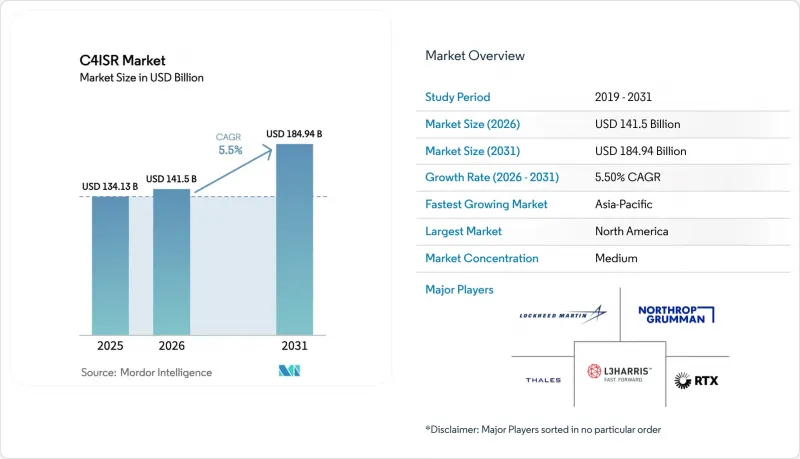
Mordor Intelligence에 의하면, C4ISR 시장 규모는 2025년 1,341억 3,000만 달러로 평가되었습니다. 2026년에는 1,415억 달러로 확대되어 2026년부터 2031년에 걸쳐 CAGR 5.50%로 성장을 지속하여, 2031년에는 1,849억 4,000만 달러에 이를 것으로 예측됩니다.
본 보고서는 플랫폼(항공, 육상, 해상, 우주), 용도(C4, ISR, EW), 구성 요소(하드웨어, 소프트웨어, 서비스), 설치 유형(신규 도입 및 업그레이드/개보수), 최종 사용자(방위 및 군사, 정부·법 집행 기관), 지역(북미, 유럽, 아시아태평양, 남미, 기타)별로 분류되어 있습니다. 시장 전망은 금액(달러) 기준으로 제시되어 있습니다.
세계의 C4ISR 시장 동향 및 인사이트
다중 도메인 C2 프로그램이 상호 운용 가능한 C4ISR의 도입을 가속화
C4ISR 시장은 공·육·해·우주·사이버 등 각 영역에 걸쳐 있으며, 센서, 의사결정자, 실행 장치를 연결하는 통합 전영역 지휘통제 프로그램을 통해 재구축되고 있습니다. 2025 회계연도, 미국 국방부(DoD)는 CJADC2에 14억 달러 이상의 예산을 요청했으며, 이는 군종 간 통합과 의사결정 우위에 대한 명확하고 지속적인 예산상의 우선순위를 보여주었습니다. 정부감사원(GAO)의 보고서에 따르면, 관련 노력은 진전을 보이고 있으나 중복 업무를 줄이고 실전 배치를 가속화하기 위해서는 국방부가 거버넌스, 교훈 공유 및 데이터 표준화를 개선해야 한다고 밝혔습니다. 또한, 이러한 프로그램들은 데이터를 신속하게 전송하고 처리하기 위해 안전하고 확장성이 뛰어난 클라우드 인프라와 기밀 네트워크의 업그레이드에 의존하고 있습니다. C4ISR 시장에 미치는 단기적인 영향은 게이트웨이, 다중 파형 무선기, 크로스 도메인 솔루션, 그리고 기밀 등급이나 연합군 경계를 넘어 운용 가능한 융합 소프트웨어에 대한 수요에서 드러나고 있습니다. 공식 교리와 인프라가 통합됨에 따라, JADC2에 부합하는 아키텍처는 C4ISR 시장의 인터페이스 표준 및 조달 방침에 점점 더 큰 영향을 미치게 될 것입니다.
무인·자율형 플랫폼의 보급에 따라 센서 및 데이터 링크의 밀도가 증가
무인 시스템은 분쟁 환경에서 C4ISR 네트워크가 지원해야 하는 센서, 데이터 링크 및 의사결정 노드의 수를 증가시킵니다. 미국의 예산 배분에는 무인 항공기 및 해상 플랫폼에 대한 지속적인 자금 지원이 명시되어 있으며, 해당 예산 항목에서는 자율성, 인식 능력, 그리고 C2 복원력이 단순한 선택적 부가 기능이 아닌 핵심 임무 요건으로 강조되고 있습니다. 나토(NATO)가 2026년에 시작할 새로운 다자간 협력 이니셔티브에는 드론을 활용한 장거리 정밀 타격 프로젝트가 포함되어 있으며, 이를 위해서는 동맹군 전체에 걸친 상호 운용 가능한 지휘·통제 및 데이터 교환이 필요합니다. 무인기 군의 확대에 따라 C4ISR 시장에서는 메쉬 네트워크, 주파수 대역을 고려한 통신, 그리고 플랫폼과 가까운 곳에서 더 많은 처리를 수행하는 엣지 분석에 대한 수요가 증가하고 있습니다. UAS(무인항공기 시스템) 대응 능력의 통합은 무리를 지어 비행하는 무인기나 동시에 발생하는 위협을 관리하기 위해 기계의 속도로 작동하는 자동화된 센서 융합 및 사격 통제 로직의 필요성을 더욱 강조하고 있습니다. 이러한 요인들이 복합적으로 작용함에 따라, 중기적으로는 C4ISR 시장 전반에 걸쳐 소프트웨어, 게이트웨이 및 훈련에 대한 수요가 확대될 것입니다.
레거시 시스템과 연합 시스템 간의 통합 복잡성과 데이터 상호운용성
복잡한 통합은 C4ISR 시장의 도입 속도와 예산 효율성 측면에서 여전히 가장 큰 걸림돌로 남아 있습니다. GAO의 CJADC2 검토 보고서에서는 중복을 방지하고 성과를 가속화하기 위해 각 군을 아우르는 보다 강력한 거버넌스, 교훈 공유 및 공통 데이터 표준이 필요하다고 지적되었습니다. 합동 작전에서는 정책적 및 기술적 마찰이 발생하며, 이에 대처하기 위해서는 분야를 아우르는 해결책, 상호 호환 가능한 데이터 형식, 그리고 동맹국과의 적시 정보 공유를 가능하게 하는 기밀 분류 경로가 필요합니다. 공통된 프레임워크가 없다면, 각 프로그램은 미들웨어, 시범 운영 및 우회책에 과도한 노력을 쏟게 되어 운영 능력 제공이 지연될 것입니다. 단기적인 대책으로는 데이터 관리를 철저히 하는 프로그램 거버넌스에 기반을 둔 인터페이스, 게이트웨이 및 표준화된 스키마에 대한 집중적인 투자를 들 수 있습니다. 이러한 해결책이 정착됨에 따라, C4ISR 시장은 도입 기간 단축과 통합 프로그램 전반에 걸친 공급업체 참여 확대라는 혜택을 누리게 될 것입니다.
부문별 분석
2025년에는 주요 항공 부대 전반에 걸쳐 센서 융합, 장거리 감지, 네트워크 기반 표적 포착 기능에 대한 지속적인 업그레이드에 힘입어 항공 플랫폼이 35.92%의 점유율을 차지했습니다. 일부 개량 프로그램에서는 대규모 구조 변경 없이 기존 항공기에 첨단 탐색·추적 기능 및 멀티 센서 기능을 도입하는 ‘업그레이드 우선’ 접근 방식이 채택되고 있으며, 이는 C4ISR 시장의 효율성 중시 기조와 부합합니다. 공통 작전 상황 인식, 기계 지원을 통한 표적 지정, 게이트웨이 기능 등이 필요한 멀티도메인 C2 구축 노력에 발맞추어, 항공 부문에서 소프트웨어 주도형 솔루션의 점유율이 확대되고 있습니다. 또한 C4ISR 시장에서는 항공기 전체를 재설계할 필요 없이 새로운 알고리즘을 활용할 수 있는 애자일형 포드, 개방형 아키텍처의 임무용 컴퓨터, 엣지 추론 가속기에 대한 수요 전환도 나타나고 있습니다. 기내 네트워크 및 도메인 간 데이터 교환 요건에 따라, 통합 화력 지원에 대응하는 다중 파형 무선기 및 게이트웨이의 조달이 지속적으로 추진되고 있습니다. 통합이 진행됨에 따라, 이 부문에서는 수명 주기 비용을 절감하고 다양한 기체군 전반에 걸친 반복 개발을 가속화하기 위해 개방형 표준으로의 전환이 진행될 것입니다. 프로그램의 동향을 보면, 2026년부터 2031년에 걸쳐 꾸준한 업데이트 주기에 힘입어 모듈식이며 소프트웨어 중심의 업그레이드가 주류를 이룰 것으로 예측됩니다.
해군 플랫폼은 2031년까지 연평균 성장률(CAGR)이 7.58%로 가장 빠르게 성장하고 있으며, 이러한 성장의 원동력은 지속적인 해상 ISR, 분산형 작전, 그리고 수상·수중·연안 방어의 각 계층에 걸친 전자 방어입니다. C4ISR 시장에서는 해상 메쉬 네트워크, 공통 전투 시스템의 백본, 그리고 밀집된 연안 환경을 관리하는 스펙트럼 대응 솔루션 분야에서 더욱 강력한 성장이 나타나고 있습니다. 동맹국 해군의 프로그램에서도 선체를 대폭 변경하지 않고도 레이더, 소나, 전자전(EW) 장비, 통신 시스템을 업그레이드할 수 있는 모듈식 규격이 채택되고 있습니다. 이러한 성장 추세는 해상에서 견고한 지휘통제 아키텍처에 기반을 둔, 육상과 함선 간의 데이터 교환 및 지평선 너머 사격 통제를 검증하는 합동 훈련을 통해 더욱 가속화되고 있습니다. 무인수상정 및 무인 잠수정이 보급됨에 따라, 해상 C4ISR 프로그램에서는 분산형 킬 체인에 자율성, 지각 기능 및 교란 대책 링크가 더욱 통합될 것입니다. 그 결과, C4ISR 시장의 해군 부문을 뒷받침하는 소프트웨어 및 모듈의 도입이 예측 가능한 속도로 진행될 것입니다.
2025년에는 ISR이 43.67%라는 최대 점유율을 차지했으며, 이는 항공, 우주, 지상 및 해상 임무에서 감지, 수집, 처리의 핵심적인 역할을 반영한 것입니다. C4ISR 시장은 다궤도 우주 투자와 개방형 아키텍처 페이로드에 힘입어, ISR이 ‘재방문 간격 단축’, ‘저지연’, ‘광대역 커버리지’로 전환되고 있는 혜택을 누리고 있습니다. 또한, 국경 경비, 해양 영역 인식, 기지 방어 분야에서 지속적인 감지 및 다중 센서 융합이 요구되는 육상 및 해상 분야에서도 ISR에 대한 수요가 증가하고 있습니다. RF, EO/IR, 레이더 간의 교차 큐잉과 지휘관에게 전달되는 우선순위가 지정된 경보는 이제 ISR 아키텍처에 있어 필수적인 기능이 되었습니다. 동맹국의 프로그램에서는 공개 가능한 수준에서 공유할 수 있는 상호 운용 가능한 ISR이 중시되고 있으며, 이는 단말기 및 게이트웨이의 요구 사항에 영향을 미치고 있습니다. 예측 기간 동안, 에지에서 이종 데이터를 융합하는 ISR 소프트웨어가 C4ISR 시장 전체의 역량 확대를 뒷받침할 것으로 보입니다.
전자전(EW)은 2031년까지 연평균 성장률(CAGR)이 6.77%에 달하고, 가장 빠르게 성장하고 있는 응용 분야이며, 그 중점 분야는 경쟁적인 전자기 환경에서의 감지, 방어 및 효과에 이릅니다. 육군의 지침에 따르면, 기계 수준의 속도로 의사결정을 내리고 동적인 스펙트럼 운용을 가능하게 하기 위해, 일관성 있게 통합되고 모듈식이며 확장성과 적응성이 뛰어난 전자전(EW) 기술이 요구되고 있으며, 이를 통해 소프트웨어 정의 무선, 애자일 안테나, 고속 튜닝 수신기, 그리고 RF 부품을 실시간으로 할당하는 리소스 매니저에 대한 투자가 촉진되고 있습니다. 전자공학(EW)과 사이버 분야의 융합이 진행됨에 따라, 설계 단계부터 보안을 고려한 펌웨어, 지속적인 재프로그래밍, 그리고 신속한 인증 주기의 필요성이 높아지고 있습니다. C4ISR 시장에서는 수동 감지, 전자적 무력화, 지휘통제 워크플로우와의 통합을 결합한 대무인항공기(UAS) 대응 능력에 대한 수요가 증가하고 있습니다. 이러한 추세는 개방형 모듈 표준을 채택하여 실전 배치까지 걸리는 시간을 단축하는 플랫폼 및 부대 전체에 통합된 전자전(EW)으로 나아가는 길을 보여주고 있습니다.
지역별 분석
2025년에는 북미가 33.11%로 가장 큰 점유율을 차지했습니다. 이는 다중 도메인 지휘통제, 차세대 ISR, 그리고 보안 통신에 대한 미국의 지속적인 투자에 힘입은 결과입니다. 프로그램 자금의 규모와 속도는 C4ISR 시장에서 동맹국의 조달 및 통합 선택지에 영향을 미치는 기술적 기준을 설정하고 있습니다. 미국의 감독 기관은 상호 운용 가능한 역량의 공동 구축을 가능하게 하는 거버넌스와 표준을 계속해서 중시하고 있으며, 이것이 공급업체의 제품 로드맵 수립 방식을 형성하고 있습니다. 캐나다의 주파수 관리 및 복원력 관련 과제는 통합된 전자전 상황 인식과 동적인 충돌 방지 도구에 대한 상호 보완적인 수요를 시사하고 있습니다. 공동 아키텍처가 성숙해짐에 따라, 북미 전역에서 연합 작전의 효율성을 높이고, 정책의 실용성을 향상시키며, 훈련의 일관성을 강화하는 표준 규격을 중심으로 수요가 통합될 것입니다. 프라임 계약업체, 전문 공급업체, 소프트웨어 기업에 이르는 이 지역의 벤더 생태계는 전 세계 C4ISR 시장의 혁신을 지속적으로 촉진하고 있습니다.
유럽은 현재 상호 운용이 가능한 ISR, 다중 궤도 통신 접속, 그리고 연합군 대응형 C2를 우선시하는 수년에 걸친 현대화 단계에 있습니다. 나토(NATO)의 2026년 다자간 협력 이니셔티브는 탄도 미사일 방어의 기반 기술, 드론을 활용한 정밀 타격, 공군의 회복탄력성과 상호운용성에 초점을 맞추고 있으며, 이 모든 것은 안전하고 공유 가능하며 모듈식인 C4ISR에 대한 요구 사항을 강화하는 것입니다. 유럽의 프로그램에서는 역량을 신속하게 확보하고 동맹국 간 산업계의 참여를 강화하기 위해 개방형 표준 및 소프트웨어 정의 기능의 활용이 확대되고 있습니다. 동유럽 전선에서의 국경 경비, 해안 감시, 방공 시스템의 업그레이드는 조달이 얼마나 시급한지를 여실히 보여주고 있습니다. 이 기간 동안 유럽의 프로그램은 정책상 허용되는 범위 내에서 미국의 아키텍처와의 연계를 강화하는 동시에, 센서, 단말기, 임무 소프트웨어 분야에서 독자적인 역량을 강화해 나갈 것으로 예측됩니다. 모듈성과 분리 가능한 상호운용성이라는 유럽의 요구를 충족시킬 수 있는 공급업체는 해당 지역의 C4ISR 시장에서 유리한 입지를 차지하게 될 것입니다.
아시아태평양은 해당 지역 국가들이 ISR 통합, 내결함성 통신 및 해상 C2에 대한 투자를 확대함에 따라, 2031년까지 7.93%라는 가장 높은 성장률을 나타낼 것으로 전망됩니다. 일본과 한국의 프로그램에서는 공중 조기경보, 네트워크화된 지휘센터, 그리고 합동작전 개념에 부합하는 임무 시스템에 대한 중점이 점점 더 커지고 있습니다. 지역 각국의 군가 자율 시스템과 해상 ISR을 확대함에 따라, 데이터 융합, 방해 대책용 파형 및 다중 궤도 단말 솔루션에 대한 수요도 확대될 것입니다. 또한 각 공급업체들은 미션 시스템과 국산 플랫폼을 결합한 파트너십을 구축하여, 배치 속도를 높이고 현지 유지관리 체제를 확립하기 위해 노력하고 있습니다. 이 지역 전체에서 C4ISR 시장의 성장은 개방형 아키텍처, 유연한 보안 프레임워크, 그리고 복잡한 통합을 신속하게 인증할 수 있는 시험·평가 프로세스의 도입에 발맞추어 이루어질 것입니다. 다중 도메인 표준을 준수하는 국가들은 상호 운용이 가능한 제품 및 서비스로 구성된 보다 광범위한 생태계의 혜택을 누리게 될 것입니다.
기타 혜택 :
- 엑셀 형식 시장 예측(ME) 시트
- 3개월간의 애널리스트 지원
자주 묻는 질문
목차
제1장 서론
제2장 조사 방법
제3장 주요 요약
제4장 시장 구도
제5장 시장 규모 및 성장 예측
제6장 경쟁 구도
제7장 시장 기회 및 향후 전망
KTH 26.06.29According to Mordor Intelligence, the C4ISR market size is expected to grow from USD 134.13 billion in 2025 to USD 141.50 billion in 2026 and is forecasted to reach USD 184.94 billion by 2031 at a 5.50% CAGR over 2026-2031.
This report is Segmented by Platform (Air, Land, Naval, and Space), Purpose (C4, ISR, and EW), Component (Hardware, Software, and Services), Installation Type (New Installation and Upgrade/Retrofit), End User (Defense and Military, and Government and Law Enforcement), and Geography (North America, Europe, Asia-Pacific, South America, and More). The Market Forecasts are Provided in Terms of Value (USD).
Global C4ISR Market Trends and Insights
Multi-Domain C2 Programs Accelerate Interoperable C4ISR Deployments
The C4ISR market is being reshaped by joint all-domain command and control programs that connect sensors, decision-makers, and effectors across air, land, sea, space, and cyber. In fiscal 2025, the Department of Defense (DoD) requested over USD 1.4 billion for CJADC2, signaling a distinct, sustained budgetary priority for cross-service integration and decision superiority. The Government Accountability Office reported that while the effort is progressing, DoD must improve governance, lesson sharing, and data standardization to reduce duplicative work and accelerate fielding. These programs also depend on secure, scalable cloud infrastructure and upgrades to classified networks to move and process data at speed. The near-term effect on the C4ISR market is visible in demand for gateways, multi-waveform radios, cross-domain solutions, and fusion software that can operate across classification levels and coalition boundaries. As formal doctrine and infrastructure converge, JADC2-aligned architectures will increasingly influence interface standards and procurement choices in the C4ISR market.
Proliferation of Unmanned and Autonomous Platforms Increases Sensor and Data-Link Density
Unmanned systems amplify the number of sensors, data links, and decision nodes that C4ISR networks must support in contested environments. US budget allocations identify continued funding for unmanned aircraft and maritime platforms, with line items that emphasize autonomy, perception, and C2 resiliency as core mission requirements rather than optional add-ons. NATO's 2026 launch of new multinational cooperation initiatives includes a drone-based deep precision strike project that will require interoperable command, control, and data exchange across allied forces. As unmanned fleets grow, the C4ISR market faces rising demand for mesh networking, spectrum-aware communications, and edge analytics that push more processing closer to the platform. The integration of counter-UAS capabilities further underscores the need for automated sensor fusion and fire control logic operating at machine speed to manage swarms and simultaneous threats. These factors collectively expand software, gateway, and training needs across the C4ISR market in the medium term.
Integration Complexity and Data Interoperability Across Legacy and Coalition Systems
Complex integration remains the most persistent brake on deployment speed and budget efficiency in the C4ISR market. GAO's review of CJADC2 identified the need for stronger governance, shared lessons learned, and common data standards across services to avoid duplication and accelerate outcomes. Coalition operations introduce policy and technical frictions that require cross-domain solutions, compatible data formats, and classification pathways that enable timely sharing with allies. Without common frameworks, programs spend disproportionate effort on middleware, test events, and workarounds, delaying delivery of operational capability. The near-term remedy is targeted investment in interfaces, gateways, and standardized schemas anchored to program governance that enforces data discipline. As solutions take hold, the C4ISR market will benefit from faster time-to-field and broader vendor participation across joint programs.
Other drivers and restraints analyzed in the detailed report include:
- Space-Based ISR and SATCOM Architectures Shift to LEO/MEO with Resilient Mesh Networking
- Open Architectures (MOSA/CMOSS/SOSA) Enable Rapid Tech Insertion
- Cyber and EW Resilience Requirements Increase Cost, Schedule, and Accreditation Burden
For complete list of drivers and restraints, kindly check the Table Of Contents.
Segment Analysis
Air platforms held 35.92% shares in 2025, supported by ongoing upgrades to sensor fusion, long-range sensing, and networked targeting across leading fleets. Select retrofit programs illustrate an upgrade-first approach that installs advanced search-and-track and multi-sensor capabilities into existing aircraft without major structural changes, aligning with the efficiency focus in the C4ISR market. A growing share of the air segment is software-led, in line with multi-domain C2 efforts that require common operating views, machine-assisted targeting, and gateway capabilities. The C4ISR market is also seeing demand shift toward agile pods, open-architecture mission computers, and edge inference accelerators that unlock new algorithms without whole-aircraft redesign. Airborne networking and cross-domain data exchange requirements continue to drive procurement of multi-waveform radios and gateways that support joint fires. As integration improves, the segment will lean into open standards that lower lifecycle costs and speed iteration across diverse fleets. Program choices indicate steady refresh cycles will favor modular, software-forward upgrades across the 2026-2031 horizon.
Naval platforms are the fastest-growing with a CAGR of 7.58% through 2031, driven by persistent maritime ISR, distributed operations, and electronic protection across surface, subsurface, and coastal defense layers. The C4ISR market is registering stronger growth for maritime mesh networking, common combat system backbones, and spectrum-aware solutions that manage dense littoral environments. Programs in allied navies are also adopting modular standards that allow radar, sonar, EW payloads, and communications to be upgraded without major hull changes. This growth trend is reinforced by joint exercises that validate ashore-aboard data exchanges and over-the-horizon fire control, which depend on resilient command-and-control architectures at sea. As unmanned surface and underwater vehicles proliferate, maritime C4ISR programs will integrate more autonomy, perception, and anti-jam links into distributed kill chains. The result is a predictable cadence of software and module insertions that sustain the naval portion of the C4ISR market.
ISR represented the largest share of 43.67% in 2025, reflecting the central role of sensing, collection, and processing across air, space, land, and maritime missions. The C4ISR market is benefiting from ISR's pivot to faster revisit, lower latency, and broader spectral coverage, supported by multi-orbit space investments and open-architecture payloads. ISR demand is also rising on the ground and at sea, where border security, maritime domain awareness, and base defense require persistent detection and multi-sensor fusion. Cross-cueing between RF, EO/IR, and radar, with prioritized alerts to commanders, is now a threshold capability for ISR architectures. Allied programs emphasize interoperable ISR that can be shared at releasable levels, which influences terminal and gateway requirements. Over the forecast period, ISR software that fuses heterogeneous data at the edge will underpin capability growth across the C4ISR market.
Electronic warfare (EW) is the fastest-growing purpose segment, with a 6.77% CAGR through 2031, and its focus areas span sensing, protection, and effects in contested electromagnetic environments. Army guidance calls for modular, scalable, and adaptable EW technologies that are integrated coherently to enable machine-speed decision-making and dynamic spectrum operations, driving investment in software-defined radios, agile antennas, fast-tuning receivers, and resource managers that allocate RF components in real time. EW and cyber are increasingly converging, which elevates the need for secure-by-design firmware, continuous reprogramming, and rapid accreditation cycles. The C4ISR market is seeing stronger demand for counter-UAS capabilities that combine passive detection, electronic defeat, and integration into command-and-control workflows. The trajectory points to embedded EW across platforms and formations with open module standards that compress time-to-field.
Geography Analysis
North America held the largest share, at 33.11%, in 2025, supported by sustained US investment in multi-domain command and control, next-generation ISR, and protected communications. The scale and cadence of program funding set technical baselines that influence allied procurements and integration choices in the C4ISR market. US oversight bodies continue to emphasize governance and standards that enable joint deployment of interoperable capabilities, which shapes how vendors approach product roadmaps. Canada's spectrum management and resilience challenges signal complementary demand for unified electromagnetic operating pictures and dynamic deconfliction tools. As joint architectures mature, demand will consolidate around standards that make coalition operations more effective, policies more workable, and training more consistent across North America. The region's vendor ecosystem, spanning primes, specialized suppliers, and software firms, remains a catalyst for innovation in the global C4ISR market.
Europe is in a multi-year modernization phase that prioritizes interoperable ISR, multi-orbit communications access, and coalition-ready C2. NATO's 2026 multinational cooperation initiatives focus on ballistic missile defense enablers, drone-enabled precision strike, and airpower resilience and interoperability, all of which reinforce requirements for secure, shareable, and modular C4ISR. European programs reflect a broadening use of open standards and software-defined functions to speed capability delivery and strengthen industrial participation across allies. Border security, coastal surveillance, and air defense upgrades on Europe's eastern flank underscore the urgency of procurement. Over the period, European programs are expected to deepen links with US architectures where policy allows, while growing native capacity in sensors, terminals, and mission software. Vendors that can meet European preferences for modularity and releasable interoperability will be well-placed in the region's C4ISR market.
Asia-Pacific is poised for the fastest growth of 7.93% through 2031 as regional actors invest in ISR integration, resilient communications, and maritime C2. Programs in Japan and South Korea show increased emphasis on airborne early warning, networked command centers, and mission systems aligned with joint operations concepts. As regional forces scale autonomous systems and maritime ISR, requirements for data fusion, anti-jam waveforms, and multi-orbit terminal solutions will expand. Suppliers are also forming partnerships that combine mission systems with indigenous platforms to accelerate fielding and localized sustainment. Across the region, growth in the C4ISR market will follow the adoption of open architectures, releasable security frameworks, and test-and-evaluation pipelines that can certify complex integrations at speed. Countries that align with multi-domain standards will benefit from broader ecosystems of interoperable products and services.
- Lockheed Martin Corporation
- Northrop Grumman Corporation
- RTX Corporation
- Thales Group
- BAE Systems plc
- L3Harris Technologies, Inc.
- General Dynamics Corporation
- Leonardo S.p.A.
- Saab AB
- Elbit Systems Ltd.
- Israel Aerospace Industries Ltd.
- Airbus SE
- HENSOLDT AG
- The Boeing Company
- CACI International Inc.
- Maxar Technologies Holdings Inc.
- Kratos Defense & Security Solutions, Inc.
- Defense Research and Development Organisation (DRDO)
- Hanwha Corporation
Additional Benefits:
- The market estimate (ME) sheet in Excel format
- 3 months of analyst support
TABLE OF CONTENTS
1 INTRODUCTION
- 1.1 Study Assumptions and Market Definition
- 1.2 Scope of the Study
2 RESEARCH METHODOLOGY
3 EXECUTIVE SUMMARY
4 MARKET LANDSCAPE
- 4.1 Market Overview
- 4.2 Market Drivers
- 4.2.1 NATO rearmament and modernization raise digital command, ISR, and secure comms demand
- 4.2.2 Multi-domain C2 programs (JADC2/CJADC2, ABMS) accelerate interoperable C4ISR deployments
- 4.2.3 Proliferation of unmanned and autonomous platforms increases sensor and data-link density
- 4.2.4 Space-based ISR and SATCOM architectures shift to LEO/MEO with resilient mesh networking
- 4.2.5 Open architectures (MOSA/CMOSS/SOSA) enable rapid tech insertion and shift spend to software/services
- 4.2.6 Edge AI/ML and cloud-to-tactical fusion compress kill chain and drive upgrade cycles
- 4.3 Market Restraints
- 4.3.1 Integration complexity and data interoperability across legacy/coalition systems
- 4.3.2 Cyber/EW resilience requirements increase cost, schedule, and accreditation burden
- 4.3.3 Export controls/ITAR and security of supply limit cross-border C4ISR sharing
- 4.3.4 Spectrum congestion and EMSO deconfliction constrain networked operations
- 4.4 Value Chain Analysis
- 4.5 Regulatory Outlook
- 4.6 Technological Outlook
- 4.7 Porter's Five Forces Analysis
- 4.7.1 Bargaining Power of Suppliers
- 4.7.2 Bargaining Power of Buyers/Consumers
- 4.7.3 Threat of New Entrants
- 4.7.4 Threat of Substitute Products
- 4.7.5 Intensity of Competitive Rivalry
5 MARKET SIZE AND GROWTH FORECASTS (VALUE)
- 5.1 By Platform
- 5.1.1 Air
- 5.1.2 Land
- 5.1.3 Naval
- 5.1.4 Space
- 5.2 By Purpose
- 5.2.1 Command, Control, Communications, and Computer (C4)
- 5.2.2 Intelligence, Surveillance, and Reconnaissance (ISR)
- 5.2.3 Electronic Warfare (EW)
- 5.3 By Component
- 5.3.1 Hardware
- 5.3.2 Software
- 5.3.3 Services
- 5.4 By Installation Type
- 5.4.1 New Installation
- 5.4.2 Upgrade/Retrofit
- 5.5 By End User
- 5.5.1 Defense and Military
- 5.5.2 Government and Law Enforcement
- 5.6 By Geography
- 5.6.1 North America
- 5.6.1.1 United States
- 5.6.1.2 Canada
- 5.6.1.3 Mexico
- 5.6.2 Europe
- 5.6.2.1 United Kingdom
- 5.6.2.2 France
- 5.6.2.3 Germany
- 5.6.2.4 Russia
- 5.6.2.5 Rest of Europe
- 5.6.3 Asia-Pacific
- 5.6.3.1 China
- 5.6.3.2 India
- 5.6.3.3 Japan
- 5.6.3.4 South Korea
- 5.6.3.5 Rest of Asia-Pacific
- 5.6.4 South America
- 5.6.4.1 Brazil
- 5.6.4.2 Rest of South America
- 5.6.5 Middle East and Africa
- 5.6.5.1 Middle East
- 5.6.5.1.1 Saudi Arabia
- 5.6.5.1.2 United Arab Emirates
- 5.6.5.1.3 Rest of Middle East
- 5.6.5.2 Africa
- 5.6.5.2.1 South Africa
- 5.6.5.2.2 Rest of Africa
- 5.6.5.1 Middle East
- 5.6.1 North America
6 COMPETITIVE LANDSCAPE
- 6.1 Market Concentration
- 6.2 Strategic Moves
- 6.3 Market Share Analysis
- 6.4 Company Profiles (includes Global level Overview, Market level Overview, Core Segments, Financials as available, Strategic Information, Market Rank/Share for key companies, Products and Services, and Recent Developments)
- 6.4.1 Lockheed Martin Corporation
- 6.4.2 Northrop Grumman Corporation
- 6.4.3 RTX Corporation
- 6.4.4 Thales Group
- 6.4.5 BAE Systems plc
- 6.4.6 L3Harris Technologies, Inc.
- 6.4.7 General Dynamics Corporation
- 6.4.8 Leonardo S.p.A.
- 6.4.9 Saab AB
- 6.4.10 Elbit Systems Ltd.
- 6.4.11 Israel Aerospace Industries Ltd.
- 6.4.12 Airbus SE
- 6.4.13 HENSOLDT AG
- 6.4.14 The Boeing Company
- 6.4.15 CACI International Inc.
- 6.4.16 Maxar Technologies Holdings Inc.
- 6.4.17 Kratos Defense & Security Solutions, Inc.
- 6.4.18 Defense Research and Development Organisation (DRDO)
- 6.4.19 Hanwha Corporation
7 MARKET OPPORTUNITIES AND FUTURE OUTLOOK
- 7.1 White-space and Unmet-Need Assessment


