

|
시장보고서
상품코드
2066497
수의용 수술 기구 : 시장 점유율 분석, 업계 동향 및 통계, 성장 예측(2026-2031년)Veterinary Surgical Instruments - Market Share Analysis, Industry Trends & Statistics, Growth Forecasts (2026 - 2031) |
||||||
 Mordor Intelligence
Mordor Intelligence에 의하면, 수의용 수술 기구 시장 규모는 2025년 16억 3,000만 달러로 평가되었습니다. 2026년에는 17억 3,000만 달러로 확대되어 2026년부터 2031년에 걸쳐 CAGR 6.40%로 성장을 지속하여, 2031년에는 23억 6,000만 달러에 이를 것으로 예측됩니다.
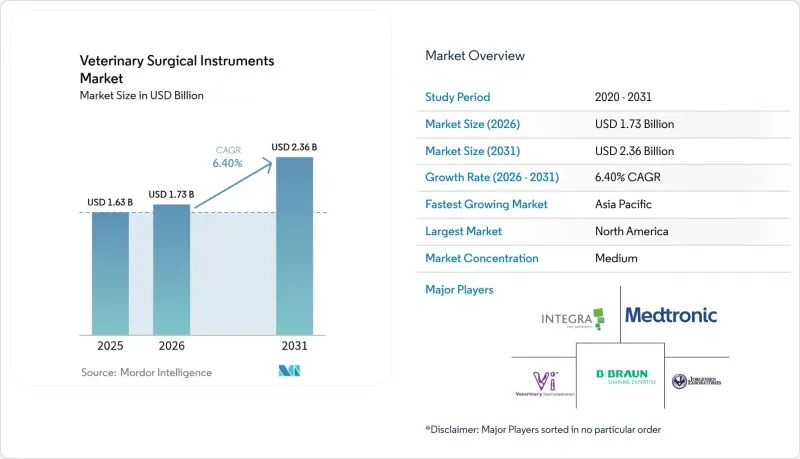
본 보고서는 제품별(봉합사 및 스테이플러, 휴대용 기구, 전기 수술 기구, 기타 제품), 동물별(반려동물 및 가축), 용도별(연조직 수술, 치과 수술, 정형외과, 안과 수술, 기타 용도), 지역별(북미, 유럽 등)로 분류되어 있습니다. 시장 규모 및 전망은 금액(달러) 기준으로 제시되어 있습니다.
세계의 수의용 수술 기구 시장 동향 및 인사이트
동물을 대상으로 한 최소 침습 수술의 동향
복강경 수술 및 관절경 수술에 대한 수요가 수의용 수술 기구 시장을 변화시키고 있습니다. 트로카, 캐뉼라, 고해상도 내시경이 개복 수술을 대체함에 따라 회복 기간이 최대 65% 단축되고, 합병증 발생률도 낮아집니다. 미국의 전문 클리닉에서는 불임 수술에 있어 최소 침습 수술(MIS)의 도입률이 42%에 달하며, 정형외과 전문의의 56%가 관절 진단 정확도를 높이기 위해 관절경 검사를 도입하고 있습니다. 회복 기간 단축을 내세우는 동물병원에서는 수술 이용률이 높아지고 있으며, 이에 따라 유통업체들은 MIS 대응 키트의 취급을 우선시하고 있습니다. 제조업체 측은 90분을 넘는 수술 중에도 외과의사의 피로를 최소화할 수 있는 인체공학에 기반한 기구의 손잡이를 개발함으로써 이에 대응하고 있습니다.
반려동물 사육 마릿수와 반려동물 보험 보급률 증가
2024년, 미국에서는 9,400만 가구가 반려동물을 키우고 있었으며, 그중 440만 명의 반려인이 반려동물 보험에 가입해 있었습니다. 이로 인해 보험에 가입된 반려동물 1마리당 수의학 치료비는 40% 증가했습니다. 이러한 추세는 정형외과 수술, 심장 치료, 고도의 치과 치료 시술 건수를 직접적으로 증가시키고 있습니다. 한편, 보험사는 인증된 의료기기를 사용하는 동물병원에 보험금을 지급함으로써 조달에 영향을 미치고, 간접적으로 고가의 의료기기 구매를 촉진하고 있습니다. 런던, 뉴욕, 상하이 등의 도시에는 고급 수요가 집중되어 있어, 공급업체들은 본격적인 사업 확장에 앞서 AI 기반 전기 수술 플랫폼의 시범 운영을 진행할 수 있게 되었습니다.
높은 비용으로 인해 첨단 장비 도입이 제한됨
고급 전기 메스 타워는 연기 흡입 장치나 양극 집게와 세트로 구성될 경우, 5만 달러를 초과하기도 합니다. 유지보수 계약, 칩 교체, 기술자 교육 등으로 인해 총 소유 비용은 기본적인 수술 세트보다 훨씬 더 많이 들며, 이로 인해 최첨단 장비를 갖춘 병원과 지방 진료소 간의 기술 격차가 더욱 벌어지고 있습니다. 리스, 종량제, 리퍼브 제품 등의 선택지가 주목을 받고 있지만, 인도, 브라질, 동남아시아에서는 도입 현황에 차이가 있습니다.
부문별 분석
봉합사와 스테이플러는 2025년 매출의 33.10%를 계속 차지했습니다. 그러나 전기 수술 시스템은 연평균 성장률(CAGR) 9.60%로 가장 빠르게 성장하고 있으며, 2031년까지 수의용 수술 기구 시장 규모를 약 2억 4,500만 달러까지 끌어올릴 것으로 전망됩니다. 수의용 수술 기구 시장은 인체공학에 기반해 설계된 손잡이와 풋 스위치의 통합을 통해, 2시간에 달하는 종양 절제 수술 중 피로를 줄일 수 있다는 점이 높이 평가받고 있습니다. 손가위는 여전히 필수품이지만, 현재 수요는 날의 예리함을 오래 유지하는 고급 강재나 미세한 톱니 모양의 날 끝 부분에 집중되어 있습니다.
미국과 호주의 수의학 교육 병원에서는 개의 경카테터 승모판막 수복술 등 심장학 분야에서 세계 최초의 사례가 발표되었으며, 이는 전기 수술의 임상 적용 범위가 확대되고 있음을 보여줍니다. 이러한 근거에 따라 민간 클리닉에서는 초급 수준의 단극식 장비가 아닌 중가대의 양극식 제너레이터로 전환하는 추세가 확산되고 있습니다. 공급업체들은 트로카 세트와 연기 흡입 장치를 세트로 판매하고 있으며, 이에 따라 2024년부터 2025년에 걸쳐 클리닉 1곳당 평균 매출액이 28% 증가했습니다.
지역별 분석
2025년, 북미는 전 세계 매출의 37.40%를 차지했습니다. AI를 활용한 영상 진단의 조기 도입과 반려동물 보험의 보급으로 인해, 동물병원은 10년에 한 번이 아니라 5년에서 7년마다 장비를 업그레이드할 수 있게 되었습니다. 미국 수의사의 30%는 이미 진단 과정에서 어떤 형태로든 인공지능을 활용하고 있으며, 이를 통해 수집된 데이터가 증가함에 따라 수술 계획 수립에 반영되고 있습니다. 그렇긴 하지만, 중서부 및 산악 지대의 주에서는 수의사 부족 문제가 심각해지고 있어 진료 부담이 증가하는 한편, 복잡한 시술을 수행하는 일반 개업수의사에 대한 원격 지도에 대한 수요가 높아지고 있습니다.
아시아태평양은 연평균 성장률(CAGR) 10.05%를 기록하며 가장 빠르게 성장하고 있는 지역입니다. 2025년 중국에서 열린 의료기기 박람회에서는 AI를 통합한 정형외과용 로봇이 소개되어, 고정밀 시스템에 대한 투자자들의 관심이 더욱 높아졌습니다. 인도의 민간 병원 체인에서는 설비 비용을 분산시키기 위해 구독형 서비스 계약 도입을 시도하고 있습니다. 지방 자치 단체는 인수공통감염병 감시와 동물병원 확충을 연계하여, 2급 도시에서 오토클레이브 및 내시경 도입을 위한 보조금을 지급하고 있습니다. 이러한 정책 덕분에 유통업체 네트워크가 확대되고, 주요 부품의 납기 기간이 단축되고 있습니다.
유럽에서는 인증된 기구의 추적성 및 멸균·재처리 기록을 의무화하는 엄격한 동물 복지 규제가 유지되고 있습니다. CVS 그룹이 2024년에 설비 현대화에 5,470만 달러를 투자한 것은 해당 지역이 로트 번호 추적이 가능한 고성능 합금 제품으로 재고를 전환하려는 의지를 뒷받침하고 있습니다. 한편, 라틴아메리카와 중동 및 아프리카에서는 반려동물 사육 마릿수가 증가함에 따라 수요가 가속화되고 있습니다. 브라질은 외과용 기구 수입에서 1위를 차지하고 있지만, 걸프 지역 국가들에서는 말 수술이 우선시되고 있어 초장형 골플레이트와 후두경용 기기에 대한 수요가 증가하고 있습니다.
기타 혜택 :
- 엑셀 형식 시장 예측(ME) 시트
- 3개월간의 애널리스트 지원
자주 묻는 질문
목차
제1장 서론
제2장 조사 방법
제3장 주요 요약
제4장 시장 구도
제5장 시장 규모 및 성장 예측
제6장 경쟁 구도
제7장 시장 기회 및 향후 전망
KTH 26.06.29According to Mordor Intelligence, the veterinary surgical instruments market size is expected to grow from USD 1.63 billion in 2025 to USD 1.73 billion in 2026 and is forecast to reach USD 2.36 billion by 2031 at 6.40% CAGR over 2026-2031.
This report is Segmented by Product (Sutures and Staplers, Handheld Instruments, Electro-Surgery Instruments, Other Products), Animal (Companion Animals and Farm Animals), Application (Soft-Tissue Surgery, Dental Surgery, Orthopedic Surgery, Ophthalmic Surgery, and Other Applications), and Geography (North America, Europe and More). The Market and Forecasts are Provided in Terms of Value (USD).
Global Veterinary Surgical Instruments Market Trends and Insights
Minimally-invasive surgery trend in animals
Demand for laparoscopic and arthroscopic procedures is transforming the veterinary surgical instruments market. Recovery times fall by up to 65% and complication rates decline when trocars, cannulas, and HD endoscopes replace open techniques. U.S. specialty clinics report 42% MIS adoption for spays, while 56% of orthopedic specialists deploy arthroscopy to refine joint diagnostics. Clinics that market shorter convalescence periods see higher case acceptance, pushing distributors to prioritize MIS-ready kits. Manufacturers respond with ergonomic instrument handles that minimize surgeon fatigue during procedures lasting beyond 90 minutes.
Rising pet ownership and pet-insurance penetration
Ninety-four million U.S. households kept pets in 2024, and 4.4 million of those owners insured their animals, triggering 40% higher veterinary outlays per insured pet. This behavior directly lifts procedure volumes for orthopedic repair, cardiac interventions, and advanced dentistry. Insurers, meanwhile, influence procurement by reimbursing clinics that use certified devices, indirectly accelerating premium instrument purchases. Cities such as London, New York, and Shanghai form dense clusters of high-end demand, allowing suppliers to pilot AI-enabled electrosurgery platforms before wider rollout.
High costs limiting adoption of advanced instruments
Premium electrosurgery towers can top USD 50,000 when bundled with smoke evacuators and bipolar forceps. Maintenance contracts, tip replacements, and technician training push total cost of ownership far above basic scalpel sets, widening the technology gap between high-end referral hospitals and rural practices. Leasing, pay-per-use, and refurbished options are gaining traction, but uptake remains uneven in India, Brazil, and South-East Asia.
Other drivers and restraints analyzed in the detailed report include:
- Growing disease burden and spay-neuter programs
- Intensifying R&D and product innovation
- Shortage of board-certified veterinary surgeons
For complete list of drivers and restraints, kindly check the Table Of Contents.
Segment Analysis
Sutures and staplers continued to command 33.10% of 2025 sales. Yet electrosurgery systems are the fastest climber with a 9.60% CAGR that will add roughly USD 245 million to the veterinary surgical instruments market size by 2031. The veterinary surgical instruments market benefits from ergonomically contoured handles and foot-switch integration that lessen fatigue during two-hour tumor resections. Handheld scissors, needle holders, and rongeurs remain essential, but demand now centers on premium steel grades and micro-serrated edges that prolong sharpness.
Veterinary teaching hospitals in the United States and Australia have publicized cardiology firsts such as transcatheter mitral-valve repair in dogs, demonstrating electrosurgery's widening clinical scope. This evidence base nudges private clinics toward mid-range bipolar generators instead of entry-level monopolar units. Suppliers bundle trocar sets and smoke extractors, boosting average sale value per clinic by 28% between 2024 and 2025.
Geography Analysis
North America generated 37.40% of global sales in 2025. Early adoption of AI-assisted imaging and a pet-insurance culture enable clinics to upgrade every five to seven years instead of once a decade. Thirty percent of U.S. veterinarians already use some form of artificial intelligence during diagnosis, increasing data capture that feeds back into surgical planning. Nonetheless, the veterinarian shortage is acute in Midwest and Mountain states, stretching case loads and pushing tele-mentoring for general practitioners undertaking complex procedures.
Asia-Pacific is the fastest-growing territory at 10.05% CAGR. China's 2025 medical-device fair introduced an AI-integrated orthopedic robot, reinforcing investor appetite for high-precision systems. India's private chain hospitals are experimenting with subscription-based service contracts to spread equipment costs. Regional governments link zoonotic-disease surveillance with veterinary-hospital expansion, unlocking grants for autoclaves and endoscopes in tier-two cities. These policies are broadening distributor networks and compressing delivery times for critical parts.
Europe maintains stringent welfare regulations that require certified instrument traceability and sterile reprocessing logs. The CVS Group's USD 54.7 million spend on upgrades in 2024 underlines the region's willingness to rotate stock toward high-performance alloys with traceable lot numbers. Meanwhile, Latin America and the Middle East and Africa show accelerating demand as pet ownership climbs. Brazil leads surgical-instrument imports, while Gulf markets prioritize equine surgery, raising requirements for extra-long bone plates and laryngoscopic devices.
- B. Braun
- Medtronic
- Integra LifeSciences
- Jorgensen Laboratories
- Kshama Surgical
- Accesia AB
- GerVetUSA
- Arch Medical Solutions Company (gSource)
- Orthomed (UK) Ltd
- Johnson & Johnson
- Eickemeyer Veterinary Equipment
- World Precision Instruments
- Dentalaire International
- SAI Infusion Technologies
- Granim Healthcare (DRE Veterinary)
- Amerisource Bergen Corporation
- Surgical Holdings
- Aspen Surgical Products, Inc.
- IndoSurgicals Private Limited
- Rajindra Surgical Industries
Additional Benefits:
- The market estimate (ME) sheet in Excel format
- 3 months of analyst support
TABLE OF CONTENTS
1 Introduction
- 1.1 Study Assumptions and Market Definition
- 1.2 Scope of the Study
2 Research Methodology
3 Executive Summary
4 Market Landscape
- 4.1 Market Overview
- 4.2 Market Drivers
- 4.2.1 Minimally-invasive surgery trend in Animals
- 4.2.2 Rising Pet Ownership and Pet Insurance Penetration
- 4.2.3 Rising Animal Disease burden and spay/neuter programs are boosting surgical volumes
- 4.2.4 Increasing R&D Expenditure and Product Innovation for Animal Healthcare
- 4.2.5 Expansion of Veterinary healthcare Infrastructure Coupled with Government Inititiaves and Animal Welfare Regulations
- 4.2.6 Clinic corporatization unlocking budgets for premium instruments
- 4.3 Market Restraints
- 4.3.1 High Cost of Advanced Surgical Instruments and Procedures
- 4.3.2 Shortage of board-certified veterinary surgeons
- 4.3.3 Stringent Regulatory Approvals
- 4.3.4 Limited sterilization infrastructure in smaller clinics curbs adoption of complex reusable surgical tools
- 4.4 Regulatory and Technological Outlook
- 4.5 Porter's Five Forces Analysis
- 4.5.1 Bargaining Power of Suppliers
- 4.5.2 Bargaining Power of Buyers
- 4.5.3 Threat of New Entrants
- 4.5.4 Threat of Substitutes
- 4.5.5 Intensity of Competitive Rivalry
5 Market Size and Growth Forecasts (Value-USD)
- 5.1 By Product
- 5.1.1 Sutures and Staplers
- 5.1.2 Handheld Instruments
- 5.1.2.1 Scalpels
- 5.1.2.2 Forceps
- 5.1.2.3 Scissors
- 5.1.2.4 Retractors
- 5.1.3 Electro-surgery Instruments
- 5.1.4 Other Products
- 5.1.4.1 Trocars and Cannulas
- 5.1.4.2 Suction and Irrigation
- 5.2 By Animal
- 5.2.1 Companion Animals
- 5.2.1.1 Dogs
- 5.2.1.2 Cats
- 5.2.2 Farm Animals
- 5.2.2.1 Bovine
- 5.2.2.2 Swine
- 5.2.2.3 Poultry
- 5.2.1 Companion Animals
- 5.3 By Application
- 5.3.1 Soft-Tissue Surgery
- 5.3.2 Dental Surgery
- 5.3.3 Orthopedic Surgery
- 5.3.4 Ophthalmic Surgery
- 5.3.5 Other Applications
- 5.4 By Geography
- 5.4.1 North America
- 5.4.1.1 United States
- 5.4.1.2 Canada
- 5.4.1.3 Mexico
- 5.4.2 Europe
- 5.4.2.1 Germany
- 5.4.2.2 United Kingdom
- 5.4.2.3 France
- 5.4.2.4 Italy
- 5.4.2.5 Spain
- 5.4.2.6 Rest of Europe
- 5.4.3 Asia-Pacific
- 5.4.3.1 China
- 5.4.3.2 Japan
- 5.4.3.3 India
- 5.4.3.4 Australia
- 5.4.3.5 South Korea
- 5.4.3.6 Rest of Asia-Pacific
- 5.4.4 Middle East and Africa
- 5.4.4.1 GCC
- 5.4.4.2 South Africa
- 5.4.4.3 Rest of Middle East and Africa
- 5.4.5 South America
- 5.4.5.1 Brazil
- 5.4.5.2 Argentina
- 5.4.5.3 Rest of South America
- 5.4.1 North America
6 Competitive Landscape
- 6.1 Strategic Moves
- 6.2 Market Share Analysis
- 6.3 Company profiles (includes Global level Overview, Market level overview, Core Segments, Financials as available, Strategic Information, Market Rank/Share for key companies, Products and Services, and Recent Developments)
- 6.3.1 B. Braun SE
- 6.3.2 Medtronic
- 6.3.3 Integra LifeSciences Corporation
- 6.3.4 Jorgensen Laboratories
- 6.3.5 Kshama Surgical
- 6.3.6 Accesia AB
- 6.3.7 GerVetUSA
- 6.3.8 Arch Medical Solutions Company (gSource)
- 6.3.9 Orthomed (UK) Ltd
- 6.3.10 Johnson and Johnson
- 6.3.11 Eickemeyer
- 6.3.12 World Precision Instruments
- 6.3.13 Dentalaire International
- 6.3.14 SAI Infusion Technologies
- 6.3.15 Granim Healthcare (DRE Veterinary)
- 6.3.16 Amerisource Bergen Corporation
- 6.3.17 Surgical Holdings
- 6.3.18 Aspen Surgical Products, Inc.
- 6.3.19 IndoSurgicals Private Limited
- 6.3.20 Rajindra Surgical Industries
7 Market Opportunities and Future Outlook
- 7.1 White-Space and Unmet-Need Assessment


