

|
시장보고서
상품코드
2066521
목재 바닥재 : 시장 점유율 분석, 업계 동향 및 통계, 성장 예측(2026-2031년)Wood Flooring - Market Share Analysis, Industry Trends & Statistics, Growth Forecasts (2026 - 2031) |
||||||
 Mordor Intelligence
Mordor Intelligence에 의하면, 목재 바닥재 시장 규모는 2025년 113억 2,000만 달러로 평가되었습니다. 2026년에는 116억 6,000만 달러로 확대되어 2031년까지 144억 1,000만 달러에 이를 것으로 예상되며 2026년부터 2031년에 걸쳐 CAGR 4.33%로 성장할 전망입니다.
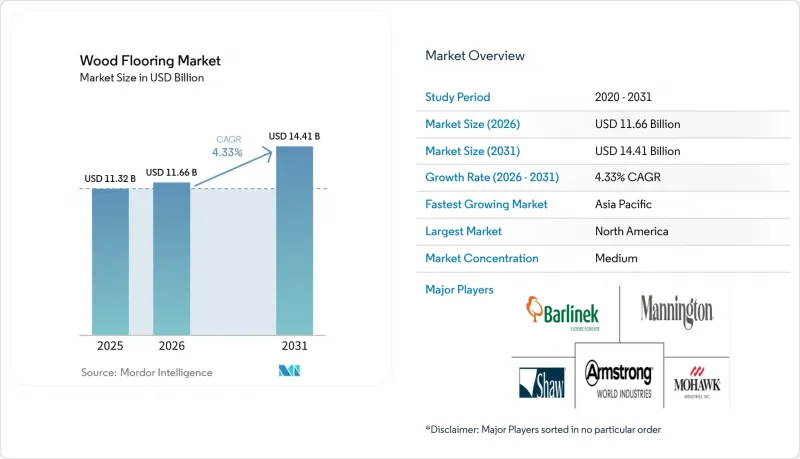
본 보고서는 제품 유형(엔지니어드 플로어링, 원목 플로어링, 재활용 소재/열처리 소재, 기타), 시공 방법(못 박기, 접착, 플로팅, 기타), 마감(사전 마감, 미마감), 유통 채널(B2C, B2B), 최종 사용자(주거용 및 상업용), 지역(북미, 남미, 아시아태평양, 유럽, 중동 및 아프리카)별로 분류되어 있습니다. 시장 전망치는 금액(달러)으로 표시되어 있습니다.
세계의 목재 바닥재 시장 동향 및 인사이트
산림관리협의회(FSC) 인증을 받은 엔지니어드 플랭크의 급증
FSC 인증은 제출 서류에 생산 이력(체인 오브 카스투디) 증명이 요구되는 공공시설이나 공동 주택 프로젝트에 사용되는 공학 목재 분야에서 공급망의 관문 관리자 역할을 수행하게 되었습니다. 전미 목재 바닥재 협회(NWFA)의 ‘Verified’ 프로그램은 공기질, 재료 구성, 노동 관행을 감사하는 것으로, 입찰 사양서에서 FSC 인증과 결합됨으로써 공공 및 민간 프로젝트의 규정 준수 심사를 효율화하고 있습니다. 미국 환경보호청(EPA)의 ‘유해물질 규제법(TSCA)’ 제VI편에서는 활엽수 합판의 베니어 코어 내 포름알데히드 농도를 0.05 ppm으로 제한하고 있으므로, 배출 기준을 준수하는 것이 중요한 요소가 되고 있습니다. 각 제조업체는 공장에서 관리된 접착제와 ‘TSCA 준수 엔지니어드 플로어링’이라는 기준에 부합하는 코어 재질을 채택함으로써 이 요건을 충족하고 있습니다. 유럽의 바이어들은 35유형의 VOC(휘발성 유기 화합물)를 평가하여 LEED v4.1 및 WELL 등의 프로그램 적합성을 인증하는 ‘FloorScore’ 인증을 자주 요구하고 있습니다. 2025년에는 공장에서 마감 처리된 엔지니어드 플랭크 시장 점유율이 확대되었습니다. 이는 프리피니시 시스템이 공사 기간 단축에 기여하는 동시에, 사람이 거주하는 건물 내에서 현장 마감 작업에 따른 배출을 방지할 수 있기 때문입니다. 조림 포플러를 코어 베니어로 활용하는 아시아의 수출업체들은 그동안 낮은 수입 비용을 실현해 왔으나, 2025년 상호 관세 도입으로 인해 북미의 주요 제조업체들이 지적해 온 기존의 수입 비용 측면에서의 우위는 축소되었습니다.
전 세계 도시 지역의 고급 아파트 붐
방갈로르, 자카르타, 멕시코시티의 도심에 위치한 고급 고층 아파트에서는 개발업체들이 프리미엄 임대 및 판매 실적을 목표로 삼는 가운데, 주거 공간에 원목이나 합성 목재를 채택하여 각 세대의 차별화를 꾀하고 있습니다. 2024년 11월 일본의 조립식 목재 마루(HS 441871-79)는 2024년 11월에 전월 대비 30% 이상, 전년 동월 대비 약 25% 증가했습니다. 『Japan Lumber Reports』 및 2025년 초 시장 정보원을 바탕으로 집계된 무역 데이터에 따르면, 도시 지역의 아파트 리모델링 수요를 충족시키기 위해 HS 441875 품목의 수출 대부분을 중국과 베트남이 합쳐서 공급하고 있습니다. 동남아시아의 시공업체들은 습도가 높은 기후에서 발생할 수 있는 변형 위험을 줄이기 위해 원목보다 엔지니어드 마루를 선호하는 경향이 있으며, 콘크리트 바닥에 플로팅 시공을 하면 습기 관리에 도움이 됩니다. 이 지역의 디자인 컨셉에서는 자연스러운 질감과 밝은 색조가 중시되며, 폭이 넓은 엔지니어드 오크와 히코리가 선호되고 있습니다. 목재 마루 시장은 고층 건축물에서 공용 공간이나 주거 단위에 고급스러운 마감 처리를 요구하는 사양 주도형 프로젝트의 혜택을 지속적으로 누리고 있습니다. 2024년 한 해 동안 중국의 주택 착공 건수는 부진을 이어가고 있지만, 인도와 동남아시아에서 고급 아파트 건설이 활발해지면서 지역 수요 부진의 일부를 상쇄하고 있습니다.
원자재 및 시공 비용의 급등
생산 비용은 활엽수 목재공급 상황과 제재소의 처리 능력에 따라 달라지며, 이는 원목과 엔지니어드 목재 모두의 이익률에 영향을 미치고 있습니다. 미국의 활엽수 목재 생산량은 2022년부터 2024년 사이에 29% 감소했습니다. 이러한 축소는 약 4만 명의 고용에 해당하는 10%의 노동력 감소 및 이와 관련된 수출액 감소와 관련이 있습니다. 각 제조업체는 공급을 확보하기 위해 수직 통합을 추진하고 있으며, 그 일환으로 원목 가격의 변동을 완화하고 목재 마루 제품의 원자재 공급을 안정시키기 위해 제재소를 인수하기도 하고 있습니다. 시공 현장에서는 폭이 넓은 원목을 시공할 경우, 안정성을 확보하기 위해 접착제를 사용한 못 박기 공법이 필요한 경우가 많아, 플로팅 방식의 클릭 잠금식 엔지니어드 플로어링 시스템에 비해 작업 시간이 더 오래 걸립니다. NWFA가 정한 바탕면의 평탄도 허용 오차에 따라, 오래된 건물의 경우 바탕면 처리 요건이 엄격해져 시공 시작 전에 추가 절차가 필요할 수 있습니다. 이러한 상황은 특히 인건비가 높은 지역에서 목재 마루 시장의 일부 프로젝트에 단기적인 비용 측면의 역풍을 가져오고 있습니다.
부문별 분석
엔지니어드 플로어링은 2025년에 53.37%의 시장 점유율을 차지했습니다. 이는 다세대 주택이나 도심 지역의 리모델링 공사에서 목재 마루 시장의 잠재적 수요 범위를 확대하는 지상층 및 지하층에 대한 높은 적용성이 배경이 되고 있습니다. 재활용 목재 및 열처리 목재는 2031년까지 연평균 성장률(CAGR) 4.26%를 나타낼 것으로 예측되며, 설계자들이 안정성, 지속가능성 및 미적 목표 간의 균형을 모색함에 따라 틈새 시장 부문에서도 주도적인 역할을 할 것으로 보입니다. 2024년에 시행된 EPA의 TSCA 제6편에 따른 포름알데히드 상한 규제 및 이에 따른 적층 제품에 관한 규정에 따라, 엔지니어드 우드 제조업체는 통제된 공장 환경에서 규정을 준수하는 코어재와 접착제를 설계할 수 있게 되었습니다. 사전 마감 처리가 완료된 엔지니어드 우드 플랭크는 현장 마감 작업으로 인한 배출 가스를 없애고, 입주 중인 건물 내 세입자에게 미치는 영향을 줄여주어 목재 바닥재 시장에 이점을 제공합니다. 원목은 쿼터 쏘잉이나 리프트 쏘잉 방식이 역사적 충실성과 성능 기준을 충족시키기 때문에 맞춤형 주택이나 복원 공사에서 여전히 많은 지지를 받고 있습니다.
열처리된 활엽수는 습도가 높은 기후에서 리모델링 공사를 진행하는 구매자들에게 인기가 높습니다. 이러한 지역에서는 그 안정성 덕분에 표준 가마 건조 오크보다 높은 가격 책정이 정당화되고 있으며, 목재 바닥재 시장에서도 해안 지역 수요 동향에 이러한 경향이 반영되고 있습니다. 2024년 유럽의 파켓 생산량은 5,150만 제곱미터로 감소했으며, 사용 수종의 83.8%를 오크가 차지하고 다층 구조 제품이 주류를 이루고 있는 만큼, 이 지역에서 엔지니어드 우드의 구조적 역할이 부각되었습니다. 2025년 NWFA 회원들의 주문 동향을 살펴보면, 화이트 오크가 국내산 수종 중 가장 많이 지정되었으며, 눈부심을 최소화하고 바이오필릭 디자인을 지원하는 밝은 내추럴 톤을 선호하는 경향이 나타납니다. 수출 동향에 있어, 아시아 제조업체들이 공급하는 인기 있는 코어형 엔지니어드 플랭크는 기존부터 낮은 운송비가 특징이었으나, 2025년 미국의 대형 공급업체가 발표한 보복 관세로 인해 수입 비용 면에서의 우위는 줄어들고 있습니다. 이러한 상황 속에서도, 규정 준수, 속도, 안정성이 사양 결정의 핵심 요소가 되는 목재 바닥재 시장에서 엔지니어드 포맷은 여전히 핵심적인 위치를 차지하고 있습니다.
2025년에는 못 박기 공법이 43.38%의 점유율을 차지하며, 기존의 시공 방식을 앞질렀습니다. 이는 신축 단독주택이나 목재 하부 구조를 활용한 리모델링 프로젝트에서 이 공법이 계속해서 채택되고 있음을 반영합니다. DIY의 보급이 확대됨에 따라, 지반 아래의 콘크리트 바닥 시공 시 관통하지 않는 공법이 요구됨에 따라, 플로팅 공법 및 클릭락 시스템은 2031년까지 연평균 성장률(CAGR) 5.33%로 가장 빠르게 성장할 것으로 예측됩니다. NWFA 지침에는 플로팅 시공 시 평탄도의 허용 오차 및 신축 틈새가 규정되어 있어, 이를 통해 주택 소유주와 전문 시공업체는 특수 공구의 사용을 최소화하면서도 예측 가능한 마감 품질을 실현할 수 있습니다. 글루다운 공법은 상업시설이나 콘크리트 바닥에 엔지니어드 플랭크를 시공할 때 여전히 중요한 기법이며, 방출률이나 상대습도(RH)가 임계치를 초과하는 경우에는 수분 함량 측정이나 방습층 설치가 필요합니다. 폭이 넓은 원목 플랭크의 경우, 뒤틀림을 방지하기 위해 접착제를 함께 사용하는 못 박기 공법이 권장되며, 시공 시간은 길어지지만 장기적인 안정성을 확보할 수 있습니다.
루즈레이 공법은 여전히 틈새 시장으로 남아 있으며, 신속한 교체 작업을 우선시하는 상업시설에 집중되는 경향이 있습니다. 목재 마루 시장에서의 시공 방법 구성은 하부 바닥재의 유형나 최종 용도의 조건에 따라 점점 더 큰 영향을 받게 되었으며, 이것이 여러 시공 방법에 대응할 수 있는 엔지니어드 제품이 부상하고 있는 이유입니다. 부유식 시공을 사전에 확인할 수 있는 시각화 도구도 주택 소유자가 단차나 방의 폭을 고려한 계획을 세우는 데 도움이 되고 있으며, 이것이 온라인 주문을 촉진하고 있습니다. 유통 채널에서는 프로세스 자동화와 재고 가시화를 통해, 표준 프로파일의 경우 시공 방법에 따른 주문을 2일 이내에 처리할 수 있는 능력이 향상되고 있습니다. 이러한 지침, 도구 및 물류의 융합을 통해 목재 바닥재 시장에서 플로팅 및 하이브리드 시공 방식은 성장세를 유지하고 있습니다.
지역별 분석
북미는 2025년에 31.38%의 점유율을 차지했습니다. 이는 지속적인 신축 공사와 마루 시공이 가능한 리모델링 공사에 자금을 투입하는 활발한 리모델링 프로그램에 힘입은 결과입니다. 2025년 8월 미국의 주택 착공 건수는 계절 조정 연율 환산 기준으로 130만 7,000호를 기록했으며, 이러한 수준은 목재 바닥재 시장에서 원목 및 엔지니어드 목재 모두에 대해 안정적인 판매량을 뒷받침하고 있습니다. 활엽수 부문은 약 4만 5,000명을 고용하고 있으며, GDP에 40억 달러를 기여하고 있어 목재 마루의 지역적 제조거점이 탄탄함을 입증하고 있습니다. 2026년 조사 데이터에 따르면, 유통업체들은 소매업체보다 더 큰 성장세를 예상하고 있으며, 이는 B2B 프로젝트로의 전환 추세와 일치합니다. 2025년에 1,214가구의 주택 소유자를 지원한 뉴욕주의 ‘THIP’과 같은 주 정부 프로그램도, 목재 바닥재 시장에 혜택을 가져다주는 리모델링 준비를 촉진하는 데 기여하고 있습니다.
아시아태평양은 2031년까지 5.48%라는 지역별 최고 연평균 성장률(CAGR)을 보일 것으로 전망됩니다. 이는 인도, 동남아시아, 그리고 고급 인테리어 마감을 중시하는 일본의 도시 지역에서 진행되는 아파트 건설이 주도하고 있습니다. 2024년 상반기, 중국의 주택 착공 건수가 24% 감소하면서 해당국 수요에 큰 부담이 되었지만, 한편으로는 아파트 리모델링 및 신축 공사가 이어지고 있는 인근 시장에서는 전망이 밝아졌습니다. 2024년 11월 일본의 조립식 목재 마루 수입량은 전월 대비 30%, 전년 동월 대비 25% 증가했습니다. HS 코드 441875에 해당하는 출하량의 65%는 중국이, 26%는 베트남이 공급하고 있습니다. 호주의 2024-25년도 목재 제품 수입액은 68억 달러에 달했으며, 2025년 9월 기준으로 분기 및 연간 가격 지수가 상승세를 보이고 있어, 이는 원자재 비용이 견조함을 나타냅니다. 이러한 추세는 목재 마루 시장에서 습도가 높고 콘크리트가 주류를 이루는 시장 전반에 걸쳐 엔지니어드 마루와 플로팅 시공을 촉진하고 있습니다.
유럽의 마루재 시장은 2024년에 5% 위축되었으며, FEP 지역의 생산량은 전년 대비 5.3% 감소한 5,150만 제곱미터로, 2000년대 이후 최저 수준을 기록했습니다. 생산량의 83%를 다층 엔지니어드 마루가 차지하고, 원목 마루가 15%, 모자이크 마루가 2%를 차지하고 있습니다. 사용된 수종의 83.8%를 오크가 차지하고 있으며, 이는 목재 바닥재 시장을 형성하는 엔지니어드 바닥재의 구성과 수종 조합을 여실히 보여주고 있습니다. 2024년 유럽의 라미네이트 바닥재 출하량은 총 3억 1,350만 제곱미터로, 서유럽은 2.74% 감소, 동유럽은 4.97% 감소, 북미는 8.85% 증가, 라틴아메리카는 8.51% 증가를 기록하며, 지역 간 경쟁 관계가 뚜렷이 드러났습니다. 남미에서는 브라질산 바닥재를 포함해 가장자리, 끝부분 또는 표면이 연속적으로 성형된 목재의 수출액이 2024년 미국으로의 HS 4409 품목 출하에서 4억 8,094만 달러에 달했으며, 이는 특정 이국적인 수종에 대한 지속적인 수요를 반영하고 있습니다. 중동 및 아프리카에서는 아랍에미리트(UAE) 등의 허브 시장으로의 수입 의존도가 높은 상황이 지속되고 있지만, 남아프리카공화국을 중심으로 한 아프리카 내 목공 완제품 무역은 2024년부터 2025년에 걸쳐 변동되었으므로, 지역 유통업체 입장에서는 안정적인 공급망 확보가 중요해졌습니다.
기타 혜택 :
- 엑셀 형식 시장 예측(ME) 시트
- 3개월간의 애널리스트 지원
자주 묻는 질문
목차
제1장 서론
제2장 조사 방법
제3장 주요 요약
제4장 시장 구도
제5장 시장 규모 및 성장 예측
제6장 경쟁 구도
제7장 시장 기회 및 향후 전망
KTH 26.06.29According to Mordor Intelligence, the wood flooring market size is expected to increase from USD 11.32 billion in 2025 to USD 11.66 billion in 2026 and reach USD 14.41 billion by 2031, growing at a CAGR of 4.33% over 2026-2031.
This report is Segmented by Product Type (Engineered, Solid, Reclaimed/Thermally Treated, and Others), Installation Method (Nail Down, Glue Down, Floating, and Others), Finish (Pre Finished and Unfinished), Distribution Channel (B2C and B2B), End User (Residential and Commercial), and Geography (North America, South America, Asia-Pacific, Europe, and Middle East & Africa). Market Forecasts are in Value (USD).
Global Wood Flooring Market Trends and Insights
Surge in Forest Stewardship Council (FSC) Certified Engineered Planks
FSC certification has become a supply chain gatekeeper for engineered wood used in institutional and multifamily projects where submittals require chain of custody documentation. The National Wood Flooring Association's Verified program, which audits air quality, material composition, and labor practices, pairs with FSC in bid specifications to streamline compliance reviews on public and private projects. Emission compliance is a central enabler since the Environmental Protection Agency's (EPA) Toxic Substances Control Act (TSCA) Title VI caps formaldehyde at 0.05 ppm for hardwood plywood veneer core, which manufacturers address with factory-controlled adhesives and cores that fit "TSCA-compliant engineered" positioning. Buyers in Europe frequently require FloorScore certification that evaluates 35 VOCs (Volatile Organic Compounds) and qualifies products for programs such as LEED v4.1 and WELL. Factory-finished engineered planks gained share in 2025 because pre-finished systems help compress job timelines while avoiding on-site finishing emissions in occupied buildings. Asian exporters leveraging plantation grown poplar in core veneers have historically delivered low landed costs, with 2025 reciprocal tariffs narrowing prior import cost advantages disclosed by major North American manufacturers.
Urban Premium Apartment Boom Worldwide
Urban luxury towers in Bengaluru, Jakarta, and Mexico City are specifying hardwood or engineered wood in living areas to differentiate units as developers target premium leasing and sales outcomes. Japan's imports of assembled wooden flooring (HS 441871-79) in November 2024 rose just over 30 % month-on-month and about 25 % year-on-year, with China and Vietnam together supplying the majority of HS 441875 shipments to meet demand in urban condominium retrofits, as reported in trade data compiled from the Japan Lumber Reports and market sources in early 2025 . Southeast Asian developers tend to prefer engineered planks over solid hardwood to mitigate movement risks in humid climates, while floating systems over concrete help manage moisture. Regional design briefs prioritize natural textures and light tones, which favor wide board engineered oak and hickory. The wood flooring market continues to benefit from specification-led projects where high-rise construction seeks premium finishes for common areas and units. Despite persistent weakness in China's residential starts through 2024, rising premium apartment activity in India and Southeast Asia offsets part of the softness in regional demand.
High Cost of Raw Materials and Installation
Production costs are sensitive to hardwood lumber availability and mill throughput, which influences margins for both solid and engineered lines. United States hardwood lumber production decreased 29% between 2022 and 2024, a contraction linked to a 10% workforce decline of about 40,000 jobs and a related reduction in export value. Manufacturers have responded with vertical integration to secure supply, including sawmill acquisitions that mitigate stumpage price volatility and stabilize inputs for wood flooring lines. On the jobsite, wide plank solid installations often require glue-assisted nail-down methods for stability, adding labor time relative to floating click-lock engineered systems. Subfloor flatness tolerances set by NWFA increase preparation requirements in older buildings, which can add steps before installation begins. These conditions create near-term cost headwinds for some projects in the wood flooring market, especially in high labor cost regions.
Other drivers and restraints analyzed in the detailed report include:
- Renovation Wave Subsidies for Thermally Treated Oak
- E Commerce AR/VR Visualizers Boost DIY Online Sales
- Strong Competition from Alternatives
For complete list of drivers and restraints, kindly check the Table Of Contents.
Segment Analysis
Engineered wood flooring held 53.37% in 2025 on the strength of grade-level and below-grade suitability that expands the wood flooring market's addressable space in multifamily and urban retrofits. Reclaimed and thermally treated wood are projected to expand at a 4.26% CAGR through 2031, setting the pace among niche categories as specifiers balance stability, sustainability, and aesthetic goals. EPA TSCA Title VI formaldehyde caps, and aligned laminated product provisions that took effect in 2024, allow engineered wood producers to design compliant cores and adhesives under controlled factory conditions. The wood flooring market benefits as pre-finished engineered planks eliminate on-site finishing emissions and shorten tenant disruption windows in occupied buildings. Solid wood maintains loyalty in custom builds and restorations where quarter-sawn or rift-sawn cuts meet historical fidelity and performance criteria.
Thermally modified hardwoods appeal to retrofit buyers in humid climates where stability justifies a premium over standard kiln-dried oak, and the wood flooring market reflects this preference in coastal demand patterns. European parquet production contracted in 2024 to 51.5 million square meters, with oak at 83.8% of species used and multi-layer formats dominant, highlighting engineered wood's structural role in the region. NWFA member ordering patterns in 2025 show white oak as the most specified domestic species, with a tilt toward light, natural tones that minimize glare and support biophilic design programs. In export flows, Asian manufacturers' popular core engineered planks have historically offered low landed costs, though reciprocal tariffs disclosed by large United States suppliers in 2025 have narrowed import cost advantages. Within this context, engineered formats continue to anchor the wood flooring market where compliance, speed, and stability dictate specification.
Nail-down led legacy formats with a 43.38% share in 2025, reflecting continued use in new construction single-family homes and retrofit projects over wood subfloors. Floating and click lock systems are projected to grow the fastest at a 5.33% CAGR through 2031 as DIY adoption rises and as below-grade concrete applications require non-penetrating methods. NWFA guidance specifies flatness tolerances and expansion gaps for floating assemblies, which enable homeowners and pros to deliver predictable results with fewer specialized tools. Glue-down remains an important method for commercial spaces and for engineered planks over concrete, where moisture testing and vapor retarders are needed if emission rates or RH exceed thresholds. Glue-assisted nail-down is recommended for wide solid planks to counter cupping, trading higher installation time for long-term stability.
Loose lay stays niche and tends to concentrate in commercial areas that prioritize fast replacement. The wood flooring market's method mix is increasingly shaped by subfloor type and end-use conditions, which is why engineered products with cross-method compatibility gain ground. Visualization tools that preview floating installations are also helping homeowners plan around transitions and room spans, which supports online ordering. In distributor channels, process automation and inventory visibility improve the ability to fulfill method-specific jobs in two days or less for standard profiles. This convergence of guidelines, tools, and logistics keeps floating and hybrid assemblies on a growth path in the wood flooring market.
Geography Analysis
North America captured 31.38% in 2025, supported by ongoing new construction and active retrofit programs that channel funds into flooring-ready repairs. United States housing starts posted 1,307,000 units at a seasonally adjusted annual rate in August 2025, a level that supports steady volumes for both solid and engineered formats within the wood flooring market. The hardwood sector employs about 45,000 people and contributes USD 4 billion to GDP, underscoring the regional manufacturing base for wood flooring. Survey data for 2026 indicates that distributors expect stronger gains than retailers, consistent with a pivot toward B2B project pipelines. State programs such as New York's T HIP that assisted 1,214 homeowners in 2025 also contribute to retrofit readiness that benefits the wood flooring market.
Asia-Pacific is projected to record the highest regional CAGR at 5.48% through 2031, driven by urban apartment construction in India, Southeast Asia, and Japan, which prioritizes premium interior finishes. Chinese housing starts contracted 24% in the first half of 2024, weighing on demand there while brightening prospects in neighboring markets where condominium retrofits and new builds continue. Japan's assembled wooden flooring imports increased 30% month over month and 25% year over year in November 2024, with China supplying 65% and Vietnam 26% of HS 441875 shipments. Australia's 2024-25 wood product imports reached USD 6.8 billion, with quarterly and annual price indices moving higher as of September 2025, which signals firm input costs. These dynamics support engineered formats and floating installations across humid and concrete-dominant markets in the wood flooring market.
Europe's parquet market contracted 5% in 2024, with production in the FEP region down 5.3% year over year to 51.5 million square meters, the lowest output since the 2000s. Multi-layer engineered formats account for 83% of production, solid for 15%, and mosaic for 2%, with oak at 83.8% of species used, which illustrates the engineering and species mix shaping the wood flooring market. European laminate shipments totaled 313.5 million square meters in 2024, with Western Europe down 2.74%, Eastern Europe down 4.97%, North America up 8.85%, and Latin America up 8.51%, which frames the competitive interplay across regions. In South America, Brazil's exports of wood, continuously shaped along any edges, ends, or faces, including flooring, reached USD 480.94 million in 2024 for HS 4409 shipments to the United States, reflecting sustained demand for selected exotic species. The Middle East and Africa continue to rely heavily on imports into hub markets such as the United Arab Emirates, while South Africa's intra-African trade in finished wood carpentry shows variability in 2024 - 2025, making consistent supply chains important for regional distributors.
- Mohawk Industries
- Shaw Industries Group
- Armstrong World Industries
- Mannington Mills Inc.
- Barlinek SA
- AHF Products
- Tarkett SA
- Johnson Hardwood
- Provenza Floors Inc.
- Somerset Hardwood Flooring
- Boise Cascade Company
- Boral Limited
- Bruce Hardwood
- Pergo AB
- Kahrs Group
- Anderson Hardwood Floors
- Galleher LLC
- Floor & Decor Holdings
- Beaulieu International Group
- Mullican Flooring
Additional Benefits:
- The market estimate (ME) sheet in Excel format
- 3 months of analyst support
TABLE OF CONTENTS
1 Introduction
- 1.1 Study Assumptions & Market Definition
- 1.2 Scope of the Study
2 Research Methodology
3 Executive Summary
4 Market Landscape
- 4.1 Market Overview
- 4.2 Market Drivers
- 4.2.1 Surge in FSC-certified engineered planks
- 4.2.2 Urban premium apartment boom worldwide
- 4.2.3 Renovation Wave subsidies for thermally-treated oak
- 4.2.4 Luxury biophilic interiors demand wide-plank solids
- 4.2.5 E-commerce AR/VR visualizers boost DIY online sales
- 4.2.6 Mass-timber office projects specify matching floors
- 4.3 Market Restraints
- 4.3.1 High Cost of Raw Materials and Installation
- 4.3.2 Environmental and Deforestation Concerns
- 4.3.3 Susceptibility to Moisture and Climate Conditions
- 4.3.4 Strong Competition from Alternatives
- 4.4 Value / Supply-Chain Analysis
- 4.5 Regulatory Outlook
- 4.6 Technological Outlook
- 4.7 Porter's Five Forces Analysis
- 4.7.1 Threat of New Entrants
- 4.7.2 Bargaining Power of Buyers
- 4.7.3 Bargaining Power of Suppliers
- 4.7.4 Threat of Substitutes
- 4.7.5 Competitive Rivalry
5 Market Size & Growth Forecasts
- 5.1 By Product Type
- 5.1.1 Engineered Wood
- 5.1.2 Solid Wood
- 5.1.3 Reclaimed / Thermally-treated Wood
- 5.1.4 Others
- 5.2 By Installation Method
- 5.2.1 Nail-down
- 5.2.2 Glue-down
- 5.2.3 Floating / Click-lock
- 5.2.4 Loose-Lay
- 5.3 By Finish
- 5.3.1 Pre-finished
- 5.3.2 Unfinished
- 5.4 By Distribution Channel
- 5.4.1 B2C/Retail Consumers
- 5.4.1.1 Home Centers
- 5.4.1.2 Specialty Flooring Stores
- 5.4.1.3 Online
- 5.4.1.4 Other Distribution Channels
- 5.4.2 B2B/Contractors/Builders
- 5.4.1 B2C/Retail Consumers
- 5.5 By End-User
- 5.5.1 Residential
- 5.5.2 Commercial
- 5.6 By Geography
- 5.6.1 North America
- 5.6.1.1 Canada
- 5.6.1.2 United States
- 5.6.1.3 Mexico
- 5.6.2 South America
- 5.6.2.1 Brazil
- 5.6.2.2 Peru
- 5.6.2.3 Chile
- 5.6.2.4 Argentina
- 5.6.2.5 Rest of South America
- 5.6.3 Asia-Pacific
- 5.6.3.1 India
- 5.6.3.2 China
- 5.6.3.3 Japan
- 5.6.3.4 Australia
- 5.6.3.5 South Korea
- 5.6.3.6 South East Asia
- 5.6.3.7 Rest of Asia-Pacific
- 5.6.4 Europe
- 5.6.4.1 United Kingdom
- 5.6.4.2 Germany
- 5.6.4.3 France
- 5.6.4.4 Spain
- 5.6.4.5 Italy
- 5.6.4.6 BENELUX
- 5.6.4.7 NORDICS
- 5.6.4.8 Rest of Europe
- 5.6.5 Middle East and Africa
- 5.6.5.1 United Arab Emirates
- 5.6.5.2 Saudi Arabia
- 5.6.5.3 South Africa
- 5.6.5.4 Nigeria
- 5.6.5.5 Rest of Middle East and Africa
- 5.6.1 North America
6 Competitive Landscape
- 6.1 Market Concentration
- 6.2 Strategic Moves
- 6.3 Market Share Analysis
- 6.4 Company Profiles (includes Global level Overview, Market level overview, Core Segments, Financials as available, Strategic Information, Market Rank/Share for key companies, Products & Services, and Recent Developments)
- 6.4.1 Mohawk Industries
- 6.4.2 Shaw Industries Group
- 6.4.3 Armstrong World Industries
- 6.4.4 Mannington Mills Inc.
- 6.4.5 Barlinek SA
- 6.4.6 AHF Products
- 6.4.7 Tarkett SA
- 6.4.8 Johnson Hardwood
- 6.4.9 Provenza Floors Inc.
- 6.4.10 Somerset Hardwood Flooring
- 6.4.11 Boise Cascade Company
- 6.4.12 Boral Limited
- 6.4.13 Bruce Hardwood
- 6.4.14 Pergo AB
- 6.4.15 Kahrs Group
- 6.4.16 Anderson Hardwood Floors
- 6.4.17 Galleher LLC
- 6.4.18 Floor & Decor Holdings
- 6.4.19 Beaulieu International Group
- 6.4.20 Mullican Flooring
7 Market Opportunities & Future Outlook
- 7.1 White-space & Unmet-need Assessment


