|
시장보고서
상품코드
2066559
칸나비디올(CBD) 오일 시장 : 점유율 분석, 업계 동향과 통계, 성장 예측(2026-2031년)Cannabidiol (CBD) Oil - Market Share Analysis, Industry Trends & Statistics, Growth Forecasts (2026 - 2031) |
||||||
 Mordor Intelligence
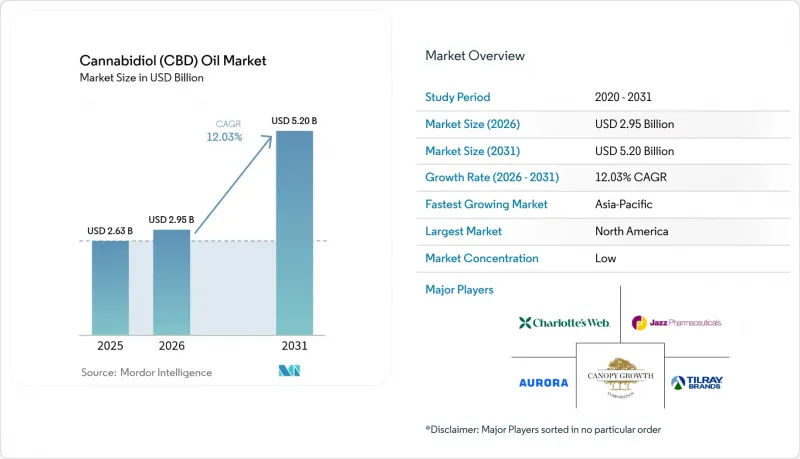
Mordor Intelligence에 의하면, 2026년 칸나비디올(CBD) 오일 시장 규모는 29억 5,000만 달러로 추정되고 있어 2025년 26억 3,000만 달러에서 확대해, 2031년에는 52억 달러에 이를 것으로 예측됩니다.
2026년부터 2031년까지의 연평균 성장률(CAGR)은 12.03%가 될 것으로 전망됩니다.
본 보고서는 원료의 유형(헴프 유래, 마리화나 유래), 제품 형태(캡슐·소프트젤 등), 판매 형태(B2B, B2C(오프라인 약국 등)), 최종 용도 분야(화장품·미용 등), 지역(북미, 유럽, 아시아태평양, 중동 및 아프리카, 남미)별로 분류되어 있습니다. 시장 전망은 금액(달러) 기준으로 제시되어 있습니다.
세계 칸나비디올(CBD) 오일 시장 동향과 인사이트
대마에 우호적인 법규의 조화가 보급을 가속화
대서양 양안의 정책 입안자들은 대마 관련 법규의 일관성을 도모하고 규정 준수 부담을 경감하는 한편, 각국의 보건 당국에 품질 기준을 충족하는 칸나비디올(CBD) 오일 제품의 승인에 관한 재량권을 부여하고 있습니다. 미국에서 제안되고 있는 스케줄 III로의 재분류는 현재 수직 통합형 기업의 매출총이익의 최대 70%를 차지하고 있는 국세법 제280E조에 근거한 비용을 무효화할 가능성이 있습니다. 독일에서도 비슷한 추세가 나타나고 있으며, GMP 인증을 받은 팅크제의 판매량은 이미 증가하고 있습니다. 이는 기업이 유럽 시장 진출을 전망할 때 인용하는 데이터 중 하나입니다. 국가 차원의 법 개정을 통해 제품 등록에 소요되는 기간이 단축됨에 따라, 브랜드는 관할 구역별로 라벨을 개별적으로 조정할 필요 없이 표준화된 SKU를 여러 시장에 출시할 수 있게 됩니다. 이러한 법규제의 조화를 통해 로트 규모가 확대되고, 생산에서 규모의 경제가 실현됩니다. 그 결과, 가격이 억제되고 소비가 촉진됩니다.
만성 통증 및 간질에 대한 CBD의 효능을 뒷받침하는 임상적 근거의 확대
40건의 연구를 대상으로 한 체계적 문헌고찰을 통해, THC를 함유하지 않은 칸나비디올이 TRPV-1 및 5HT-1A 경로를 활성화한다는 사실이 확인되었으며, 퇴행성 관절염 및 신경성 통증에 대한 그 진통 효과가 입증되었습니다. 미국의 종양 전문의들은 2024년 지지 요법 지침에서 특히 난치성 화학요법으로 인한 메스꺼움에 대해 칸나비디올을 보조 요법으로 권장하고 있습니다. 이러한 증거가 축적됨에 따라, 제약사는 보험 급여를 확보할 가능성이 있는 무작위 대조 시험의 실시를 정당화할 수 있게 됩니다. 따라서 칸나비디올(CBD) 오일 시장은 ‘소비자에게 친숙한 이미지’와 ‘확고한 임상 데이터’라는 두 가지 신뢰 요인으로부터 혜택을 받고 있으며, 건강에 관심이 많은 소비자와 처방 의사 모두로부터 교차 수요를 창출하고 있습니다.
THC 함량 제한 및 표시 기준에 관한 규제상의 모호성
53종의 대마 제품을 대상으로 한 동료 심사 평가 결과, 샘플의 66%에서 표시 오류가 확인되었으며, 구매자가 의도치 않게 향정신성 물질을 섭취할 위험에 노출되어 있는 것으로 밝혀졌습니다. 이러한 조사 결과는 신뢰를 훼손할 뿐만 아니라, 책임감 있는 생산자들에게 품질 보증 비용 증가를 강요하게 되어, 결과적으로 이익률을 압박하고 있습니다. 현재 소매업체들은 QR 코드가 포함된 분석 증명서를 요구하고 있으며, 이로 인해 상품 등록에 번거로움이 따르면서 주요 플랫폼에서 저예산 신규 시장 진출기업들이 배제되는 상황이 벌어지고 있습니다.
부문별 분석
대마 유래 오일은 칸나비디올(CBD) 오일 시장의 매출액 대부분을 차지하고 있습니다. 이는 THC 함량 0.3%라는 기준을 준수함으로써 주를 넘나드는 거래, 금융 서비스 이용, 그리고 대형 소매점에서의 상품 판매가 용이해지기 때문입니다. 전국 각지의 약국 체인들은 리스크를 줄이기 위해 대마 제품을 적극적으로 취급하고 있으며, 진열대에 처음 진열한 지 6개월 이내에 재주문량이 30% 증가한 것으로 보고되었습니다. 이익률 구조는 규모의 경제 효과를 누리고 있습니다. 한 번의 추출 공정으로 화장품, 영양보조식품, 팅크제의 충전 라인에 공급할 수 있는 경우가 많아, 간접비를 여러 수익원으로 분산시킬 수 있습니다. 현재는 헴프가 주류를 이루고 있지만, 미량의 칸나비노이드가 지닌 다양성을 더 강력한 증상 완화와 연결 짓는 경험이 풍부한 사용자들 사이에서는 마리화나 유래 오일이 지지를 얻고 있습니다. 인가를 받은 약국의 보고에 따르면, 풀 스펙트럼 오일은 35-50%의 가격 프리미엄이 붙음에도 불구하고 높은 회전율을 유지하고 있으며, 구매 결정은 가격 그 자체보다 ‘가치 인식’에 의해 좌우된다는 사실이 시사되고 있습니다. 수직 통합형 기업은 이러한 동향을 고려하여 두 가지 제품 라인을 운영하고 있습니다. 즉, 대형 소매점에는 대마 제품을, 의료용 약국에는 풀 스펙트럼 제품을 각각 공급함으로써 규제 위험을 분산시키면서 다양한 수요에 대응하고 있습니다.
대마초 유래 오일은 미국에서 성인용 사용이 합법화된 주들의 판매점 확대와 독일의 개인 사용 법안에 힘입어 연평균 성장률(CAGR) 13.12%를 나타낼 것으로 전망됩니다. 만성 통증을 앓고 있는 환자들은 스스로 ‘효과 향상’이라고 표현하는 경험을 한 후, 아이솔레이트에서 풀 스펙트럼 블렌드로 전환하는 경우가 많으며, 이러한 전환으로 인해월평균 지출은 22% 증가합니다. 그러나 규제 준수를 위해서는 유효 성분 농도의 상한선 및 위조 방지 포장이 요구되며, 이로 인해 제품 원가가 상승하고 있습니다. 자사 내 검사 및 날짜 코드가 포함된 일련번호 부여 시스템을 통합한 사업자는 이러한 부담을 줄이고, 규제 시장에서 판매 우선권을 확보하고 있습니다. 공급 측면에서는 실내 재배업자들이 LED 스펙트럼의 미세 조정을 점점 더 적극적으로 활용하여 마이너 칸나비노이드의 비율을 높이고, 칸나비디올(CBD) 오일 시장의 제형 수요에 맞추어 작물의 특성을 조정하고 있습니다.
오일은 투여량의 유연성, 설하 투여 시 15-45분 내에 효과가 나타나는 점, 그리고 대마 테르펜 특유의 쓴맛을 완화해 주는 페퍼민트 등의 향과 잘 어우러진다는 점 덕분에, 계속해서 칸나비디올(CBD) 오일 시장의 주력 제품으로 자리 잡고 있습니다. 임상의들은 발작 억제 요법의 투여량을 조절할 때 눈금이 표시된 주사기를 선호하며, 약사들은 처방약과 마찬가지로 오일을 카운터 뒤에 보관하는 경우가 많아, 이로 인해 의료용 등급이라는 인식이 강화되고 있습니다. 전환율 분석을 통해 교차 판매 동향이 드러나고 있습니다. 오일 구매자의 28%가 같은 장바구니에 외용 롤러를 추가하고 있어, 추가적인 고객 유치 비용을 들이지 않고도 단위당 수익성을 높이고 있습니다. 각 병입 업체들은 가볍고 재활용이 가능한 유리 용기를 채택하여 운송 중량을 7% 줄였습니다. 이러한 물류 측면의 이점은 매출총이익으로 직접 이어집니다.
식용 제품과 구미는 급속한 성장을 거듭하고 있으며, 1회 분량의 편의성과 4-8시간에 달하는 긴 전신 작용 지속 시간을 제공하기 때문에 다른 어떤 형태보다 빠르게 시장을 확대되고 있습니다. 비건용 펙틴 함유 제품은 플렉시테리언들의 관심을 끌고 있으며, 무설탕 SKU는 당뇨병 환자에게 제공되어 타겟 고객층을 확대되고 있습니다. 칸나비디올(CBD) 오일 시장도 그 혜택을 누리고 있습니다. 왜냐하면, 식용 제품으로 시작한 사용자는 제품에 익숙해지면 오일 제품으로 전환하는 경우가 많아, 평생 가치(LTV)가 향상되기 때문입니다. 밤이나 경피 패치와 같은 피부 접촉형 제품은 칸나비디올의 항염증 작용을 활용해 국소적인 관리를 가능하게 하며, 운동선수와 중장년층에게 인기를 얻고 있습니다. 이러한 부문들은 판매량 측면에서는 여전히 소규모이지만, 개발 파이프라인의 현황을 고려할 때 향후 SKU의 다양성이 높아질 것으로 예측됩니다.
지역별 분석
북미는 칸나비디올(CBD) 오일 시장의 전 세계 매출의 거의 절반을 차지하고 있으며, 성숙한 소매 네트워크, 국경을 초월한 재배 클러스터, 그리고 첨단 임상 연구센터를 특징으로 합니다. 미국 사업자들은 제3류로 재분류됨에 따라 표준 세액 공제가 가능해져, 순이익률이 10-15% 개선될 가능성이 있을 것으로 전망하고 있습니다(FDA.GOV). 캐나다의 한 제조업체는 유럽과 호주에 의약품 등급의 아이솔레이트를 공급하고 있으며, 이는 명확한 국내 제도적 체계가 수출을 통한 자본 확보를 어떻게 촉진하는지 보여주고 있습니다. 멕시코의 법안 초안에는 CBD 생산자를 위한 연방 등록 제도가 포함되어 있으며, 최종 규정이 공포되면 저비용 노동력을 활용하면서도 1억 3,000만 명의 주민에게 서비스를 제공할 수 있는 새로운 남북 공급 경로가 생겨날 가능성을 시사하고 있습니다.
아시아태평양은 칸나비디올(CBD) 오일 시장이 가장 빠르게 성장하고 있으며, 호주의 ‘특별 접근 제도’, 일본의 THC 무함유 화장품 시장, 그리고 한국의 관리 하에 운영되는 처방 프로그램을 통해 그 성장세가 더욱 가속화되고 있습니다. 중국의 대마 재배 면적은 전 세계 총 재배 면적의 절반 이상을 차지하고 있으며, 국내 규제로 인해 섭취 용도가 제한되어 있기 때문에 가공업체들은 수출 전용 GMP(우수 제조 기준) 공장을 운영하고 있습니다. 싱가포르의 스타트업 기업들은 보다 광범위한 규제 완화를 전망하며, 지역적인 품질 관리 거점이 되기 위해 블록체인을 활용한 컴플라이언스 관리 시스템 개발을 추진하고 있습니다. 투자자들은 현지 재배와 호주식 엄격한 임상 기준을 결합함으로써, 점점 늘어나는 중산층 소비자층에 서비스를 제공할 수 있다는 점에 큰 가능성을 보고 있습니다.
유럽에서는 2024년 4월에 시행된 독일의 개인 사용법에 따라 진전이 나타나고 있으며, 이미 전자담배 판매와 의료용 처방전 갱신이 확대되고 있습니다. 영국 식품표준청(FSA)은 신규 식품 신청을 검토 중이며, 대부분의 수출업체가 라벨을 약간 수정하는 것만으로 대응할 수 있는 최대 섭취량을 제시하고 있습니다. 이탈리아에서는 의료용 대마 프로그램 확대가 논의되고 있으며, 스페인은 시범적인 재배 허가 도입을 검토하고 있습니다. 또한 프랑스에서는 수지 제품에서 허브 제품으로의 점진적인 전환이 진행되고 있으며, 이러한 움직임이 정책 입안자들에게 규제 현대화를 촉구하고 있습니다. 규제 조화는 여전히 더딘 상황이지만, 의약품 도매업체들은 EU 전역을 아우르는 계약을 체결해 놓았으며, 승인이 나자마자 국경을 넘는 출하를 신속하게 진행할 수 있는 체제를 갖추고 있습니다.
중동 및 아프리카에서는 이스라엘의 임상시험 생태계가 전 세계 제약 기업들과의 제휴를 이끌어내며 15% 중반대의 성장률을 기록하고 있습니다. 한편, 남아프리카공화국에서는 비범죄화라는 획기적인 진전을 계기로, 규제된 공급망에 대한 시범 운영이 진행되고 있습니다. 남미는 경쟁력 있는 농업 기술과 유리한 일조 조건을 바탕으로 성장을 이어가고 있습니다. 브라질에서는 처방전에 따라 THC 함량 0.2%인 오일의 개인 수입이 허용되고 있으며, 국내 연구소들은 보다 광범위한 개혁을 염두에 두고 우수 제조 기준(GMP)을 마련하고 있습니다. 콜롬비아의 인가를 받은 은행은 재배와 제조를 모두 아우르며, 유럽 바이어들의 관심을 끄는 EU-GMP 인증을 지원하고 있습니다. 아르헨티나의 새로운 의료 규제에는 수입 의존도를 낮추기 위한 목적으로 국내 재배를 장려하는 방안이 포함되어 있습니다. 칸나비디올(CBD) 오일 시장은 저비용 바이오매스의 이점을 누리고 있는 반면, 환율 변동에 직면해 있어, 이로 인해 수년에 걸친 가격 협상이 복잡해지고 있습니다.
기타 혜택:
- 엑셀 형식 시장 예측(ME) 시트
- 3개월간의 애널리스트 지원
자주 묻는 질문
목차
제1장 서론
제2장 조사 방법
제3장 주요 요약
제4장 시장 구도
제5장 시장 규모와 성장 예측
제6장 경쟁 구도
제7장 시장 기회와 향후 전망
JHS 26.06.29According to Mordor Intelligence, cannabidiol (CBD) oil market size in 2026 is estimated at USD 2.95 billion, growing from 2025 value of USD 2.63 billion with 2031 projections showing USD 5.2 billion, growing at 12.03% CAGR over 2026-2031.
This report is Segmented by Source Type (Hemp-Derived, Marijuana-Derived), Product Form (Capsules & Softgels and More), Sales Type (B2B, B2C [Offline Retail Pharmacies and More]), End-Use Sector (Cosmetics & Beauty and More), and Geography (North America, Europe, Asia-Pacific, Middle East and Africa, South America). The Market Forecasts are Provided in Terms of Value (USD).
Global Cannabidiol (CBD) Oil Market Trends and Insights
Harmonization of Hemp-friendly Legislation Accelerating Adoption
Policymakers on both sides of the Atlantic are aligning hemp statutes, lowering the compliance burden and giving national health agencies leeway to approve Cannabidiol (CBD) Oil market formulations that meet quality norms. The proposed U.S. re-schedule to Schedule III could neutralize Internal Revenue Code Section 280E expenses, which currently absorb up to 70 % of gross profit for vertically integrated firms. Comparable momentum in Germany has already lifted unit sales of GMP-certified tinctures, a data point firms cite when forecasting European rollouts. Country-level law changes shorten product-registration timelines, letting brands launch standardized SKUs across multiple markets rather than tailoring labels for every jurisdiction. This convergence prompts batch-size increases that drive production economies of scale, thereby dampening prices and boosting consumption.
Expanding Clinical Evidence Validating CBD for Chronic Pain & Epilepsy
A systematic review covering 40 studies confirmed that THC-free cannabidiol activates TRPV-1 and 5HT-1A pathways, substantiating its analgesic impact on osteoarthritis and neuropathic pain. U.S. oncologists now reference cannabidiol adjunct therapy in 2024 supportive-care guidelines, especially for intractable chemotherapy-induced nausea. This growing dossier enables drug developers to justify randomized controlled trials that may secure insurance reimbursement. The Cannabidiol (CBD) Oil market therefore benefits from dual credibility-familiar consumer perception and hard clinical data-creating cross-over demand from both wellness shoppers and prescribers.
Regulatory Ambiguity on THC Limits and Labeling Standards
A peer-reviewed assessment of 53 hemp items found labeling inaccuracies in 66 % of samples, exposing buyers to unintentional psychotropic intake. Such findings erode trust and force responsible producers to shoulder higher quality-assurance costs, which in turn compress margins. Retailers now demand certificates of analysis with QR codes, adding friction to listings and eliminating low-budget newcomers from key platforms.
Other drivers and restraints analyzed in the detailed report include:
- Consumer Migration Toward Plant-based, Non-opioid Therapeutics
- Omnichannel Distribution Boom Boosting Accessibility
- Supply-chain Bottlenecks in Organic-certified Hemp Seeds
For complete list of drivers and restraints, kindly check the Table Of Contents.
Segment Analysis
Hemp-derived oils make up the majority of Cannabidiol (CBD) Oil market revenue because 0.3 % THC compliance eases interstate commerce, financial-service access, and mainstream-retailer placements. National pharmacy groups prefer hemp SKUs for risk mitigation, documenting a 30 % reorder increase within six months of initial shelf launches. Margin architecture benefits from scale: a single extraction batch often supplies cosmetic, nutraceutical, and tincture fill lines, spreading overhead across multiple revenue streams. Despite hemp leadership today, marijuana-sourced oils are gaining favor among experienced users who equate trace cannabinoid diversity with stronger symptom relief. Licensed dispensaries report that full-spectrum oils command 35-50 % price premiums yet maintain high turn rates, suggesting value-perception rather than price alone guides purchase decisions. Vertical integrators weigh these dynamics by operating dual lines, isolating hemp flows for big-box retail and full-spectrum lines for medical dispensaries, thereby hedging regulatory risk while meeting diverse demand.
Marijuana-derived oils notch a 13.12 % CAGR forecast, powered by dispensary expansion in U.S. adult-use states and Germany's personal-use law. Patients with chronic pain often pivot from isolates to full-spectrum blends after experiencing what they describe as enhanced efficacy, a switch that raises average monthly spend by 22 %. Compliance, however, involves potency caps and tamper-proof packaging, boosting cost-of-goods. Operators that integrate in-house testing and date-coded serialization mitigate these burdens and secure listing priority in regulated markets. On the supply side, indoor cultivators increasingly use LED spectra fine-tuning to boost minor cannabinoid ratios, aligning crop profiles with formulation demand in the Cannabidiol (CBD) Oil market.
Oils remain the backbone of the Cannabidiol (CBD) Oil market thanks to dose flexibility, sublingual onset of 15-45 minutes, and easy pairing with flavors like peppermint to mask hemp's terpene bitterness. Clinicians favor calibrated droppers when titrating seizure-control regimens, and pharmacists often lock oils behind counters alongside prescription items, reinforcing their medical-grade perception. Conversion analytics reveal cross-selling dynamics: 28 % of oil buyers add topical rollers in the same basket, inflating unit economics without extra acquisition cost. Bottlers embrace lightweight recyclable glass, trimming freight weight by 7 %, a logistics gain that flows directly to gross margin.
Edibles and gummies are on a growth tear, advancing faster than any other form factor as they offer single-serve convenience and longer systemic windows of 4-8 hours. Vegan pectin versions attract flexitarians, while sugar-free SKUs serve diabetic customers, expanding addressable pools. The Cannabidiol (CBD) Oil market benefits because edible-first users often graduate to oils once familiarity sets in, increasing lifetime value. Skin-contact products such as balms and transdermal patches harness cannabidiol's anti-inflammatory traits for localized support, appealing to athletes and mature adults. Though these segments remain smaller by volume, innovation pipelines suggest higher SKU diversity ahead.
Geography Analysis
North America contributes nearly half of global revenue in the Cannabidiol (CBD) Oil market and features mature retail networks, cross-border cultivation clusters, and advanced clinical research centers. U.S. operators anticipate that a Schedule III re-classification will allow standard tax deductions, potentially improving net margins by 10-15 % [FDA.GOV]. Canadian issuers supply pharmaceutical-grade isolate to Europe and Australia, illustrating how a clear national framework unlocks export capital. Mexico's draft bill outlines a federal registry for CBD producers, hinting at new North-South supply corridors that could leverage low-cost labor while serving 130 million residents once final rules publish.
Asia-Pacific is expanding the Cannabidiol (CBD) Oil market fastest, gaining traction in Australia's Special Access Scheme, Japan's zero-THC cosmetic aisle, and South Korea's monitored prescription program. Chinese hemp acreage covers more than half the planet's total, and processors run GMP plants dedicated to export because domestic rules limit ingestible use. Start-ups in Singapore pursue blockchain compliance engines to serve as regional quality hubs, anticipating wider liberalization. Investors see an upside in blending local cultivation with Australian-style clinical rigor to serve rising middle-class consumers.
Europe advances under Germany's April 2024 personal-use law, which has already lifted vaporizer sales and medical-prescription renewals. The United Kingdom's Food Standards Agency weighs novel-food applications and signals dosage caps that most exporters can meet with minor label edits. Italy debates expansion of its medical program, Spain explores pilot cultivation licenses, and France tracks a gradual shift from resin toward herbal formats-a movement that nudges policymakers toward modernizing rules. Harmonization remains slow, yet pharmaceutical distributors hold pan-EU contracts that accelerate cross-border shipments once clearances emerge.
Middle East & Africa post mid-teen growth as Israel's clinical-trial ecosystem draws global pharmaceutical partnerships, while South Africa prototypes a regulated supply chain after its decriminalization milestone. South America rides competitive agronomy and favorable sunlight. Brazil allows personal imports of 0.2 % THC oils via prescription, and domestic labs are honing good-manufacturing standards in anticipation of broader reforms. Colombia's licensed bank covers both cultivation and manufacturing, supporting EU-GMP certification that draws European buyers. Argentina's new medical regulations include local cultivation incentives aiming to reduce reliance on imports. The Cannabidiol (CBD) Oil market thus benefits from low-cost biomass but confronts currency volatility that complicates multi-year pricing agreements.
- Aurora Cannabis Inc.
- Canopy Growth
- CBD American Shaman LLC
- Charlotte's Web Holdings Inc.
- ConnOils
- CV Sciences
- Diamond CBD
- Elixinol Wellness Ltd.
- ENDOCA BV
- Gaia Herbs
- Green Roads
- Hempstrol
- Honest Paws
- Irwin Naturals (IRIE CBD)
- Jazz Pharmaceuticals plc
- Medical Marijuana
- Medipharm Labs
- MedReleaf Australia
- Mile High Labs
- NuLeaf Naturals LLC
- Pet Releaf
- Tilray Brands Inc.
Additional Benefits:
- The market estimate (ME) sheet in Excel format
- 3 months of analyst support
TABLE OF CONTENTS
1 Introduction
- 1.1 Study Assumptions & Market Definition
- 1.2 Scope of the Study
2 Research Methodology
3 Executive Summary
4 Market Landscape
- 4.1 Market Overview
- 4.2 Market Drivers
- 4.2.1 Harmonization of Hemp-friendly Legislation Accelerating Adoption
- 4.2.2 Expanding Clinical Evidence Validating CBD for Chronic Pain & Epilepsy
- 4.2.3 Consumer Migration Toward Plant-based, Non-opioid Therapeutics
- 4.2.4 Omnichannel Distribution Boom Boosting Accessibility
- 4.2.5 Cost Declines from Large-scale Hemp Cultivation & Extraction Technology
- 4.2.6 Widespread Integration of CBD into Functional Beverages and Ready-to-Drink Formats
- 4.3 Market Restraints
- 4.3.1 Regulatory Ambiguity on THC Limits and Labeling Standards
- 4.3.2 Supply-chain Bottlenecks in Organic-Certified Hemp Seeds
- 4.3.3 Quality Inconsistency Owing to Lack of Unified Global GMP Protocols
- 4.3.4 Inconsistent Customs Enforcement Across Borders
- 4.4 Supply Chain Analysis
- 4.5 Regulatory Landscape
- 4.6 Technological Outlook
- 4.7 Porter's Five Forces Analysis
- 4.7.1 Threat of New Entrants
- 4.7.2 Bargaining Power of Buyers
- 4.7.3 Bargaining Power of Suppliers
- 4.7.4 Threat of Substitutes
- 4.7.5 Intensity of Competitive Rivalry
5 Market Size & Growth Forecasts (Value)
- 5.1 By Source Type
- 5.1.1 Hemp-derived
- 5.1.2 Marijuana-derived
- 5.2 By Product Form
- 5.2.1 Capsules & Softgels
- 5.2.2 Edibles & Gummies
- 5.2.3 Oils
- 5.2.4 Topicals & Creams
- 5.2.5 Other Forms
- 5.3 By Sales Type
- 5.3.1 Business-to-Business (B2B)
- 5.3.2 Business-to-Consumer (B2C)
- 5.3.2.1 Offline Retail Pharmacies
- 5.3.2.2 Online / E-commerce
- 5.3.2.3 Others
- 5.4 By End-Use Sector
- 5.4.1 Cosmetics & Beauty
- 5.4.2 Medical & Pharmaceuticals
- 5.4.3 Nutraceuticals & Functional Foods
- 5.4.4 Veterinary Products
- 5.4.5 Wellness & Personal Care
- 5.5 By Geography
- 5.5.1 North America
- 5.5.1.1 United States
- 5.5.1.2 Canada
- 5.5.1.3 Mexico
- 5.5.2 Europe
- 5.5.2.1 Germany
- 5.5.2.2 United Kingdom
- 5.5.2.3 France
- 5.5.2.4 Netherlands
- 5.5.2.5 Spain
- 5.5.2.6 Rest of Europe
- 5.5.3 Asia-Pacific
- 5.5.3.1 China
- 5.5.3.2 Japan
- 5.5.3.3 India
- 5.5.3.4 Australia
- 5.5.3.5 South Korea
- 5.5.3.6 Rest of Asia-Pacific
- 5.5.4 Middle East and Africa
- 5.5.4.1 Israel
- 5.5.4.2 South Africa
- 5.5.4.3 Rest of Middle East and Africa
- 5.5.5 South America
- 5.5.5.1 Brazil
- 5.5.5.2 Argentina
- 5.5.5.3 Rest of South America
- 5.5.1 North America
6 Competitive Landscape
- 6.1 Market Concentration
- 6.2 Competitive Benchmarking
- 6.3 Market Share Analysis
- 6.4 Company Profiles (includes Global level Overview, Market level overview, Core Segments, Financials as available, Strategic Information, Market Rank/Share for key companies, Products & Services, and Recent Developments)
- 6.4.1 Aurora Cannabis Inc.
- 6.4.2 Canopy Growth Corporation
- 6.4.3 CBD American Shaman LLC
- 6.4.4 Charlotte's Web Holdings Inc.
- 6.4.5 ConnOils LLC
- 6.4.6 CV Sciences Inc.
- 6.4.7 Diamond CBD
- 6.4.8 Elixinol Wellness Ltd.
- 6.4.9 ENDOCA BV
- 6.4.10 Gaia Herbs
- 6.4.11 Green Roads
- 6.4.12 Hempstrol
- 6.4.13 Honest Paws
- 6.4.14 Irwin Naturals (IRIE CBD)
- 6.4.15 Jazz Pharmaceuticals plc
- 6.4.16 Medical Marijuana Inc.
- 6.4.17 Medipharm Labs
- 6.4.18 MedReleaf Australia
- 6.4.19 Mile High Labs
- 6.4.20 NuLeaf Naturals LLC
- 6.4.21 Pet Releaf
- 6.4.22 Tilray Brands Inc.
7 Market Opportunities & Future Outlook
- 7.1 White-space & Unmet-need Assessment