|
시장보고서
상품코드
2073124
북미의 칸나비디올(CBD) 시장 : 점유율 분석, 업계 동향과 통계, 성장 예측(2026-2031년)North America Cannabidiol (CBD) - Market Share Analysis, Industry Trends & Statistics, Growth Forecasts (2026 - 2031) |
||||||
 Mordor Intelligence
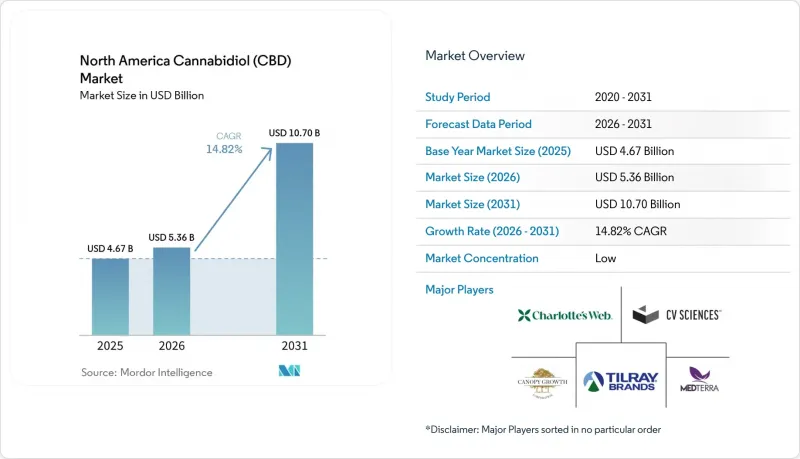
Mordor Intelligence에 의하면, 북미 칸나비디올(CBD) 시장 규모는 2025년 46억 7,000만 달러에서 2026년에는 53억 6,000만 달러로 확대되어 2031년까지 107억 달러에 이를 것으로 예상되고 있어 2026년부터 2031년까지 CAGR 14.82%로 성장할 전망입니다.
본 보고서는 원료별(헴프, 마리화나), 용도별(의약품, 웰니스, 식품 및 음료, 화장품·스킨케어, 반려동물 용품, 기타), 제품 형태별(오일, 캡슐, 구미·과자, 외용제, 기타), 유통 채널별(병원 약국, 소매점, 전자상거래, 기타), 국가별(미국, 캐나다, 멕시코)로 분류되어 있습니다. 시장 전망치는 금액(달러)으로 표시되어 있습니다.
북미 칸나비디올(CBD) 시장 동향 및 분석
통증 및 불안 관리 분야에서 임상적 적용 확대
북미의 칸나비디올(CBD) 시장은 불안, 수면장애 및 관련 치료 분야에서 임상적 활용 사례가 더욱 명확해짐에 따라 지지를 넓혀가고 있습니다. 2024년에 실시된 다기관 공동 무작위 임상시험에서 나노 분산형 CBD가 위약에 비해 GAD-7 불안 점수를 7.02점 낮췄을 뿐만 아니라, 수면의 질과 우울 증상 지표도 개선된 것으로 보고되었습니다. 학술 기관에서도 임상 개발이 계속되고 있으며, 플로리다 대학교가 진행 중인 불안 및 수면장애에 대한 CBD 임상시험은 2상 단계로 접어들었으며, 2026년 말까지 주요 평가 지표 달성을 목표로 하고 있습니다. 또한 2025년 말, 백악관이 각 기관에 칸나비디올 연구를 우선시하고 의사를 통한 접근 경로를 확대하도록 지시함에 따라 연방 정부의 정책 방향도 보다 긍정적인 쪽으로 전환되었습니다. 이는 북미의 칸나비디올(CBD) 시장에 있어 중요한 의미를 지닙니다. 왜냐하면, 보다 확고한 근거와 명확한 문서화, 그리고 엄격한 제조 체계를 갖춘 브랜드는 단순한 유료 소비자 홍보 활동에 의존하는 대신, 의사의 추천을 한 걸음 더 가까이 다가갈 수 있기 때문입니다. 또한, 임상적 준비 상황이 보험 급여 적용, 약국에서의 취급, 그리고 의료 관련 채널에서의 경쟁력에 영향을 미치게 되면서 브랜드 포지셔닝도 변화하고 있습니다.
대마 유래 CBD 제품의 소매 시장에서의 대중화
북미의 칸나비디올(CBD) 시장은 주요 디지털 채널과 주류 유통 채널 전반에 걸쳐 소매 접근성이 정상화되는 광범위한 변화의 혜택을 누리고 있습니다. 대형 소매업체와 마켓플레이스 운영자들이 CBD를 일반적인 상품 구성 논리에 반영함에 따라, 진열대 등재는 단순한 유통상의 성공을 넘어 품질 필터로서의 역할을 수행하게 되었습니다. 샬럿츠 웹(Charlotte’s Web)사는 2025년의 성장이 Walmart.com, Amazon, Faire에서의 입지 확대를 통해 뒷받침되었다고 밝혔으며, 이는 소매업과의 광범위한 통합이 이제 규모 확대를 위한 기본 요건이 되었음을 보여줍니다. 하지만 이러한 변화로 인해 경쟁이 쉬워지는 것은 아닙니다. 왜냐하면, 상품 선정 기준이 엄격해짐에 따라 경쟁력이 낮은 제품이 해당 카테고리에서 배제되고, 규정을 준수한 브랜드가 보다 지속적인 인지도를 확보할 수 있게 되기 때문입니다. 따라서 2026년 북미 칸나비디올(CBD) 시장은 더욱 계층화된 구조를 띠게 될 전망이며, 충분한 시험과 적절한 문서화가 이루어진 제품일수록 정식 소매 환경에서 시장 내 입지를 유지하기 위한 명확한 길을 확보할 수 있을 것입니다.
주 및 연방 차원의 규정 준수 요건의 차이
북미의 칸나비디올(CBD) 시장은 관할 구역이나 판매 채널에 따라 규정 준수 요건이 제각각이기 때문에 여전히 심각한 걸림돌에 직면해 있습니다. 메드테라(Medterra)사는 캘리포니아주 의회 법안 제8호에 따라 2026년 7월 1일 이후 해당 주에서 THC 함유 제품의 판매가 중단될 것이라고 밝혔으며, 이는 주 차원의 조치가 기존 제품 포트폴리오에 얼마나 신속하게 혼란을 초래할 수 있는지를 보여줍니다. 캐나다에서는 제품 유통 경로를 보다 명확히 하기 위한 협의와 합리화 과정이 진행되고 있지만, 이러한 대조적인 상황은 지역별 체계가 얼마나 불균일한지를 여실히 보여주고 있습니다. 대기업은 소규모 브랜드에 비해 제품의 재구성 작업이나 규정 준수 심사, 승인까지 걸리는 시간의 지연을 더 수월하게 감당할 수 있습니다. 이는 수요가 증가하고 있을 뿐만 아니라, 규정 준수를 위한 비용이 지속적으로 증가하고 있기 때문에 북미의 칸나비디올(CBD) 시장에서는 앞으로도 통합이 계속될 가능성이 있음을 의미합니다.
부문별 분석
2025년, 헴프는 북미 칸나비디올(CBD) 시장 점유율의 71.31%를 차지하며, 매출액 기준으로 대마초 유래 CBD를 확실히 앞질렀습니다. 이러한 선도적 위상은 대마 재배, 추출 역량, 확립된 공급망, 그리고 지역 전체의 주류 웰니스 시장과의 폭넓은 친화성을 바탕으로 구축된 규모의 우위를 반영하고 있습니다. 북미의 칸나비디올(CBD) 업계에서 대마는 이미 더 광범위한 상업적 활용 사례에 널리 보급되어 있기 때문에 일반적인 소매 및 전자상거래 비즈니스 모델에도 쉽게 적용될 수 있습니다. 이러한 기존 기반을 바탕으로, 대마 유래 제품은 일관성과 신뢰할 수 있는 조달처가 요구되는 오일, 구미, 캡슐, 외용제 및 약국 관련 제품 형태에서 강력한 입지를 보여주고 있습니다. 또한, 이는 북미의 칸나비디올(CBD) 시장에서 가장 큰 점유율을 차지하는 업체들이 여전히 농업 투입 자재, 추출 기준, 품질 문서를 대규모로 관리할 수 있는 공급업체에 의존하고 있음을 의미합니다.
대마초 유래 CBD 시장은 2031년까지 연평균 성장률(CAGR) 17.38%를 나타낼 것으로 예측되며, 이는 전체 시장의 성장 속도를 상회하는 수치로, 수요가 최대 공급원 범주를 넘어 확대되고 있음을 보여줍니다. 이러한 성장의 일부는 성인용 대마초 시장에서 비롯된 것으로, 이 시장의 소비자들은 더 풍부한 칸나비노이드 성분을 선호하는 경향이 있으며, 그러한 제제를 더 강력하거나 더 완벽한 것으로 인식하고 있습니다. 또한, 백악관이 칸나비노이드 연구 확대에 주력하고 있는 점도 임상 중심의 개발 경로에 대한 관심을 높이고 있으며, 이는 향후 두 원료 그룹 모두에 걸쳐 더 높은 부가가치를 지닌 제제를 뒷받침할 가능성이 있습니다. 따라서 북미의 칸나비디올(CBD) 시장은 원료별로 양극화된 구조를 보이고 있으며, 헴프가 더 큰 상업적 기반을 유지하는 한편, 마리화나 유래 CBD가 프리미엄 성장 분야를 확대되고 있습니다. 이러한 균형은 규모의 경제를 대마에 집중시키는 동시에, 임상적 평가, 유통 규정, 소비자의 기호에 따라 차별화된 칸나비노이드 원료를 선호하는 분야에서 수요가 더욱 빠르게 확대될 수 있도록 한다는 점에서 중요합니다.
2025년에는 웰니스 및 개인용이 시장의 32.24%를 차지하며, 북미의 칸나비디올(CBD) 시장에서 가장 큰 최종 용도 부문이 되었습니다. 이 부문은 CBD를 수면 지원, 스트레스 관리, 운동 후 회복, 그리고 일상적인 웰니스 습관과 연계하고 있기 때문에 여전히 판매량의 기반을 이루고 있습니다. 또한, 브랜드가 여러 제형에 걸쳐 포지셔닝을 펼치기에 가장 용이한 카테고리이기도 하며, 이것이 구미, 팅크제, 캡슐, 외용 제품이 모두 동일한 수요층으로 유입되고 있는 이유 중 하나입니다. 웰니스 및 개인용 서비스의 광범위한 보급은 기업에게 중요한 소비자 진입로가 되지만, 한편으로는 보다 직접적인 가격 경쟁과 모방의 가속화를 초래하고 있습니다. 따라서 북미의 칸나비디올(CBD) 시장에서 활동하는 브랜드들은 최대 규모의 최종 소비자층 내에서 차별화를 꾀하기 위해, 다층적인 배합, 성분의 조합, 그리고 더욱 강력한 품질 강조 등을 빈번히 활용하고 있습니다.
펫케어 시장은 2031년까지 연평균 성장률(CAGR) 16.52%를 나타낼 것으로 예측되며, 이는 최종 용도 부문 중 가장 강력한 성장 전망을 보여줄 뿐만 아니라, 이 이용 사례가 얼마나 빠르게 주류로 자리 잡고 있는지를 보여줍니다. 캐나다 보건부(Health Canada)의 의견 수렴 과정에서 수의학 분야에서의 CBD 활용 방안에 대한 큰 관심이 표명되었으며, 이는 반려동물용 CBD 수요가 공식적인 전문가 감독 체제로 접어들고 있다는 관점을 뒷받침하고 있습니다. 의약품 분야도 전략적으로 중요한 위치를 차지하고 있습니다. 의사 주도의 보상 체계를 통해 CBD 수요의 일부를 임의 지출에서 예산에 반영된 의료비로 전환할 수 있기 때문입니다. 이러한 변화는 북미의 칸나비디올(CBD) 시장에 중요한 의미를 지닙니다. 왜냐하면 임상 채널은 소비자 주도 채널보다 문서화, 표준화 및 제제의 엄격성을 더 중시하기 때문입니다. 따라서 최종 용도 구조는 대규모이며 안정적인 웰니스 분야를 기반으로 하며, 반려동물 케어와 의약품이라는 두 가지 부가가치 창출 분야가 결합되어 있어, 이를 통해 가격 책정의 질과 유통 채널의 방어력을 높일 수 있습니다.
기타 혜택:
- 엑셀 형식 시장 예측(ME) 시트
- 3개월간의 애널리스트 지원
자주 묻는 질문
목차
제1장 서론
제2장 조사 방법
제3장 주요 요약
제4장 시장 구도
제5장 시장 규모와 성장 예측
제6장 경쟁 구도
제7장 시장 기회와 향후 전망
JHS 26.07.03According to Mordor Intelligence, the north america cannabidiol market size is expected to increase from USD 4.67 billion in 2025 to USD 5.36 billion in 2026 and reach USD 10.70 billion by 2031, growing at a CAGR of 14.82% over 2026-2031.
This report is Segmented by Source (Hemp, Marijuana), End Use (Pharmaceuticals, Wellness, F&B, Cosmetics and Skin Care, Pet Care, Others), Product Form (Oils, Capsules, Gummies and Confectionery, Topicals, Others), Distribution Channel (Hospital Pharmacies, Retail Stores, E-Commerce, Others), and Country (United States, Canada, Mexico). Market Forecasts are in Value (USD).
North America Cannabidiol (CBD) Market Trends and Insights
Expanding Clinical Adoption In Pain And Anxiety Management
The North America cannabidiol (CBD) market is gaining support from a clearer clinical use case in anxiety, sleep disturbance, and related care settings. A 2024 multicenter randomized clinical trial reported that nanodispersible CBD reduced GAD-7 anxiety scores by 7.02 points versus placebo, while also improving sleep quality and depression measures. Clinical development is also continuing in academic settings, with the University of Florida trial on CBD for anxiety and sleep disturbance moving through Phase 2 and targeting primary completion by late 2026. Federal policy direction also turned more favorable in late 2025 when the White House instructed agencies to prioritize cannabidiol research and widen physician access pathways. This matters for the North America cannabidiol (CBD) market because brands with stronger evidence, cleaner documentation, and more disciplined manufacturing can move closer to physician recommendation instead of depending only on paid consumer outreach. It also changes brand positioning, since clinical readiness now affects reimbursement access, pharmacy acceptance, and the ability to compete in healthcare-linked channels.
Retail Normalization Of Hemp-Derived CBD Products
The North America cannabidiol (CBD) market is also benefiting from a broader shift toward normalized retail access across major digital and mainstream channels. As large retailers and marketplace operators bring CBD into regular assortment logic, shelf access becomes a quality filter instead of a simple distribution win. Charlotte's Web said its 2025 growth was supported by expanded presence on Walmart.com, Amazon, and Faire, which showed that broad retail integration is now a basic requirement for scale. This shift does not make competition easier, because tighter assortment rules can push weaker products out of the category and give compliant brands more durable visibility. The North America cannabidiol (CBD) market therefore looks more tiered in 2026, with better-tested and better-documented products holding a clearer path to retention in normalized retail environments.
Patchwork State And Federal Compliance Requirements
The North America cannabidiol (CBD) market still faces a serious drag from uneven compliance rules across jurisdictions and channels. Medterra said California Assembly Bill 8 will halt its THC-containing product sales in the state after July 1, 2026, which shows how state-level action can quickly disrupt existing product portfolios. Canada is moving through a different process, with consultation and streamlining steps that point to a more defined product pathway, but that contrast also highlights how uneven the regional framework remains. Larger operators can absorb reformulation work, compliance review, and slower approval timing more easily than smaller brands can. This means the North America cannabidiol (CBD) market may continue to consolidate, not only because demand is rising, but because the cost of staying compliant keeps increasing.
Other drivers and restraints analyzed in the detailed report include:
- Strong Pull From Pet Wellness And Veterinary Adjacent Use Cases
- E-Commerce And Direct-To-Consumer Brand Scaling
- Price Erosion From Hemp Biomass Oversupply And Private Labeling
For complete list of drivers and restraints, kindly check the Table Of Contents.
Segment Analysis
Hemp accounted for 71.31% of the North America cannabidiol (CBD) market share in 2025, which kept it firmly ahead of marijuana-derived CBD on a revenue basis. This lead reflects the scale advantage built around hemp cultivation, extraction capacity, established supply routes, and wider compatibility with mainstream wellness positioning across the region. In the North America cannabidiol (CBD) industry, hemp also fits more easily into broad retail and e-commerce models because it has already been normalized for a larger set of commercial use cases. That installed base gives hemp-derived products a strong presence across oils, gummies, capsules, topicals, and pharmacy-adjacent formats that need consistency and familiar sourcing. It also means the largest share of the North America cannabidiol (CBD) market still rests on suppliers that can manage agricultural inputs, extraction standards, and quality documentation at scale.
Marijuana-derived CBD is projected to grow at a 17.38% CAGR through 2031, which places it ahead of the overall market pace and shows that demand is broadening beyond the largest source category. Part of that growth comes from adult-use cannabis settings where consumers often prefer fuller cannabinoid profiles and perceive those formulations as more potent or more complete. The White House focus on expanding cannabinoid research also gives more visibility to clinically oriented development pathways, which may support higher-value formulations across both source groups over time. The North America cannabidiol (CBD) market therefore has a dual structure by source, with hemp preserving the larger commercial base and marijuana-derived CBD widening the premium growth lane. This balance matters because it keeps scale economics centered in hemp while allowing faster-growth demand pockets to emerge where clinical perception, channel rules, and consumer preference favor differentiated cannabinoid origin.
Wellness and personal use held 32.24% of the market in 2025, which made it the largest end-use category in the North America cannabidiol (CBD) market. This segment remains the volume anchor because it connects CBD with sleep support, stress management, exercise recovery, and familiar daily wellness routines. It is also the easiest category for brands to position across multiple formats, which helps explain why gummies, tinctures, capsules, and topical products all feed into this same demand pool. The broad reach of wellness and personal use gives companies a large consumer entry point, but it also creates more direct price competition and faster imitation. For that reason, brands in the North America cannabidiol (CBD) market often use formulation layering, ingredient pairing, and stronger quality signals to stand out within the largest end-use base.
Pet care is projected to grow at a 16.52% CAGR through 2031, which gives it the strongest growth outlook among end-use segments and shows how quickly the use case is becoming mainstream. Health Canada's consultation process signaled material interest in veterinary CBD pathways, which supports the idea that pet demand is moving closer to formal professional oversight. Pharmaceuticals also carry strategic weight because physician-directed reimbursement pathways can convert part of CBD demand from discretionary spending into budgeted care spending. That shift matters for the North America cannabidiol (CBD) market because clinical channels place more value on documentation, standardization, and formulation discipline than consumer-led channels do. The end-use structure therefore mixes a large and steady wellness base with two value-accretive lanes, one in pet care and one in pharmaceuticals, that can improve pricing quality and channel defensibility.
Complete Report Scope:
- By Source
- Hemp
- Marijuana
- By End Use
- Pharmaceuticals
- Wellness and Personal Use
- Food and Beverages
- Cosmetics and Skin Care
- Pet Care
- Other End Use
- By Product Form
- Oils and Tinctures
- Capsules and Softgels
- Gummies and Confectionery
- Topicals and Skin Care
- Other Product Forms
- By Distribution Channel
- Hospital and Specialty Pharmacies
- Retail Stores
- E-commerce
- Other Distribution Channels
- By Country
- United States
- Canada
- Mexico
List of Companies Covered in this Report:
- Aurora Cannabis Inc.
- cbdMD, Inc.
- Charlotte's Web Holdings, Inc.
- Colorado Botanicals
- Cornbread Hemp
- CV Sciences, Inc.
- Green Roads, LLC
- Holistic Hound
- Jazz Pharmaceuticals plc (GW Pharmaceuticals)
- Joy Organics
- Kazmira LLC
- Lazarus Naturals
- Medical Marijuana
- Medterra CBD
- NuLeaf Naturals
- Pet Releaf
- Tilray Brands, Inc.
Additional Benefits:
- The market estimate (ME) sheet in Excel format
- 3 months of analyst support
TABLE OF CONTENTS
1 Introduction
- 1.1 Study Assumptions & Market Definition
- 1.2 Scope of the Study
2 Research Methodology
3 Executive Summary
4 Market Landscape
- 4.1 Market Overview
- 4.2 Market Drivers
- 4.2.1 Expanding Clinical Adoption in Pain and Anxiety Management
- 4.2.2 Retail Normalization of Hemp-Derived CBD Products
- 4.2.3 Strong Pull from Pet Wellness and Veterinary Adjacent Use Cases
- 4.2.4 Product Innovation in Gummies, Softgels, and Beverages
- 4.2.5 Rising Demand for Third-Party Tested, Traceable CBD Formulations
- 4.2.6 E-Commerce and Direct-to-Consumer Brand Scaling
- 4.3 Market Restraints
- 4.3.1 Patchwork State and Federal Compliance Requirements
- 4.3.2 Ongoing Banking, Payments, and Insurance Frictions for CBD Brands
- 4.3.3 Price Erosion from Hemp Biomass Oversupply and Private Labeling
- 4.3.4 Restrictive Labeling, Claims, and Advertising Enforcement
- 4.4 Supply Chain Analysis
- 4.5 Regulatory Landscape
- 4.6 Technological Outlook
- 4.7 Porter's Five Forces Analysis
- 4.7.1 Threat of New Entrants
- 4.7.2 Bargaining Power of Buyers
- 4.7.3 Bargaining Power of Suppliers
- 4.7.4 Threat of Substitutes
- 4.7.5 Intensity of Competitive Rivalry
5 Market Size & Growth Forecasts (Value, USD)
- 5.1 By Source
- 5.1.1 Hemp
- 5.1.2 Marijuana
- 5.2 By End Use
- 5.2.1 Pharmaceuticals
- 5.2.2 Wellness and Personal Use
- 5.2.3 Food and Beverages
- 5.2.4 Cosmetics and Skin Care
- 5.2.5 Pet Care
- 5.2.6 Other End Use
- 5.3 By Product Form
- 5.3.1 Oils and Tinctures
- 5.3.2 Capsules and Softgels
- 5.3.3 Gummies and Confectionery
- 5.3.4 Topicals and Skin Care
- 5.3.5 Other Product Forms
- 5.4 By Distribution Channel
- 5.4.1 Hospital and Specialty Pharmacies
- 5.4.2 Retail Stores
- 5.4.3 E-commerce
- 5.4.4 Other Distribution Channels
- 5.5 By Country
- 5.5.1 United States
- 5.5.2 Canada
- 5.5.3 Mexico
6 Competitive Landscape
- 6.1 Market Concentration
- 6.2 Market Share Analysis
- 6.3 Company Profiles (includes Global Level Overview, Market Level Overview, Core Segments, Financials as available, Strategic Information, Market Rank/Share, Products and Services, Recent Developments)
- 6.3.1 Aurora Cannabis Inc.
- 6.3.2 cbdMD, Inc.
- 6.3.3 Charlotte's Web Holdings, Inc.
- 6.3.4 Colorado Botanicals
- 6.3.5 Cornbread Hemp
- 6.3.6 CV Sciences, Inc.
- 6.3.7 Green Roads, LLC
- 6.3.8 Holistic Hound
- 6.3.9 Jazz Pharmaceuticals plc (GW Pharmaceuticals)
- 6.3.10 Joy Organics
- 6.3.11 Kazmira LLC
- 6.3.12 Lazarus Naturals
- 6.3.13 Medical Marijuana, Inc.
- 6.3.14 Medterra CBD
- 6.3.15 NuLeaf Naturals, LLC
- 6.3.16 Pet Releaf
- 6.3.17 Tilray Brands, Inc.
7 Market Opportunities & Future Outlook
- 7.1 White-Space and Unmet-Need Assessment