|
시장보고서
상품코드
2066589
해군 함정 시장 : 점유율 분석, 업계 동향과 통계, 성장 예측(2026-2031년)Naval Vessels - Market Share Analysis, Industry Trends & Statistics, Growth Forecasts (2026 - 2031) |
||||||
 Mordor Intelligence
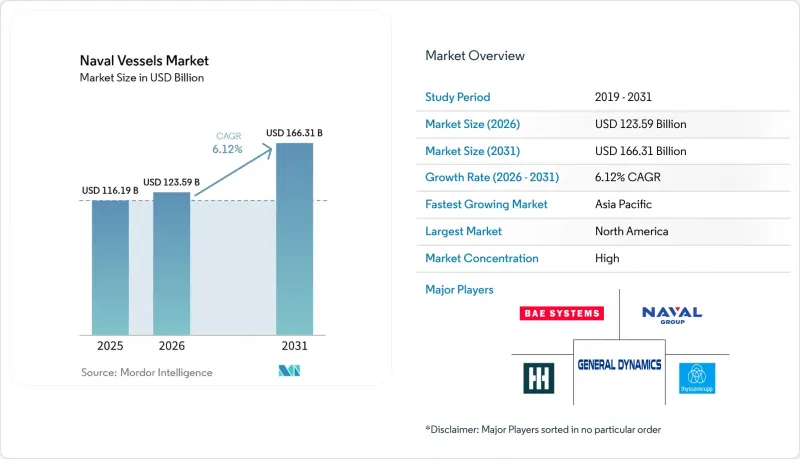
Mordor Intelligence에 의하면, 해군 함정 시장 규모는 2025년 1,161억 9,000만 달러에서 2026년에는 1,235억 9,000만 달러로 확대되어 2026년부터 2031년까지 CAGR 6.12%로 성장을 지속하여, 2031년에는 1,663억 1,000만 달러에 이를 것으로 예측됩니다.
본 보고서는 함정 유형(구축함, 프리깃함, 잠수함, 코르벳함, 항공모함, 기타), 시스템(선박용 엔진, 무기 발사 장치, 센서, 항법·제어 시스템 등), 솔루션(신규 장착 및 개조), 용도(수색 및 구조, 전투, 기뢰 대책, 연안 경비 등), 지역(북미, 유럽, 아시아태평양 등)별로 분류되어 있습니다. 시장 전망은 금액(달러) 기준으로 제시되어 있습니다.
세계 해군 함정 시장 동향과 인사이트
SSN/SSBN 현대화 계획과 AUKUS가 잠수함 조달을 가속화
동맹국 정부가 원자력 공격형 잠수함 및 탄도 미사일 잠수함에 대한 다년간의 예산을 확정함에 따라, 잠수함 함대가 조달 추진력의 원동력이 되고 있습니다. 미국에서는 버지니아급 및 콜롬비아급 잠수함의 선행 조달과 관련된 최근 계약 체결로 인해 견실한 잠수함 수주 잔고가 더욱 공고해졌으며, 이로 인해 해군 함정 시장 전반에 걸친 주요 부품 및 전문 직종공급망과 일정이 안정되고 있습니다. AUKUS와 관련된 계획 및 인프라 구축 노력은 계속해서 산업 역량에 관한 의사결정에 영향을 미치고 있는 반면, 해상 전력의 재구축을 목표로 하는 미국의 정책 이니셔티브는 잠수함 프로그램을 뒷받침하는 첨단 조선 및 인재 양성에 높은 우선순위를 두고 있음을 강조하고 있습니다. 억지력 재구축의 규모는 동맹국 간의 상호운용성 요건과 맞물려, 2031년 이후에도 지속될 해군 함정 시장의 설계, 건조, 시험 및 유지보수 파이프라인에 대한 투자를 뒷받침하고 있습니다. 이러한 장기적인 노력은 자재의 조기 조달과 공급업체와의 계약 체결을 가능하게 함으로써 일정상의 위험을 줄이는 동시에, 잠수함 생산을 수행하는 데 필요한 핵심 기술 분야의 훈련 및 인증 절차를 조율하는 데 기여하고 있습니다.
다목적 수상 전투함의 개조(대공 방어/탄도 미사일 방어, 수직 발사 시스템, 센서)
수상 전투함은 플랫폼 중심의 개념에서 능력 중심의 개념으로 전환되고 있으며, 레이더의 개구 면적, 미사일 방어 체계의 통합, 그리고 협동적인 표적 공격이 결정적인 우위를 가져다줍니다. 새로운 SPY-6 제품군의 수주 사례에서 볼 수 있듯이, 능동형 전자 스캔 어레이(AESA) 레이더 및 소프트웨어 정의형 센서 스위트의 급속한 도입은 현행 및 향후 함급에 걸친 다층적인 방공·미사일 방어를 강화하고, 해군 함정 시장에서의 가치 창출에 있어 센서의 역할을 가속화하고 있습니다. 각국 해군이 수직 발사 장치의 밀도를 높이고 전투 시스템 소프트웨어를 정교화함에 따라, 조선소 체류 기간을 단축하고 구조상의 대폭적인 변경을 최소화하면서도 새로운 능력을 보다 신속하게 도입할 수 있는 모듈성을 추구하고 있습니다. 통합된 방공·미사일 방어 체계에 중점을 두게 됨에 따라 전력, 냉각, 전자기 호환성에 대한 요구 사항이 높아지고 있으며, 그 결과 통합의 복잡성과 소요 기간은 증가하겠지만, 인도 후 발생하는 비용이 많이 드는 수정 작업은 줄어들 것입니다. 이러한 선택에 따라 센서와 소프트웨어는 예산상의 우선순위가 되며, 업그레이드 프로그램은 함대의 즉각적인 대응 능력을 뒷받침하는 핵심적인 역할을 맡게 됩니다. 이는 해군 함정 시장에서 나타나는 유지관리 계약 증가 추세와 일치하는 양상입니다. 그 결과, 신조 함정 및 기존 함정의 개량 과정에서 다목적 대응 능력이 중시되게 되었으며, 상호 운용성과 디지털 아키텍처는 함정 보유 수와 마찬가지로 중요하게 여겨지고 있습니다.
비용 초과와 장기화되는 건조 주기가 신규 착공을 제약하고 있습니다.
비용 증가와 일정 지연은 신규 건조 계획에 부담을 주며, 예산을 우선 순위 프로그램이나 유지 관리에 재분배할 수밖에 없게 만들고 있습니다. 정부가 실시한 독립적인 검토 결과, 주요 함정 유형 전반에 걸친 지속적인 예산 문제와 계획된 함대 전력을 저해하는 일정 지연이 지적되었으며, 이로 인해 해군 함정 시장의 단기 전력 구축 계획이 복잡해지고 있습니다. 대형 전투함 및 항공모함의 프로그램 기준선은 계속해서 재검토되고 있으며, 감독 기관은 재작업을 억제하고 지연의 연쇄반응을 방지하기 위해 설계 성숙도, 시험 및 공급업체의 준비 상황에 대한 보다 강력한 관리가 필요하다고 지적하고 있습니다. 그 결과, 신규 플랫폼의 착공 건수가 제약을 받게 되면서, 가능한 한 기존 함정의 수명 연장이 더욱 중시되고 있습니다. 이러한 동향은 함정 전체를 교체하는 데 따르는 비용이나 위험을 감수하지 않고도 도입할 수 있는 모듈식 시스템과 단계적인 능력 증강의 중요성을 높여주고 있으며, 이는 해군이 함정 시장에서 우선순위를 정하는 방식에 영향을 미치고 있습니다. 자본 집약도가 높은 프로젝트의 완료에는 시간이 오래 걸리기 때문에 프로그램 관리자는 정당한 사유가 있는 경우 여러 해에 걸친 조달에 의존하여 공급업체 기반을 안정화하고, 장기적으로 단위 비용을 절감하고자 합니다.
부문별 분석
잠수함은 2025년 해군 함정 시장 점유율의 33.26%를 차지하고 있으며, 2031년까지 연평균 성장률(CAGR) 7.81%로 확대될 것으로 전망됩니다. 이는 동맹국 각국의 함대에서 잠수함을 현대화하고, 생산 할당량 및 공급업체 계약의 기반이 되는 장기적인 억지력 프로그램을 반영한 것입니다. 미국의 버지니아급 공격형 잠수함 및 콜롬비아급 탄도미사일 잠수함 수주는 수주 잔고의 가시성을 대폭 높이고 공급 기반을 강화하는 동시에, 해군 함정 시장에서 생산량 증대를 실현하기 위해 필수적인 다년간의 도입 계획을 뒷받침하고 있습니다. 수상 전투함은 여전히 필수적이지만, 그 능력은 함정 수의 점진적인 증가보다는 통합 센서나 소프트웨어 정의형 무기에 의존하는 소수의 다목적 플랫폼에 점점 더 집중되고 있습니다. 항공모함 건조는 장기간에 걸친 일정에 따라 진행되고 있으며, 계속해서 막대한 자금을 흡수하고 있기 때문에 단기적인 성장은 잠수함과 첨단 수상 전투함이 계속해서 주도하고 있습니다. 전략적 틀에서 볼 때, 은밀성, 생존성 및 탄약고 수용 능력이 여전히 투자 결정을 좌우하고 있으며, 이에 따라 설계 및 조달은 해군 함정 시장의 현재 계획 기간을 넘어 확장되는 운용상의 요구 사항과 부합하고 있습니다.
해군이 고도의 억지력과 일상적인 경비 임무 간의 균형을 맞추어 나가면서, 함정의 구성은 변화하고 있습니다. 잠수함은 다년 계약과 전문적인 산업 역량의 혜택을 누리고 있는 반면, 수상 함대는 지속적인 업그레이드를 전제로 설계된, 수는 적지만 성능이 뛰어난 함정을 중심으로 최적화되어 있습니다. 이러한 접근 방식을 통해 해군은 중요한 수중 우위를 유지하면서, 필요에 따라 보다 경제적인 플랫폼을 활용하여 일상적인 존재감 과시 임무에도 대응할 수 있게 됩니다. 잠수함 시장은 동맹국 간의 협력 프로그램과 조선소의 생산 능력 및 숙련된 인력 확보를 목표로 한 산업 정책에 의해 뒷받침되고 있으며, 이러한 요소들이 계획대로 잠수함을 함대에 인도할 수 있다는 신뢰의 기반이 되고 있습니다. 또한, 잠수함의 현대화는 센서, 통신, 동력 시스템에 대한 투자를 촉진하며, 그 파급 효과는 수상 전투함 프로그램에도 미치기 때문에 플랫폼 생태계 전체에 이점을 가져다줍니다.
2025년 매출액 중 선박용 엔진 플랫폼이 28.55%를 차지하는 반면, 해군이 감지, 추적, 통합 사격 통제에 주력함에 따라 센서 제품군은 2031년까지 연평균 성장률(CAGR) 8.17%를 나타낼 것으로 예측됩니다. 첨단 레이더 시스템은 도입 기반을 확대하고 있으며, 디지털 빔 포밍, 개방형 아키텍처, 통합 전투 시스템 소프트웨어를 중시함으로써 대응력과 생존성을 높이고 있습니다. 수직 발사 능력과 통신 시스템 업그레이드에 대한 수요가 증가함에 따라, 협동 교전 능력과 분산형 화력의 실현이 뒷받침되고 있습니다. 지휘통제(C2) 소프트웨어, 네트워크화된 무선기, 데이터 링크는 기존 센서 및 무기의 운용 가치를 높이기 위해 매우 중요해지고 있으며, 정기적인 업데이트를 통해 뒷받침되는 지속 가능한 애프터마켓을 창출하고 있습니다.
소프트웨어 릴리스 주기가 가속화되는 가운데, 주요 제조업체와 시스템 통합사업자들은 수정 프로그램의 개발 기간과 위험을 줄이기 위해 모듈식 설계를 채택하고 있습니다. 첨단 센서 시장은 신조 함정에 탑재되는 것 외에도, 기존 시스템을 능동 배열로 교체하고 소프트웨어 업데이트를 통해 새로운 모드를 통합하는 개조 공사를 통해 확대되고 있습니다. 또한 각국 해군은 임무 수행의 확실성을 저해하지 않으면서 새로운 기능을 배치할 수 있도록 사이버 복원력을 강화하고 시험 환경에 투자하고 있습니다. 이러한 변화로 인해 예산이 중장비에서 소프트웨어 및 통합 서비스로 재분배되면서, 가용성 및 성능 지표와 연계된 유지보수 계약의 중요성이 커지고 있습니다.
지역별 분석
북미는 대규모 잠수함 프로그램과 수중 억지력 및 최첨단 능력을 우선시하는 지속적인 현대화 자금의 지원에 힘입어, 2025년 해군 함정 시장 점유율 32.22%를 유지했습니다. 최근 미국에서 버지니아급 공격형 잠수함과 콜롬비아급 탄도미사일 잠수함에 대한 계약이 체결된 것은 해군 함정 시장에서 해당 지역의 수중 투자 규모가 크고 안정적임을 여실히 보여주고 있습니다. 정책 입안자들이 조선 능력과 해상 전력의 재구축을 중시하는 가운데, 조선소의 현대화와 공급망의 회복탄력성을 뒷받침할 산업 생산 능력, 인재 공급 체계, 자금 조달 수단의 확대를 목표로 한 새로운 노력이 추진되고 있습니다. 이러한 노력은 수명 주기 유지 관리 및 역량 갱신에 대한 집중과 맞물려, 대규모 프로그램의 일정상 압박을 완화하고 해군 함정 시장에서 통합 서비스 및 애프터마켓 서비스에 대한 전반적인 수요를 유지하는 데 기여하고 있습니다.
동맹국들이 변화하는 해양 안보 수요에 대응하기 위해 수중 및 수상 역량을 강화함에 따라, 아시아태평양은 2031년까지 연평균 성장률(CAGR) 7.54%를 기록하며 이 지역 내에서 가장 빠른 성장세를 보일 것으로 전망됩니다. 아시아태평양 지역의 해군 함정 시장은 동맹국 간의 협력 체제와 국내 산업 투자의 혜택을 받고 있으며, 이 두 가지 요소가 결합되어 기술 이전, 인재 양성, 그리고 현지 요구 사항에 맞춘 유지보수 모델을 뒷받침하고 있습니다. 지역 구매국들은 최첨단 억지력과 주권 순찰 및 치안 유지 임무 간의 균형을 맞추기 위해 다목적 수상함 및 잠수함의 확보와 현대화를 점점 더 중요하게 여기고 있습니다. 각국 정적층 가공의 현지화를 추진하며, 국내 산업 발전으로 이어지는 장기적인 생산 역량을 구축하려는 가운데, 오프셋 및 공동 생산 조건이 계약 수주 및 일정에 반영되고 있습니다. 이러한 요건들은 1호기 납품까지의 기간을 연장할 가능성이 있지만, 한편으로는 지속적인 애프터마켓 및 업그레이드 수요를 창출하여 해군 함정 시장의 장기적인 전망을 강화하는 결과로 이어지기도 합니다.
유럽에서는 여러 국가의 우선순위를 조율하면서 차세대 호위함 및 잠수함 프로그램에 대한 투자가 계속되고 있습니다. 이로 인해 일정이 복잡해질 가능성은 있지만, 위험 분산과 상호 운용성 강화도 도모되고 있습니다. 제재 및 수출 관리 체제는 특정 참여업체공급망과 부품 조달에 영향을 미치고 있으며, 이로 인해 해군 함정 시장의 국경을 초월한 프로그램 전반에 걸쳐 다각화와 규정 준수 절차의 강화가 촉진되고 있습니다. 유럽의 주요 주계약업체들은 구매자의 비용 및 성능 목표를 충족하는 모듈식 탑재체와 맞춤형 전투 시스템을 갖춘 제품군을 바탕으로, 코르벳함과 연안경비정(OPV) 분야에서 견고한 수출 기반을 유지하고 있습니다. 중동 및 아프리카 및 남미 전역에서는 조달 활동이 더욱 선택적으로 이루어지고 있으며, 시급한 안보 과제에 대응하기 위한 초계함 및 수상 전투함급, 그리고 제한된 예산 내에서 운용 가능성을 확보하기 위한 유지보수 파트너십에 중점을 두고 있습니다. 이러한 요인들이 복합적으로 작용하여 함정 유형 구성과 조달 속도 면에서 지역별 다양성이 지속되고 있으며, 이로 인해 해군 함정 시장에서 수년에 걸친 수주 전망이 유지되고 있습니다.
기타 혜택:
- 엑셀 형식 시장 예측(ME) 시트
- 3개월간의 애널리스트 지원
자주 묻는 질문
목차
제1장 서론
제2장 조사 방법
제3장 주요 요약
제4장 시장 구도
제5장 시장 규모와 성장 예측
제6장 경쟁 구도
제7장 시장 기회와 향후 전망
JHS 26.06.29According to Mordor Intelligence, the naval vessels market size is expected to grow from USD 116.19 billion in 2025 to USD 123.59 billion in 2026 and is forecasted to reach USD 166.31 billion by 2031 at a 6.12% CAGR over 2026-2031.
This report is Segmented by Vessel Type (Destroyers, Frigates, Submarines, Corvettes, Aircraft Carriers, and Others), System (Marine Engine, Weapon Launch, Sensor, Navigation and Control, and More), Solution (Linefit and Retrofit), Application (Search and Rescue, Combat, MCM, Coastal, and More), and Geography (North America, Europe, Asia-Pacific, and More). The Market Forecasts are Provided in Terms of Value (USD).
Global Naval Vessels Market Trends and Insights
SSN/SSBN Recapitalization and AUKUS Accelerate Undersea Procurement
Subsurface fleets anchor the procurement momentum as allied governments lock multiyear spending on nuclear-powered attack and ballistic-missile submarines. In the US, recent awards for Virginia-class boats and Columbia-class advance procurement reinforce a durable undersea backlog that stabilizes supply chains and schedules for core components and specialized trades across the naval vessels market. AUKUS-related planning and infrastructure steps continue to shape industrial capacity decisions, while US policy initiatives to rebuild maritime strength underscore the priority given to high-end shipbuilding and workforce development that supports undersea programs. The scale of deterrent recapitalization, combined with allied interoperability requirements, sustains investment in design, construction, testing, and sustainment pipelines that extend beyond 2031 for the naval vessels market. These long-horizon commitments help offset schedule risk by enabling earlier material buys and supplier agreements, while aligning training and certification pathways for critical trades needed to execute submarine production.
Multi-Mission Surface Combatant Upgrades (AAW/BMD, VLS, Sensors)
Surface combatants are shifting from platform-centric to capability-centric concepts, where radar aperture, missile defense integration, and cooperative target engagement deliver the decisive edge. The rapid adoption of active electronically scanned array radars and software-defined sensor suites, exemplified by new SPY-6 family awards, strengthens layered air and missile defense across current and future classes, accelerating the role of sensors in value creation within the naval vessels market. As navies expand vertical launch density and refine combat-system software, they pursue modularity that allows faster drops of new capability with less time in the yard and fewer intrusive structural changes. The emphasis on integrated air and missile defense raises requirements for power, cooling, and electromagnetic compatibility, which in turn increases the complexity and timeline for integration, but reduces costly rework post-delivery. These choices elevate sensors and software to budget priorities and position upgrade programs as central to fleet readiness, a pattern consistent with the growing sustainment awards visible in the naval vessels market. The net effect is a tilt toward multi-mission fit across new builds and backfits, with interoperability and digital architecture considered as crucial as hull count.
Cost Overruns and Long Build Cycles Constrain New Starts
Cost growth and schedule slippage pressure new starts and force budget reallocation toward priority programs and sustainment. Independent government reviews highlight persistent budget challenges across major classes and delayed schedules that compress planned fleet capacity, which complicates near-term readiness planning in the naval vessels market. Program baselines for large combatants and carriers continue to be revised, and oversight bodies cite the need for stronger controls on design maturity, testing, and supplier readiness to curb rework and avoid compounding delays. The effect is a constrained pipeline for new platform starts and a heavier emphasis on extending the life of existing hulls where feasible. These dynamics also raise the importance of modular systems and incremental capability insertions that can be delivered without the costs and risks of full-ship replacement, which influences how navies set priorities in the naval vessels market. As the most capital-intensive projects take longer to complete, program managers lean on multiyear procurement when justified to stabilize supplier bases and lower unit costs over time.
Other drivers and restraints analyzed in the detailed report include:
- Grey-Zone/Coastal Security Boosts OPV, Corvette, Auxiliary Demand
- Rapid Integration of USV/UUV into Hybrid Fleet Concepts
- Workforce and Tier-2/3 Supplier Fragility Delays Deliveries
For complete list of drivers and restraints, kindly check the Table Of Contents.
Segment Analysis
Submarines accounted for 33.26% of the 2025 naval vessels market share and are forecast to expand at a 7.81% CAGR through 2031, reflecting undersea recapitalization across allied fleets and long-dated deterrence programs that anchor production slots and supplier contracts. US awards for Virginia-class attack submarines and Columbia-class ballistic-missile submarines provide substantial backlog visibility, strengthening the supply base and supporting multi-year hiring plans essential to executing increased throughput within the naval vessels market. Surface combatants remain essential, yet capability is increasingly concentrated in fewer multi-mission platforms that rely more on integrated sensors and software-defined weapons than on incremental increases in hull count. Carriers progress on long schedules and continue to absorb significant capital, which keeps near-term growth led by submarines and advanced surface combatants. The strategic framing is that stealth, survivability, and magazine depth continue to dominate investment decisions, which align design and procurement with operational needs that extend beyond the current planning window for the naval vessels market.
The mix of vessel types is evolving as navies balance high-end deterrence with routine constabulary operations. Submarines benefit from multi-year contracts and specialized industrial capabilities, while surface fleets are optimized around fewer but more capable hulls that are designed for consistent upgrades. This approach allows navies to protect critical undersea advantages and still respond to day-to-day presence missions with more economical platforms where appropriate. The naval vessels market for submarines is supported by allied cooperation programs and industrial policy actions that seek to expand yard capacity and skilled labor pipelines, which underpin confidence in delivering planned boats to the fleet. Undersea modernization also catalyzes investment in sensors, communications, and power systems that spill over into surface combatant programs, which spreads the benefit across the platform ecosystem.
Marine engine platforms captured 28.55% of 2025 revenue, while sensor suites are projected to grow at an 8.17% CAGR through 2031 as navies focus on detection, tracking, and integrated fire control. Advanced radar systems are expanding the installed base, emphasizing digital beamforming, open architectures, and integrated combat-system software to enhance readiness and survivability. Increased demand for vertical launch capacity and communication upgrades supports cooperative engagement and distributed lethality. Command and control (C2) software, networked radios, and data links are becoming critical as they enhance the operational value of existing sensors and weapons, creating a durable aftermarket driven by recurring updates.
As software cadence accelerates, primes and integrators are adopting modular designs that reduce yard time and risk for retrofit programs. The market for advanced sensors is growing through both new ship installations and retrofits that replace legacy systems with active arrays and integrate new modes via software updates. Navies are also investing in cyber hardening and test environments to ensure new capabilities are deployed without compromising mission assurance. This shift reallocates budgets from heavy equipment to software and integration services, increasing the importance of sustainment contracts tied to availability and performance metrics.
Geography Analysis
North America retained 32.22% of the 2025 naval vessels market share, supported by large submarine programs and sustained modernization funding that prioritize undersea deterrence and high-end capability. The recent US contract awards for Virginia-class attack submarines and Columbia-class ballistic-missile submarines illustrate the magnitude and stability of the region's undersea investment footprint in the naval vessels market. As policymakers emphasize rebuilding shipbuilding capacity and maritime strength, new initiatives aim to expand industrial throughput, workforce pipelines, and financing tools that support yard modernization and supply chain resilience. These actions, combined with a focus on lifecycle sustainment and capability refresh, help offset schedule pressure on the largest programs and sustain overall demand for integration and aftermarket services in the naval vessels market.
Asia-Pacific is projected to deliver the fastest regional expansion, with a 7.54% CAGR to 2031, as allies reinforce undersea and surface capabilities to address evolving maritime security needs. The naval vessels market in Asia-Pacific benefits from allied cooperation frameworks and domestic industrial investment, which together support technology transfer, workforce training, and sustainment models tailored to local requirements. Regional buyers increasingly emphasize multi-mission surface ships and submarine acquisition or modernization to balance high-end deterrence with sovereignty patrols and constabulary tasks. Offset and co-production terms factor into awards and timelines, as governments seek to localize manufacturing and build long-term maintenance capability tied to domestic industry development. These requirements can lengthen first-article schedules but also add durable aftermarket and upgrade demand, strengthening the long-run outlook for the naval vessels market.
Europe continues to invest in next-generation frigates and submarine programs while coordinating across multiple national priorities, which can introduce schedule complexity but also share risk and deepen interoperability. Sanctions and export-control regimes affect supply chains and component sourcing for specific participants, which encourages diversification and enhanced compliance processes across cross-border programs in the naval vessels market. Major European primes maintain strong export positions in corvettes and OPVs, supported by product families designed for modular payloads and tailored combat systems that meet buyer cost and capability targets. Across the Middle East, Africa, and South America, procurement is more selective, with emphasis on patrol and surface combatant classes that address immediate security tasks and on sustainment partnerships that ensure availability within constrained budgets. The combined effect is continued regional diversity in vessel type mix and procurement pacing that sustains multi-year order visibility for the naval vessels market.
- General Dynamics Corporation
- ThyssenKrupp AG
- BAE Systems plc
- Naval Group
- EDGE Group PJSC
- Damen Holding B.V.
- HD Korea Shipbuilding & Offshore Engineering Co., Ltd.
- Huntington Ingalls Industries, Inc.
- Lockheed Martin Corporation
- Austal Limited
- FINCANTIERI S.p.A.
- Hanwha Ocean
- Larsen & Toubro Limited
- PT PAL Indonesia
- Navantia SA
- Kalashnikov Group
- Lurssen Werft GmbH & Co. KG
- China Shipbuilding Corporation Limited
Additional Benefits:
- The market estimate (ME) sheet in Excel format
- 3 months of analyst support
TABLE OF CONTENTS
1 INTRODUCTION
- 1.1 Study Assumptions and Market Definition
- 1.2 Scope of the Study
2 RESEARCH METHODOLOGY
3 EXECUTIVE SUMMARY
4 MARKET LANDSCAPE
- 4.1 Market Overview
- 4.2 Market Drivers
- 4.2.1 SSN/SSBN recapitalization and AUKUS accelerate undersea procurement
- 4.2.2 Grey-zone/coastal security boosts OPV, corvette, auxiliary demand
- 4.2.3 Multi-mission surface combatant upgrades (AAW/BMD, VLS, sensors)
- 4.2.4 Rapid integration of USV/UUV into hybrid fleet concepts
- 4.2.5 Lifecycle and digital sustainment contracts expand aftermarket
- 4.2.6 Co-production/local-content offsets unlock deals in emerging navies
- 4.3 Market Restraints
- 4.3.1 Cost overruns and long build cycles constrain new starts
- 4.3.2 Workforce and tier-2/3 supplier fragility delays deliveries
- 4.3.3 Export controls/sanctions complicate cross-border programs
- 4.3.4 Shipyard and dry-dock capacity bottlenecks cap throughput
- 4.4 Value Chain Analysis
- 4.5 Regulatory Outlook
- 4.6 Technological Outlook
- 4.7 Porter's Five Forces Analysis
- 4.7.1 Bargaining Power of Suppliers
- 4.7.2 Bargaining Power of Buyers/Consumers
- 4.7.3 Threat of New Entrants
- 4.7.4 Threat of Substitute Products
- 4.7.5 Intensity of Competitive Rivalry
5 MARKET SIZE AND GROWTH FORECASTS (VALUE)
- 5.1 By Vessel Type
- 5.1.1 Destroyers
- 5.1.2 Frigates
- 5.1.3 Submarines
- 5.1.4 Corvettes
- 5.1.5 Aircraft Carriers
- 5.1.6 Other Vessel Types
- 5.2 By System
- 5.2.1 Marine Engine
- 5.2.2 Weapon Launch
- 5.2.3 Sensors
- 5.2.4 Navigation and Control
- 5.2.5 Communication
- 5.2.6 Others (Electrical, Auxiliary)
- 5.3 By Solution
- 5.3.1 Linefit
- 5.3.2 Retrofit
- 5.4 By Application
- 5.4.1 Search and Rescue
- 5.4.2 Combat
- 5.4.3 Mine Countermeasure (MCM)
- 5.4.4 Coastal
- 5.4.5 Others
- 5.5 By Geography
- 5.5.1 North America
- 5.5.1.1 United States
- 5.5.1.2 Canada
- 5.5.1.3 Mexico
- 5.5.2 Europe
- 5.5.2.1 United Kingdom
- 5.5.2.2 France
- 5.5.2.3 Germany
- 5.5.2.4 Russia
- 5.5.2.5 Rest of Europe
- 5.5.3 Asia-Pacific
- 5.5.3.1 China
- 5.5.3.2 India
- 5.5.3.3 Japan
- 5.5.3.4 Australia
- 5.5.3.5 Rest of Asia-Pacific
- 5.5.4 South America
- 5.5.4.1 Brazil
- 5.5.4.2 Rest of South America
- 5.5.5 Middle East and Africa
- 5.5.5.1 Middle East
- 5.5.5.1.1 United Arab Emirates
- 5.5.5.1.2 Saudi Arabia
- 5.5.5.1.3 Rest of Middle East
- 5.5.5.2 Africa
- 5.5.5.2.1 South Africa
- 5.5.5.2.2 Rest of Africa
- 5.5.5.1 Middle East
- 5.5.1 North America
6 COMPETITIVE LANDSCAPE
- 6.1 Market Concentration
- 6.2 Strategic Moves
- 6.3 Market Share Analysis
- 6.4 Company Profiles (includes Global level Overview, Market level overview, Core Segments, Financials as available, Strategic Information, Market Rank/Share for key companies, Products and Services, and Recent Developments)
- 6.4.1 General Dynamics Corporation
- 6.4.2 ThyssenKrupp AG
- 6.4.3 BAE Systems plc
- 6.4.4 Naval Group
- 6.4.5 EDGE Group PJSC
- 6.4.6 Damen Holding B.V.
- 6.4.7 HD Korea Shipbuilding & Offshore Engineering Co., Ltd.
- 6.4.8 Huntington Ingalls Industries, Inc.
- 6.4.9 Lockheed Martin Corporation
- 6.4.10 Austal Limited
- 6.4.11 FINCANTIERI S.p.A.
- 6.4.12 Hanwha Ocean
- 6.4.13 Larsen & Toubro Limited
- 6.4.14 PT PAL Indonesia
- 6.4.15 Navantia SA
- 6.4.16 Kalashnikov Group
- 6.4.17 Lurssen Werft GmbH & Co. KG
- 6.4.18 China Shipbuilding Corporation Limited
7 MARKET OPPORTUNITIES AND FUTURE OUTLOOK
- 7.1 White-space and Unmet-need Assessment