|
시장보고서
상품코드
2122483
해군 함정 MRO : 시장 점유율 분석, 업계 동향 및 통계, 성장 예측(2026-2031년)Naval Vessel MRO - Market Share Analysis, Industry Trends & Statistics, Growth Forecasts (2026 - 2031) |
||||||
 Mordor Intelligence
2025년 해군 함정 MRO 시장에서 잠수함은 33.46%를 차지했습니다. 이것은 원자력 추진 시스템 복잡성이나 억제력으로서의 가치가, 복수년에 걸치는 정비 계약 기반이 되고 있는 것을 반영하고 있습니다.
엄격한 규제 장벽이 경쟁을 제한하고 높은 수준의 요금을 유지하고 있습니다. 프리깃함은 분산형 수상 작전에서의 역할과 비교적 짧은 건조 주기로 인해 조기에 유지보수 단계에 진입한다는 점에서 연평균 성장률(CAGR) 5.05%를 기록하며 가장 빠르게 성장하는 부문입니다.

Mordor Intelligence에 따르면, 2025년 해군 함정의 MRO 시장 규모는 613억 8,000만 달러에 달할 것으로 전망됩니다. 본 보고서는 함정 유형별(항공모함, 구축함, 호위함,코르벳, 기타), MRO 유형별(엔진 MRO, 드라이독 MRO, 부품 MRO, 기타), 정비 수준별(조직·운용 수준, 디포 정비, 기타), 추진 방식별(원자력 함정, 일반 동력 함정), 지역별(북미, 유럽, 아시아태평양, 기타)로 분류되어 있습니다. 시장 예측은 금액(달러)으로 표시되어 있습니다.
세계의 해군 함정 MRO 시장 동향 및 인사이트
함대 현대화 프로그램
각국 정부가 단순히 함정 수를 늘리는 것이 아니라 능력 확대를 목표로 하고 있기 때문에 전국 규모의 업그레이드 계획이 해군 함정 MRO 시장 수요를 재편하고 있습니다. 필리핀의 350억 달러 규모 현대화 계획이나 튀르키예의 3년에 걸친 함대 강화 이니셔티브에서는 단순한 신규 도입뿐만 아니라 정비 인프라 및 플랫폼 업그레이드에 상당한 비중이 할당되고 있습니다. 덴마크와 호주에서 시행되고 있는 유사한 전략은 중규모 해군이라도 개조, 오버홀,모듈식 업그레이드에 자금을 투입함으로써, 그 규모에 비해 훨씬 큰 능력 향상을 확보할 수 있음을 보여주고 있습니다. 잠수함의 선체 수명 연장은 신조 비용의 약 4분의 1로 10-15년의 복무 기간을 연장하여, 지속적인 MRO 수익을 창출합니다. 단계적인 작업 패키지를 통해 계약업체는 인건비와 재고를 충분히 미리 계획할 수 있으므로, 예측 가능성이 높아지고 일정 지연이 줄어듭니다.
구형 함정의 수명 연장
차세대 함정의 취역이 지연됨에 따라, 구형 함정의 전투 준비 태세를 유지하는 것은 단순한 경비 절약에서 필수 불가결한 조치로 변화하고 있습니다. 미 해군의 순양함 대수리 계획이나 영국 해군의 유형 23 호위함 수명 연장 노력은 해군이 교체 비용의 불과 15-25%로 현대적인 능력의 70-80%를 확보할 수 있음을 보여줍니다. 고성능 코팅, 구조 건전성 모니터링,함정 수명 중반에 전투 시스템을 교체함으로써 피로 및 노후화에 대처하는 동시에, 예측 분석을 통해 점검 주기를 단축하고 있습니다. 구형 함정에 대한 의존도가 높아짐에 따라, 독립 조선소에서는 쉽게 재현할 수 없는 데포 수준의 개조에 대한 수요가 안정화되어, 기존 계약업체들의 높은 가격 책정을 뒷받침하고 있습니다.
드라이독 가용 슬롯 부족과 비용
시설 노후화와 프로젝트 규모 확대로 인해 오버홀 예산은 계획을 크게 상회하고 있습니다. 펄 하버 드라이독 현대화 비용은 61억 달러에서 160억 달러로 급증했고, 포츠머스 해군 조선소의 비용은 4배로 치솟아 다른 긴급 작업 수행 능력을 저해하고 있습니다. ‘조선소 인프라 최적화 프로그램’에 210억 달러가 투입되었지만, 그럼에도 잠수함 개조를 12-18개월 지연시키는 단기적인 공백을 해소할 수는 없습니다. 민간 조선소는 비용 초과가 수익성을 위협하기 때문에 해군의 계약을 거절하는 경우가 많아, 이로 인해 병목 현상이 더욱 심각해지고 있습니다.
부문별 분석
구축함과 코르벳함은 중간 수준에 위치해 있습니다. 전자는 이지스 시스템의 유지보수로 인한 혜택을 받고 있으며, 후자는 예산 부담이 적은 초계함을 찾는 신흥 연안 해군으로부터 주목을 받고 있습니다.
잠수함 플랫폼에는 원자로 연료 교체, 음향 시그니처 점검, 선체 내압 검사, 데포 수준에서의 작업량 고정화 등 광범위한 작업이 필요합니다. 프리깃함 프로그램에서는 모듈식 전투 시스템 블록을 활용하고 있으며, 이를 통해 취역 중기 개조가 간소화되어 해군은 신조 함정이 아닌 단계적인 능력 향상에 대한 투자를 선택하고 있습니다. 스페인의 ISOPRENE 프로젝트에서 진행된 디지털 트윈 시범 운영을 통해 두 함종 모두 예정에 없던 가동 중단 시간을 15-20% 줄일 수 있음이 입증되었으며, 예측 기간 동안 그 도입이 더욱 확대될 전망입니다.
2025년에는 법정 선체 검사, 축계 교체, 입도크를 의무화하는 추진 시스템 정비를 통해 드라이독 작업이 해군 함정의 MRO 시장의 38.57%를 차지했습니다. 이 부문은 의무화된 정기성 덕분에 수년에 걸친 마스터 일정이 확립되어 있어 안정적인 수요가 예상됩니다. 해군이 신조 함정의 취역을 기다리지 않고 센서, 무기, 전자전 시스템의 개조를 수행함에 따라 개조 및 업그레이드 서비스는 연평균 3.60%의 성장률을 보이고 있습니다.
적층 가공는 부품 수리 비용 효율성을 획기적으로 변화시키고 있습니다. USS 바탄에 탑재된 금속 3D 프린터는 이미 해상에서 인증을 받은 예비 부품을 생산하고 있으며, 이를 통해 물류 지연이 단축되고 더 대규모 작업을 위한 도크 공간이 확보되고 있습니다. PBL(성과 기반 계약) 체계는 부품 납기 단축이 계약 성과 지표를 향상시키기 때문에 공급업체가 이 역량에 대한 투자를 더욱 확대하도록 유도하고 있습니다.
지역별 분석
아시아태평양은 2025년 해군 함정 MRO 시장 지출의 37.14%를 차지했습니다. 이는 2030년까지 435척으로 확대될 중국의 함대와, 호주의 수상 전력을 두 배로 늘리겠다는 계획 등 동맹국의 대응 조치가 주요 원인입니다. 조선 강국인 한국과 일본은 잉여 도크 용량을 제공합니다. 한화오션이 한국 조선소 최초로 미 해군 수리 계약을 수주한 것은 동맹국 간의 협력 관계가 더욱 깊어지고 있음을 보여줍니다.
나토(NATO) 회원국들이 국방비를 GDP의 최소 2%로 인상함에 따라, 유럽은 연평균 성장률(CAGR) 3.88%로 가장 빠르게 성장하는 지역입니다. 덴마크의 대규모 함대 확충, 프랑스의 잠수함 ‘투르빌’ 취역, 그리스의 270억 달러 규모 재군비 계획에 따라 새로운 함정이 정비 파이프라인으로 유입되고 있습니다. 튀르키예가 3억 5,000만 유로를 투자한 악사즈 해군 기지 개보수는 해당 지역의 정비 선택지를 더욱 넓히는 동시에 지중해 전역에 걸친 안보상의 우려를 반영하고 있습니다.
북미에서는 미국 해군이 현대화와 조선소의 노후화로 인한 제약 사이의 균형을 모색하고 있어, 견조하고 안정적인 수요가 유지되고 있습니다. 잠수함 건조 인건비에 대한 57억 달러의 긴급 추가 예산과,연간 401억 달러의 조선 예산은 재정적 노력을 여실히 보여주고 있으며, 예상되는 함정 수는 2027년까지 283척으로 감소한 후, 2054년까지 381척으로 재건될 전망입니다. 남미와 중동 및 아프리카는 여전히 기여도가 낮지만, 14억 랜드(7,890만 달러) 규모의 잠수함 개량 프로그램 등 수요가 서서히 증가할 조짐이 보입니다.
기타 혜택
- 엑셀 형식 시장 예측(ME) 시트
- 3개월간의 애널리스트 지원
자주 묻는 질문
목차
제1장 서론
제2장 조사 방법
제3장 주요 요약
제4장 시장 구도
제5장 시장 규모 및 성장 예측
제6장 경쟁 구도
제7장 시장 기회 및 향후 전망
KTH 26.09.08Submarines accounted for 33.46% of the 2025 naval vessel MRO market, reflecting their nuclear-propulsion complexity and deterrence value that anchor multi-year service contracts. High regulatory barriers restrict competition and support premium rates. Frigates represent the fastest-growing slice at 5.05% CAGR thanks to their role in distributed surface operations and relatively quicker build cycles that soon enter sustainment phases.
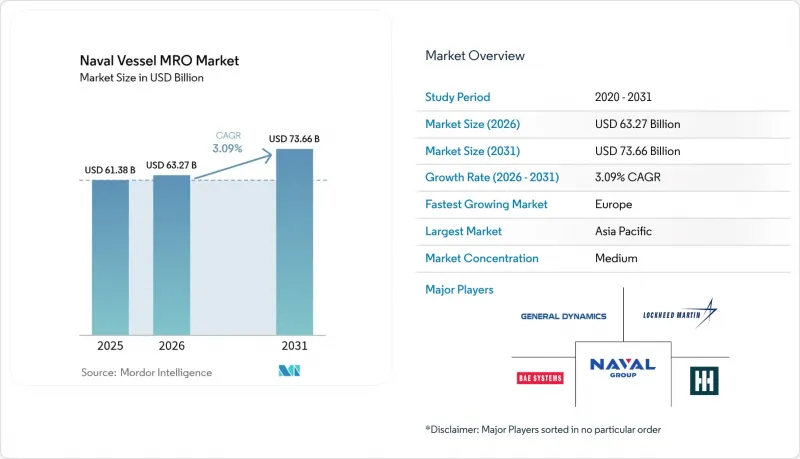
According to Mordor Intelligence, the naval vessel MRO market size stands at USD 61.38 billion in 2025. This report is Segmented by Vessel Type (Aircraft Carriers, Destroyers, Frigates, Corvettes, and More), MRO Type (Engine MRO, Dry-Dock MRO, Component MRO, and More), Maintenance Level (Organizational/Operational, Depot, and More), Propulsion Type (Nuclear-Powered Vessels, Conventional), and Geography (North America, Europe, Asia-Pacific, and More). The Market Forecasts are Provided in Terms of Value (USD).
Global Naval Vessel MRO Market Trends and Insights
Fleet-Modernization Programs
Nationwide upgrade plans are reshaping the naval vessel MRO market demand as governments aim to stretch capability rather than merely expand fleet count. The Philippines' USD 35 billion modernization drive and Turkey's three-year fleet enhancement initiative earmark sizable shares for maintenance infrastructure and platform upgrades rather than for acquisition only. Similar strategies in Denmark and Australia show that mid-tier navies can secure disproportionate capability gains by funding refits, overhauls, and modular upgrades. Submarine hull-life extensions add 10-15 years of service at near one-quarter of new-build cost, generating durable MRO revenue. Predictability improves because phased work packages allow contractors to plan labor and inventory well in advance, narrowing schedule slippage.
Life-Extension of Legacy Fleets
Keeping older ships battle-ready has moved from thrift to necessity as next-generation hulls arrive late. The US Navy cruiser overhaul program and the Royal Navy Type 23 frigate life-extension effort illustrate how navies capture 70-80% of modern capability for only 15-25% of replacement cost. Enhanced coatings, structural health monitoring, and mid-life combat-system swaps tackle fatigue and obsolescence while predictive analytics tighten inspection intervals. Growing reliance on legacy vessels stabilizes demand for depot-level refits that independent yards cannot easily replicate, bolstering premium pricing for incumbent contractors.
Dry-Dock Slot Overruns and Costs
Aging facilities and project creep push overhaul budgets well above plan. Pearl Harbor's dry-dock modernization ballooned from USD 6.1 billion to USD 16 billion, while Portsmouth Naval Shipyard costs quadrupled, blocking capacity for other urgent work. The Shipyard Infrastructure Optimization Program injects USD 21 billion, yet it cannot eliminate near-term gaps that delay submarine refits by 12-18 months. Commercial yards often refuse naval contracts because overruns jeopardize profitability, further tightening the bottleneck.
Other drivers and restraints analyzed in the detailed report include:
- Rising Maritime-Security Tensions
- Adoption of PBL Contracts
- Skilled-Labor Shortages
For complete list of drivers and restraints, kindly check the Table Of Contents.
Segment Analysis
Destroyers and corvettes sit mid-pack; the former benefit from Aegis-system maintenance, while the latter attract emerging littoral navies seeking budget-friendly patrol craft.
Subsurface platforms require extensive reactor refueling, acoustic signature checks, hull pressure tests, and lock-in depot-level workloads. Frigate programs leverage modular combat-system blocks, simplifying mid-life upgrades and enticing navies to invest in incremental capability paths instead of fresh hulls. Digital twin pilots under Spain's ISOPRENE project have demonstrated 15-20% cuts in unscheduled downtime for both vessel classes, pointing toward broader adoption over the forecast period.
Dry-dock work held 38.57% of the naval vessel MRO market in 2025 due to statutory hull inspections, shaft-line replacements, and propulsion-system overhauls that mandate docking. The segment enjoys steady visibility because mandatory periodicity supports multi-year master schedules. Modification and upgrade services are growing 3.60% annually as navies retrofit sensors, weapons, and electronic-warfare suites rather than wait for new builds.
Additive manufacturing is reshaping component repair economics. Metal 3D printers on the USS Bataan already produce certified spares at sea, cutting logistics lag and freeing dock space for heavier tasks. PBL frameworks incentivize suppliers to invest further in this capability, as faster part turnarounds boost contract performance metrics.
Complete Report Scope:
- By Vessel Type
- Aircraft Carriers
- Destroyers
- Frigates
- Corvettes
- Submarines
- Other Vessel Types (Support and Auxiliary Vessels, Unmanned Surface, and Underwater Vessels)
- By MRO Type
- Engine MRO
- Dry-Dock MRO
- Component MRO
- Modification and Upgrade
- By Maintenance Level
- Organizational/Operational
- Intermediate/Field
- Depot
- By Propulsion Type
- Nuclear-Powered Vessels
- Conventional (Diesel/Gas Turbine)
- By Geography
- North America
- United States
- Canada
- Mexico
- Europe
- United Kingdom
- France
- Germany
- Italy
- Spain
- Russia
- Rest of Europe
- Asia-Pacific
- China
- India
- Japan
- South Korea
- Australia
- Rest of Asia-Pacific
- South America
- Brazil
- Argentina
- Rest of South America
- Middle East and Africa
- Middle East
- Saudi Arabia
- United Arab Emirates
- Turkey
- Rest of Middle East
- Africa
- Egypt
- South Africa
- Rest of Africa
- Middle East
- North America
Geography Analysis
Asia-Pacific held 37.14% of the 2025 naval vessel MRO market spending, anchored by China's fleet growth toward 435 ships by 2030 and allied counter-moves such as Australia's plan to double its surface force. Shipbuilding powerhouses South Korea and Japan offer overflow dock capacity; Hanwha Ocean became the first Korean yard to win US Navy repair work, underscoring deeper allied collaboration.
Europe is the fastest-growing region at 3.88% CAGR as NATO members lift defense outlays to at least 2% of GDP. Denmark's large-scale fleet expansion, France's Tourville submarine commissioning, and Greece's USD 27 billion rearmament funnel fresh hulls into sustainment pipelines. Turkey's EUR 350 million Aksaz Naval Base upgrade further broadens regional maintenance options and reflects wider Mediterranean security concerns.
North America sustains robust but stable demand as the US Navy balances modernization with aging-yard constraints. Emergency supplements of USD 5.7 billion for submarine labor and a USD 40.1 billion annual shipbuilding budget highlight fiscal commitment, yet projected force levels drop to 283 ships by 2027 before rebuilding toward 381 by 2054. South America and the Middle East/Africa remain smaller contributors, though programs like ZAR 1.4 billion (USD 78.90 million) submarine refit point to gradual upticks.
- General Dynamics Corporation
- Huntington Ingalls Industries, Inc.
- Lockheed Martin Corporation
- NAVANTIA, S.A., SME
- thyssenkrupp AG
- BAE Systems plc
- Naval Group
- Rolls-Royce plc
- Rhoads Industries, Inc.
- Abu Dhabi Ship Building Company PJSC
- Larsen & Toubro Limited
- Damen Shipyards Group
- Singapore Technologies Engineering Ltd.
- FINCANTIERI S.p.A.
- HD Hyundai Heavy Industries Co., Ltd.
- Saab AB
- Austal Limited
- Mitsubishi Heavy Industries, Ltd.
- Kongsberg Gruppen ASA
Additional Benefits:
- The market estimate (ME) sheet in Excel format
- 3 months of analyst support
TABLE OF CONTENTS
1 INTRODUCTION
- 1.1 Study Assumptions and Market Definition
- 1.2 Scope of the Study
2 RESEARCH METHODOLOGY
3 EXECUTIVE SUMMARY
4 MARKET LANDSCAPE
- 4.1 Market Overview
- 4.2 Market Drivers
- 4.2.1 Fleet-modernization programs
- 4.2.2 Life-extension of legacy fleets
- 4.2.3 Rising maritime-security tensions
- 4.2.4 Adoption of PBL contracts
- 4.2.5 Digital-twin based predictive MRO
- 4.2.6 Additive-manufactured spares
- 4.3 Market Restraints
- 4.3.1 Dry-dock slot overruns and costs
- 4.3.2 Skilled-labor shortages
- 4.3.3 Cyber-risk to connected shipyards
- 4.3.4 Green-compliance waste-disposal cost
- 4.4 Value Chain Analysis
- 4.5 Regulatory Landscape
- 4.6 Technological Outlook
- 4.7 Porter's Five Forces Analysis
- 4.7.1 Bargaining Power of Buyers
- 4.7.2 Bargaining Power of Suppliers
- 4.7.3 Threat of New Entrants
- 4.7.4 Threat of Substitutes
- 4.7.5 Intensity of Competitive Rivalry
5 MARKET SIZE AND GROWTH FORECASTS (VALUE)
- 5.1 By Vessel Type
- 5.1.1 Aircraft Carriers
- 5.1.2 Destroyers
- 5.1.3 Frigates
- 5.1.4 Corvettes
- 5.1.5 Submarines
- 5.1.6 Other Vessel Types (Support and Auxiliary Vessels, Unmanned Surface, and Underwater Vessels)
- 5.2 By MRO Type
- 5.2.1 Engine MRO
- 5.2.2 Dry-Dock MRO
- 5.2.3 Component MRO
- 5.2.4 Modification and Upgrade
- 5.3 By Maintenance Level
- 5.3.1 Organizational/Operational
- 5.3.2 Intermediate/Field
- 5.3.3 Depot
- 5.4 By Propulsion Type
- 5.4.1 Nuclear-Powered Vessels
- 5.4.2 Conventional (Diesel/Gas Turbine)
- 5.5 By Geography
- 5.5.1 North America
- 5.5.1.1 United States
- 5.5.1.2 Canada
- 5.5.1.3 Mexico
- 5.5.2 Europe
- 5.5.2.1 United Kingdom
- 5.5.2.2 France
- 5.5.2.3 Germany
- 5.5.2.4 Italy
- 5.5.2.5 Spain
- 5.5.2.6 Russia
- 5.5.2.7 Rest of Europe
- 5.5.3 Asia-Pacific
- 5.5.3.1 China
- 5.5.3.2 India
- 5.5.3.3 Japan
- 5.5.3.4 South Korea
- 5.5.3.5 Australia
- 5.5.3.6 Rest of Asia-Pacific
- 5.5.4 South America
- 5.5.4.1 Brazil
- 5.5.4.2 Argentina
- 5.5.4.3 Rest of South America
- 5.5.5 Middle East and Africa
- 5.5.5.1 Middle East
- 5.5.5.1.1 Saudi Arabia
- 5.5.5.1.2 United Arab Emirates
- 5.5.5.1.3 Turkey
- 5.5.5.1.4 Rest of Middle East
- 5.5.5.2 Africa
- 5.5.5.2.1 Egypt
- 5.5.5.2.2 South Africa
- 5.5.5.2.3 Rest of Africa
- 5.5.5.1 Middle East
- 5.5.1 North America
6 COMPETITIVE LANDSCAPE
- 6.1 Market Concentration
- 6.2 Strategic Moves
- 6.3 Market Share Analysis
- 6.4 Company Profiles (includes Global level Overview, Market level overview, Core Segments, Financials as available, Strategic Information, Market Rank/Share for key companies, Products and Services, and Recent Developments)
- 6.4.1 General Dynamics Corporation
- 6.4.2 Huntington Ingalls Industries, Inc.
- 6.4.3 Lockheed Martin Corporation
- 6.4.4 NAVANTIA, S.A., SME
- 6.4.5 thyssenkrupp AG
- 6.4.6 BAE Systems plc
- 6.4.7 Naval Group
- 6.4.8 Rolls-Royce plc
- 6.4.9 Rhoads Industries, Inc.
- 6.4.10 Abu Dhabi Ship Building Company PJSC
- 6.4.11 Larsen & Toubro Limited
- 6.4.12 Damen Shipyards Group
- 6.4.13 Singapore Technologies Engineering Ltd.
- 6.4.14 FINCANTIERI S.p.A.
- 6.4.15 HD Hyundai Heavy Industries Co., Ltd.
- 6.4.16 Saab AB
- 6.4.17 Austal Limited
- 6.4.18 Mitsubishi Heavy Industries, Ltd.
- 6.4.19 Kongsberg Gruppen ASA
7 MARKET OPPORTUNITIES AND FUTURE OUTLOOK
- 7.1 White-space and Unmet-Need Assessment