|
시장보고서
상품코드
2066592
북미의 소형 위성 시장 : 시장 점유율 분석, 업계 동향 및 통계, 성장 예측(2026-2031년)North America Small Satellite - Market Share Analysis, Industry Trends & Statistics, Growth Forecasts (2026 - 2031) |
||||||
 Mordor Intelligence
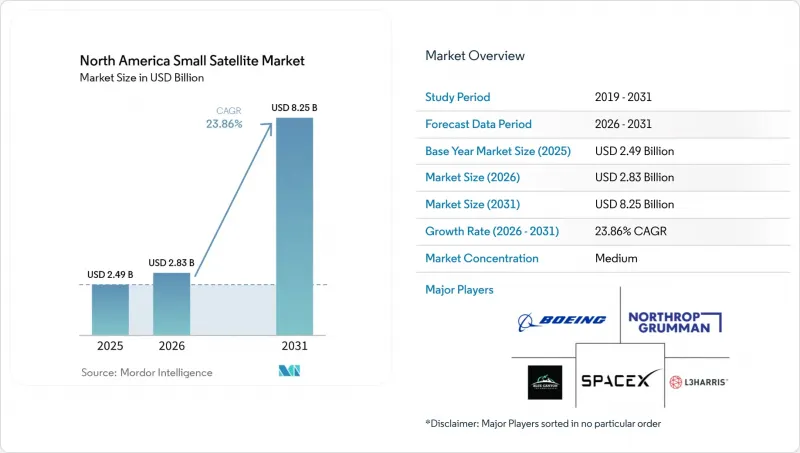
Mordor Intelligence에 의하면, 북미의 소형 위성 시장 규모는 2025년 24억 9,000만 달러로 평가되었고, 2026년 28억 3,000만 달러로 추정되고, 2031년까지 82억 5,000만 달러로 확대될 것으로 예측되며, 2026-2031년 연평균 복합 성장률(CAGR)은 23.86%를 나타낼 전망입니다.
본 보고서는 용도별(통신, 지구관측, 항법, 우주 관측, 기타), 궤도별(LEO, MEO, GEO), 최종 사용자별(민간, 정부·민간, 군사), 위성 질량별(펨토 위성, 피코 위성, 나노 위성, 기타) 및 지역별(미국, 캐나다, 멕시코)로 분류되어 있습니다. 시장 전망은 금액(달러) 기준으로 제시되어 있습니다.
북미의 소형 위성 시장 동향 및 인사이트
고해상도 지구관측 이미지에 대한 수요 증가
고해상도 지구 이미지에 대한 수요 증가는 농업, 도시 개발, 보안, 재난 구호 분야에서의 활용에 힘입어 이루어지고 있습니다. Maxar Technologies의 ‘WorldView Legion’ 시리즈에 속하는 위성은 매우 상세한 이미지(30cm급)와 향상된 재촬영 빈도를 제공하여, 자연재해 등 시간적 제약이 있는 상황에 신속하게 대응할 수 있게 해줍니다. Planet Labs가 앞으로 선보일 ‘Pelican’ 시리즈는 위성에 컴퓨팅 기능을 탑재하여 효율적인 데이터 처리와 지연 시간 단축을 실현합니다. 또한, ICEYE는 고해상도(25cm급)의 전천후 이미지를 제공하기 위해 SAR 위성군 구축을 계속하고 있습니다. 이러한 일련의 발전은 모두 구독형 지구관측 서비스로의 전환에 기여하고 있습니다. Planet Labs나 Maxar Technologies와 같은 기업들 덕분에 북미에서 고해상도 이미지의 실시간 분석이 가능해졌습니다.
재사용형 로켓을 통한 발사 비용 절감
재사용 가능한 발사 시스템은 가격을 낮출 뿐만 아니라, 발사 빈도와 신뢰성을 높임으로써 비용 구조를 크게 변화시키고 있습니다. 스페이스X는 팰컨 9 로켓으로 300회 이상의 부스터 착륙에 성공했으며, 이를 통해 로켓의 재사용이 가능해져 다른 로켓보다 비용 효율성이 높아졌습니다. 그 결과, 엄격한 일정과 주 임무의 우선순위 부여와 같은 과제가 있음에도 불구하고, 이 회사의 차량 공유 서비스의 경쟁력은 높아지고 있습니다. 그럼에도 불구하고, 위성 운영 사업자들은 비용 효율성이 뛰어나기 때문에 이러한 임무를 선호하는 경향이 있습니다. 동시에, Rocket Lab, Firefly Aerospace, Relativity Space와 같은 기업들의 새로운 발사를 통해 소형 로켓의 성능이 향상되고 있습니다. 부스터의 신속한 재사용을 통해 소형 위성 사업자들은 유연하고 수요에 따른 배치를 계획할 수 있게 되었으며, 이를 통해 자본 위험을 줄이는 동시에 위성 군집의 확장성을 높이고 있습니다.
궤도 상의 우주 쓰레기 과밀화와 점점 더 엄격해지는 면허 규제
우주 쓰레기로 인한 혼잡 문제가 심각해짐에 따라, 우주선 운영 사업자에 대한 규제가 강화되고 있습니다. 특히 미국에서는 소형 위성에 대한 면허 요건이 더욱 엄격해지고 있습니다. 연방통신위원회(FCC)는 현재 저궤도 위성에 대해 임무 완료 후 5년 이내에 궤도 이탈을 의무화하고 있습니다. 이 규제에 따라 운영 사업자는 추진 시스템이나 공기 저항 증가 기술 등의 대책을 마련해야 합니다. 또한, 이러한 기준을 준수하기 위해 우주 쓰레기 감축에 관한 규정 개정도 진행되고 있습니다. 위성 운영 사업자 입장에서는 라이선스 발급 절차의 신속화 같은 이점도 인식되고 있습니다. 그러나 위성 군집의 규모가 확대됨에 따라 설계 및 운영이 복잡해지고 있어, 규제 준수에 드는 비용은 증가하는 추세입니다.
부문별 분석
2025년 북미의 소형 위성 시장에서 통신 분야는 여전히 가장 큰 점유율을 차지했으며, 매출의 48.25%를 차지했습니다. 이는 주로 Starlink의 운용 중인 위성 수가 6,000기를 돌파하면서, 이동통신망에 대한 직접 연결(Direct-to-Cell)의 커버리지 범위가 확대되었기 때문입니다. 그러나 기업 고객들이 구독형 분석 서비스로 전환함에 따라, 지구관측 분야는 연평균 성장률(CAGR) 24.78%라는 빠른 속도로 성장하고 있습니다. Planet이 체결한 2억 4,000만 유로(2억 8,135만 달러) 규모의 독일용 용량 계약과 타나가-1이 감지한 5,500건의 메탄 현상은 단순한 픽셀 데이터가 의사결정에 직접적으로 연결되는 인사이트으로 전환되고 있음을 보여줍니다. Xona의 센티미터급 정밀도를 자랑하는 ‘Pulsar’ 콘스텔레이션과 같은 항법 및 하이브리드 PNT 페이로드가 시장의 다양화를 가져오는 한편, 우주 관측 임무에서는 Satellogic과 같은 상용 버스를 활용해 새로운 센서의 프로토타입 개발이 진행되고 있습니다. 이에 따른 부수적인 효과로 상호 간의 시너지 효과를 들 수 있습니다. 하이브리드 위성은 광대역 무선 통신과 광학 이미저를 결합함으로써 1kg당 수익을 극대화하고 있습니다. 규제상의 장벽은 여러 갈래로 나뉘어 있습니다. 통신 사업자들은 FCC의 절차 간소화 혜택을 누리고 있는 반면, 지구관측 임무는 여전히 리드타임을 연장시키는 수출 관리 심사를 통과해야 합니다. 따라서 분석 업체들은 고객의 온보딩을 가속화하기 위해 정책 조화를 추진하고 있으며, 이러한 추세에 힘입어 예측 기간 동안 북미 소형 위성 시장은 확대될 것으로 전망됩니다.
2025년에는 LEO가 매출 점유율의 45.75%를 차지했습니다. 이는 500-600킬로미터라는 최적의 궤도 고도가 재방문 빈도, 발사 비용, 통신 예산 간의 균형을 최적화하기 때문입니다. MEO는 현재 연평균 성장률(CAGR) 24.83%로 성장하고 있으며, 이를 주도하고 있는 것은 5센티미터의 정확도와 간섭 내성을 갖춘, Xona가 계획 중인 258기의 위성으로 구성된 ‘Pulsar’ 네트워크입니다. 북미의 MEO 서비스용 소형 위성 시장은 농업 및 자율주행차 분야의 고객들이 보장된 신뢰성과 이중화 기능을 위해 다소 높은 요금을 지불하고 있기 때문에 성장이 예상됩니다. GEO 임무는 추진 시스템의 비용으로 인해 소형 우주선의 질량 등급이 높아지고 있기 때문에 여전히 그 전개가 제한적입니다. 그렇긴 하지만, 노스롭 그루먼의 ‘미션 익스텐션 포드’가 보여주듯이, 전기 추진과 수명 연장 서비스를 결합하면 500kg 미만의 우주선이라도 GEO 궤도 운용을 경제적으로 실현할 수 있습니다. 또한, 노선별 규제 역시 수요에 영향을 미치고 있습니다. FCC의 5년 규정은 LEO에 가장 큰 타격을 주는 반면, GEO 운영 사업자들은 경도 슬롯 조정에 주력하고 있습니다.
기타 혜택 :
- 엑셀 형식 시장 예측(ME) 시트
- 3개월간의 애널리스트 지원
자주 묻는 질문
목차
제1장 서론
제2장 조사 방법
제3장 주요 요약
제4장 시장 구도
제5장 시장 규모 및 성장 예측
제6장 경쟁 구도
제7장 시장 기회 및 향후 전망
AJY 26.06.30According to Mordor Intelligence, the north america small satellite market size is projected to expand from USD 2.49 billion in 2025 and USD 2.83 billion in 2026 to USD 8.25 billion by 2031, registering a 23.86% CAGR between 2026 and 2031.
This report is Segmented by Application (Communication, Earth Observation, Navigation, Space Observation, and Others), Orbit (LEO, MEO, and GEO), End-User (Commercial, Government and Civil, and Military), Satellite Mass (Femtosatellites, Picosatellites, Nanosatellites, and More), and Geography (United States, Canada, and Mexico). The Market Forecasts are Provided in Terms of Value (USD).
North America Small Satellite Market Trends and Insights
Growing Demand for High-Resolution Earth-Observation Imagery
The growing demand for high-resolution Earth imagery is driven by its applications in agriculture, urban development, security, and disaster relief. Satellites belonging to Maxar Technologies' WorldView Legion series provide highly detailed imagery (30 cm class) and improved revisit frequency, enabling faster responses to time-sensitive incidents such as natural disasters. The upcoming Pelican series from Planet Labs features satellites with onboard computing, enabling efficient data processing and reduced latency. In addition, ICEYE continues to build its SAR constellation to deliver highly detailed (25 cm-class) all-weather imagery. All of these developments are contributing to the move toward subscription-based Earth observation services. Companies like Planet Labs and Maxar Technologies have enabled real-time analysis of high-resolution images in North America.
Declining Launch Costs Driven by Reusable Rockets
Reusable launch systems are significantly altering cost structures by not only reducing prices but also enhancing launch frequency and reliability. SpaceX has achieved over 300 booster landings with Falcon 9 rockets, making them reusable and more cost-effective than other rockets, thereby increasing the competitiveness of its rideshare missions, despite challenges such as rigid schedules and the prioritization of the primary mission. Nevertheless, satellite operators often prefer these missions as they provide better cost efficiency. Simultaneously, new launches by companies such as Rocket Lab, Firefly Aerospace, and Relativity Space have enhanced the capabilities of small launchers. The rapid turnaround of boosters enables small satellite operators to plan flexible, on-demand deployments, reducing capital risks and enhancing the scalability of satellite constellations.
Orbital-Debris Congestion and Stricter Licensing Rules
The growing congestion issue has led to stricter regulations for spacecraft operators, particularly in the US, where licensing requirements for small satellites are becoming more stringent. The Federal Communications Commission (FCC) now requires that low Earth orbit satellites be deorbited within 5 years of completing their missions. This regulation requires operators to implement mitigation measures such as propulsion systems or drag augmentation technology. Additionally, debris mitigation regulations are being updated to ensure adherence to these standards. Satellite operators have recognized benefits, such as faster compliance licensing processes. However, compliance is becoming more expensive due to the growing size of constellations, which adds complexity to design and operations.
Other drivers and restraints analyzed in the detailed report include:
- Rising Private Investment in Large Small-Sat Constellations
- Government Spending on National-Security Small-Sat Programs
- Limited Launch-Slot Availability During Peak Windows
For complete list of drivers and restraints, kindly check the Table Of Contents.
Segment Analysis
Communication remained the largest slice of the North America small satellite market in 2025, accounting for 48.25% of revenue, chiefly because Starlink surpassed 6,000 active satellites and expanded direct-to-cell coverage. Yet Earth observation is growing faster, at a 24.78% CAGR, as enterprise customers migrate to subscription-based analytics. Planet's EUR 240 million (USD 281.35 million) German capacity deal and Tanager-1's detection of 5,500 methane events illustrate how value shifts from raw pixels to decision-ready insights. Navigation and hybrid PNT payloads such as Xona's centimeter-level Pulsar constellation add diversification, while space-observation missions use commercial buses like Satellogic's to prototype new sensors. A second-order effect is cross-fertilization: hybrid satellites combine broadband radios with optical imagers, maximizing revenue per kilogram. Regulatory hurdles diverge; communication operators benefit from streamlined FCC procedures, whereas Earth-observation missions still navigate export-control reviews that extend lead times. Analytics providers, therefore, push for policy harmonization to accelerate customer onboarding, a trend that should enlarge the North America small satellite market over the forecast period.
LEO captured 45.75% of the revenue share in 2025 because its 500-600 kilometer sweet spot balances revisit rates, launch costs, and link budgets. MEO is now growing at a 24.83% CAGR, led by Xona's planned 258-satellite Pulsar network offering 5-centimeter accuracy and anti-jam resilience. The North America small satellite market for MEO services is poised to grow as agriculture and autonomous-vehicle customers pay premiums for guaranteed integrity and redundancy. GEO missions remain sparsely populated because propulsion budgets push small spacecraft into higher mass classes. Still, Northrop Grumman's Mission Extension Pods show that even sub-500-kilogram craft can make GEO financially viable when electric propulsion is combined with life-extension services. Orbit-specific regulation also shapes demand: the FCC's five-year rule hits LEO hardest, whereas GEO operators focus on longitudinal slot coordination.
List of Companies Covered in this Report:
- Space Exploration Technologies Corp.
- Airbus SE
- The Boeing Company
- Lockheed Martin Corporartion
- ICEYE Oy
- AAC Clyde Space AB
- OHB SE
- Surrey Satellite Technology Ltd.
- Thales Alenia Space
- L3Harris Technologies, Inc.
- Sierra Space Corporation
- Planet Labs PBC
- Northrop Grumman Corporation
- Blue Canyon Technologies, LLC (RTX Corporation)
- Spire Global, Inc.
- Satellogic Inc.
Additional Benefits:
- The market estimate (ME) sheet in Excel format
- 3 months of analyst support
TABLE OF CONTENTS
1 INTRODUCTION
- 1.1 Study Assumptions and Market Definition
- 1.2 Scope of the Study
2 RESEARCH METHODOLOGY
3 EXECUTIVE SUMMARY
4 MARKET LANDSCAPE
- 4.1 Market Overview
- 4.2 Market Drivers
- 4.2.1 Declining launch costs driven by reusable rockets
- 4.2.2 Rising private investment in large small-sat constellations
- 4.2.3 Growing demand for high-resolution Earth observation imagery
- 4.2.4 Government spending on national security small-sat programs
- 4.2.5 Shift toward software-defined payloads enabling rapid re-tasking
- 4.2.6 Emergence of on-orbit servicing contracts for small satellites
- 4.3 Market Restraints
- 4.3.1 Orbital-debris congestion and stricter licensing rules
- 4.3.2 RF-spectrum crowding for small-sat communications
- 4.3.3 Limited launch-slot availability during peak windows
- 4.3.4 Insurance-premium hikes for multi-sat rideshare launches
- 4.4 Value Chain Analysis
- 4.5 Regulatory Landscape
- 4.6 Technological Outlook
- 4.7 Porter's Five Forces Analysis
- 4.7.1 Bargaining Power of Suppliers
- 4.7.2 Bargaining Power of Buyers/Consumers
- 4.7.3 Threat of New Entrants
- 4.7.4 Threat of Substitutes
- 4.7.5 Intensity of Competitive Rivalry
5 MARKET SIZE AND GROWTH FORECASTS (VALUE)
- 5.1 By Application
- 5.1.1 Communication
- 5.1.2 Earth Observation
- 5.1.3 Navigation
- 5.1.4 Space Observation
- 5.1.5 Others
- 5.2 By Orbit
- 5.2.1 Low Earth Orbit (LEO)
- 5.2.2 Medium Earth Orbit (MEO)
- 5.2.3 Geostationary Orbit (GEO)
- 5.3 By End-User
- 5.3.1 Commercial
- 5.3.2 Government and Civil
- 5.3.3 Military
- 5.4 By Satellite Mass
- 5.4.1 Femtosatellites
- 5.4.2 Picosatellites
- 5.4.3 Nanosatellites
- 5.4.4 Microsatellites
- 5.4.5 Minisatellites
- 5.5 By Geography
- 5.5.1 United States
- 5.5.2 Canada
- 5.5.3 Mexico
6 COMPETITIVE LANDSCAPE
- 6.1 Market Concentration
- 6.2 Strategic Moves
- 6.3 Market Share Analysis
- 6.4 Company Profiles (includes Global level Overview, Market level overview, Core Segments, Financials, Strategic Information, Market Rank/Share, Products and Services, and Recent Developments)
- 6.4.1 Space Exploration Technologies Corp.
- 6.4.2 Airbus SE
- 6.4.3 The Boeing Company
- 6.4.4 Lockheed Martin Corporartion
- 6.4.5 ICEYE Oy
- 6.4.6 AAC Clyde Space AB
- 6.4.7 OHB SE
- 6.4.8 Surrey Satellite Technology Ltd.
- 6.4.9 Thales Alenia Space
- 6.4.10 L3Harris Technologies, Inc.
- 6.4.11 Sierra Space Corporation
- 6.4.12 Planet Labs PBC
- 6.4.13 Northrop Grumman Corporation
- 6.4.14 Blue Canyon Technologies, LLC (RTX Corporation)
- 6.4.15 Spire Global, Inc.
- 6.4.16 Satellogic Inc.
7 MARKET OPPORTUNITIES AND FUTURE OUTLOOK
- 7.1 White-space and Unmet-need Assessment