|
시장보고서
상품코드
2066624
모기 기피제 : 시장 점유율 분석, 업계 동향 및 통계, 성장 예측(2026-2031년)Mosquito Repellent - Market Share Analysis, Industry Trends & Statistics, Growth Forecasts (2026 - 2031) |
||||||
 Mordor Intelligence
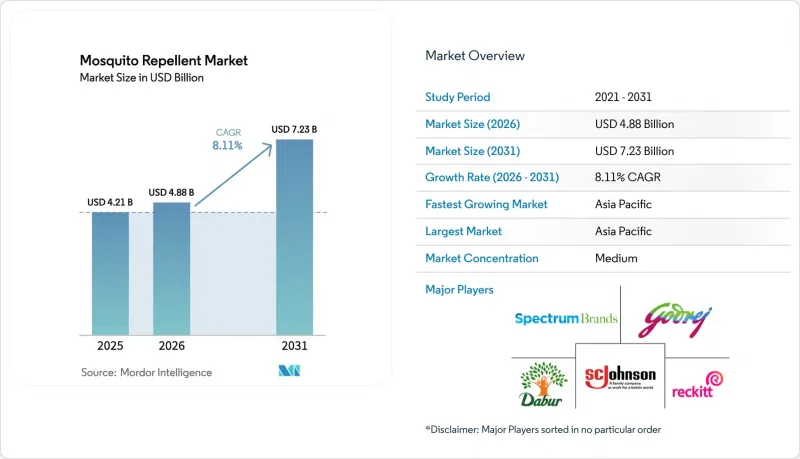
Mordor Intelligence에 의하면, 모기 기피제 시장 규모는 2026년에 48억 8,000만 달러에 달할 것으로 예상됩니다. 2025년 42억 1,000만 달러에서 확대해, 2031년까지 72억 3,000만 달러에 이를 것으로 예측됩니다.
이는 연평균 성장률(CAGR) 8.11%를 나타낼 것으로 전망되며, 질병의 확산, 기후 변화로 인한 매개생물 증가, 그리고 제품 형태의 다양화가 수요를 뒷받침하고 있습니다.
본 보고서는 제품 유형(액체형 기화기, 코일, 스프레이/에어로졸 등), 성분 유형(천연 유래 및 기존), 최종 사용자(성인 및 어린이), 유통 채널(슈퍼마켓 및 하이퍼마켓, 편의점/식료품점 등), 지역(북미, 유럽, 아시아태평양, 남미 등)별로 분류되어 있습니다. 시장 전망은 금액(달러) 기준으로 제시되어 있습니다.
세계의 모기 기피제 시장 동향 및 분석
모기 매개 질환 증가
2024년, 전 세계 뎅기열 환자 수는 1,460만 명으로 급증했으며, 1만 2,000명 이상이 사망했습니다. 미국 질병통제예방센터(CDC)의 보고에 따르면, 2025년 첫 7개월 동안 400만 건 이상의 확진 사례와 3,000명의 사망자가 발생했습니다. 한편, 2023년 말라리아 환자 수는 2억 4,600만 명에 달했으며, 매개성 질환으로 인한 연간 사망자 수는 70만 명을 넘어섰습니다. 기후 변화로 인해 감염 시즌이 장기화되고, 네타이시마카와 마다라카가 과거에는 온대 지역이었던 곳까지 서식 범위를 넓히고 있어, 산발적인 발생이 지속적인 위협으로 변하고 있습니다. 2024년, 인도에서는 뎅기열 환자 수가 28만 5,296명, 사망자 수가 190명을 기록했으며, 2023년에는 말라리아 환자 수가 160만 명을 기록했습니다. 인도네시아에서는 뎅기열 확진자 수가 14만 3,266명, 사망자 수가 1,481명에 달했으며, 태국에서는 확진자 수가 13만 4,784명, 사망자 수가 141명이었습니다. 기온 상승과 도시화로 인해 저수조, 폐타이어, 건설 현장 등에 모기 서식지가 형성되면서, 열대 지역의 대도시에서는 일년내내 감염이 확산되는 상황이 되고 있습니다. 그 결과, 모기 퇴치 시장에서 도포형 및 공간용 퇴치제를 통한 개인 보호 수단은 계절적인 예방책에서 일상 필수품으로 변화하며, 유행 지역에서의 지속적인 수요 성장을 이끌고 있습니다.
천연·유기농·식물 유래 방충제에 대한 선호도 증가
모기 기피제 시장에서 북미와 유럽의 소비자들은 피부 자극, 신경 독성, 환경 내 잔류성에 대한 우려를 이유로 DEET와 같은 합성 성분에 대해 점점 더 신중한 태도를 보이고 있습니다. USDA 인증 유기농 에센셜 오일이 함유된 ‘Lafe's Baby Organic Mosquito Repellent’는 4온스 용량으로 8.99달러에 판매되고 있습니다. 한편, Hello Bello의 식물성 스프레이는 6.7온스 용량에 10.99달러이며, CVS, 콜스, 타겟, 월마트 등 대형 소매점을 통해 판매되고 있습니다. Wondercide는 실험실 테스트를 거친 식물성 제품을 12.99달러에서 44.99달러의 가격대로 제공하며, DEET가 함유되지 않은 대체품을 찾는 반려동물 주인과 가족을 주요 고객층으로 삼고 있습니다. 미국 환경보호청(EPA)은 특정 식물 유래 성분을 제25(b)조 면제 대상으로 분류하고 있으며, 이에 따라 완전한 등록 절차를 거치지 않고도 신속하게 시장에 진출할 수 있게 되었습니다. 그러나 연구 결과에 따르면, 이러한 성분들은 피카리딘이나 IR3535와 같은 검증된 대안에 비해 방충 효과가 지속되는 시간이 짧은 것으로 밝혀졌습니다. 각 브랜드는 마케팅상의 주장과 제품의 성능 간의 균형을 신중하게 고려해야 합니다. 소비자의 취향도 제각각이라, 2시간마다 모기 기피제를 다시 바르는 것을 꺼리지 않는 사람도 있는 반면, 하루 종일 효과가 지속되는 제품을 선호하는 사람도 있습니다. 이러한 수요의 다양성이 모기 기피제 시장의 성장을 이끄는 주요 요인이 되고 있습니다.
합성 화학 물질의 독성, 피부 자극 및 장기적인 영향과 관련된 건강 및 안전상의 우려
건강에 대한 우려로 인해, 학부모, 임산부 및 민감성 피부를 가진 분들 사이에서는 이러한 제품의 사용이 주춤하고 있습니다. 가장 널리 사용되는 유효 성분인 DEET는 미국 환경보호청(EPA)과 유럽화학물질청(ECHA)으로부터 수십 년간 규제 승인을 받아왔음에도 불구하고, 잠재적인 신경 독성 및 피부 반응에 대한 비판을 받고 있습니다. 피카리딘이나 IR3535는 비슷한 효과를 가지면서도 피부에 대한 자극이 적은 것이 특징이지만, 소비자 인지도가 낮기 때문에 많은 시장에서 여전히 DEET가 기본 선택지로 자리 잡고 있습니다. 시트로넬라, 레몬그라스, 유칼립투스 등의 에센셜 오일은 방충 효과가 짧아(보통 2시간 이내), 모기가 가장 활발하게 활동하는 시간대에는 자주 다시 바르거나 도포 범위를 좁혀야 합니다. 미국 식품의약국(FDA)과 미국 질병통제예방센터(CDC)는 확실한 보호를 위해 EPA에 등록된 방충제 사용을 권장하고 있습니다. 그러나 온라인 포럼이나 소셜 미디어를 통해 확산된 부작용에 대한 체험담이 합성 성분이 함유된 제품에 대한 신뢰를 떨어뜨리고 있습니다. 모기 기피제 시장에서 임상시험, 피부과적 시험 및 투명한 성분 표시에 주력하는 브랜드는 안전성에 대한 인식이 점점 더 중요시되는 시장에서 타사와의 차별화를 꾀할 수 있습니다.
부문별 분석
2025년에는 스프레이 및 에어로졸 유형이 모기 기피제 시장의 46.25%를 차지했으며, 특히 야외 활동, 여행, 긴급 상황 등에서 휴대성이 뛰어나고 즉효성이 있는 제품에 대한 소비자의 강한 수요가 두드러지게 나타났습니다. 피부에 닿을 염려가 없고 자주 덧바를 필요가 없으며, 밤새도록 효과가 지속된다는 점 때문에 선호되는 액체형 발연기는 특히 뎅기열이 유행하기 쉬운 지역에서 2031년까지 연평균 성장률(CAGR) 9.14%를 기록하며 가장 높은 성장률을 보일 것으로 전망됩니다. 인도에서는 고드레이 컨슈머 프로덕츠(Godray’s Consumer Products)사의 ‘굿나이트(Goodnight)’ 액체 연무기가 도시 및 준도시 지역 시장을 휩쓸고 있습니다. 마찬가지로, 레킷 벤키저사의 ‘몰테인’ 브랜드는 호주와 동남아시아에서 큰 시장 점유율을 차지하고 있습니다. 모기향은 전력 공급이 제한된 농촌 지역이나 야외 환경에서 여전히 널리 사용되고 있습니다.
그러나 연기 흡입이나 연소 시간이 짧다는 점에 대한 우려로 인해, 도시 지역에서의 인기는 떨어지고 있습니다. 부모 입장에서는 크림, 로션, 롤온 제품이 자녀에게 바르는 양을 조절하기 쉬운 선택지로 자리 잡고 있으며, 다부르(Dabur)사의 ‘오도모스(Odomos)’ 크림이 인도 바르는 제품 시장을 선도하고 있습니다. 패치 및 웨어러블 제품은 규모가 가장 작은 부문이지만, 주목할 만한 혁신적인 시도들이 모여 있습니다. 'Wondercide'나 'Hello Bello'와 같은 브랜드는 등산객, 페스티벌 참가자, 군 관계자를 대상으로 DEET가 함유되지 않은 클립형 기기와 접착 패치를 개발하고 있습니다. 미국 환경보호청(EPA)의 VERV 프로그램은 이러한 혁신적인 살포 시스템에 대한 심사를 신속하게 처리함으로써, 제조업체들이 실내용 방충제나 잦은 재도포가 필요 없는 오래 지속되는 제제에 대한 투자를 촉진하고 있습니다.
2025년, 기존의 합성 방충제는 모기 기피제 시장 점유율의 83.48%를 차지했으며, 이는 DEET가 수십 년에 걸쳐 입증된 효능과 미국 환경보호청 및 유럽 화학물질청의 승인을 바탕으로 한 결과입니다. 2026년부터 2031년에 걸쳐 천연 유래 모기 기피제 시장은 연평균 성장률(CAGR) 9.55%로 성장할 것으로 전망됩니다. 이는 북미와 유럽의 소비자들이 성분 표기를 점점 더 중요하게 여기며, 시트로넬라, 레몬그라스, 유칼립투스, 님 등 식물 유래 유효 성분을 선호하는 경향이 강해지고 있기 때문입니다. USDA 인증 유기농 에센셜 오일을 사용한 ‘Lafe's Baby Organic Mosquito Repellent’는 4온스 용량에 8.99달러입니다. 한편, Hello Bello의 식물성 스프레이는 6.7온스 용량에 10.99달러이며, CVS, 콜스, 타겟, 월마트 등 대형 소매점에서 판매되고 있습니다. Wondercide사는 DEET가 함유되지 않은 제품을 찾는 반려동물 주인과 가족들을 위해, 실험실 테스트를 거친 식물 유래 제품을 12.99달러에서 44.99달러의 가격대로 제공합니다.
그러나 유효성 면에서는 여전히 큰 차이가 있습니다. 에센셜 오일의 보호 효과는 보통 약 2시간인 반면, 피카리딘이나 IR3535와 같은 합성 성분은 8-12시간 동안 효과를 발휘합니다. 그 결과, 천연 유래 제품을 사용하는 사람들은 더 자주 덧바르거나, 모기의 활동이 가장 활발한 시간대에는 보호 효과가 떨어지는 것을 받아들여야 합니다. 미국 환경보호청(EPA)은 특정 식물 유래 성분을 제25조(b)항의 적용 제외 대상으로 분류하고 있으며, 이에 따라 완전한 등록 절차를 거치지 않고도 신속하게 시장에 진출할 수 있게 되었습니다. 그러나 시판 후 모니터링을 통해 제제마다 성능에 편차가 있는 것으로 밝혀졌습니다. 모기 기피제 시장에서 마이크로캡슐화, 서방형 폴리머, 시너지 효과를 내는 블렌드 등 혁신적인 기술에 주력하는 브랜드는 천연 유래 제품의 효능을 향상시키고, 합성 제품과의 성능 격차를 좁힐 수 있습니다. 이를 통해, 미미한 개선을 위해 고가를 지불하는 것을 주저하는 비용에 민감한 소비자를 유치할 수 있게 됩니다.
지역별 분석
2025년, 아시아태평양은 모기 기피제 시장에서 54.72%라는 높은 점유율을 차지했으며, 2031년까지 연평균 성장률(CAGR) 9.58%라는 견조한 성장세를 유지하며 가장 빠르게 성장하는 지역으로서의 위상을 유지할 것으로 예측됩니다. 이러한 증가는 주로 뎅기열과 관련된 우려스러운 통계 자료에 의해 주도되고 있습니다. 2024년, 인도에서는 28만 5,296건의 확진 사례와 190명의 사망자가 보고되었으며, 인도네시아에서는 14만 3,266건의 확진 사례와 1,481명의 사망자가 기록되었고, 태국에서는 13만 4,784건의 확진 사례와 141명의 사망자가 보고되었습니다. 중국에서는 국가위생건강위원회가 광둥성, 광남성, 푸젠성 등 남부 성에서 연간 환자 수가 2,000건에서 1만 건 사이인 지역을 대상으로, 통합적인 매개체 관리를 통해 뎅기열 대책을 적극적으로 추진하고 있습니다. 중국, 인도, 인도네시아에서는 가처분 소득 증가에 따라 고품질의 천연 유래 제제나 오래 지속되는 기화식 제품에 대한 수요가 높아지고 있으며, 기존의 코일식에서 액상 기화기나 에어로졸 제품으로의 전환이 진행되고 있습니다. 일본, 한국, 싱가포르와 같은 성숙한 시장에서는 공간용 방충제나 웨어러블 기기의 보급률이 이미 높은 수준입니다. 한편, 호주에서는 아웃도어 중심의 라이프스타일이 뿌리 깊게 자리 잡고 있어, 고농도의 DEET나 피카리진이 함유된 스프레이에 대한 수요가 계속해서 지지를 받고 있습니다.
북미 및 유럽의 모기 기피제 시장에서 소비자들은 DEET와 같은 합성 성분에 대해 점점 더 신중해지고 있으며, 천연·유기 성분이 함유된 제품을 선호하는 경향이 높아지고 있습니다. 이 지역들의 규제 체계는 식물 유래 대체재의 사용을 장려함으로써 이러한 변화를 더욱 뒷받침하고 있습니다. 예를 들어, 미국 환경보호청(EPA)의 제25조(b)항에 따른 면제 조치 덕분에 특정 식물 유래 성분 시장 진입이 가속화되고 있습니다. 마찬가지로, 유럽화학물질청(ECHA)은 살생물제 규정(EU) 528/2012에 따라 엄격한 규제를 시행하고 있으며, 유효 성분의 승인 및 회원국에 의한 인가를 의무화하고 있습니다. Lafe's, Hello Bello, Wondercide 등의 브랜드는 USDA 인증 유기농 및 식물 유래 성분을 사용하며, 8.99달러에서 44.99달러의 가격대로 프리미엄 시장을 개척하고 있습니다. 이러한 제품들은 CVS, 콜스, 타겟, 월마트 등 대형 소매점뿐만 아니라 소비자에게 직접 판매하는 채널을 통해서도 널리 구할 수 있습니다.
남미에서는 뎅기열이나 말라리아와 같은 질병의 위협이 여전히 존재하고 있어, 효과적이면서도 가격 부담이 적은 모기 기피제에 대한 수요가 지속되고 있습니다. SC 존슨사는 2024년 아르헨티나에서 뎅기열이 유행했을 때, 모기 기피제 24만 개를 배포하는 등 적극적인 대책을 마련했습니다. 또한, 이 회사는 2023년 1월 브라질의 인플루언서 타타 베르네크 씨와 제휴하여 소셜 미디어 캠페인 ‘#ViraOJogo’를 통해 2만 5,000명 이상의 사람들에게 도달했습니다. 브라질, 콜롬비아, 칠레, 페루 등의 국가에서는 뎅기열이 풍토병으로 널리 퍼져 있습니다. 학교, 군사 기지, 공공 주택 프로젝트를 위한 정부 계약을 통해 방충제에 대한 안정적인 수요가 확보되고 있지만, 예산 제약과 관료적 지연으로 인해 방충제 시장공급망이 종종 혼란을 겪고 있습니다. 남아프리카, 사우디아라비아, 아랍에미리트(UAE) 등 1인당 소득이 높은 지역에서는 고품질 천연 성분이 함유된 제품이나 오래 지속되는 연무식 방충제에 대한 투자가 이루어지는 경향이 있습니다. 그러나 특히 분쟁의 영향을 받고 있는 지역에서는 자원 부족과 정세 불안으로 인해 효과적인 대책의 시행이 계속해서 저해되고 있습니다.
기타 혜택 :
- 엑셀 형식 시장 예측(ME) 시트
- 3개월간의 애널리스트 지원
자주 묻는 질문
목차
제1장 서론
제2장 조사 방법
제3장 주요 요약
제4장 시장 구도
제5장 시장 규모 및 성장 예측
제6장 경쟁 구도
제7장 시장 기회 및 향후 전망
KTH 26.06.29According to Mordor Intelligence, the mosquito repellent market size is valued at USD 4.88 billion in 2026, growing from the 2025 value of USD 4.21 billion, and is forecast to climb to USD 7.23 billion by 2031, advancing at a 8.11% CAGR, with accelerating disease prevalence, climate-driven vector expansion, and expanding product formats supporting demand.
This report is Segmented by Product Type (Liquid Vaporizers, Coils, Sprays/Aerosols, and More), Ingredient Type (Natural and Conventional), End User (Adults and Kids/Children), Distribution Channel (Supermarkets/Hypermarkets, Convenience/Grocery Stores, and More), and Geography (North America, Europe, Asia-Pacific, South America, and More). The Market Forecasts are Provided in Terms of Value (USD).
Global Mosquito Repellent Market Trends and Insights
Increasing Prevalence of Mosquito-Borne Diseases
In 2024, global dengue cases surged to 14.6 million, leading to over 12,000 fatalities. The Centers for Disease Control and Prevention reported that in the first seven months of 2025, there were more than 4 million cases and 3,000 deaths. Meanwhile, malaria cases stood at 246 million in 2023, and vector-borne diseases accounted for over 700,000 annual deaths. Climate change is lengthening transmission seasons and relocating Aedes and Anopheles mosquitoes to once-temperate areas, turning sporadic outbreaks into persistent threats. In 2024, India recorded 285,296 dengue cases with 190 deaths, and in 2023, it logged 1.6 million malaria cases. Indonesia faced 143,266 dengue cases and 1,481 deaths, while Thailand had 134,784 cases with 141 fatalities. Rising temperatures and urbanization are creating breeding grounds in water storage containers, discarded tires, and construction sites, enabling year-round transmission in tropical megacities. As a result, personal protection through topical and spatial repellents in the mosquito repellent market has shifted from a seasonal precaution to a daily necessity, driving sustained demand growth in endemic regions.
Rising Preference for Natural, Organic, and Plant-Based Repellents
In the mosquito repellent market, consumers in North America and Europe are increasingly cautious about synthetic ingredients like DEET, citing concerns over skin irritation, neurotoxicity, and environmental persistence. Lafe's Baby Organic Mosquito Repellent, featuring USDA Certified Organic essential oils, is priced at USD 8.99 for a 4-ounce bottle. In comparison, Hello Bello's plant-based spray, priced at USD 10.99 for 6.7 ounces, is distributed through major retailers such as CVS, Kohl's, Target, and Walmart. Wondercide offers lab-tested, plant-based formulations priced between USD 12.99 and USD 44.99, catering to pet owners and families seeking DEET-free alternatives. The U.S. Environmental Protection Agency (EPA) has categorized certain botanical ingredients under its 25(b) exemptions, enabling quicker market entry without full registration. However, studies reveal that these ingredients provide shorter protection durations compared to established options like picaridin or IR3535. Brands must carefully balance their marketing claims with product performance. Consumer preferences also vary, with some willing to reapply repellents every two hours, while others prioritize products offering all-day protection. This diversity in demand is a primary driver of growth in the mosquito repellent market.
Health and Safety Concerns Over Synthetic Chemicals' Toxicity, Skin Irritation, and Long-Term Effects
Health concerns are slowing adoption among parents, pregnant women, and individuals with sensitive skin. DEET, the most widely used active ingredient, faces criticism for potential neurotoxicity and skin reactions, despite decades of regulatory approval from the US Environmental Protection Agency and the European Chemicals Agency. Picaridin and IR3535 provide similar efficacy with gentler sensory profiles, but limited consumer awareness keeps DEET as the default choice in many markets. Essential oils like citronella, lemongrass, and eucalyptus offer shorter protection durations-typically two hours or less-requiring frequent reapplication or reduced coverage during peak biting periods. The US Food and Drug Administration and the Centers for Disease Control and Prevention recommend EPA-registered repellents for reliable protection. However, anecdotal reports of adverse reactions, amplified by online forums and social media, are undermining confidence in synthetic formulations. Brands in the mosquito repellent market that focus on clinical trials, dermatological testing, and transparent ingredient labeling can stand out in a market increasingly driven by safety perceptions.
Other drivers and restraints analyzed in the detailed report include:
- Innovation in Product Formats, Including Wearables, Mats, Coils, and Long-Lasting Formulations
- Government Initiatives and Public Health Campaigns
- Stringent Regulations on Chemical Ingredients
For complete list of drivers and restraints, kindly check the Table Of Contents.
Segment Analysis
In 2025, spray and aerosol formats accounted for 46.25% of the mosquito repellent market, highlighting strong consumer demand for portable and instant solutions, particularly for outdoor activities, travel, and emergencies. Liquid vaporizers, preferred for their overnight protection without requiring skin contact or frequent reapplication, are projected to grow at the fastest rate, with a 9.14% CAGR through 2031, especially in dengue-prone regions. In India, Godrej Consumer Products' Goodknight liquid vaporizers dominate urban and semi-urban markets. Similarly, Reckitt Benckiser's Mortein brand holds a significant market share in Australia and Southeast Asia. Coils continue to be widely used in rural areas and outdoor settings where electricity access is limited.
However, concerns about smoke inhalation and shorter burn durations have reduced their popularity in urban areas. For parents, creams, lotions, and roll-ons provide a controlled application option for children, with Dabur's Odomos cream leading India's topical market. Although patches and wearables represent the smallest segment, they are attracting notable innovation efforts. Brands such as Wondercide and Hello Bello are developing DEET-free clip-on devices and adhesive patches aimed at hikers, festival-goers, and military personnel. The US Environmental Protection Agency's VERV program is expediting the review of these innovative delivery systems, motivating manufacturers to invest in spatial repellents and long-lasting formulations that reduce the need for frequent reapplication.
In 2025, conventional synthetic repellents accounted for 83.48% of the mosquito repellent market share, supported by DEET's proven efficacy over decades and approvals from the US Environmental Protection Agency and the European Chemicals Agency. Between 2026 and 2031, natural mosquito repellents are projected to grow at a 9.55% CAGR, driven by North American and European consumers increasingly examining ingredient labels and favoring botanical actives such as citronella, lemongrass, eucalyptus, and neem. Lafe's Baby Organic Mosquito Repellent, made with USDA Certified Organic essential oils, is priced at USD 8.99 for a 4-ounce bottle. In comparison, Hello Bello's plant-based spray, priced at USD 10.99 for 6.7 ounces, is available through major retailers like CVS, Kohl's, Target, and Walmart. Wondercide offers lab-tested, plant-based formulations priced between USD 12.99 and USD 44.99, catering to pet owners and families seeking DEET-free options.
However, a significant efficacy gap remains: essential oils typically provide around two hours of protection, whereas synthetics like picaridin or IR3535 offer eight to twelve hours. As a result, users of natural products must either reapply more frequently or accept reduced coverage during peak biting periods. The US Environmental Protection Agency classifies certain botanical ingredients under its 25(b) exemptions, enabling faster market entry without full registration. However, post-market surveillance has revealed varying performance across formulations. In the mosquito repellent market, brands focusing on innovations such as microencapsulation, controlled-release polymers, and synergistic blends can improve the efficacy of natural products, narrowing the performance gap with synthetic alternatives and attracting cost-conscious consumers who are reluctant to pay higher prices for minimal improvements.
Geography Analysis
In 2025, Asia-Pacific accounted for a significant 54.72% share of the mosquito repellent market and is expected to maintain its position as the fastest-growing region with a strong 9.58% CAGR through 2031. This growth is primarily driven by concerning dengue statistics: India reported 285,296 cases and 190 deaths in 2024, Indonesia recorded 143,266 cases with 1,481 fatalities, and Thailand reported 134,784 cases with 141 deaths. In China, the National Health Commission actively manages dengue through integrated vector management in southern provinces such as Guangdong, Yunnan, and Fujian, where annual cases range between 2,000 and 10,000. Rising disposable incomes in China, India, and Indonesia are driving demand for premium natural formulations and long-lasting vaporizers, with a shift from traditional coils to liquid vaporizers and aerosols. In the mature markets of Japan, South Korea, and Singapore, spatial repellents and wearable devices have achieved high penetration. Meanwhile, Australia's outdoor lifestyle continues to sustain demand for high-concentration DEET and picaridin sprays.
In the mosquito repellent market in North America and Europe, consumers are increasingly cautious about synthetic ingredients like DEET, driving a preference for natural and organic formulations. Regulatory frameworks in these regions further support this shift by promoting botanical alternatives. For example, the US Environmental Protection Agency's 25(b) exemptions facilitate quicker market entry for certain plant-based ingredients. Similarly, the European Chemicals Agency enforces strict regulations under the Biocidal Products Regulation (EU) 528/2012, requiring active substance approval and member-state authorization. Brands such as Lafe's, Hello Bello, and Wondercide are capitalizing on the premium market with USDA Certified Organic and plant-powered formulations priced between USD 8.99 and USD 44.99. These products are widely available at major retailers like CVS, Kohl's, Target, and Walmart, as well as through direct-to-consumer channels.
In South America, the ongoing threat of diseases like dengue and malaria sustains demand for effective and affordable mosquito repellents. SC Johnson took proactive measures by distributing 240,000 mosquito repellents during Argentina's 2024 dengue outbreak. The company also partnered with Brazilian influencer Tata Werneck in January 2023, using the #ViraOJogo social media campaign to reach over 25,000 individuals. Countries such as Brazil, Colombia, Chile, and Peru face endemic dengue transmission. Government contracts for schools, military bases, and public housing projects provide stable demand for repellents, but budget limitations and bureaucratic delays often disrupt supply chains within the mosquito repellent market. Regions like South Africa, Saudi Arabia, and the UAE, with higher per-capita incomes, are more likely to invest in premium natural formulations and long-lasting vaporizers. However, resource shortages and political instability, particularly in conflict-affected areas, continue to hinder effective implementation.
- S. C. Johnson and Son, Inc.
- Reckitt Benckiser Group plc
- Spectrum Brands Holdings Inc.
- Godrej Consumer Products Limited
- Dabur India Ltd
- PIC Corporation
- Tiger Brands Ltd
- Coghlan's Ltd.
- HonasaConsumer Pvt. Ltd.
- Henkel AG and Co. KGaA
- Natura and Co. Holding SA (Avon)
- 3M Company
- Newell Brands Inc.
- Sawyer Products, Inc.
- Jyothy Labs Limited
- PelGar International Limited
- Enesis Group
- Clariant AG
- Hello Bello LLC
- Mother Sparsh Baby Care Private Limite
Additional Benefits:
- The market estimate (ME) sheet in Excel format
- 3 months of analyst support
TABLE OF CONTENTS
1 INTRODUCTION
- 1.1 Study Assumptions and Market Definition
- 1.2 Scope of the Study
2 RESEARCH METHODOLOGY
3 EXECUTIVE SUMMARY
4 MARKET LANDSCAPE
- 4.1 Market Overview
- 4.2 Market Drivers
- 4.2.1 Increasing prevalence of mosquito-borne diseases
- 4.2.2 Rising preference for natural, organic, and plant-based repellents
- 4.2.3 Innovation in product formats, including wearables, mats, coils, and long-lasting formulations
- 4.2.4 Government initiatives and public health campaigns
- 4.2.5 Influence of Social Media Platforms and Celebrity Endorsements
- 4.2.6 Higher disposable incomes in developing markets enable spending on premium and eco-friendly products
- 4.3 Market Restraints
- 4.3.1 Proliferation of Counterfeit Products
- 4.3.2 Health and safety concerns over synthetic chemicals' toxicity, skin irritation, and long-term effects
- 4.3.3 Stringent regulations on chemical ingredients
- 4.3.4 Consumer shift toward Traditional products
- 4.4 Consumer Behaviour Analysis
- 4.5 Technology Outlook
- 4.6 Regulatory Outlook
- 4.7 Value Chain Analysis
- 4.8 Porter's Five Forces
- 4.8.1 Threat of New Entrants
- 4.8.2 Bargaining Power of Buyers/Consumers
- 4.8.3 Bargaining Power of Suppliers
- 4.8.4 Threat of Substitute Products
- 4.8.5 Intensity of Competitive Rivalry
5 MARKET SIZE AND GROWTH FORECASTS (VALUE)
- 5.1 Product Type
- 5.1.1 Liquid Vaporizer
- 5.1.2 Coils
- 5.1.3 Spray/Aerosol
- 5.1.4 Creams, Lotions, and Roll-ons
- 5.1.5 Patches and Wearables
- 5.1.6 Other Product Types
- 5.2 Ingredient Type
- 5.2.1 Natural Mosquito Repellent
- 5.2.2 Conventional Mosquito Repellent
- 5.3 Distribution Channels
- 5.3.1 Supermarkets/Hypermarkets
- 5.3.2 Convenience Stores
- 5.3.3 Pharmacies and Drug Stores
- 5.3.4 Online Retail Channels
- 5.3.5 Other Distrbution Channels
- 5.4 By Geography
- 5.4.1 North America
- 5.4.1.1 United States
- 5.4.1.2 Canada
- 5.4.1.3 Mexico
- 5.4.1.4 Rest of North America
- 5.4.2 Europe
- 5.4.2.1 Germany
- 5.4.2.2 United Kingdom
- 5.4.2.3 Italy
- 5.4.2.4 France
- 5.4.2.5 Spain
- 5.4.2.6 Netherlands
- 5.4.2.7 Poland
- 5.4.2.8 Belgium
- 5.4.2.9 Sweden
- 5.4.2.10 Rest of Europe
- 5.4.3 Asia-Pacific
- 5.4.3.1 China
- 5.4.3.2 India
- 5.4.3.3 Japan
- 5.4.3.4 Australia
- 5.4.3.5 Indonesia
- 5.4.3.6 South Korea
- 5.4.3.7 Thailand
- 5.4.3.8 Singapore
- 5.4.3.9 Rest of Asia-Pacific
- 5.4.4 South America
- 5.4.4.1 Brazil
- 5.4.4.2 Argentina
- 5.4.4.3 Colombia
- 5.4.4.4 Chile
- 5.4.4.5 Peru
- 5.4.5 Middle East and Africa
- 5.4.5.1 South Africa
- 5.4.5.2 Saudi Arabia
- 5.4.5.3 United Arab Emirates
- 5.4.5.4 Nigeria
- 5.4.5.5 Egypt
- 5.4.5.6 Morocco
- 5.4.5.7 Turkey
- 5.4.5.8 Rest of Middle East and Africa
- 5.4.1 North America
6 COMPETITIVE LANDSCAPE
- 6.1 Market Concentration
- 6.2 Strategic Moves
- 6.3 Market Ranking Analysis
- 6.4 Company Profiles (includes Global-level Overview, Market-level Overview, Core Segments, Financials (if available), Strategic Information, Market Rank/Share, Products and Services, Recent Developments)
- 6.4.1 S. C. Johnson and Son, Inc.
- 6.4.2 Reckitt Benckiser Group plc
- 6.4.3 Spectrum Brands Holdings Inc.
- 6.4.4 Godrej Consumer Products Limited
- 6.4.5 Dabur India Ltd
- 6.4.6 PIC Corporation
- 6.4.7 Tiger Brands Ltd
- 6.4.8 Coghlan's Ltd.
- 6.4.9 HonasaConsumer Pvt. Ltd.
- 6.4.10 Henkel AG and Co. KGaA
- 6.4.11 Natura and Co. Holding SA (Avon)
- 6.4.12 3M Company
- 6.4.13 Newell Brands Inc.
- 6.4.14 Sawyer Products, Inc.
- 6.4.15 Jyothy Labs Limited
- 6.4.16 PelGar International Limited
- 6.4.17 Enesis Group
- 6.4.18 Clariant AG
- 6.4.19 Hello Bello LLC
- 6.4.20 Mother Sparsh Baby Care Private Limite