|
시장보고서
상품코드
2097443
북미의 모기 기피제 : 시장 점유율 분석, 업계 동향과 통계, 성장 예측(2026-2031년)North America Mosquito Repellent - Market Share Analysis, Industry Trends & Statistics, Growth Forecasts (2026 - 2031) |
||||||
 Mordor Intelligence
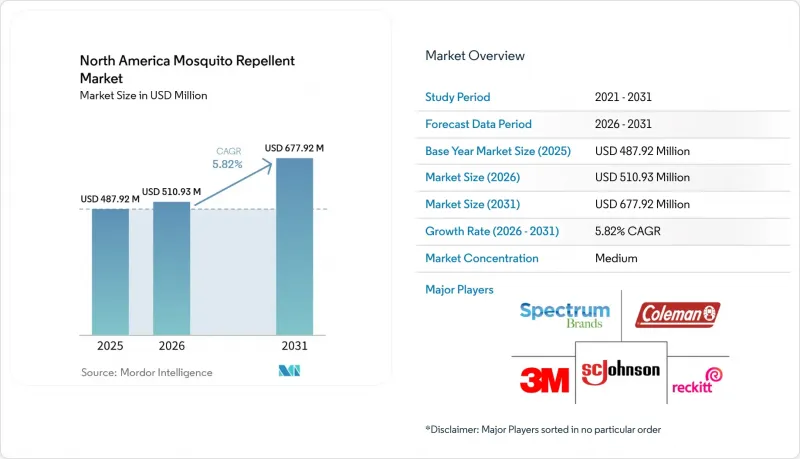
Mordor Intelligence에 의하면, 북미의 모기 기피제 시장 규모는 2025년 4억 8,790만 달러, 2026년 5억 1,090만 달러에서 2031년까지 6억 7,790만 달러에 달할 것으로 예측되며, 2026-2031년 연평균 복합 성장률(CAGR)은 5.8%를 나타낼 전망입니다.
본 보고서는 제품 유형(액체형 스프레이, 크림/로션 등), 성분 유형(천연 유래 및 기존), 최종 사용자(성인 및 어린이), 판매 채널(슈퍼마켓, 편의점, 약국, 온라인 소매 등), 지역(미국, 캐나다, 멕시코 및 기타 북미)별로 분류되어 있습니다. 시장 전망은 금액(달러) 기준으로 제시되어 있습니다.
북미 모기 퇴치제 시장 동향 및 인사이트
모기 매개 질환에 대한 인식 제고 및 예방을 위한 지출 증가
북미에서는 매개 질환의 사례 수가 증가하고 있으며, 이것이 모기 퇴치 제품에 대한 수요를 견인하고 있습니다. 이로 인해 유행이 잦아든 시기에도 공중 보건에 대한 관심이 지속되고 있습니다. 2024년, 미국 질병통제예방센터(CDC)는 전미 각 주 및 워싱턴 D.C.에서 3,798건의 뎅기열 사례를 보고했습니다. 이는 2010년부터 2023년까지의 연간 평균과 비교했을 때, 무려 359%라는 놀라운 급증세를 보여줍니다. 플로리다주, 캘리포니아주, 뉴욕주, 텍사스주가 주요 감염 핫스팟으로 떠올랐으며, 플로리다주에서는 10개 카운티에서 지역 내 감염이 확인되었습니다. 미국 보건복지부는 2024년 ‘국가 공중보건 전략’을 통해 매개성 감염병을 연방 정부의 우선 과제로 지정했습니다. 이 전략은 CDC와 EPA(환경보호청)의 협력을 촉진하고 있으며, 개별 브랜드의 마케팅 없이도 광범위한 소비자 인식 제고를 이끌어내고 있습니다. 감염병의 위협이 커짐에 따라, 기존의 피부 도포형을 넘어선 공간용 방충 기술에 대한 제도적 관심이 높아지고 있습니다. SC 존슨의 ‘가디언’은 2025년 8월, 공간용 방충제로서는 최초로 WHO의 지침에 따른 승인을 받았습니다. 이는 북미에서 이 제품 카테고리가 공중보건 분야에서 일반 소매 시장으로 전환될 가능성을 시사합니다. 또한, 학교에서의 예방 캠페인과 정부의 여행 권고는 무료 인식 제고 도구로 기능하며, 추가 마케팅 비용을 들이지 않고도 방충제 시장을 확대되고 있습니다.
야외 레크리에이션 및 여행 이용이 정점에 달할 전망
미국 경제분석국(BEA) 보고서에 따르면, 2024년 북미의 야외 레크리에이션은 경제 효과로 무려 1조 2,000억 달러를 창출하여 GDP의 2.3%를 차지하고, 500만 명의 일자리를 지탱했습니다. 이러한 규모는 야외 레크리에이션이 기존에 여겨지던 틈새 시장의 범주를 넘어, 주류적인 경제적 의미를 지닌다는 점을 여실히 보여줍니다. OIA(전미 아웃도어 산업 협회)의 '2025년 참여 동향 보고서'에 따르면, 미국의 아웃도어 참여자 수는 전년 대비 3% 증가하여 2024년에는 1억 8,110만 명에 달했습니다. 특히 하이킹과 캠핑은 각각 200만 명 이상의 신규 참가자를 확보했으며, 이는 모기에 노출될 기회를 늘리고, 결과적으로 방충제 제품 구매를 촉진하는 ‘입문 활동’으로서의 역할을 하고 있습니다. KOA의 『2026년 캠핑·아웃도어·호스피탈리티 보고서』에 따르면, 2025년에는 북미에서 5,200만 가구 이상이 캠핑을 즐긴 것으로 나타났습니다. 아웃도어·호스피탈리티 분야에 대한 지출은 660억 달러로 급증하여, 2024년 대비 50억 달러 증가를 기록했습니다. 이 데이터는 팬데믹 이후 아웃도어 활동에 대한 열기가 2020년 이전 수준까지 사그라들지 않았음을 뒷받침합니다. 이러한 가족 중심의 아웃도어 트렌드를 반영하여, ‘어린이’ 최종 사용자 부문은 2031년까지 연평균 성장률(CAGR) 7.12%를 나타낼 것으로 예측됩니다. 가족들이 여행 계획에 캠핑, 하이킹, 수변 레크리에이션을 점점 더 많이 포함함에 따라, 어린이를 위한 모기 퇴치제 사용의 빈도와 다양성이 확대되고 있습니다.
합성 유효 성분을 둘러싼 안전성 우려
미국 환경보호청(EPA)과 캐나다 보건부의 수십 년에 걸친 권장에도 불구하고, DEET의 안전성에 대한 평가는 특히 어린 자녀를 둔 부모들 사이에서 후퇴하고 있습니다. 아이들의 민감한 피부에 모기 퇴치제를 자주 바르는 이러한 부모들은 과학적 근거보다는 인식에 더 크게 좌우되는 경향이 강해지고 있습니다. PubMed Central에 게재된 2025년 연구에서는 잠재적인 위험이 부각되었습니다. 이 연구에서는 DEET 노출과 소아 및 청소년의 성호르몬 및 골밀도에 미치는 악영향 사이에 역학적 연관성이 확인되었습니다. 이러한 연구 결과가 더 널리 알려지면, 소아용 제품의 성분 재조정을 요구하는 움직임이 가속화되어 현재의 과학적 근거를 넘어 안전성에 대한 우려가 높아질 가능성이 있습니다. 한편, 캐나다 보건부는 재평가 결정안 PRVD2025-09(2025년 10월)에서 DEET 제품의 라벨 갱신을 제안하고 있습니다. 여기에는 어린이용 농도 지침이 포함되어 있어, 모기 퇴치 제품의 성분 구성에 관한 보호자의 선택권을 재구성하고 있는 엄격한 감독 상황을 여실히 보여주고 있습니다. 2025년에는 기존 방충제가 성분 부문의 82.72% 점유율을 차지했으나, 이미지 리스크로 인해 브랜드 가치는 서서히 훼손되고 있습니다. 고급 소매점들은 매장에 ‘깨끗한’ 대체품을 진열하는 경향을 강화하고 있으며, 온라인 육아 커뮤니티에서는 안전에 대한 우려가 확산되고 있어, 그 영향은 본 조사의 역학적 의의를 훨씬 뛰어넘는 범위에 미치고 있습니다. 그렇지만 스스로 설정한 한계도 있습니다. 고위험 지역에서 네타이지마카나 집모기에 대한 DEET의 입증된 효과는 대부분의 천연 유래 대체품을 능가하기 때문입니다. 그러나 이러한 인식의 격차로 인해 당분간 기존 부문의 성장률은 둔화될 것으로 예측됩니다.
부문 분석
2025년, 스프레이/에어로졸 유형은 소비자에게 친숙하고 다용도로 사용 가능하다는 점 덕분에 북미 모기 퇴치제 시장에서 43.79%의 점유율을 차지했습니다. 미국 환경보호청(EPA) 및 캐나다 보건부(Health Canada)에서 승인한 DEET, 피카리딘, IR3535 등의 유효 성분이 그 우위를 더욱 공고히 하고 있습니다. 이 형태는 캠핑, 하이킹, 낚시 등의 야외 활동에서 특히 뛰어나며, 재도포가 용이하고 네타이미카나 유슬리카 등의 매개 모기에 대한 고농도 처방이 대중 시장에서 매력을 높이고 있습니다. 액체형 스프레이는 실내 및 파티오 공간에서 비접촉식 무취 방충 대책에 대한 수요에 힘입어, 2031년까지 연평균 성장률(CAGR)이 6.96%에 달하며 가장 빠르게 성장하는 제품 유형입니다. 이처럼 피부에 바르는 유형에서 전환됨에 따라 소매 시장에서 독자적인 입지를 확립했으며, 평균 판매 가격도 상승하고 있습니다. 모기향은 야외 및 저소득층 부문, 특히 멕시코에서 여전히 중요한 위치를 차지하고 있지만, 크림, 로션, 롤온은 어린이나 민감성 피부를 가진 분들을 위한 정밀한 도포가 가능한 대안으로 지지를 얻고 있으며, 전신으로의 흡수를 억제한다는 장점도 제공합니다.
써마셀(Thermacell)이 2026년 6월에 출시한 ‘LIV 2.0’은 EPA(미국 환경보호청)에 등록된 시스템으로, 허브 1개당 최대 3,140제곱피트의 범위를 모기와 노시움으로부터 보호합니다. 이 제품은 프리미엄 야외 시장 및 기관 시장에서 기술 주도형 구역형 제품의 중요성이 점점 더 커지고 있음을 여실히 보여줍니다. 패치나 웨어러블 제품은 틈새 시장이지만, 북미 젊은 층 사이에서 ‘핸즈프리’의 편의성이 요구됨에 따라 꾸준히 성장하고 있습니다. 주목할 만한 또 다른 동향은 미국 및 캐나다에서 충전식 구역형 기기의 급속한 보급으로, 이로 인해 모기향 수요가 감소하는 속도가 가속화될 가능성이 있습니다. 도시 근교 야외 활동 사용자들 사이에서 무연 유형이 지지를 얻고 있는 가운데, 자체 브랜드 모기향 공급업체들은 시장에 대한 인식 제고 활동을 적극적으로 펼치고 있는 브랜드 계열 기화식 제품 제조업체들에 뒤처질 가능성이 있습니다.
천연 유래 모기 퇴치제는 2031년까지 연평균 성장률(CAGR) 6.81%를 나타낼 것으로 예측됩니다. 이 성장률은 최근까지 안정적이고 거의 독점적인 지위를 누려왔던 기존 제제를 상회하는 수치입니다. 2025년, 기존 모기 퇴치제는 성분 유형별 부문의 82.72%를 차지했습니다. 이 압도적인 점유율은 DEET, 피카리딘, IR3535에 대한 소비자의 확고한 신뢰를 뒷받침합니다. 이러한 성분들은 모기 발생 위험이 높은 환경에서 수십 년에 걸쳐 효능이 입증되었으며, 미국 환경보호청(EPA) 및 캐나다 보건부(Health Canada)의 두 기관 모두의 규정에 따라 이중 등록 상태를 보유하고 있습니다. 이 두 부문의 성장 궤적 차이는 성분 투명성에 대한 기대치에서 나타나는 세대 간 변화에서 기인한 것으로 보입니다. 예를 들어, 밀레니얼 세대 부모들은 식품이나 퍼스널케어 제품에 적용되는 것과 동일한 ‘클린 라벨’ 관점에서 방충 제품을 면밀히 검토하고 있습니다. 이에 따라 그들은 완전 합성 제제와 완전 식물 유래 제제 사이의 중간 위치에 해당하는 레몬 유칼립투스 오일 등의 EPA 승인 식물 유래 유효 성분이나 피카리진을 선호하게 되었습니다.
천연 제품 부문에서 중요한 점은 현재 시장 규모가 아니라, 대형 유통업체 내 진열 공간의 급속한 확대입니다. 이러한 동향은 대개 주류 시장으로의 침투를 나타내며, 소비재 판매량의 급증 전조가 됩니다. 2025년 PMC 연구에서는 DEET 노출과 소아의 내분비 교란 마커 사이에 잠재적인 연관성이 시사되었습니다. 만약 대규모 코호트 연구를 통해 이 사실이 입증된다면, 규제 주도 하에 성분 변경이 의무화되어 천연 유래 모기 퇴치제의 성장이 현재 예측을 상회하는 속도로 가속화될 가능성이 있습니다. 또한, 시트로넬라나 레몬 유칼립투스 오일의 마이크로캡슐화 같은 기술 발전으로 인해 합성 DEET와의 방충 지속 시간 차이는 점차 좁혀지고 있습니다. 이러한 발전으로 인해 천연 유래 브랜드는 더 폭넓은 아웃도어 활동 및 질병 위험이 있는 상황에서 경쟁력을 발휘할 수 있게 되며, 그동안 시장 보급을 저해해 온 성능 측면의 주요 우려 사항을 효과적으로 해소할 수 있게 될 것입니다.
기타 혜택:
- 엑셀 형식 시장 예측(ME) 시트
- 3개월간의 애널리스트 지원
자주 묻는 질문
목차
제1장 서론
제2장 조사 방법
제3장 주요 요약
제4장 시장 구도
제5장 시장 규모와 성장 예측
제6장 경쟁 구도
제7장 시장 기회와 향후 전망
KTH 26.08.06According to Mordor Intelligence, the North America mosquito repellent market size is projected to expand from USD 487.9 million in 2025 and USD 510.9 million in 2026 to USD 677.9 million by 2031, registering a CAGR of 5.8% between 2026 and 2031.
This report is Segmented by Product Type (Liquid Vaporizer, Creams/Lotions, and More), Ingredient Type (Natural and Conventional), End User (Adults and Kids), Distribution Channel (Supermarkets, Convenience Stores, Pharmacies, Online Retail, and Others), and Geography (United States, Canada, Mexico, and the Rest of North America). Market Forecasts are Provided in Terms of Value (USD).
North America Mosquito Repellent Market Trends and Insights
Rising mosquito-borne disease awareness and preventive spend
In North America, rising cases of vector-borne diseases are driving demand for insect repellents, keeping public health in the spotlight even during lulls between outbreaks. In 2024, the CDC reported 3,798 dengue cases across U.S. states and D.C., marking a staggering 359% surge from the 2010-2023 annual average. Florida, California, New York, and Texas were the primary hotspots, with ten counties in Florida confirming local transmissions. The U.S. Department of Health and Human Services, through its 2024 National Public Health Strategy, has spotlighted vector-borne diseases as a federal priority. This strategy promotes collaboration between the CDC and EPA, leading to widespread consumer education without the need for individual brand marketing. As the disease threat grows, there's a heightened institutional interest in spatial repellent technology, moving beyond traditional skin-applied formats. SC Johnson's Guardian, in August 2025, became the first spatial repellent to earn a WHO policy nod, hinting at a potential shift of this product category from public health channels to mainstream retail in North America. Moreover, school prevention campaigns and government travel advisories serve as free educational tools, broadening the market for insect repellents without added marketing costs.
Outdoor recreation and travel-led usage peaks
In 2024, outdoor recreation in North America generated a whopping USD 1.2 trillion in economic output, accounting for 2.3% of the GDP and supporting 5 million jobs, as reported by the US Bureau of Economic Analysis. This scale underscores the mainstream economic significance of outdoor recreation, moving it beyond its previously perceived niche status. According to the OIA's 2025 Participation Trends Report, the US outdoor participant base grew by 3% year-on-year, reaching 181.1 million Americans in 2024. Notably, hiking and camping each welcomed over 2 million new participants, serving as gateway activities that heighten exposure to mosquitoes and subsequently drive repellent purchases. KOA's 2026 Camping and Outdoor Hospitality Report highlighted that over 52 million North American households went camping in 2025. Outdoor hospitality spending surged to USD 66 billion, marking a USD 5 billion jump from 2024. This data confirms that the post-pandemic enthusiasm for outdoor activities hasn't waned to pre-2020 levels. Reflecting this family-oriented outdoor trend, the Kids end-user segment is projected to grow at a 7.12% CAGR through 2031. As families increasingly incorporate camping, hiking, and waterside recreation into their travel plans, the frequency and diversity of pediatric-specific repellent use occasions are expanding.
Safety perception risks around synthetic actives
Despite decades of endorsement from the EPA and Health Canada, DEET's safety narrative is losing ground, especially among parents of young children. These parents, who frequently apply repellents on their children's sensitive skin, are increasingly swayed by perception over evidence. A 2025 study in PubMed Central highlighted potential risks: it found epidemiological links between DEET exposure and negative impacts on sex hormones and bone mass in children and adolescents. If these findings gain traction on a larger scale, they could prompt a push for pediatric reformulations and heighten safety concerns beyond the current evidence. Meanwhile, Health Canada, in its proposed re-evaluation decision PRVD2025-09 (October 2025), is advocating for updated DEET product labels. These include concentration guidelines for children, underscoring the scrutiny reshaping parental choices in repellent formulations. While conventional repellents held an 82.72% share of the ingredient segment in 2025, brand equity is being chipped away by perception risks. Premium retailers are increasingly favoring "clean" alternatives on their shelves, and online parenting communities are amplifying safety concerns, reaching audiences far beyond the study's epidemiological significance. Yet, there's a self-imposed limit: DEET's established effectiveness against Aedes aegypti and Culex pipiens in high-risk areas outshines most natural alternatives. However, this perception gap is poised to stifle growth rates in the conventional segment for the foreseeable future.
Other drivers and restraints analyzed in the detailed report include:
- Retail premiumization toward natural and DEET-free formats
- E-commerce-enabled trial, subscription, and replenishment behavior
- Regulatory friction for novel actives and claims substantiation
For complete list of drivers and restraints, kindly check the Table Of Contents.
Segment Analysis
In 2025, the Spray/Aerosol format held a 43.79% share of North America's mosquito repellent market, driven by consumer familiarity and multi-surface versatility. Active ingredients like DEET, picaridin, and IR3535, validated by EPA and Health Canada, further reinforce its dominance. The format excels in outdoor activities such as camping, hiking, and fishing, where ease of reapplication and high-concentration formulations for Aedes and Culex vectors strengthen its mass-market appeal. The Liquid Vaporizer is the fastest-growing product type, with a 6.96% CAGR through 2031, fueled by demand for contactless, odor-neutral protection in indoor and patio spaces. This shift from skin-applied formats creates distinct retail positioning and higher average selling prices. Coils remain relevant in outdoor and lower-income segments, particularly in Mexico, while Creams, Lotions, and Roll-ons gain traction as precision-application options for children and sensitive-skin users, offering reduced systemic absorption.
Thermacell's June 2026 launch of LIV 2.0, an EPA-registered system protecting up to 3,140 sq. ft. per hub against mosquitoes and no-see-ums, highlights the growing importance of technology-driven zone formats in premium outdoor and institutional markets. Patches and Wearables, though niche, are growing steadily, driven by demand for hands-free convenience among younger North Americans. Another trend to monitor is the rapid adoption of rechargeable zone devices in the US and Canada, which could accelerate the decline of coil demand. As smoke-free formats gain traction among urban-adjacent outdoor users, private-label coil suppliers may lag behind branded vaporizer players who are actively educating the market.
Natural mosquito repellents are projected to grow at a 6.81% CAGR through 2031. This growth is outpacing the conventional formulations, which until recently enjoyed a stable and largely uncontested position. In 2025, conventional mosquito repellents commanded 82.72% of the ingredient-type segment. This dominance underscores the enduring consumer trust in DEET, picaridin, and IR3535. These ingredients boast multi-decade efficacy validation in high-exposure vector environments and enjoy dual registration status under both EPA and Health Canada frameworks. The divergent growth trajectories of the two segments can be attributed to a generational shift in ingredient transparency expectations. Millennial parents, for instance, are now scrutinizing repellent products through the same clean-label lens they apply to food and personal care. This has led them to favor EPA-approved botanical actives, such as Oil of Lemon Eucalyptus, and picaridin, which serve as a middle ground between fully synthetic and entirely botanical formulations.
In the naturals segment, the key takeaway isn't its current size but its rapid ascent in shelf-space within mass-market retail. This trend often signals mainstream adoption, a precursor to volume surges in consumer goods. A 2025 PMC study hinted at a potential link between DEET exposure and endocrine disruption markers in children. Should larger cohort studies validate this, it might spur a regulatory-driven reformulation mandate, propelling the growth of natural repellents beyond current projections. Moreover, advancements like the microencapsulation of citronella and lemon eucalyptus oil are narrowing the protection-duration gap with synthetic DEET. This progress empowers natural brands to compete in a wider array of outdoor and disease-risk scenarios, effectively addressing a core performance concern that has historically constrained their market reach.
Complete Report Scope:
- Product Type
- Liquid Vaporizer
- Coils
- Spray/Aerosol
- Creams, Lotions, and Roll-ons
- Patches and Wearables
- Other Product Types
- Ingredient Type
- Natural Mosquito Repellent
- Conventional Mosquito Repellent
- End User
- Adults
- Kids
- Distribution Channel
- Supermarkets/Hypermarkets
- Convenience Stores
- Pharmacies and Drug Stores
- Online Retail Channels
- Other Distribution Channels
- Geography
- United States
- Canada
- Mexico
- Rest of North America
List of Companies Covered in this Report:
- S. C. Johnson & Son, Inc.
- Reckitt Benckiser Group plc
- Spectrum Brands Holdings, Inc.
- 3M Company
- The Coleman Company, Inc.
- Thermacell Repellents, Inc.
- Quantum Health, Inc.
- Coghlan's Ltd.
- Tender Corporation
- Sawyer Products, Inc.
- The Avon Company
- Godrej Consumer Products Limited
- Dabur India Ltd.
- Jyothy Laboratories Ltd.
- Newell Brands Inc.
- Hello Bello LLC
- Murphy's Naturals, Inc.
- PIC Corporation
- Henkel AG and Co. KGaA
- The Honest Company, Inc.
Additional Benefits:
- The market estimate (ME) sheet in Excel format
- 3 months of analyst support
TABLE OF CONTENTS
1 INTRODUCTION
- 1.1 Study Assumptions and Market Definition
- 1.2 Scope of the Study
2 RESEARCH METHODOLOGY
3 EXECUTIVE SUMMARY
4 MARKET LANDSCAPE
- 4.1 Market Overview
- 4.2 Market Drivers
- 4.2.1 Rising Mosquito-Borne Disease Awareness and Preventive Spend
- 4.2.2 Outdoor Recreation and Travel-Led Usage Peaks
- 4.2.3 Retail Premiumization Toward Natural and DEET-Free Formats
- 4.2.4 E-Commerce-Enabled Trial, Subscription, and Replenishment Behavior
- 4.2.5 Climate-Driven Season Extension in Southern North America
- 4.2.6 Higher Sensitivity to Skin-Compatibility and Family-Safe Claims
- 4.3 Market Restraints
- 4.3.1 Safety Perception Risks Around Synthetic Actives
- 4.3.2 Regulatory Friction for Novel Actives and Claims Substantiation
- 4.3.3 Price Premium of Natural and Plant-Based Alternatives
- 4.3.4 Product Compliance and Efficacy Gaps in Low-Cost Imports
- 4.4 Value Chain Analysis
- 4.5 Regulatory Landscape
- 4.6 Technological Outlook
- 4.7 Porter's Five Forces
- 4.7.1 Threat of New Entrants
- 4.7.2 Bargaining Power of Buyers
- 4.7.3 Bargaining Power of Suppliers
- 4.7.4 Threat of Substitutes
- 4.7.5 Intensity of Competitive Rivalry
5 MARKET SIZE AND GROWTH FORECASTS (VALUE)
- 5.1 Product Type
- 5.1.1 Liquid Vaporizer
- 5.1.2 Coils
- 5.1.3 Spray/Aerosol
- 5.1.4 Creams, Lotions, and Roll-ons
- 5.1.5 Patches and Wearables
- 5.1.6 Other Product Types
- 5.2 Ingredient Type
- 5.2.1 Natural Mosquito Repellent
- 5.2.2 Conventional Mosquito Repellent
- 5.3 End User
- 5.3.1 Adults
- 5.3.2 Kids
- 5.4 Distribution Channel
- 5.4.1 Supermarkets/Hypermarkets
- 5.4.2 Convenience Stores
- 5.4.3 Pharmacies and Drug Stores
- 5.4.4 Online Retail Channels
- 5.4.5 Other Distribution Channels
- 5.5 Geography
- 5.5.1 United States
- 5.5.2 Canada
- 5.5.3 Mexico
- 5.5.4 Rest of North America
6 COMPETITIVE LANDSCAPE
- 6.1 Market Concentration
- 6.2 Strategic Moves
- 6.3 Market Ranking Analysis
- 6.4 Company Profiles
- 6.4.1 S. C. Johnson & Son, Inc.
- 6.4.2 Reckitt Benckiser Group plc
- 6.4.3 Spectrum Brands Holdings, Inc.
- 6.4.4 3M Company
- 6.4.5 The Coleman Company, Inc.
- 6.4.6 Thermacell Repellents, Inc.
- 6.4.7 Quantum Health, Inc.
- 6.4.8 Coghlan's Ltd.
- 6.4.9 Tender Corporation
- 6.4.10 Sawyer Products, Inc.
- 6.4.11 The Avon Company
- 6.4.12 Godrej Consumer Products Limited
- 6.4.13 Dabur India Ltd.
- 6.4.14 Jyothy Laboratories Ltd.
- 6.4.15 Newell Brands Inc.
- 6.4.16 Hello Bello LLC
- 6.4.17 Murphy's Naturals, Inc.
- 6.4.18 PIC Corporation
- 6.4.19 Henkel AG and Co. KGaA
- 6.4.20 The Honest Company, Inc.