
|
시장보고서
상품코드
2066694
실란트 : 시장 점유율 분석, 업계 동향 및 통계, 성장 예측(2026-2031년)Sealants - Market Share Analysis, Industry Trends & Statistics, Growth Forecasts (2026 - 2031) |
||||||
 Mordor Intelligence
Mordor Intelligence에 의하면, 실란트 시장 규모는 2025년에 115억 5,000만 달러로 평가되었습니다. 2026년 122억 7,000만 달러에서 2031년까지 166억 달러에 이를 것으로 예상되며, 예측 기간(2026-2031년) CAGR은 6.23%를 나타낼 전망입니다.
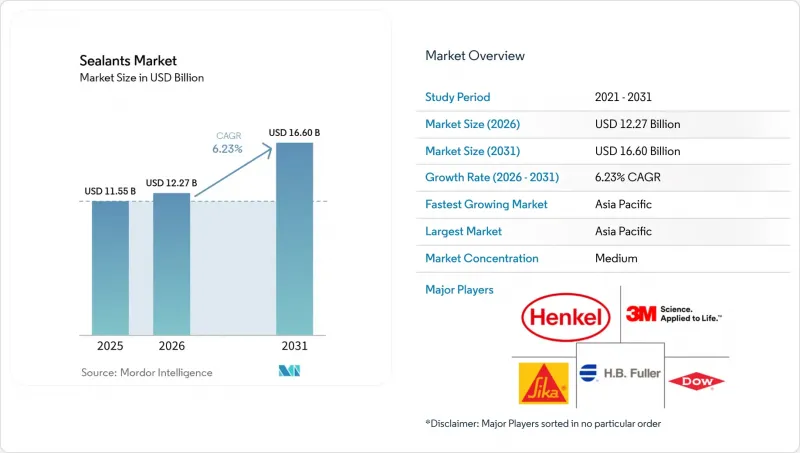
본 보고서는 수지별(아크릴, 에폭시, 폴리우레탄, 실리콘, 기타 수지), 최종 사용자 산업별(항공우주, 자동차, 건축 및 건설, 의료, 기타 최종 사용자 산업), 지역별(아시아태평양, 북미, 유럽, 남미, 중동 및 아프리카)로 분류되어 있습니다. 시장 전망은 금액(달러) 기준으로 제시되어 있습니다.
세계의 실란트 시장 동향 및 인사이트
전 세계 인프라 투자 확대
각국 정부와 다자간 금융기관은 2025년 인프라 계획에 주력했으며, 2024년과 비교해 증가 추세를 보였습니다. 교량 상판의 신축 이음매, 터널용 개스킷, 파이프라인용 밀봉재는 모두 응집 파괴를 일으키지 않으면서 ±50%의 변위를 견딜 수 있는 폴리설파이드계 또는 폴리우레탄계 재료에 의존하고 있습니다. 인도의 국가 인프라 계획에서는 고속도로, 지하철, 항만의 현대화에 자원이 배정되어 있으며, 이들 모두는 ASTM C920 클래스 25를 준수하는 견고한 접합 재료가 필요합니다.
중국의 ‘일대일로’ 이니셔티브를 통해, 고습도 환경에서도 끈적임 없이 경화될 수 있는 2액형 실리콘계 시스템이 지정된 철도 회랑 및 심수 터미널에 대한 자금 지원이 계속되고 있습니다. 민관 협력(PPP)을 통해 입찰 일정이 단축됨에 따라, ISO 11600에 따른 설계 승인을 조기에 획득한 공급업체는 전략적 우위를 확보할 수 있습니다. 전반적으로, 공공 부문의 자본 지출 증가로 인해 초기 실링 및 정기적인 보수가 필요한 접합부의 설치 기반이 확대되면서 실란트 시장이 성장하고 있습니다.
전기자동차의 경량화와 다종 소재 접착
2025년에는 배터리식 전기자동차의 생산량이 대폭 증가했습니다. 자동차 제조업체들은 강철 재질의 커버를 알루미늄이나 탄소섬유 복합재로 대체하고 있으며, 이로 인해 기계적 체결 부품으로는 해결할 수 없는 갈바닉 부식의 위험이 발생하고 있습니다. 구조용 실란트는 이종 기재를 접합하고 진동을 흡수하는 동시에, -40°C에서 +85°C 사이에서 온도 변동이 반복되는 배터리 팩 내부에서 유전 절연을 제공합니다. SikaPower 플렉서블 에폭시 등의 조성물에는 난연성 충전제가 포함되어 있어, UN ECE R100.03에서 정한 5분이라는 임계치를 초과하여 열폭주 발생 시 탈출 시간을 연장합니다. 리튬철인산염 배터리는 에너지 밀도가 낮기 때문에 설계자들은 모듈 길이를 늘리고 밀봉 길이를 증가시킴으로써 차량 1대당 밀봉재 사용량(그램 단위)을 늘리고 있습니다. 따라서 자동차 업계의 경량화, 정숙성 향상, 안전성 향상을 위한 노력은 실란트 시장의 매출을 꾸준히 증가시키고 있습니다.
VOC 및 REACH 규제의 강화로 인해 배합 변경 비용이 상승하고 있습니다.
REACH 부속서 XVII에서는 실내용 실란트의 VOC 함량 상한선이 설정되어 있으며, 캘리포니아주 규정 1168에서는 이에 비해 더욱 엄격한 상한선이 적용되고 있습니다. 이러한 기준을 충족하기 위해 제품의 성분을 재조정하려면 막대한 투자와 시간이 소요됩니다. 이 과정에는 가속 풍화 시험 및 제3자 기관에 의한 GREENGUARD 평가가 포함됩니다. 방향족 용매를 아세톤이나 테르티어 부틸 아세테이트로 대체하면 작업 가능 시간이 단축됩니다. 그 결과, 시공업체는 공극 발생을 방지하기 위해 실링재 도포 속도를 조절해야 합니다. 또한, 수성 아크릴계 실링재에는 살균제나 동결-해동 안정제가 필요하기 때문에 포장이 복잡해지고 원자재 비용도 증가합니다. 이 지역의 제조업체들은 폴리머 합성 능력이 부족하기 때문에 미리 배합된 저VOC 수지를 고가에 구입할 수밖에 없습니다. 그 결과, 규제를 준수하는 제품 시장 점유율은 확대될 전망인 반면, 실란트 시장의 당면한 수익성에는 어려움이 발생하고 있습니다.
부문별 분석
2025년 판매량에서 실리콘 제품이 44.11%를 차지했으며, 움직임이 심한 접합부, 고온용 개스킷, 그리고 자외선에 노출되는 외벽에서 내구성의 기준이 되고 있다는 점이 입증되었습니다. 아크릴계 제품은 VOC 50 g/L 제한 기준을 충족하는 수성 캐리어에 힘입어 2031년까지 연평균 성장률(CAGR) 6.21%로 성장하고 있으며, 다공성 기질 용도 분야에서 실리콘 시장 점유율을 잠식하고 있습니다. 폴리우레탄은 내마모성과 도장성의 균형이 잘 잡힌 중견 시장의 틈새 시장을 차지하고 있으며, 주차장이나 광장의 이음매에 적합합니다. 에폭시 수지는 취성이 있어 동적인 움직임에 대응할 수 없기 때문에 여전히 화학 처리나 폐수 처리 환경으로 그 용도가 제한되어 있습니다. 폴리설파이드, 부틸계, 라텍스 아크릴계가 시장을 보완하고 있으며, 폴리설파이드는 수증기 투과율이 3 g/m²·일 미만이기 때문에 복층 유리 유닛 분야에서 확고한 입지를 다지고 있습니다. ISO 11600에 따른 공개 요건의 강화로 인해, 수지 공급업체는 온도 범위 전반에 걸친 탄성 계수 및 성장률 프로파일을 공개해야 할 의무가 있으며, 이를 통해 사양 수립자는 산출된 이음매의 변위에 적합한 제품을 선정할 수 있게 되었습니다. 실리콘 제조업체들은 아크릴계 수지의 부상에 대응하여, 플라즈마 처리 없이도 폴리에틸렌이나 폴리프로필렌에 접착되는 중성 경화형·프라이머가 필요 없는 제품을 출시하고 있습니다. 한편, 하이브리드 시릴 말단 폴리에테르계 수지는 자외선 내성과 도장성을 겸비하여 새로운 틈새 시장을 개척하고 있습니다. 이러한 수지 기술의 혁신이 맞물리면서 실란트 시장은 호황을 누리고 있으며, 특수 모노머공급을 확대할 수 있는 제조업체에 유리하게 작용하고 있습니다.
지역별 분석
아시아태평양은 2025년에 세계 수요의 36.13%를 차지했으며, 2031년까지 연평균 성장률(CAGR) 7.32%를 기록할 전망입니다. 중국은 주거용 고층 빌딩 건설로 인해 여전히 소비의 중심지 역할을 하고 있지만, ‘친환경 건축물 평가 기준’에 따른 새로운 규정에 따라 실란트 배출량이 0.05 mg/m³·h*로 제한됨에 따라, 용제형에서 수성형으로의 전환이 가속화되고 있습니다. 인도의 자동차 생산 대수는 2025년에 사상 최고치를 기록했으며, 그 대부분을 전동 이륜차 및 삼륜차가 차지해, 피디라이트(Pidilite)사와 일본의 실리콘 공급업체가 합작한 기업이 생산하는 배터리 팩용 실란트에 대한 현지 수요를 창출했습니다. 베트남이나 인도네시아 등 동남아시아 국가들에서는 공급망의 다각화에 따라 전자기기 및 자동차 조립 산업이 유치되면서, 클린룸용 및 열전도성 등급 제품에 대한 수요가 증가하고 있습니다. 비교적 성숙한 시장인 일본과 한국에서도 초고순도 실리콘에 의존하는 반도체 및 연료전지용 실링재 분야에서 여전히 성장이 나타나고 있습니다.
성장률 면에서는 아시아·태평양 지역이 선두를 달리고 있는 반면, 2025년 총 생산량의 대부분을 차지한 북미와 유럽은 성장세에서 뒤처지고 있습니다. ‘인프라 투자 및 고용법’의 뒷받침을 받은 미국에서는 수요가 꾸준히 급증하고 있습니다. 이 법은 교량 보수 및 교통 시설 개보수에 자금을 지원하고 있으며, 특히 ±50%의 변위에 대응할 수 있는 폴리우레탄 및 폴리설파이드 재질의 접합 시스템의 채택을 명시하고 있습니다. 한편, 2030년까지 수백만 채의 건물 에너지 효율 향상을 목표로 하는 유럽의 ‘리노베이션 웨이브’는 기밀성을 높이는 저탄성 실리콘 주변 밀봉재에 대한 수요를 끌어올리고 있습니다. 또한, REACH 부속서 XVII에 따라 현지에서 배합 변경이 요구되고 있으며, 그 결과 시장 진입 장벽이 높아져 연구 개발 규모가 큰 기존 기업들이 유리한 입지를 점하고 있습니다.
나머지 시장 점유율은 남미와 중동 및 아프리카가 차지하고 있습니다. 사우디아라비아에서는 공공투자기금(PIF)이 NEOM 및 기타 메가 프로젝트에 막대한 자금을 배정하고 있습니다. 이러한 프로젝트에서는 사막의 기온 변동에 견딜 수 있도록 설계된, 저탄성률 폴리우레탄 재질의 파사드 이음재 사용이 의무화되어 있습니다. 한편, 브라질에서는 해상 개발이 진행됨에 따라, 특히 해수 침지에 내성이 있는 폴리설파이드계 및 에폭시계 등급에 대한 수요가 증가하고 있습니다. 한편, 남아프리카에서는 재생에너지에 대한 관심이 다시 높아지고 있어, 태양광 발전 모듈의 밀봉재로 자외선 안정성이 뛰어난 실리콘에 대한 수요가 증가하고 있습니다. 이 지역들은 절대적인 규모로 보면 작을지 모르지만, 경험이 풍부한 사료 제조업체에게는 성장의 기회가 될 것입니다. 가혹한 기후와 까다로운 기술 사양이라는 과제를 극복하려는 의지가 있는 기업은 실란트 시장에서의 점유율을 대폭 확대할 수 있을 것입니다.
기타 혜택 :
- 엑셀 형식 시장 예측(ME) 시트
- 3개월간의 애널리스트 지원
자주 묻는 질문
목차
제1장 서론
제2장 조사 방법
제3장 주요 요약
제4장 시장 구도
제5장 시장 규모 및 성장 예측
제6장 경쟁 구도
제7장 시장 기회 및 향후 전망
KTH 26.06.29According to Mordor Intelligence, the sealants market size was valued at USD 11.55 billion in 2025 and is estimated to grow from USD 12.27 billion in 2026 to reach USD 16.60 billion by 2031, at a CAGR of 6.23% during the forecast period (2026-2031).
This report is Segmented by Resin (Acrylic, Epoxy, Polyurethane, Silicone, and Other Resins), End-User Industry (Aerospace, Automotive, Building and Construction, Healthcare, and Other End-User Industries), and Geography (Asia-Pacific, North America, Europe, South America, and Middle-East and Africa). The Market Forecasts are Provided in Terms of Volume (USD).
Global Sealants Market Trends and Insights
Growth in Global Infrastructure Spending
Governments and multilateral lenders committed to infrastructure programs in 2025, showing an increase over 2024. Bridge-deck expansion joints, tunnel gaskets, and pipeline seals all rely on polysulfide or polyurethane grades that tolerate +-50% movement without cohesive failure. India's National Infrastructure Pipeline earmarks resources for highways, metro rail, and port modernization, each requiring robust jointing materials that comply with ASTM C920 Class 25.
China's Belt and Road Initiative continues to fund rail corridors and deep-water terminals that specify two-component silicone systems capable of tack-free cure in high-humidity climates. Public-private partnerships are compressing bid schedules, so suppliers that secure early design approvals under ISO 11600 gain a strategic advantage. Overall, higher public capital outlays enlarge the sealants market by widening the installed base of joints that need initial sealing and periodic renewal.
Lightweighting and Multi-Material Bonding in Electric Vehicles
Battery-electric vehicle production increased significantly in 2025. Automakers are replacing steel closures with aluminum and carbon-fiber composites, creating galvanic-corrosion risks that mechanical fasteners cannot manage. Structural sealants bridge dissimilar substrates, damp vibration, and supply dielectric insulation inside battery packs that cycle between -40 °C and +85 °C. Formulations such as SikaPower flexible epoxies incorporate flame-retardant fillers, extending thermal-runaway escape time beyond the 5-minute threshold set by UN ECE R100.03. As lithium-iron-phosphate chemistries have lower energy density, designers lengthen modules and increase linear seal length, boosting grams-per-vehicle consumption. The automotive drive toward lighter, quieter, and safer platforms, therefore, channels steady incremental revenue to the sealants market.
VOC and REACH Tightening Driving Reformulation Costs
REACH Annex XVII has set a VOC content limit for interior sealants, while California's Rule 1168 imposes an even stricter ceiling. Reformulating products to meet these thresholds requires significant investment and time. This process includes accelerated weathering tests and third-party GREENGUARD evaluations. When aromatic solvents are replaced with acetone or tertiary butyl acetate, the open time decreases. As a result, applicators need to adjust their bead-laying speed to prevent voids. Additionally, water-based acrylics necessitate biocides and freeze-thaw stabilizers, complicating packaging and increasing raw material costs. Producers in the region, lacking polymer synthesis capabilities, are forced to pay a premium for pre-formulated low-VOC resins. Consequently, while compliant products are poised to capture a larger market share, the immediate profitability of the sealants market faces challenges.
Other drivers and restraints analyzed in the detailed report include:
- Demand for High-Performance Weatherproofing in Smart Buildings
- Rapid Expansion of Asia-Pacific End-Markets
- Silicone Monomer Price Volatility
For complete list of drivers and restraints, kindly check the Table Of Contents.
Segment Analysis
Silicone products controlled 44.11% of 2025 volume, confirming their role as the durability benchmark for high-movement joints, high-temperature gaskets, and ultraviolet-exposed facades. Acrylic chemistries, propelled by water-based carriers that meet 50 g/L VOC limits, are advancing at a 6.21% CAGR through 2031, eroding silicone share in porous-substrate applications. Polyurethanes occupy a mid-market niche, balancing abrasion resistance and paintability, which suits parking deck and plaza joints. Epoxies remain confined to chemical-processing and wastewater environments because brittleness restricts dynamic movement. Polysulfides, butyls, and latex acrylics round out the mix, with polysulfides holding a foothold in insulated-glass units thanks to moisture-vapor-transmission rates under 3 g/m2*day. Intensifying disclosure under ISO 11600 forces resin suppliers to publish modulus and elongation profiles across temperatures, enabling specifiers to match products to calculated joint movement. Silicone makers counter the acrylic advance with neutral-cure, primerless grades that adhere to polyethylene and polypropylene without plasma treatment, while hybrid silyl-terminated polyether systems blend UV endurance and paintability to open new niches. Collectively, resin innovation keeps the sealants market dynamic and favors producers able to scale specialty monomer supply.
Geography Analysis
Asia-Pacific accounted for 36.13% of global demand in 2025 and is on track for a 7.32% CAGR to 2031. China continues to headline consumption through residential tower construction, yet new rules from the Green Building Evaluation Standard cap sealant emissions at 0.05 mg/m3*h, accelerating the switch from solvent to water-based systems. India's automotive output hit record vehicles in 2025, with electric two- and three-wheelers comprising a significant portion of the mix, creating local demand for battery-pack sealants serviced by joint ventures between Pidilite and Japanese silicone suppliers. Southeast Asian nations such as Vietnam and Indonesia are attracting electronics and vehicle assembly as supply chains diversify, lifting call-offs for clean-room and thermally conductive grades. Japan and South Korea, relatively mature markets, still see growth in semiconductor and fuel-cell sealing that depends on ultra-pure silicones.
Asia-Pacific leads in growth, while North America and Europe, together accounting for a significant portion of the 2025 volume, lag. The United States, buoyed by the Infrastructure Investment and Jobs Act, is witnessing a steady demand surge. This act funds bridge repairs and transit upgrades, specifically calling for polyurethane and polysulfide joint systems rated for +-50% movement. Meanwhile, Europe's Renovation Wave, aiming for energy upgrades on millions of buildings by 2030, is driving up demand for low-modulus silicone perimeter seals that enhance airtightness. Additionally, REACH Annex XVII is compelling local reformulations, thereby raising entry barriers and bolstering incumbents with their research and development scale.
South America and the Middle East-Africa account for the remaining market share. In Saudi Arabia, the Public Investment Fund has allocated significant resources for NEOM and other mega-projects. These projects mandate low-modulus polyurethane facade joints, designed to withstand desert temperature fluctuations. Over in Brazil, the offshore build-out is pushing the need for polysulfide and epoxy grades, specifically those resistant to seawater immersion. South Africa, on the other hand, is driving demand for UV-stable silicones in photovoltaic module sealing, thanks to its renewed focus on renewable energy. While these regions may be smaller in absolute terms, they present growth opportunities for seasoned formulators. Those willing to navigate the challenges of extreme climates and stringent technical specifications stand to significantly boost their stake in the sealants market.
- 3M
- Arkema
- Avery Dennison
- BASF SE
- Carlisle Companies
- Dow
- H.B. Fuller Company
- Henkel AG & Co. KGaA
- Illinois Tool Works
- MAPEI S.p.A.
- Momentive
- Pidilite Industries Ltd
- RPM International
- Saint-Gobain
- Shin-Etsu Chemical Co., Ltd.
- Sika AG
- Soudal Holding N.V.
- THE YOKOHAMA RUBBER CO., LTD.
- ThreeBond Holdings Co., Ltd.
- Tremco
- Wacker Chemie AG
Additional Benefits:
- The market estimate (ME) sheet in Excel format
- 3 months of analyst support
TABLE OF CONTENTS
1 Introduction
- 1.1 Study Assumptions and Market Definition
- 1.2 Scope of the Study
2 Research Methodology
3 Executive Summary
4 Market Landscape
- 4.1 Market Overview
- 4.2 Market Drivers
- 4.2.1 Growth in global infrastructure spending
- 4.2.2 Lightweighting and multi-material bonding in Electricle Vehicles
- 4.2.3 Demand for high-performance weather-proofing in smart buildings
- 4.2.4 Rapid expansion of Asia-Pacific end-markets
- 4.2.5 Adoption of automated/robotic dispensing lines
- 4.3 Market Restraints
- 4.3.1 VOC and REACH tightening driving reformulation costs
- 4.3.2 Silicone monomer price volatility
- 4.3.3 Skilled-labour gap for correct application
- 4.4 Value Chain Analysis
- 4.5 Porter's Five Forces
- 4.5.1 Threat of New Entrants
- 4.5.2 Bargaining Power of Suppliers
- 4.5.3 Bargaining Power of Buyers
- 4.5.4 Threat of Substitutes
- 4.5.5 Competitive Rivalry
- 4.6 Distribution Channel Analysis
5 Market Size and Growth Forecasts (Volume)
- 5.1 By Resin
- 5.1.1 Acrylic
- 5.1.2 Epoxy
- 5.1.3 Polyurethane
- 5.1.4 Silicone
- 5.1.5 Other Resins
- 5.2 By End-User Industry
- 5.2.1 Aerospace
- 5.2.2 Automotive
- 5.2.3 Building and Construction
- 5.2.4 Healthcare
- 5.2.5 Other End-user Industries
- 5.3 By Geography
- 5.3.1 Asia-Pacific
- 5.3.1.1 China
- 5.3.1.2 India
- 5.3.1.3 Japan
- 5.3.1.4 South Korea
- 5.3.1.5 Malaysia
- 5.3.1.6 Thailand
- 5.3.1.7 Indonesia
- 5.3.1.8 Singapore
- 5.3.1.9 Australia
- 5.3.1.10 Rest of Asia-Pacific
- 5.3.2 North America
- 5.3.2.1 United States
- 5.3.2.2 Canada
- 5.3.2.3 Mexico
- 5.3.3 Europe
- 5.3.3.1 Germany
- 5.3.3.2 United Kingdom
- 5.3.3.3 France
- 5.3.3.4 Italy
- 5.3.3.5 Spain
- 5.3.3.6 NORDIC Countries
- 5.3.3.7 Russia
- 5.3.3.8 Rest of Europe
- 5.3.4 South America
- 5.3.4.1 Brazil
- 5.3.4.2 Argentina
- 5.3.4.3 Rest of South America
- 5.3.5 Middle-East and Africa
- 5.3.5.1 Saudi Arabia
- 5.3.5.2 South Africa
- 5.3.5.3 Rest of Middle-East and Africa
- 5.3.1 Asia-Pacific
6 Competitive Landscape
- 6.1 Market Concentration
- 6.2 Strategic Moves
- 6.3 Market Share/Ranking Analysis
- 6.4 Company Profiles (includes Global level Overview, Market level overview, Core Segments, Financials as available, Strategic Information, Market Rank/Share for key companies, Products and Services, and Recent Developments)
- 6.4.1 3M
- 6.4.2 Arkema
- 6.4.3 Avery Dennison
- 6.4.4 BASF SE
- 6.4.5 Carlisle Companies
- 6.4.6 Dow
- 6.4.7 H.B. Fuller Company
- 6.4.8 Henkel AG & Co. KGaA
- 6.4.9 Illinois Tool Works
- 6.4.10 MAPEI S.p.A.
- 6.4.11 Momentive
- 6.4.12 Pidilite Industries Ltd
- 6.4.13 RPM International
- 6.4.14 Saint-Gobain
- 6.4.15 Shin-Etsu Chemical Co., Ltd.
- 6.4.16 Sika AG
- 6.4.17 Soudal Holding N.V.
- 6.4.18 THE YOKOHAMA RUBBER CO., LTD.
- 6.4.19 ThreeBond Holdings Co., Ltd.
- 6.4.20 Tremco
- 6.4.21 Wacker Chemie AG
7 Market Opportunities and Future Outlook
- 7.1 White-Space and Unmet-Need Assessment