

|
시장보고서
상품코드
2115014
탄성 접착제 및 실란트 시장 : 시장 점유율 분석, 업계 동향 및 통계, 성장 예측(2026-2031년)Elastic Bonding Adhesive And Sealant - Market Share Analysis, Industry Trends & Statistics, Growth Forecasts (2026 - 2031) |
||||||
 Mordor Intelligence
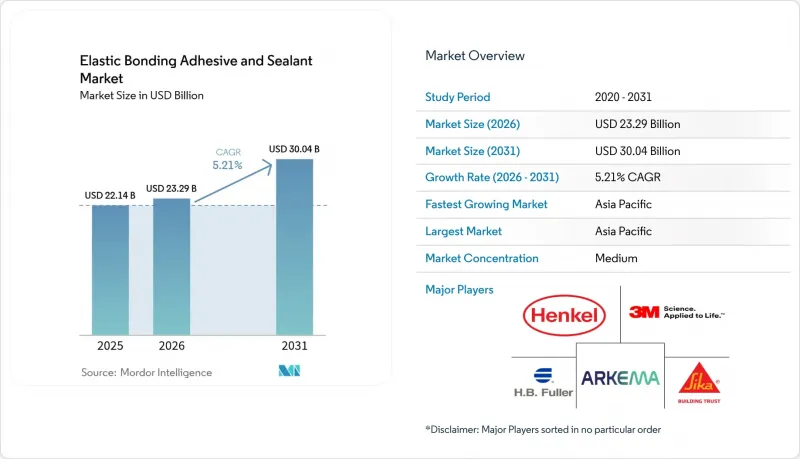
Mordor Intelligence에 의하면, 탄성 접착제 및 실란트 시장 규모는 2025년 221억 4,000만 달러로 평가되었고, 2026년에는 232억 9,000만 달러로 추정되고, 2026-2031년 CAGR 5.21%로 성장을 지속할 전망이며, 2031년에는 300억 4,000만 달러에 이를 것으로 예측됩니다.
본 보고서는 제품 유형별(폴리우레탄(PU), 실릴 및 실란 개질 폴리머 등), 최종 사용자 산업별(건축 및 건설, 자동차 및 운송, 산업용, 기타 최종 사용자 산업) 및 지역별(아시아태평양, 북미, 유럽, 남미, 중동 및 아프리카)로 분류되어 있습니다. 시장 예측은 금액(달러) 기준으로 제시되어 있습니다.
세계의 탄성 접착제 및 실란트 시장 동향 및 인사이트
경량화 및 다중 소재 차량 구조로의 전환
각 자동차 제조업체는 차량 경량화, CO2 배출 목표 달성, 그리고 NVH(소음·진동·거칠기) 개선을 위해 용접 및 리벳을 고강도 접착으로 대체하고 있습니다. 강철, 알루미늄, CFRP, 바이오 복합재를 조합한 복합 소재 차체에는 열팽창계의 큰 차이를 메울 수 있는 접착제가 필요합니다. 접착제 사용량은 2001년 차량 1대당 30리니어피트에서 현재 모델에서는 400피트 이상으로 증가했습니다. 배터리식 전기자동차(BEV)의 경우, 셀-투-팩(cell-to-pack) 설계에서 셀의 열을 방출시키는 구조용 접착이 요구되므로, 이에 대한 의존도가 더욱 높아지고 있습니다. Parker LORD와 같은 공급업체들은 박리 저항 및 충돌 시 에너지 흡수 성능에 최적화된 아크릴계 및 에폭시계 제품을 출시하고 있습니다. 0.1Kg의 경량화가 주행 거리 연장으로 이어지기 때문에 탄성 접착제 및 실란트 시장은 신형 차량 플랫폼마다 지속적인 수요를 확보하고 있습니다.
모듈식 파사드 및 커튼월 시스템의 채택 확대
건축가들은 공사 기간을 단축하고, 노동 위험을 줄이며, 세련된 유리 외관을 구현하기 위해 조립식 파사드 유닛을 선호하고 있습니다. 이러한 시스템은 허리케인급 강풍, 지진으로 인한 진동, 그리고 30년 이상에 걸친 자외선으로 인한 열화를 견뎌내야 하는 구조용 실리콘 글레이징에 의존하고 있습니다. 모멘티브(Momentive)사의 ‘UltraGlaze’ 실란트는 상하이에서 시카고에 이르는 랜드마크적인 고층 빌딩에 이미 채택되었습니다. H.B. 풀러(H.B. Fuller)사의 ‘Kodiglaze’ 하이브리드 제품을 통해 설계자는 프레임 단면을 얇게 하고, 유리 면적을 확대하며, 외벽에 구멍을 뚫지 않고도 IoT 센서를 통합할 수 있게 되었습니다. 친환경 건축 기준에 따라 공기 누출률이 더욱 엄격해지는 가운데, 건설업체들은 연속 비드 접착 방식을 선택하고 있으며, 이는 탄성 접착제 및 실란트 시장 수요를 끌어올리고 있습니다.
원자재 가격 변동(이소시아네이트, 실리콘)
2025년 초, 동아시아 정제소의 가동 중단으로 MDI 공급업체가 불가항력을 선언함에 따라 이소시아네이트 가격이 급등했습니다. 또한, 석영 공급 부족과 운임 급등으로 인해 실리콘 원료 가격은 매주 크게 변동했습니다. 유럽에서는 건설 수요가 둔화되면서 에폭시 공급이 회복되었지만, 장기적인 가격 전망의 불투명성이 배합 제조업체의 이익률을 압박하고 있습니다. 이러한 예측 불가능성으로 인해 제품 출시가 지연되고, 가공업체들은 재고를 늘릴 수밖에 없게 되어, 탄성 접착제 및 실란트 시장의 단기적인 성장에 큰 부담이 되고 있습니다.
부문 분석
2025년, 폴리우레탄은 탄성 접착제 및 실란트 시장 점유율의 41.63%를 차지했으며, 차체, 창틀, 풍력 발전용 블레이드 등에서 그 범용성을 돋보이게 했습니다. 인성, 저온 경화성, 폭넓은 기판과의 적합성 덕분에 폴리우레탄의 입지는 흔들리지 않지만, 유리 이소시아네이트 농도에 대한 규제 당국의 감시가 엄격해지는 가운데, 배합 재검토가 시급한 과제가 되고 있습니다. 가공 업체들이 2차 방습 도료가 필요 없는 VOC 프리 도포를 추구하는 가운데, 실릴 개질 폴리머 수요는 연평균 성장률(CAGR) 7.01%로 증가하고 있습니다. 하이브리드 등급은 폴리우레탄 골격의 강도와 실란 말단기를 융합하여 저장 기간을 연장하는 동시에, 습도가 높은 기후에서도 기포 없는 경화를 보장합니다. 헨켈, 시카, 보스틱 각사는 현재 포장 폐기물을 줄이고 로봇을 통한 도포를 용이하게 하는 호일 팩에 담긴 프리폴리머 블렌드를 공급하고 있습니다. 실리콘 및 에폭시계 화학제품은 180°C를 초과하는 내열성이 필수적인 항공우주용 내장재, 전자기기의 포팅, 고온용 개스킷 이용 사례에서 여전히 중요한 역할을 하고 있습니다. 이러한 틈새 시장 용도에서는 프리미엄 가격 책정과 소량 생산으로 인해 1kg당 매출이 여전히 높은 수준을 유지하고 있어, 탄성 접착제 및 실란트 시장 전체의 이익률에 가해지는 압박을 완화하고 있습니다.
2세대 바이오 폴리우레탄은 대두유와 피마자유에서 폴리올을 추출하여, 석유 유래 동등 제품에 비해 CO2 환산치를 최대 40%까지 줄이고 있습니다. 독일에서 실시된 주택 건설 시범 프로젝트에서는 교차 적층재에 프라이머 없이도 접착이 가능함이 확인되어, 대규모 목조 건축 분야에서 새로운 수요가 예상됩니다. 나노튜브 강화 에폭시 수지는 파괴 인성이 30% 향상되어, 가장자리 침식으로 어려움을 겪고 있는 풍력 발전용 블레이드 제조업체에게 매력적인 제품이 되고 있습니다. 제품 포트폴리오의 다각화에 따라 유통업체은 소량이지만 폭넓은 SKU를 취급하게 되었으며, 맞춤형 제품 선정 및 컨설팅 서비스가 활성화되어 탄성 접착제 및 실란트 시장을 강화하고 있습니다.
지역별 분석
아시아태평양은 2025년에 전 세계 매출의 42.88%를 차지한 것으로 평가되었으며, 2031년까지 연평균 성장률(CAGR) 6.67%를 나타낼 것으로 전망되어, 이는 지역별로는 가장 높은 성장 속도입니다. 중국의 압도적인 배터리 공급망은 열전도성 갭 필러 및 폴리우레탄 개스킷 수요를 견인하여 두 자릿수 성장률을 달성하고 있습니다. 인도에서는 공공 부문의 주택 건설과 ‘메이크 인 인디아(Make in India)’ 자동차 추진 정책으로 인해 접착제 수요가 급증하고 있으며, 이는 리드타임 단축과 수입 감소를 실현하는 헨켈(Henkel)사의 LEED 골드 인증을 획득한 쿠르쿰브(Kurkumb) 공장의 생산 확대가 뒷받침하고 있습니다. 일본과 한국은 정밀 전자기기 및 차세대 모빌리티에 주력하고 있으며, 카메라 모듈 및 ADAS 센서용으로 초저아웃가스성 배합이 요구되고 있습니다. 아세안(ASEAN) 국가들은 대량 고속 수송(BRT) 노선 및 데이터센터에 대한 투자를 추진하고 있으며, 이 모두 난연성 실란트에 의존하고 있어 탄성 접착제 및 실란트 시장에 대한 해당 지역 수요를 더욱 확대시키고 있습니다.
북미는 여전히 2위 시장입니다. 캘리포니아주의 VOC 규제 상한선으로 인해 무용제 제품의 채택이 가속화되고 있는 한편, ‘인플레이션 감축법(Inflation Reduction Act)’에 따라 풍력 발전 및 전기차(EV) 공장에 수십억이 투입되고 있으며, 이 모두 Kg 단위의 접착제를 소비하고 있습니다. 워싱턴주 및 퀘벡주의 주요 항공우주 기업들은 복합재 나셀용으로 고온용 비스마레이미드 페이스트를 지정하고 있습니다. 멕시코의 수출 지향형 자동차 클러스터에서는 사이클 타임의 예측 가능성을 높이고 재작업량을 줄이는 로봇 비드 시스템이 도입되어, 탄성 접착제 및 실란트 시장에 새로운 수요원을 창출하고 있습니다.
유럽에서는 성숙한 수요와 규제 측면의 주도력이 결합되어 있으며, 2023년 8월에 시행된 REACH 규정에 따른 이소시아네이트 함유율 0.1% 초과 제한이 하이브리드 제품으로의 전환을 가속화하고 있습니다. 이에 따라 독일, 오스트리아, 이탈리아의 연구개발 센터에서는 촉매가 필요 없는 경화 공정에 대한 실증 시험이 진행되고 있습니다. 중부 유럽의 자동차 조립 공장에서는 E-코팅로에서 견딜 수 있고 충돌 시 에너지 흡수 기능을 갖춘 접착 기술에 대한 수요가 증가하고 있습니다. 북해의 해상 풍력 발전소에서는 블레이드 접착에 내피로성 에폭시 수지가 채택되어, 이를 통해 교체 주기를 연장하고 있습니다. 남미, 중동 및 아프리카의 합계 점유율은 작지만, 브라질의 BR-163호선 개량이나 사우디아라비아의 기가 프로젝트와 같은 인프라 정비로 인해 현지 생산에 대한 인센티브가 생겨나, 향후 탄성 접착제 및 실란트 시장 진출이 기대됩니다.
기타 혜택 :
- 엑셀 형식 시장 예측(ME) 시트
- 3개월간의 애널리스트 지원
자주 묻는 질문
목차
제1장 서론
제2장 조사 방법
제3장 주요 요약
제4장 시장 구도
제5장 시장 규모 및 성장 예측
제6장 경쟁 구도
제7장 시장 기회 및 향후 전망
AJY 26.08.28According to Mordor Intelligence, the elastic bonding adhesive and sealant market size is expected to grow from USD 22.14 billion in 2025 to USD 23.29 billion in 2026 and is forecast to reach USD 30.04 billion by 2031 at 5.21% CAGR over 2026-2031.
This report is Segmented by Product Type (Polyurethane (PU), Silyl and Silane Modified Polymers, and More), End-User Industry (Building and Construction, Automotive and Transportation, Industrial, and Other End-User Industries), and Geography (Asia-Pacific, North America, Europe, South America, and Middle East and Africa). The Market Forecasts are Provided in Terms of Value (USD).
Global Elastic Bonding Adhesive And Sealant Market Trends and Insights
Shift to Lightweight Multi-Material Vehicle Structures
Automakers are replacing welds and rivets with high-strength bonding to shave vehicle weight, meet CO2 targets, and improve NVH. Mixed-material bodies that combine steel, aluminum, CFRP, and bio-composites demand adhesives able to bridge wide differences in thermal expansion. Adoption grew from 30 linear feet of adhesive per car in 2001 to more than 400 feet in current models. Battery-electric vehicles deepen this dependence because cell-to-pack designs require structural bonding that also channels heat away from cells. Suppliers such as Parker LORD have released acrylic and epoxy grades tuned for peel resistance and crash energy absorption. As every tenth of a kilogram saved translates into longer driving range, the Elastic Bonding Adhesive and Sealant market captures recurring volume per new vehicle platform.
Rising Adoption of Modular Facade and Curtain Wall Systems
Architects favor prefabricated facade units to accelerate schedules, lower labor risk, and achieve sleek glass exteriors. These systems rely on structural silicone glazing that must resist hurricane-force winds, seismic sway, and UV degradation for 30 years or more. Momentive UltraGlaze sealants are already specified on landmark towers from Shanghai to Chicago. Kodiglaze hybrids from H.B. Fuller let designers slim frame profiles, enlarge pane area, and integrate IoT sensors without drilling hardware through the envelope. As green-building codes tighten air-leakage rates, builders opt for continuous bead bonding, which raises unit demand for the Elastic Bonding Adhesive and Sealant market.
Raw-Material Price Volatility (Isocyanates, Silicone)
Isocyanate costs surged in early 2025 after refinery outages in East Asia forced force-majeure at MDI suppliers. Silicone feedstock values swung week-to-week due to quartz shortages and freight spikes. Epoxy supply rebounded in Europe when construction demand softened, but the lack of long-term price visibility squeezes formulators' margins. Such unpredictability delays product launches and prompts converters to carry higher inventory, weighing on near-term growth for the Elastic Bonding Adhesive and Sealant market.
Other drivers and restraints analyzed in the detailed report include:
- Stricter VOC Regulations Driving Solvent-Free Chemistries
- Wind-Turbine Blade Fatigue Mitigation Needs
- Limited Durability Data for New Hybrid Chemistries
For complete list of drivers and restraints, kindly check the Table Of Contents.
Segment Analysis
Polyurethane commanded 41.63% of Elastic Bonding Adhesive and Sealant market share in 2025, underlining its versatility in vehicle bodies, window frames, and wind blades. Toughness, low-temperature cure, and broad substrate compatibility keep polyurethane entrenched, yet regulatory scrutiny of free isocyanate levels creates reformulation urgency. Silyl-modified polymer demand is climbing at a 7.01% CAGR as processors seek VOC-free dispensing without secondary moisture-barrier paints. Hybrid grades blend polyurethane backbone strength with silane end-groups, extending shelf life and ensuring bubble-free cures even in humid climates. Henkel, Sika, and Bostik now supply pre-polymer blends shipped in foil packs that cut packaging waste and aid robotic application. Silicone and epoxy chemistries still serve aerospace interiors, electronics potting, and high-temperature gasketing where heat resistance above 180 °C is critical. Within these niche use-cases, premium pricing and lower volume still lift revenue per kilogram, cushioning margin pressure across the Elastic Bonding Adhesive and Sealant market.
Second-generation bio-based polyurethane pulls polyols from soybean oil and castor beans, lowering CO2-equivalent by up to 40% against petroleum analogues. Pilot housing projects in Germany report primer-less adhesion to cross-laminated timber, opening fresh volumes in mass-timber construction. Nanotube-reinforced epoxies deliver 30% higher fracture toughness, appealing to wind-blade makers fighting edge erosion. As product portfolios diversify, distributors carry smaller lot sizes but wider SKU counts, fostering bespoke selection and advisory services that strengthen the Elastic Bonding Adhesive and Sealant market.
Complete Report Scope:
- By Product Type
- Polyurethane (PU)
- Silyl and Silane Modified Polymers
- Silicone
- Other Products
- By End-User Industry
- Building and Construction
- Automotive and Transportation
- Industrial
- Other End-User Industries
- By Geography
- Asia-Pacific
- China
- India
- Japan
- South Korea
- ASEAN
- Rest of Asia-Pacific
- North America
- United States
- Canada
- Mexico
- Europe
- Germany
- United Kingdom
- France
- Italy
- Spain
- Rest of Europe
- South America
- Brazil
- Argentina
- Rest of South America
- Middle East and Africa
- Saudi Arabia
- United Arab Emirates
- South Africa
- Nigeria
- Rest of Middle East and Africa
- Asia-Pacific
Geography Analysis
Asia-Pacific generated 42.88% of global revenue in 2025 and is projected to post a 6.67% CAGR to 2031, the highest regional pace. China's dominant battery supply chain pulls in thermally conductive gap fillers and polyurethane gasketing at double-digit growth. India's adhesive demand surges on public-sector housing and the Make-in-India automotive push, reinforced by Henkel's LEED-Gold Kurkumbh facility ramp-up, which shortens lead times and trims imports. Japan and South Korea focus on precision electronics and next-generation mobility, requiring ultra-low outgassing formulas for camera modules and ADAS sensors. ASEAN economies invest in mass-rapid-transit lines and data centers, both reliant on fire-retardant sealants, therefore extending the regional pull on the Elastic Bonding Adhesive and Sealant market.
North America remains the second-largest market. California's VOC cap accelerates zero-solvent adoption, while the Inflation Reduction Act channels billions into wind-power and EV factories, each consuming kilogram-scale adhesive lines. Aerospace primes in Washington and Quebec specify high-temperature bismaleimide pastes for composite nacelles. Mexico's export-oriented auto clusters integrate robotic bead systems that improve cycle-time predictability and cut rework, contributing new demand nodes to the Elastic Bonding Adhesive and Sealant market.
Europe blends mature demand with regulatory leadership. The August 2023 REACH limit on diisocyanates above 0.1% spurs accelerated substitution toward hybrids, pushing R&D centers in Germany, Austria, and Italy to pilot catalyst-free cure routes. Automotive assembly plants in Central Europe hunger for bonding that tolerates e-coat ovens and provides crash energy absorption. Offshore wind farms in the North Sea rely on fatigue-resistant epoxies for blade bonding, safeguarding replacement intervals. South America and the Middle East and Africa collectively hold smaller shares, yet infrastructure builds such as Brazil's BR-163 upgrades and Saudi giga-projects open localized production incentives, pointing to future participation in the Elastic Bonding Adhesive and Sealant market.
- 3M
- Arkema (Bostik)
- Cemedine Co., Ltd.
- Dow
- H.B. Fuller Company
- Henkel AG & Co. KGaA
- Huntsman International LLC
- Jowat SE
- MAPEI S.p.A.
- Permabond LLC
- PPG Industries, Inc.
- RPM International Inc.
- Sika AG
- ThreeBond Holdings Co. Ltd
- Wacker Chemie AG
Additional Benefits:
- The market estimate (ME) sheet in Excel format
- 3 months of analyst support
TABLE OF CONTENTS
1 Introduction
- 1.1 Study Assumptions and Market Definition
- 1.2 Scope of the Study
2 Research Methodology
3 Executive Summary
4 Market Landscape
- 4.1 Market Overview
- 4.2 Market Drivers
- 4.2.1 Shift to Lightweight Multi-Material Vehicle Structures
- 4.2.2 Rising Adoption of Modular Facade and Curtain Wall Systems
- 4.2.3 Stricter VOC Regulations Driving Solvent-Free Chemistries
- 4.2.4 Wind-Turbine Blade Fatigue Mitigation Needs
- 4.2.5 EV Battery Pack Gap-Filling for Thermal Shock Control
- 4.3 Market Restraints
- 4.3.1 Raw-Material Price Volatility (Isocyanates, Silicone)
- 4.3.2 Limited Durability Data for New Hybrid Chemistries
- 4.3.3 Smart Mechanical Fasteners as Substitute Solutions
- 4.4 Value Chain Analysis
- 4.5 Porter's Five Forces Analysis
- 4.5.1 Bargaining Power of Suppliers
- 4.5.2 Bargaining Power of Buyers
- 4.5.3 Threat of New Entrants
- 4.5.4 Threat of Substitute Products
- 4.5.5 Degree of Competition
5 Market Size and Growth Forecasts (Value)
- 5.1 By Product Type
- 5.1.1 Polyurethane (PU)
- 5.1.2 Silyl and Silane Modified Polymers
- 5.1.3 Silicone
- 5.1.4 Other Products
- 5.2 By End-User Industry
- 5.2.1 Building and Construction
- 5.2.2 Automotive and Transportation
- 5.2.3 Industrial
- 5.2.4 Other End-User Industries
- 5.3 By Geography
- 5.3.1 Asia-Pacific
- 5.3.1.1 China
- 5.3.1.2 India
- 5.3.1.3 Japan
- 5.3.1.4 South Korea
- 5.3.1.5 ASEAN
- 5.3.1.6 Rest of Asia-Pacific
- 5.3.2 North America
- 5.3.2.1 United States
- 5.3.2.2 Canada
- 5.3.2.3 Mexico
- 5.3.3 Europe
- 5.3.3.1 Germany
- 5.3.3.2 United Kingdom
- 5.3.3.3 France
- 5.3.3.4 Italy
- 5.3.3.5 Spain
- 5.3.3.6 Rest of Europe
- 5.3.4 South America
- 5.3.4.1 Brazil
- 5.3.4.2 Argentina
- 5.3.4.3 Rest of South America
- 5.3.5 Middle East and Africa
- 5.3.5.1 Saudi Arabia
- 5.3.5.2 United Arab Emirates
- 5.3.5.3 South Africa
- 5.3.5.4 Nigeria
- 5.3.5.5 Rest of Middle East and Africa
- 5.3.1 Asia-Pacific
6 Competitive Landscape
- 6.1 Market Concentration
- 6.2 Strategic Moves
- 6.3 Market Share (%)/ Ranking Analysis
- 6.4 Company Profiles (includes Global level Overview, Market level overview, Core Segments, Financials as available, Strategic Information, Market Rank/Share for key companies, Products and Services, and Recent Developments)
- 6.4.1 3M
- 6.4.2 Arkema (Bostik)
- 6.4.3 Cemedine Co., Ltd.
- 6.4.4 Dow
- 6.4.5 H.B. Fuller Company
- 6.4.6 Henkel AG & Co. KGaA
- 6.4.7 Huntsman International LLC
- 6.4.8 Jowat SE
- 6.4.9 MAPEI S.p.A.
- 6.4.10 Permabond LLC
- 6.4.11 PPG Industries, Inc.
- 6.4.12 RPM International Inc.
- 6.4.13 Sika AG
- 6.4.14 ThreeBond Holdings Co. Ltd
- 6.4.15 Wacker Chemie AG
7 Market Opportunities and Future Outlook
- 7.1 White-space and Unmet-need Assessment


