|
시장보고서
상품코드
2066720
알루미늄 재활용 : 시장 점유율 분석, 업계 동향 및 통계, 성장 예측(2026-2031년)Aluminum Recycling - Market Share Analysis, Industry Trends & Statistics, Growth Forecasts (2026 - 2031) |
||||||
 Mordor Intelligence
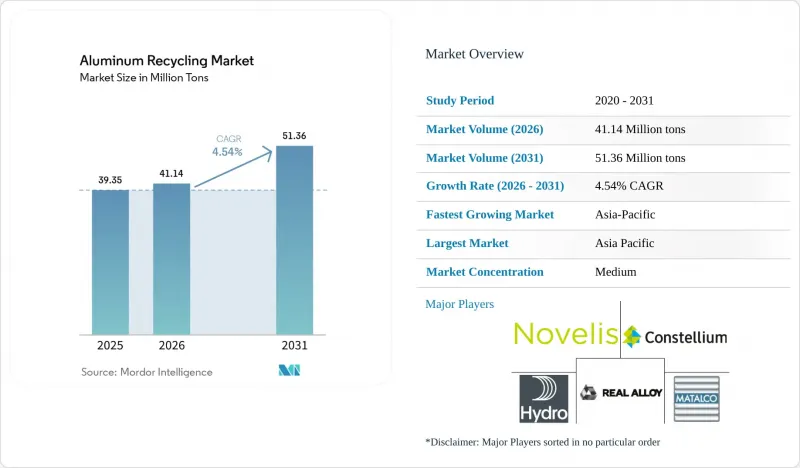
Mordor Intelligence에 의하면, 2026년 알루미늄 재활용 시장 규모는 4,114만 톤에 달할 것으로 예상됩니다. 2025년 3,935만 톤으로부터 확대해, 2031년에는 5,136만 톤에 이를 것으로 예측됩니다.
2026년부터 2031년까지 연평균 성장률(CAGR) 4.54%로 성장할 것으로 전망됩니다.
본 보고서는 제품 유형(주조용 합금, 압출재, 시트, 기타), 최종 사용자 산업(자동차, 항공우주 및 방위, 건축 및 건설, 전기 및 전자, 포장, 기타 최종 사용자 산업) 및 지역(아시아태평양, 북미, 유럽, 남미, 중동 및 아프리카)별로 분류되어 있습니다. 시장 전망은 수량(톤) 기준으로 제시되어 있습니다.
세계의 알루미늄 재활용 시장 동향 및 인사이트
1차 알루미늄 생산에 있어 에너지 절약 측면의 이점
2차 제련은 전해 제련 공정에 비해 에너지 사용량을 95% 줄입니다. 이러한 격차는 전력 가격이 급등하거나 탄소세가 강화될 경우 더욱 확대될 것입니다. 북미의 2차 생산 업체들은 2020년부터 2024년 사이에 평균 탄소 발자국을 60% 감축함으로써, 현재 스코프 3 배출량 감사를 실시하고 있는 자동차 제조업체 및 항공기 OEM과 공급 계약을 체결할 수 있었습니다. 2024년 12월, 알루미나 현물 가격은 톤당 800달러를 돌파했으나, 재활용 업체들은 알루미나 정제 공정을 완전히 생략함으로써 이 비용을 절감할 수 있었습니다. 그 후, 투자은행은 2025년 알루미늄 업계의 가격 전망치를 상향 조정하여 2차 제련업체에 추가적인 이익 마진을 확보할 여지를 마련해 주었습니다. 그 때문에 EU나 북미 일부 등 탄소 가격 제도를 도입한 지역에서는 1차 알루미늄에서 재활용 금속으로의 전환이 가속화되고 있습니다.
건설 분야에서의 재활용 알루미늄 이용 확대
급속한 도시화와 친환경 건축 기준에 따라, 건설업체들은 커튼월, 파사드 시스템, 창틀에 재활용률이 높은 압출 성형재를 채택하고 있습니다. LEED나 BREEAM과 같은 인증 제도에서는 재활용 자재 사용에 대해 가산점이 부여되기 때문에 단순한 비용 절감에 그치지 않는 견인 효과가 더욱 강화되고 있습니다. 아시아의 건설 수요는 2022년부터 2024년에 걸쳐 9% 증가했으며, 인도, 인도네시아, 필리핀의 대도시권에서 대중교통 및 주택 프로젝트가 확대됨에 따라 2027년까지 이러한 추세가 지속될 것으로 전망됩니다. 유럽의 압출 공장에서는 이미 90%가 넘는 재활용률로 가동되고 있으며, 이는 캐나다와 일본에서 추진 중인 새로운 ‘재료 여권(Material Passport)’ 이니셔티브의 정책 모델이 되고 있습니다. 건설 분야 수요가 견조한 점도 스크랩 회수 주기를 단축시키고, 재용해로에 공급되는 사용 후 프로파일의 안정적인 공급을 보장하고 있습니다.
바람직하지 않은 불순물(Fe, Mg, Zn)의 존재
철의 혼입률이 0.20%를 초과하면, 알루미늄은 항공우주 분야나 전기자동차(EV)의 구조용 용도 대부분에서 사용할 수 없게 되며, 재활용 업체들은 오염된 로트를 대폭 할인된 가격으로 주조 시장이나 탈산 시장으로 돌릴 수밖에 없게 됩니다. 해체 현장에서 나오는 혼합 스크랩에는 6000계 및 7000계 합금과 도장 처리된 건축용 프로파일이 혼재되어 있는 경우가 많으며, 이로 인해 정제 비용과 에너지 소비량이 증가합니다. 대규모 제련소에서는 철의 혼입을 억제하기 위해 플럭스제를 첨가하고 전자기 교반기를 도입하고 있지만, 설비 투자 부담이 크기 때문에 소규모 사업자는 프리미엄 시장에 진입할 수 없습니다. 또한, 철이 혼입되면 응고 시 미세 편석을 유발하여 피로 강도를 저하시킵니다. 이는 항공기 OEM 각사가 엄격한 공급업체 인증 감사를 통해 면밀히 모니터링하고 있는 문제입니다.
부문별 분석
2025년, 건축가와 자동차 제조업체들이 파사드, 섀시 부재, 배터리 케이스에 경량성이 뛰어나고 내식성이 우수한 프로파일을 채택함에 따라, 압출 성형 제품은 알루미늄 재활용 시장에서 35.10%라는 압도적인 점유율을 차지했습니다. 이 부문은 2031년까지 연평균 성장률(CAGR) 5.29%를 나타낼 것으로 예측되며, 시트 및 주조 등급과의 격차를 꾸준히 벌리고 있습니다. 압출 성형품은 단일 합금의 조성을 사용하는 경우가 많기 때문에 합금의 화학 조성을 유지하고 등급 저하로 인한 손실을 최소화하는 폐쇄형 재활용에 가장 적합한 후보가 됩니다. 콘스텔리움사는 2024년 시험에서 사용된 항공기 외판을 항공우주 등급의 빌렛으로 재용해하는 데 성공했으며, 합금의 희석이 수반되지 않는 다중 재활용 사이클의 기술적 실현 가능성을 입증했습니다.
시트는 주요 제품군으로, 표면 품질이 매우 중요한 자동차 외판이나 음료 캔 본체에 공급되고 있습니다. 시트 공장에서는 까다로운 가장자리 처리 및 성형성 목표를 충족하면서, 더 높은 스크랩 혼입률에도 대응할 수 있는 연속 주조 라인에 대한 투자가 진행되고 있습니다. 주조용 합금은 생산량은 적지만, 복잡한 형상이나 열전도성이 요구되는 엔진 블록이나 전기 모터 하우징 분야에서 꾸준한 수요가 있습니다. 박막 및 선재의 용도는 여전히 안정적인 틈새 시장이지만, 연포장 분야에서 재생 폴리머로의 대체가 진행되고 있어 박막 시장의 성장이 주춤하고 있습니다.
지역별 분석
아시아태평양은 2025년에 전 세계 알루미늄 재활용 시장 점유율의 61.20%를 차지했으며, 2031년까지 연평균 성장률(CAGR) 5.55%로 확대될 것으로 전망됩니다. 중국의 2차 생산 능력 증대는 4,500만 톤이라는 1차 생산 능력 상한선과 부합하며, 제련소들이 고철 수입 및 국내 회수 체계로 전환하도록 유도하고 있습니다. 인도의 ‘스마트 시티 미션’에서는 교통 회랑과 저렴한 주택에 재생 압출재가 도입되면서 빌렛 수요가 더욱 증가하고 있습니다. 일본과 한국은 고품질의 고철 선별 기술을 제공하고 있으며, 회수부터 완제품 생산에 이르는 지역적 수직 통합을 강화하고 있습니다.
북미와 유럽은 합쳐서 세계 수요의 상당 부분을 차지하고 있습니다. 2024년 미국의 알루미늄 생산량 중 80% 이상이 2차 생산을 통해 이루어졌습니다. 이는 40년 전에는 30% 미만이었던 것에 비하면 크게 증가한 수치입니다. 미국 10개 주에서 시행되고 있는 보증금 환급 제도와 재활용 소재 사용에 대한 연방 세액 공제가 음료 캔용 시트의 안정적인 공급을 뒷받침하고 있습니다. EU가 2029년까지 금속 음료 용기의 회수율을 90%로 의무화하겠다는 방침을 내놓으면서, 캔 전용 재활용 공장에 대한 투자가 가속화되고 있습니다. 두 지역 모두 전기 요금이 높은 수준을 유지하고 있어, 재생에너지 도입이 더욱 가속화되고 있습니다. 스페인의 하이드로(Hydro)사가 운영하는 1억 8,000만 유로 규모의 트리하 공장에서는 용융 비용을 절감하기 위해 부지 내 태양광 발전 시설을 활용할 예정입니다.
중동 및 아프리카는 처리량 면에서는 뒤처져 있지만, 비약적인 성장이 예상됩니다. 에미레이트 월드 알루미늄(EGA)은 미네소타주에 본사를 둔 스펙트로 알로이즈를 8,000만 달러에 인수하고, 2025년 7월에 생산을 재개했습니다. 이는 GCC(걸프협력회의) 회원국들의 60억 달러 규모의 재활용 시장을 공략하려는 움직임을 보여줍니다. 모로코는 태양광 발전의 저렴한 비용을 활용해 2024년에 국내 최초의 알루미늄 스크랩 전용 제련소를 가동했습니다. 남미의 전망은 브라질에 집중되어 있으며, 이 나라의 전력망의 90%가 재생에너지로 공급되고 있어 2차 금속의 탄소 강도가 낮아져 다국적 음료 및 자동차 브랜드의 지속가능성 기준을 충족하고 있습니다.
기타 혜택 :
- 엑셀 형식 시장 예측(ME) 시트
- 3개월간의 애널리스트 지원
자주 묻는 질문
목차
제1장 서론
제2장 조사 방법
제3장 주요 요약
제4장 시장 구도
제5장 시장 규모 및 성장 예측
제6장 경쟁 구도
제7장 시장 기회 및 향후 전망
KTH 26.06.29According to Mordor Intelligence, aluminum recycling market size in 2026 is estimated at 41.14 million tons, growing from 2025 value of 39.35 million tons with 2031 projections showing 51.36 million tons, growing at 4.54% CAGR over 2026-2031.
This report is Segmented by Product Type (Casting Alloys, Extrusion, Sheets, Other Types), End-User Industry (Automotive, Aerospace and Defense, Building and Construction, Electrical and Electronics, Packaging, Other End-User Industries), and Geography (Asia-Pacific, North America, Europe, South America, Middle-East and Africa). The Market Forecasts are Provided in Terms of Volume (Tons).
Global Aluminum Recycling Market Trends and Insights
Energy-saving advantage over primary aluminum production
Secondary smelting cuts energy use by 95% compared with electrolytic processes, a gap that widens when electricity prices spike and carbon fees tighten. North American secondary producers slashed their average carbon footprint by 60% between 2020 and 2024, enabling them to win supply contracts with automakers and aircraft OEMs that now audit Scope 3 emissions. Spot alumina breached USD 800 per ton in December 2024, but recyclers avoided that cost because they bypassed alumina refining entirely. Investment banks subsequently lifted 2025 aluminum- industry price forecasts, giving secondary smelters additional margin headroom. Regions with carbon-price regimes, such as the EU and parts of North America, are therefore accelerating substitution of primary with recycled metal.
Growing utilization of recycled aluminum in construction
Rapid urbanization and green-building codes are driving builders to specify high-recycled-content extrusions for curtain walls, facade systems, and window frames. Certification schemes such as LEED and BREEAM award credits for recycled content, magnifying the pull effect beyond pure cost savings. Asian construction demand climbed 9% between 2022 and 2024, and similar momentum is forecast through 2027 as megacities in India, Indonesia, and the Philippines expand mass-transit and residential projects. Europe's extrusion plants already operate at recycling rates above 90%, serving as policy templates for new material-passport initiatives in Canada and Japan. Strong construction uptake also shortens scrap collection loops, ensuring a stable inflow of post-consumer profiles for remelt furnaces.
Presence of undesirable impurities (Fe, Mg, Zn)
Contamination above 0.20% iron disqualifies aluminum for most aerospace and EV structural uses, forcing recyclers to divert tainted batches to foundry or de-oxidation markets at steep discounts. Mixed streams from demolition sites often blend 6000-series and 7000-series alloys with painted architectural profiles, raising purification costs and energy consumption. Large smelters add fluxing agents and employ electromagnetic stirrers to lower iron pick-up, but the capital hurdle keeps smaller operators out of premium markets. Iron contamination also creates micro-segregation during solidification, impairing fatigue resistance-an issue that aircraft OEMs monitor closely through rigid supplier-qualification audits.
Other drivers and restraints analyzed in the detailed report include:
- Booming demand from automotive lightweighting
- Adoption of AI-enabled scrap-sorting platforms
- Scrap-price volatility compressing secondary-smelter margins
For complete list of drivers and restraints, kindly check the Table Of Contents.
Segment Analysis
Extrusions held a commanding 35.10% aluminum recycling market share in 2025 as architects and automakers turned to light, corrosion-resistant profiles for facades, chassis members, and battery enclosures. The segment is on track for a 5.29% CAGR through 2031, steadily widening its gap over sheet and casting grades. Extruded sections often use single-alloy compositions, making them ideal candidates for closed-loop recycling, which conserves alloy chemistry and minimizes downgrading losses. Constellium successfully remelted end-of-life aircraft skins into aerospace-grade billet during 2024 trials, demonstrating the technical viability of multiple recycling loops without alloy dilution.
Sheets represent a key category, supplying automotive outer panels and beverage can bodies where surface quality is critical. Sheet mills are investing in continuous casting lines that accept higher scrap percentages while meeting strict earing and formability targets. Casting alloys account for a smaller volume but enjoy robust demand in engine blocks and e-motor housings that require complex geometry and thermal conductivity. Foil and wire applications remain steady niche outlets; however, rising substitution by recycled polymers in flexible packaging is capping foil growth.
Geography Analysis
Asia-Pacific accounted for 61.20% of global aluminum recycling market share in 2025 and is projected to expand at a 5.55% CAGR through 2031. China's secondary capacity additions align with its 45 million-ton primary cap, nudging smelters toward scrap imports and domestic collection schemes. India's Smart Cities Mission is injecting recycled extrusions into transit corridors and affordable housing, further lifting billet demand. Japan and South Korea supply high-grade scrap sorting technology, reinforcing regional vertical integration from collection to finished goods.
North America and Europe collectively represent a significant portion of global demand. More than 80% of U.S. aluminum production was secondary in 2024, up from less than 30% four decades earlier. Deposit-return laws in ten U.S. states and federal tax credits for recycled content underpin stable can-sheet flows. The EU's 90% collection requirement for metal beverage containers by 2029 is accelerating investment in dedicated can-recycling plants. Both regions face high power tariffs, creating extra impetus to integrate renewables: Hydro's EUR 180 million Torija plant in Spain will source on-site solar to cut melt costs.
The Middle East and Africa trail in volume but offer outsized growth. Emirates Global Aluminium (EGA) acquired Minnesota-based Spectro Alloys for USD 80 million and restarted production in July 2025, signaling a push to capture the GCC's USD 6 billion recycling potential. Morocco commissioned its first dedicated aluminum scrap refinery in 2024, leveraging low solar power costs. South America's prospects cluster around Brazil, where a 90% renewable-electricity grid lowers the carbon intensity of secondary metal and meets the sustainability thresholds of multinational beverage and auto brands.
- Alcoa Corporation
- AMAG Austria Metall AG
- Constellium
- Emirates Global Aluminium PJSC
- Kuusakoski Oy
- Matalco Inc
- Norsk Hydro ASA
- Novelis Inc.
- Raffmetal
- REAL ALLOY
- Speira GmbH
- Stena Metall AB
- Ye Chiu Group
Additional Benefits:
- The market estimate (ME) sheet in Excel format
- 3 months of analyst support
TABLE OF CONTENTS
1 Introduction
- 1.1 Study Assumptions and Market Definition
- 1.2 Scope of the Study
2 Research Methodology
3 Executive Summary
4 Market Landscape
- 4.1 Market Overview
- 4.2 Market Drivers
- 4.2.1 Energy-saving advantage over primary aluminium production
- 4.2.2 Growing utilisation of recycled aluminium in construction
- 4.2.3 Booming demand from automotive lightweighting
- 4.2.4 EU beverage-can closed-loop programmes scaling up
- 4.2.5 Adoption of AI-enabled scrap-sorting platforms
- 4.3 Market Restraints
- 4.3.1 Presence of undesirable impurities (Fe, Mg, Zn)
- 4.3.2 Scrap-price volatility compressing secondary-smelter margins
- 4.3.3 Competition from low-cost virgin metal in periods of surplus
- 4.4 Value Chain Analysis
- 4.5 Porter's Five Forces
- 4.5.1 Bargaining Power of Suppliers
- 4.5.2 Bargaining Power of Buyers
- 4.5.3 Threat of New Entrants
- 4.5.4 Threat of Substitutes
- 4.5.5 Degree of Competition
5 Market Size and Growth Forecasts (Volume)
- 5.1 By Product Type
- 5.1.1 Casting Alloys
- 5.1.2 Extrusion
- 5.1.3 Sheets
- 5.1.4 Other Types
- 5.2 By End-user Industry
- 5.2.1 Automotive
- 5.2.2 Aerospace and Defense
- 5.2.3 Building and Construction
- 5.2.4 Electrical and Electronics
- 5.2.5 Packaging
- 5.2.6 Other End-user Industries
- 5.3 By Geography
- 5.3.1 Asia-Pacific
- 5.3.1.1 China
- 5.3.1.2 India
- 5.3.1.3 Japan
- 5.3.1.4 South Korea
- 5.3.1.5 Malaysia
- 5.3.1.6 Thailand
- 5.3.1.7 Indonesia
- 5.3.1.8 Vietnam
- 5.3.1.9 Rest of Asia-Pacific
- 5.3.2 North America
- 5.3.2.1 United States
- 5.3.2.2 Canada
- 5.3.2.3 Mexico
- 5.3.3 Europe
- 5.3.3.1 Germany
- 5.3.3.2 United Kingdom
- 5.3.3.3 Italy
- 5.3.3.4 France
- 5.3.3.5 Russia
- 5.3.3.6 Spain
- 5.3.3.7 Turkey
- 5.3.3.8 NORDIC Countries
- 5.3.3.9 Rest of Europe
- 5.3.4 South America
- 5.3.4.1 Brazil
- 5.3.4.2 Argentina
- 5.3.4.3 Colombia
- 5.3.4.4 Rest of South America
- 5.3.5 Middle-East and Africa
- 5.3.5.1 Saudi Arabia
- 5.3.5.2 United Arab Emirates
- 5.3.5.3 Qatar
- 5.3.5.4 Egypt
- 5.3.5.5 Nigeria
- 5.3.5.6 South Africa
- 5.3.5.7 Rest of Middle-East and Africa
- 5.3.1 Asia-Pacific
6 Competitive Landscape
- 6.1 Market Concentration
- 6.2 Strategic Moves
- 6.3 Market Share (%)**/Ranking Analysis
- 6.4 Company Profiles {(includes Global level Overview, Market level overview, Core Segments, Financials as available, Strategic Information, Market Rank/Share for key companies, Products and Services, and Recent Developments)}
- 6.4.1 Alcoa Corporation
- 6.4.2 AMAG Austria Metall AG
- 6.4.3 Constellium
- 6.4.4 Emirates Global Aluminium PJSC
- 6.4.5 Kuusakoski Oy
- 6.4.6 Matalco Inc
- 6.4.7 Norsk Hydro ASA
- 6.4.8 Novelis Inc.
- 6.4.9 Raffmetal
- 6.4.10 REAL ALLOY
- 6.4.11 Speira GmbH
- 6.4.12 Stena Metall AB
- 6.4.13 Ye Chiu Group
7 Market Opportunities and Future Outlook
- 7.1 White-space and Unmet-Need Assessment