

|
시장보고서
상품코드
2072458
유럽의 차세대 스토리지 : 시장 점유율 분석, 업계 동향 및 통계, 성장 예측(2026-2031년)Europe Next Generation Storage - Market Share Analysis, Industry Trends & Statistics, Growth Forecasts (2026 - 2031) |
||||||
 Mordor Intelligence
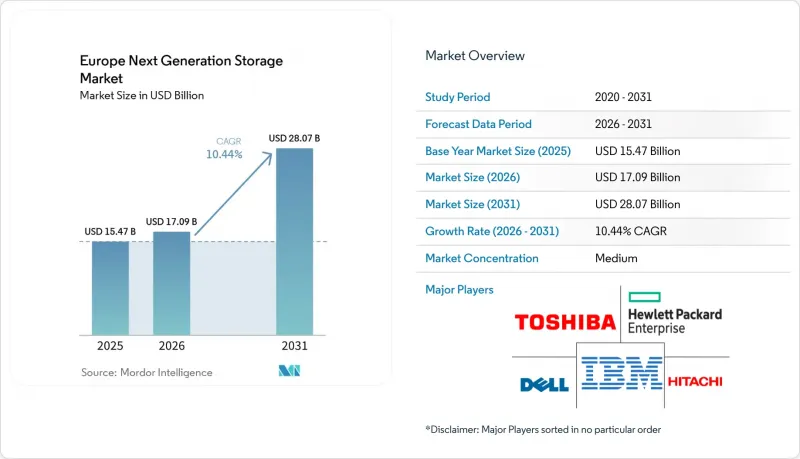
Mordor Intelligence에 의하면, 유럽의 차세대 스토리지 시장 규모는 2025년에 154억 7,000만 달러로 평가되었습니다. 2026년 170억 9,000만 달러에서 2031년까지 280억 7,000만 달러에 이를 것으로 예상되며, 예측 기간(2026-2031년) CAGR은 10.44%를 나타낼 전망입니다.
본 보고서는 스토리지 시스템(직접 연결 스토리지(DAS), 네트워크 연결 스토리지(NAS) 등), 스토리지 아키텍처(파일 및 오브젝트 기반 스토리지, 블록 스토리지 등), 메모리 및 미디어 유형(하드 디스크 드라이브(HDD), NAND 플래시 등), 최종 사용자 산업(은행, 금융서비스 및 보험(BFSI), 소매 및 전자상거래 등), 그리고 국가별로 분류되어 있습니다. 시장 전망은 금액(달러) 기준으로 제시되어 있습니다.
유럽의 차세대 스토리지 시장 동향 및 인사이트
폭발적으로 증가하는 디지털 데이터의 양
2023년부터 2028년에 걸쳐 전 세계 데이터 생성량은 3배로 증가할 것으로 예상되며, GDPR(EU 개인정보보호규정)에 따른 현지 저장 의무에 따라 그 증가분의 대부분은 EU 역내에 저장되어야 합니다. 따라서 페타바이트 규모의 용량을 계획하고 있는 기업들은 On-Premise 어레이와 소버린 클라우드의 확장 기능을 결합한 하이브리드 토폴로지를 도입하여, 규정 준수를 확보하는 동시에 지연 시간을 줄이고 있습니다. 지출 동향을 살펴보면, 벤더 종속성에 빠지지 않으면서도 다양한 파일 및 오브젝트 워크로드를 수용할 수 있는 확장 가능한 소프트웨어 정의 플랫폼으로의 뚜렷한 전환이 나타나고 있습니다. 그 결과, 기업들이 단일 아키텍처 내에서 규정 준수 및 성능 향상을 동시에 달성하고자 노력하는 가운데, 유럽의 차세대 스토리지 시장 성장률은 세계 평균을 웃도는 추세를 보이고 있습니다.
SSD 및 NVMe 아키텍처로의 급속한 전환
기업에서 PCIe Gen5 NVMe를 도입함에 따라, 과거 On-Premise 어레이와 퍼블릭 클라우드 계층을 갈라놓았던 성능 격차가 점차 해소되고 있습니다. 인더스트리 4.0을 도입한 독일의 제조 공장에서는 지연 시간 허용치를 100µs 미만으로 유지하고 있는데, 이는 회전식 디스크로는 달성할 수 없는 기준치입니다. 에너지 효율은 이제 이사회 차원에서 중요하게 여겨지는 지표가 되었습니다. SSD는 HDD에 비해 테라바이트당 전력 소비량이 현저히 적어, 이를 통해 사업자들은 2027년에 제정된 독일 에너지 효율법에 명시된 데이터센터용 재생에너지 50% 기준을 달성하는 데 기여하고 있습니다. 이러한 동향에 따라, 유럽의 차세대 스토리지 업계에서 플래시 미디어는 전술적 투자라기보다는 전략적 투자로 자리매김하고 있습니다.
올플래시 및 NVMe 어레이의 높은 초기 투자 비용
엔터프라이즈용 SSD는 여전히 HDD의 용량당 단가에 비해 최대 9.9배나 비싼 단가를 보이고 있습니다. 중소기업의 경우, 이 가격 차이는 플래시로 인한 에너지 절감 효과를 고려하더라도 ROI 산정을 복잡하게 만들고 있습니다. 하이퍼스케일러들의 도입이 단기적인 가격 안정화를 뒷받침하고 있지만, 플래시의 비트당 단가가 임계값 아래로 떨어질 때까지는 많은 유럽의 중소기업들이 QLC 플래시와 대용량 디스크를 결합한 하이브리드 구성으로 워크로드를 단계적으로 계속 이전해 나갈 것입니다.
부문별 분석
2025년 유럽의 차세대 스토리지 시장 규모 중 직접 어태치드 스토리지(DAS)가 45.02%의 점유율을 차지했으며, 이는 기업들이 미션 크리티컬 워크로드에서 예측 가능한 지연 시간을 중요시하고 있음을 여실히 보여주었습니다. 한편, 하이퍼컨버지드 인프라(HCI)는 연평균 성장률(CAGR) 11.18%를 나타낼 것으로 예측되며, 이는 컴퓨팅, 스토리지, 네트워크를 단일 정책 도메인으로 통합하는 스케일아웃형 노드에 대한 수요를 반영한 것입니다.
하이퍼 컨버전스로의 추세는 독일의 국가 디지털화 지원금을 통해 힘을 얻고 있습니다. 해당 국가에서는 제조업체가 주권 관련 규정을 위반하지 않고 센서 데이터를 분석하기 위해 현장 처리가 필수로 요구됩니다. 델 테크놀로지스와 CoreWeave의 랙급 AI 플랫폼은 통합 리소스가 페타바이트 규모의 플래시 스토리지와 결합되어 1.4 엑사 FLOPS의 성능을 제공할 수 있음을 입증했으며, 모놀리식 어레이와 순수한 퍼블릭 클라우드 계층 사이의 매력적인 대안으로 자리매김하고 있습니다.
파일 및 객체 기반 스토리지는 분석 로그부터 8K 미디어 파일에 이르기까지 비정형 데이터 세트를 위한 RESTful 스케일아웃형 저장소를 제공함으로써, 2025년 유럽의 차세대 스토리지 시장 점유율의 65.05%를 차지했습니다. 소프트웨어 정의 스토리지(SDS)는 서비스를 하드웨어에서 분리함으로써 ‘데이터 중심’의 이식성 원칙을 충족시키고 있어, 연평균 성장률(CAGR) 11.74%라는 빠른 속도로 성장하고 있습니다.
유럽의 은행 및 보험사들은 트랜잭션 지연을 초래하지 않으면서, 소버린 클라우드 파트너 간에 페타바이트 규모의 데이터 세트를 실시간으로 마이그레이션할 수 있는 데이터 모빌리티 오케스트레이터의 시범 운영을 진행하고 있습니다. 히타치 반타라와 해머스페이스 등과의 파트너십을 통해 메타데이터의 일관성을 유지한 채 자동 분류 및 이동이 가능해졌으며, 레거시 용도 리팩토링에 따른 부담을 최소화하고 있습니다.
기타 혜택 :
- 엑셀 형식 시장 예측(ME) 시트
- 3개월간의 애널리스트 지원
자주 묻는 질문
목차
제1장 서론
제2장 조사 방법
제3장 주요 요약
제4장 시장 구도
제5장 시장 규모 및 성장 예측
제6장 경쟁 구도
제7장 시장 기회 및 향후 전망
KTH 26.07.03According to Mordor Intelligence, the europe next generation storage market size was valued at USD 15.47 billion in 2025 and estimated to grow from USD 17.09 billion in 2026 to reach USD 28.07 billion by 2031, at a CAGR of 10.44% during the forecast period (2026-2031).
This report is Segmented by Storage System (Direct-Attached Storage (DAS), Network-Attached Storage (NAS), and More), Storage Architecture (File and Object-Based Storage, Block Storage, and More), Memory and Media Type (Hard Disk Drive (HDD), NAND Flash, and More), End-User Industry (BFSI, Retail and E-Commerce, and More), and Country. The Market Forecasts are Provided in Terms of Value (USD).
Europe Next Generation Storage Market Trends and Insights
Exploding Volume of Digital Data
Global data creation is set to triple between 2023 and 2028, and local retention obligations under GDPR mean most of that growth must be stored inside EU borders. Enterprises planning for petabyte-scale capacity are therefore deploying hybrid topologies that couple on-premises arrays with sovereign-cloud extensions, ensuring compliance while keeping latency in check. Spending patterns show a marked tilt toward scalable, software-defined platforms that can ingest diverse file and object workloads without vendor lock-in. The result is a Europe next generation storage market whose expansion rate outpaces global averages as organizations attempt to blend compliance and performance within a single architecture.
Rapid Shift to SSD and NVMe Architectures
Enterprise adoption of PCIe Gen5 NVMe is eliminating the performance gap that once separated on-premises arrays from public-cloud tiers. German manufacturing plants embracing Industry 4.0 have pushed latency budgets below 100 µs, a threshold unattainable for spinning disks. Energy efficiency is now a board-level metric; SSDs consume markedly fewer kilowatt-hours per terabyte than HDDs, helping operators meet the German Energy Efficiency Act's 50% renewable-energy threshold for data centres set for 2027. These dynamics position flash media as a strategic rather than tactical investment across the Europe next generation storage industry.
High Capital Cost of All-Flash and NVMe Arrays
Enterprise SSDs still carry a unit-cost premium as high as 9.9X over HDD capacity. For small and midsize firms, this delta complicates ROI calculations even when flash energy savings are factored in. Hyperscaler uptake is driving near-term price easing, but many European SMEs will continue staging workloads on hybrid tiers that mix QLC flash with high-capacity disk until flash crosses the cost-per-bit threshold.
Other drivers and restraints analyzed in the detailed report include:
- AI / ML Workloads Demanding Ultra-Low Latency
- Hybrid Multi-Cloud Adoption Across EU Enterprises
- Data-Sovereignty Compliance Fragmentation Across EU
For complete list of drivers and restraints, kindly check the Table Of Contents.
Segment Analysis
Direct-Attached Storage contributed 45.02% share to Europe next generation storage market size in 2025, underscoring enterprises' preference for predictable latency in mission-critical workloads. Hyper-Converged Infrastructure, however, is forecast to log an 11.18% CAGR, reflecting appetite for scale-out nodes that blend compute, storage and networking into a single policy domain.
Momentum toward hyperconvergence is reinforced by national digitalisation grants in Germany, where manufacturers need on-site processing to analyse sensor data without violating sovereignty rules. Dell Technologies and CoreWeave's rack-level AI platform demonstrates how converged resources can supply 1.4 exaFLOPS alongside petabyte-scale flash, making them an attractive middle ground between monolithic arrays and purely public-cloud tiers.
File and Object-Based Storage captured 65.05% of Europe next generation storage market share in 2025 by delivering RESTful, scale-out repositories for unstructured datasets, from analytics logs to 8K media files. Software-Defined Storage is scaling faster at 11.74% CAGR because it uncouples services from hardware, thereby fulfilling the Data Act's portability ethos.
European banks and insurers are piloting data-mobility orchestrators capable of live-migrating petabyte datasets between sovereign-cloud partners without disrupting transaction latency. Partnerships such as Hitachi Vantara and Hammerspace provide automated classification and movement that preserve metadata integrity, minimizing refactoring pain for legacy apps.
Complete Report Scope:
- By Storage System
- Direct-Attached Storage (DAS)
- Network-Attached Storage (NAS)
- Storage Area Network (SAN)
- Hyper-Converged Infrastructure (HCI)
- Others
- By Storage Architecture
- File and Object-Based Storage
- Block Storage
- Software-Defined Storage (SDS)
- By Memory and Media Type
- Hard Disk Drive (HDD)
- NAND Flash
- NVMe
- 3D XPoint / Optane
- Emerging NVM
- By End-User Industry
- BFSI
- Retail and e-Commerce
- IT and Telecom
- Healthcare and Life Sciences
- Media and Entertainment
- Government and Defence
- Other End-User Industries
- By Country
- Germany
- United Kingdom
- France
- Italy
- Spain
- Rest of Europe
List of Companies Covered in this Report:
- Dell Technologies
- Hewlett Packard Enterprise (HPE)
- NetApp
- Hitachi Vantara
- IBM
- Toshiba
- Pure Storage
- DataDirect Networks (DDN)
- Scality
- Fujitsu
- Netgear
- Huawei Technologies
- Samsung Electronics
- Western Digital
- Seagate Technology
- Micron Technology
- Lenovo
- Cisco Systems
- Oracle
- VAST Data
Additional Benefits:
- The market estimate (ME) sheet in Excel format
- 3 months of analyst support
TABLE OF CONTENTS
1 INTRODUCTION
- 1.1 Study Assumptions and Market Definition
- 1.2 Scope of the Study
2 RESEARCH METHODOLOGY
3 EXECUTIVE SUMMARY
4 MARKET LANDSCAPE
- 4.1 Market Overview
- 4.2 Market Drivers
- 4.2.1 Exploding volume of digital data
- 4.2.2 Rapid shift to SSD and NVMe architectures
- 4.2.3 AI / ML workloads demanding ultra-low latency
- 4.2.4 Hybrid multi-cloud adoption across EU enterprises
- 4.2.5 Edge-computing and 5G micro-data-centre proliferation
- 4.2.6 EU Gaia-X and Data Act enabling sovereign-cloud storage
- 4.3 Market Restraints
- 4.3.1 High capital cost of all-flash and NVMe arrays
- 4.3.2 Data-sovereignty compliance fragmentation across EU
- 4.3.3 Legacy workload migration and vendor lock-in risks
- 4.3.4 Rare-earth and critical-metal supply constraints for NAND/SSD
- 4.4 Value Chain Analysis
- 4.5 Regulatory Landscape
- 4.6 Technological Outlook
- 4.7 Porter's Five Forces Analysis
- 4.7.1 Bargaining Power of Suppliers
- 4.7.2 Bargaining Power of Buyers
- 4.7.3 Threat of New Entrants
- 4.7.4 Threat of Substitutes
- 4.7.5 Intensity of Competitive Rivalry
- 4.8 Assessment of the Impact of Macroeconomic Trends on the Market
5 MARKET SIZE AND GROWTH FORECASTS (VALUE)
- 5.1 By Storage System
- 5.1.1 Direct-Attached Storage (DAS)
- 5.1.2 Network-Attached Storage (NAS)
- 5.1.3 Storage Area Network (SAN)
- 5.1.4 Hyper-Converged Infrastructure (HCI)
- 5.1.5 Others
- 5.2 By Storage Architecture
- 5.2.1 File and Object-Based Storage
- 5.2.2 Block Storage
- 5.2.3 Software-Defined Storage (SDS)
- 5.3 By Memory and Media Type
- 5.3.1 Hard Disk Drive (HDD)
- 5.3.2 NAND Flash
- 5.3.3 NVMe
- 5.3.4 3D XPoint / Optane
- 5.3.5 Emerging NVM
- 5.4 By End-User Industry
- 5.4.1 BFSI
- 5.4.2 Retail and e-Commerce
- 5.4.3 IT and Telecom
- 5.4.4 Healthcare and Life Sciences
- 5.4.5 Media and Entertainment
- 5.4.6 Government and Defence
- 5.4.7 Other End-User Industries
- 5.5 By Country
- 5.5.1 Germany
- 5.5.2 United Kingdom
- 5.5.3 France
- 5.5.4 Italy
- 5.5.5 Spain
- 5.5.6 Rest of Europe
6 COMPETITIVE LANDSCAPE
- 6.1 Market Concentration
- 6.2 Strategic Moves
- 6.3 Market Share Analysis
- 6.4 Company Profiles (includes Global level Overview, Market level overview, Core Segments, Financials as available, Strategic Information, Market Rank/Share for key companies, Products and Services, and Recent Developments)
- 6.4.1 Dell Technologies
- 6.4.2 Hewlett Packard Enterprise (HPE)
- 6.4.3 NetApp
- 6.4.4 Hitachi Vantara
- 6.4.5 IBM
- 6.4.6 Toshiba
- 6.4.7 Pure Storage
- 6.4.8 DataDirect Networks (DDN)
- 6.4.9 Scality
- 6.4.10 Fujitsu
- 6.4.11 Netgear
- 6.4.12 Huawei Technologies
- 6.4.13 Samsung Electronics
- 6.4.14 Western Digital
- 6.4.15 Seagate Technology
- 6.4.16 Micron Technology
- 6.4.17 Lenovo
- 6.4.18 Cisco Systems
- 6.4.19 Oracle
- 6.4.20 VAST Data
7 MARKET OPPORTUNITIES AND FUTURE OUTLOOK
- 7.1 White-space and Unmet-Need Assessment


