

|
시장보고서
상품코드
2072484
클라우드 통합 소프트웨어 : 시장 점유율 분석, 업계 동향 및 통계, 성장 예측(2026-2031년)Cloud Integration Software - Market Share Analysis, Industry Trends & Statistics, Growth Forecasts (2026 - 2031) |
||||||
 Mordor Intelligence
Mordor Intelligence에 의하면, 클라우드 통합 소프트웨어 시장 규모는 2025년에 76억 8,000만 달러로 평가되었습니다. 2026년 87억 1,000만 달러에서 2031년까지 163억 5,000만 달러에 이를 것으로 예상되며, 예측 기간(2026-2031년) CAGR은 13.41%를 나타낼 전망입니다.
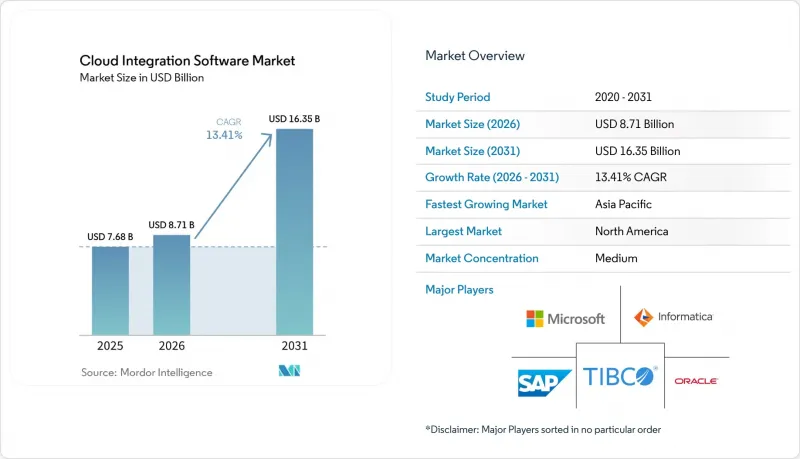
본 보고서는 유형별(PaaS, IaaS, SaaS), 통합 유형별(애플리케이션 통합, 데이터 통합 등), 기업 규모별(대기업 및 중소기업(SME)), 서비스 유형별(전문 서비스 및 관리형 서비스), 최종 사용자 산업별(은행, 금융서비스 및 보험(BFSI), IT 및 통신 등), 지역별로 분류되어 있습니다.
세계의 클라우드 통합 소프트웨어 시장 동향 및 인사이트
멀티 클라우드 도입 확대
기업들은 멀티클라우드를 단순한 대비책이 아닌, 경쟁 우위를 확보하는 수단으로 간주하고 있으며, GPU가 밀집된 노드를 AI 훈련에 할당하는 한편, 규제 대상 데이터를 주권 관할 구역 내에 보관하고 있습니다. 각 하이퍼스케일러 기업들은 지연을 줄이고 아웃바운드 요금을 없애는 크로스 클라우드 데이터베이스 및 네트워크 서비스를 통해 이에 대응하고 있으며, 이는 여러 공급자를 아우르며 정책 적용을 추상화하는 제어 플레인에 대한 수요를 촉진하고 있습니다. 워크로드가 어디에 배치되든 암호화 및 로깅이 일관되게 수행되므로, 통일된 거버넌스를 통해 파트너 온보딩이 신속하게 이루어집니다.
일관된 통합이 필요한 SaaS 용도의 확산
현재 일반적인 기업에서는 360개 이상의 SaaS 용도이 가동되고 있으며, 포인트-투-포인트 연결은 규모 확대에 대응하지 못해 데이터의 파편화와 규정 위반을 초래하고 있습니다. 최신 iPaaS에는 미리 구축된 커넥터, 스키마 매핑, 버전 관리 기능이 통합되어 있어, 팀은 스크립트를 작성할 필요 없이 즉시 레코드를 동기화할 수 있습니다. 또한 이 벤더는 고객이 엄선된 커넥터를 판매할 수 있는 API 마켓플레이스를 추가했으며, 이를 통해 통합은 백오피스 비용에서 추가 수익으로 전환되고 있습니다.
데이터 주권과 규정 준수의 복잡성
개인정보 관련 법규가 지역마다 다르기 때문에 팀은 규제 대상 데이터를 해당 지역 내에 보관하면서도 전 세계적인 분석이 가능하도록 지역별 맞춤형 파이프라인을 구축할 수밖에 없습니다. 벤더들은 주권형 클라우드 존이나 정책 기반 라우팅을 통해 이에 대응하고 있지만, 규정 준수 감사로 인해 도입 기간이 길어지고 운영 비용이 증가하고 있습니다.
부문별 분석
2025년에도 플랫폼 서비스형(PaaS)은 57.95%의 점유율을 유지했습니다. 이는 대기업들이 고도의 맞춤화가 필요하기 때문입니다. 그러나 SaaS 통합은 즉각적인 확장성, 내장된 가시성, 그리고 자본 지출(CapEx)을 대폭 절감하는 구독형 가격 정책 덕분에 연평균 15.12%의 성장률이 예상됩니다. 각 벤더사는 AI 기반의 데이터 매핑 및 이상 감지 기능을 SaaS 계층에 통합하여, 보안 팀이 관리 권한을 유지하면서 일반 개발자가 코드를 작성하지 않고도 워크플로를 구축할 수 있도록 하고 있습니다.
규제 대상 산업 분야에서는 Infrastructure-as-a-Service(IaaS) 통합이, 엄격한 감사 하에 있는 전용 호스트에서 워크로드를 운영함으로써 여전히 중요한 역할을 수행하고 있습니다. 이러한 도입 과정에서는 대개 정책 템플릿을 적용하고 클러스터 간에 시크릿을 복제하는 Kubernetes 오퍼레이터가 활용됩니다.
2025년에는 애플리케이션 통합이 매출의 36.45%를 차지하며 ERP 및 CRM 간의 연동을 뒷받침했습니다. 한편, 기업들이 디지털 자산의 수익화 및 마이크로서비스 도입을 추진함에 따라 API 관리 시장은 연평균 성장률(CAGR) 14.02%를 나타낼 것으로 전망됩니다. 게이트웨이에는 현재 셀프 서비스형 개발자 포털, 할당량 적용, 스키마 인트로스펙션 기능이 기본으로 탑재되어 있어, 파트너 온보딩 기간을 몇 개월에서 며칠로 단축하고 있습니다.
EDI의 현대화도 탄력을 받고 있습니다. 제조업체들은 배치 처리를 통한 플랫 파일 교환을, 재고 회전율을 높이고 품절 현상을 줄이는 실시간 이벤트 스트림으로 대체하고 있습니다.
지역별 분석
북미는 2025년에 36.02%의 시장 점유율을 차지했습니다. 이는 클라우드에 대한 심도 있는 전문 지식, 데이터 흐름에 관한 규제 완화, 그리고 공급업체의 본사와의 근접성으로 인해 최첨단 기능을 조기에 이용할 수 있다는 점이 뒷받침하고 있습니다. 이 지역의 기업들은 API 호출, 메시지 큐, 데이터 파이프라인을 단일 관리 화면에서 상호 연관성을 분석하는 AI 기반 통합 가시성 솔루션을 도입하고 있습니다.
아시아태평양은 2031년까지 연평균 성장률(CAGR) 14.25%를 기록하며 가장 높은 성장세를 보일 것으로 전망됩니다. 소버린 클라우드 프로그램에서는 데이터 상주 요건을 준수하면서도 연구 개발(R&D) 워크로드를 전 세계에 걸쳐 동기화할 수 있는 하이브리드 플랫폼이 요구되고 있습니다. 중국, 일본, 한국에서 5G가 급속히 확산되고 IoT가 보급됨에 따라 텔레메트리 데이터가 급증하고 있으며, 이를 중앙 데이터 레이크에 아카이브하기 전에 엣지 측에서 데이터 정제 작업을 수행해야 합니다.
유럽은 감사 로그, 동의 워크플로우, 불변의 데이터 계보 등을 중시하는 엄격한 개인정보 보호 규제로 인해 여전히 큰 시장 점유율을 유지하고 있습니다. 곧 시행될 ‘디지털 운영 복원력법(Digital Operational Resilience Act)’에 따라, 금융 기관들은 단일 장애 지점에 대한 내성을 갖춘 이벤트 스트리밍 아키텍처를 도입해야할 것입니다.
기타 혜택 :
- 엑셀 형식 시장 예측(ME) 시트
- 3개월간의 애널리스트 지원
자주 묻는 질문
목차
제1장 서론
제2장 조사 방법
제3장 주요 요약
제4장 시장 구도
제5장 시장 규모 및 성장 예측
제6장 경쟁 구도
제7장 시장 기회 및 향후 전망
KTH 26.07.03According to Mordor Intelligence, the cloud integration software market size was valued at USD 7.68 billion in 2025 and estimated to grow from USD 8.71 billion in 2026 to reach USD 16.35 billion by 2031, at a CAGR of 13.41% during the forecast period (2026-2031).
This report is Segmented by Type (PaaS, IaaS, and SaaS), Integration (Application Integration, Data Integration, and More), Enterprise Size (Large Enterprises and Small and Medium Enterprises (SMEs)), Service Type (Professional Service and Managed Services), End-User Industry (BFSI, IT and Telecom, and More), and Geography.
Global Cloud Integration Software Market Trends and Insights
Proliferation of Multi-Cloud Adoption
Enterprises treat multi-cloud as a competitive lever rather than an insurance policy, matching GPU-dense nodes to AI training while housing regulated data in sovereign regions. Hyperscalers respond with cross-cloud database and networking services that trim latency and erase egress fees, spurring demand for control planes that abstract policy enforcement across providers. Unified governance hastens partner onboarding because encryption and logging remain consistent no matter where workloads land.
SaaS Application Sprawl Requiring Unified Integration
With the average enterprise now running more than 360 SaaS apps, point-to-point links crack under scale, fragmenting data and harming compliance. Modern iPaaS bundles pre-built connectors, schema mapping, and version control so teams can sync records instantly without scripting. Vendors further add API marketplaces that let customers sell curated connectors, turning integration from back-office cost into incremental revenue.
Data-Sovereignty and Compliance Complexity
Fragmented privacy laws force teams to build region-specific pipelines that keep regulated data resident while still enabling global analytics. Vendors answer with sovereign cloud zones and policy-based routing, but compliance audits prolong rollouts and inflate operating costs.
Other drivers and restraints analyzed in the detailed report include:
- Need for Real-Time Data Analytics and API-Led Connectivity
- Event-Driven Architectures in Microservices
- Legacy On-Premises Integration Complexity
For complete list of drivers and restraints, kindly check the Table Of Contents.
Segment Analysis
Platform-as-a-Service kept 57.95% share in 2025 because large enterprises need advanced customisation. Yet SaaS integration will grow 15.12% annually, thanks to instant scaling, built-in observability, and subscription pricing that slashes CapEx. Vendors weave AI-based data mapping and anomaly detection into their SaaS layers, letting citizen developers build flows without code while security teams remain in control.
For regulated sectors, Infrastructure-as-a-Service integration maintains relevance by anchoring workloads on dedicated hosts under strict audit. These deployments often rely on Kubernetes operators that enforce policy templates and replicate secrets across clusters.
Application Integration dominated revenue at 36.45% in 2025, underpinning ERP and CRM linkages. API Management, however, will post a 14.02% CAGR as firms monetise digital assets and adopt microservices. Gateways now ship with self-service developer portals, quota enforcement, and schema introspection, shrinking partner onboarding windows from months to days.
EDI modernisation also gains steam: manufacturers replace batch flat-file exchanges with real-time event streams that improve inventory turns and reduce stock-outs.
Complete Report Scope:
- By Type
- PaaS
- IaaS
- SaaS
- By Integration
- Application Integration
- Data Integration
- API Management
- Process Integration and Orchestration
- B2B/EDI Integration
- By Enterprise Size
- Large Enterprises
- Small and Medium Enterprises (SMEs)
- By Service Type
- Professional Services
- Managed Services
- By End-user Industry
- BFSI
- IT and Telecom
- Retail and E-commerce
- Education
- Healthcare and Life Sciences
- Manufacturing
- Government and Public Sector
- Others
- By Geography
- North America
- United States
- Canada
- Mexico
- Europe
- Germany
- United Kingdom
- France
- Italy
- Spain
- Russia
- Rest of Europe
- Asia-Pacific
- China
- Japan
- India
- South Korea
- Australia and New Zealand
- Rest of Asia-Pacific
- South America
- Brazil
- Argentina
- Rest of South America
- Middle East and Africa
- Middle East
- Saudi Arabia
- United Arab Emirates
- Turkey
- Rest of Middle East
- Africa
- South Africa
- Nigeria
- Rest of Africa
- Middle East
- North America
Geography Analysis
North America held 36.02% market share in 2025, buoyed by deep cloud expertise, permissive data-flow regimes, and proximity to vendor headquarters that grants early access to bleeding-edge features. Enterprises here adopt AI-driven integration observability that correlates API calls, message queues, and data pipelines under one pane of glass.
Asia-Pacific is forecast for the fastest 14.25% CAGR through 2031. Sovereign cloud programs require hybrid platforms able to enforce data-residency while still syncing R and D workloads globally. Rapid 5G deployment and IoT proliferation in China, Japan, and South Korea generate telemetry bursts that must be cleansed at the edge before archive to central data lakes.
Europe keeps sizable share due to strict privacy mandates that emphasise audit logs, consent workflows, and immutable data lineage. The upcoming Digital Operational Resilience Act will push financial institutions to adopt event-streaming architectures that survive single-point failures.
- Microsoft
- Salesforce (MuleSoft)
- IBM
- Boomi
- Informatica
- SAP
- Oracle
- TIBCO
- SnapLogic
- Software AG
- Workato
- Celigo
- Jitterbit
- Talend
- WSO2
- Red Hat
- Axway
- Kong Inc.
- Accenture
- Deloitte
Additional Benefits:
- The market estimate (ME) sheet in Excel format
- 3 months of analyst support
TABLE OF CONTENTS
1 INTRODUCTION
- 1.1 Study Assumptions and Market Definition
- 1.2 Scope of the Study
2 RESEARCH METHODOLOGY
3 EXECUTIVE SUMMARY
4 MARKET LANDSCAPE
- 4.1 Market Overview
- 4.2 Market Drivers
- 4.2.1 Proliferation of multi-cloud adoption
- 4.2.2 SaaS application sprawl requiring unified integration
- 4.2.3 Need for real-time data analytics and API-led connectivity
- 4.2.4 Event-driven architectures in micro-services
- 4.2.5 Edge-to-cloud orchestration for Industry 4.0
- 4.2.6 Monetisation of marketplace connectors (iPaaS)
- 4.3 Market Restraints
- 4.3.1 Data-sovereignty and compliance complexity
- 4.3.2 Legacy on-prem integration complexity
- 4.3.3 Rising hyperscaler egress charges
- 4.3.4 Scarcity of cloud-native integration talent
- 4.4 Value Chain Analysis
- 4.5 Regulatory Landscape
- 4.6 Technological Outlook
- 4.7 Porter's Five Forces Analysis
- 4.7.1 Bargaining Power of Buyers
- 4.7.2 Bargaining Power of Suppliers
- 4.7.3 Threat of New Entrants
- 4.7.4 Threat of Substitutes
- 4.7.5 Intensity of Competitive Rivalry
- 4.8 Investment Analysis
- 4.9 Assessment of the Impact of Macroeconomic Trends on the Market
5 MARKET SIZE AND GROWTH FORECASTS (VALUE)
- 5.1 By Type
- 5.1.1 PaaS
- 5.1.2 IaaS
- 5.1.3 SaaS
- 5.2 By Integration
- 5.2.1 Application Integration
- 5.2.2 Data Integration
- 5.2.3 API Management
- 5.2.4 Process Integration and Orchestration
- 5.2.5 B2B/EDI Integration
- 5.3 By Enterprise Size
- 5.3.1 Large Enterprises
- 5.3.2 Small and Medium Enterprises (SMEs)
- 5.4 By Service Type
- 5.4.1 Professional Services
- 5.4.2 Managed Services
- 5.5 By End-user Industry
- 5.5.1 BFSI
- 5.5.2 IT and Telecom
- 5.5.3 Retail and E-commerce
- 5.5.4 Education
- 5.5.5 Healthcare and Life Sciences
- 5.5.6 Manufacturing
- 5.5.7 Government and Public Sector
- 5.5.8 Others
- 5.6 By Geography
- 5.6.1 North America
- 5.6.1.1 United States
- 5.6.1.2 Canada
- 5.6.1.3 Mexico
- 5.6.2 Europe
- 5.6.2.1 Germany
- 5.6.2.2 United Kingdom
- 5.6.2.3 France
- 5.6.2.4 Italy
- 5.6.2.5 Spain
- 5.6.2.6 Russia
- 5.6.2.7 Rest of Europe
- 5.6.3 Asia-Pacific
- 5.6.3.1 China
- 5.6.3.2 Japan
- 5.6.3.3 India
- 5.6.3.4 South Korea
- 5.6.3.5 Australia and New Zealand
- 5.6.3.6 Rest of Asia-Pacific
- 5.6.4 South America
- 5.6.4.1 Brazil
- 5.6.4.2 Argentina
- 5.6.4.3 Rest of South America
- 5.6.5 Middle East and Africa
- 5.6.5.1 Middle East
- 5.6.5.1.1 Saudi Arabia
- 5.6.5.1.2 United Arab Emirates
- 5.6.5.1.3 Turkey
- 5.6.5.1.4 Rest of Middle East
- 5.6.5.2 Africa
- 5.6.5.2.1 South Africa
- 5.6.5.2.2 Nigeria
- 5.6.5.2.3 Rest of Africa
- 5.6.5.1 Middle East
- 5.6.1 North America
6 COMPETITIVE LANDSCAPE
- 6.1 Market Concentration
- 6.2 Strategic Moves
- 6.3 Market Share Analysis
- 6.4 Company Profiles (includes Global level Overview, Market level overview, Core Segments, Financials as available, Strategic Information, Market Rank/Share for key companies, Products and Services, and Recent Developments)
- 6.4.1 Microsoft
- 6.4.2 Salesforce (MuleSoft)
- 6.4.3 IBM
- 6.4.4 Boomi
- 6.4.5 Informatica
- 6.4.6 SAP
- 6.4.7 Oracle
- 6.4.8 TIBCO
- 6.4.9 SnapLogic
- 6.4.10 Software AG
- 6.4.11 Workato
- 6.4.12 Celigo
- 6.4.13 Jitterbit
- 6.4.14 Talend
- 6.4.15 WSO2
- 6.4.16 Red Hat
- 6.4.17 Axway
- 6.4.18 Kong Inc.
- 6.4.19 Accenture
- 6.4.20 Deloitte
7 MARKET OPPORTUNITIES AND FUTURE OUTLOOK
- 7.1 White-space and Unmet-need Assessment


