|
시장보고서
상품코드
2072523
임상 종양 NGS : 시장 점유율 분석, 업계 동향 및 통계, 성장 예측(2026-2031년)Clinical Oncology NGS - Market Share Analysis, Industry Trends & Statistics, Growth Forecasts (2026 - 2031) |
||||||
 Mordor Intelligence
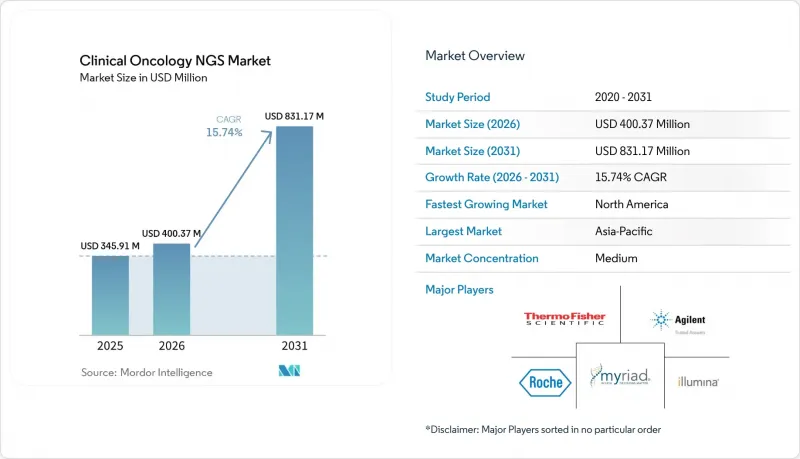
Mordor Intelligence에 의하면, 임상 종양 NGS 시장 규모는 2025년 3억 4,591만 달러로 평가되었습니다. 2026년에는 4억 37만 달러로 확대되어 2026-2031년에 걸쳐 CAGR 15.74%로 성장을 지속하여, 2031년까지 8억 3,117만 달러에 이를 것으로 예측됩니다.
본 보고서는 기술별(전장 유전체 염기서열 분석 등), 워크플로우별(분석 전 시료 전처리 등), 시료 유형별(조직 유래 등), 용도별(스크리닝 등), 최종 사용자별(병원·암 센터 등), 지역별(북미, 유럽, 아시아태평양, 중동 및 아프리카, 남미)로 분류되어 있습니다. 시장 전망은 금액(달러) 기준으로 제시되어 있습니다.
세계의 임상 종양 NGS 시장 동향 및 인사이트
정밀 종양학의 도입 확대와 CGP의 표준 치료로 자리매김
폐암, 유방암, 대장암, 전립선암, 난소암에 관한 임상 지침에서는 현재 NGS에 기반한 종합적인 유전체 프로파일링을 1차 검사 방법으로 권장하고 있습니다. FoundationOne CDx만으로도 300개 이상의 암 관련 유전자를 아우르며, 미국 내 동반진단 승인 건수의 60%를 차지하고 있습니다. 여러 가지 단일 유전자 검사를 하나의 패널로 통합함으로써, 전체 검사 소요 기간이 30일에서 2-3일로 단축되어 입원 비용을 절감하고 표적 치료의 시작 시기를 앞당길 수 있습니다. 의료 시스템의 비용 절감과 생존율 향상 덕분에 CGP의 광범위한 보급이 뒷받침되고 있습니다.
전 세계 암 발병률 증가와 고령화
고령화의 진행과 생활 방식의 변화로 인해 전 세계적으로 암 유병률이 증가하고 있으며, 고처리량 NGS에 대한 수요가 높아지고 있습니다. 인도에서는 유전자 프로파일링 검사를 받은 환자 1,000명 중 80%가 치료에 활용할 수 있는 변이를 가지고 있는 것으로 나타났으며, 이에 따라 2025년에는 9만 9,858 카롤 루피(123억 달러) 규모의 암 대책 예산이 편성되었습니다. 중국, 일본, 미국에서도 이와 유사한 인구 통계학적 압력으로 인해 연간 검사 건수가 증가하고 있으며, 특히 고령층이 선호하는 비침습적인 재채혈 검사에 대한 수요가 높아지고 있습니다.
생물정보학 인력과 데이터 관리의 병목 현상
임상 생물정보학자공급은 폭발적으로 증가하는 검사 수요를 따라가지 못하고 있습니다. 병원들은 높은 급여를 지급하고 클라우드 파이프라인에 투자하고 있지만, 변이 주석 작업의 복잡성으로 인해 여전히 보고가 지연되고 있습니다. 전문 업체에 업무를 외주화하거나 AI 해석 엔진을 도입함으로써 인력 부족 문제는 일부 해소되었지만, 교육 격차를 완전히 해소하기에는 아직 미치지 못하고 있습니다.
부문별 분석
타겟 패널은 실용적인 유전자 분석과 간결한 보고서 작성을 원하는 보험사의 요구를 조화시킴으로써, 2025년 임상 종양 NGS 시장 점유율의 52.05%를 차지했습니다. DNA와 RNA를 통합한 이 키트는 융합 유전자의 검출 정확도를 높이는 동시에, 병원 IT 팀이 관리하기 쉬운 파일 크기를 유지하고 있습니다. 전 엑솜 프로파일링은 비용 면에서 추격세를 보이고 있으며, 연평균 성장률(CAGR) 16.98%를 기록해 2031년까지 그 격차를 좁힐 전망입니다. 임상의들은 불균일한 드라이버 돌연변이를 가진 종양 유형에 대해 엑솜 검사를 점점 더 많이 의뢰하고 있으며, 보다 광범위한 돌연변이의 전체적인 양상을 활용하여 면역요법 병용 요법을 결정하고 있습니다. 고형암에 대한 설득력 있는 증거가 축적됨에 따라, 전체 엑솜 시퀀싱을 활용한 임상 종양 NGS 시장 규모는 2026년부터 급격히 확대될 전망입니다.
성장 전망 측면에서 볼 때, 검사실이 한 번의 분석으로 50개 유전자로 구성된 핫스팟 패널과 2만 개 유전자로 구성된 엑솜을 전환할 수 있는 플랫폼이 유리합니다. FoundationOne RNA는 318개 유전자에 걸친 스플라이스 변이에 대한 정보를 추가함으로써, 멀티오믹스 패널이 표준 키트로 자리 잡는 시대의 도래를 시사하고 있습니다. 한편, 전장유전체 분석은 구조적 변이가 많은 악성 종양이나 연구 코호트를 대상으로 한 틈새 선택지에 그치고 있지만, 시약 비용 하락으로 인한 혜택은 여전히 누리고 있습니다. 병원의 분자진단위원회가 성숙해짐에 따라, 수요는 단일 유전자·단일 약물에서 범종양 바이오마커 시그니처로 전환되고 있으며, 이에 따라 표적 치료 및 엑솜 분석이라는 두 가지 영역에 걸쳐 임상 종양 NGS 시장의 성장세가 유지되고 있습니다.
2025년에는 시퀀싱 장비가 매출의 43.41%를 차지했으며, 이는 해당 장비의 자본 비용과 소모품 사용량이 반영된 결과입니다. 그러나 FASTQ 파일을 치료 권고 사항으로 변환하는 작업은 여전히 많은 노력이 필요하기 때문에 데이터 분석 분야가 연평균 성장률(CAGR) 18.9%로 가장 빠르게 성장하고 있습니다. 클라우드 네이티브 분석 제품군은 현재 자동화된 품질 관리(QC), 주석 달기, 보고서 생성을 통합하여 임상 실험실이 안고 있는 제한된 컴퓨팅 리소스에 대한 부담을 덜어주고 있습니다. 새로운 표준으로서, 종양만을 대상으로 한 파이프라인 및 대조군 정상 조직과의 쌍 분석에 더해, 우발적 소견으로 인한 혼란을 방지하기 위한 생식세포 계통 필터링이 포함되어 있습니다.
Tempus, SOPHiA GENETICS 및 Microsoft는 소프트웨어 라이선스와 시퀀싱 서비스 크레딧을 묶은 패키지를 통해 하이브리드 SaaS 및 벤치탑 모델로의 전환을 구현하고 있습니다. 롱 리드 어셈블러와 그래프 기반 정렬기는 컴퓨팅 인프라에 가해지는 부하를 더욱 증가시켜, GPU 팜과 FPGA 가속기 수요를 촉진하고 있습니다. 그 결과, 임상종양 NGS 시장의 데이터 분석 분야 규모 확대가 장비 판매 증가율을 상회하고 있으며, 2031년 초까지 수익 구조가 분석 구독 모델로 전환될 전망입니다. LIS 연동, 청구 자동화, 임상시험 대조 기능을 통합한 공급업체는 학술 기관과 지역 암 진료 네트워크 양쪽 모두로부터 계약을 수주하고 있습니다.
지역별 분석
2025년 북미는 전 세계 매출의 45.20%를 계속 차지했습니다. 이는 CMS(미국 의료보험서비스센터)의 지역별 보장 결정(Local Coverage Determinations)에 따라, 조직 및 혈장 유래 CGP(유전체 프로파일링)가 개별 사례별 사전 승인 없이 보험 적용을 받기 때문입니다. FDA(미국 식품의약국)의 ‘획기적인 의료기기(Breakthrough Device)’ 인증 절차에 따라 액체 생검의 승인이 가속화되고 있으며, US Oncology나 Mayo Clinic 등 미국의 종양학 네트워크에서는 치료 지침에 NGS를 공식적으로 도입하고 있습니다. 캐나다의 공적 자금에 의한 의료 제도를 채택한 각 주에서는 캐나다 전역을 대상으로 한 종양학 의약품 심사(OCDR)의 통합이 진행되고 있는 반면, 멕시코의 민간 보험사들은 미국의 CPT 코드를 점차 도입하고 있습니다.
유럽에서의 도입 과정은 IVDR 및 2025년 1월부터 시행된 HTA 규정에 의해 형성되고 있으며, 이를 통해 27개국의 임상적·경제적 심사가 통일될 것입니다. 독일, 프랑스, 영국은 전국 규모의 유전체 의료 이니셔티브를 확대하고, 실제 임상 증거 데이터 세트를 제공하는 중앙 집중형 시퀀싱 허브에 자금을 지원하고 있습니다. 남유럽 및 동유럽 회원국들은 ‘호라이즌 유럽(Horizon Europe)’의 보조금을 통해 역량을 강화하고 있으나, 인증 절차의 병목 현상으로 인해 소규모 검사실의 서비스 제공이 지연되고 있습니다. ESG에 대한 관심이 높아지는 가운데, EU의 구매자들은 탄소 발자국이 낮은 것으로 입증된 장비를 선택하도록 권장받고 있으며, 이로 인해 설비 투자는 다소 증가하겠지만, 그린 딜의 조달 기준에 부합하는 방향으로 이루어지고 있습니다.
아시아태평양은 연평균 성장률(CAGR) 20.7%를 기록하며 성장의 견인차 역할을 하고 있습니다. 중국에서는 국내 주요 NGS 기업들과 엄격한 데이터 현지화 의무가 공존하는 한편, 농촌 지역의 암 검진 시범 사업에 자금을 지원하고 있습니다. 일본에서는 CGP가 국민건강보험의 적용 대상이며, 급속한 고령화와 위암의 높은 유병률을 배경으로 패널 수요가 확대되고 있습니다. 인도에서는 막대한 환자 수와 정부 예산 증가로 인해 NovaSeq X를 도입한 벵갈루루와 하이데라바드의 참조 검사실로 검사 건수가 집중되고 있습니다. 호주, 싱가포르, 한국은 기술 실증의 장으로 기능하고 있으며, AI를 활용한 당일 암 진단 보고서를 시범 도입하여 그 성과를 공급업체의 연구개발 파이프라인에 반영하고 있습니다. 전반적으로, 보험 적용 범위 확대, 수입 관세 완화, 그리고 높은 암 발병률 덕분에 아시아태평양은 임상 종양 NGS 시장에서 가장 빠르게 성장하는 지역으로서의 입지를 확고히 하고 있습니다.
기타 혜택 :
- 엑셀 형식 시장 예측(ME) 시트
- 3개월간의 애널리스트 지원
자주 묻는 질문
목차
제1장 서론
제2장 조사 방법
제3장 주요 요약
제4장 시장 구도
제5장 시장 규모 및 성장 예측
제6장 경쟁 구도
제7장 시장 기회 및 향후 전망
KTH 26.07.07According to Mordor Intelligence, the clinical oncology NGS market size is expected to grow from USD 345.91 million in 2025 to USD 400.37 million in 2026 and is forecast to reach USD 831.17 million by 2031 at 15.74% CAGR over 2026-2031.
This report is Segmented by Technology (Whole Genome Sequencing, and More), Workflow (Pre-Analytical Sample Preparation, and More), Sample Type (Tissue-Based, and More), Application (Screening, and More), End User (Hospitals & Cancer Centers, and More), and Geography (North America, Europe, Asia-Pacific, Middle East & Africa, South America). The Market Forecasts are Provided in Terms of Value (USD).
Global Clinical Oncology NGS Market Trends and Insights
Advancing Precision-Oncology Adoption & CGP Standard-Of-Care
Clinical guidelines in lung, breast, colorectal, prostate, and ovarian cancers now recommend NGS-based comprehensive genomic profiling as first-line testing. FoundationOne CDx alone underpins 60% of U.S. companion-diagnostic approvals, spanning 300+ cancer-related genes. Consolidating multiple single-gene assays into one panel trims overall turnaround from 30 days to 2-3 days, lowering inpatient costs and accelerating targeted therapy start-dates. Health-system savings and survival gains sustain widespread CGP uptake.
Rising Global Cancer Incidence & Aging Population
An older population profile and lifestyle shifts increase worldwide cancer prevalence, spurring demand for high-throughput NGS. In India, 80% of 1,000 profiled patients carried actionable alterations, prompting a national cancer budget of INR 99,858 crore (USD 12.3 billion) in 2025. Similar demographic pressure in China, Japan, and the United States drives annual test volumes, particularly for less invasive repeat draws favored by geriatric cohorts.
Bioinformatics Talent & Data-Management Bottlenecks
The supply of clinical bioinformaticians lags behind explosive test demand. Hospitals pay premium salaries while investing in cloud pipelines, yet variant-annotation complexity still slows reporting. Outsourcing to specialty providers and embedding AI interpretation engines partly offsets workforce constraints but does not fully resolve the training gap.
Other drivers and restraints analyzed in the detailed report include:
- Rapid Decline in Sequencing Cost Per Sample
- Expanded Reimbursement For NGS-Based Oncology Tests
- Uncertain Regulatory Pathways for Pan-Cancer Panels
For complete list of drivers and restraints, kindly check the Table Of Contents.
Segment Analysis
Targeted panels held 52.05% of the clinical oncology NGS market share in 2025 by aligning actionable genes with payer preferences for concise reporting. Integrated DNA-plus-RNA kits enhance fusion detection while keeping file sizes manageable for hospital IT teams. Whole exome profiling is catching up on cost grounds, propelling a 16.98% CAGR that will narrow the gap by 2031. Clinicians increasingly order exomes for tumor types with heterogeneous driver mutations, leveraging the broader mutational canvas to guide immunotherapy combinations. The clinical oncology NGS market size for whole exome sequencing is set to climb sharply from 2026 as compelling evidence in solid tumors accumulates.
Growth prospects favor platforms that let laboratories toggle between 50-gene hotspot panels and 20,000-gene exomes within a single run. FoundationOne RNA adds splice-variant insight across 318 genes, signaling an era in which multi-omic panels become standard kit. Meanwhile, whole-genome assays remain a niche option for structural-variant-heavy malignancies or research cohorts but still benefit from falling reagents cost. As hospital molecular boards mature, demand shifts from "one-gene, one-drug" to pan-tumor biomarker signatures, sustaining the clinical oncology NGS market momentum across both targeted and exome modalities.
Sequencing instruments accounted for 43.41% revenue in 2025, reflecting their capital cost and consumables footprint. Yet the data-analysis tier is the fastest climber at 18.9% CAGR, because converting FASTQ files into therapy recommendations remains labor-intensive. Cloud-native interpretation suites now bundle automated QC, annotation, and report drafting, relieving clinical labs of scarce computational expertise. The emerging standard attaches tumor-only and paired-normal pipelines plus germline filtering to prevent incidental findings confusion.
Tempus, SOPHiA GENETICS, and Microsoft illustrate the shift toward hybrid SaaS plus bench-top models that bundle software seats with sequencing service credits. Long-read assemblers and graph-based aligners further stress compute infrastructure, fueling demand for GPU farms and FPGA accelerators. Consequently, the clinical oncology NGS market size expansion in data analytics is outpacing instrument sales, flipping the revenue mix toward interpretation subscriptions by early 2031. Vendors that integrate LIS connectivity, billing automation, and clinical-trial matching win contracts with both academic centers and community oncology chains.
Complete Report Scope:
- By Technology
- Whole Genome Sequencing
- Whole Exome Sequencing
- Targeted Sequencing & Resequencing Centrifuges
- By Workflow
- Pre-analytical Sample Preparation
- Sequencing
- Data Analysis & Interpretation
- By Sample Type
- Tissue-based
- Liquid Biopsy
- Other Biofluids
- By Application
- Screening
- Sporadic Cancer
- Inherited Cancer
- Companion Diagnostics
- Minimal Residual-Disease Monitoring
- Tumor Mutation-Burden Profiling
- Other Diagnostics
- Screening
- By End User
- Hospitals & Cancer Centers
- Clinical Reference Laboratories
- Academic & Research Institutes
- Contract Research Organizations
- By Geography
- North America
- United States
- Canada
- Mexico
- Europe
- Germany
- United Kingdom
- France
- Italy
- Spain
- Rest of Europe
- Asia-Pacific
- China
- Japan
- India
- Australia
- South Korea
- Rest of Asia-Pacific
- Middle East & Africa
- GCC
- South Africa
- GCC
- Rest of Middle East & Africa
- South America
- Brazil
- Argentina
- Rest of South America
- North America
Geography Analysis
North America retained 45.20% of global revenue in 2025 because CMS Local Coverage Determinations reimburse both tissue and plasma CGP without case-by-case pre-authorization. FDA's breakthrough-device pathway hastens liquid-biopsy approvals, and U.S. oncology networks such as US Oncology and Mayo Clinic institutionalize NGS in treatment guidelines. Canada's publicly funded provinces follow with pan-Canadian Oncology Drug Review alignment, while Mexico's private insurers gradually adopt U.S. CPT codes.
Europe's adoption trajectory is shaped by IVDR and the January 2025 HTA regulation that synchronizes clinical-and-economic reviews across 27 countries. Germany, France, and the United Kingdom extend nationwide genomic medicine initiatives, funding centralized sequencing hubs that feed real-world evidence datasets. Southern and Eastern members ramp capacity through Horizon Europe grants, yet certification bottlenecks slow small lab offerings. ESG scrutiny nudges EU buyers toward instruments with documented lower carbon footprints, modestly inflating capital expense but aligning with Green Deal procurement criteria.
Asia-Pacific is the growth locomotive at 20.7% CAGR. China blends domestic NGS champions with strict data-localization mandates yet funds rural cancer screening pilots. Japan covers CGP under national insurance and features a rapidly aging demographic with high gastric-cancer prevalence, boosting panel demand. India's large patient pool and government budget increases funnel volume to Bengaluru and Hyderabad reference labs equipped with NovaSeq X. Australia, Singapore, and South Korea act as technology testbeds, trialing AI-enabled same-day oncology reporting that feeds back into vendor R&D pipelines. Overall, expanding reimbursement, relaxed import duties, and high cancer incidence cement Asia-Pacific as the fastest mover in the clinical oncology NGS market.
- Illumina
- Thermo Fisher Scientific
- Roche
- Agilent Technologies
- Foundation Medicine, Inc.
- Guardant Health, Inc.
- BGI Genomics Co. Ltd.
- Pacific Bioscience
- Oxford Nanopore Technologies plc
- QIAGEN
- Exact Sciences
- Caris Life Sciences
- Myriad Genetics
- Adaptive Biotechnologies Corp.
- Personalis, Inc.
- ArcherDX (Invitae)
- Eurofins
- PerkinElmer
- SOPHiA GENETICS SA
- Tempus Labs, Inc.
Additional Benefits:
- The market estimate (ME) sheet in Excel format
- 3 months of analyst support
TABLE OF CONTENTS
1 Introduction
- 1.1 Study Assumptions & Market Definition
- 1.2 Scope of the Study
2 Research Methodology
3 Executive Summary
4 Market Landscape
- 4.1 Market Overview
- 4.2 Market Drivers
- 4.2.1 Advancing Precision-Oncology Adoption & CGP Standard-of-Care
- 4.2.2 Rising Global Cancer Incidence & Ageing Population
- 4.2.3 Rapid Decline in Sequencing Cost Per Sample
- 4.2.4 Expanded Reimbursement For NGS-Based Oncology Tests
- 4.2.5 Liquid-Biopsy-Based MRD Monitoring Boosting Repeat Testing
- 4.2.6 AI-Enabled Ultra-Rapid Sequencing for Point-Of-Care Decisions
- 4.3 Market Restraints
- 4.3.1 Bioinformatics Talent & Data-Management Bottlenecks
- 4.3.2 Uncertain Regulatory Pathways for Pan-Cancer Panels
- 4.3.3 ESG Scrutiny of Sequencer Carbon Footprint Elevates Costs
- 4.3.4 Cross-Border Genomic-Data Privacy Legislation
- 4.4 Regulatory Landscape
- 4.5 Technological Outlook
- 4.6 Porter's Five Forces Analysis
- 4.6.1 Threat of New Entrants
- 4.6.2 Bargaining Power of Buyers/Consumers
- 4.6.3 Bargaining Power of Suppliers
- 4.6.4 Threat of Substitute Products
- 4.6.5 Intensity of Competitive Rivalry
5 Market Size & Growth Forecasts (Value in USD)
- 5.1 By Technology
- 5.1.1 Whole Genome Sequencing
- 5.1.2 Whole Exome Sequencing
- 5.1.3 Targeted Sequencing & Resequencing Centrifuges
- 5.2 By Workflow
- 5.2.1 Pre-analytical Sample Preparation
- 5.2.2 Sequencing
- 5.2.3 Data Analysis & Interpretation
- 5.3 By Sample Type
- 5.3.1 Tissue-based
- 5.3.2 Liquid Biopsy
- 5.3.3 Other Biofluids
- 5.4 By Application
- 5.4.1 Screening
- 5.4.1.1 Sporadic Cancer
- 5.4.1.2 Inherited Cancer
- 5.4.2 Companion Diagnostics
- 5.4.3 Minimal Residual-Disease Monitoring
- 5.4.4 Tumor Mutation-Burden Profiling
- 5.4.5 Other Diagnostics
- 5.4.1 Screening
- 5.5 By End User
- 5.5.1 Hospitals & Cancer Centers
- 5.5.2 Clinical Reference Laboratories
- 5.5.3 Academic & Research Institutes
- 5.5.4 Contract Research Organizations
- 5.6 By Geography
- 5.6.1 North America
- 5.6.1.1 United States
- 5.6.1.2 Canada
- 5.6.1.3 Mexico
- 5.6.2 Europe
- 5.6.2.1 Germany
- 5.6.2.2 United Kingdom
- 5.6.2.3 France
- 5.6.2.4 Italy
- 5.6.2.5 Spain
- 5.6.2.6 Rest of Europe
- 5.6.3 Asia-Pacific
- 5.6.3.1 China
- 5.6.3.2 Japan
- 5.6.3.3 India
- 5.6.3.4 Australia
- 5.6.3.5 South Korea
- 5.6.3.6 Rest of Asia-Pacific
- 5.6.4 Middle East & Africa
- 5.6.4.1 GCC
- 5.6.4.2 South Africa
- 5.6.4.2.1 GCC
- 5.6.4.3 Rest of Middle East & Africa
- 5.6.5 South America
- 5.6.5.1 Brazil
- 5.6.5.2 Argentina
- 5.6.5.3 Rest of South America
- 5.6.1 North America
6 Competitive Landscape
- 6.1 Market Concentration
- 6.2 Market Share Analysis
- 6.3 Company Profiles (includes Global level Overview, Market level overview, Core Segments, Financials as available, Strategic Information, Market Rank/Share for key companies, Products & Services, and Recent Developments)
- 6.3.1 Illumina, Inc.
- 6.3.2 Thermo Fisher Scientific Inc.
- 6.3.3 F. Hoffmann-La Roche Ltd.
- 6.3.4 Agilent Technologies, Inc.
- 6.3.5 Foundation Medicine, Inc.
- 6.3.6 Guardant Health, Inc.
- 6.3.7 BGI Genomics Co. Ltd.
- 6.3.8 Pacific Biosciences of California, Inc.
- 6.3.9 Oxford Nanopore Technologies plc
- 6.3.10 QIAGEN N.V.
- 6.3.11 Exact Sciences Corporation
- 6.3.12 Caris Life Sciences
- 6.3.13 Myriad Genetics, Inc.
- 6.3.14 Adaptive Biotechnologies Corp.
- 6.3.15 Personalis, Inc.
- 6.3.16 ArcherDX (Invitae)
- 6.3.17 Eurofins Scientific S.E.
- 6.3.18 PerkinElmer, Inc.
- 6.3.19 SOPHiA GENETICS SA
- 6.3.20 Tempus Labs, Inc.
7 Market Opportunities & Future Outlook
- 7.1 White-space & Unmet-need Assessment