

|
시장보고서
상품코드
2072617
층간 격리 시장 : 시장 점유율 분석, 업계 동향 및 통계, 성장 예측(2026-2031년)Zonal Isolation - Market Share Analysis, Industry Trends & Statistics, Growth Forecasts (2026 - 2031) |
||||||
 Mordor Intelligence
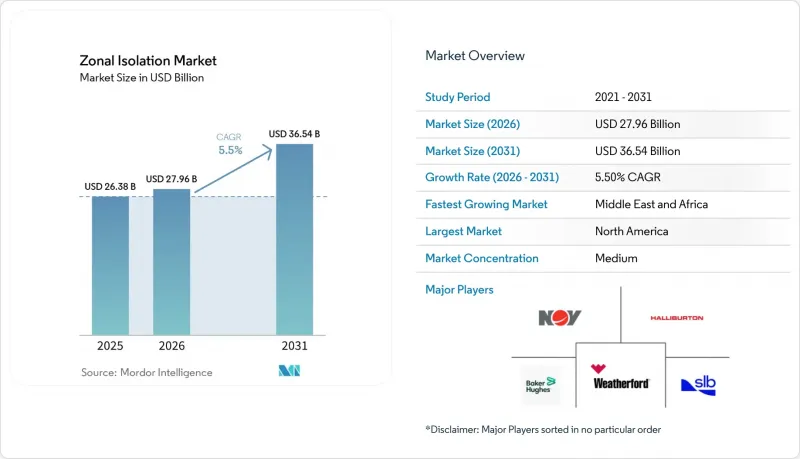
Mordor Intelligence에 의하면, 층간 격리 시장 규모는 2025년 263억 8,000만 달러로 평가되었고, 2026년에는 279억 6,000만 달러로 추정되고, 2031년까지 365억 4,000만 달러에 이를 것으로 예상되며, 2026-2031년 CAGR 5.5%로 성장할 전망입니다.
본 보고서는 기술별(기계적, 화학적), 유정 유형별(수직, 경사, 수평, 다방향), 저류층 환경별(기존, 기타), 수명 주기 단계별(시추, 기타), 용도별(1차, 복구, P&A), 입지별(육상, 해상), 지역별(북미, 유럽, 아시아태평양, 기타)로 분류되어 있습니다. 시장 전망은 금액(달러) 기준으로 제시되어 있습니다.
세계의 층간 격리 시장 동향 및 인사이트
셰일 및 타이트 가스 시추 붐
퍼미안 분지의 동시 파쇄(simul-frac) 프로그램에서는 현재 최대 8개의 수평정을 동시에 파쇄하고 있으며, 사이클 시간이 단축되는 한편, 1단계당 15분 이내에 드릴아웃이 가능한 복합 플러그에 대한 수요가 증가하고 있습니다. 하나의 패드에 최대 300개의 플러그가 필요한 경우도 있어, 우물당 비용은 낮아지고 있지만 총 수요량은 증가하고 있습니다. 사우디아라비아의 자프라 탄산염 암반층에서는 10,000피트를 초과하는 측갱을 봉쇄하고, CO₂가 풍부하게 포함된 유체에 견디기 위해 내산성 엘라스토머가 필요합니다. 아르헨티나의 바카 무에르타에서는 2026년까지 28,040개의 시추 단계가 완료될 전망이며, 이에 따라 브리지 플러그 및 시멘트 리테이너공급망 현지화가 필요해질 것입니다. 마찬가지로, 중국 쓰촨성의 셰일가스 개발 계획에 따르면 2030년까지 6,000개의 신규 수평정 시추가 예정되어 있으며, 각 정당 30-50개의 배리어가 필요할 것으로 보입니다.
심해 및 초심해 개발의 급증
SLB사가 브라질에서 수주한 35개 유정의 프리솔트층 계약에는 전전기식 완공 공법이 포함되어 있어, 이로 인해 패커의 수는 줄어들지만 수심 2,000미터의 환경에서 정밀한 시멘트 접합이 요구됩니다. ONGC의 50억 8,000만 달러 규모의 '클러스터 2' 이 프로젝트에서는 총 깊이 4,200미터에 달하는 35개의 시추공이 시추되며, 각 주입정에는 5,000 psi 이상의 내압 성능을 갖춘 격리 장치가 필요합니다. 엑슨모빌의 가이아나 생산량은 2026년에 하루 90만 배럴에 달했으나, 퇴적된 터비다이트층에서는 워터코닝을 완화하기 위해 고성능 시멘트의 사용이 필수적입니다.
원유 가격 변동이 설비 투자 주기를 억제
2026년 초, 브렌트 원유 가격이 배럴당 75-85달러 범위에서 등락함에 따라, 셰브론사는 2026년 지출 상한선을 190억 달러로 설정하고 심해 탐사 시추 프로젝트를 연기하기로 했습니다. 2025년 하반기 미국 셰일 시추 장비 수가 8% 감소함에 따라, 시추공 완공 건수가 줄어들었고, 플러그 소비량도 감소했습니다. 중동의 국영 석유 회사(NOC)는 수십억 달러 규모의 프로그램을 유지함으로써 이러한 감소를 부분적으로 완화하고, 활동의 지속을 보장했습니다.
부문별 분석
2025년에는 기계식 공구가 매출의 대부분을 차지했으나, 자가 복구 기능 및 지오폴리머 블렌드 등의 화학 기술 발전에 힘입어 2031년까지 연평균 성장률(CAGR) 6.2%로 성장할 것으로 전망됩니다. 베이커 휴즈의 'InvictaSet'는 미세한 균열 내의 탄산칼슘 침전을 촉진하여, 초임계 CO₂ 조건 하에서 CCS 우물의 수명을 연장합니다. 마찬가지로, SLB사의 'SqueezeCRETE' 는 40-320°F의 온도 범위에서 120마이크론 크기의 틈새로 침투하여, 기존 마이크로시멘트를 능가하는 중간 수명 수리 솔루션을 제공합니다. 유럽 및 북미에서 저탄소화가 의무화됨에 따라, 화학 시스템을 활용한 층간 격리 시장 규모는 확대될 것으로 예측됩니다. 동시에, 투르크메니스탄에서 웨더포드(Weatherford)사가 개발한 회전식 라이너 행거나 멕시코만에서 오일필드 서비스 프로페셔널스(Oilfield Service Professionals)사가 개발한 34,000피트 길이의 주철 리테이너와 같은 기계적 혁신은 가혹한 시추 조건에 대응하는 하드웨어의 지속적인 발전을 입증하고 있습니다. 브리지 플러그 설치에 이어 그 상부에 시멘트를 주입하는 하이브리드 방식은 기계적 도구를 통한 즉각적인 차단 효과와 경화된 시멘트의 내구성을 모두 갖추고 있습니다. ISO 14310 및 API 65-3에 기반한 규제 시험을 통해 기계식 시스템과 화학식 시스템 모두가 동일한 무결성 기준을 충족함이 보장되며, 상호 대체가 아닌 공존이 촉진되고 있습니다.
2025년에는 수직 시추가 시장 가치의 41.4%를 차지한 것으로 평가되었으며, 한편으로 시추 업체들이 저류층과의 접촉 면적을 극대화하는 데 주력함에 따라 수평 시추는 연평균 성장률(CAGR) 6.4%로 성장하고 있습니다. 퍼미안 분지에서는 현재 측면 연장 거리가 15,000피트를 초과하고, 유정당 60개 이상의 스테이지가 시추되고 있어, 유정 수가 정체 상태임에도 불구하고 유정당 자재 소비량이 실질적으로 두 배로 증가하며, 층간 격리 시장의 성장을 주도하고 있습니다. 마찬가지로, 바카 무에르타 지역의 10,000피트 수평 시추공도 비슷한 시공 밀도를 보이고 있으며, GeoPark, YPF, Shell, Chevron 등의 사업자들은 2026년까지 28,040단계의 시추를 완료할 전망입니다. 쿠웨이트나 오만 등 지역의 다자간 유정은 틈새 성장 분야로 주목받고 있습니다. 이러한 지역에서는 추가적인 지표면 구멍을 뚫지 않고도 분기점을 격리하기 위해 수지계 실란트가 사용되고 있습니다. 그 결과, 층간 격리 분야에서 수평 시추 시장 점유율은 앞으로도 계속 확대될 것으로 예측됩니다. 그러나 몬토니 지역에서 시행된 슬라이딩 슬리브 공법은 플러그 대신 슬리브를 사용함으로써 공구 사용량을 줄일 수 있음을 보여주고 있으며, 이로 인해 시멘트의 품질이 다시 중요시되고 있습니다.
지역별 분석
북미는 2025년 매출의 39.1%를 차지한 것으로 평가되었습니다. 퍼미안 분지에서 동시 파쇄(simul-frac) 프로그램이 증가함에 따라 플러그에 대한 수요가 높아지고 있는 반면, 안전·환경 집행국(BSEE)의 휴면 유정에 대한 규제 강화로 인해 멕시코만에서의 플러그 앤 어밴던먼트(P&A) 활동에 대한 지출이 가속화되고 있습니다. 캐나다에서는 몬토니 층에서 슬라이딩 슬리브 시스템에 대한 시험이 진행되고 있으며, 이를 통해 하드웨어 요구 사항은 완화되지만, 슬리브 간의 간섭을 방지하기 위해서는 정밀한 시멘트 주입이 필수적입니다. 이러한 동향은 해당 지역이 가동 효율 향상과 규제 요건 준수에 주력하고 있음을 여실히 보여주고 있습니다.
중동 및 아프리카는 연평균 성장률(CAGR)이 6.5%로, 가장 빠르게 성장하고 있는 지역입니다. 사우디아라비아의 자프라(Jafra) 타이트 탄산염 암석층에서는 15%의 CO₂를 함유한 유체를 관리하기 위해 내산성 엘라스토머가 필요합니다. 또한, ADNOC Drilling사가 시추공 완공 기간을 10% 단축함에 따라 오만과 쿠웨이트에서 시추 장비 군을 확대하기 위한 자본 재분배가 가능해졌으며, 두 나라를 합쳐 300기 이상의 시추 장비가 가동되고 있습니다. 이 지역의 성장은 시추 기술의 발전에 힘입어 확대된 탐사 및 생산 활동에 의해 주도되고 있습니다.
아시아태평양과 남미는 다음 성장 단계를 이끌고 있습니다. 중국에서는 쓰촨 분지에서 6,000개의 신규 수평정 시추가 예상되며, 각 우물에는 30-50개의 배리어가 필요합니다. 남미에서는 브라질의 프레솔트층과 가이아나의 스태블록 블록에서 수많은 해저 유정의 개발이 진행되고 있으며, 수심 2,000미터까지 견딜 수 있는 고사양 시멘트가 요구되고 있습니다. 이 지역들은 업스트림 부문에 대한 투자와 인프라 개발의 확대를 통해 상당한 성장이 예상됩니다.
유럽에서는 초점을 폐지 조치 활동으로 옮겨가고 있습니다. 북해 이전국(NSTA)이 관리하는 미처리 건들이 견조한 해양 플러그 앤 어밴던먼트(P&A) 서비스 시장의 원동력이 되고 있습니다. 이러한 동향은 노후화된 인프라에 대한 대응과 환경 규정 준수를 우선시하는 해당 지역의 입장을 반영하고 있으며, 폐설 서비스에 대한 지속적인 수요가 확보되고 있습니다.
기타 혜택 :
- 엑셀 형식 시장 예측(ME) 시트
- 3개월간의 애널리스트 지원
자주 묻는 질문
목차
제1장 서론
제2장 조사 방법
제3장 주요 요약
제4장 시장 구도
제5장 시장 규모 및 성장 예측
제6장 경쟁 구도
제7장 시장 기회 및 향후 전망
AJY 26.07.03According to Mordor Intelligence, the zonal isolation market size is expected to increase from USD 26.38 billion in 2025 to USD 27.96 billion in 2026 and reach USD 36.54 billion by 2031, growing at a CAGR of 5.5% over 2026-2031.
This report is Segmented by Technology (Mechanical, Chemical), Well Type (Vertical, Deviated, Horizontal, Multilateral), Reservoir Environment (Conventional, and More), Lifecycle Stage (Drilling, and More), Application (Primary, Remedial, P&A), Location (Onshore, Offshore), and Geography (North America, Europe, Asia-Pacific, and More). The Market Forecasts are Provided in Terms of Value (USD).
Global Zonal Isolation Market Trends and Insights
Shale and Tight-Gas Drilling Boom
Permian simul-frac programs now fracture up to eight horizontal wells simultaneously, reducing cycle times and increasing the demand for composite plugs that can be drilled out in under 15 minutes per stage. A single pad may require up to 300 plugs, driving higher volumes despite a lower cost per well. In Saudi Arabia's Jafurah carbonate formation, acid-resistant elastomers are needed to seal laterals exceeding 10,000 feet while withstanding CO2-rich fluids. Argentina's Vaca Muerta is projected to complete 28,040 stages by 2026, necessitating the localization of a supply chain for bridge plugs and cement retainers. Similarly, China's Sichuan shale gas initiative plans for 6,000 new horizontal wells by 2030, each requiring 30-50 barriers.
Deep- and Ultra-Deepwater Development Upsurge
SLB's 35-well pre-salt contract in Brazil includes all-electric completions, which reduce the number of packers but require precise cement bonding at water depths of 2,000 meters. ONGC's USD 5.08 billion Cluster 2 project involves 35 wells reaching a total depth of 4,200 meters, with each injector requiring isolation rated above 5,000 psi. ExxonMobil's production in Guyana reached 900,000 barrels per day in 2026, with stacked turbidites necessitating the use of high-performance cements to mitigate water coning.
Crude-Price Volatility Curbing CAPEX Cycles
Brent crude prices ranged between USD 75 - 85 per barrel in early 2026, leading Chevron to cap its 2026 spending at USD 19 billion and postpone exploratory deepwater drilling projects. An 8% decline in U.S. shale rigs during late 2025 resulted in reduced well completions and decreased plug consumption. Middle Eastern NOCs partially mitigated these reductions by maintaining their multi-billion-dollar programs, ensuring continued activity.
Other drivers and restraints analyzed in the detailed report include:
- Stricter Well-Integrity Mandates
- Horizontal and Multistage Frac Completions
- Cement Sustainability and CO2 Footprint Scrutiny
For complete list of drivers and restraints, kindly check the Table Of Contents.
Segment Analysis
Mechanical tools accounted for the majority of revenue in 2025; however, chemical advancements, such as self-healing and geopolymer blends, are projected to grow at a 6.2% CAGR through 2031. Baker Hughes' InvictaSet facilitates calcium carbonate precipitation in micro-cracks, enhancing the lifespan of CCS wells under super-critical CO2 conditions. Similarly, SLB's SqueezeCRETE penetrates 120-micron slots at temperatures ranging from 40 to 320 °F, providing a mid-life repair solution that surpasses traditional micro-cements. The zonal isolation market size for chemical systems is expected to expand, driven by low-carbon mandates in Europe and North America. Concurrently, mechanical innovations, such as Weatherford's rotating liner hanger in Turkmenistan and Oilfield Service Professionals' 34,000-foot cast-iron retainer in the Gulf, demonstrate ongoing advancements in hardware for extreme well conditions. Hybrid approaches, which involve setting a bridge plug followed by cement squeezing above it, combine the immediate isolation provided by mechanical tools with the durability of cured cement. Regulatory testing under ISO 14310 and API 65-3 ensures that both mechanical and chemical systems meet the same integrity standards, promoting coexistence rather than replacement.
Vertical drilling is projected to account for 41.4% of the market value in 2025, while horizontal wells are growing at a compound annual growth rate (CAGR) of 6.4% as operators focus on maximizing reservoir contact. In the Permian Basin, lateral lengths now exceed 15,000 feet, with over 60 stages per well, effectively doubling the consumption of materials per well and driving growth in the zonal isolation market, even as well counts stabilize. Similarly, Vaca Muerta's 10,000-foot horizontal wells demonstrate comparable intensity, with operators such as GeoPark, YPF, Shell, and Chevron expected to complete 28,040 stages by 2026. Multilateral wells in regions like Kuwait and Oman highlight niche growth, where resin sealants are used to isolate branch junctions without requiring additional surface holes. Consequently, the market share for horizontal wells in zonal isolation is anticipated to continue increasing. However, sliding-sleeve completions in the Montney region indicate that tool intensity can decrease when sleeves replace plugs, shifting the focus back to cement quality.
Complete Report Scope:
- By Technology
- Mechanical Zonal Isolation
- Chemical Zonal Isolation
- By Well Type
- Vertical Wells
- Deviated Wells
- Horizontal Wells
- Multilateral Wells
- By Reservoir Environment
- Conventional
- Unconventional
- HPHT Reservoirs
- By Lifecycle Stage
- Drilling
- Completion
- Production
- Abandonment
- By Application
- Primary Zonal Isolation
- Remedial Zonal Isolation
- Plug and Abandonment (P&A)
- By Location
- Onshore
- Offshore
- By Geography
- North America
- United States
- Canada
- Mexico
- Europe
- Germany
- United Kingdom
- France
- Italy
- NORDIC Countries
- Russia
- Rest of Europe
- Asia-Pacific
- China
- India
- Japan
- South Korea
- ASEAN Countries
- Rest of Asia-Pacific
- South America
- Brazil
- Argentina
- Rest of South America
- Middle East and Africa
- Saudi Arabia
- United Arab Emirates
- South Africa
- Egypt
- Rest of Middle East and Africa
- North America
Geography Analysis
North America is projected to account for 39.1% of the 2025 revenue. The rise in Permian simul-frac programs has increased demand for plugs, while stricter idle-well regulations from the Bureau of Safety and Environmental Enforcement (BSEE) have accelerated spending on plug and abandonment (P&A) activities in the Gulf of Mexico. In Canada, the Montney formation is testing sliding-sleeve systems, which reduce hardware requirements but rely on precise cementing to prevent sleeve cross-talk. These developments underscore the region's focus on improving operational efficiency and adhering to regulatory requirements.
The Middle East & Africa is the fastest-growing region, with a compound annual growth rate (CAGR) of 6.5%. In Saudi Arabia, the Jafurah tight carbonate formations require acid-resistant elastomers to manage fluids containing 15% CO2. Additionally, ADNOC Drilling's 10% improvement in well delivery times has enabled capital reallocation for expanding rig fleets in Oman and Kuwait, which together operate over 300 units. Growth in this region is driven by increased exploration and production activities, supported by advancements in drilling technologies.
Asia-Pacific and South America represent the next tier of growth. In China, the Sichuan Basin is expected to see the drilling of 6,000 new horizontal wells, each requiring 30-50 barriers. In South America, Brazil's pre-salt fields and Guyana's Stabroek block are contributing to the development of numerous subsea wells, necessitating high-specification cements capable of withstanding water depths of up to 2,000 meters. These regions are positioned for significant growth due to increasing investments in upstream activities and infrastructure development.
Europe is shifting its focus toward decommissioning activities. The backlog managed by the North Sea Transition Authority (NSTA) is driving a robust offshore plug and abandonment (P&A) services market. This trend reflects the region's priority on addressing aging infrastructure and meeting environmental compliance standards, ensuring sustained demand for decommissioning services.
- Schlumberger Ltd.
- Halliburton Co.
- Baker Hughes Co.
- Weatherford Intl. plc
- NOV Inc.
- TechnipFMC plc
- Expro Group Holdings
- Tendeka (TGS)
- Superior Energy Services
- Nine Energy Service
- Welltec A/S
- TAM International
- Core Laboratories
- Trican Well Service
- Rubicon Oilfield Intl.
- Packers Plus Energy Svcs.
- Archer Ltd.
- Vallourec S.A.
- Forum Energy Technologies
- Elite Downhole Tools
Additional Benefits:
- The market estimate (ME) sheet in Excel format
- 3 months of analyst support
TABLE OF CONTENTS
1 Introduction
- 1.1 Study Assumptions & Market Definition
- 1.2 Scope of the Study
2 Research Methodology
3 Executive Summary
4 Market Landscape
- 4.1 Market Overview
- 4.2 Market Drivers
- 4.2.1 Shale & tight-gas drilling boom
- 4.2.2 Deep- & ultra-deepwater development upsurge
- 4.2.3 Stricter well-integrity mandates (API Std 65-3, ISO 14310)
- 4.2.4 Rising horizontal & multistage frac completions
- 4.2.5 Geothermal heat-loop wells demanding high-temp isolation
- 4.2.6 CCS injection wells needing ultra-long-life barriers
- 4.3 Market Restraints
- 4.3.1 Crude-price volatility curbing CAPEX cycles
- 4.3.2 Cement-sustainability & CO2 footprint scrutiny
- 4.3.3 Supply-chain pinch in specialty swell-elastomers
- 4.3.4 Rise of all-electric completions bypassing mechanical tools
- 4.4 Supply-Chain Analysis
- 4.5 Regulatory Landscape
- 4.6 Technological Outlook
- 4.7 Porter's Five Forces
- 4.7.1 Threat of New Entrants
- 4.7.2 Bargaining Power of Buyers
- 4.7.3 Bargaining Power of Suppliers
- 4.7.4 Threat of Substitutes
- 4.7.5 Competitive Rivalry
5 Market Size & Growth Forecasts
- 5.1 By Technology
- 5.1.1 Mechanical Zonal Isolation
- 5.1.2 Chemical Zonal Isolation
- 5.2 By Well Type
- 5.2.1 Vertical Wells
- 5.2.2 Deviated Wells
- 5.2.3 Horizontal Wells
- 5.2.4 Multilateral Wells
- 5.3 By Reservoir Environment
- 5.3.1 Conventional
- 5.3.2 Unconventional
- 5.3.3 HPHT Reservoirs
- 5.4 By Lifecycle Stage
- 5.4.1 Drilling
- 5.4.2 Completion
- 5.4.3 Production
- 5.4.4 Abandonment
- 5.5 By Application
- 5.5.1 Primary Zonal Isolation
- 5.5.2 Remedial Zonal Isolation
- 5.5.3 Plug and Abandonment (P&A)
- 5.6 By Location
- 5.6.1 Onshore
- 5.6.2 Offshore
- 5.7 By Geography
- 5.7.1 North America
- 5.7.1.1 United States
- 5.7.1.2 Canada
- 5.7.1.3 Mexico
- 5.7.2 Europe
- 5.7.2.1 Germany
- 5.7.2.2 United Kingdom
- 5.7.2.3 France
- 5.7.2.4 Italy
- 5.7.2.5 NORDIC Countries
- 5.7.2.6 Russia
- 5.7.2.7 Rest of Europe
- 5.7.3 Asia-Pacific
- 5.7.3.1 China
- 5.7.3.2 India
- 5.7.3.3 Japan
- 5.7.3.4 South Korea
- 5.7.3.5 ASEAN Countries
- 5.7.3.6 Rest of Asia-Pacific
- 5.7.4 South America
- 5.7.4.1 Brazil
- 5.7.4.2 Argentina
- 5.7.4.3 Rest of South America
- 5.7.5 Middle East and Africa
- 5.7.5.1 Saudi Arabia
- 5.7.5.2 United Arab Emirates
- 5.7.5.3 South Africa
- 5.7.5.4 Egypt
- 5.7.5.5 Rest of Middle East and Africa
- 5.7.1 North America
6 Competitive Landscape
- 6.1 Market Concentration
- 6.2 Strategic Moves (M&A, Partnerships, PPAs)
- 6.3 Market Share Analysis (Market Rank/Share for key companies)
- 6.4 Company Profiles (includes Global level Overview, Market level overview, Core Segments, Financials as available, Strategic Information, Products & Services, and Recent Developments)
- 6.4.1 Schlumberger Ltd.
- 6.4.2 Halliburton Co.
- 6.4.3 Baker Hughes Co.
- 6.4.4 Weatherford Intl. plc
- 6.4.5 NOV Inc.
- 6.4.6 TechnipFMC plc
- 6.4.7 Expro Group Holdings
- 6.4.8 Tendeka (TGS)
- 6.4.9 Superior Energy Services
- 6.4.10 Nine Energy Service
- 6.4.11 Welltec A/S
- 6.4.12 TAM International
- 6.4.13 Core Laboratories
- 6.4.14 Trican Well Service
- 6.4.15 Rubicon Oilfield Intl.
- 6.4.16 Packers Plus Energy Svcs.
- 6.4.17 Archer Ltd.
- 6.4.18 Vallourec S.A.
- 6.4.19 Forum Energy Technologies
- 6.4.20 Elite Downhole Tools
7 Market Opportunities & Future Outlook
- 7.1 White-Space & Unmet-Need Assessment


