

|
시장보고서
상품코드
2072732
미국의 의료 청구 업무 아웃소싱 시장 : 시장 점유율 분석, 업계 동향 및 통계, 성장 예측(2026-2031년)United States Medical Billing Outsourcing - Market Share Analysis, Industry Trends & Statistics, Growth Forecasts (2026 - 2031) |
||||||
 Mordor Intelligence
Mordor Intelligence에 의하면, 미국의 의료 청구 업무 아웃소싱 시장 규모는 2025년에 55억 달러로 평가되었고, 2026년 61억 8,000만 달러로 추정되고, 2031년까지 111억 1,000만 달러에 이를 것으로 예측되며, 예측 기간(2026-2031년) CAGR은 12.45%를 나타낼 전망입니다.
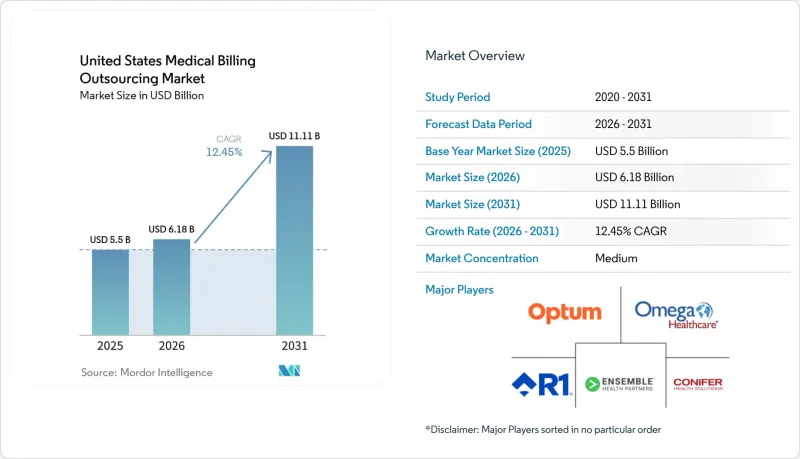
본 보고서는 서비스별(프론트엔드, 미들엔드, 백엔드 서비스), 아웃소싱 모델별(풀 서비스 등), 도입 형태별(클라우드 기반 등), 청구 유형별(개인, 의료기관 등), 최종 사용자별(병원 등), 전문 분야별(1차 진료 등), 지불자 유형별(민간 보험, 메디케어 등)로 분류되어 있습니다. 시장 전망은 금액(달러) 기준으로 제시되어 있습니다.
미국의 의료 청구 업무 아웃소싱 시장 동향 및 인사이트
청구의 복잡화와 문서 작성 부담 증가
청구의 복잡성과 사내 청구 팀의 처리 능력 간의 격차가 계속 확대되고 있어, 시장은 계속해서 혜택을 보고 있습니다. 의료 서비스 제공업체들은 끊임없이 이어지는 코딩 및 문서 작성 업무의 변경 사항에 대응하고 있으며, 이로 인해 직원들이 준비에 할애할 수 있는 시간이 줄어들고, 청구서 제출 시 오류 발생 위험이 높아지고 있습니다. 익스페리안 헬스(Experian Health)는 2025년 보고서에서 의료 기관의 41%가 10% 이상의 청구 거절률을 겪고 있으며, 50%는 거절의 주된 원인으로 데이터 누락이나 부정확성을 꼽고 있다고 보고했습니다. 또한 HFMA는 지불 측의 자동화로 인해 청구 접수 후 몇 초 이내에 거절 통지가 발송되는 경우가 있으며, 여전히 사내 팀에 의존하고 있는 의료 기관의 경우 수작업에 의한 수정 주기가 느린 것은 더 이상 현실적이지 않다고 지적하고 있습니다. 이러한 상황에서 최신 코딩 로직을 유지하고, 청구서 제출 전 편집 기능과 지속적인 불승인 피드백 루프를 갖춘 벤더야말로 현재 미국 의료 청구 업무 아웃소싱 시장에서 요구되는 업무 속도에 대응할 수 있는 입장에 있습니다.
사내 청구 업무의 고정비 절감을 위한 비용 절감 압박
미국의 의료 청구 업무 아웃소싱 시장은 의료 제공업체의 이익률이 이미 압박을 받고 있는 상황에서 고정적인 청구 간접비를 절감해야 할 필요성에 힘입어 성장하고 있습니다. Kodiak Solutions의 플랫폼을 이용하는 병원들은 2025년에 최종 청구 거절 및 미회수 환자 미납금으로 인해 480억 달러 이상의 순수익을 잃었습니다. 이로 인해, 예방 가능한 청구 건당 비용은 전년보다 더욱 높아졌습니다. 소규모 진료소나 지역 밀착형 의료 제공업체 그룹은 더욱 어려운 상황에 직면해 있습니다. 왜냐하면, 규정 준수 대응 도구, 직원 교육, 분석, 그리고 보험사 측의 워크플로우 업데이트와 같은 노력은 청구 건수가 적을 경우 효율적으로 확장되지 않기 때문입니다. 공급업체는 자동화, 코딩 감독 및 청구 거절 분석에 드는 비용을 다수의 고객 기반에 분산시킬 수 있으며, 이로 인해 경제성이 공급업체 측에 유리하게 작용합니다. 그 결과, 미국의 의료 청구 업무 아웃소싱 시장은 단순한 인력 대체뿐만 아니라 운영 레버리지에 의해 점점 더 뒷받침되고 있습니다.
데이터 개인정보 보호 및 사이버 보안 위험
사이버 보안은 미국의 의료 청구 업무 아웃소싱 시장에서 여전히 가장 뚜렷한 사업적 제약 요인으로 남아 있습니다. 미국 보건복지부(HHS)는 체인지 헬스케어(Change Healthcare)의 사이버 보안 사고가 최종적으로 약 1억 9,270만 명에게 영향을 미쳤다고 발표했으며, 단일 플랫폼이 기능 장애에 빠졌을 때, 일원화된 청구·지급 인프라가 시스템 전체에 혼란을 초래할 수 있는 실태를 여실히 드러냈습니다. 현재 구매 담당자들은 공급업체를 평가할 때 보안 아키텍처, 접근 제어, 사고 대응 체계 및 제3자 보증을 이전보다 훨씬 더 중요하게 여기고 있습니다. 이로 인해 판매 주기가 길어지고, 사업 비용이 증가하고 있습니다. 특히, 분산형 제공 모델에 의존하고 있는 벤더나, 규정 준수 담당 팀이 소규모인 벤더의 경우 그 영향이 두드러집니다. 미국의 의료 청구 업무 아웃소싱 시장에는 여전히 강력한 수요가 있지만, 사이버 보안은 더 이상 단순한 배경적인 IT 문제가 아니라 계약 확대의 성패를 좌우하는 핵심 요소가 되었습니다.
부문별 분석
2025년, 백엔드 서비스는 미국 의료 청구 업무 아웃소싱 시장의 38.3%를 차지했으며, 가장 큰 서비스 부문이 되었습니다. 이는 청구 기각 관리, 이의 제기, 미수금 추적이 가장 시급한 재무적 과제이기 때문입니다. Kodiak Solutions사의 보고서에 따르면, 해당 회사의 플랫폼을 이용하는 병원들은 2025년에 최종 거절 및 미회수 환자 미수금으로 인해 480억 달러 이상의 순수익을 잃을 것으로 예상되며, 최종 거절률의 중앙값은 2024년의 2.5%에서 2.7%로 상승했습니다. 이러한 수치는 의료기관의 구매 담당자들이 아웃소싱 계약에서 회수 및 사후 관리 능력을 여전히 가장 중요한 요소로 여기는 이유를 설명해 줍니다. 프론트엔드 서비스는 여전히 2위의 규모를 차지하고 있지만, 수급 자격 확인 및 기본적인 접수 업무의 자동화가 진행됨에 따라 그 점유율은 서서히 압박을 받고 있습니다.
미들엔드 서비스는 가장 빠르게 성장하고 있는 서비스 부문으로, 2031년까지 연평균 성장률(CAGR) 13.4%를 기록하며 성장할 전망입니다. 이는 코딩, 임상 문서 개선 및 청구 정보 수집이 현재 상환 위험이 처음 발생하는 시점에 더 가깝게 위치해 있기 때문입니다. 미국의 의료 청구 업무 아웃소싱 시장에서는 AI 도입에도 여전히 예외 처리, 검증 및 지급자 규정 모니터링이 필요하기 때문에 미들엔드 전문가에 대한 수요는 줄어들지 않을 것입니다. IKS Health가 2026년 4월에 감사 대응형 자율 코딩 엔진을 출시한 것은 각 벤더들이 단순한 수동 코딩 작업 제공업체가 아니라 자동화 운영 관리자로서 자신의 위치를 재정의하고 있음을 보여줍니다. 이러한 변화로 인해 미들엔드 서비스는 여전히 장기적인 공급업체 계약에 묶여 있는 상태입니다. 왜냐하면 의료 제공업체는 기술과 감사 거버넌스 모두를 필요로 하기 때문입니다. 실제로, 미국의 의료 청구 업무 아웃소싱 시장은 정확한 코딩, 청구 전 검토, 그리고 후속 청구 거절 방지를 하나의 운영 루프로 통합할 수 있는 공급업체에 대한 의존도를 높이고 있습니다.
2025년, 미국의 의료 청구 업무 아웃소싱 시장에서 풀서비스 아웃소싱이 42.2%를 차지했습니다. 이는 접수, 코딩, 청구, 미승인 관리, 회수 등 전 과정에 걸쳐 단일 파트너를 원하는 의료 시스템의 입장에서 단일 공급업체에 의한 책임 체계가 매력적임을 반영하고 있습니다. 이 모델은 제한적인 업무 지원이 아닌, 운영 체제의 전면적인 재검토가 필요한 조직에 가장 적합합니다. 또한, 수익 누락이 이미 뚜렷하고 지속적으로 발생하고 있는 경우, 성과에 대한 책임 소재를 보다 명확히 하고자 하는 의료기관에도 적합합니다. 현재 미국의 의료 청구 업무 아웃소싱 시장에서 종단간 서비스 범위는 대규모 고객사가 여러 시설 및 지급자 계약에 걸쳐 거버넌스를 표준화하는 데 있어 여전히 가장 쉬운 수단으로 남아 있습니다.
'소프트웨어를 활용한 매니지드 서비스'는 2031년까지 연평균 성장률(CAGR)이 14.5%에 달할 전망이며, 가장 빠르게 성장하고 있는 아웃소싱 모델입니다. 이는 구매자가 더 이상 단순한 인력 확충 이상의 것을 기대하고 있기 때문입니다. 각 벤더사는 AI, 룰 엔진, 분석 기능, 워크플로우 오케스트레이션을 관리형 계약에 포함시키고, 가격 책정을 거래 건수가 아닌 성과와 더욱 밀접하게 연동되도록 노력하고 있습니다. 2025년 10월 Waystar가 Iodine Software를 인수한 것은 임상 인텔리전스와 재무 워크플로 기능을 단일 플랫폼 전략 아래 통합함으로써 이러한 방향성을 더욱 공고히 했습니다. R1 역시 2025년에 Phare Health를 인수하여 입원 환자의 코딩 및 청구 전 임상 문서 개선 분야의 자동화를 심화함으로써, 이와 유사한 행보를 보여주었습니다. 따라서 미국의 의료 청구 업무 아웃소싱 시장은 광범위한 인력 중심의 대응 방식에서 플랫폼 주도의 관리형 운영 방식으로 전환되고 있습니다.
2025년, 미국 의료 청구 업무 아웃소싱 시장 규모의 62.5%를 클라우드 기반 도입이 차지했으며, 이는 SaaS 기반 운영 모델이 청구 및 수익 주기의 전체 워크플로우에 얼마나 확고하게 자리 잡았는지를 보여줍니다. 의료 서비스 제공업체가 클라우드 서비스를 선호하는 이유는 온프레미스 인프라의 부담을 줄이고, 소프트웨어 업데이트, 분석 도구 도입, 보안 패치 적용을 대규모로 관리하기 쉬워지기 때문입니다. 이러한 장점은 지급 기관의 규정 변경이나 코딩 로직 업데이트를 여러 시설에 신속하게 반영해야 할 때 특히 중요합니다. 미국의 의료 청구 업무 아웃소싱 시장에서 AI 및 분석 기능을 통합한 엔터프라이즈 계약을 지원하고자 하는 벤더들에게 클라우드 제공은 표준적인 선택지가 되고 있습니다.
하이브리드 클라우드는 2031년까지 연평균 성장률(CAGR)이 13.3%에 달할 전망이며, 가장 빠르게 성장하고 있는 도입 형태입니다. 이는 대규모 의료 시스템이 청구 워크플로를 외부로 이전하면서도, 일부 임상 데이터와 거버넌스 관리는 핵심 시스템에 가까운 곳에 유지하고 싶어 하기 때문입니다. 이 아키텍처는 온프레미스 관리를 완전히 포기하지 않으면서도 수익 주기 업무의 현대화를 추진하고 있는 대학 부속 병원이나 대규모 통합 의료 네트워크(IDN)에 가장 적합합니다. 2026년 3월 Ensemble Health Partners가 Cohere와 체결한 제휴는 클라우드 기반 인프라가 왜 중요한지를 보여줍니다. 이 회사는 운영 데이터를 활용해 학습시키고, 워크플로우 환경에서 AI 에이전트를 통해 적용되는 RCM(수익 관리)에 특화된 대규모 언어 모델을 구축하고 있기 때문입니다. 온프레미스형 모델의 점유율은 계속해서 감소하고 있지만, 거버넌스나 소유권, 혹은 주별 데이터 규제로 인해 광범위한 전환이 제한되는 상황에서는 여전히 중요한 역할을 하고 있습니다. 따라서 미국의 의료 청구 업무 아웃소싱 시장은 단순히 클라우드와 온프레미스 시스템으로 나뉘어 있는 것은 아닙니다. 그 이유는 성장세가 가장 두드러진 고객들 중 상당수가 그 대신 하이브리드형 아키텍처를 선택하고 있기 때문입니다.
기타 혜택 :
- 엑셀 형식 시장 예측(ME) 시트
- 3개월간의 애널리스트 지원
자주 묻는 질문
목차
제1장 서론
제2장 조사 방법
제3장 주요 요약
제4장 시장 구도
제5장 시장 규모 및 성장 예측
제6장 경쟁 구도
제7장 시장 기회 및 향후 전망
AJY 26.07.03According to Mordor Intelligence, the united states medical billing outsourcing market size was valued at USD 5.5 billion in 2025 and is estimated to grow from USD 6.18 billion in 2026 to reach USD 11.11 billion by 2031, at a CAGR of 12.45% during the forecast period (2026-2031).
This report is Segmented by Service (Front-End, Middle-End, Back-End Services), Outsourcing Model (Full-Service, and More), Deployment (Cloud-Based, and More), Billing Type (Professional, Institutional, and More), End User (Hospitals, and More), Specialty (Primary Care, and More), and Payer Type (Commercial, Medicare, and More). The Market Forecasts are Provided in Terms of Value (USD).
United States Medical Billing Outsourcing Market Trends and Insights
Rising Claim Complexity and Documentation Burden
The market continues to benefit from the widening gap between claim complexity and the capacity of internal billing teams. Providers are working through a steady stream of coding and documentation updates, which shortens the time available to prepare staff and hardens the risk of submission errors. Experian Health reported in 2025 that 41% of providers were facing denial rates of 10% or higher, while 50% identified missing or inaccurate data as the leading cause of those denials. HFMA also noted that payer-side automation is sending some denials within seconds of claim receipt, which makes slow manual correction loops less workable for providers that still depend on internal teams. In this setting, vendors that can maintain current coding logic, pre-submission claim edits, and continuous denial feedback loops are better placed to manage the operating pace now expected in the United States medical billing outsourcing market.
Cost Pressure to Reduce In-House Billing Overhead
The United States medical billing outsourcing market is also being pushed forward by the need to lower fixed billing overhead at a time when provider margins are already under pressure. Hospitals on the Kodiak Solutions platform lost more than USD 48 billion in net revenue to final denials and uncollected patient balances in 2025, which makes every avoidable billing error more expensive than it was a year earlier. Smaller practices and community-based provider groups face an even harder equation because compliance tools, staff training, analytics, and payer workflow updates do not scale efficiently at low claim volume. Outsourced vendors can spread the cost of automation, coding oversight, and denial analytics across a large client base, which changes the economics in their favor. The result is that the United States medical billing outsourcing market is increasingly supported by operating leverage, not just by labor substitution.
Data Privacy and Cybersecurity Exposure
Cybersecurity remains the clearest operating restraint on the United States medical billing outsourcing market. HHS stated that the Change Healthcare cybersecurity incident ultimately affected an estimated 192.7 million individuals, exposing how a centralized claims and payment infrastructure can create system-wide disruption when a single platform fails. Buyers now place much greater weight on security architecture, access controls, incident response readiness, and third-party assurance when evaluating vendors. This extends sales cycles and raises the cost of doing business, especially for vendors that rely on distributed delivery models or smaller compliance teams. The United States medical billing outsourcing market still has strong demand, but cybersecurity is now a core gatekeeper to contract growth rather than a background IT issue.
Other drivers and restraints analyzed in the detailed report include:
- Payer Denial Intensity and Audit Escalation
- Shift to Value-Based Reimbursement Models
- Legislative and Payer-Policy Volatility
For complete list of drivers and restraints, kindly check the Table Of Contents.
Segment Analysis
Back-End Services held 38.3% of the United States medical billing outsourcing market in 2025, making it the largest service layer because denial management, appeals, and accounts receivable follow-up carry the greatest financial urgency. Kodiak Solutions reported that hospitals on its platform lost more than USD 48 billion in net revenue to final denials and uncollected patient balances in 2025, while the median final denial rate rose to 2.7% from 2.5% in 2024. Those figures explain why provider buyers continue to treat recovery and follow-up capability as the most valuable part of an outsourcing contract. Front-End Services remains the second-largest tier, but its share faces gradual pressure as eligibility checks and basic intake tasks become easier to automate.
Middle-End Services is the fastest-growing service category, expanding at a 13.4% CAGR through 2031, because coding, clinical documentation improvement, and charge capture now sit closer to the point where reimbursement risk first appears. The United States medical billing outsourcing market is not reducing demand for middle-end specialists, because AI deployment still requires exception handling, validation, and payer-rule oversight. IKS Health's April 2026 launch of an audit-ready autonomous coding engine showed how vendors are repositioning themselves as operational stewards of automation, not just as providers of manual coding labor. That same shift keeps middle-end services tied to long-term vendor contracts, since providers need both technology and audit governance. In practice, the United States medical billing outsourcing market is becoming more dependent on vendors that can connect clean coding, pre-bill review, and downstream denial prevention into one operating loop.
Full-Service Outsourcing accounted for 42.2% of the United States medical billing outsourcing market in 2025, reflecting the appeal of single-vendor accountability for health systems that want one partner across intake, coding, billing, denial management, and collections. This model works best for organizations that need a full operating reset rather than narrow task support. It also fits providers that want clearer performance ownership when revenue leakage is already material and persistent. In the current United States medical billing outsourcing market, end-to-end scope remains the easiest way for large clients to standardize governance across multiple facilities and payer contracts.
Software-Enabled Managed Services is the fastest-growing outsourcing model, with a 14.5% CAGR through 2031, because buyers now expect more than staff augmentation. Vendors are layering AI, rules engines, analytics, and workflow orchestration into managed contracts so that pricing can be linked more closely to outcomes instead of transaction counts. Waystar's acquisition of Iodine Software in October 2025 reinforced this direction by combining clinical intelligence and financial workflow capabilities under one platform strategy. R1 also signaled the same path when it moved to acquire Phare Health in 2025 to deepen automation in inpatient coding and pre-bill clinical documentation improvement. The United States medical billing outsourcing market is therefore shifting from broad labor coverage toward platform-led managed execution.
Cloud-Based deployment represented 62.5% of the United States medical billing outsourcing market size in 2025, showing how firmly SaaS-based operating models have taken hold across billing and revenue cycle workflows. Providers favor cloud delivery because it reduces local infrastructure burden and makes software updates, analytics deployment, and security patching easier to manage at scale. This advantage is especially relevant when payer rule changes and coding logic updates need to move quickly across multiple facilities. Within the United States medical billing outsourcing market, cloud delivery has become the default path for vendors that want to support enterprise contracts with AI and analytics embedded.
Hybrid Cloud is the fastest-growing deployment mode, with a 13.3% CAGR through 2031, because large health systems still want to keep some clinical data and governance controls closer to core systems while shifting billing workflows outward. That architecture is well suited to academic medical centers and large IDNs that are modernizing revenue cycle operations without fully giving up local control. Ensemble Health Partners' March 2026 partnership with Cohere shows why cloud-capable infrastructure matters, because the company is building an RCM-native large language model trained on operational data and deployed through AI agents in workflow settings. On-premise models continue to lose share, but they remain relevant where governance, ownership, or state-specific data rules limit broader migration. The United States medical billing outsourcing market is therefore not split between cloud and local systems in a simple way, because many of the fastest-growing accounts are choosing a mixed architecture instead.
Complete Report Scope:
- By Service
- Front-End Services
- Middle-End Services
- Back-End Services
- By Outsourcing Model
- Full-Service Outsourcing
- Selective Function Outsourcing
- Extended Business Office
- Co-Managed Revenue Cycle
- Software-Enabled Managed Services
- By Deployment
- Cloud-Based
- Hybrid Cloud
- On-Premise
- By Billing Type
- Professional Billing
- Institutional Billing
- Laboratory and Diagnostic Billing
- Dental Billing
- Durable Medical Equipment Billing
- By End User
- Hospitals and Health Systems
- Physician Practices
- Ambulatory Surgery Centers
- Diagnostic Laboratories
- Dental Practices
- Other End Users
- By Specialty
- Primary Care
- Emergency Medicine
- Radiology
- Orthopedics
- Cardiology
- Oncology
- Behavioral Health
- Other Specialties
- By Payer Type
- Commercial Insurance
- Medicare
- Medicaid
- Workers' Compensation
- Self-Pay
List of Companies Covered in this Report:
- 24/7 Medical Billing Services
- Access Healthcare
- AdvancedMD
- AGS Health
- Athenahealth
- CareCloud
- Cognizant Technology Solutions Corp.
- Conifer Health Solutions
- CorroHealth
- eClinicalWorks LLC
- Ensemble Health Partners
- Experian Health
- FinThrive Inc.
- Firstsource Solutions Ltd.
- GeBBs Healthcare Solutions
- Guidehouse Inc.
- Health Prime International
- NextGen Healthcare
- Omega Healthcare Management Services
- Optum
- Promantra Inc.
- R1 RCM
- Savista RCM
- Sutherland Global Services
- Tebra Technologies Inc.
- The SSI Group LLC
- Veradigm
- Waystar Holding Corp.
Additional Benefits:
- The market estimate (ME) sheet in Excel format
- 3 months of analyst support
TABLE OF CONTENTS
1 Introduction
- 1.1 Study Assumptions & Market Definition
- 1.2 Scope of the Study
2 Research Methodology
3 Executive Summary
4 Market Landscape
- 4.1 Market Overview
- 4.2 Market Drivers
- 4.2.1 Rising Claim Complexity and Documentation Burden
- 4.2.2 Cost Pressure to Reduce In-House Billing Overhead
- 4.2.3 Payer Denial Intensity and Audit Escalation
- 4.2.4 Shift to Value-Based Reimbursement Models
- 4.2.5 Prior Authorization Digitization Creating Outsourced Workflow Demand
- 4.2.6 Specialty-Specific Autonomous Coding Adoption
- 4.3 Market Restraints
- 4.3.1 Data Privacy and Cybersecurity Exposure
- 4.3.2 Legislative and Payer-Policy Volatility
- 4.3.3 Large IDN Insourcing Through Enterprise RCM Platforms
- 4.3.4 Payer Portal Restrictions on Automation and Offshore Access
- 4.4 Value Chain Analysis
- 4.5 Regulatory Landscape
- 4.6 Technological Outlook
- 4.7 Porter's Five Forces
- 4.7.1 Threat of New Entrants
- 4.7.2 Bargaining Power of Buyers
- 4.7.3 Bargaining Power of Suppliers
- 4.7.4 Threat of Substitutes
- 4.7.5 Competitive Rivalry
5 Market Size & Growth Forecasts (Value, USD)
- 5.1 By Service
- 5.1.1 Front-End Services
- 5.1.2 Middle-End Services
- 5.1.3 Back-End Services
- 5.2 By Outsourcing Model
- 5.2.1 Full-Service Outsourcing
- 5.2.2 Selective Function Outsourcing
- 5.2.3 Extended Business Office
- 5.2.4 Co-Managed Revenue Cycle
- 5.2.5 Software-Enabled Managed Services
- 5.3 By Deployment
- 5.3.1 Cloud-Based
- 5.3.2 Hybrid Cloud
- 5.3.3 On-Premise
- 5.4 By Billing Type
- 5.4.1 Professional Billing
- 5.4.2 Institutional Billing
- 5.4.3 Laboratory and Diagnostic Billing
- 5.4.4 Dental Billing
- 5.4.5 Durable Medical Equipment Billing
- 5.5 By End User
- 5.5.1 Hospitals and Health Systems
- 5.5.2 Physician Practices
- 5.5.3 Ambulatory Surgery Centers
- 5.5.4 Diagnostic Laboratories
- 5.5.5 Dental Practices
- 5.5.6 Other End Users
- 5.6 By Specialty
- 5.6.1 Primary Care
- 5.6.2 Emergency Medicine
- 5.6.3 Radiology
- 5.6.4 Orthopedics
- 5.6.5 Cardiology
- 5.6.6 Oncology
- 5.6.7 Behavioral Health
- 5.6.8 Other Specialties
- 5.7 By Payer Type
- 5.7.1 Commercial Insurance
- 5.7.2 Medicare
- 5.7.3 Medicaid
- 5.7.4 Workers' Compensation
- 5.7.5 Self-Pay
6 Competitive Landscape
- 6.1 Market Concentration
- 6.2 Market Share Analysis
- 6.3 Company Profiles (includes Global level Overview, Market level overview, Core Segments, Financials as available, Strategic Information, Market Rank/Share for key companies, Products & Services, and Recent Developments)
- 6.3.1 24/7 Medical Billing Services
- 6.3.2 Access Healthcare
- 6.3.3 AdvancedMD Inc.
- 6.3.4 AGS Health
- 6.3.5 athenahealth Inc.
- 6.3.6 CareCloud Inc.
- 6.3.7 Cognizant Technology Solutions Corp.
- 6.3.8 Conifer Health Solutions LLC
- 6.3.9 CorroHealth
- 6.3.10 eClinicalWorks LLC
- 6.3.11 Ensemble Health Partners
- 6.3.12 Experian Health
- 6.3.13 FinThrive Inc.
- 6.3.14 Firstsource Solutions Ltd.
- 6.3.15 GeBBS Healthcare Solutions
- 6.3.16 Guidehouse Inc.
- 6.3.17 Health Prime International
- 6.3.18 NextGen Healthcare Inc.
- 6.3.19 Omega Healthcare Management Services
- 6.3.20 Optum Inc.
- 6.3.21 Promantra Inc.
- 6.3.22 R1 RCM Inc.
- 6.3.23 Savista RCM
- 6.3.24 Sutherland Global Services
- 6.3.25 Tebra Technologies Inc.
- 6.3.26 The SSI Group LLC
- 6.3.27 Veradigm LLC
- 6.3.28 Waystar Holding Corp.
7 Market Opportunities & Future Outlook
- 7.1 White-space & Unmet-Need Assessment


