
|
시장보고서
상품코드
2072741
AI 기반 마이크로바이옴 플랫폼 시장 : 시장 점유율 분석, 업계 동향 및 통계, 성장 예측(2026-2031년)AI-Based Microbiome Platforms - Market Share Analysis, Industry Trends & Statistics, Growth Forecasts (2026 - 2031) |
||||||
 Mordor Intelligence
Mordor Intelligence에 의하면, AI 기반 마이크로바이옴 플랫폼 시장은 2025년 6억 1,000만 달러로 평가되었고, 2026년에는 6억 7,000만 달러로 추정되고, 2026-2031년 CAGR 12.17%로 성장을 지속할 전망이며, 2031년에는 11억 9,000만 달러에 이를 것으로 예측됩니다.
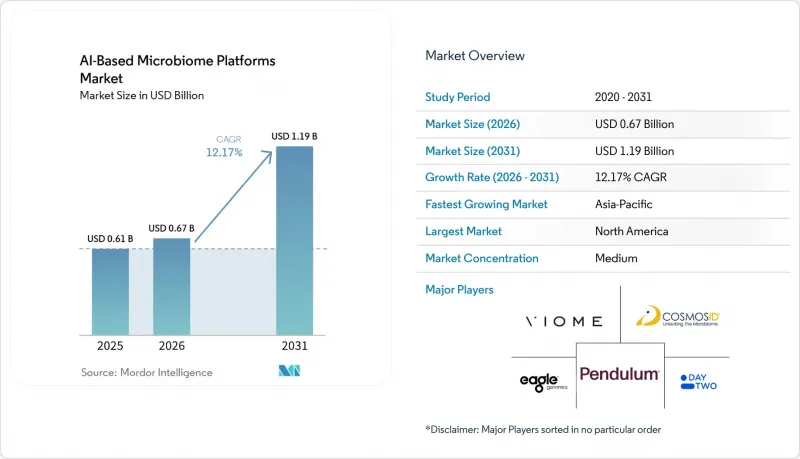
본 보고서는 마이크로바이옴 유형별(장내 마이크로바이옴, 기타), 도입 형태별(클라우드 기반, 온프레미스형, 하이브리드형), 용도별(신약 및 의약품 개발, 기타), 최종 사용자별(제약 및 바이오기술 기업, 기타), 지역별(북미, 유럽, 아시아태평양, 중동 및 아프리카, 남미)로 분류되어 있습니다. 시장 전망은 금액(달러) 기준으로 제시되어 있습니다.
세계의 AI 기반 마이크로바이옴 플랫폼 시장 동향 및 인사이트
AI를 활용한 균주 설계 도구의 상용화
AI 기반 마이크로바이옴 플랫폼 시장에서 자동화된 균주 설계 플랫폼은 기존에 오랜 시간이 소요되던 실험실 작업 주기를 확장 가능한 상용 서비스로 변화시키고 있습니다. Ginkgo Bioworks사는 2026년 5월, 보스턴에 위치한 자사의 자율형 연구소 'Nebula'가 100개 이상의 로봇 어레이 구성으로 확장되어 24시간 가동 중이며, 여기서 수집된 실험 데이터가 신약 개발 및 산업용 생명공학에 활용되는 AI 모델에 제공되고 있다고 발표했습니다. 이 점이 중요한 이유는 공유형 자율 인프라를 통해 소규모 마이크로바이옴 기업들이 자체 시설을 건설하는 대신 클라우드 기반 서비스 모델을 통해 균주 공학 기술을 활용할 수 있게 되기 때문입니다. bitBiome사는 2026년 5월, 자사의 미생물 유전자 데이터베이스와 고처리량 균주 공학 플랫폼을 중심으로, 신청 건수가 할당량을 초과한 시드 자금 추가 조달 라운드를 완료하며, 이러한 상업적 방향성을 한층 더 공고히 했습니다. 그 결과, AI 기반 마이크로바이옴 플랫폼 시장에서 경쟁 우위를 확보하는 데 있어 균주 라이브러리의 충실도가 알고리즘의 품질만큼이나 중요해지고 있습니다.
마이크로바이옴 분석 분야에서의 AI 도입 확대
AI를 활용한 마이크로바이옴 분석은 탐색적 조사 단계를 넘어, 현재는 AI 기반 마이크로바이옴 플랫폼 시장 전반에서 임상 진단 및 정밀 영양 프로그램을 뒷받침하는 수준에 이르렀습니다. 2025년 9월 『Gut』지에 게재된 총설에 따르면, 랜덤 포레스트부터 그래프 신경망, 대규모 언어 모델에 이르기까지 다양한 기법이 소화기계, 종양학, 대사성 질환 분야의 바이오마커 발견, 질병 예측, 환자 계층화 및 맞춤형 중재 설계에 활용되고 있습니다. 가장 중요한 변화는 메타트랜스크립토믹스와 AI 추천 엔진을 결합한 플랫폼이 정적인 조성 분석에 국한된 시스템보다 뛰어난 임상적 유용성을 보여주고 있다는 점입니다. 2025년 7월 Viome이 Microsoft와 체결한 제휴는 RNA 기반 마이크로바이옴 분석에 필요한 스토리지 및 메모리 요구 사항을 고려하여 설계된 것으로, 이는 멀티오믹스 AI 워크플로우에는 표준 GPU 훈련 스택과는 다른 인프라 구성이 필요함을 시사합니다. Viome는 106개국에 걸쳐 100만 건 이상의 샘플과 10경 개가 넘는 생물학적 데이터 포인트를 보고하고 있으며, AI 기반 마이크로바이옴 플랫폼 시장에서 규모의 경제에 따른 우위를 점차 확대해 나가고 있습니다.
고급 컴퓨팅 인프라 및 멀티오믹스 통합 비용
AI 기반 마이크로바이옴 플랫폼 시장은 실용 수준의 컴퓨팅 인프라 측면에서 여전히 막대한 비용 장벽에 직면해 있습니다. 시퀀싱 비용이 낮아졌습니다고는 하지만, 군유전체학, 대사체학, 트랜스크립토믹스를 결합한 종단간 분석에는 고속 스토리지, 대용량 메모리 및 GPU를 활용한 추론이 필요하며, 이로 인해 강력한 사내 인프라를 갖추지 못한 연구소의 도입 총비용이 상승하고 있습니다. 고성능 온프레미스형 조사 노드의 가격은 50만 달러를 넘기도 하여, 많은 사용자가 클라우드로의 전환을 피할 수 없게 되고 있습니다. 그러나 이로 인해 지속적인 처리 비용이 발생하게 되며, 처리량이 적은 워크플로우의 경우 수익성을 압박하게 됩니다. 2025년 PMC 리뷰에서는 시퀀싱 플랫폼 간 배치 효과가 여전히 해결되지 않은 과제로 지적되었으며, AI 모델을 훈련하거나 기관 간에 적용하기 위해서는 막대한 비용을 들여 보정을 수행해야 합니다. 따라서 소규모 생명공학 기업이나 신흥 시장의 도입자들에게는 특히 계산 규모와 표준화된 데이터 세트가 모두 부족한 경우, AI 기반 마이크로바이옴 플랫폼 시장에 진입하기가 더욱 어려워지고 있습니다.
부문별 분석
2025년 기준으로, 장내 미생물군은 AI를 활용한 미생물군 플랫폼 시장의 56.24%를 차지했으며, 매출 기준 최대 규모의 미생물군 카테고리가 되고 있습니다. 이 부문이 주도적인 위치를 차지하는 이유는 동료 심사를 거친 임상 연구 자료가 가장 풍부하고, 대상 질환의 범위가 가장 넓으며, 염증성 장 질환, 대사성 질환 및 종양학 분야의 치료 반응 예측에 이르기까지 아우르는 가장 성숙한 AI 훈련 데이터셋을 보유하고 있기 때문입니다. 또한, AI 기반 마이크로바이옴 플랫폼 업계의 이 분야는 누적 데이터가 주는 이점도 누리고 있습니다. 이는 더 대규모의 종단적 데이터 세트를 보유한 플랫폼일수록, 대사 및 면역 점수 산정에서 더 강력한 특징을 도출할 수 있기 때문입니다.
일본은 AI 기반 마이크로바이옴 플랫폼 시장에서 장내 환경에 초점을 맞춘 분석 분야에서 점차 입지를 다져가고 있습니다. 기린 홀딩스는 2026년 2월, Cowellnex사와 Metagen사가 일본 최대 규모의 샷건 메타유전체 장내 데이터를 활용해 일본인의 마이크로바이옴 특성에 맞춘 새로운 검사 항목과 식단 권장 알고리즘을 개발하기 위한 공동 연구를 시작했다고 발표했습니다. 환경 마이크로바이옴 시장은 AI 도구가 토양 건강 상태, 수산 양식 분야의 병원체 위험, 수계 모니터링 분야로 진출함에 따라 2031년까지 연평균 성장률(CAGR) 12.50%를 나타낼 것으로 예측되며, 이는 마이크로바이옴 유형 중 가장 빠른 성장률입니다. 또한, 콘체르토 바이오사이언스사의 '스킨 유니버스 프로젝트'를 통해 피부 마이크로바이옴에 대한 연구도 주목을 받고 있습니다. 한편, 2025년에 발표된 구강 마이크로바이옴 조사에서는 두경부 편평상피암의 검출에 있어 메타유전체 AI 분류기가 AUC 값 0.78-0.89를 달성한 것으로 나타났습니다.
2025년 기준으로, AI 기반 마이크로바이옴 플랫폼 시장 규모의 59.66%를 클라우드 기반 플랫폼이 차지했으며, 2031년까지 연평균 성장률(CAGR) 13.18%로 성장이 전망되며, 가장 빠르게 확대되는 도입 모델이 될 것으로 예측됩니다. 이러한 우위는 단순한 사용자의 선호라기보다는 워크플로우상의 요건을 반영한 것입니다. 왜냐하면 멀티오믹스 데이터셋은 방대한 원시 데이터 파일을 생성하며, 연구 규모에 걸맞은 분류학적 주석 부여, 배치 효과 보정 및 AI 추론이 필요하기 때문입니다.
온프레미스형 플랫폼은 건강 데이터 주권에 관한 규제로 인해 외부 서버 이용이 제한되고 있는 AI 기반 마이크로바이옴 플랫폼 시장의 일부에서 여전히 중요한 역할을 수행하고 있습니다. 이는 환자의 마이크로바이옴 데이터에 대해 보다 엄격한 보관 장소 관리가 요구되는 독일, 중국, 일본 등의 규제 환경에서 특히 해당됩니다. 따라서, 특히 기밀성이 높은 환자 데이터를 온프레미스에 보관하면서 계산 부하가 큰 모델 훈련을 클라우드로 이전하는 대형 제약 그룹에게 하이브리드 아키텍처가 실용적인 타협안으로 부상하고 있습니다. 이러한 경향은 AI 기반 마이크로바이옴 플랫폼 시장에서 규모가 작은 온프레미스 및 하이브리드 부문이 여전히 대기업과의 계약을 성사시키고 있는 이유를 설명하는 한 가지 요인이 되고 있습니다.
지역별 분석
2025년, 북미는 AI 기반 마이크로바이옴 플랫폼 시장 점유율의 50.43%를 차지했으며, 현재 매출 측면에서 가장 규모가 큰 지역 거점이 되고 있습니다. 이 지역이 주도적인 위치를 차지하고 있는 것은 제약·바이오기술 분야의 풍부한 연구 예산, 강력한 벤처 캐피털의 지원, 그리고 차세대 염기서열 분석 기능을 갖춘 확립된 임상 검사 네트워크가 결합되어 있기 때문입니다. 미국은 AI 기반 마이크로바이옴 플랫폼 시장에서 특히 임상 진단 및 제약 연구 프로그램 분야에서 절대적인 도입 수익이 가장 높습니다. 캐나다와 멕시코는 여전히 시장 점유율이 낮지만, 연구 파트너십과 소비자 웰니스 활동을 통해 수요를 서서히 확대되고 있습니다.
2025년, 유럽은 AI 기반 마이크로바이옴 플랫폼 시장에서 지역별 2위를 차지했습니다. 독일은 강력한 소화기내과 연구 기반과 임상 마이크로바이옴 진단에 대한 증거 기반 접근 방식을 바탕으로 주요 혁신 허브로서 두각을 나타내고 있습니다. 또한, EU의 SoHO 규정은 AI 기반 마이크로바이옴 플랫폼 시장에 대해 인간 마이크로바이옴 유래 제제에 관한 보다 조화로운 틀을 제공하며, 이행 기간이 진행됨에 따라 여러 국가에 걸친 규정 준수상의 마찰을 완화할 것으로 기대됩니다.
아시아태평양은 AI 기반 마이크로바이옴 플랫폼 시장에서 가장 빠르게 성장할 지역으로 전망되며, 2031년까지 연평균 성장률(CAGR) 14.42%로 확대될 것으로 예측됩니다. 일본은 주요 수요의 견인차 역할을 하고 있으며, 기린은 2025년 9월, 자사의 'MicroBio Me' 서비스와 관련해, 2026년 말까지 1,000개 의료기관과 제휴하고 누적 5,000건의 검사를 실시하는 것을 목표로 한다고 발표했습니다. 중국은 지역 차원의 모델 학습을 지원할 수 있는 대규모 독자적인 마이크로바이옴 참조 자산을 구축함으로써, 장기적인 경쟁을 위한 데이터 기반을 강화하고 있습니다. 싱가포르와 호주 역시 마이크로바이옴 의료 분야의 협력 및 전문적인 임상 프로그램을 통해, AI 기반 마이크로바이옴 플랫폼 시장의 새로운 거점으로 부상하고 있습니다. 한편, 남미와 중동 및 아프리카는 현재로서는 시장 규모가 작지만, 각국의 건강 데이터 활용 노력과 연계된 시퀀싱 인프라를 통해 주목을 받고 있습니다.
기타 혜택 :
- 엑셀 형식 시장 예측(ME) 시트
- 3개월간의 애널리스트 지원
자주 묻는 질문
목차
제1장 서론
제2장 조사 방법
제3장 주요 요약
제4장 시장 구도
제5장 시장 규모 및 성장 예측
제6장 경쟁 구도
제7장 시장 기회 및 향후 전망
AJY 26.07.07According to Mordor Intelligence, the AI-based microbiome platforms market is expected to grow from USD 0.61 billion in 2025 to USD 0.67 billion in 2026 and is forecasted to reach USD 1.19 billion by 2031 at 12.17% CAGR over 2026-2031.
This report is Segmented by Microbiome Type (Gut Microbiome, and Others), Deployment Mode (Cloud-Based, On-Premises, Hybrid), Application (Drug Discovery and Development, and Others), End-User (Pharma and Biotechnology Companies, and Others), and Geography (North America, Europe, Asia-Pacific, Middle East and Africa, South America). The Market Forecasts are Provided in Terms of Value (USD).
Global AI-Based Microbiome Platforms Market Trends and Insights
Commercial Adoption of AI-Driven Strain-Design Tools
Automated strain-design platforms are turning a long wet-lab cycle into a scalable commercial service inside the AI-based microbiome platforms market. Ginkgo Bioworks stated in May 2026 that its Nebula autonomous lab in Boston is expanding to more than 100 robotic array configurations and operates around the clock, with experiments feeding AI models used in drug discovery and industrial biotechnology. This matters because shared autonomous infrastructure lets smaller microbiome companies access strain-engineering capacity through cloud-style service models instead of building proprietary facilities. bitBiome reinforced that commercial direction when it closed an oversubscribed seed extension round in May 2026 around its microbial gene database and high-throughput strain engineering platform. The result is that strain library depth is becoming as important as algorithm quality in defining competitive advantage across the AI-based microbiome platforms market.
Rising Adoption of AI in Microbiome Analytics
AI-driven microbiome analytics has moved beyond exploratory research and now supports clinical diagnostics and precision nutrition programs across the AI-based microbiome platforms market. A review published in Gut in September 2025 showed that methods ranging from random forests to graph neural networks and large language models are being used for biomarker discovery, disease prediction, patient stratification, and personalized intervention design across gastrointestinal, oncological, and metabolic conditions. The most important change is that platforms combining metatranscriptomics with AI recommendation engines are showing better clinical usefulness than systems limited to static composition analysis. Viome's July 2025 collaboration with Microsoft was designed around the storage and memory requirements of RNA-based microbiome analysis, which signals that multi-omics AI workflows need a different infrastructure profile than standard GPU training stacks. With Viome reporting more than 1 million samples across 106 countries and over 10 quadrillion biological data points, scale advantages are widening inside the AI-based microbiome platforms market.
High Computational Infrastructure and Multi-Omics Integration Costs
The AI-based microbiome platforms market still faces a major cost barrier in production-grade compute infrastructure. Even with cheaper sequencing, end-to-end analysis that combines metagenomics, metabolomics, and transcriptomics needs high-speed storage, large memory capacity, and GPU-backed inference, which raises the total cost of deployment for laboratories without strong internal infrastructure. A capable on-premises research node can exceed USD 500,000, which pushes many users toward cloud migration but adds recurring processing costs that pressure margins in lower-volume workflows. A 2025 PMC review also highlighted batch effects across sequencing platforms as a persistent issue that requires expensive correction before AI models can be trained or applied across institutions. This makes the AI-based microbiome platforms market harder to enter for smaller biotech companies and emerging-market adopters, especially when they lack both compute scale and harmonized datasets.
Other drivers and restraints analyzed in the detailed report include:
- Surge in Multi-Omics Data Generation and Falling Sequencing Costs
- Regulatory Green Lights for Microbiome-Based Therapeutics
- Uncertain Reimbursement Pathways for AI-Guided Interventions
For complete list of drivers and restraints, kindly check the Table Of Contents.
Segment Analysis
Gut microbiome held 56.24% of the AI-based microbiome platforms market in 2025, making it the largest microbiome category by revenue. The segment leads because it has the deepest body of peer-reviewed clinical research, the widest disease coverage, and the most mature AI training datasets spanning inflammatory bowel disease, metabolic disorders, and oncology response prediction. This part of the AI-based microbiome platforms industry also benefits from cumulative data advantages, because platforms with larger longitudinal datasets can generate stronger signatures for metabolic and immune scoring.
Japan is building a parallel position in gut-focused analytics inside the AI-based microbiome platforms market. Kirin Holdings announced in February 2026 that Cowellnex and Metagen had launched joint research using Japan's largest collection of shotgun metagenomic gut data to develop new test items and food recommendation algorithms tailored to Japanese microbiome characteristics. Environmental microbiome is projected to grow at 12.50% CAGR through 2031, the fastest among microbiome types, as AI tools move into soil health, aquaculture pathogen risk, and water system monitoring. Skin microbiome also gained traction through Concerto Biosciences' Skin Universe Project, while oral microbiome research published in 2025 showed metagenomic AI classifiers reaching AUC values of 0.78 to 0.89 in head and neck squamous cell carcinoma detection.
Cloud-based platforms held 59.66% of the AI-based microbiome platforms market size in 2025 and are also expected to be the fastest-growing deployment model at 13.18% CAGR through 2031. Their lead reflects workflow demands rather than simple user preference, because multi-omics datasets create large raw files that require taxonomic annotation, batch-effect correction, and AI inference at research scale.
On-premises platforms still matter in parts of the AI-based microbiome platforms market where health data sovereignty rules limit use of external servers. That is particularly relevant in regulated environments across Germany, China, and Japan, where patient microbiome data can require tighter location control. Hybrid architectures are therefore emerging as a practical middle ground, especially for large pharmaceutical groups that keep sensitive patient data on site while shifting compute-heavy model training to the cloud. This pattern helps explain why the smaller on-premises and hybrid segments can still attract large enterprise contracts in the AI-based microbiome platforms market.
Complete Report Scope:
- By Microbiome Type
- Gut Microbiome
- Skin Microbiome
- Oral Microbiome
- Environmental Microbiome
- By Depolyment Mode
- Cloud-Based Platforms
- On-Premises Platforms
- Hybrid Models
- By Application
- Drug Discovery and Development
- Clinical Diagnostics
- Precision Medicine and Personalized Nutrition
- Consumer Microbiome and Wellness Platforms
- Other Applications
- By End-User
- Pharma and Biotechnology Companies
- Clinical and Diagnostic Laboratories
- Research and Academic Institutes
- Food and Nutrition Companies
- Other End-Users
- By Geography
- North America
- United States
- Canada
- Mexico
- Europe
- Germany
- United Kingdom
- France
- Italy
- Spain
- Rest of Europe
- Asia-Pacific
- China
- Japan
- India
- Australia
- South Korea
- Rest of Asia-Pacific
- Middle East and Africa
- GCC
- South Africa
- Rest of Middle East and Africa
- South America
- Brazil
- Argentina
- Rest of South America
- North America
Geography Analysis
North America held 50.43% of the AI-based microbiome platforms market share in 2025, making it the largest regional center for current revenue. The region leads because it combines deep pharma and biotech research budgets, strong venture backing, and an established clinical laboratory network with next-generation sequencing capability. The United States generates the largest absolute deployment revenue within the AI-based microbiome platforms market, especially across clinical diagnostics and pharmaceutical research programs. Canada and Mexico still represent smaller shares, but they are adding incremental demand through research partnerships and consumer wellness activity.
Europe held the second-largest regional position in the AI-based microbiome platforms market in 2025. Germany stands out as the main innovation hub because of its strong gastroenterology research base and its evidence-led approach to clinical microbiome diagnostics. The EU SoHO Regulation also gives the AI-based microbiome platforms market a more harmonized framework for human microbiome-derived preparations, which should reduce multi-country compliance friction as the transition period progresses.
Asia-Pacific is projected to be the fastest-growing region in the AI-based microbiome platforms market and is projected to expand at 14.42% CAGR through 2031. Japan is a major demand engine, and Kirin said in September 2025 that its MicroBio Me service was targeting 1,000 clinical facility partnerships and 5,000 cumulative tests by the end of 2026. China is strengthening the data foundation for long-term competition by building large proprietary microbiome reference assets that can support model training at local scale. Singapore and Australia are also emerging nodes for the AI-based microbiome platforms market through microbiome medicine partnerships and specialized clinical programs, while South America and the Middle East and Africa remain smaller today but are gaining attention through sequencing infrastructure tied to national health data efforts.
- Atlas Biomed
- Biohm Health
- Biome Diagnostics GmbH
- BiomeSense
- CosmosID
- DayTwo
- Eagle Genomics
- Finch Therapeutics
- Ginkgo Bioworks
- HelloBiome
- Insilico Medicine
- Metagenomi
- Onegevity (Thorne)
- Pendulum Therapeutics
- Second Genome
- Seed Health
- Seer Bio
- Sun Genomics
- Synlogic
- Viome Life Sciences
Additional Benefits:
- The market estimate (ME) sheet in Excel format
- 3 months of analyst support
TABLE OF CONTENTS
1 Introduction
- 1.1 Study Assumptions and Market Definition
- 1.2 Scope of the Study
2 Research Methodology
3 Executive Summary
4 Market Landscape
- 4.1 Market Overview
- 4.2 Market Drivers
- 4.2.1 Commercial Adoption of AI-Driven Strain-Design Tools
- 4.2.2 Rising Adoption of AI In Microbiome Analytics
- 4.2.3 Surge in Multi-Omics Data Generation and Falling Sequencing Costs
- 4.2.4 Regulatory Green Lights for Microbiome-Based Therapeutics
- 4.2.5 Growth in Personalized Medicine and Precision Nutrition
- 4.2.6 Advancements in Cloud Computing and High-Performance Bioinformatics Infrastructure
- 4.3 Market Restraints
- 4.3.1 High Computational Infrastructure and Multi-Omics Integration Costs
- 4.3.2 Lack of Standardized Reference Databases Across Ethnic Cohorts
- 4.3.3 Uncertain Reimbursement Pathways for AI-Guided Interventions
- 4.3.4 Limited Clinical Validation and Model Interpretability
- 4.4 Supply/Value Chain Analysis
- 4.5 Regulatory Landscape
- 4.6 Technological Outlook
- 4.7 Porter's Five Forces Analysis
- 4.7.1 Threat of New Entrants
- 4.7.2 Bargaining Power of Suppliers
- 4.7.3 Bargaining Power of Buyers
- 4.7.4 Threat of Substitutes
- 4.7.5 Competitive Rivalry
5 Market Size & Growth Forecasts (Value, USD)
- 5.1 By Microbiome Type
- 5.1.1 Gut Microbiome
- 5.1.2 Skin Microbiome
- 5.1.3 Oral Microbiome
- 5.1.4 Environmental Microbiome
- 5.2 By Depolyment Mode
- 5.2.1 Cloud-Based Platforms
- 5.2.2 On-Premises Platforms
- 5.2.3 Hybrid Models
- 5.3 By Application
- 5.3.1 Drug Discovery and Development
- 5.3.2 Clinical Diagnostics
- 5.3.3 Precision Medicine and Personalized Nutrition
- 5.3.4 Consumer Microbiome and Wellness Platforms
- 5.3.5 Other Applications
- 5.4 By End-User
- 5.4.1 Pharma and Biotechnology Companies
- 5.4.2 Clinical and Diagnostic Laboratories
- 5.4.3 Research and Academic Institutes
- 5.4.4 Food and Nutrition Companies
- 5.4.5 Other End-Users
- 5.5 By Geography
- 5.5.1 North America
- 5.5.1.1 United States
- 5.5.1.2 Canada
- 5.5.1.3 Mexico
- 5.5.2 Europe
- 5.5.2.1 Germany
- 5.5.2.2 United Kingdom
- 5.5.2.3 France
- 5.5.2.4 Italy
- 5.5.2.5 Spain
- 5.5.2.6 Rest of Europe
- 5.5.3 Asia-Pacific
- 5.5.3.1 China
- 5.5.3.2 Japan
- 5.5.3.3 India
- 5.5.3.4 Australia
- 5.5.3.5 South Korea
- 5.5.3.6 Rest of Asia-Pacific
- 5.5.4 Middle East and Africa
- 5.5.4.1 GCC
- 5.5.4.2 South Africa
- 5.5.4.3 Rest of Middle East and Africa
- 5.5.5 South America
- 5.5.5.1 Brazil
- 5.5.5.2 Argentina
- 5.5.5.3 Rest of South America
- 5.5.1 North America
6 Competitive Landscape
- 6.1 Market Concentration
- 6.2 Market Share Analysis
- 6.3 Company Profiles (includes Global level Overview, Market level overview, Core Segments, Financials as available, Strategic Information, Market Rank/Share for key companies, Products & Services, Recent Developments)
- 6.3.1 Atlas Biomed
- 6.3.2 Biohm Health
- 6.3.3 Biome Diagnostics GmbH
- 6.3.4 BiomeSense
- 6.3.5 CosmosID
- 6.3.6 DayTwo
- 6.3.7 Eagle Genomics
- 6.3.8 Finch Therapeutics
- 6.3.9 Ginkgo Bioworks
- 6.3.10 HelloBiome
- 6.3.11 Insilico Medicine
- 6.3.12 Metagenomi
- 6.3.13 Onegevity (Thorne)
- 6.3.14 Pendulum Therapeutics
- 6.3.15 Second Genome
- 6.3.16 Seed Health
- 6.3.17 Seer Bio
- 6.3.18 Sun Genomics
- 6.3.19 Synlogic
- 6.3.20 Viome Life Sciences
7 Market Opportunities & Future Outlook
- 7.1 White-space & Unmet-need Assessment