

|
시장보고서
상품코드
2072748
원격 환자 모니터링용 AI 시장 : 시장 점유율 분석, 업계 동향 및 통계, 성장 예측(2026-2031년)AI In Remote Patient Monitoring - Market Share Analysis, Industry Trends & Statistics, Growth Forecasts (2026 - 2031) |
||||||
 Mordor Intelligence
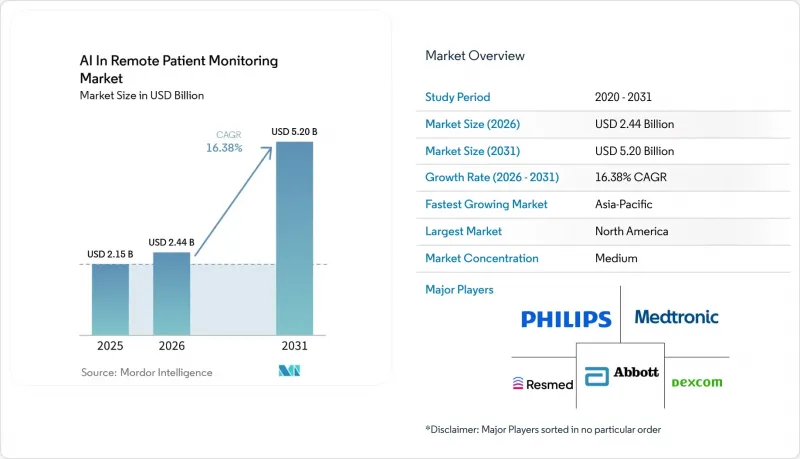
Mordor Intelligence에 의하면, 원격 환자 모니터링용 AI 시장 규모는 2025년 21억 5,000만 달러로 평가되었고, 2026년에는 24억 4,000만 달러로 추정되고, 2026-2031년 CAGR 16384%로 성장을 지속할 전망이며, 2031년에는 52억 달러에 이를 것으로 예측됩니다.
본 보고서는 구성 요소별(소프트웨어 플랫폼, 서비스), 도입 형태별(클라우드 기반, 온프레미스형), 용도별(심혈관 모니터링, 당뇨병 및 대사성 질환, 기타), 최종 사용자별(병원 및 진료소, 기타), 지역별(북미, 유럽, 아시아태평양, 중동 및 아프리카, 남미)로 분류되어 있습니다. 시장 전망은 금액(달러) 기준으로 제시되어 있습니다.
세계의 원격 환자 모니터링용 AI 시장 동향 및 인사이트
만성 질환이 초래하는 보편적인 부담과 원격의료에 대한 보험 급여 의무
원격 환자 모니터링 분야의 AI 시장에서는 만성 질환 관리를 위해 정기적인 내원만으로는 부족할 정도로 빈번한 접촉이 필요하기 때문에 지속적인 수요가 예상됩니다. 현재 비감염성 질환은 전 세계 사망 원인의 74%를 차지하고 있으며, 그 부담의 대부분은 심혈관 질환, 당뇨병 및 만성 호흡기 질환이 차지하고 있습니다. CMS의 ACCESS 모델에서는 만성 질환 관리에 대한 지속적인 지불이 단순한 기기 가동 현황이 아닌 건강상의 성과와 연계되어 있기 때문에 이러한 임상적 요구가 지출로 이어지고 있습니다. 메디케어도 원격 모니터링 이용을 지속적으로 확대하고 있으며, 2024년 지급액은 5억 3,600만 달러를 넘어섰고, 가입자 수는 100만 명에 육박하고 있습니다. 공개된 프로그램의 실증 데이터는 의료 시스템이 예산 증액을 정당화하는 데 일조하고 있습니다. 2025년 말에 주목을 받은 『Mayo Clinic Proceedings』의 연구에 따르면, 체계적인 원격 환자 모니터링(RPM) 프로그램에 참여한 환자들에서 총 의료비 및 입원비가 감소한 것으로 나타났습니다. 이러한 경제적 근거가 명확해짐에 따라, 원격 환자 모니터링 시장에서 AI는 주류 진료 과정으로 더욱 깊이 자리 잡고 있습니다.
AI를 활용한 엣지 처리 및 웨어러블 기기의 효율성 향상 분야에서의 진전
원격 환자 모니터링 시장에서 AI는 기기 상의 추론 능력 향상으로 인해 혜택을 보고 있습니다. 이는 신호 처리의 상당 부분이 더 이상 클라우드에 전송되지 않고, 데이터 수집 현장에서 직접 수행될 수 있게 되었기 때문입니다. 이러한 변화로 인해 대역폭 수요가 감소하고, 기기의 효율이 향상되며, 장시간 착용 시에도 지속적인 모니터링이 더욱 실용적으로 이루어질 수 있게 됩니다. 또한, 칩 성능의 향상만으로는 독자적인 알고리즘이나 라벨이 붙은 훈련 데이터의 가치가 사라지는 것은 아니기 때문에 차별화의 초점도 변화하고 있습니다. 원격 환자 모니터링 분야의 AI 시장에서 생체 신호 라이브러리를 풍부하게 보유한 업체들은 상태 악화 감지, 심박 리듬 분석, 또는 위험 예측 모델 학습을 수행할 때 여전히 우위를 점하고 있습니다. iRhythm사는 30억 시간 이상에 달하는 엄선된 심전도 데이터와 지속적인 알고리즘 개발을 강조하고 있으며, 이는 하드웨어가 발전하더라도 데이터의 깊이가 여전히 경쟁 우위가 될 수 있음을 보여줍니다. 그 결과, 고성능 웨어러블 기기가 시장 성장을 뒷받침하는 한편, 가장 강력한 가격 결정력은 여전히 효율적인 하드웨어와 임상적으로 검증된 AI를 결합한 플랫폼에 머물 가능성이 높다고 볼 수 있습니다.
알고리즘의 편향과 임상 검증의 격차가 FDA/EMA의 승인을 지연시키고 있습니다.
원격 환자 모니터링 시장에서 AI는 AI가 탑재된 의료기기 간 검증 품질의 편차라는 여전히 심각한 제약에 직면해 있습니다. 미국병원협회(AHA)가 다룬 2025년 보고서에 따르면, 60종의 AI 탑재 기기가 182건의 리콜 사례와 관련이 있었으며, 그중 43%는 최초 승인 후 1년 이내에 발생했습니다. 많은 AI 기기가 실제 환경에서 수행된 전향적 시험이 제한적인 상태에서 시장에 출시되고 있기 때문에 이러한 경향은 중요한 의미를 지닙니다. 2025년에 발표된 동료 심사를 거친 연구에 따르면, 머신러닝 모델은 생체 신호 수치만으로도 인종이나 민족을 추측할 수 있는 것으로 밝혀졌으며, 이는 표준적인 성능 지표로는 간과되기 쉬운 공정성상의 위험을 시사합니다. 또한, 2025년 『npj Cardiovascular Health』지에 게재된 또 다른 연구에 따르면, 심전도(ECG) 신호를 이용해 학습시킨 딥러닝 모델은 유전적 요인으로 설명할 수 없는 경우에도 인종 집단 간에 서로 다른 결과를 보일 가능성이 있는 것으로 나타났습니다. 원격 환자 모니터링 시장에서 AI의 경우, 이는 검증 과정에서 정확성, 안전성, 그리고 인구통계학적 형평성을 동시에 충족해야 함을 의미하며, 그 결과 여러 질환 분야로 확대하는 데 드는 비용과 복잡성이 증가하게 됩니다.
부문별 분석
2025년, 원격 환자 모니터링 시장에서 소프트웨어 플랫폼이 AI 시장 점유율의 70.24%를 차지했으며, 이는 센서 하드웨어 자체보다 분석, 경보, 모델 오케스트레이션이 얼마나 큰 가치를 지니고 있는지를 보여줍니다. 원격 환자 모니터링 분야의 AI 시장에서는 핵심 지능이 플랫폼 계층에 존재할 경우, 정기적인 라이선스 수익 확대가 용이하기 때문에 소프트웨어가 우위를 점하고 있습니다. 이러한 장점은 대규모 라벨이 지정된 생체 신호 데이터셋을 기반으로 독자적인 모델을 구축한 공급업체에서 가장 두드러집니다. 임상 훈련 데이터 수집에는 시간, 워크플로우에 대한 접근 권한, 그리고 긴 검증 주기가 필요하기 때문에 이러한 공급업체의 차별화 요소를 단기간 내에 모방하기는 어렵습니다. 그렇다고는 해도, 소프트웨어가 주도권을 쥐고 있다고 해서 밸류체인의 다른 부분이 정체되어 있는 것은 아닙니다.
서비스 분야는 2026-2031년 연평균 성장률(CAGR) 17.47%를 나타낼 것으로 예측되며, 이는 원격 환자 모니터링 분야의 전체 AI 시장 성장률을 소폭 상회하는 수준입니다. 의료 기관들은 벤더가 워크플로우 설정, 환자 참여 유도, 보고서 작성, 운영 실행을 지원하는 관리형 RPM 프로그램을 점점 더 선호하고 있습니다. 이러한 변화로 인해 구매 측의 내부 부담이 줄어들면서, 구매 결정의 초점이 소프트웨어 라이선스 수에서 지속적인 성능 제공으로 옮겨가고 있습니다. 따라서 원격 환자 모니터링 분야의 AI 업계는 플랫폼의 중요성은 유지하면서도, 서비스의 질이 고객 유지와 계정 성장에 점점 더 큰 영향을 미치는 '2층 모델'로 점차 전환되고 있습니다.
2025년 기준으로 원격 환자 모니터링 시장 규모의 55.76%를 클라우드 기반 솔루션이 차지했으며, 2031년까지 연평균 성장률(CAGR) 18.37%라는 가장 높은 성장률을 기록하며 확대될 것으로 전망됩니다. 이는 원격 환자 모니터링 시장에서 가장 큰 부문이 동시에 성장률이 가장 높은 부문이기도 한, 유일한 주요 세분화입니다. 그 이유는 간단명료합니다. 스트리밍되는 생체 신호 데이터에 대한 AI 재학습에는 유연한 컴퓨팅 및 스토리지 인프라가 필요하지만, 이를 온프레미스 환경에서 경제적으로 구현하기는 어렵기 때문입니다. 또한, 클라우드를 통한 제공은 서비스 제공업체에게 업데이트, 분석 기능의 배포 및 여러 거점으로의 확장을 용이하게 합니다. 그렇다고는 해도, 클라우드의 눈부신 성장이 온프레미스 구축의 의미를 완전히 상실하게 만드는 것은 아닙니다.
데이터 보관 장소, 주권 및 규정 준수 요건이 여전히 엄격한 원격 환자 모니터링 분야의 AI 시장에서 온프레미스 배포는 구조적인 틈새 시장으로서의 입지를 계속 유지하고 있습니다. 2025년 JMIR AI 연구에서는 원본 환자 데이터를 국경을 넘어 전송하지 않고도 8개국·4개 대륙에 걸쳐 있는 12개 병원을 연계한 연합 딥러닝(Federated Deep Learning) 구성도 제시되었습니다. 이 모델은 하이브리드 아키텍처가 로컬 데이터 관리를 유지하면서도 보다 광범위한 알고리즘 개발을 지원할 수 있음을 보여줍니다. 클라우드 규모의 훈련과 로컬 추론을 결합하는 벤더는 원격 환자 모니터링 분야의 AI 시장 규제 대상 부문에서 더 유리한 입지를 차지할 가능성이 높습니다.
지역별 분석
2025년, 북미는 원격 환자 모니터링 분야의 AI 시장 규모에서 54.37%를 차지했으며, 여전히 가장 큰 비중을 차지하는 지역으로 자리매김하고 있습니다. 북미에서 원격 환자 모니터링(RPM) 분야의 AI 시장이 가장 활발한 이유는 미국에는 이미 성숙한 보험 급여 체계가 마련되어 있고, 수년에 걸쳐 RPM 프로그램을 확대해 온 의료 제공업체 기반이 존재하기 때문입니다. 2024년 원격 모니터링 서비스에 대한 메디케어 지급액은 5억 3,600만 달러를 넘어섰으며, 같은 해에는 100만 명에 가까운 가입자가 RPM 서비스를 이용했습니다. 2026년에 'Hospital-at-Home' 프로그램이 2030년까지 연장된 것은 해당 지역에서 AI를 활용한 재택 모니터링에 대한 구조적인 뒷받침이 더욱 강화될 것임을 의미합니다.
아시아태평양은 2026-2031년 연평균 성장률(CAGR) 19.62%를 나타낼 것으로 예측되며, 원격 환자 모니터링 분야의 AI 시장에서 가장 두드러진 성장을 보일 것으로 전망됩니다. 아시아태평양 전체의 원격 환자 모니터링용 AI 시장 성장은 방대한 인구 규모, 만성 질환으로 인한 부담 증가, 그리고 디지털 헬스 인프라 구축이 진전되고 있는 점이 원동력이 되고 있습니다. 중국은 고령화와 만성 질환 관리로 인한 부담으로 인해 확장성이 높은 모니터링에 대한 수요가 크게 증가하고 있어, 앞으로도 중요한 시장으로 남을 것입니다. 한편, 품질에 대한 기대가 높아지고 있는 만큼, 소비자용 제품보다는 임상적으로 신뢰성이 높은 기기가 선택되는 경향이 있는 것으로 보입니다. 일본, 호주, 한국도 디지털 헬스 프로그램을 통해 보급을 뒷받침하고 있으며, 인도의 경우 원격의료 규제와 의료 인프라가 지속적으로 발전하고 있어 보다 장기적인 전망을 가질 수 있는 기회로 평가되고 있습니다.
유럽은 원격 환자 모니터링 분야의 AI 시장에서 여전히 큰 비중을 차지하고 있지만, 의료 서비스 제공 및 지불 규정이 국가마다 다르기 때문에 구조적으로 더 복잡한 임베디드니다. 독일에서는 전자의무기록 의무화 및 디지털 혁신을 의료 분야에 더욱 깊이 통합하기 위한 공식 전략 등, 디지털화 추진을 통해 RPM 도입을 위한 방향성이 점차 명확해지고 있습니다. 영국, 프랑스, 이탈리아, 스페인에서는 국가 차원의 디지털 헬스 시스템이 구축되어 있으며, 이로 인해 조달 기회가 생기는 한편 상호 운용성에 대한 기대도 높아지고 있습니다. 원격 환자 모니터링 분야의 AI 시장에서는 중동 및 아프리카가 GCC 국가들의 디지털 헬스 투자에 힘입어 소규모 기반에서 성장을 이어가고 있습니다. 한편, 남미에서는 브라질과 아르헨티나에서 민간 네트워크 도입이 여전히 주를 이루고 있습니다.
기타 혜택 :
- 엑셀 형식 시장 예측(ME) 시트
- 3개월간의 애널리스트 지원
자주 묻는 질문
목차
제1장 서론
제2장 조사 방법
제3장 주요 요약
제4장 시장 구도
제5장 시장 규모 및 성장 예측
제6장 경쟁 구도
제7장 시장 기회 및 향후 전망
AJY 26.07.03According to Mordor Intelligence, the AI in remote patient monitoring market is expected to grow from USD 2.15 billion in 2025 to USD 2.44 billion in 2026 and is forecasted to reach USD 5.20 billion by 2031 at 16384% CAGR over 2026-2031.
This report is Segmented by Component (Software Platform, Services), Deployment Mode (Cloud-Based, On-Premise), Application (Cardiovascular Monitoring, Diabetes and Metabolic Disorders, and Others), End-User (Hospitals and Clinics, and Others), and Geography (North America, Europe, Asia-Pacific, Middle East and Africa, South America). The Market Forecasts are Provided in Terms of Value (USD).
Global AI In Remote Patient Monitoring Market Trends and Insights
Ubiquitous Chronic-Disease Burden and Telehealth Reimbursement Mandates
The AI in remote patient monitoring market is seeing durable demand because chronic disease management requires contact far more often than periodic office visits can provide. Noncommunicable diseases now account for 74% of global deaths, with cardiovascular disease, diabetes, and chronic respiratory illness carrying a major share of that burden. That clinical need is turning into spend because the CMS ACCESS model links recurring chronic care payments to health outcomes rather than to device activity alone. Medicare also continues to scale its use of remote monitoring, with payments above USD 536 million in 2024 and enrollment nearing 1 million beneficiaries. Published program evidence is helping health systems justify larger budgets, with a Mayo Clinic Proceedings study highlighted in late 2025 showing lower total cost of care and lower inpatient spending for patients in a structured RPM program. As that financial case becomes clearer, the AI in remote patient monitoring market is moving further into mainstream care pathways.
Advancements in AI-Enabled Edge Processing and Wearable Efficiency
The AI in remote patient monitoring market is gaining from better on-device inference, because more signal processing can now happen at the point of capture instead of being pushed to the cloud first. That shift helps lower bandwidth demand, improves device efficiency, and makes continuous monitoring more practical for longer wear periods. It also changes where differentiation sits, since better chip performance alone does not remove the value of proprietary algorithms and labeled training data. In the AI in remote patient monitoring market, vendors with strong biosignal libraries still have an advantage when they train deterioration detection, rhythm analysis, or predictive risk models. iRhythm has pointed to more than 3 billion hours of curated ECG data and continued algorithm development, which shows how data depth can remain a moat even as hardware improves.The result is that better wearables support growth, but the strongest pricing power is still likely to sit with platforms that combine efficient hardware with clinically validated AI.
Algorithmic Bias and Clinical-Validation Gaps Slowing FDA/EMA Approvals
The AI in remote patient monitoring market still faces a meaningful restraint from uneven validation quality across AI-enabled medical devices. A 2025 review discussed by the American Hospital Association found 60 AI-enabled devices linked to 182 recall events, with 43% of those recalls occurring within 1 year of initial clearance. That pattern matters because many AI devices still reach market with limited prospective real-world testing. A peer-reviewed 2025 study found that machine learning models could infer race or ethnicity from vital-sign values alone, which points to fairness risks that standard performance metrics may miss. Another 2025 study in npj Cardiovascular Health showed that deep learning models trained on ECG signals could surface different outcomes across racial groups even in the absence of genetic explanations. For the AI in remote patient monitoring market, this means validation now has to cover accuracy, safety, and demographic equity at the same time, which raises the cost and complexity of expansion across multiple conditions.
Other drivers and restraints analyzed in the detailed report include:
- Expansion of Hospital-at-Home and Decentralized Care Delivery Models
- Shift Toward Value-Based Care and Population Health Management Programs
- Cyber-Security Liabilities for Multi-Tenant Cloud RPM Platforms
For complete list of drivers and restraints, kindly check the Table Of Contents.
Segment Analysis
Software platforms held 70.24% of the AI in remote patient monitoring market share in 2025, which shows how much value sits in analytics, alerting, and model orchestration rather than in sensor hardware alone. The AI in remote patient monitoring market has favored software because recurring licensing revenue is easier to scale when the core intelligence sits in the platform layer. That advantage is strongest among vendors that have built proprietary models on large labeled biosignal datasets. Their differentiation is harder to copy quickly because clinical training data take time, workflow access, and long validation cycles to assemble. Even so, the software lead does not mean the rest of the value chain is standing still.
Services are projected to grow at a 17.47% CAGR from 2026 to 2031, which places them slightly ahead of the overall AI in remote patient monitoring market. Health systems increasingly prefer managed RPM programs where the vendor supports workflow setup, patient engagement, reporting, and operating execution. That shift reduces the buyer's internal burden and makes the purchase decision less about a software seat and more about ongoing performance delivery. The AI in remote patient monitoring industry is therefore moving toward a two-layer model where the platform remains important, but services increasingly determine retention and account growth.
Cloud-based deployment accounted for 55.76% of the AI in remote patient monitoring market size in 2025, and it is also projected to grow at the fastest 18.37% CAGR through 2031. This is the only major segmentation line in the AI in remote patient monitoring market where the largest segment is also the fastest-growing one. The explanation is straightforward because AI retraining on streaming biosignal data requires elastic compute and storage that are hard to match economically with local installations. Cloud delivery also makes updates, analytics rollouts, and multi-site scaling easier for provider organizations. Even so, strong growth in cloud does not mean on-premise deployment loses all relevance.
On-premise deployment continues to hold a structural niche in the AI in remote patient monitoring market where data residency, sovereignty, and compliance requirements remain strict. A 2025 JMIR AI study also showed a federated deep learning setup that linked 12 hospitals across 8 nations and 4 continents without moving raw patient data across borders. That model shows how hybrid architectures can preserve local data control while still supporting broader algorithm development. Vendors that combine cloud-scale training with local inference are likely to be better positioned in regulated parts of the AI in remote patient monitoring market.
Complete Report Scope:
- By Component
- Software Platform
- Services
- By Deployment Mode
- Cloud-Based
- On-Premise
- By Application
- Cardiovascular Monitoring
- Diabetes and Metabolic Disorders
- Respiratory Monitoring
- Oncology and Specialty Care
- Post-Acute and Chronic Care Management
- Sleep and Mental Health Monitoring
- Other Applications
- By End-User
- Hospitals and Clinics
- Home-Care Settings
- Ambulatory Surgical centers
- By Geography
- North America
- United States
- Canada
- Mexico
- Europe
- Germany
- United Kingdom
- France
- Italy
- Spain
- Rest of Europe
- Asia-Pacific
- China
- Japan
- India
- Australia
- South Korea
- Rest of Asia-Pacific
- Middle East and Africa
- GCC
- South Africa
- Rest of Middle East and Africa
- South America
- Brazil
- Argentina
- Rest of South America
- North America
Geography Analysis
North America accounted for 54.37% of the AI in remote patient monitoring market size in 2025, which keeps it as the largest regional contributor. The AI in remote patient monitoring market is strongest in North America because the United States already has a mature reimbursement path and a provider base that has expanded RPM programs over several years. Medicare payments for remote monitoring services exceeded USD 536 million in 2024, and nearly 1 million enrollees received RPM services during that year. The 2026 extension of Hospital-at-Home through 2030 adds further structural support for AI-enabled home monitoring in the region.
Asia-Pacific is projected to grow at a 19.62% CAGR from 2026 to 2031, making it the fastest-growing region in the AI in remote patient monitoring market. Growth in the AI in remote patient monitoring market across Asia-Pacific is being driven by demographic scale, rising chronic disease pressure, and improving digital health infrastructure. China remains important because its aging population and chronic care burden create strong demand for scalable monitoring, while tighter quality expectations are likely to favor clinically reliable devices over consumer-grade offerings. Japan, Australia, and South Korea are also supporting uptake through digital health programs, while India remains a longer-horizon opportunity as telehealth regulation and care infrastructure continue to mature.
Europe remains a large part of the AI in remote patient monitoring market, but it is structurally more complex because healthcare delivery and payment rules vary by country. Germany's digitalization push, including mandatory electronic patient records and an official strategy to integrate digital innovation more deeply into care, is creating a clearer direction for RPM adoption. The United Kingdom, France, Italy, and Spain are building national digital health systems that create procurement openings but also raise interoperability expectations. In the AI in remote patient monitoring market, the Middle East and Africa are growing from a smaller base, led by GCC investment in digital health, while South America remains centered on private network adoption in Brazil and Argentina.
- Abbott Laboratories
- AliveCor
- AMC Health
- Apple
- Biofourmis Inc.
- Current Health Ltd.
- Dexcom
- Google LLC
- iRhythm Technologies
- Koninklijke Philips
- Masimo
- Medtronic
- Nihon Kohden
- Omada Health
- Preventice Solutions
- Qardio Inc.
- Resmed
- Teladoc Health
- VitalConnect Inc.
- Withings S.A.
Additional Benefits:
- The market estimate (ME) sheet in Excel format
- 3 months of analyst support
TABLE OF CONTENTS
1 Introduction
- 1.1 Study Assumptions and Market Definition
- 1.2 Scope of the Study
2 Research Methodology
3 Executive Summary
4 Market Landscape
- 4.1 Market Overview
- 4.2 Market Drivers
- 4.2.1 Ubiquitous Chronic-Disease Burden and Telehealth Reimbursement Mandates
- 4.2.2 Advancements in AI-Enabled Edge Processing and Wearable Efficiency
- 4.2.3 Real-Time AI Edge-Processing Chips Extending Wearable Battery Life
- 4.2.4 Expansion of Hospital-at-Home and Decentralized Care Delivery Models
- 4.2.5 Shift Toward Value-Based Care and Population Health Management Programs
- 4.2.6 Federated-Learning Models Solving Cross-Border Data-Privacy Barriers
- 4.3 Market Restraints
- 4.3.1 Algorithmic Bias and Clinical-Validation Gaps Slowing FDA/EMA Approvals
- 4.3.2 Cyber-Security Liabilities for Multi-Tenant Cloud RPM Platforms
- 4.3.3 High Implementation and Integration Costs Limiting Adoption in Emerging Markets
- 4.3.4 Lack of Device-to-EHR Interoperability Standards in Emerging Markets
- 4.4 Supply/Value Chain Analysis
- 4.5 Regulatory Landscape
- 4.6 Technological Outlook
- 4.7 Porter's Five Forces Analysis
- 4.7.1 Threat of New Entrants
- 4.7.2 Bargaining Power of Suppliers
- 4.7.3 Bargaining Power of Buyers
- 4.7.4 Threat of Substitutes
- 4.7.5 Competitive Rivalry
5 Market Size & Growth Forecasts (Value, USD)
- 5.1 By Component
- 5.1.1 Software Platform
- 5.1.2 Services
- 5.2 By Deployment Mode
- 5.2.1 Cloud-Based
- 5.2.2 On-Premise
- 5.3 By Application
- 5.3.1 Cardiovascular Monitoring
- 5.3.2 Diabetes and Metabolic Disorders
- 5.3.3 Respiratory Monitoring
- 5.3.4 Oncology and Specialty Care
- 5.3.5 Post-Acute and Chronic Care Management
- 5.3.6 Sleep and Mental Health Monitoring
- 5.3.7 Other Applications
- 5.4 By End-User
- 5.4.1 Hospitals and Clinics
- 5.4.2 Home-Care Settings
- 5.4.3 Ambulatory Surgical centers
- 5.5 By Geography
- 5.5.1 North America
- 5.5.1.1 United States
- 5.5.1.2 Canada
- 5.5.1.3 Mexico
- 5.5.2 Europe
- 5.5.2.1 Germany
- 5.5.2.2 United Kingdom
- 5.5.2.3 France
- 5.5.2.4 Italy
- 5.5.2.5 Spain
- 5.5.2.6 Rest of Europe
- 5.5.3 Asia-Pacific
- 5.5.3.1 China
- 5.5.3.2 Japan
- 5.5.3.3 India
- 5.5.3.4 Australia
- 5.5.3.5 South Korea
- 5.5.3.6 Rest of Asia-Pacific
- 5.5.4 Middle East and Africa
- 5.5.4.1 GCC
- 5.5.4.2 South Africa
- 5.5.4.3 Rest of Middle East and Africa
- 5.5.5 South America
- 5.5.5.1 Brazil
- 5.5.5.2 Argentina
- 5.5.5.3 Rest of South America
- 5.5.1 North America
6 Competitive Landscape
- 6.1 Market Concentration
- 6.2 Market Share Analysis
- 6.3 Company Profiles (includes Global level Overview, Market level overview, Core Segments, Financials as available, Strategic Information, Market Rank/Share for key companies, Products & Services, Recent Developments)
- 6.3.1 Abbott Laboratories
- 6.3.2 AliveCor Inc.
- 6.3.3 AMC Health
- 6.3.4 Apple Inc.
- 6.3.5 Biofourmis Inc.
- 6.3.6 Current Health Ltd.
- 6.3.7 Dexcom Inc.
- 6.3.8 Google LLC
- 6.3.9 iRhythm Technologies Inc.
- 6.3.10 Koninklijke Philips N.V.
- 6.3.11 Masimo Corporation
- 6.3.12 Medtronic plc
- 6.3.13 Nihon Kohden Corporation
- 6.3.14 Omada Health Inc.
- 6.3.15 Preventice Solutions
- 6.3.16 Qardio Inc.
- 6.3.17 ResMed Inc.
- 6.3.18 Teladoc Health Inc.
- 6.3.19 VitalConnect Inc.
- 6.3.20 Withings S.A.
7 Market Opportunities & Future Outlook
- 7.1 White-space & Unmet-need Assessment


