

|
시장보고서
상품코드
2072752
병원용 가운 시장 : 시장 점유율 분석, 업계 동향 및 통계, 성장 예측(2026-2031년)Hospital Gowns - Market Share Analysis, Industry Trends & Statistics, Growth Forecasts (2026 - 2031) |
||||||
 Mordor Intelligence
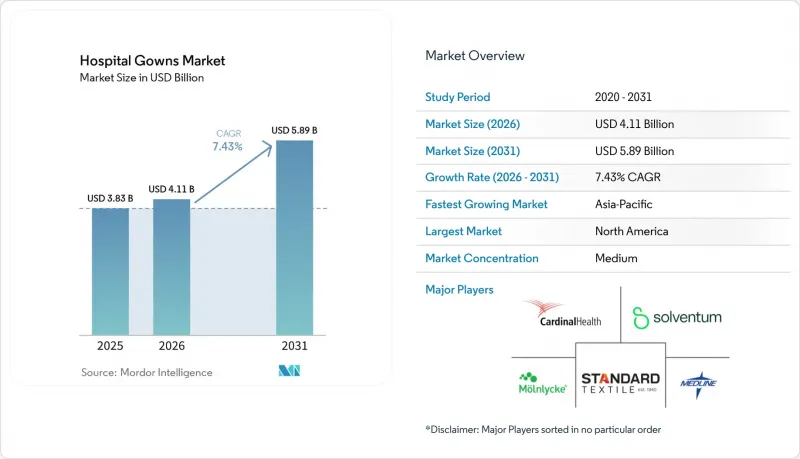
Mordor Intelligence에 의하면, 병원용 가운 시장 규모는 2025년 38억 3,000만 달러로 평가되었고, 2026년에는 41억 1,000만 달러로 추정되고, 2026-2031년 CAGR 7.43%로 성장을 지속할 전망이며, 2031년에는 58억 9,000만 달러에 이를 것으로 예측됩니다.
본 보고서는 용도별(일회용, 재사용 가능), 유형별(수술용, 비수술용, 환자용 가운), 위험도별(최소, 저, 중, 고위험), 최종 사용자별(병원 및 진료소, 장기 요양 시설, 외래수술센터(ASC), 재택치료), 지역별(북미, 유럽, 아시아태평양, 중동 및 아프리카, 남미)로 분류되어 있습니다. 시장 전망은 금액(달러) 기준으로 제시되어 있습니다.
세계의 병원용 가운 시장 동향 및 인사이트
감염 관리 의무화와 병원 내 감염(HAI) 예방
의료 관련 감염의 경우, 급성기 의료, 장기 요양 및 기타 환자와 접촉하는 상황에서 예방 프로토콜에 따라 가운의 정기적인 사용이 의무화되어 있기 때문에 병원용 가운 시장에 대한 견고한 수요 하한선을 지속적으로 형성하고 있습니다. WHO 보고서에 따르면, 유럽에서는 의료 관련 감염으로 인해 매년 2,500만 일분의 입원 일수가 추가되고, 연간 130억-240억 유로(151억-279억 달러)의 비용이 발생하고 있어, 이로 인해 감염 예방에 대한 지출을 미루기 어려운 상황이 지속되고 있습니다. OECD 조사 결과, 적절한 가운 착용을 포함한 감염 예방 및 관리 조치를 통해 감염을 최대 70%까지 줄일 수 있으며, OECD, EU, EEA 회원국에서 투자액 1달러당 24.6달러의 수익을 얻을 수 있는 것으로 밝혀졌습니다. 저소득 국가에서는 이러한 부담이 더욱 크며, WHO는 감염 발생률이 훨씬 높다는 점을 지적하고 있습니다. 이에 따라 대규모 공공 의료 시스템에서는 보호복 조달을 변동비 항목으로 취급하지 말고, 정식 예산 항목으로 임베디드해야 한다는 압박을 받고 있습니다. 미국에서는 CDC(미국 질병통제예방센터)의 '강화된 방어 대책'에 관한 지침에 따라, 밀접한 접촉이 수반되는 요양 시설에서의 활동에서도 가운의 일상적인 사용이 확대되고 있으며, 이에 따라 병원용 가운 시장의 잠재 고객층은 병원에만 국한되지 않고 더욱 넓어지고 있습니다.
수술 건수 증가와 처치 처리 능력 요건
수술 건수 증가는 병원용 가운 시장을 지속적으로 뒷받침하고 있습니다. 이는 수술 건수의 회복이 단순히 밀려 있던 수술을 처리하는 데 그치지 않고, 외래 진료 및 저침습 치료 경로의 보다 광범위한 확대로 이어지고 있기 때문입니다. 『랜싯』지는 전 세계 수술 건수가 연간 1억 6,000만 건 이상에 달할 것으로 예측하고 있으며, 이는 병원 및 외래 진료 현장에서 수술 가운의 지속적인 소비가 예상을 시사합니다. CMS(미국 의료보험 및 의료보조 서비스 센터)는 2026년 ASC(외래수술센터(ASC)) 대상 시술 목록에 289개의 시술을 추가했습니다. 이로 인해 처리 능력이 중요시되는 일회용 제품이 여전히 보편적인 외래 진료 현장으로 더 많은 사례가 계속해서 유입되고 있습니다. 이러한 진료 현장의 전환이 중요한 이유는 ASC에서 시행되는 중증도 높은 시술의 경우 엄격하게 표준화된 수술 키트나 효율적인 수술실 회전 프로토콜이 채택되는 경우가 많으며, 이로 인해 신뢰성 높은 가운 공급의 운영적 가치가 높아지기 때문입니다. 그 결과, 시술 건수 증가는 병원용 가운 시장의 단위 수요를 끌어올리고 있을 뿐만 아니라, 수술실 회전율 향상, 예측 가능한 규정 준수, 그리고 손쉬운 재고 관리를 지원할 수 있는 제품으로 시장의 구성을 변화시키고 있습니다.
예산 제약이 있는 시설에서 고급 제품의 비용 부담
비용 압박은 병원용 가운 시장에 여전히 실질적인 걸림돌로 작용하고 있습니다. 왜냐하면, 차단 성능이 뛰어난 가운은 이미 빠듯한 운영 예산에 직면해 있는 시설의 조달 비용을 증가시키기 때문입니다. 2025년에 134개국 5,230명의 수술 전후 관리 전문가를 대상으로 실시한 국제 설문조사에 따르면, 수술복 품질 향상의 가장 큰 걸림돌로 가장 자주 언급된 것은 재정적 제약이었으며, 응답자의 19.9%가 이를 지적했습니다. 해당 조사에서는 인프라상의 제약과 비용 압박이 종종 공존하는 것으로 나타났으며, 이는 의료기관이 도입 단계를 단순한 순서대로 진행하지는 않는다는 것을 의미합니다. 소규모 외래수술센터(ASC), 장기 요양 시설 및 공립 병원은 대규모 통합 네트워크가 가진 것과 같은 구매력을 갖추지 못하기 때문에 단위당 비용이 구조적으로 높은 수준을 유지하는 경향이 있습니다. 이 때문에 임상 팀이 더 높은 착용감, 통기성 또는 차단 성능을 원하더라도, 병원용 가운 시장의 일부는 여전히 기본적인 제품 수준에 머물러 있습니다.
부문별 분석
2025년, 일회용 가운은 병원용 가운 시장 점유율의 56.31%를 차지했습니다. 이는 워크플로우 규정에 따라 환자 1인당 1회 사용이 여전히 주를 이루고 있는 급성기 병원, ASC 및 응급 현장에서의 광범위한 사용을 반영한 것입니다. 병원용 가운 시장에서의 그 위상은 높은 회전율, 간편한 물류, 그리고 병원 내 섬유 제품 관리의 필요성이 낮다는 점에 의해 뒷받침되고 있습니다. 예측 불가능한 환자 수와 재처리 인프라의 제약에 직면한 의료 기관에서는 세탁으로 인한 병목 현상의 위험을 제거하고 부서 간 조정 부담을 줄일 수 있기 때문에 여전히 일회용 제품에 의존하고 있습니다. 이 때문에 병원용 가운 시장 전체가 더욱 엄선된 제품 및 서비스의 조합으로 전환되고 있는 상황에서도 일회용 제품에 대한 수요는 견조한 추세를 보이고 있습니다.
재사용 가능한 가운 시장은 2026-2031년 연평균 성장률(CAGR) 10.38%를 나타낼 것으로 예측되며, 조달 과정에서 지속가능성 목표와 수명 주기 비용 재검토가 더욱 중요시됨에 따라 빠르게 성장하는 부문으로 부상하고 있습니다. 2025년 세계 수술 전후 관리 조사에 따르면, 멸균과 관련된 제약이 여전히 주요 장벽으로 작용하고 있기 때문에 재사용 가능한 가운의 도입은 임상적 수용도보다는 서비스 준비 상황에 크게 좌우되고 있습니다. 실제로, 병원용 가운 업계는 '대체'가 아니라 '공존'의 방향으로 전환되고 있으며, 재사용 가능한 프로그램은 예정 수술 분야에서 가장 두드러지는 반면, 응급, 외상, 외래 분야에서는 일회용 제품에 대한 수요가 꾸준히 유지되고 있습니다. 하이브리드 조달 모델은 이러한 현실에 잘 부합합니다. 왜냐하면 이 모델을 통해 의료기관은 예정된 수술실 가동량에는 재사용 가능한 직물을 사용하면서도, 수요가 급증하는 시기나 환자 교체 빈도가 높은 치료에는 일회용 제품의 재고를 확보할 수 있기 때문입니다. 구매자들이 단일 형식에 얽매이지 않고 점점 더 유연성을 요구하고 있기 때문에 두 모델 모두에 대응할 수 있는 공급업체는 병원용 가운 시장에서 더 유리한 입지를 확보할 수 있을 것입니다.
2025년, 수술용 가운은 병원용 가운 시장 규모의 45.24%를 차지했습니다. 이는 수술 관리에서 필수적인 역할과, 더욱 엄격해진 차단 요건으로 인해 평균 단가가 높아진 점을 반영한 것입니다. 병원용 가운 시장에서 이 제품이 차지하는 우위는 심장·흉부외과, 정형외과, 복강경 수술, 그리고 기타 체액에 노출되는 상황 등, 통제된 무균 상태가 요구되는 모든 시술과 밀접한 관련이 있습니다. 비수술용 가운은 격리, 접촉 예방 조치, 항암 치료 관리 및 감염 관리 지침에 따라 정해진 기타 처치상의 요구 사항을 충족하기 위해 의료 기관에서 여전히 중요한 품목으로 자리 잡고 있습니다. 이에 따라 유형별 수요는 폭넓은 기반을 유지하고 있으며, 수술용, 비수술용, 환자용과 같은 각 카테고리는 단일한 공통된 수요 패턴을 따르지 않고, 각각 서로 다른 치료 경로에 대응하고 있습니다.
환자용 가운 시장은 2026-2031년 연평균 성장률(CAGR) 10.52%를 기록하며 성장할 것으로 전망됩니다. 이는 외래 진료 및 재택 서비스가 확대되고 있는 데 따른 것으로, 병원용 가운 시장 전체보다 빠른 성장세를 보이고 있습니다. 현재, 점점 더 많은 외래 진료 센터와 독립 클리닉이 병원 주도의 유통 경로를 통해 조달하는 대신 직접 구매하는 방식으로 전환하고 있어, 이 부문의 구매 기반이 확대되고 있습니다. 또한, 디자인 개선 덕분에 환자용 가운은 더욱 전략적인 가치를 갖게 되었습니다. 특히, 쾌적성, 존엄성, 그리고 이용 편의성이 환자 경험 향상이라는 목표를 뒷받침하는 상황에서 이러한 경향이 두드러집니다. 처치 현장에서 감염 위험이 존재하는 경우, 환자가 착용하는 일부 의류도 체액으로부터의 보호와 관련된 표준화된 요건에 점차 부합해 가고 있습니다. 그 결과, 서비스 모델의 변화에 따라 환자용 가운은 지속적인 수요의 원천으로서 더욱 중요한 역할을 수행하게 되었으며, 더 이상 병원용 가운 시장의 저가 부문에 머무르는 제품이 아닙니다.
지역별 분석
2025년, 북미는 병원용 가운 시장 점유율의 38.52%를 차지했으며, 인증된 의료 기관이 밀집된 기반, AAMI 규격에 대한 명확한 준수, 그리고 강력한 조달 규모를 바탕으로 지역별 최대 기여도를 기록했습니다. 미국에서는 병원, 외래수술센터(ASC), 그리고 그룹 구매 조직이 신뢰할 수 있는 물류 체계와 탄탄한 규정 준수 실적을 갖춘 공급업체를 우선적으로 선정하고 있기 때문에 병원용 가운 시장은 여전히 핵심 수익원으로 자리 잡고 있습니다. 캐나다에서는 통합된 조달 체계에 더해, 의료 시스템의 지속가능성이라는 광범위한 목표에 부합하는 재사용 가능한 가운 프로그램에 대한 관심이 높아지면서 시장에 새로운 변화를 가져오고 있습니다. 멕시코에서는 공공 및 민간 의료 기관들이 수술용 및 감염 예방 제품의 체계적인 조달을 확대하고 있어, 성장 시장으로서 계속해서 발전하고 있습니다. 또한, 2025년 8월, 불순물이 혼입된 MicroCool 수술용 가운과 관련해 미국 법무부(DOJ)와의 화해가 성사됨에 따라 규제 당국의 감독도 강화되었습니다. 이에 따라 북미의 조달 결정 과정에서 시험 결과의 신뢰성과 공급업체의 문서 관리의 중요성이 더욱 커지고 있습니다.
유럽은 지속가능성 목표가 구매자들의 일회용 제품과 재사용 가능 제품에 대한 비교 방식을 변화시키고 있기 때문에 병원용 가운 시장에서 전략적으로 독보적인 위치를 유지하고 있습니다. 서유럽 의료 시스템에서는 수술실용 섬유 제품의 재사용이 급속히 확대되고 있으며, 2025년에는 바츠 헬스 NHS 트러스트가 폐기물 감축 목표와 연계된 대규모 재사용 가능 가운 계약을 체결함으로써 그 대표적인 사례를 보여주었습니다. 이 지역의 배경에는 여전히 높은 감염 부담이 존재하며, OECD 보고서에 따르면 EU의 급성기 병원에서는 매년 약 430만 건의 의료 관련 감염이 발생하고 있으며, 이것이 회원국 전체의 가운에 대한 기본적인 수요를 뒷받침하고 있습니다. 이로 인해 유럽의 병원용 가운 시장에는 이중적인 수요 구조가 형성되고 있습니다. 즉, 감염 방지 대책으로 인해 수요량은 안정적으로 유지되고 있는 반면, 지속가능성 정책에 따라 선호되는 섬유 제품이 변화하고 있는 것입니다.
아시아태평양은 2026-2031년 연평균 성장률(CAGR) 9.55%로 확대될 것으로 예상되며, 병원용 가운 시장에서 가장 빠르게 성장하는 지역이 될 전망입니다. 2025년에는 병원 확장, 조달 합리화 및 수출 역량 강화로 인해 인증된 가운 부문의 역할이 확대됨에 따라, 중국이 해당 지역의 최대 시장 점유율을 차지했습니다. 인도 역시 정부 주도의 병원 확충과 고성능 제품을 추구하는 민간 의료 시스템의 확대를 통해 시장 규모를 확대되고 있습니다. 중동 및 아프리카에서는 GCC 국가들의 의료 시스템이 국제 기준으로 전환되고, 몰른리케사의 사우디아라비아 합작 사업과 같은 현지 생산 노력을 추진하고 있는 반면, 사하라 이남 아프리카의 대부분 지역에서는 예산 및 인프라 제약으로 인해 여전히 발전이 제한적인 상황입니다. 남미 지역에서는 브라질의 체계적인 공공 및 민간 조달과 아르헨티나 의료기관의 구매 활동이 단계적으로 정상화되고 있는 점이 긍정적인 요인으로 작용하고 있습니다.
기타 혜택 :
- 엑셀 형식 시장 예측(ME) 시트
- 3개월간의 애널리스트 지원
자주 묻는 질문
목차
제1장 서론
제2장 조사 방법
제3장 주요 요약
제4장 시장 구도
제5장 시장 규모 및 성장 예측
제6장 경쟁 구도
제7장 시장 기회 및 향후 전망
AJY 26.07.07According to Mordor Intelligence, the hospital gowns market size is expected to grow from USD 3.83 billion in 2025 to USD 4.11 billion in 2026 and is forecast to reach USD 5.89 billion by 2031 at 7.43% CAGR over 2026-2031.
This report is Segmented by Usability (Disposable, Reusable), Type (Surgical, Non-Surgical, Patient Gowns), Risk Type (Minimal, Low, Moderate, High Risk), End User (Hospitals and Clinics, Long-Term Care, Ambulatory Surgical Centers, Home Healthcare), and Geography (North America, Europe, Asia-Pacific, Middle East and Africa, South America). The Market Forecasts are Provided in Terms of Value (USD).
Global Hospital Gowns Market Trends and Insights
Infection Control Mandates And HAI Prevention
Healthcare associated infections continue to create a firm demand floor for the hospital gowns market because prevention protocols require regular gown use in acute care, long term care, and other patient contact settings. WHO reported that healthcare associated infections add 25 million extra hospital days each year in Europe and impose EUR 13-24 billion (USD 15.1 to 27.9 billion) in annual costs, which keeps infection prevention spending difficult to defer. OECD also found that infection prevention and control measures, including appropriate gown use, can reduce infections by up to 70% and return USD 24.6 for every USD 1 invested across OECD and EU and EEA countries. The burden is even higher in lower income settings, where WHO noted much greater infection incidence, and that pushes large public systems to formalize procurement of protective apparel rather than treat it as a variable line item. In the United States, CDC guidance on Enhanced Barrier Precautions is extending routine gown use into nursing home activities that involve close contact, which broadens the addressable base for the hospital gowns market beyond hospitals alone.
Surgical Volume Growth And Procedural Throughput Requirements
Procedure growth continues to support the hospital gowns market because surgical case recovery has moved beyond backlog clearing and into a broader expansion of outpatient and minimally invasive care pathways. The Lancet projected global surgical volumes at no less than 160 million operations annually, which implies durable consumption of surgical gowns across hospital and ambulatory settings. CMS added 289 procedures to the ASC Covered Procedures List for 2026, which keeps moving more cases into ambulatory settings where throughput matters and disposable configurations remain common. That site of care shift matters because high acuity procedures done in ASCs often use tightly standardized packs and lean room turnover protocols, which increases the operational value of dependable gown supply. As a result, procedure growth is not only lifting unit demand in the hospital gowns market, it is also changing the mix toward products that can support faster turnover, predictable compliance, and easier inventory control.
Premium Product Cost Pressure In Budget-Constrained Facilities
Cost pressure remains a real brake on the hospital gowns market because higher barrier garments raise procurement costs for facilities that already face tight operating budgets. The 2025 international study covering 5,230 perioperative professionals across 134 countries found that financial constraints were the most frequently cited barrier to improving gown quality, identified by 19.9% of respondents. The same study showed that infrastructure limits and cost pressures often appear together, which means facilities do not move through adoption stages in a simple sequence. Smaller ASCs, long term care centers, and public hospitals also lack the purchasing leverage available to large integrated networks, so per unit costs can stay structurally higher for them. This keeps part of the hospital gowns market anchored to basic product tiers, even where clinical teams would prefer better comfort, breathability, or barrier performance.
Other drivers and restraints analyzed in the detailed report include:
- Rising Preference For Disposable Gowns In High-Turnover Care Settings
- Sustainability-Led Reusable Gown Procurement In Mature Health Systems
- Regulatory And Barrier-Performance Compliance Complexity
For complete list of drivers and restraints, kindly check the Table Of Contents.
Segment Analysis
Disposable Gowns held 56.31% of the hospital gowns market share in 2025, which reflected their deep use in acute care hospitals, ASCs, and emergency settings where single patient use remains central to workflow discipline. Their position in the hospital gowns market is supported by fast turnover, simple logistics, and a lower need for internal textile management. Facilities that face unpredictable caseloads or limited reprocessing infrastructure still rely on disposables because they remove the risk of laundry bottlenecks and reduce coordination across departments. This makes disposable volume resilient even as the broader hospital gowns market shifts toward more selective product and service combinations.
Reusable Gowns are forecast to grow at a 10.38% CAGR during 2026-2031, making them the faster moving usability segment as sustainability goals and life cycle cost reviews gain more weight in procurement. The 2025 global perioperative study found that sterilization related limits remain a core barrier, so reusable adoption depends less on clinical acceptance and more on service readiness. In practice, the hospital gowns industry is moving toward coexistence rather than replacement, with reusable programs strongest in planned surgical environments and disposable demand staying firm in emergency, trauma, and outpatient channels. Hybrid procurement models fit this reality well because they let systems use reusable textiles for scheduled operating room volume and keep disposable stock for surge periods and high turnover care. Suppliers that can serve both models should be better placed in the hospital gowns market because buyers increasingly want flexibility instead of a single format commitment.
Surgical Gowns accounted for 45.24% share of the hospital gowns market size in 2025, which reflected their mandatory role in operative care and their higher average value under stricter barrier requirements. Their lead in the hospital gowns market is tied to every procedure that demands controlled sterile conditions, including cardiothoracic, orthopedic, laparoscopic, and other fluid exposure settings. Non surgical gowns remain an important institutional category because they support isolation, contact precautions, chemotherapy handling, and other procedural needs shaped by infection control guidance. This keeps type level demand broad based, with surgical, non surgical, and patient use categories responding to different care pathways rather than one common demand pattern.
Patient Gowns are projected to grow at a 10.52% CAGR during 2026-2031, which is a faster pace than the overall hospital gowns market because outpatient care and home based services are expanding. More ambulatory centers and independent clinics are now buying directly instead of drawing from hospital led channels, which is widening the purchasing base for this category. Design upgrades are also giving patient gowns more strategic value, especially where comfort, dignity, and better handling support patient experience goals. In procedural settings, some patient facing garments are also moving closer to standardized fluid protection expectations when exposure risk is present. The result is that patient gowns no longer sit only at the low end of the hospital gowns market, because service model changes are making them a more active source of recurring volume.
Complete Report Scope:
- By Usability
- Disposable Gowns
- Reusable Gowns
- By Type
- Surgical Gowns
- Non-Surgical Gowns
- Patient Gowns
- By Risk Type
- Minimal Risk Gowns
- Low Risk Gowns
- Moderate Risk Gowns
- High Risk Gowns
- By End User
- Hospitals and Clinics
- Long-Term Care Facilities
- Ambulatory Surgical Centers
- Home Healthcare
- By Geography
- North America
- United States
- Canada
- Mexico
- Europe
- Germany
- United Kingdom
- France
- Italy
- Spain
- Rest of Europe
- Asia-Pacific
- China
- Japan
- India
- Australia
- South Korea
- Rest of Asia-Pacific
- Middle East and Africa
- GCC
- South Africa
- Rest of Middle East and Africa
- South America
- Brazil
- Argentina
- Rest of South America
- North America
Geography Analysis
North America accounted for 38.52% of the hospital gowns market share in 2025, which made it the largest regional contributor on the back of a dense accredited provider base, clear AAMI alignment, and strong purchasing scale. The United States remains the central revenue engine in the hospital gowns market because its hospitals, ASCs, and group purchasing organizations favor suppliers with dependable logistics and strong compliance records. Canada adds a different layer, with centralized procurement and growing interest in reusable gown programs that fit broader health system sustainability goals. Mexico continues to develop as a growth market as public and private providers expand structured procurement for surgical and infection prevention products. Regulatory scrutiny also intensified after the August 2025 DOJ settlement involving adulterated MicroCool surgical gowns, which raised the importance of testing credibility and supplier documentation across North American sourcing decisions.
Europe remains a strategically distinct region in the hospital gowns market because sustainability targets are changing how buyers compare single use and reusable options. Western European systems are moving faster on reusable operating room textiles, and Barts Health NHS Trust provided a visible example in 2025 with a large reusable gown contract tied to waste reduction goals. The regional backdrop is still shaped by a high infection burden, with OECD reporting around 4.3 million healthcare associated infection episodes each year in EU acute care hospitals, which sustains the baseline need for gowns across member states. This leaves Europe with a dual demand structure in the hospital gowns market, where infection control keeps volumes steady while sustainability policy changes the preferred textile model.
Asia-Pacific is forecast to expand at a 9.55% CAGR during 2026-2031, making it the fastest growing regional block in the hospital gowns market. China held the largest regional share in 2025 as hospital expansion, procurement rationalization, and export capability strengthened the role of validated gown categories. India is also adding scale through government backed hospital expansion and a growing private system that demands higher performance products. The Middle East and Africa shows a split pattern, with GCC systems moving toward international standards and local production initiatives such as Molnlycke's Saudi joint venture, while much of sub Saharan Africa remains limited by budget and infrastructure constraints. South America is being supported by structured public and private procurement in Brazil and a gradual normalization of institutional purchasing in Argentina.
- Ahlstrom Oyj
- AmeriPride Services, Inc.
- Ansell
- Atlas Infiniti Limited
- B. Braun
- Bellcross Industries Pvt. Ltd.
- Cardinal Health
- Dynarex
- Lohmann & Rauscher GmbH and Co. KG
- Medline Industries
- Molnlycke Health Care
- Owens & Minor, Inc.
- Hartmann Group
- Priontex Ltd.
- Sara Healthcare Pvt. Ltd.
- Solventum Corporation
- Standard Textile Co., Inc.
- TIDI Products, LLC
Additional Benefits:
- The market estimate (ME) sheet in Excel format
- 3 months of analyst support
TABLE OF CONTENTS
1 Introduction
- 1.1 Study Assumptions & Market Definition
- 1.2 Scope of the Study
2 Research Methodology
3 Executive Summary
4 Market Landscape
- 4.1 Market Overview
- 4.2 Market Drivers
- 4.2.1 Infection Control Mandates and Hospital-Acquired Infection Prevention
- 4.2.2 Surgical Volume Growth and Procedural Throughput Requirements
- 4.2.3 Rising Preference for Disposable Gowns in High-Turnover Care Settings
- 4.2.4 Sustainability Led Reusable Gown Procurement in Mature Health Systems
- 4.2.5 Reusable Gown Laundering Validation and Closed-Loop Service Models
- 4.2.6 Gown Performance Verification, Traceability, and Procurement Digitization
- 4.3 Market Restraints
- 4.3.1 Premium Product Cost Pressure in Budget-Constrained Facilities
- 4.3.2 Regulatory and Barrier-Performance Compliance Complexity
- 4.3.3 Supply Chain Dependence on Nonwoven and Meltblown Inputs
- 4.3.4 Operational Readiness Gaps for Reusable Gown Adoption
- 4.4 Supply Chain Analysis
- 4.5 Regulatory Landscape
- 4.6 Technological Outlook
- 4.7 Porter's Five Forces Analysis
- 4.7.1 Threat of New Entrants
- 4.7.2 Bargaining Power of Suppliers
- 4.7.3 Bargaining Power of Buyers
- 4.7.4 Threat of Substitutes
- 4.7.5 Competitive Rivalry
5 Market Size & Growth Forecasts (Value, USD)
- 5.1 By Usability
- 5.1.1 Disposable Gowns
- 5.1.2 Reusable Gowns
- 5.2 By Type
- 5.2.1 Surgical Gowns
- 5.2.2 Non-Surgical Gowns
- 5.2.3 Patient Gowns
- 5.3 By Risk Type
- 5.3.1 Minimal Risk Gowns
- 5.3.2 Low Risk Gowns
- 5.3.3 Moderate Risk Gowns
- 5.3.4 High Risk Gowns
- 5.4 By End User
- 5.4.1 Hospitals and Clinics
- 5.4.2 Long-Term Care Facilities
- 5.4.3 Ambulatory Surgical Centers
- 5.4.4 Home Healthcare
- 5.5 By Geography
- 5.5.1 North America
- 5.5.1.1 United States
- 5.5.1.2 Canada
- 5.5.1.3 Mexico
- 5.5.2 Europe
- 5.5.2.1 Germany
- 5.5.2.2 United Kingdom
- 5.5.2.3 France
- 5.5.2.4 Italy
- 5.5.2.5 Spain
- 5.5.2.6 Rest of Europe
- 5.5.3 Asia-Pacific
- 5.5.3.1 China
- 5.5.3.2 Japan
- 5.5.3.3 India
- 5.5.3.4 Australia
- 5.5.3.5 South Korea
- 5.5.3.6 Rest of Asia-Pacific
- 5.5.4 Middle East and Africa
- 5.5.4.1 GCC
- 5.5.4.2 South Africa
- 5.5.4.3 Rest of Middle East and Africa
- 5.5.5 South America
- 5.5.5.1 Brazil
- 5.5.5.2 Argentina
- 5.5.5.3 Rest of South America
- 5.5.1 North America
6 Competitive Landscape
- 6.1 Market Concentration
- 6.2 Market Share Analysis
- 6.3 Company Profiles (includes Global Level Overview, Market Level Overview, Core Segments, Financials as available, Strategic Information, Market Rank/Share, Products and Services, Recent Developments)
- 6.3.1 Ahlstrom Oyj
- 6.3.2 AmeriPride Services, Inc.
- 6.3.3 Ansell Limited
- 6.3.4 Atlas Infiniti Limited
- 6.3.5 B. Braun Melsungen AG
- 6.3.6 Bellcross Industries Pvt. Ltd.
- 6.3.7 Cardinal Health, Inc.
- 6.3.8 Dynarex Corporation
- 6.3.9 Lohmann & Rauscher GmbH and Co. KG
- 6.3.10 Medline Industries, LP
- 6.3.11 Molnlycke Health Care AB
- 6.3.12 Owens & Minor, Inc.
- 6.3.13 Paul Hartmann AG
- 6.3.14 Priontex Ltd.
- 6.3.15 Sara Healthcare Pvt. Ltd.
- 6.3.16 Solventum Corporation
- 6.3.17 Standard Textile Co., Inc.
- 6.3.18 TIDI Products, LLC
7 Market Opportunities & Future Outlook
- 7.1 White-space & unmet-need assessment


