

|
시장보고서
상품코드
2073165
북미의 병원용 가운 : 시장 점유율 분석, 업계 동향 및 통계, 성장 예측(2026-2031년)North America Hospital Gowns - Market Share Analysis, Industry Trends & Statistics, Growth Forecasts (2026 - 2031) |
||||||
 Mordor Intelligence
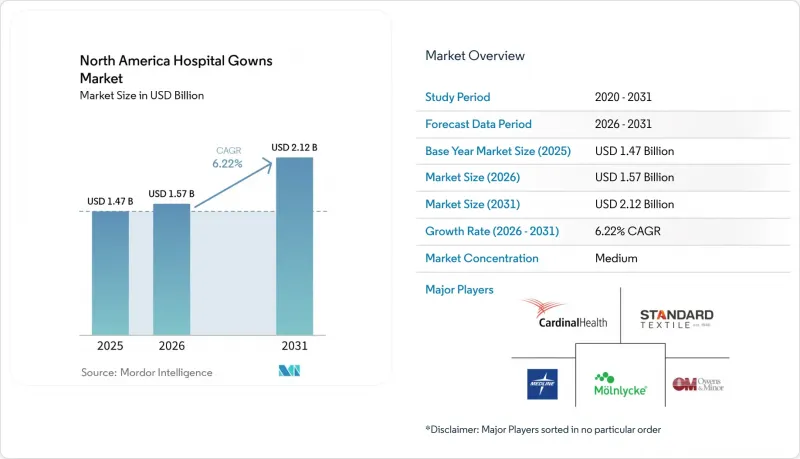
Mordor Intelligence에 의하면, 북미의 병원용 가운 시장 규모는 2025년 14억 7,000만 달러로 평가되었습니다. 2026년에는 15억 7,000만 달러로 확대되어 2031년까지 21억 2,000만 달러에 이를 것으로 예상되며 2026년부터 2031년에 걸쳐 CAGR 6.22%로 성장할 전망입니다.
본 보고서는 사용 편의성별(일회용 가운, 재사용 가능 가운), 유형별(수술용 가운, 비수술용 가운, 환자용 가운), 위험 수준별(최소 위험, 저위험, 중위험, 고위험), 최종 사용자별(병원 및 진료소, 장기 요양 시설, 외래수술센터(ASC), 재택치료), 국가별(미국, 캐나다, 멕시코)로 분류되어 있습니다. 시장 전망은 금액(달러) 기준으로 제시되어 있습니다.
북미의 병원용 가운 시장 동향 및 분석
감염 관리 의무화와 병원 내 감염 예방
감염 관리 규정은 북미의 병원용 가운 시장의 기본적인 수요 패턴을 계속해서 좌우하고 있습니다. 이는 급성기 의료, 급성기 이후의 의료 환경, 그리고 장기 요양 환경 어느 곳에서나 시설이 여전히 규정을 준수하는 보호복을 필요로 하기 때문입니다. CIDRAP이 인용한 CDC 보고서에 따르면, 2024년에는 입원 환자 31명 중 1명이 임의의 하루에 적어도 한 가지의 의료 관련 감염증을 앓고 있었던 것으로 나타났으며, 이로 인해 예방을 위한 지출은 일시적인 집단 감염 대응이 아닌 일상적인 의료 관행과 연계되고 있습니다. CLABSI(중심정맥카테터 관련 혈류 감염), CAUTI(카테터 관련 요로 감염) 및 입원 중 발병한 C. 디피실 감염의 발생률이 감소했음에도 불구하고, 가운 착용의 필요성은 줄어들지 않았습니다. 왜냐하면 이러한 개선은 일관된 감염 관리 조치와 진료 현장에서의 PPE(개인보호구(PPE)) 착용에 대한 지속적인 준수에 달려 있었기 때문입니다. 또한, CDC의 “강화된 방어막 예방책"에 따라, 요양 시설에서 접촉 빈도가 높은 활동 시 가운과 장갑의 사용이 확대되었으며, 그 이용 사례가 급성기 병원을 넘어 확산되면서 전문 요양 시설에서의 사용이 더욱 일상화되었습니다. 이러한 간호 활동의 적용 범위가 확대되는 것이 중요한 이유는 가운이 더 이상 수술실이나 격리 조치에만 국한되는 것이 아니라, 취약한 환자를 수용하는 시설에서 입소자에 대한 일상적인 대응이나 직접적인 접촉을 수반하는 간호 업무에도 필수적이 되었기 때문입니다. 그 결과, 개별 감염 지표가 개선되더라도 수요의 하한선은 견조하게 유지될 것입니다. 왜냐하면, 성과가 좋은 의료 시스템은 대개 방역 조치를 완화하는 것이 아니라 일상적인 방역 절차를 지속적으로 유지하고 있기 때문입니다.
수술 건수 증가와 처치 처리 능력 요건
수술 건수 증가는 여전히 북미의 병원용 가운 시장의 직접적인 성장 동력으로 작용하고 있습니다. 특히, 신뢰할 수 있는 공급과 신속한 보충이 필요한 외래수술센터(ASC)로 더 많은 시술이 이전되고 있는 것이 그 원인입니다. MedPAC 보고서에 따르면, 메디케어 종량제 급여 수급자 1,000명당 외래수술센터(ASC)의 수는 2024년에 3.4% 증가했습니다. 이는 외래 시술에 대한 수요가 지속적으로 증가하고 있으며, 진료 건수가 병원 외의 시설로 계속 이동하고 있음을 뒷받침합니다. 이는 가운 수요에 있어 중요한 의미를 지닙니다. 왜냐하면 ASC(외래수술센터(ASC))는 일반적으로 재고를 엄격하게 관리하고 수술실 회전율도 높기 때문에 즉시 사용 가능한 재고, 간결한 SKU 계획, 그리고 신뢰할 수 있는 납품 주기의 가치가 높아지기 때문입니다. 또한, 많은 외래 진료 시설은 주요 병원 시스템의 구매를 특징으로 하는 대규모 집중 조달 체제 밖에서 운영되고 있기 때문에 유통 채널의 경제성에도 변화가 생깁니다. 고품질의 차단 보호, 신속한 보충, 소규모 시설을 위한 서비스 모델을 지원할 수 있는 공급업체는 지역 전체에서 대응 방안이 지속적으로 변화하는 가운데 더 유리한 입지를 확보할 수 있습니다. 언뜻 보면 수량 변화처럼 보이는 이 현상은 동시에 유통 형태의 변화이기도 하며, 그로 인해 유연한 주문 처리 체계를 갖춘 공급업체는 북미의 병원용 가운 시장에서 더 뚜렷한 시기적 우위를 점하게 될 것입니다.
예산 제약이 있는 시설에서 프리미엄 제품의 비용 부담
비용 압박은 여전히 모든 의료 현장에서 북미의 병원용 가운 시장이 프리미엄 제품으로 어느 정도 전환될 수 있는지를 제한하고 있습니다. 특히, 감염 예방 대책에 대한 수요와 고정된 운영 예산 사이의 균형을 맞추어야 하는 현장에서는 이러한 경향이 두드러집니다. 세이프티넷 병원, 크리티컬 액세스 시설 및 공급비에 제약이 있는 공공시설에서는 차단 성능이 뛰어난 가운이 표준 대체품에 비해 현저히 높은 가격을 요구할 경우, 저비용 제품을 우선적으로 선택하는 경향이 강해집니다. 이러한 압박은 번들형이나 가치 기반 지불 모델 하에서는 더욱 심해집니다. 왜냐하면 관리자들은 임상 처리 능력이나 규정 준수를 저해하지 않으면서도 진료 1회당 공급 비용을 관리해야 하는 압박을 받기 때문입니다. 따라서 일상적인 관리에는 재사용 가능한 제품을, 수술이나 위험이 높은 격리 용도에는 일회용 제품을 할당하는 ‘하이브리드형 조달"가 점차 일반화되고 있습니다. 이 접근 방식은 임상 기준을 유지하지만, 섬유 관련 예산의 각 항목을 면밀히 검토하고 있는 기관에서는 프리미엄 일회용 가운의 단위 수요를 감소시킬 가능성이 있습니다. 그 결과, 임상 담당자들이 뛰어난 차단 보호 기능이나 보다 전문적인 가운 형태의 운영상 이점을 인식하고 있더라도, 예산에 민감한 시설에서는 업그레이드 주기가 늦어지는 경향이 있습니다.
부문별 분석
2025년, 북미의 병원용 가운 시장에서 일회용 가운은 71.31%의 점유율을 차지했습니다. 이는 즉각적인 사용 가능성이 여전히 임상적으로 요구되는 수술, 격리 및 환자 회전율이 높은 치료 환경에서 일회용 가운이 확고한 역할을 수행하고 있음을 반영합니다. 그 우위는 일시적인 것이 아니라 구조적인 것이었습니다. 왜냐하면 접촉 빈도가 높고 회전 주기가 짧은 상황에서는 많은 감염 예방 프로토콜과 병원의 일상 업무 흐름에서 여전히 일회용 사용이 주는 확실성이 우선시되고 있기 때문입니다. 이러한 위상은 환자 진료의 틈틈이 수거, 분류, 재처리 등의 공정이 수반하는 복잡성을 피하고자 하는 응급의료, 수술실, 외래 진료 현장에서 더욱 확고해지고 있습니다. 또한, 차단 성능 검증과 관련된 규제 환경에서도 시설 측에서는 대개 도입이 간편하고 개별 제품 수준에서 일관된 성능을 발휘하는 제품을 선호하는 경향이 있으며, 이것이 해당 제품의 입지를 뒷받침하고 있습니다. 그 결과, 조달 팀이 폐기물 감축과 수명 주기 비용 절감을 더욱 강력히 요구하고 있음에도 불구하고, 북미의 병원용 가운 업계 전반에 걸쳐 일회용 가운에 대한 수요는 여전히 깊게 뿌리내리고 있습니다.
재사용 가능한 가운 시장은 2031년까지 연평균 성장률(CAGR) 8.38%로 확대될 것으로 예상되며, 지속가능성 및 ‘1회당 비용"라는 사고방식이 널리 받아들여짐에 따라, 북미의 병원용 가운 시장에서 가장 빠르게 성장하는 부문이 되고 있습니다. 이러한 성장 추세가 가장 두드러지는 경우는 의료 시스템이 현장 직원의 업무 부담을 늘리지 않으면서도 세탁 검증, 반환 물류 및 가운 추적을 지원할 수 있는 경우입니다. Island Health의 2025년 재사용 가능한 가운 프로그램은 감염 관리 기준 및 일관된 섬유 제품 취급 관행을 유지하면서, 이러한 요건들을 운영 중인 의료 네트워크 내에서 관리할 수 있음을 보여주었습니다. 복잡한 외과 수술 환경에서는 장시간에 걸친 시술로 인해 체액 관리에 대한 요구가 높고, 차단 성능에 대한 기대치도 더욱 엄격하기 때문에 도입 속도는 그리 빠르지 않습니다. 반면, 가운 교체 빈도가 높고 일회용 제품으로 인한 누적 폐기물을 측정하기 쉬운 일상적인 환자 간호, 격리 병동 및 장기 요양 환경에서는 도입이 빠르게 진행되고 있습니다. 재사용 가능한 프로그램의 경제성은 가운의 사양과 마찬가지로 서비스 설계에도 크게 좌우되기 때문에 이러한 프로그램은 단순한 섬유 제품의 대체품이 아니라 운영 시스템으로 자리매김하고 있습니다.
2025년, 북미의 병원용 가운 시장 규모에서 수술용 가운은 55.24%의 점유율을 차지했습니다. 이로 인해 이 카테고리는 유형별 부문 전체에서 1위를 유지하고 있으며, 모든 수술실에서 사용이 의무화되어 있는 현실을 반영하고 있습니다. 이러한 위상은 여전히 신뢰할 수 있는 장벽 보호, 표준화된 분류, 그리고 병원이나 외래 진료 현장을 불문하고 확실한 SKU 공급이 요구되는 광범위한 침습적 시술에 의해 뒷받침되고 있습니다. 매출 집중도가 가장 높은 품목은 수술용 가운입니다. 이는 이러한 제품에는 더 높은 성능 요건이 요구되며, 기본적인 비수술용 대체품에 비해 단위당 가치가 높은 경우가 많기 때문입니다. 동시에, 외래 환자 수가 증가함에 따라 수술실과 동등한 수준의 수술복에 대한 수요가 대규모 병원과 다른 조달 방식을 채택하는 다양한 시설로 확대되고 있습니다. 이에 따라 북미의 병원용 가운 시장에서 특히 고품질의 차단 제품군과 뛰어난 납품 실적을 보유한 공급업체들에게 수술용 가운은 계속해서 경쟁 전략의 핵심적인 위치를 차지하고 있습니다.
환자용 가운 시장은 2031년까지 연평균 성장률(CAGR) 9.52%를 나타낼 것으로 예측되며, 외래 환자 수용 증가, 특정 의료 현장에서의 환자 체류 기간 연장, 그리고 편안함을 중시하는 조달 우선순위의 상승에 힘입어 가장 두드러진 성장을 보이는 부문으로 자리매김하고 있습니다. 비수술용 가운은 간호, 진찰, 시술 후 사용 등 폭넓은 일상 간호의 기반으로 여전히 활용되고 있지만, 단가가 낮기 때문에 이 부문은 예산상의 절충의 영향을 받기 쉬운 상황에 놓여 있습니다. 메드라인사가 2025년 7월에 출시한 ‘ComfortTemp 환자 체온 유지 시스템"는 환자용 가운의 개발이 단순한 기본 복장에서 수술 전후 관리에서의 임상적 유용성 향상으로 전환되고 있음을 보여줍니다. 이러한 방향성이 중요한 이유는 원단 선택이 관리 경험과 업무 흐름의 효율성 모두에 영향을 미치는 가운데, 의료진이 환자의 편안함, 착용감 및 치료 순응도를 더욱 중요하게 여기게 되었기 때문입니다. 또한, 고품질의 환자용 가운은 수술용 제품의 특징인 높은 차단 성능을 필요로 하지 않으면서도 보다 광범위한 치료 목표를 지원할 수 있다는 점에서도 중요합니다. 따라서 환자용 가운 시장의 기회는 판매량과 디자인의 중요성 두 가지 측면에서 모두 확대되고 있으며, 과거에는 단순한 일반 상품으로 여겨졌던 이 부문에서 공급업체들이 차별화를 꾀할 여지가 생겨나고 있습니다.
기타 혜택 :
- 엑셀 형식 시장 예측(ME) 시트
- 3개월간의 애널리스트 지원
자주 묻는 질문
목차
제1장 서론
제2장 조사 방법
제3장 주요 요약
제4장 시장 구도
제5장 시장 규모 및 성장 예측
제6장 경쟁 구도
제7장 시장 기회 및 향후 전망
KTH 26.07.08According to Mordor Intelligence, the north america hospital gowns market size is expected to increase from USD 1.47 billion in 2025 to USD 1.57 billion in 2026 and reach USD 2.12 billion by 2031, growing at a CAGR of 6.22% over 2026-2031.
This report is Segmented by Usability (Disposable Gowns, Reusable Gowns), Type (Surgical Gowns, Non-Surgical Gowns, Patient Gowns), Risk Type (Minimal, Low, Moderate, High Risk), End User (Hospitals and Clinics, Long-Term Care, Ambulatory Surgical Centers, Home Healthcare), and Country (United States, Canada, Mexico). The Market Forecasts are Provided in Terms of Value (USD).
North America Hospital Gowns Market Trends and Insights
Infection Control Mandates and Hospital-Acquired Infection Prevention
Infection control rules continue to set the base demand pattern for the North America hospital gowns market, because facilities still need compliant protective apparel across acute care, post-acute settings, and long-term care environments. CDC reporting cited by CIDRAP showed that 1 in 31 hospitalized patients had at least 1 healthcare-associated infection on any given day in 2024, which keeps prevention spending tied to routine care practice rather than temporary outbreak response. Lower rates for CLABSI, CAUTI, and hospital-onset C. difficile did not reduce the need for gowns, because those gains depended on consistent infection-control behavior and continued PPE discipline at the point of care. CDC Enhanced Barrier Precautions also extended gown-and-glove use for high-contact activities in nursing homes, which widened the use case beyond acute care hospitals and made utilization more routine in skilled nursing settings. That broader care footprint matters because gowns are no longer tied only to operating rooms or isolation episodes, they are also tied to everyday resident handling and direct-contact care tasks in facilities with vulnerable patients. The result is a demand floor that stays firm even when individual infection indicators improve, because the health systems that perform better are usually the ones that keep protective routines in place rather than easing them.
Surgical Volume Growth and Procedural Throughput Requirements
Surgical throughput remains a direct growth engine for the North America hospital gowns market, especially as more procedures move into ambulatory settings that need dependable supply and rapid replenishment. MedPAC reported that ambulatory surgical center volume per 1,000 Medicare fee-for-service beneficiaries rose 3.4% in 2024, which confirms that outpatient procedural demand kept moving higher and continued to shift case volume beyond the hospital setting. This matters for gown demand because ASCs usually run tighter inventories and faster room turnover, which raises the value of ready-to-use stock, simple SKU planning, and dependable delivery cadence. It also changes channel economics, since many outpatient sites operate outside the large centralized procurement structures that define purchasing in major hospital systems. Vendors that can support premium barrier protection, responsive restocking, and a smaller-site service model are better positioned as procedural mix keeps changing across the region. What looks like a volume shift is also a distribution shift, and that gives suppliers with flexible fulfillment a clearer timing advantage in the North America hospital gowns market.
Premium Product Cost Pressure in Budget-Constrained Facilities
Cost pressure still limits how far the North America hospital gowns market can move into premium products across every care setting, especially where infection-control needs must be balanced against fixed operating budgets. Safety-net hospitals, critical access sites, and public facilities with constrained supply spending are more likely to favor lower-cost tiers when higher-barrier gowns carry a visible price premium over standard alternatives. That pressure becomes stronger under bundled and value-based payment models, because administrators are pushed to manage supply cost per encounter without disrupting clinical throughput or compliance. Hybrid purchasing is therefore becoming more common, with reusable products used for routine care and disposable products reserved for surgery or higher-risk isolation use. This approach protects clinical standards, but it can reduce unit demand for premium single-use gowns in facilities that are actively reviewing every line item in their textile budgets. The result is a slower upgrade cycle in budget-sensitive accounts, even when clinicians recognize the operational benefits of better barrier protection and more specialized gown formats.
Other drivers and restraints analyzed in the detailed report include:
- Rising Preference for Disposable Gowns in High-Turnover Care Settings
- Sustainability-Led Reusable Gown Procurement in Mature Health Systems
- Supply Chain Dependence on Nonwoven and Meltblown Inputs
For complete list of drivers and restraints, kindly check the Table Of Contents.
Segment Analysis
Disposable gowns held 71.31% of North America hospital gowns market share in 2025, which reflected their entrenched role in surgical, isolation, and fast-turnover care environments where immediate availability remains a clinical expectation. Their lead was structural rather than temporary, because many infection-prevention protocols and day-to-day hospital workflows still favor single-use assurance when contact intensity is high and turnaround windows are short. This position is reinforced in emergency care, operating rooms, and outpatient sites that do not want added complexity from collection, sorting, or reprocessing steps between encounters. It is also reinforced by the regulatory culture around barrier validation, where facilities often prefer products with straightforward deployment and consistent unit-level performance. As a result, disposable volume remains deeply rooted across the North America hospital gowns industry even as procurement teams put more pressure on waste reduction and lifecycle cost.
Reusable gowns are forecast to expand at 8.38% CAGR through 2031, which makes them the faster-moving usability segment in the North America hospital gowns market as sustainability and cost-per-use logic gain wider acceptance. The growth case is strongest where health systems can support laundry validation, return logistics, and garment tracking without increasing operational burden for frontline staff. Island Health's 2025 reusable gown program showed that these requirements can be managed inside a working care network while maintaining infection-control standards and consistent textile handling practices. Adoption is not moving fastest in complex surgical settings, because those environments carry more fluid-management demands and stricter barrier-performance expectations over prolonged procedures. It is moving faster in routine patient care, isolation corridors, and long-term care environments where gowns are changed often and the cumulative waste from disposables is easier to measure. This is why reusable programs are increasingly framed as operational systems rather than textile substitutions, because their economics depend on service design as much as garment specification.
Surgical gowns accounted for 55.24% share of the North America hospital gowns market size in 2025, which kept this category in the leading position across type segments and reflected its mandatory use in every operating room encounter. Their position remains supported by the broad range of invasive procedures that still require reliable barrier protection, standardized classification, and dependable SKU availability across hospital and outpatient settings. Revenue concentration stays strongest in surgical gowns because these products carry higher performance requirements and often command more value per unit than basic non-surgical alternatives. At the same time, the expansion of outpatient case flow is extending operating-room-equivalent gown demand into a wider set of facilities that do not purchase in exactly the same way as large hospitals. This keeps surgical gowns at the center of competitive strategy in the North America hospital gowns market, particularly for suppliers with premium barrier portfolios and strong delivery performance.
Patient gowns are projected to grow at 9.52% CAGR through 2031, which makes them the fastest-moving type segment as outpatient admissions, longer patient stays in selected settings, and comfort-related procurement priorities gain weight. Non-surgical gowns still serve a broad daily care base across nursing, examination, and post-procedure use, but their lower unit values keep the category more exposed to budget tradeoffs. Medline's July 2025 launch of the ComfortTemp Patient Warming System showed how patient gown development is moving beyond basic coverage toward added clinical utility in perioperative care. That direction matters because providers are looking more closely at patient comfort, fit, and compliance when textile decisions affect both care experience and workflow efficiency. It also matters because premium patient gown formats can support broader care objectives without requiring the same barrier premium that defines surgical products. The patient gown opportunity is therefore expanding on both volume and design relevance, which gives suppliers space to differentiate in a category once treated as a simple commodity.
Complete Report Scope:
- By Usability
- Disposable Gowns
- Reusable Gowns
- By Type
- Surgical Gowns
- Non-Surgical Gowns
- Patient Gowns
- By Risk Type
- Minimal Risk Gowns
- Low Risk Gowns
- Moderate Risk Gowns
- High Risk Gowns
- By End User
- Hospitals and Clinics
- Long-Term Care Facilities
- Ambulatory Surgical Centers
- Home Healthcare
- By Country
- United States
- Canada
- Mexico
List of Companies Covered in this Report:
- Solventum Corporation
- Aramark
- B. Braun
- Cardinal Health
- Dynarex
- Encompass Group, LLC
- Halyard Health, Inc.
- Kimberly-Clark Worldwide
- Lohmann and Rauscher GmbH and Co. KG
- Medline Industries
- Molnlycke Health Care
- Owens and Minor, Inc.
- Hartmann Group
- PRIMED Medical Products Inc.
- Standard Textile Co., Inc.
- TIDI Products, LLC
- Vestis Corporation
Additional Benefits:
- The market estimate (ME) sheet in Excel format
- 3 months of analyst support
TABLE OF CONTENTS
1 Introduction
- 1.1 Study Assumptions & Market Definition
- 1.2 Scope of the Study
2 Research Methodology
3 Executive Summary
4 Market Landscape
- 4.1 Market Overview
- 4.2 Market Drivers
- 4.2.1 Infection Control Mandates and Hospital-Acquired Infection Prevention
- 4.2.2 Surgical Volume Growth and Procedural Throughput Requirements
- 4.2.3 Rising Preference for Disposable Gowns in High-Turnover Care Settings
- 4.2.4 Sustainability-Led Reusable Gown Procurement in Mature Health Systems
- 4.2.5 Reusable Gown Laundering Validation and Closed-Loop Service Models
- 4.2.6 Gown Performance Verification, Traceability, and Procurement Digitization
- 4.3 Market Restraints
- 4.3.1 Premium Product Cost Pressure in Budget-Constrained Facilities
- 4.3.2 Regulatory and Barrier-Performance Compliance Complexity
- 4.3.3 Supply Chain Dependence on Nonwoven and Meltblown Inputs
- 4.3.4 Operational Readiness Gaps for Reusable Gown Adoption
- 4.4 Supply Chain Analysis
- 4.5 Regulatory Landscape
- 4.6 Technological Outlook
- 4.7 Porter's Five Forces Analysis
- 4.7.1 Threat of New Entrants
- 4.7.2 Bargaining Power of Suppliers
- 4.7.3 Bargaining Power of Buyers
- 4.7.4 Threat of Substitutes
- 4.7.5 Competitive Rivalry Analysis
5 Market Size & Growth Forecasts (Value, USD)
- 5.1 By Usability
- 5.1.1 Disposable Gowns
- 5.1.2 Reusable Gowns
- 5.2 By Type
- 5.2.1 Surgical Gowns
- 5.2.2 Non-Surgical Gowns
- 5.2.3 Patient Gowns
- 5.3 By Risk Type
- 5.3.1 Minimal Risk Gowns
- 5.3.2 Low Risk Gowns
- 5.3.3 Moderate Risk Gowns
- 5.3.4 High Risk Gowns
- 5.4 By End User
- 5.4.1 Hospitals and Clinics
- 5.4.2 Long-Term Care Facilities
- 5.4.3 Ambulatory Surgical Centers
- 5.4.4 Home Healthcare
- 5.5 By Country
- 5.5.1 United States
- 5.5.2 Canada
- 5.5.3 Mexico
6 Competitive Landscape
- 6.1 Market Concentration
- 6.2 Market Share Analysis
- 6.3 Company Profiles (includes Global Level Overview, Market Level Overview, Core Segments, Financials as available, Strategic Information, Market Rank/Share, Products and Services, Recent Developments)
- 6.3.1 Solventum Corporation
- 6.3.2 Aramark
- 6.3.3 B. Braun Melsungen AG
- 6.3.4 Cardinal Health, Inc.
- 6.3.5 Dynarex Corporation
- 6.3.6 Encompass Group, LLC
- 6.3.7 Halyard Health, Inc.
- 6.3.8 Kimberly-Clark Corporation
- 6.3.9 Lohmann and Rauscher GmbH and Co. KG
- 6.3.10 Medline Industries, LP
- 6.3.11 Molnlycke Health Care AB
- 6.3.12 Owens and Minor, Inc.
- 6.3.13 Paul Hartmann AG
- 6.3.14 PRIMED Medical Products Inc.
- 6.3.15 Standard Textile Co., Inc.
- 6.3.16 TIDI Products, LLC
- 6.3.17 Vestis Corporation
7 Market Opportunities & Future Outlook
- 7.1 White-Space and Unmet-Need Assessment


