
|
시장보고서
상품코드
2072755
IVD 수탁 제조 시장 : 시장 점유율 분석, 업계 동향 및 통계, 성장 예측(2026-2031년)In-Vitro Diagnostics (IVD) Contract Manufacturing - Market Share Analysis, Industry Trends & Statistics, Growth Forecasts (2026 - 2031) |
||||||
 Mordor Intelligence
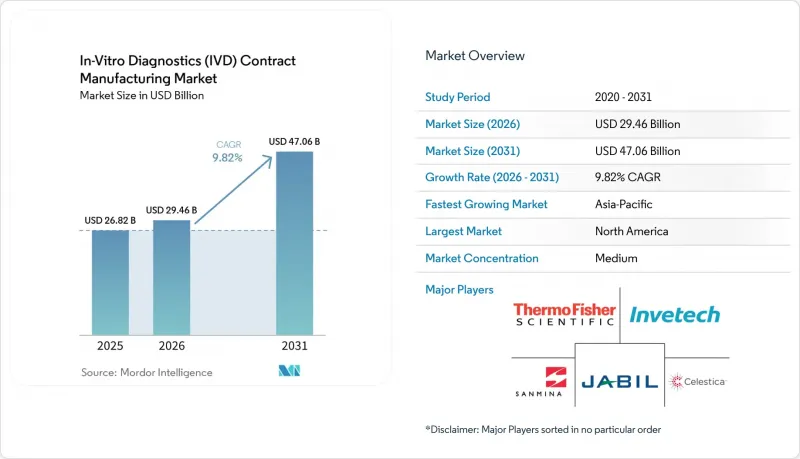
Mordor Intelligence에 의하면, IVD 수탁 제조 시장 규모는 2025년 268억 2,000만 달러로 평가되었고, 2026년 294억 6,000만 달러로 추정되고, 2031년까지 470억 6,000만 달러로 확대될 것으로 예측되며, 2026-2031년 연평균 복합 성장률(CAGR)은 9.82%를 나타낼 전망입니다.
본 보고서는 제품 유형별(기기, 시약 등), 서비스 유형별(제조 서비스, 분석법 개발 등), 기술별(면역측정법, 분자진단, 임상화학 등), 최종 사용자별(의료기기 및 생명공학, 제약, 병원 및 검사실, 연구기관), 지역별(북미, 유럽, 아시아태평양 등)로 분류되어 있습니다. 시장 예상치는 금액(달러)으로 표시되어 있습니다.
세계의 IVD 수탁 제조 시장 동향 및 인사이트
OEM을 통한 IVD 제조 아웃소싱 증가
IVD 수탁 제조 시장은 OEM의 행동 양식에 뚜렷한 변화가 나타나고 있는 데서 혜택을 보고 있습니다. 현재 아웃소싱은 단순히 비용 절감을 위해서뿐만 아니라, 운영 리스크나 규정 준수상의 부담을 전가하는 수단으로도 활용되고 있기 때문입니다. 현재의 진단 플랫폼은 다중 분석 기술, 마이크로플루이딕스 카트리지, 임베디드 소프트웨어를 결합하고 있기 때문에 제품 유형별로 별도의 사내 생산 라인을 구축하는 것의 타당성을 설명하기가 어려워지고 있습니다. 따라서 검증된 외부 생산 능력이 전문 시설에 대한 반복적인 설비 투자를 대체할 수 있는 현실적인 대안이 됨에 따라, IVD 수탁 제조 시장은 확대되고 있습니다. 2026년, FDA는 '품질 경영 시스템 규정'을 시행합니다. 이는 21 CFR Part 820을 ISO 13485:2016에 부합하도록 조정하고, 외부 위탁 업무 전반에 걸친 설명 책임을 강화하기 위한 것입니다. 이러한 규제 체계는 스폰서의 책임을 경감시키는 것은 아니지만, 이미 성숙한 품질 관리 체계 하에서 사업을 전개하고 있는 경험 많은 파트너의 가치를 높여줄 것입니다. IVD 수탁 제조 시장은 제조 관련 업체의 수는 줄어들고 있지만, 보다 긴밀하게 통합된 관계가 선호되는 이러한 추세로부터 혜택을 보고 있습니다.
분자진단 및 면역 분석 파이프라인의 확대
IVD 수탁 제조 시장은 면역 분석법, 분자진단, 현장 진단(Point-of-Care) 방식에 이르는 검사 항목의 폭넓은 확장에 힘입어 성장하고 있습니다. 로슈 다이아그노스틱스는 2025년부터 2028년에 걸쳐 출시될 예정인 약 130건의 신규 검사 파이프라인을 공개했습니다. 이는 대형 OEM이 관련 제조 공정을 모두 사내에 구축하지 않고도 관리하려는 상용화 작업의 규모를 보여줍니다. OEM 기업이 자본을 파이프라인 확장에 투입하고, 공정 확대, 배치 이전, 생산 준비를 외부 파트너에게 맡기기로 선택할 경우, IVD 수탁 제조 시장은 그 혜택을 누리게 됩니다. 이러한 경향은 동일한 운영 모델 내에서 개발 이관 및 생산 가동을 처리할 수 있는 CMO에게 특히 유리합니다. 이를 통해 분석법 설계부터 상업적 생산에 이르는 과정이 단축되고, 연구개발 팀과 생산 팀 간의 마찰이 줄어듭니다. 따라서 IVD 수탁 제조 시장에서는 과학적인 복잡성과 제품 출시를 모두 담당할 수 있는 파트너에 대한 수요가 높아지고 있습니다.
여러 거점에 있는 파트너 간 지적 재산권 유출 위험
IVD 수탁 제조 시장에서는 규모 확대와 핵심 분석법의 노하우 보호 사이에서 여전히 근본적인 긴장 관계가 존재하고 있습니다. 분석법 처방, 항체 클론의 특정 정보, 시약의 조성은 OEM 업체에게 여전히 핵심적인 경쟁 우위 요소이며, 이를 여러 파트너 거점에 광범위하게 분산시키는 것은 이러한 정보에 대한 노출을 증가시킵니다. 특히 워크플로가 여러 관할 구역에 걸쳐 있는 경우, 소규모 혁신 기업들은 더 광범위한 네트워크로 생산을 확대하는 데 신중한 태도를 보이는 경향이 있어, IVD 수탁 제조 시장은 제약을 받고 있습니다. 실제로 많은 프로그램에서 기술 이전의 구분화, 정보 접근 제한, 그리고 거점별 프로세스 분리 등의 대책이 마련되어 있습니다. 이러한 관리 조치는 위험을 줄여주지만, 한편으로는 조정에 소요되는 시간과 관리상의 부담도 증가시킵니다. 따라서, 지적재산권 보호가 여전히 파트너 선정 및 네트워크 설계에 영향을 미치고 있기 때문에 일부 프로그램에서는 수요 증가만으로는 예상되는 것보다 IVD 수탁 제조 시장의 성장 속도가 둔화되고 있습니다.
부문별 분석
2025년, 시약 및 소모품은 IVD 수탁 제조 시장 규모의 70.31%를 차지했으며, 이 부문은 진단용 제품의 외부 위탁 생산에서 핵심적인 수익 기반으로 자리매김했습니다. 병원 검사실, 현장 진단(PoC) 환경 및 연구 워크플로우에서 시약 보충이 지속적으로 이루어지기 때문에 IVD 수탁 제조 시장은 이러한 지속적인 수요에 크게 의존하고 있습니다. 임상화학 및 면역측정 시스템 분야의 시약 임대 모델은 장비 도입 후 발생하는 시약 수요의 롱테일을 뒷받침하고 있으며, 이를 통해 제조 파트너는 수요를 보다 쉽게 예측할 수 있게 되었습니다. 측류 스트립, ELISA용 구성 요소 및 단일클론 항체 기반 시약 키트는 IVD 수탁 제조 시장의 이 분야에서 여전히 핵심 제품 카테고리로 자리 잡고 있습니다.
가장 규모가 작은 제품 카테고리라 할지라도, 소프트웨어 및 관련 서비스가 단독 애드온으로 판매되는 것이 아니라 프리미엄 제조 계약에 번들로 포함되는 사례가 늘어나고 있어, 여전히 전략적 가치를 제공합니다. 기기는 가장 빠르게 성장하고 있는 제품 부문으로, 2026-2031년 예상 연평균 성장률(CAGR)은 12.38%입니다. 이는 IVD 수탁 제조 시장이 더욱 복잡한 하드웨어 업무 분야로 깊이 진출하고 있음을 보여주는 가장 명확한 징후 중 하나입니다. 각 OEM 업체들은 PCB 조립, 광학 서브시스템 및 최종 조립 일체를 전자기기 제조 실적이 있는 파트너 기업에 위탁하고 있습니다. 이는 최대 규모의 플랫폼을 제외하고는 사내 하드웨어 생산 라인을 유지해야 할 정당성을 입증하기가 어려워지고 있기 때문입니다. 차세대 시스템이 마이크로플루이딕스 기술, 임베디드 소프트웨어, 무선 연결, 그리고 더욱 엄격해진 품질 보증 요건을 결합함에 따라, IVD 수탁 제조 시장에서는 소모품뿐만 아니라 장비의 전체 제조 과정을 관리할 수 있는 CMO(수탁 제조업체)로 가치가 점차 이동하고 있습니다.
2025년, 제조 서비스는 IVD 수탁 제조 시장 규모의 45.24%를 차지했으며, 핵심 생산 업무가 여전히 대부분의 상업적 관계의 기반을 이루고 있음을 알 수 있습니다. IVD 수탁 제조 업계에서 이 부문은 대개 첫 번째 진입점이 됩니다. 이는 OEM 각사가 업무 범위를 확대하기 전에, 충진 및 마무리, 키트화, 로트 릴리스, 혹은 기본적인 생산 지원부터 시작하기 때문입니다. IVD 수탁 제조 시장은 거의 모든 제품 및 기술 범주에서 계속해서 이러한 서비스에 의존하고 있으며, 그로 인해 이 부문은 특정 플랫폼 유형의 변화에 따른 영향을 덜 받는 상황입니다. 또한, OEM 업체들이 다운스트림 공정의 실행을 보다 종합적으로 일원화해 줄 파트너를 찾는 경향이 강해지고 있어, 포장, 라벨 부착, 품질 지원 분야도 확대되고 있습니다.
분석법 개발 서비스는 더욱 빠르게 성장하고 있으며, 2026-2031년 연평균 성장률(CAGR) 10.52%를 나타낼 것으로 전망됩니다. 이러한 성장은 개발과 제조 간의 관계가 더욱 긴밀해지고 있음을 반영하고 있습니다. IVD 수탁 제조 시장은 제품이 본격적인 상업적 이관에 이르기 전에 제조 가능성을 검토하는 초기 단계의 협력을 통해 점점 더 형성되고 있습니다. 이 모델이 매력적인 이유는 분석법에 사소한 변경이 있더라도 새로운 검증 작업이 필요하며, 출시 후에도 개발 지원이 지속적으로 중요시되기 때문입니다. 따라서 IVD 수탁 제조 업계는 단순한 '설계도대로의 제조'라는 형태에서 개발, 검증, 생산이 하나의 연속적인 워크플로우로 관리되는 보다 장기적인 파트너십으로 전환되고 있습니다.
지역별 분석
2025년, 북미는 IVD 수탁 제조 시장 규모의 41.22%를 차지했으며, 진단약 제조 아웃소싱 분야에서 최대 지역 거점으로서의 위상을 유지했습니다. 이 지역은 OEM 본사가 밀집해 있고, FDA 등록 제조 거점의 광범위한 네트워크를 갖추고 있으며, 감사 대응이 가능한 파트너에 대한 수요가 높다는 등의 이점을 누리고 있습니다. 또한, 북미의 IVD 수탁 제조 시장은 2026년 QMSR(품질 관리 시스템 규정) 시행에 힘입어 성장하고 있습니다. 이는 OEM 각사가 규제 강화에 앞서, 성숙한 품질 시스템과의 일관성을 더욱 확실히 보여줄 수 있는 파트너를 이미 우선적으로 선택하고 있기 때문입니다. 로슈는 2025년 5월, 인디애나폴리스에 위치한 진단용 의약품 제조 거점에 5억 5,000만 달러를 투자한다고 발표했습니다. 이는 국내 진단약 생산 능력을 확대하고 공급 안정성을 확보하기 위한 것입니다. 이러한 투자는 해당 지역의 IVD 수탁 제조 시장이 리쇼어링, 규제 대응 준비, 그리고 국내 제조의 깊이에서 비롯된 가치와 밀접하게 연관되어 있음을 보여줍니다.
2025년, 유럽은 지역별 규모에서 2위를 차지하고 있으며, 이 지역의 IVD 수탁 제조 시장은 IVDR로의 전환과 인증된 생산 능력에 대한 수요에 의해 계속해서 형성되고 있습니다. 독일은 유럽 내에서 여전히 최대의 IVD 생산 거점으로서의 위상을 유지했습니다. bioMerieux사는 2026년 5월 29일, 프랑스 라발름레그로트에서 2억 5,000만 유로(2억 9,625만 달러)를 투자한 새로운 PCR 검사 생산 시설의 착공식을 가졌습니다. 이는 BIOFIRE 증후군별 검사 패널의 유럽 내 공급 안정성을 강화하기 위한 것입니다. 따라서 유럽의 IVD 수탁 제조 시장은 생산 플랫폼의 수를 줄이고, 규모를 확대하며, 규정 준수 대응을 강화하는 방향으로 전환되고 있습니다.
아시아태평양은 IVD 수탁 제조 시장에서 가장 빠르게 성장하고 있는 지역으로, 2026-2031년 예상 연평균 성장률(CAGR)은 12.65%입니다. 이러한 성장은 병원 인프라 확충, 만성 질환 부담 증가, 그리고 중국, 인도, 한국 등 국가들의 현지 진단약 제조에 대한 정책적 지원에 힘입어 이루어지고 있습니다. 아시아태평양의 IVD 수탁 제조 시장은 OEM 업체들이 물류 리스크를 줄이고 지역별 조달 상황에 신속하게 대응하기 위해 최종 수요지와 가까운 곳에서 생산하기를 원한다는 사실에서도 혜택을 보고 있습니다. 중동 및 아프리카 및 남미는 절대적인 규모 면에서는 여전히 작지만, 지역 내 수요가 현지 공급 안정성과 특정 전문 생산을 중심으로 증가하고 있어, IVD 수탁 제조 시장은 이들 지역에서도 꾸준히 확대되고 있습니다.
기타 혜택 :
- 엑셀 형식 시장 예측(ME) 시트
- 3개월간의 애널리스트 지원
자주 묻는 질문
목차
제1장 서론
제2장 조사 방법
제3장 주요 요약
제4장 시장 구도
제5장 시장 규모 및 성장 예측
제6장 경쟁 구도
제7장 시장 기회 및 향후 전망
AJY 26.07.07According to Mordor Intelligence, the in-Vitro diagnostics (IVD) contract manufacturing market size is projected to expand from USD 26.82 billion in 2025 and USD 29.46 billion in 2026 to USD 47.06 billion by 2031, registering a CAGR of 9.82% between 2026 to 2031.
This report is Segmented by Product Type (Instruments, Reagents and More), Service Type (Manufacturing Services, Assay Development, and More), Technology (Immunoassays, Molecular Diagnostics, Clinical Chemistry, and More), End User (Medical Device/Biotech, Pharma, Hospitals/Labs, Research), and Geography (North America, Europe, Asia-Pacific, and More). Forecasts in Value (USD).
Global In-Vitro Diagnostics (IVD) Contract Manufacturing Market Trends and Insights
Rising Outsourcing of IVD Manufacturing by OEMs
The IVD contract manufacturing market is benefiting from a clear change in OEM behavior, as outsourcing is now used to transfer operating risk and compliance burden, not only to reduce cost. Diagnostic platforms now combine multiplex chemistries, microfluidic cartridges, and embedded software, which makes it harder to justify separate in-house production lines for every product variation. The IVD contract manufacturing market is therefore expanding because validated external capacity offers a practical alternative to repeated capital spending on specialized facilities. In 2026, the FDA implements the Quality Management System Regulation, which aligns 21 CFR Part 820 with ISO 13485:2016 and reinforces accountability across outsourced operations. That regulatory structure does not reduce sponsor responsibility, but it does make experienced partners more valuable because they already operate within mature quality frameworks. The IVD contract manufacturing market is gaining from this preference for fewer and more deeply integrated manufacturing relationships.
Expanding Molecular Diagnostics and Immunoassay Pipelines
The IVD contract manufacturing market is also being lifted by broader test menu expansion across immunoassay, molecular, and point-of-care formats. Roche Diagnostics disclosed a pipeline of around 130 new tests planned for launch across 2025 to 2028, which shows the scale of commercialization work that large OEMs are trying to manage without building all related manufacturing internally. The IVD contract manufacturing market benefits when OEMs choose to direct capital toward pipeline expansion and leave process scale-up, batch transfer, and production readiness to outside partners. This pattern is especially supportive for CMOs that can handle development transfer and manufacturing ramp-up within the same operating model. It shortens the path from assay design to commercial output and reduces friction between R&D teams and production teams. The IVD contract manufacturing market is therefore seeing stronger demand for partners that can absorb both scientific complexity and launch execution.
Intellectual Property Leakage Risk Across Multi-Site Partners
The IVD contract manufacturing market still faces a basic tension between scale expansion and protection of core assay know-how. Assay formulations, antibody clone identities, and reagent compositions remain central competitive assets for OEMs, and wider distribution across multiple partner sites increases exposure. The IVD contract manufacturing market is constrained because smaller innovators are often cautious about how far they extend production across a broader network, especially when workflows cross several jurisdictions. In practice, many programs respond through compartmentalized tech transfer, narrower information access, and site-specific process segregation. Those controls reduce risk, but they also add coordination time and management overhead. The IVD contract manufacturing market therefore expands more slowly in some programs than demand alone would suggest, because IP protection still shapes partner selection and network design.
Other drivers and restraints analyzed in the detailed report include:
- Regulatory Burden Favoring Specialist Contract Manufacturers
- Scaling Need for High-Mix, Low-Volume Diagnostic Production
- High Validation, Documentation, and Quality System Costs
For complete list of drivers and restraints, kindly check the Table Of Contents.
Segment Analysis
Reagents and Consumables held 70.31% share of the IVD contract manufacturing market size in 2025, which kept this category as the core revenue base for outsourced diagnostics production. The IVD contract manufacturing market depends heavily on this recurring demand because reagent replenishment happens continuously across hospital laboratories, point-of-care settings, and research workflows. The reagent-lease model in clinical chemistry and immunoassay systems supports long-tail reagent volumes after instrument placement, which makes demand more predictable for manufacturing partners. Lateral flow strips, ELISA components, and monoclonal antibody-based reagent kits remain central product classes in this part of the IVD contract manufacturing market.
The smallest product category still adds strategic value because software and related services are increasingly bundled with premium manufacturing contracts instead of being sold as stand-alone add-ons. Instruments are the fastest-growing product segment, with a forecast CAGR of 12.38% over 2026-2031, and this is one of the clearest signs that the IVD contract manufacturing market is moving deeper into higher-complexity hardware work. OEMs are handing over PCB assembly, optical subsystems, and full final assembly to partners with electronics manufacturing heritage because in-house hardware lines are harder to justify for anything other than the highest-volume platforms. As next-generation systems combine microfluidics, embedded software, wireless connectivity, and tighter quality assurance needs, the IVD contract manufacturing market is seeing more value move toward CMOs that can manage complete instrument builds instead of only consumables.
Manufacturing Services captured 45.24% of the IVD contract manufacturing market size in 2025, which shows that core production work still anchors most commercial relationships. In the IVD contract manufacturing industry, this segment is often the first point of entry because OEMs begin with fill-finish, kitting, lot release, or basic production support before expanding the scope of work. The IVD contract manufacturing market continues to rely on these services across nearly every product and technology category, which makes the segment less exposed to shifts in any single platform type. Packaging, labeling, and quality support are also expanding because OEMs increasingly want one partner to absorb more downstream execution.
Assay Development Services are growing faster, with a 10.52% CAGR projected for 2026-2031, and that growth reflects a more involved relationship between development and manufacturing. The IVD contract manufacturing market is increasingly shaped by early-stage collaboration, where manufacturability is addressed before a product reaches full commercial transfer. That model is attractive because even small assay changes can lead to fresh validation work, which keeps development support relevant well after launch. The IVD contract manufacturing industry is therefore shifting away from simple build-to-print engagement and toward longer partnerships where development, validation, and production are managed as one continuous workflow.
Complete Report Scope:
- By Product Type
- Instruments
- Reagents and Consumables
- Software and Services
- By Service Type
- Manufacturing Services
- Assay Development Services
- Packaging, Labeling, and Quality and Regulatory Support Services
- By Technology
- Immunoassays
- Molecular Diagnostics
- Clinical Chemistry
- Hematology
- Microbiology
- Coagulation and Hemostasis
- By End User
- Medical Device and Biotechnology Companies
- Pharmaceutical Companies
- Hospitals and Clinical Laboratories
- Research and Academic Institutes
- By Geography
- North America
- United States
- Canada
- Mexico
- Europe
- Germany
- United Kingdom
- France
- Italy
- Spain
- Rest of Europe
- Asia-Pacific
- China
- Japan
- India
- Australia
- South Korea
- Rest of Asia-Pacific
- Middle East and Africa
- GCC
- South Africa
- Rest of Middle East and Africa
- South America
- Brazil
- Argentina
- Rest of South America
- North America
Geography Analysis
North America accounted for 41.22% of the IVD contract manufacturing market size in 2025, which kept it as the largest regional base for outsourced diagnostics production. The region benefits from a dense concentration of OEM headquarters, a large network of FDA-registered manufacturing sites, and stronger demand for audit-ready partners. The IVD contract manufacturing market in North America is also being lifted by the 2026 QMSR implementation, because OEMs are already favoring partners that can show stronger alignment with mature quality systems before enforcement hardens. Roche announced a USD 550 million investment in its Indianapolis diagnostics manufacturing hub in May 2025, aimed at expanding domestic diagnostics capacity and supporting supply security. That kind of investment shows why the IVD contract manufacturing market in the region remains closely tied to reshoring, regulatory readiness, and the value of domestic manufacturing depth.
Europe held the second-largest regional position in 2025, and the IVD contract manufacturing market there continues to be shaped by the IVDR transition and the need for certified capacity. Germany remained the largest national IVD base in Europe. bioMerieux broke ground on 29 May 2026 for a new EUR 250 million (USD 296.25 million) PCR test production facility in La Balme-les-Grottes, France, which is intended to strengthen European supply security for BIOFIRE syndromic panels. The IVD contract manufacturing market in Europe is therefore moving toward fewer, larger, and more compliance-ready production platforms.
Asia-Pacific is the fastest-growing region in the IVD contract manufacturing market, with a forecast CAGR of 12.65% over 2026-2031. Growth is supported by expanding hospital infrastructure, rising chronic disease burden, and policy support for local diagnostics manufacturing in countries such as China, India, and South Korea. The IVD contract manufacturing market in Asia-Pacific also benefits from the fact that OEMs want production closer to end demand in order to reduce logistics exposure and respond faster to regional procurement conditions. Middle East and Africa and South America remain smaller in absolute terms, but the IVD contract manufacturing market is still gaining ground there as regional demand builds around local supply security and targeted specialist production.
- Abbott Laboratories
- Beckton Dickinson
- Benchmark Electronics, Inc.
- bioMerieux
- Bio-Rad Laboratories
- Celestica
- Danaher
- Flex
- Gerresheimer
- Invetech
- Jabil
- Merck
- Phillips-Medisize
- Roche
- Sanmina Corporation
- Siemens Healthineers
- Sysmex
- Thermo Fisher Scientific
Additional Benefits:
- The market estimate (ME) sheet in Excel format
- 3 months of analyst support
TABLE OF CONTENTS
1 Introduction
- 1.1 Study Assumptions & Market Definition
- 1.2 Scope of the Study
2 Research Methodology
3 Executive Summary
4 Market Landscape
- 4.1 Market Overview
- 4.2 Market Drivers
- 4.2.1 Rising Outsourcing of IVD Manufacturing by OEMs
- 4.2.2 Expanding Molecular Diagnostics and Immunoassay Pipelines
- 4.2.3 Regulatory Burden Favoring Specialist Contract Manufacturers
- 4.2.4 Scaling Need for High-Mix, Low-Volume Diagnostic Production
- 4.2.5 Rapid Localization of Supply Chains Near Demand Centers
- 4.2.6 More Frequent Platform Revalidation After Minor Assay Changes
- 4.3 Market Restraints
- 4.3.1 Intellectual Property Leakage Risk Across Multi-Site Partners
- 4.3.2 High Validation, Documentation, and Quality System Costs
- 4.3.3 Capacity Bottlenecks for Specialized Reagents and Cartridges
- 4.3.4 Supplier Qualification Complexity for Critical Inputs
- 4.4 Value Chain Analysis
- 4.5 Regulatory Landscape
- 4.6 Technological Outlook
- 4.7 Porter's Five Forces Analysis
- 4.7.1 Bargaining Power of Suppliers
- 4.7.2 Bargaining Power of Buyers
- 4.7.3 Threat of New Entrants
- 4.7.4 Threat of Substitutes
- 4.7.5 Competitive Rivalry
5 Market Size & Growth Forecasts (Value, USD)
- 5.1 By Product Type
- 5.1.1 Instruments
- 5.1.2 Reagents and Consumables
- 5.1.3 Software and Services
- 5.2 By Service Type
- 5.2.1 Manufacturing Services
- 5.2.2 Assay Development Services
- 5.2.3 Packaging, Labeling, and Quality and Regulatory Support Services
- 5.3 By Technology
- 5.3.1 Immunoassays
- 5.3.2 Molecular Diagnostics
- 5.3.3 Clinical Chemistry
- 5.3.4 Hematology
- 5.3.5 Microbiology
- 5.3.6 Coagulation and Hemostasis
- 5.4 By End User
- 5.4.1 Medical Device and Biotechnology Companies
- 5.4.2 Pharmaceutical Companies
- 5.4.3 Hospitals and Clinical Laboratories
- 5.4.4 Research and Academic Institutes
- 5.5 By Geography
- 5.5.1 North America
- 5.5.1.1 United States
- 5.5.1.2 Canada
- 5.5.1.3 Mexico
- 5.5.2 Europe
- 5.5.2.1 Germany
- 5.5.2.2 United Kingdom
- 5.5.2.3 France
- 5.5.2.4 Italy
- 5.5.2.5 Spain
- 5.5.2.6 Rest of Europe
- 5.5.3 Asia-Pacific
- 5.5.3.1 China
- 5.5.3.2 Japan
- 5.5.3.3 India
- 5.5.3.4 Australia
- 5.5.3.5 South Korea
- 5.5.3.6 Rest of Asia-Pacific
- 5.5.4 Middle East and Africa
- 5.5.4.1 GCC
- 5.5.4.2 South Africa
- 5.5.4.3 Rest of Middle East and Africa
- 5.5.5 South America
- 5.5.5.1 Brazil
- 5.5.5.2 Argentina
- 5.5.5.3 Rest of South America
- 5.5.1 North America
6 Competitive Landscape
- 6.1 Market Concentration
- 6.2 Market Share Analysis
- 6.3 Company Profiles (includes Global Level Overview, Market Level Overview, Core Segments, Financials as available, Strategic Information, Market Rank/Share, Products and Services, Recent Developments)
- 6.3.1 Abbott Laboratories
- 6.3.2 Becton, Dickinson and Company
- 6.3.3 Benchmark Electronics, Inc.
- 6.3.4 bioMerieux SA
- 6.3.5 Bio-Rad Laboratories, Inc.
- 6.3.6 Celestica Inc.
- 6.3.7 Danaher Corporation
- 6.3.8 Flex Ltd.
- 6.3.9 Gerresheimer AG
- 6.3.10 Invetech
- 6.3.11 Jabil Inc.
- 6.3.12 Merck KGaA
- 6.3.13 Phillips-Medisize
- 6.3.14 Roche Diagnostics
- 6.3.15 Sanmina Corporation
- 6.3.16 Siemens Healthineers AG
- 6.3.17 Sysmex Corporation
- 6.3.18 Thermo Fisher Scientific Inc.
7 Market Opportunities & Future Outlook
- 7.1 White-space & unmet-need assessment