

|
시장보고서
상품코드
2072794
의료 데이터 수익화 분야 AI 시장 : 시장 점유율 분석, 업계 동향 및 통계, 성장 예측(2026-2031년)AI In Healthcare Data Monetization - Market Share Analysis, Industry Trends & Statistics, Growth Forecasts (2026 - 2031) |
||||||
 Mordor Intelligence
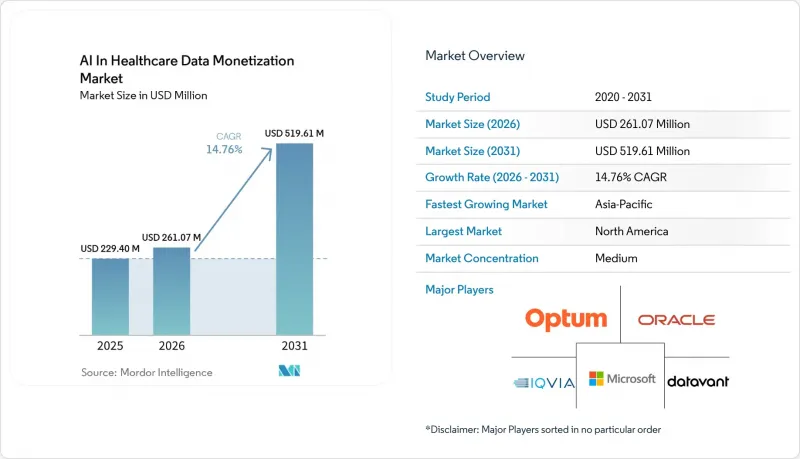
Mordor Intelligence에 의하면, 의료 데이터 수익화 분야 AI 시장 AI 시장 규모는 2025년 2억 2,940만 달러로 평가되었고, 2026년에는 2억 6,107만 달러로 추정되고, 2026-2031년 CAGR 14.76%로 성장을 지속할 전망이며, 2031년에는 5억 1,961만 달러에 이를 것으로 예측됩니다.
본 보고서는 수익화 모델별(직접 데이터 수익화, 간접 데이터 수익화), 솔루션 유형별(Data-As-A-Service(DaaS), 기타), 데이터 유형별(임상 데이터, 기타), 배포 방식별(클라우드, 기타), 최종 사용자별(제약 및 바이오기술 기업, 기타), 지역(북미, 유럽, 아시아태평양, 기타)로 분류되어 있습니다. 예상치는 금액(달러)으로 표시되어 있습니다.
세계의 의료 데이터 수익화 분야 AI 시장 동향 및 인사이트
AI를 활용한 임상 및 업무상의 가치 도출
의료 데이터 수익화 분야 AI 시장에서는 AI를 활용한 가치 추출을 통해 상용화가 가능한 자산의 범위가 확대되고 있습니다. 이는 방대한 양의 비정형 진료 기록을 대규모로 활용할 수 있게 되었기 때문입니다. 진료 기록은 여전히 전자건강기록(EHR) 컨텐츠의 대부분을 차지하고 있지만, 기존의 분석 파이프라인으로는 이를 구매자가 라이선싱, 근거 자료 생성 또는 보상 분석에 활용할 수 있는 표준화된 결과물로 확실하게 변환할 수 없었습니다. Tempus AI는 2026년 6월, 자사의 멀티모달 기반 모델 관련 작업이 4,500만 건 이상의 익명화된 환자 여정과 500페타바이트 이상의 데이터에 이르고 있다고 보고했습니다. 이는 이러한 새로운 데이터 수집 풀이 이미 얼마나 대규모로 성장했는지를 보여줍니다. AI를 통해 서술형 기록과 구조화된 필드 간의 비용 격차가 줄어들면, 병리 소견, 영상 진단 보고서, 치료 계획 및 경과 요약은 모두 의료 제공업체나 플랫폼이 관리하는 상업적 자산으로 활용될 수 있게 됩니다. IQVIA는 2026년 3월, NVIDIA와 공동으로 'IQVIA.ai'를 출범시키고, 임상, 상업 및 실제 업무 흐름에 150개 이상의 지능형 에이전트를 도입함으로써 이러한 방향성을 한층 더 강화했습니다. 이미 상위 20개 제약사 중 19곳이 업무에 IQVIA의 에이전트를 활용하고 있습니다. 이와 유사한 데이터 추출 로직은 병원 운영 분야로도 확대되고 있으며, AI가 코딩 오류, 사전 승인 과정의 마찰, 수익 누락 패턴을 파악하여 이를 수익화 가능한 인사이트 제품이나 내장형 분석 서비스로 패키지화하고 있습니다.
지불자 및 제약사의 업무 흐름에서 리얼 월드 에비던스에 대한 수요
의료 데이터 수익화 분야 AI 시장에서 리얼 월드 에비던스에 대한 수요가 증가함에 따라, 데이터의 상업적 역할은 수동적인 아카이브에서 보험사, 제약사 및 제품 출시 계획 워크플로우의 능동적인 구성 요소로 변화하고 있습니다. 구매 측은 서로 다른 공급업체 간에 방식을 재구축할 필요 없이, 보험 적용 범위 협의, 처방약 목록 재검토, 규제 당국에 대한 신청 및 출시 후 추적을 지원할 수 있는 연계된 데이터 세트를 점점 더 요구하고 있습니다. 이러한 추세에 따라, 재사용 가능성이 제한적인 개별 파일을 판매하는 것이 아니라, 단일 관리 환경 내에서 관리·임상·결과 기록을 연계할 수 있는 데이터 공급업체가 우대받고 있습니다. 이 모델이 보급됨에 따라, 의료 데이터 수익화 분야 AI 시장의 수익은 원시 데이터 제공에 그치지 않고, 연구 설계, 증거 통합, 의사결정 지원으로 점차 전환되고 있습니다. 실질적인 영향으로, 데이터 소유자가 높은 링크 품질과 재현 가능한 워크플로를 갖추고 있다면 더 높은 가치를 제시할 수 있게 됩니다. 이는 구매자가 기록에 대한 접근 권한에 대해 비용을 지불하는 것과 마찬가지로, 종단 간 증거 활용 준비 태세에 대해서도 대가를 지불하고 있기 때문입니다.
익명화된 의료 데이터 세트의 재식별 위험
의료 데이터 수익화 분야 AI 시장은 익명화된 기록이 기존의 상업화 모델이 전제로 삼았던 단순한 법적 안정감을 더 이상 제공하지 못하게 됨에 따라 직접적인 구조적 제약에 직면해 있습니다. 『Scientific Reports』지에 게재된 2025년 연구에 따르면, 현재의 익명화 기법으로는 고도의 정보 제거 도구를 사용하더라도 원본 정보의 74%를 추론할 수 있으며, 차등 프라이버시를 적용한 합성 데이터조차도 완전한 프라이버시 설정이 적용되기 전 단계에서 48%의 재식별률이 확인되었습니다. 이러한 증거로 인해 데이터 소유자, 심사위원회 및 구매자는 익명화를 단순한 전처리 단계가 아닌 지속적인 위험 관리 활동으로 다루지 않을 수 없게 되었습니다. 상업적인 측면에서 보면, 이로 인해 각 데이터 세트의 심사 비용이 증가하고, 직접 라이선스를 부여하는 제품의 이익률이 압박을 받게 되며, 구매자의 워크플로우에 신속하게 통합될 것으로 기대되었던 신규 자산의 출시 일정이 지연될 것입니다. 신뢰성, 감사 가능성 및 타당성을 갖춘 위험 평가가 더욱 개선될 때까지는 이 문제가 의료 데이터 수익화 분야 AI 시장에서 AI가 직접 접근형 및 고세분화 제품 제공을 어느 정도 속도로 확대할 수 있는지를 계속해서 제한할 것입니다.
부문별 분석
2025년 기준으로, 직접 데이터 수익화는 의료 데이터 수익화 분야 AI 시장의 56.76%를 차지했으며, 2031년까지 연평균 성장률(CAGR) 16.11%를 나타낼 것으로 예측됩니다. 이에 따라, 현재의 전체 수익원 중에서 이 모델이 주류 상업 모델이 될 것으로 전망됩니다. 이 부문이 큰 규모를 유지하고 있는 이유는 의료 시스템 및 전문 벤더들이 제약 기업이나 보험사 등의 구매자에게 이미 친숙한 구독, 라이선싱 또는 접근 제어 방식의 구조를 통해 선별된 데이터 세트를 판매할 수 있기 때문입니다. 이러한 구매자들은 데이터의 출처, 재현성 및 관리 이력에 대한 문서화가 규제 당국이나 보험사의 심사를 통과해야 하는 경우, 여전히 직접 계약 방식을 선호합니다. 따라서 광범위한 플랫폼의 유연성이나 소폭의 소프트웨어 비용 절감보다, 소스 관리가 중요한 증거 생성 및 공식 조사 워크플로우에서 직접 채널은 특히 뛰어난 견고성을 발휘합니다.
간접적인 데이터 수익화는 현재 수익 규모로 볼 때 여전히 미미한 수준이지만, 구매자가 단순한 데이터 전송이 아닌 성과, 인사이트 제공 및 거버넌스가 적용된 접근 권한에 대해 대가를 지불하게 됨에 따라, 의료 데이터 수익화 분야 AI 시장에서 AI가 점차 어떤 방향으로 전환되고 있는지를 보여주고 있습니다. 이 모델에서는 데이터가 임베디드형 AI 서비스, 상환 지원, 에비던스 워크플로우 또는 기존의 데이터 세트 판매를 필요로 하지 않는 성과 연동형 상업 계약을 추진함으로써 가치가 창출됩니다. 가치 기반 의료, 성과 조사, 클린룸 워크플로우가 확대됨에 따라, 의료 데이터 수익화 분야 AI 업계에서는 간접 모델이 현재 시장 점유율이 시사하는 것보다 더 빠른 속도로 그 중요성이 커질 것으로 보입니다.
2025년, 데이터 수익화 플랫폼은 매출의 44.33%를 차지했으며, 의료 데이터 수익화 분야 AI 시장 전체에서 가장 높은 솔루션 점유율을 기록했습니다. 이러한 우위는 보다 광범위한 의료 기술 스택 전반에서 오픈 API 표준이 성숙하기 훨씬 전부터, 교환 채널, 구매자와의 관계, 워크플로우 통합 분야에서 선구자로서 주도권을 장악해 왔기 때문입니다. 또한, 이 부문은 구매자들이 접근 제어, 계약 관리, 데이터 탐색, 분석 업무 인계를 일원화하여 처리할 수 있는 단일 조정 계층을 선호하는 경향에서 혜택을 보고 있습니다. 이러한 운영상의 편의성과 내재된 신뢰성이 결합되어, 이 플랫폼은 해당 시장의 수많은 상업 거래에서 여전히 기본 프론트엔드로서의 입지를 유지하고 있습니다.
데이터-어즈-어-서비스(DaaS)는 2031년까지 연평균 성장률(CAGR) 16.76%를 나타낼 것으로 예측되며, 의료 데이터 수익화 분야 AI 시장에서 가장 빠르게 성장하고 있는 솔루션 유형입니다. 수요가 이러한 방향으로 이동하고 있는 이유는 디지털 헬스 분야의 구매자들이 처음부터 광범위한 플랫폼을 보유하는 데 전념하기보다는 API 우선 접근 방식, 모듈식 조달, 그리고 사용량에 따른 가격 책정을 원하기 때문입니다. 애널리틱스-어-서비스(AaaS)와 인사이트-어-서비스(IaaS)는 전체 플랫폼과 원시 데이터에 대한 접근 사이에서 위치하며, 구매자가 데이터 분석, 워크플로우 속도, 의사결정에 직접적으로 연결되는 결과물에 대해 대가를 지불하려는 경향이 강해짐에 따라, 두 개념의 중요성은 더욱 높아지고 있습니다. 이는 의료 데이터 수익화 분야 AI 업계의 수익 중심이 소프트웨어 환경의 소유에서 거버넌스가 적용된 데이터에 대한 신뢰성 높은 접근 및 보다 소규모 단위로 제공되는 분석 인텔리전스로 점차 이동하고 있음을 의미합니다.
지역별 분석
북미는 2025년에 의료 데이터 수익화 분야 AI 시장 점유율의 50.56%를 차지했으며, 전 세계 수익 측면에서 여전히 가장 큰 기여를 한 지역이 되었습니다. 이 지역의 경쟁력은 탄탄한 의료 IT 인프라, 성숙한 보험사 및 의료 제공업체 간의 교환 네트워크, 그리고 이미 대형 제약사의 구매자 기반과 연계되어 있는 상용 실세계 데이터 생태계에 의해 뒷받침되고 있습니다. '21세기 치료법(21st Century Cures Act)' 및 FHIR에 기반한 새로운 접근 규칙으로 인해 데이터 집약의 한계 비용은 지속적으로 감소하고 있으며, 이에 따라 의료 데이터 수익화 분야 AI 시장의 수익 기반이 확대되는 한편, 인프라 계층에서의 경쟁도 격화되고 있습니다.
아시아태평양은 2031년까지 연평균 성장률(CAGR) 17.21%로 확대될 것으로 예상되며, 의료 데이터 수익화 분야 AI 시장에서 지역별로는 가장 빠른 성장세를 보이고 있습니다. 중국, 인도, 일본이 대규모 등록 데이터베이스, 식별자, 전자 기록을 2차 활용에 적합한 자산으로 전환하는 정부 주도의 디지털 헬스 프로그램을 추진하고 있어, 해당 지역은 급속히 발전하고 있습니다. 인도의 '아유슈만 바라트 디지털 미션'은 대규모 연합형 건강 ID 기반을 구축하고 있는 반면, 한국의 전국 보험 청구 데이터베이스나 호주의 '나의 건강 기록' 시스템은 지역 내의 연계 가능한 데이터 풀에 깊이를 더하고 있습니다. 또한, 일본은 파트너십 모델을 통해 국제적인 플랫폼 진출의 거점으로 부상하고 있으며, 이를 통해 해외 AI 데이터 기업들은 인프라의 모든 부분을 직접 구축하지 않고도 현지 구매자들에게 접근할 수 있게 되었습니다.
유럽에서는 2025년 3월에 EHDS 규정(EU) 2025/327이 시행되어, 조화로운 2차 이용 인프라에 8억 1,000만 유로(8억 4,900만 달러)가 투입됨에 따라, 의료 데이터 수익화 분야 AI 시장에서 거버넌스 주도형 확장이 추진되고 있습니다. 독일은 이러한 노력의 규모를 여실히 보여주고 있으며, 2026년 2월 기준으로 82개 기관이 국립 건강 데이터 연구소에 등록되어 있고, 2026년 말까지 법정 보험 가입자 7,500만 명의 가명 처리된 데이터를 활용한 300건 이상의 조사 프로젝트를 가동하는 것을 목표로 하고 있습니다. 중동 및 아프리카 및 남미는 여전히 초기 단계의 기여자에 그치고 있으며, GCC(걸프협력회의)의 국가 정보 플랫폼에 대한 투자나 브라질의 LGPD(개인정보보호법)는 단기적인 세계 리더십이라기보다는 향후 수익 확대를 위한 거버넌스 기반을 마련하는 것입니다.
기타 혜택 :
- 엑셀 형식 시장 예측(ME) 시트
- 3개월간의 애널리스트 지원
자주 묻는 질문
목차
제1장 서론
제2장 조사 방법
제3장 주요 요약
제4장 시장 구도
제5장 시장 규모 및 성장 예측
제6장 경쟁 구도
제7장 시장 기회 및 향후 전망
AJY 26.07.07According to Mordor Intelligence, the AI in healthcare data monetization market is expected to grow from USD 229.40 million in 2025 to USD 261.07 million in 2026 and is forecasted to reach USD 519.61 million by 2031 at 14.76% CAGR over 2026-2031.
This report is Segmented by Monetization Model (Direct Data Monetization, Indirect Data Monetization), Solution Type (Data-As-A-Service (DaaS), and Others), Data Type (Clinical Data, and Others), Deployment Mode (Cloud, and Others), End-User (Pharmaceutical and Biotechnology Companies, and Others), and Geography (North America, Europe, Asia-Pacific, and Others). Forecasts are in Value (USD).
Global AI In Healthcare Data Monetization Market Trends and Insights
AI-Driven Clinical and Operational Value Extraction
In the AI in healthcare data monetization market, AI-driven value extraction is widening the set of assets that can be commercialized because it finally makes large volumes of unstructured notes usable at scale. Clinical notes still represent the majority of EHR content, yet older analytics pipelines could not reliably convert them into standardized outputs that buyers could use for licensing, evidence generation, or reimbursement analysis. Tempus AI reported in June 2026 that its multimodal foundation model work spans more than 45 million de-identified patient journeys and more than 500 petabytes of data, which shows how large these new curation pools have already become. Once AI reduces the cost gap between narrative records and structured fields, pathology notes, imaging reports, care plans, and longitudinal summaries can all enter the commercial inventory that providers and platforms manage. IQVIA reinforced this direction in March 2026 when it launched IQVIA.ai with NVIDIA, deploying more than 150 intelligent agents across clinical, commercial, and real-world workflows, with 19 of the top 20 pharmaceutical companies already using IQVIA agents in their work.The same extraction logic is also spreading into hospital operations, where AI can surface coding errors, prior authorization friction, and revenue leakage patterns that are then packaged as monetizable insight products or embedded analytics services.
Real-World Evidence Demand from Payer and Pharma Workflows
In the AI in healthcare data monetization market, demand for real-world evidence is changing the commercial role of data from a passive archive into an active component of payer, pharma, and launch planning workflows. Buyers increasingly want linked datasets that can support coverage discussions, formulary reviews, regulatory submissions, and post-launch tracking without rebuilding methods across separate vendors. That preference favors data suppliers that can connect administrative, clinical, and outcomes records inside one governed environment rather than selling isolated files with limited reuse. As this model spreads, revenue in the AI in healthcare data monetization market moves closer to study design, evidence orchestration, and decision support instead of stopping at raw dataset delivery. The practical effect is that data owners with strong linkage quality and reproducible workflows can command higher value, because buyers are paying for end-to-end evidence readiness as much as they are paying for access to records.
Re-Identification Risk in De-Identified Health Datasets
The AI in healthcare data monetization market faces a direct structural restraint because de-identified records no longer provide the simple legal comfort that earlier commercialization models assumed. A 2025 study in Scientific Reports found that current sanitization methods still left 74% of original information inferable with advanced removal tools, and even differentially private synthetic data showed 48% re-identification rates before full privacy settings were applied. That kind of evidence forces data owners, review boards, and buyers to treat de-identification as a continuing risk-management exercise instead of a completed preprocessing step. Commercially, this raises the review cost of each dataset, narrows the margin on direct licensing products, and slows the release schedule for new assets that were expected to move quickly into buyer workflows. Until trust, auditability, and defensible risk scoring improve further, this issue will continue to limit how quickly the AI in healthcare data monetization market can expand direct-access and high-granularity product offerings.
Other drivers and restraints analyzed in the detailed report include:
- Privacy-Preserving Data Collaboration Networks
- Expansion of Federated Learning and Secure Data Clean Rooms
- Fragmented Consent Management Across Data Contributors
For complete list of drivers and restraints, kindly check the Table Of Contents.
Segment Analysis
Direct data monetization held 56.76% of the AI in healthcare data monetization market share in 2025, and is expected to grow at a 16.11% CAGR through 2031, making it the dominant commercial model across current revenue streams. The segment stays large because health systems and specialty vendors can sell curated datasets through subscription, licensing, or controlled-access structures that are already familiar to pharma and payer buyers. Those buyers still prefer direct arrangements in cases where data provenance, reproducibility, and chain-of-custody documentation need to stand up to regulatory or payer review. This makes direct channels especially resilient in evidence generation and formal research workflows, where source control matters more than broad platform flexibility or marginal software savings.
Indirect data monetization remains smaller in current revenue terms, but it reveals where the AI in healthcare data monetization market is gradually moving as buyers pay for outcomes, insight delivery, and governed access rather than simple data transfer. In this model, value is created when data powers embedded AI services, reimbursement support, evidence workflows, or performance-linked commercial arrangements that do not require a traditional dataset sale. As value-based care, outcomes research, and clean-room workflows expand, the AI in healthcare data monetization industry is likely to see indirect models gain importance faster than their current share suggests.
Data monetization platforms held 44.33% of revenue in 2025, giving them the largest solution footprint across the AI in healthcare data monetization market. Their lead came from first-mover control of exchange rails, buyer relationships, and workflow integration long before open API standards began to mature across the wider healthcare technology stack. The segment also benefits from the fact that buyers often want a single coordination layer for access control, contract management, data discovery, and analytical handoff. That combination of operational convenience and embedded trust has allowed platforms to remain the default front end for many commercial transactions in this market.
Data-as-a-service (DaaS) is projected to grow at 16.76% CAGR through 2031, which makes it the fastest-expanding solution type in the AI in healthcare data monetization market. Demand is shifting in this direction because digital health buyers want API-first access, modular procurement, and consumption-based pricing instead of committing to broad platform ownership from the start. analytics-as-a-Service (AaaS) and insight-as-a-Service (IaaS) sit between full platforms and raw data access, and both are gaining relevance as buyers increasingly pay for interpretation, workflow speed, and decision-ready outputs. This means the revenue center of the AI in healthcare data monetization industry is gradually shifting from ownership of software environments toward reliable access to governed data and analytical intelligence delivered in smaller units.
Complete Report Scope:
- By Monetization Model
- Direct Data Monetization
- Indirect Data Monetization
- By Solution Type
- Data-as-a-Service (DaaS)
- Analytics-as-a-Service (AaaS)
- Insight-as-a-Service (IaaS)
- Data Monetization Platforms
- By Data Type
- Clinical Data
- Claims and Financial Data
- Pharmaceutical and R&D Data
- Patient-Generated Data
- Operational and Administrative Data
- By Deployment Mode
- Cloud-Based
- On-Premise
- Hybrid
- By End-User
- Pharmaceutical and Biotechnology Companies
- Healthcare Providers
- Healthcare Payers
- Medical Technology Companies
- Research Organizations and CROs
- By Geography
- North America
- United States
- Canada
- Mexico
- Europe
- Germany
- United Kingdom
- France
- Italy
- Spain
- Rest of Europe
- Asia-Pacific
- China
- Japan
- India
- Australia
- South Korea
- Rest of Asia-Pacific
- Middle East and Africa
- GCC
- South Africa
- Rest of Middle East and Africa
- South America
- Brazil
- Argentina
- Rest of South America
- North America
Geography Analysis
North America captured 50.56% of the AI in healthcare data monetization market share in 2025 and remained the largest regional contributor to global revenue. The region's lead rests on deep health IT infrastructure, mature payer-provider exchange networks, and a commercial real-world data ecosystem that is already connected to large pharmaceutical buyer bases. The 21st Century Cures Act and newer FHIR-based access rules continue to lower the marginal cost of aggregation, which intensifies competition at the infrastructure layer even as it broadens the revenue pool for the AI in healthcare data monetization market.
Asia-Pacific is projected to expand at 17.21% CAGR through 2031, which gives the AI in healthcare data monetization market its fastest regional growth profile. The region is moving quickly because China, India, and Japan are pushing government-backed digital health programs that convert large-scale registries, identifiers, and electronic records into assets suitable for secondary use. India's Ayushman Bharat Digital Mission is building a large federated health ID base, while South Korea's national claims databases and Australia's My Health Record system add depth to the regional pool of linkable data. Japan is also emerging as an entry point for international platforms through partnership models, which helps foreign AI data firms reach local buyers without building every part of the infrastructure themselves.
Europe is undergoing a governance-led buildout in the AI in healthcare data monetization market after EHDS Regulation (EU) 2025/327 came into force in March 2025 with EUR 810 million, or USD 849 million, committed to harmonized secondary-use infrastructure. Germany shows the scale of that effort, with 82 institutions registered with the National Health Data Lab in February 2026 and a target of more than 300 active research projects by the end of 2026 using pseudonymized data from 75 million statutorily insured people. Middle East and Africa and South America remain earlier-stage contributors, with GCC investment in national information platforms and Brazil's LGPD laying the governance foundation for future revenue expansion rather than near-term global leadership.
- Accenture
- Aetion, Inc.
- Clarify Health Solutions, Inc.
- Datavant, Inc.
- Evidation Health, Inc.
- Flatiron Health, Inc.
- H1, Inc.
- HealthVerity, Inc.
- Innovaccer
- Inovalon Holdings, Inc.
- IQVIA
- Komodo Health, Inc.
- Medable, Inc.
- Microsoft
- Optum
- Oracle
- Salesforce, Inc.
- SAP
- SAS Institute
- Snowflake Inc.
- Tempus AI, Inc.
- Verana Health, Inc.
Additional Benefits:
- The market estimate (ME) sheet in Excel format
- 3 months of analyst support
TABLE OF CONTENTS
1 Introduction
- 1.1 Study Assumptions and Market Definition
- 1.2 Scope of the Study
2 Research Methodology
3 Executive Summary
4 Market Landscape
- 4.1 Market Overview
- 4.2 Market Drivers
- 4.2.1 AI-Driven Clinical and Operational Value Extraction
- 4.2.2 Real-World Evidence Demand from Payer and Pharma Workflows
- 4.2.3 Privacy-Preserving Data Collaboration Networks
- 4.2.4 Expansion of Federated Learning and Secure Data Clean Rooms
- 4.2.5 Monetization of Longitudinal and Cross-Platform Patient Journeys
- 4.2.6 Reimbursement Pressure Driving Data-Backed Efficiency Gains
- 4.3 Market Restraints
- 4.3.1 Re-Identification Risk in De-Identified Health Datasets
- 4.3.2 Fragmented Consent Management Across Data Contributors
- 4.3.3 Interoperability Gaps Between Legacy EHR and Analytics Stacks
- 4.3.4 High Governance Cost for Continuous Model Validation and Auditability
- 4.4 Supply/Value Chain Analysis
- 4.5 Regulatory Landscape
- 4.6 Technological Outlook
- 4.7 Porter's Five Forces Analysis
- 4.7.1 Threat of New Entrants
- 4.7.2 Bargaining Power of Suppliers
- 4.7.3 Bargaining Power of Buyers
- 4.7.4 Threat of Substitutes
- 4.7.5 Competitive Rivalry
5 Market Size & Growth Forecasts (Value, USD)
- 5.1 By Monetization Model
- 5.1.1 Direct Data Monetization
- 5.1.2 Indirect Data Monetization
- 5.2 By Solution Type
- 5.2.1 Data-as-a-Service (DaaS)
- 5.2.2 Analytics-as-a-Service (AaaS)
- 5.2.3 Insight-as-a-Service (IaaS)
- 5.2.4 Data Monetization Platforms
- 5.3 By Data Type
- 5.3.1 Clinical Data
- 5.3.2 Claims and Financial Data
- 5.3.3 Pharmaceutical and R&D Data
- 5.3.4 Patient-Generated Data
- 5.3.5 Operational and Administrative Data
- 5.4 By Deployment Mode
- 5.4.1 Cloud-Based
- 5.4.2 On-Premise
- 5.4.3 Hybrid
- 5.5 By End-User
- 5.5.1 Pharmaceutical and Biotechnology Companies
- 5.5.2 Healthcare Providers
- 5.5.3 Healthcare Payers
- 5.5.4 Medical Technology Companies
- 5.5.5 Research Organizations and CROs
- 5.6 By Geography
- 5.6.1 North America
- 5.6.1.1 United States
- 5.6.1.2 Canada
- 5.6.1.3 Mexico
- 5.6.2 Europe
- 5.6.2.1 Germany
- 5.6.2.2 United Kingdom
- 5.6.2.3 France
- 5.6.2.4 Italy
- 5.6.2.5 Spain
- 5.6.2.6 Rest of Europe
- 5.6.3 Asia-Pacific
- 5.6.3.1 China
- 5.6.3.2 Japan
- 5.6.3.3 India
- 5.6.3.4 Australia
- 5.6.3.5 South Korea
- 5.6.3.6 Rest of Asia-Pacific
- 5.6.4 Middle East and Africa
- 5.6.4.1 GCC
- 5.6.4.2 South Africa
- 5.6.4.3 Rest of Middle East and Africa
- 5.6.5 South America
- 5.6.5.1 Brazil
- 5.6.5.2 Argentina
- 5.6.5.3 Rest of South America
- 5.6.1 North America
6 Competitive Landscape
- 6.1 Market Concentration
- 6.2 Market Share Analysis
- 6.3 Company Profiles (includes Global level Overview, Market level overview, Core Segments, Financials as available, Strategic Information, Market Rank/Share for key companies, Products & Services, Recent Developments)
- 6.3.1 Accenture
- 6.3.2 Aetion, Inc.
- 6.3.3 Clarify Health Solutions, Inc.
- 6.3.4 Datavant, Inc.
- 6.3.5 Evidation Health, Inc.
- 6.3.6 Flatiron Health, Inc.
- 6.3.7 H1, Inc.
- 6.3.8 HealthVerity, Inc.
- 6.3.9 Innovaccer, Inc.
- 6.3.10 Inovalon Holdings, Inc.
- 6.3.11 IQVIA Holdings Inc.
- 6.3.12 Komodo Health, Inc.
- 6.3.13 Medable, Inc.
- 6.3.14 Microsoft Corporation
- 6.3.15 Optum, Inc.
- 6.3.16 Oracle
- 6.3.17 Salesforce, Inc.
- 6.3.18 SAP SE
- 6.3.19 SAS Institute Inc.
- 6.3.20 Snowflake Inc.
- 6.3.21 Tempus AI, Inc.
- 6.3.22 Verana Health, Inc.
7 Market Opportunities & Future Outlook
- 7.1 White-space & Unmet-need Assessment


