
|
시장보고서
상품코드
2072797
병원 커맨드 센터 시장 : 시장 점유율 분석, 업계 동향 및 통계, 성장 예측(2026-2031년)Hospital Command Center - Market Share Analysis, Industry Trends & Statistics, Growth Forecasts (2026 - 2031) |
||||||
 Mordor Intelligence
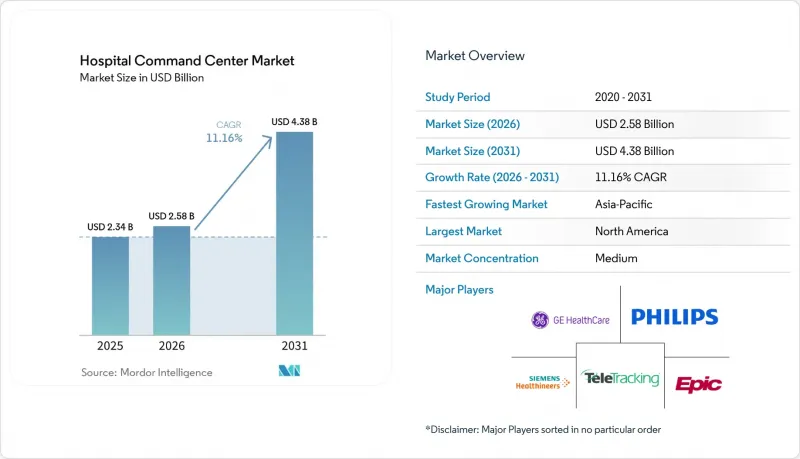
Mordor Intelligence에 의하면, 병원 커맨드 센터 시장은 2025년 23억 4,000만 달러로 평가되었고, 2026년에는 25억 8,000만 달러로 추정되고, 2031년까지 43억 8,000만 달러에 이를 것으로 예상되며, 2026-2031년 CAGR 11.16%로 성장할 전망입니다.
본 보고서는 구성 요소별(소프트웨어, 하드웨어, 서비스), 배포 방식별(클라우드 기반, 하이브리드형, 온프레미스형), 커맨드 센터 유형별(수용 능력 및 병상 관리 센터, 기타), 기능 모듈별(데이터 집계, 기타), 최종 사용자별(대규모 의료 시스템, 기타), 지역별(북미, 유럽, 기타)로 분류되어 있습니다. 시장 전망은 금액(달러) 기준으로 제시되어 있습니다.
세계의 병원 커맨드 센터 시장 동향 및 인사이트
실시간 환자 흐름 조정에 대한 수요 증가
병원 커맨드 센터 시장은 이러한 시스템이 단순한 수동적 대시보드가 아니라 수용 능력을 두 배로 늘리는 역할을 한다는 실증 데이터를 바탕으로 점차 형성되고 있습니다. 하와이의 퀸즈 헬스 시스템즈는 시스템 도입 후 응급실 대기 환자 수가 63.9% 감소했다고 보고했으며, 이는 매달 503명의 환자 감소에 해당합니다. 이를 도입함으로써 평균 입원 일수가 1.07일 단축되었으며, 병상 수를 물리적으로 늘리지 않고도 첫해에 약 2,000만 달러의 비용 절감을 달성했습니다. 이러한 성과는 병원이 환자 흐름 관리를 단순히 각 부서의 인력 배치 문제가 아니라, 병원 전체의 수용 능력과 수익성 문제로 인식하고 있음을 보여줍니다. 병원 지휘센터 시장에서 이로 인해 규제가 엄격한 자본 집약적인 병상 증설보다 기존 인프라를 활용한 처리 능력 향상이 더 매력적인 선택지가 되고 있습니다.
가상 진료와 재택치료 연계 확대
병원 커맨드 센터 시장은 통합된 원격 조정이 필요한 가상 진료 프로그램을 통해 더욱 확대되고 있습니다. 2025년 9월 기준으로, 미국 39개 주의 147개 의료 시스템에 소속된 419개 병원이 '재택 병원(Hospital-at-Home)' 서비스를 제공하기 위해 CMS(미국 의료보험 및 의료서비스 센터)의 승인을 받았습니다. 2025년 12월, 미국 하원은 '병원 입원 서비스 현대화법(Hospital Inpatient Services Modernization Act)'을 가결했습니다. 이를 통해 면제 조치가 2030년까지 연장됨에 따라, 해당 프로그램에 대한 보다 장기적인 계획 수립이 지원될 것입니다. 등록된 환자 한 명 한 명에게 지속적인 모니터링, 치료 조정 및 단계적 대응 지원이 필요하며, 이로 인해 프로그램의 규모는 가상 지휘통제 체계에 대한 수요와 직접적으로 연결되어 있습니다. 해켄색 메리디안 헬스는 2025년에 'Hospital From Home' 프로그램을 두 곳의 병원으로 더 확대했는데, 이는 의료 시스템이 이러한 서비스를 보다 광범위한 운영으로 전환하고 있음을 보여줍니다. 이 케어 모델이 시범 단계에서 장기적인 서비스 라인으로 전환됨에 따라, 병원 커맨드 센터 시장은 입원 환자 흐름에 그치지 않고 원격 임상 조정 분야로 확대되고 있습니다.
기존 병원 IT 시스템과의 고도화된 통합이 수반하는 복잡성
병원 커맨드 센터 시장은 여전히 구식 병원 IT 환경으로 인해 큰 도입 장벽에 직면해 있습니다. 많은 병원에서는 수십 년에 걸쳐 수많은 임상 시스템에 걸쳐 맞춤화된 HL7 v2 인터페이스가 운영되고 있으며, 이로 인해 통합이 지연되고 현장 워크플로우 매핑에 크게 의존하게 됩니다. FHIR 기반 아키텍처로의 전환에는 1-3년이 소요되며, IT 팀, 임상정보학 리더 및 EHR 공급업체 간의 협력이 필요합니다. 의료 시스템의 통합은 더 큰 어려움을 초래합니다. 여러 EHR이 혼재된 환경에서는 플랫폼 통합이 지연되어, 가치를 실현하기까지의 기간이 늦어지는 경향이 있기 때문입니다. 병원 커맨드 센터 시장에서 미리 구축된 커넥터와 보다 표준화된 도입 방식을 갖춘 벤더는 이러한 마찰을 줄이고 도입까지의 과정을 단축하는 데 유리한 입장에 있습니다.
부문별 분석
병원 커맨드 센터 시장에서 2025년에는 소프트웨어가 매출의 49.27%를 차지했으며, 모든 도입 모델에서 핵심 플랫폼 계층으로서의 위치를 유지했습니다. 구매자는 일반적으로 데이터를 연동하고, 의사결정을 지원하며, 시스템 전체의 현황을 하나의 운영 화면에 표시할 수 있는 플랫폼부터 도입을 시작합니다. 비디오 월, 디스플레이 시스템, 워크스테이션, RTLS 장치가 물리적 지휘 센터 환경을 뒷받침하고 있기 때문에 하드웨어는 여전히 중요하지만, 이 부분이 지출의 대부분을 차지하지는 않게 되었습니다.
병원 커맨드 센터 시장에서 서비스 부문은 2031년까지 연평균 성장률(CAGR) 11.52%를 나타낼 것으로 예측되며, 이는 도입 지원, 워크플로우 재설계 및 도입 관리에 대한 수요를 반영한 것입니다. 병원은 대개 시간이 지남에 따라 하나의 모듈에서 추가적인 이용 사례로 확장되기 때문에 1세대 도입 후에는 서비스 계층의 중요성이 커집니다. 이를 통해 최적화, 교육, 변경 지원을 통해 관계가 지속되므로, 일회성 소프트웨어 도입보다 정착도가 높은 수익원이 창출됩니다. 따라서 병원 커맨드 센터 업계는 단순한 도입 주기에서 벗어나, 벤더가 본 가동 후에도 장기간에 걸쳐 지속적으로 관여하는 보다 장기적인 운영 파트너십 모델로 전환되고 있습니다.
병원 커맨드 센터 시장에서 2025년에는 클라우드 기반 솔루션 도입이 매출의 50.13%를 차지했습니다. 이는 의료 시스템이 벤더 관리를 통해 확장성, 신속한 도입 및 인프라 부담 경감을 중시했기 때문입니다. 이 모델은 지속적인 공급업체 지원을 선호하며, 분석 및 오케스트레이션을 위한 유연한 기반이 필요한 의료 시스템에 가장 적합합니다. 또한, 초기 단계에서 대규모 인프라 투자의 필요성을 줄일 수 있기 때문에 커맨드 센터 프로그램이 제한된 운영 범위에서 시작되는 경우에는 특히 중요합니다.
병원 지휘센터 시장에서 데이터 거버넌스의 중요성이 커짐에 따라, 하이브리드형 도입은 2031년까지 연평균 성장률(CAGR) 12.19%로 성장할 것으로 전망됩니다. 연구 의무를 지고 임상시험을 적극적으로 실시하고 있는 대학 병원에서는 광범위한 협력을 위해 클라우드 분석을 활용하는 한편, 기밀성이 높은 데이터 세트를 로컬 인프라에 보관해야 하는 경우가 많습니다. 이러한 요건으로 인해 정부 기관이나 군 병원 등 보안 수준이 높은 환경에서 온프레미스 노드의 역할이 유지되고 있습니다. 온프레미스 운영용 데이터 스토어 위에 클라우드 네이티브 분석 기능을 배치하는 명확한 도입 패턴이 대두되고 있으며, 이를 통해 병원 커맨드 센터 시장에서 AI 기능과 기밀 데이터의 엄격한 관리를 동시에 실현할 수 있게 되었습니다.
지역별 분석
2025년, 북미는 병원 커맨드 센터 시장 점유율의 42.41%를 차지했습니다. 이는 해당 지역이 심각한 수용 능력 부족을 겪고 있을 뿐만 아니라, 효율성을 평가하고 피할 수 있는 지연을 제재하는 보상 모델을 동시에 갖추고 있기 때문입니다. 도입 실적이 대부분 미국에 집중되어 있으며, 주요 의료 제공 네트워크에서는 환자 처리 능력 및 치료 조정 프로그램 분야에서 이미 수년에 걸쳐 커맨드 센터를 활용해 온 실적이 확인됩니다. 캐나다에서는 보다 일원화된 운영 관리를 지원하기 위한 주 차원의 통합이 추진되고 있는 반면, 멕시코는 도입 초기 단계에 있으며 민간 병원 그룹의 활동이 활발해지고 있습니다. 북미에서 또 다른 수요 촉진요인으로 작용하고 있는 것은 상호운용성에 관한 정책으로, 이를 통해 API 준비 상황이 꾸준히 개선되고 있으며, 향후 플랫폼 간 연동에 따른 장벽이 낮아지고 있습니다.
병원 지휘센터 시장에서 유럽은 여전히 2위 지역 클러스터로, 독일, 영국, 프랑스가 주도하고 있습니다. 국민건강보험 서비스의 구조는 특히 공적 시스템이 기존 자산을 보다 효율적으로 활용해야 하는 경우, 병원 네트워크 전반에 걸친 중앙 집중식 조정의 자연스러운 근거가 됩니다. 독일과 프랑스는 인프라 현대화를 지원하고, 지휘 센터 프로젝트의 자금 조달 근거를 강화하는 디지털 헬스 현대화 노력의 혜택을 누리고 있습니다. 이탈리아, 스페인 및 기타 유럽 국가들은 도입 단계에서 아직 초기 단계에 머물러 있지만, 중동 및 아프리카의 경우, 걸프 연안 국가들의 스마트 병원 프로젝트와 사하라 이남 아프리카 대부분 지역에서 진행되고 있는 훨씬 초기 단계의 도입 사이에서 상황의 뚜렷한 차이가 나타납니다.
병원 커맨드 센터 시장에서 아시아태평양은 2031년까지 연평균 성장률(CAGR) 13.62%를 기록하며 성장할 것으로 전망되며, 여전히 가장 빠르게 성장하는 지역으로 남아 있습니다. 이러한 성장은 정부 주도의 디지털 헬스 프로그램, 스마트 병원에 대한 투자, 그리고 주요 경제권에서 AI를 활용한 병원 운영이 널리 받아들여진 데 힘입은 것입니다. 일본에서도 2025년 GE 헬스케어 재팬이 발표한 국립병원기구에 대한 첫 도입 사례를 비롯해, 실제 운영 현장에서의 커맨드 센터 도입 사례가 점차 늘어나고 있습니다. 브라질을 필두로 한 남미는 여전히 성장의 초기 단계에 있으며, 민간 병원 그룹과 보험사들이 북미의 경험을 바탕으로 한 모델을 도입하기 시작하고 있습니다.
기타 혜택 :
- 엑셀 형식 시장 예측(ME) 시트
- 3개월간의 애널리스트 지원
자주 묻는 질문
목차
제1장 서론
제2장 조사 방법
제3장 주요 요약
제4장 시장 구도
제5장 시장 규모 및 성장 예측
제6장 경쟁 구도
제7장 시장 기회 및 향후 전망
AJY 26.07.07According to Mordor Intelligence, the hospital command center market is expected to increase from USD 2.34 billion in 2025 to USD 2.58 billion in 2026 and reach USD 4.38 billion by 2031, growing at a CAGR of 11.16% over 2026-2031.
This report is Segmented by Component (Software, Hardware, Services), Deployment Mode (Cloud-Based, Hybrid, On-Premises), Command Center Type (Capacity and Bed Management Centers, and Others), Functional Module (Data Aggregation, and Others), End-User (Large Health Systems, and Others), and Geography (North America, Europe, and Others). The Market Forecasts are Provided in Terms of Value (USD).
Global Hospital Command Center Market Trends and Insights
Rising Need for Real-Time Patient Flow Orchestration
The hospital command center market is being shaped by evidence that these systems act as capacity multipliers rather than passive dashboards. The Queen's Health Systems in Hawaii reported a 63.9% reduction in emergency department boarding, equal to 503 fewer patients each month after deployment. The same deployment reduced average length of stay by 1.07 days and generated an estimated USD 20 million in first-year savings without adding physical bed capacity. Results like these show why hospitals are treating flow management as a systemwide capacity and margin issue rather than a unit-level staffing problem. In the hospital command center market, that makes throughput improvement from existing infrastructure a more attractive path than regulated and capital-heavy bed expansion.
Expansion of Virtual Care and Hospital-at-Home Coordination
The hospital command center market is also expanding through virtual care programs that require centralized remote coordination. As of September 2025, 419 hospitals across 147 health systems in 39 U.S. states had CMS approval to provide Hospital-at-Home services. In December 2025, the U.S. House of Representatives passed the Hospital Inpatient Services Modernization Act, which would extend the waiver through 2030 and support more permanent planning around these programs. Each enrolled patient needs continuous monitoring, care coordination, and escalation support, which ties program scale directly to demand for a virtual command layer. Hackensack Meridian Health expanded its Hospital From Home program to two more hospitals in 2025, which shows how health systems are moving these services into broader operational use. As this care model shifts from pilot status to a longer-term service line, the hospital command center market is extending beyond inpatient flow into remote clinical coordination.
High Integration Complexity with Legacy Hospital IT
The hospital command center market still faces a major deployment barrier from legacy hospital IT environments. Many hospitals run decades of customized HL7 v2 interfaces across large numbers of clinical systems, which makes integration slow and highly dependent on local workflow mapping. Migration toward FHIR-based architectures can take 1-3 years and requires coordination across IT teams, clinical informatics leaders, and EHR vendors. Health system consolidation adds another layer of difficulty because multi-EHR environments often delay platform harmonization and push out the timing of realized value. In the hospital command center market, vendors with pre-built connectors and more standardized deployment methods are better placed to reduce this friction and shorten the path to adoption.
Other drivers and restraints analyzed in the detailed report include:
- Operational Pressure from ED Boarding and Capacity Constraints
- Adoption of AI-Enabled Predictive Hospital Operations
- Cybersecurity and Data Privacy Exposure
For complete list of drivers and restraints, kindly check the Table Of Contents.
Segment Analysis
In the hospital command center market, software held 49.27% of revenue in 2025 and remained the core platform layer across deployment models. Buyers usually start with a platform that can connect data, support decisions, and present systemwide flow conditions in one operating view. Hardware still matters because video walls, display systems, workstations, and RTLS devices support physical command center environments, but that layer no longer drives the bulk of spending.
In the hospital command center market, services are projected to grow at an 11.52% CAGR through 2031, which reflects the need for implementation support, workflow redesign, and adoption management. The services layer becomes more important after first-generation rollouts because hospitals often expand from one module into additional operational use cases over time. That creates a stickier revenue stream than a one-time software deployment because the relationship continues through optimization, training, and change support. The hospital command center industry is therefore moving from an installation cycle toward a longer operating partnership model in which vendors remain involved well beyond go-live.
In the hospital command center market, cloud-based deployment held 50.13% of revenue in 2025 because health systems favored vendor-managed scalability, faster rollouts, and lower infrastructure burden. This model fits well with health systems that prefer ongoing vendor support and need a flexible base for analytics and orchestration. It also lowers the need for large up-front infrastructure commitments, which is important when command center programs start with a focused operational scope.
In the hospital command center market, hybrid deployment is projected to grow at a 12.19% CAGR through 2031 as data governance needs become more important. Academic medical centers with research obligations and active clinical trial activity often need to keep sensitive datasets on local infrastructure while still using cloud analytics for broader coordination. That requirement is sustaining the role of on-premises nodes in high-security environments such as government and military hospitals. A clear deployment pattern is emerging in which cloud-native analytics sits above on-premises operational stores, allowing the hospital command center market to combine AI capability with tighter control of sensitive data.
Complete Report Scope:
- By Component
- Software
- Hardware
- Services
- By Deployment Mode
- Cloud-Based
- Hybrid
- On-Premises
- By Command Center Type
- Capacity and Bed Management Centers
- Operations and Resource Orchestration Centers
- Centralized Clinical Command Centers
- Incident Response and Emergency Operations Centers
- Security and Facilities Operations Centers
- By Functional Module
- Data Aggregation and Interoperability
- Real-Time Operational Intelligence and Dashboards
- Predictive Forecasting and Machine Learning
- Alerting, Escalation, and Workflow Automation
- Simulation and Digital Twin
- Performance and KPI Reporting and Business Intelligence
- RTLS and IoT Integration
- By End-User
- Large Health Systems and Multi-Hospital Networks
- Tertiary and Academic Medical Centers
- Community and Regional Hospitals
- Ambulatory Surgery Centers and Integrated Clinics
- Third-Party Virtual Command Center Operators
- By Geography
- North America
- United States
- Canada
- Mexico
- Europe
- Germany
- United Kingdom
- France
- Italy
- Spain
- Rest of Europe
- Asia-Pacific
- China
- Japan
- India
- Australia
- South Korea
- Rest of Asia-Pacific
- Middle East and Africa
- GCC
- South Africa
- Rest of Middle East and Africa
- South America
- Brazil
- Argentina
- Rest of South America
- North America
Geography Analysis
North America held 42.41% of hospital command center market share in 2025 because the region combines severe capacity pressure with reimbursement models that reward efficiency and penalize avoidable delays. The United States represented the large majority of installed activity, and major delivery networks have already shown multi-year command center use across throughput and care coordination programs. Canada is moving through provincial consolidation efforts that support more centralized operational management, while Mexico remains earlier in adoption and is seeing more activity from private hospital groups. A separate North American demand tailwind comes from interoperability policy, which is steadily improving API readiness and reducing friction for future platform connections.
In the hospital command center market, Europe remained the second-largest regional cluster, led by Germany, the United Kingdom, and France. National health service structures create a natural case for centralized coordination across hospital networks, especially when public systems need to use existing assets more efficiently. Germany and France are benefiting from digital health modernization efforts that support infrastructure upgrades and improve the funding case for command center projects. Italy, Spain, and the rest of Europe are still earlier in the rollout curve, while the Middle East and Africa show a split picture between Gulf smart hospital projects and much earlier-stage adoption across much of Sub-Saharan Africa.
In the hospital command center market, Asia-Pacific is projected to grow at a 13.62% CAGR through 2031 and remains the fastest-growing region. Growth is being supported by government-backed digital health programs, smart hospital investment, and broader acceptance of AI-enabled hospital operations across major economies. Japan is also building real-world command center references, including the first National Hospital Organization deployment announced by GE HealthCare Japan in 2025. South America, led by Brazil, remains in an early growth phase where private hospital groups and insurers are beginning to adopt models shaped by North American experience.
- AdvancedMD
- Assort Health
- Clearwave Corporation
- eClinicalWorks
- Epic Systems
- Hyro
- Kyruus
- LeanTaaS
- Luma Health
- NexHealth
- Notable
- Phreesia, Inc.
- Qualifacts
- Qventus
- Relatient
- ScienceSoft USA
- symplr
- UnityAI, Inc.
- Veradigm
- Voiceoc
- Zocdoc
Additional Benefits:
- The market estimate (ME) sheet in Excel format
- 3 months of analyst support
TABLE OF CONTENTS
1 Introduction
- 1.1 Study Assumptions and Market Definition
- 1.2 Scope of the Study
2 Research Methodology
3 Executive Summary
4 Market Landscape
- 4.1 Market Overview
- 4.2 Market Drivers
- 4.2.1 Rising Need for Real-Time Patient Flow Orchestration
- 4.2.2 Expansion of Virtual Care and Hospital-at-Home Coordination
- 4.2.3 Operational Pressure from ED Boarding and Capacity Constraints
- 4.2.4 Adoption of AI-Enabled Predictive Hospital Operations
- 4.2.5 Interoperability Demand Across Multi-Hospital Networks
- 4.2.6 Need for Resilient Emergency Preparedness and Surge Management
- 4.3 Market Restraints
- 4.3.1 High Integration Complexity with Legacy Hospital IT
- 4.3.2 Cybersecurity and Data Privacy Exposure
- 4.3.3 Change Management and Clinical Workflow Resistance
- 4.3.4 Capital Intensity for Display, Network, and Analytics Infrastructure
- 4.4 Supply/Value Chain Analysis
- 4.5 Regulatory Landscape
- 4.6 Technological Outlook
- 4.7 Porter's Five Forces Analysis
- 4.7.1 Threat of New Entrants
- 4.7.2 Bargaining Power of Suppliers
- 4.7.3 Bargaining Power of Buyers
- 4.7.4 Threat of Substitutes
- 4.7.5 Competitive Rivalry
5 Market Size & Growth Forecasts (Value, USD)
- 5.1 By Component
- 5.1.1 Software
- 5.1.2 Hardware
- 5.1.3 Services
- 5.2 By Deployment Mode
- 5.2.1 Cloud-Based
- 5.2.2 Hybrid
- 5.2.3 On-Premises
- 5.3 By Command Center Type
- 5.3.1 Capacity and Bed Management Centers
- 5.3.2 Operations and Resource Orchestration Centers
- 5.3.3 Centralized Clinical Command Centers
- 5.3.4 Incident Response and Emergency Operations Centers
- 5.3.5 Security and Facilities Operations Centers
- 5.4 By Functional Module
- 5.4.1 Data Aggregation and Interoperability
- 5.4.2 Real-Time Operational Intelligence and Dashboards
- 5.4.3 Predictive Forecasting and Machine Learning
- 5.4.4 Alerting, Escalation, and Workflow Automation
- 5.4.5 Simulation and Digital Twin
- 5.4.6 Performance and KPI Reporting and Business Intelligence
- 5.4.7 RTLS and IoT Integration
- 5.5 By End-User
- 5.5.1 Large Health Systems and Multi-Hospital Networks
- 5.5.2 Tertiary and Academic Medical Centers
- 5.5.3 Community and Regional Hospitals
- 5.5.4 Ambulatory Surgery Centers and Integrated Clinics
- 5.5.5 Third-Party Virtual Command Center Operators
- 5.6 By Geography
- 5.6.1 North America
- 5.6.1.1 United States
- 5.6.1.2 Canada
- 5.6.1.3 Mexico
- 5.6.2 Europe
- 5.6.2.1 Germany
- 5.6.2.2 United Kingdom
- 5.6.2.3 France
- 5.6.2.4 Italy
- 5.6.2.5 Spain
- 5.6.2.6 Rest of Europe
- 5.6.3 Asia-Pacific
- 5.6.3.1 China
- 5.6.3.2 Japan
- 5.6.3.3 India
- 5.6.3.4 Australia
- 5.6.3.5 South Korea
- 5.6.3.6 Rest of Asia-Pacific
- 5.6.4 Middle East and Africa
- 5.6.4.1 GCC
- 5.6.4.2 South Africa
- 5.6.4.3 Rest of Middle East and Africa
- 5.6.5 South America
- 5.6.5.1 Brazil
- 5.6.5.2 Argentina
- 5.6.5.3 Rest of South America
- 5.6.1 North America
6 Competitive Landscape
- 6.1 Market Concentration
- 6.2 Market Share Analysis
- 6.3 Company Profiles (includes Global level Overview, Market level overview, Core Segments, Financials as available, Strategic Information, Market Rank/Share for key companies, Products & Services, Recent Developments)
- 6.3.1 AdvancedMD
- 6.3.2 Assort Health
- 6.3.3 Clearwave Corporation
- 6.3.4 eClinicalWorks
- 6.3.5 Epic Systems Corporation
- 6.3.6 Hyro
- 6.3.7 Kyruus
- 6.3.8 LeanTaaS
- 6.3.9 Luma Health
- 6.3.10 NexHealth
- 6.3.11 Notable
- 6.3.12 Phreesia, Inc.
- 6.3.13 Qualifacts
- 6.3.14 Qventus
- 6.3.15 Relatient
- 6.3.16 ScienceSoft USA Corporation
- 6.3.17 symplr
- 6.3.18 UnityAI, Inc.
- 6.3.19 Veradigm LLC
- 6.3.20 Voiceoc
- 6.3.21 Zocdoc
7 Market Opportunities & Future Outlook
- 7.1 White-space & Unmet-need Assessment