

|
시장보고서
상품코드
2072813
심낭천자 시술 시장 : 시장 점유율 분석, 업계 동향 및 통계, 성장 예측(2026-2031년)Pericardiocentesis Procedures - Market Share Analysis, Industry Trends & Statistics, Growth Forecasts (2026 - 2031) |
||||||
 Mordor Intelligence
Mordor Intelligence에 의하면, 심낭천자 시술 시장 규모는 2025년에 10억 9,000만 달러로 평가되었고, 2026년 11억 4,000만 달러로 추정되고, 2031년까지 15억 달러에 이를 것으로 예측되며, 예측 기간(2026-2031년) CAGR은 5.63%를 나타낼 전망입니다.
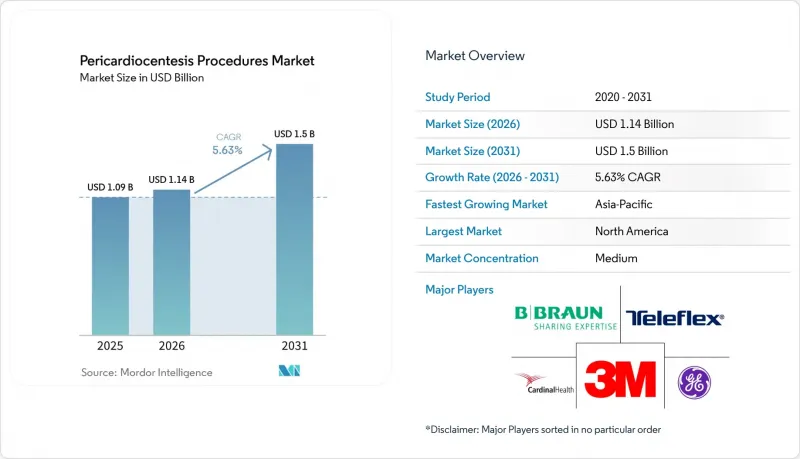
본 보고서는 시술 유형별(응급, 예정), 유도 방법별(심초음파 유도, 투시 유도, CT 유도), 적응증별(심장 탐포네이드, 심낭액 축적, 심막염), 최종 용도별(병원, 외래수술센터(ASC), 전문 클리닉), 지역별(북미, 유럽, 아시아태평양, 중동 및 아프리카, 남미)로 분류되어 있습니다. 시장 전망은 금액(달러) 기준으로 제시되어 있습니다.
세계의 심낭천자 시술 시장 동향 및 인사이트
심낭액 축적 및 심막압박증의 부담 증가
심낭천자 시술 시장은 신부전, 자가면역 질환, 전신성 경피증, 악성 종양 및 임상적으로 유의미한 심막액 축적을 유발할 가능성이 있는 기타 질환을 앓고 있는 고령 환자의 생존 기간이 연장됨에 따라, 더 많은 환자 수를 흡수하고 있습니다. 2024년 일본의 한 순환기 병원에서 실시된 후향적 연구에 따르면, 심초음파 검사를 받은 환자의 0.4%에서 심낭액 저류가 확인되었으며, 악성 종양 및 특발성 원인이 각각 배액이 필요한 사례의 3분의 1 가까이를 차지했습니다. 이 연구에서는 추적 기간 동안의 전사인 사망률 및 심혈관 사건 발생률 증가도 보고되었으며, 이는 고위험 환자에 대한 면밀한 모니터링과 적시의 배액의 중요성을 뒷받침하고 있습니다. 폐고혈압에서도 치료가 미흡한 경우가 있습니다. 이 질환의 경우, 사망률 개선 효과가 입증되었음에도 불구하고, 폐고혈압이 없는 환자에 비해 심낭천자를 받는 빈도가 낮아, 심낭천자 시술 시장에서 시술이 지연되거나 간과되는 사례가 상당수 존재합니다. 중동에서 4년간 진행된 후향적 연구에서도 결핵, 악성 종양, 그리고 시술 후 합병증이 모두 지역적 수요에 기여하고 있는 것으로 나타났으며, 이는 시술 건수 증가가 단일한 질환 패턴에 기인한 것이 아니라 다양한 임상 경로를 통해 주도되고 있음을 의미합니다.
악성 흉수에 기인한 종양학 관련 시술 수요
심낭천자 시술 시장은 종양학과 순환기학의 경계가 점점 모호해지는 가운데 재편되고 있으며, 악성 흉수 및 면역 관련 합병증이 지속적인 시술 수요를 창출하고 있습니다. 2024년 『Cardio-Oncology』지에 게재된 체계적 문헌고찰에 따르면, 면역관문억제제와 관련된 심막 질환을 앓고 있는 환자의 68%가 심막천자를 필요로 했으며, 41%가 심막압박증을 발병한 것으로 밝혀졌습니다. 이 중 니볼루맙과 펨브롤리주맙이 가장 빈번하게 관련되어 있었으며, 기저 악성 종양으로는 폐암이 가장 많았습니다. 2025년에 FAERS 데이터베이스를 대상으로 실시된 불균형성 분석에 따르면, 2012년 이후 약물 유발성 심막액 저류 보고가 지속적으로 증가하고 있으며, 전체 보고 건수 중 면역관문억제제와 관련된 신호의 비율이 확대되고 있는 것으로 나타났습니다. 재발이야말로 이 요인이 극히 중요한 주된 이유입니다. 2025년 총설에 따르면, 면역관문억제제 치료를 중단하고 첫 번째 심낭 천자를 받은 환자의 50% 가까이가 이후 재발성 심낭액 축적을 일으켰으며, 한 번의 발작이 여러 차례의 시술이 필요한 치료 과정으로 이어졌습니다고 지적되고 있습니다. 2025년 튀르키예에서 실시된 후향적 연구는 이러한 경향을 더욱 뒷받침해 주었습니다. 이 연구에서는 배액이 필요한 심낭액 저류의 가장 흔한 원인으로 악성 종양이 34.6%를 차지하는 것으로 밝혀졌을 뿐만 아니라, 악성 종양, 심탬포네이드, 그리고 저혈청 알부민이 예후 불량과 관련이 있는 것으로 나타났으며, 이러한 요인들은 현재 종양·심장 전문센터의 트리아지에 영향을 미치고 있습니다.
시술에 따른 합병증 위험 및 시술자의 경험 부족으로 인한 결과의 편차
심낭천자 시술 시장은 여전히 시술자의 경험이라는 명확한 제약에 직면해 있습니다. 왜냐하면 안전성과 자신감은 진료 사례 수 및 연수의 질과 밀접한 관련이 있기 때문입니다. 2025년 IRCCS 산 제랄도의 연구에 따르면, 과거 검상돌기 하부 천자 시술의 약 4분의 1이 맹천자 방식으로 수행된 것으로 나타났으며, 가이드 하 시술이 더 우수한 결과를 보인다는 점을 고려하여 일상적인 맹천자 시술의 중단을 권고했습니다. 2026년 다차원 CUSUM 분석에 따르면, 초보 시술자는 약 14건의 증례를 거친 후에야 비로소 시술 숙련도에 도달했으며, 첫 14건의 증례에 소요된 시간은 중앙값 기준 12.7분인 반면, 그 임계값을 넘긴 후에는 7.9분이었습니다. 이러한 학습 곡선으로 인해, 환자 수가 적은 병원에서는 초기 위험이 집중하게 되며, 이는 심낭천자 시술 시장 전체에서 복잡한 흉수 관리가 계속해서 대규모 의뢰 의료기관으로 집중되고 있는 이유 중 하나를 설명해 줍니다. 시뮬레이션을 활용한 위험 완화 대책은 발전하고 있지만, 반복적으로 이루어지는 실제 시술 경험을 완전히 대체할 수는 없으며, 어디까지나 보조적인 조치에 그치고 있습니다.
부문별 분석
2025년에는 응급 심낭 천자가 시술 건수의 55.32%를 차지했으며, 심낭천자 시술 시장에서 응급 배액 경로가 가장 큰 점유율을 유지했습니다. 이러한 상황은 배액이 지연될 경우 심심막압박증이 급속히 쇼크나 부정맥으로 악화될 가능성이 있다는 임상적 현실을 반영하고 있습니다. 6만 6,812건의 침습적 심장 시술을 대상으로 한 13년간의 단일 기관 등록 연구에 따르면, 심탬포네이드의 전체 발생률은 0.176%로 보고되었으며, 좌심방귀개 폐쇄술의 경우 그 발생률이 1.42%에 달할 전망입니다. 이는 예상치 못한 배수 수요가 안정적인 수준에서 존재하고 있음을 뒷받침합니다. 중등도의 악성 및 염증성 심낭액 축적에 대해 진단, 증상 완화 및 심막압박증의 진행 방지를 목적으로 임상의들이 조기에 개입하게 됨에 따라, 선택적 심낭천자는 2031년까지 연평균 성장률(CAGR) 7.14%를 나타낼 것으로 예측됩니다.
심낭천자 시술 분야에서 시술 시기와 마찬가지로 가이드 선택도 점점 더 중요해지고 있습니다. 이는 영상 진단 기술의 발전으로 인해 누가, 어디서 시술을 수행할 수 있는지에 대한 기준이 바뀌었기 때문입니다. 이탈리아의 199건 사례로 구성된 코호트 연구에 따르면, 초음파 유도법 또는 초음파 보조법이 전체 시술의 77.4%를 차지하고 있으며, 심초음파 검사가 대부분의 일상적인 사례에서 실용적인 표준으로 자리 잡고 있음이 확인되었습니다. 이 유도법은 휴대성, 실시간 시각화, 그리고 방사선 피폭이 없습니다는 장점을 갖추고 있어, 중환자 치료나 병상 환경에서 뚜렷한 이점을 제공합니다. 카테터 검사실이나 심초음파에서 가시성이 낮은 전벽성 또는 구획화된 삼출액의 경우, 여전히 투시 유도 하의 배액이 중요하며, 2025년 튀르키예에서 실시된 후향적 연구에 따르면, 주로 악성 및 특발성 원인에 의한 127건의 검상돌기 하부 천자가 투시 유도 하에 시행되었다고 보고되었습니다. CT 유도 하 천자는 수술 후나 해부학적으로 어려운 흉수 사례에서 여전히 틈새 분야로 남아 있습니다. 즉, 심낭천자 시술 시장에서는 단일한 범용적 접근 방식이 아닌, 다층적인 유도 기법의 조합이 계속해서 선호되고 있다는 것입니다.
지역별 분석
2025년 북미는 심낭천자 시술 시장 규모의 37.23%를 차지했습니다. 이는 심장 전문 의료시설의 탄탄한 인프라, 첨단 심초음파 검사의 활용, 그리고 확립된 보험 급여 체계에 힘입은 결과입니다. 미국은 여전히 이 지역의 핵심적인 존재이며, CMS(미국 의료보험서비스센터)는 2025년을 목표로 외래 진료 보수를 2.9% 인상하는 한편, 병원 외래 및 ASC(외래수술센터(ASC))에서의 시술 경로를 모두 지속적으로 지원하고 있습니다. 이러한 지불 구조는 의료 제공업체들이 대규모 프로그램에서 여전히 비용 절감 압박에 직면해 있음에도 불구하고, 여러 의료 현장에 걸쳐 시술을 지속적으로 제공하는 데 도움이 되고 있습니다. 또한, 이 지역은 면역관문억제제를 이용한 치료 건수가 많고, 심장 종양학과의 연계가 잘 갖춰져 있다는 점도 강점으로 작용하고 있으며, 이로 인해 악성 및 면역 관련 흉수 환자들의 의뢰 흐름이 더욱 안정적으로 유지되고 있습니다.
유럽은 심낭천자 시술 시장에서 여전히 2위를 차지하는 지역 블록이며, 독일은 더욱 견고한 코딩 체계와 체계화된 시술 프로토콜로 두각을 나타내고 있습니다. 이 체계는 보다 적절한 기록 작성, 벤치마킹 및 품질 보고를 지원하며, 이를 통해 대규모 의료 센터는 응급 및 계획적 배액 모두를 보다 일관성 있게 관리할 수 있게 되었습니다. 프랑스는 종양학 분야에서 보다 제한적인 입장을 취하고 있으며, 국가 지침에 따라 폐암 환자의 심낭 천자는 심막압박증을 보이는 사례로만 제한되어 있어, 선택적 시술의 확대가 억제되고 있습니다. 영국, 이탈리아, 스페인 및 기타 유럽 시장에서는 심장 센터의 수용 능력이 향상되고, 진료 지침이 더 많은 2차 의료 기관에 보급됨에 따라 다중 모달 영상 진단의 도입이 꾸준히 확대되고 있습니다.
아시아태평양은 2031년까지 연평균 성장률(CAGR) 6.03%를 기록하며 성장할 것으로 예상되며, 심낭천자 시술 시장에서 가장 빠르게 성장하는 지역이 될 전망입니다. 일본에서는 이미 뚜렷한 임상적 빈도가 관찰되고 있으며, 2024년 병원 조사 결과, 심초음파 검사를 받은 환자의 0.4%에서 심낭액 저류가 확인되어, 진료 후에도 지속적인 경과 관찰이 필요한 위험성이 드러났습니다. 또한 일본에서는 2025년, 심낭압박증의 관리 및 심낭 배액 프로토콜에 관한 전문적인 보도를 통해 학계에서의 관심이 높아지고 있습니다. 인도에서는 주요 도시를 제외한 지역에서는 영상 진단에 대한 접근성이나 전문의 체계가 여전히 고르지 않아, 질병 부담에 비해 시장 침투율은 낮은 수준을 유지하고 있습니다. 중동 및 아프리카은 다소 완만한 속도로 확산되고 있지만, 해당 지역을 대상으로 한 4년간의 소급 조사 결과, 병인의 다양성이 뚜렷한 것으로 나타났으며, 이에 따라 유연한 처치 프로토콜과 상황에 맞는 키트 선정이 필요하다는 점이 부각되고 있습니다. 남미에서는 암 치료의 보급과 병원 투자가 확대됨에 따라 응급 배액술 및 악성 흉수와 관련된 선택적 수술에 대한 수요가 모두 증가하고 있으며, 소규모 기반에서 시장이 확대되고 있습니다.
기타 혜택 :
- 엑셀 형식 시장 예측(ME) 시트
- 3개월간의 애널리스트 지원
자주 묻는 질문
목차
제1장 서론
제2장 조사 방법
제3장 주요 요약
제4장 시장 구도
제5장 시장 규모 및 성장 예측
제6장 경쟁 구도
제7장 시장 기회 및 향후 전망
AJY 26.07.07According to Mordor Intelligence, the pericardiocentesis procedures market size was valued at USD 1.09 billion in 2025 and is estimated to grow from USD 1.14 billion in 2026 to reach USD 1.5 billion by 2031, at a CAGR of 5.63% during the forecast period (2026-2031).
This report is Segmented by Procedure Type (Emergency, Elective), Guidance Method (Echocardiography-Guided, Fluoroscopy-Guided, CT-Guided), Application (Cardiac Tamponade, Pericardial Effusion, Pericarditis), End Use (Hospitals, Ascs, Specialty Clinics), and Geography (North America, Europe, Asia-Pacific, Middle East & Africa, South America). Market Forecasts are Provided in Terms of Value (USD).
Global Pericardiocentesis Procedures Market Trends and Insights
Rising Pericardial Effusion and Cardiac Tamponade Burden
The pericardiocentesis procedures market is absorbing more case volume as older patients live longer with renal failure, autoimmune disease, systemic sclerosis, malignancy, and other conditions that can lead to clinically significant pericardial effusion. A 2024 retrospective study at a Japanese cardiovascular hospital found pericardial effusion in 0.4% of patients undergoing echocardiography, and malignancy plus idiopathic causes each represented close to one-third of drainage-requiring cases. The same study reported elevated all-cause mortality and cardiovascular event rates during follow-up, which supports closer monitoring and timely drainage in higher-risk patients. Under-treatment is also visible in pulmonary hypertension, where patients underwent pericardiocentesis less often than patients without pulmonary hypertension, despite a mortality benefit, leaving a meaningful pool of delayed or unrealized procedures inside the pericardiocentesis procedures market. A 4-year Middle Eastern retrospective also showed that tuberculosis, malignancy, and post-interventional causes all contribute to regional demand, which means procedure growth is being driven through different clinical pathways rather than a single disease pattern.
Oncology-Linked Procedural Demand From Malignant Effusions
The pericardiocentesis procedures market is being reshaped by the growing overlap between oncology and cardiology, where malignant effusions and immune-related complications are creating recurring procedural demand. A 2024 systematic review in Cardio-Oncology found that 68% of patients with immune checkpoint inhibitor associated pericardial disease required pericardiocentesis and 41% experienced cardiac tamponade, with nivolumab and pembrolizumab most often involved and lung cancer the leading underlying malignancy. A 2025 disproportionality analysis of the FAERS database showed a sustained rise in reports of drug-induced pericardial effusion from 2012 onward, with immune checkpoint inhibitor signals taking a growing share of total reports. Recurrence is a major reason this driver matters so much because a 2025 review noted that close to 50% of patients who discontinued immune checkpoint inhibitor therapy and underwent initial pericardiocentesis later developed recurrent effusion, turning one episode into a multi-procedure care path. A 2025 Turkish retrospective further reinforced this pattern by identifying malignancy as the most common cause of drainage-requiring effusions at 34.6%, while also linking malignant etiology, tamponade, and low serum albumin to worse outcomes that now influence triage at oncology-cardiac centers.
Procedural Complication Risk and Low-Volume Operator Variability
The pericardiocentesis procedures market still faces a clear limit from operator experience, because safety and confidence remain closely tied to case volume and training quality. The 2025 IRCCS San Gerardo study showed that nearly one-quarter of historical subxiphoid procedures were performed blindly and recommended discontinuing routine blind access because guided techniques performed better. A 2026 multidimensional CUSUM analysis found that a novice operator reached procedural competency only after close to 14 cases, with the first 14 cases taking a median 12.7 minutes compared with 7.9 minutes after that threshold. That learning curve concentrates early risk in low-volume hospitals and helps explain why complex effusion management keeps consolidating into larger referral centers across the pericardiocentesis procedures market. Simulation-based mitigation is advancing, but it remains a support measure rather than a full replacement for repeated live procedural exposure.
Other drivers and restraints analyzed in the detailed report include:
- Broader Use of Echocardiography-Guided Bedside Drainage
- Day-Case and Short-Stay Workflow Shift in Cardiac Centers
- Reimbursement Friction Across Emergency and Inpatient Settings
For complete list of drivers and restraints, kindly check the Table Of Contents.
Segment Analysis
Emergency pericardiocentesis represented 55.32% of procedure volume in 2025, which kept the largest share of the pericardiocentesis procedures market inside urgent drainage pathways. That position reflects the clinical reality that tamponade can deteriorate quickly into shock and arrhythmia when drainage is delayed. A 13-year single-center registry covering 66,812 invasive cardiac procedures reported an overall tamponade incidence of 0.176%, with rates reaching 1.42% in left atrial appendage closure, which supports a steady baseline of unplanned drainage demand. Elective pericardiocentesis is projected to grow at a 7.14% CAGR through 2031 as clinicians intervene earlier in moderate malignant and inflammatory effusions for diagnosis, symptom relief, and prevention of tamponade progression.
Guidance choice is becoming just as important as timing inside the Pericardiocentesis procedures industry, because imaging has changed who can perform the procedure and where it can be performed. Echo-guided or echo-assisted methods accounted for 77.4% of procedures in the 199-case Italian cohort, which confirms that echocardiography has become the practical standard for most routine cases. This guidance model supports portability, real-time visualization, and freedom from radiation exposure, which gives it a clear advantage in critical care and bedside settings. Fluoroscopy-guided drainage still matters in catheterization laboratories and in anterior or loculated effusions where echocardiographic windows are weak, and a 2025 Turkish retrospective documented fluoroscopy-guided subxiphoid procedures across 127 cases with mostly malignant and idiopathic etiologies. CT-guided access remains a smaller niche for post-surgical or anatomically difficult effusions, which means the pericardiocentesis procedures market continues to support a layered guidance mix rather than a single universal approach.
Complete Report Scope:
- By Procedure Type
- Emergency Pericardiocentesis
- Elective Pericardiocentesis
- By Guidance Method
- Echocardiography-Guided Pericardiocentesis
- Fluoroscopy-Guided Pericardiocentesis
- CT-Guided Pericardiocentesis
- By Application
- Cardiac Tamponade
- Pericardial Effusion
- Pericarditis
- By End Use
- Hospitals
- Ambulatory Surgical Centers
- Specialty Clinics
- By Geography
- North America
- United States
- Canada
- Mexico
- Europe
- Germany
- United Kingdom
- France
- Italy
- Spain
- Rest of Europe
- Asia-Pacific
- China
- Japan
- India
- Australia
- South Korea
- Rest of Asia-Pacific
- Middle East & Africa
- GCC
- South Africa
- Rest of Middle East & Africa
- South America
- Brazil
- Argentina
- Rest of South America
- North America
Geography Analysis
North America held 37.23% of the pericardiocentesis procedures market size in 2025, supported by dense cardiac center infrastructure, advanced echocardiography use, and established reimbursement channels. The United States remains the regional anchor, where CMS implemented a 2.9% outpatient payment update for 2025 and continued to support both hospital outpatient and ASC procedural pathways. Those payment structures help sustain procedure availability across multiple care settings, even though providers still face pressure to control costs in higher-volume programs. The region also benefits from high immune checkpoint inhibitor treatment volumes and better cardio-oncology coordination, which creates a more recurring referral flow for malignant and immune-related effusions.
Europe remains the second-largest regional block in the pericardiocentesis procedures market, with Germany standing out for a stronger coding structure and more formalized procedural pathways. That framework supports better documentation, benchmarking, and quality reporting, which helps larger centers manage both emergency and planned drainage more consistently. France takes a more restrictive stance in oncology, where national guidance limits pericardiocentesis in lung cancer to tamponade-presenting cases and therefore contains elective expansion. The United Kingdom, Italy, Spain, and other European markets are steadily widening multi-modal imaging adoption as cardiac center capacity improves and guidance tools reach more secondary hospitals.
Asia-Pacific is forecast to grow at a 6.03% CAGR through 2031, making it the fastest-growing region in the pericardiocentesis procedures market. Japan already shows measurable clinical density, with a 2024 hospital study finding pericardial effusion in 0.4% of echocardiography patients and continued follow-up risk after presentation. Japan also showed rising academic attention in 2025 through dedicated coverage of tamponade management and pericardial drainage protocols. India remains underpenetrated relative to disease burden because imaging access and specialist capacity are still uneven outside major centers. The Middle East and Africa are expanding more gradually, but a 4-year retrospective from the region showed meaningful etiologic diversity, which underlines the need for flexible procedural protocols and adaptable kit selection. South America is growing from a smaller base as cancer treatment adoption and hospital investment raise demand for both emergency drainage and malignant-effusion related elective procedures.
- Abbott Laboratories
- AngioDynamics
- B. Braun
- Beckton Dickinson
- Boston Scientific
- Cardinal Health
- Cook Group
- Edward Lifesciences
- FUJIFILM
- GE HealthCare Technologies Inc.
- Getinge
- Johnson & Johnson
- Koninklijke Philips
- Medtronic
- Merit Medical Systems
- Nipro
- Siemens Healthineers
- Stryker
- Teleflex
- Terumo
Additional Benefits:
- The market estimate (ME) sheet in Excel format
- 3 months of analyst support
TABLE OF CONTENTS
1 Introduction
- 1.1 Study Assumptions & Market Definition
- 1.2 Scope of the Study
2 Research Methodology
3 Executive Summary
4 Market Landscape
- 4.1 Market Overview
- 4.2 Market Drivers
- 4.2.1 Rising Pericardial Effusion and Cardiac Tamponade Burden
- 4.2.2 Broader Use of Echocardiography-Guided Bedside Drainage
- 4.2.3 Oncology-Linked Procedural Demand From Malignant Effusions
- 4.2.4 Day-Case and Short-Stay Workflow Shift in Cardiac Centers
- 4.2.5 Expansion of Point-of-Care Ultrasound in Emergency Pathways
- 4.2.6 Standardization of Pericardiocentesis Kits and Protocols
- 4.3 Market Restraints
- 4.3.1 Procedural Complication Risk and Low-Volume Operator Variability
- 4.3.2 Reimbursement Friction Across Emergency and Inpatient Settings
- 4.3.3 Dependence on Skilled Imaging and Drainage Support Teams
- 4.3.4 Sterile Consumable Supply Volatility and Kit Availability Constraints
- 4.4 Value / Supply-Chain Analysis
- 4.5 Regulatory Landscape
- 4.6 Technological Outlook
- 4.7 Porter's Five Forces Analysis
- 4.7.1 Threat of New Entrants
- 4.7.2 Bargaining Power of Suppliers
- 4.7.3 Bargaining Power of Buyers
- 4.7.4 Threat of Substitutes
- 4.7.5 Industry Rivalry
5 Market Size & Growth Forecasts
- 5.1 By Procedure Type
- 5.1.1 Emergency Pericardiocentesis
- 5.1.2 Elective Pericardiocentesis
- 5.2 By Guidance Method
- 5.2.1 Echocardiography-Guided Pericardiocentesis
- 5.2.2 Fluoroscopy-Guided Pericardiocentesis
- 5.2.3 CT-Guided Pericardiocentesis
- 5.3 By Application
- 5.3.1 Cardiac Tamponade
- 5.3.2 Pericardial Effusion
- 5.3.3 Pericarditis
- 5.4 By End Use
- 5.4.1 Hospitals
- 5.4.2 Ambulatory Surgical Centers
- 5.4.3 Specialty Clinics
- 5.5 By Geography
- 5.5.1 North America
- 5.5.1.1 United States
- 5.5.1.2 Canada
- 5.5.1.3 Mexico
- 5.5.2 Europe
- 5.5.2.1 Germany
- 5.5.2.2 United Kingdom
- 5.5.2.3 France
- 5.5.2.4 Italy
- 5.5.2.5 Spain
- 5.5.2.6 Rest of Europe
- 5.5.3 Asia-Pacific
- 5.5.3.1 China
- 5.5.3.2 Japan
- 5.5.3.3 India
- 5.5.3.4 Australia
- 5.5.3.5 South Korea
- 5.5.3.6 Rest of Asia-Pacific
- 5.5.4 Middle East & Africa
- 5.5.4.1 GCC
- 5.5.4.2 South Africa
- 5.5.4.3 Rest of Middle East & Africa
- 5.5.5 South America
- 5.5.5.1 Brazil
- 5.5.5.2 Argentina
- 5.5.5.3 Rest of South America
- 5.5.1 North America
6 Competitive Landscape
- 6.1 Market Concentration
- 6.2 Market Share Analysis
- 6.3 Company Profiles (includes Global Level Overview, Market-level Overview, Core Segments, Financials, Strategic Information, Market Rank/Share, Products & Services, Recent Developments)
- 6.3.1 Abbott Laboratories
- 6.3.2 AngioDynamics, Inc.
- 6.3.3 B. Braun Melsungen AG
- 6.3.4 Becton, Dickinson and Company
- 6.3.5 Boston Scientific Corporation
- 6.3.6 Cardinal Health, Inc.
- 6.3.7 Cook Medical
- 6.3.8 Edwards Lifesciences Corporation
- 6.3.9 FUJIFILM Holdings Corporation
- 6.3.10 GE HealthCare Technologies Inc.
- 6.3.11 Getinge AB
- 6.3.12 Johnson and Johnson
- 6.3.13 Koninklijke Philips N.V.
- 6.3.14 Medtronic plc
- 6.3.15 Merit Medical Systems, Inc.
- 6.3.16 Nipro Corporation
- 6.3.17 Siemens Healthineers AG
- 6.3.18 Stryker Corporation
- 6.3.19 Teleflex Incorporated
- 6.3.20 Terumo Corporation
7 Market Opportunities & Future Outlook
- 7.1 White-space & Unmet-need Assessment


