|
시장보고서
상품코드
2072857
의료용 인공호흡기 시장 : 시장 점유율 분석, 업계 동향 및 통계, 성장 예측(2026-2031년)Medical Ventilator - Market Share Analysis, Industry Trends & Statistics, Growth Forecasts (2026 - 2031) |
||||||
 Mordor Intelligence
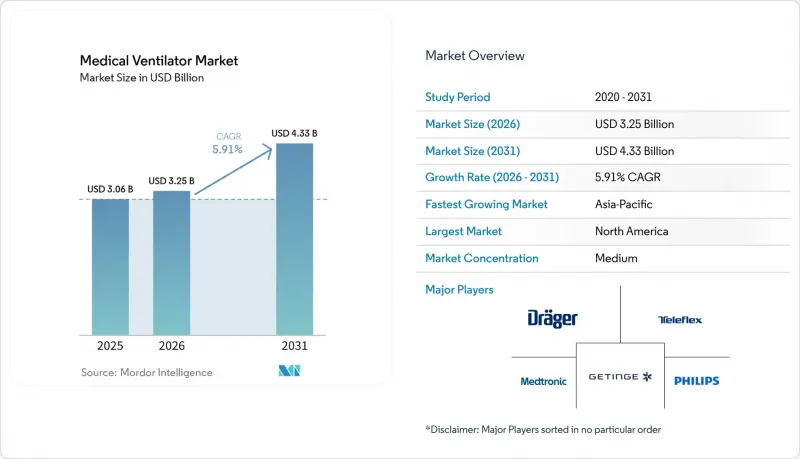
Mordor Intelligence에 의하면, 의료용 인공호흡기 시장 규모는 2025년 30억 6,000만 달러로 평가되었고, 2026년에는 32억 5,000만 달러로 추정되고, 2031년까지 43억 3,000만 달러에 이를 것으로 예상되며, 2026-2031년 CAGR 5.91%로 성장할 전망입니다.
본 보고서는 제품 유형별(중환자용, 신생아용, 이송 및 휴대용, 재택 간호용), 인터페이스별(침습형, 비침습형), 기술별(기존, 지능형 및 폐쇄 루프형, 터빈식), 최종 사용자별(병원, 재택 간호 시설, 외래수술센터(ASC), 응급 및 의료 제공업체), 지역별(북미, 유럽, 아시아태평양, 중동 및 아프리카, 남미)로 분류되어 있습니다. 예측치는 금액(달러)으로 표시되어 있습니다.
세계의 의료용 인공호흡기 시장 동향 및 인사이트
만성 호흡기 질환으로 인한 부담 증가
만성 호흡기 질환, 특히 만성폐쇄성폐질환(COPD) 및 급성 호흡곤란 증후군 사례는 의료용 인공호흡기 시장 수요를 견인하는 주요 요인입니다. 2025년 세계 질병 부담 연구(GBD)에 따르면, 전 세계적으로 5억 6,920만 건의 만성 호흡기 질환이 보고되었으며, 이는 선진국과 개발도상국 모두의 의료 시스템에서 치료가 필요한 환자 수가 막대하다는 사실을 여실히 보여주고 있습니다. WHO는 만성 호흡기 질환이 동남아시아에서 심각한 사망률 문제로 대두되고 있음을 지적하며, 인공호흡기 수요가 단순한 응급 상황뿐만 아니라 일상적인 치료와도 관련이 있음을 밝혔습니다. 또한, WHO와 ERS는 유럽에서 만성 호흡기 질환의 진단이 미흡하며, 관련 사망의 80%를 COPD가 차지하고 있다고 지적했습니다. 이는 현재의 조달 동향에는 아직 반영되지 않은 향후 발생할 대규모 수요의 존재를 시사하고 있습니다. 중소득 국가에서 선별 검사 및 진단 체계가 개선됨에 따라, 특히 아시아태평양의 의료용 인공호흡기 시장에서 잠재적 수요가 적극적인 구매로 전환될 가능성이 있습니다.
인공호흡기가 필요한 고령 인구
COPD나 수술 후 호흡부전과 같은 문제에 자주 직면하는 고령층은 의료용 인공호흡기 시장을 주도하는 중요한 계층입니다. 세계보건기구(WHO)는 2024년 10월, 21세기 중반까지 전 세계 노인의 80%가 개발도상국에 거주할 것으로 예측했습니다. 이러한 추세는 호흡 관리 체계가 잘 갖춰진 지역에서도 관리 부담이 증가하고 있음을 보여줍니다. 호흡근의 약화나 여러 가지 건강 문제를 안고 있는 고령 환자들은 병원에서 인공호흡기를 장기간 사용해야 하는 경우가 종종 있습니다. 이러한 장기 사용은 중환자실(ICU)의 병상 회전율을 저하시킬 가능성이 있어, 의료진은 환자의 상태를 즉시 안정시키고 원활한 회복을 모두 촉진할 수 있는 장비를 찾고 있습니다. 또한, 많은 고령 환자들이 퇴원 후에도 지속적인 호흡 지원이 필요하기 때문에 재택 호흡 지원에 대한 수요가 증가하고 있습니다.
높은 총 소유 비용과 서비스 부담
의료용 인공호흡기 시장은 소유에 드는 비용이 구매 가격에만 그치지 않기 때문에 막대한 비용 문제에 직면해 있습니다. 첨단 중환자 치료 시스템의 가격은 대당 5,000-5만 달러 이상이며, 여기에 교정, 소모품, 유지보수, 소프트웨어 업데이트, 수리 등의 추가 비용이 발생합니다. 빠듯한 예산으로 운영되는 공립병원이나 자원이 제한된 의료 시스템의 경우, 이러한 비용을 관리하기는 어렵습니다. 기술의 급속한 발전으로 인해 구형 기종은 하드웨어 수명 주기가 끝나기도 전에 구식이 되어버리기 때문에 구매자들은 렌탈 모델이나 서비스 계약이 포함된 요금제를 선택하고 있습니다. 이러한 모델은 도입을 촉진하는 한편, 시장에서 하드웨어를 통한 일시적인 수익 창출을 지연시키는 요인이 되고 있습니다.
부문별 분석
2025년, 집중치료용 인공호흡기는 고도의 치료와 복잡한 인공호흡이 필요한 중환자실 입원 환자에게 없어서는 안 될 역할을 수행하고 있어, 의료용 인공호흡기 시장에서 44.58%의 점유율을 차지했습니다. 이러한 인공호흡기는 침습적 인공호흡, 수술 전후 관리 및 장기적인 호흡 지원에 있어 필수적이며, 신뢰성과 다중 모드 기능이 매우 중요합니다. 병원들은 중환자 치료 대비 및 응급 대응에서의 중요성을 이유로 설비 투자 계획에서 이러한 시스템을 우선시하고 있으며, 선별적인 조달 동향이 있음에도 불구하고 견조한 도입 대수를 유지하고 있습니다. 이 분야는 3차 의료 현장에서 여전히 없어서는 안 될 존재입니다.
이송 및 휴대용 인공호흡기는 가장 빠르게 성장하는 부문으로, 2026-2031년 연평균 성장률(CAGR) 6.72%를 나타낼 것으로 전망됩니다. 이러한 성장은 업계가 기동성, 분산형 치료, 그리고 장소에 구애받지 않고 끊김 없이 제공되는 호흡 지원으로 전환되고 있음을 반영합니다. 응급 이송, 군사 작전, 병원 내 이송 시 안정적인 성능을 유지할 수 있고 배터리 효율이 뛰어난 터빈식 시스템에 대한 수요가 증가하고 있습니다. 적응형 시간별 환기 분야의 임상적 발전은 휴대용 기기의 역할을 더욱 강화하고 있으며, 의료용 인공호흡기 시장에서 중요한 부문으로서의 입지를 확고히 하고 있습니다.
2025년, 침습형 인공호흡은 의료용 인공호흡기 시장의 64.88%를 차지했으며, 중환자실 치료, 응급 상황에서의 상태 안정화, 그리고 수술 후 호흡 관리에서 이 기술이 수행하는 매우 중요한 역할을 여실히 보여주고 있습니다. 자발 호흡이나 기도 보호를 유지할 수 없는 환자의 경우, 기관 내 삽관이나 기관 절개에 기반한 지원이 여전히 필수적이며, 침습적 시스템은 병원 구매 및 임상 업무 흐름에서 핵심적인 위치를 차지하고 있습니다. 비침습적 치료법의 도입이 확대되고 있음에도 불구하고, 이 부문은 여전히 시장을 독점하고 있습니다.
비침습형 부문은 인터페이스 부문 중 가장 빠르게 성장하고 있으며, 2026-2031년 연평균 성장률(CAGR) 6.45%를 나타낼 것으로 전망됩니다. 이러한 성장은 급성기 치료, 수술 후 회복, 그리고 만성 폐쇄성 폐질환(COPD)의 장기 관리 분야에서 적용 범위가 확대된 데 기인합니다. 의료 기준의 발전과 임상 현장에서의 사용 편의성을 높여주는 차세대 기능 덕분에 그 보급이 더욱 확대되고 있습니다. 재택의료의 보험 적용 범위 확대와 더불어, 비침습적 지원은 의료용 인공호흡기 시장에서 상당한 성장이 예상됩니다.
지역별 분석
2025년, 북미는 의료용 인공호흡기 시장 점유율의 38.99%를 차지했습니다. 이는 잘 갖춰진 ICU 인프라, 확립된 보험 환급 제도, 그리고 소프트웨어 통합형 인공호흡 플랫폼의 급속한 보급에 힘입은 결과입니다. 미국에서는 2025년 6월 CMS(미국 의료보험서비스센터)의 결정에 따라 급성기 의료의 범위를 넘어 재택 비침습적 지원이 확대됨에 따라, 병원들이 첨단 응급의료 시스템으로의 업그레이드를 추진하고 있어 수요를 견인하고 있습니다. 이로 인해 중증 환자 대상 병원 치료와 퇴원 후 호흡 관리 양쪽 모두에서 균형 잡힌 수요 구조가 형성되고 있습니다. 캐나다와 멕시코 역시 인프라 투자와 장비 교체를 통해 성장에 기여하고 있습니다. 그러나 문서화의 질이나 청구 관리의 철저함 등 행정상의 과제는 여전히 보다 원활한 상환 절차의 걸림돌로 남아 있습니다.
성숙기를 맞이하면서도 계속 진화하고 있는 유럽 시장에서는 2026-2031년 4억 3,000만 달러 이상 시장 규모 확대가 예상됩니다. 독일은 견고한 제조거점과 안정적인 병원용 교체 수요를 바탕으로 시장에서 중심적인 역할을 수행하고 있습니다. 드라거(Drager)는 2025 회계연도에 사상 최대인 30억 유로의 순매출을 기록했으며, 의료 부문의 수주액은 8.9% 증가한 20억 4,660만 유로(약 22억 1,000만 달러)를 기록했습니다. EU의 의료기기 규제가 강화됨에 따라 규정 준수 및 시판 후 감시 비용이 증가하고 있어, 중소 제조업체들이 압박을 받고 있습니다. Fisher & Paykel Healthcare는 지속적인 매출 성장을 보이고 있으며, 2026 회계연도 병원용 제품군의 매출은 전년 대비 18% 증가한 15억 1,000만 NZD(약 9억 600만 달러)를 기록했습니다.
아시아태평양은 의료용 인공호흡기 시장에서 가장 빠르게 성장하고 있는 지역으로, 2026-2031년 연평균 성장률(CAGR) 8.12%를 나타낼 것으로 전망됩니다. 이러한 성장은 정부 주도의 중환자실(ICU) 확충, 고령화, 그리고 중국과 인도 등 국가들의 국내 생산 기반 강화에 힘입어 이루어지고 있습니다. 2025년, 중국의 공립 병원은 1만 7,448대, 총액 26억 5,000만 위안(약 3억 6,500만 달러) 상당의 인공호흡기를 조달했습니다. 해당 시장 점유율에서 Mindray Bio-Medical이 40.74%로 1위를 차지했으며, 그 뒤를 이어 Drager가 15.62%, KOMAN이 12.43%를 기록했습니다. 이 상위 3개 브랜드가 국내 공공 조달 시장의 68.79%를 차지했습니다. 2026년에 수립된 중국의 제15차 5개년 계획은 국내에서 고성능 의료기기 개발을 지원하고 있어, 국내 경쟁이 치열해지고 있습니다. 인도 및 인도네시아 역시 현지 제조 파트너십과 국내 부가가치 향상을 통해 성장을 주도하고 있습니다.
기타 혜택 :
- 엑셀 형식 시장 예측(ME) 시트
- 3개월간의 애널리스트 지원
자주 묻는 질문
목차
제1장 서론
제2장 조사 방법
제3장 주요 요약
제4장 시장 구도
제5장 시장 규모 및 성장 예측
제6장 경쟁 구도
제7장 시장 기회 및 향후 전망
AJY 26.07.07According to Mordor Intelligence, the medical ventilator market size is expected to increase from USD 3.06 billion in 2025 to USD 3.25 billion in 2026 and reach USD 4.33 billion by 2031, growing at a CAGR of 5.91% over 2026-2031.
This report is Segmented by Product Type (Critical Care, Neonatal, Transport and Portable, Home Care), Interface (Invasive, Non-Invasive), Technology (Conventional, Intelligent/Closed-Loop, Turbine-Based), End User (Hospitals, Home Care Settings, Ambulatory Surgical Centers, Emergency Providers), and Geography (North America, Europe, Asia-Pacific, MEA, South America). Forecasts in Value (USD).
Global Medical Ventilator Market Trends and Insights
Rising Burden Of Chronic Respiratory Diseases
Chronic respiratory diseases, particularly COPD and acute respiratory distress cases, are the primary drivers of demand in the medical ventilator market. In 2025, the Global Burden of Disease Study highlighted 569.2 million cases of chronic respiratory diseases globally, underscoring the vast treatment pool in both advanced and developing health systems. The WHO pointed out that chronic respiratory diseases pose a significant mortality challenge in South-East Asia, linking ventilation demand to routine care rather than just emergencies. Furthermore, the WHO and ERS highlighted that Europe underdiagnoses chronic respiratory diseases, with COPD responsible for 80% of related deaths. This suggests a substantial future demand not yet reflected in current procurement trends. As screening and diagnosis improve in middle-income countries, there's a potential shift from a hidden demand to active purchasing in the medical ventilator market, particularly in the Asia-Pacific region.
Aging Population Requiring Assisted Ventilation
Older adults, who frequently face challenges like COPD and post-surgical respiratory failures, are a significant demographic driving the medical ventilator market. The WHO, in October 2024, projected that by mid-century, 80% of the world's elderly population will reside in developing nations. This trend indicates a growing care burden in regions still enhancing their respiratory care capabilities. Given their weaker respiratory muscles and multiple health challenges, older patients often experience prolonged ventilator use in hospitals. This extended usage can slow ICU bed turnover, prompting healthcare providers to seek devices that facilitate both immediate stabilization and a smoother recovery. Moreover, a significant number of elderly patients require continued respiratory support post-discharge, bolstering the demand for home respiratory assistance.
High Total Cost Of Ownership And Service Burden
The medical ventilator market faces significant cost challenges, as ownership involves more than just the purchase price. High-acuity critical care systems cost between USD 5,000 and over USD 50,000 per unit, with additional expenses for calibration, consumables, servicing, software updates, and repairs. Public hospitals and resource-limited systems, operating under tight budgets, find these costs difficult to manage. Rapid technology advancements make older units appear outdated before their hardware lifecycle ends, pushing buyers toward rental models and bundled service contracts. While these models aid adoption, they delay one-time hardware revenue realization in the market.
Other drivers and restraints analyzed in the detailed report include:
- Expansion Of Home-Based Non-Invasive Ventilation
- Replacement Demand For Connected And Smart Ventilators
- Reimbursement Pressure On Long-Term Home Ventilation
For complete list of drivers and restraints, kindly check the Table Of Contents.
Segment Analysis
In 2025, critical care ventilators held a 44.58% share of the medical ventilator market, driven by their essential role in ICU admissions requiring high-acuity and complex ventilation. These ventilators are critical for invasive ventilation, perioperative care, and prolonged respiratory support, where reliability and multi-mode capabilities are vital. Hospitals prioritize these systems in capital planning due to their importance in critical care readiness and emergency response, ensuring a strong installed base despite selective procurement trends. This category remains indispensable in tertiary care settings.
Transport and portable ventilators are the fastest-growing segment, with a projected 6.72% CAGR from 2026 to 2031. This growth reflects the industry's shift toward mobility, distributed care, and uninterrupted respiratory support across locations. Demand is rising for battery-efficient turbine systems capable of maintaining stable performance during emergency transport, military operations, and intrahospital transfers. Clinical advancements in adaptive minute ventilation further enhance the role of portable devices, positioning them as a significant segment in the medical ventilator market.
In 2025, invasive ventilation accounted for 64.88% of the medical ventilator market, underscoring its critical role in ICU care, emergency stabilization, and post-surgical respiratory management. Endotracheal intubation and tracheostomy-based support remain essential for patients unable to maintain ventilation or airway protection, keeping invasive systems central to hospital purchasing and clinical workflows. This segment continues to dominate despite the growing adoption of non-invasive care.
Non-invasive ventilation is the fastest-growing interface segment, with a 6.45% CAGR expected from 2026 to 2031. Its growth stems from expanding applications in acute care, post-surgical recovery, and long-term COPD management. Evolving care standards and next-generation features enhancing clinical usability are driving broader adoption. Combined with expanded home reimbursement policies, non-invasive support is poised for significant growth in the medical ventilator market.
Complete Report Scope:
- By Product Type
- Critical Care Ventilators
- Neonatal Ventilators
- Transport and Portable Ventilators
- Home Care Ventilators
- By Interface
- Invasive Ventilation
- Non-Invasive Ventilation
- By Technology
- Conventional Ventilators
- Intelligent and Closed-Loop Ventilators
- Turbine-Based Ventilators
- By End User
- Hospitals
- Home Care Settings
- Ambulatory Surgical Centers
- Emergency and Prehospital Care Providers
- By Geography
- North America
- United States
- Canada
- Mexico
- Europe
- Germany
- United Kingdom
- France
- Italy
- Spain
- Rest of Europe
- Asia-Pacific
- China
- India
- Japan
- Australia
- South Korea
- Rest of Asia-Pacific
- Middle East and Africa
- GCC
- South Africa
- Rest of Middle East and Africa
- South America
- Brazil
- Argentina
- Rest of South America
- North America
Geography Analysis
In 2025, North America held 38.99% of the medical ventilator market share, driven by a strong ICU infrastructure, established reimbursement systems, and rapid adoption of software-integrated ventilation platforms. The U.S. leads demand as hospitals upgrade to advanced critical care systems, supported by the June 2025 CMS decision expanding home non-invasive support beyond acute settings. This creates a balanced demand mix across high-acuity hospital care and post-discharge respiratory management. Canada and Mexico also contribute to growth through infrastructure investments and fleet upgrades. However, administrative challenges, such as documentation quality and billing discipline, remain barriers to smoother reimbursement processes.
Europe, a mature yet evolving market, is expected to add over USD 430 million in value between 2026 and 2031. Germany anchors the market with a strong manufacturing base and steady hospital replacement demand. Drager reported record net sales of EUR 3 billion in fiscal 2025, with its medical division order intake growing 8.9% to EUR 2,046.6 million (approximately USD 2.21 billion). Stricter EU device regulations are increasing compliance and post-market surveillance costs, pressuring smaller manufacturers. Fisher & Paykel Healthcare demonstrated growth in recurring revenue, with FY2026 hospital product group revenue reaching NZD 1.51 billion (approximately USD 906 million), up 18% year over year.
Asia-Pacific is the fastest-growing region in the medical ventilator market, with an 8.12% CAGR projected from 2026 to 2031. Growth is fueled by government-led ICU expansions, aging populations, and a stronger domestic manufacturing base in countries like China and India. In 2025, China's public hospitals procured 17,448 ventilators worth CNY 2.65 billion (approximately USD 365 million), with Mindray Bio-Medical holding a 40.74% value share, followed by Drager at 15.62% and KOMAN at 12.43%. These top three brands controlled 68.79% of the domestic public procurement market. China's 15th Five-Year Plan in 2026 supports domestic high-end medical equipment development, intensifying local competition. India and Indonesia also drive growth through local manufacturing partnerships and increased in-country value addition.
- Air Liquide S.A.
- Beckton Dickinson
- Dragerwerk AG and Co. KGaA
- Fisher and Paykel Healthcare Corporation Limited
- GE HealthCare Technologies Inc.
- Getinge
- Hamilton Medical
- ICU Medical
- Inspiration Healthcare Group plc
- Koninklijke Philips
- Lowenstein Medical Technology GmbH + Co. KG
- Medtronic
- Nihon Kohden
- Resmed
- Mindray
- Skanray Technologies Private Limited
- Teleflex
- Vyaire Medical
- Zoll Medical
Additional Benefits:
- The market estimate (ME) sheet in Excel format
- 3 months of analyst support
TABLE OF CONTENTS
1 INTRODUCTION
- 1.1 Study Assumptions and Market Definition
- 1.2 Scope of the Study
2 RESEARCH METHODOLOGY
3 EXECUTIVE SUMMARY
4 MARKET LANDSCAPE
- 4.1 Market Overview
- 4.2 Market Drivers
- 4.2.1 Rising Burden of Chronic Respiratory Disease and ICU Admissions
- 4.2.2 Aging Population Requiring Assisted Ventilation
- 4.2.3 Expansion of Home-Based Non-Invasive Ventilation
- 4.2.4 Replacement Demand for Connected and Smart Ventilators
- 4.2.5 Need for Supply Chain Localization in Critical Care Equipment
- 4.2.6 Risk-Adjusted Procurement Favoring Multi-Mode Ventilation Platforms
- 4.3 Market Restraints
- 4.3.1 High Total Cost of Ownership and Service Burden
- 4.3.2 Reimbursement Pressure on Long-Term Home Ventilation
- 4.3.3 Regulatory Recertification and Compliance Delays
- 4.3.4 Under-Reporting of Ventilator Demand Outside Large Hospital Networks
- 4.4 Supply/Value Chain Analysis
- 4.5 Regulatory Landscape
- 4.6 Technological Outlook
- 4.7 Porter's Five Forces Analysis
- 4.7.1 Bargaining Power of Buyers
- 4.7.2 Bargaining Power of Suppliers
- 4.7.3 Threat of New Entrants
- 4.7.4 Threat of Substitutes
- 4.7.5 Intensity of Competitive Rivalry
5 MARKET SIZE AND GROWTH FORECASTS (VALUE, USD)
- 5.1 By Product Type
- 5.1.1 Critical Care Ventilators
- 5.1.2 Neonatal Ventilators
- 5.1.3 Transport and Portable Ventilators
- 5.1.4 Home Care Ventilators
- 5.2 By Interface
- 5.2.1 Invasive Ventilation
- 5.2.2 Non-Invasive Ventilation
- 5.3 By Technology
- 5.3.1 Conventional Ventilators
- 5.3.2 Intelligent and Closed-Loop Ventilators
- 5.3.3 Turbine-Based Ventilators
- 5.4 By End User
- 5.4.1 Hospitals
- 5.4.2 Home Care Settings
- 5.4.3 Ambulatory Surgical Centers
- 5.4.4 Emergency and Prehospital Care Providers
- 5.5 By Geography
- 5.5.1 North America
- 5.5.1.1 United States
- 5.5.1.2 Canada
- 5.5.1.3 Mexico
- 5.5.2 Europe
- 5.5.2.1 Germany
- 5.5.2.2 United Kingdom
- 5.5.2.3 France
- 5.5.2.4 Italy
- 5.5.2.5 Spain
- 5.5.2.6 Rest of Europe
- 5.5.3 Asia-Pacific
- 5.5.3.1 China
- 5.5.3.2 India
- 5.5.3.3 Japan
- 5.5.3.4 Australia
- 5.5.3.5 South Korea
- 5.5.3.6 Rest of Asia-Pacific
- 5.5.4 Middle East and Africa
- 5.5.4.1 GCC
- 5.5.4.2 South Africa
- 5.5.4.3 Rest of Middle East and Africa
- 5.5.5 South America
- 5.5.5.1 Brazil
- 5.5.5.2 Argentina
- 5.5.5.3 Rest of South America
- 5.5.1 North America
6 COMPETITIVE LANDSCAPE
- 6.1 Market Concentration
- 6.2 Market Share Analysis
- 6.3 Company Profiles (includes Global Level Overview, Market Level Overview, Core Segments, Financials as available, Strategic Information, Market Rank/Share, Products and Services, Recent Developments)
- 6.3.1 Air Liquide S.A.
- 6.3.2 Becton, Dickinson and Company
- 6.3.3 Dragerwerk AG and Co. KGaA
- 6.3.4 Fisher and Paykel Healthcare Corporation Limited
- 6.3.5 GE HealthCare Technologies Inc.
- 6.3.6 Getinge AB
- 6.3.7 Hamilton Medical AG
- 6.3.8 ICU Medical, Inc.
- 6.3.9 Inspiration Healthcare Group plc
- 6.3.10 Koninklijke Philips N.V.
- 6.3.11 Lowenstein Medical Technology GmbH + Co. KG
- 6.3.12 Medtronic plc
- 6.3.13 Nihon Kohden Corporation
- 6.3.14 ResMed Inc.
- 6.3.15 Shenzhen Mindray Bio-Medical Electronics Co., Ltd.
- 6.3.16 Skanray Technologies Private Limited
- 6.3.17 Teleflex Incorporated
- 6.3.18 Vyaire Medical, Inc.
- 6.3.19 ZOLL Medical Corporation
7 MARKET OPPORTUNITIES AND FUTURE OUTLOOK
- 7.1 White-Space and Unmet-Need Assessment