

|
시장보고서
상품코드
2072940
피펫 팁 시장 : 시장 점유율 분석, 업계 동향 및 통계, 성장 예측(2026-2031년)Pipette Tips - Market Share Analysis, Industry Trends & Statistics, Growth Forecasts (2026 - 2031) |
||||||
 Mordor Intelligence
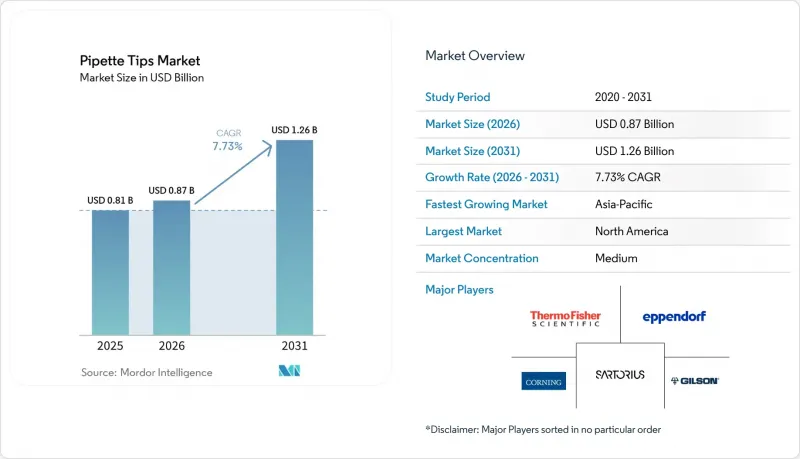
Mordor Intelligence에 의하면, 피펫 팁 시장 규모는 2025년 8억 1,000만 달러로 평가되었고, 2026년에는 8억 7,000만 달러로 추정되고, 2031년까지 12억 6,000만 달러에 이를 것으로 예상되며, 2026-2031년 CAGR 7.73%로 성장할 전망입니다.
본 보고서는 제품 유형별(표준, 필터 장착형, 기타), 기술 유형별(비로봇식, 로봇식), 용도별(진단 및 헬스케어, 제약 및 바이오기술, 기타), 최종 사용자별(진단 및 헬스케어, 제약 및 바이오기술 기업, 기타) 및 지역별(북미, 유럽, 아시아태평양, 기타)로 분류되어 있습니다. 시장 전망은 금액(달러) 기준으로 제시되어 있습니다.
세계의 피펫 팁 시장 동향 및 인사이트
고처리량 진단 및 조사 워크플로우 증가가 소비량 확대를 주도
고속 처리 실험실에서는 기존의 단일 시료 분석법에 비해 피펫 팁의 소비량이 현저히 증가합니다. 예를 들어, 1회의 96웰 프로토콜에서 96-192개의 칩이 사용되는 경우도 있으며, 이것이 플레이트 기반 검사, 유전체학, 신약 개발 분야 수요를 견인하고 있습니다. 2025년 8월, 서모피셔 사이언티피크는 노스캐롤라이나주 메바인에 375,000제곱피트 규모의 탄소 중립 시설을 개장했습니다. 이 시설은 1억 9,250만 달러 규모의 미국 정부 계약에 따른 자금의 일부를 투입하여 건설되었습니다. 이 시설은 주당 4,000만 개의 피펫 팁을 생산하도록 설계되어 있으며, 이는 국가 보건의료 체계와 실험실 운영에서 피펫 팁이 수행하는 지극히 중요한 역할을 여실히 보여주고 있습니다. 고도의 자동화를 통해 12초마다 96개의 칩을 생산할 수 있게 되어, 제조 효율이 실험실 수요 증가에 부응하고 있습니다. 이러한 생산 능력 향상으로 인해 북미 시장에서는 수입된 표준 규격 제품에 대한 가격 압박이 가해질 가능성이 있으며, 공급업체들은 이익률을 유지하기 위해 성능 면에서의 차별화에 주력해야할 것입니다.
자동화와의 호환성이 조달 기준에 포함됨
로봇을 이용한 액체 취급은 호환성에 대한 개념을 완전히 새롭게 바꾸었으며, 소모품이 자동화 시스템과 원활하게 통합될 수 있어야 합니다. 2025년 조사 결과, Opentrons의 OT-2에 탑재된 AI 기반 컴퓨터 비전 모델이 피펫 팁의 누락이나 잘못된 장착을 98%의 정확도로 감지할 수 있음이 입증되었습니다. 칩의 형상에 편차가 있으면 자동화된 워크플로우나 액체 취급에 지장을 초래하므로, 치수의 일관성이 이제 매우 중요해졌습니다. 엄격한 공차를 유지하지 못하는 공급업체는 자동화 조달 프로그램에서 어려움을 겪을 가능성이 있습니다. 해밀턴의 'GreenLine Tips'는 이 회사의 카탈로그의 85%를 차지하고 있으며, 품질 보증과 지속가능성을 모두 실현하고 있습니다. 이는 자동화 수준이 높은 고객사들 사이에서 정확성이 검증된 공급업체로 시장이 이동하고 있음을 반영한 것입니다.
플라스틱 폐기물 처리에 대한 압박과 재활용 격차가 조달 리스크를 야기하고 있습니다.
연구소에서는 막대한 양의 플라스틱 폐기물이 발생하고 있으며, 2025년 조사에 따르면 전 세계 약 20,500개 연구 기관에서 550만 톤의 폐기물이 발생할 것으로 추정됩니다. 이 폐기물이 환경에 미치는 영향은 영국 주민 100만 명 이상의 이산화탄소 배출량에 해당합니다. 대부분의 재활용 시스템에서는 오염 우려로 인해 연구소에서 발생하는 플라스틱은 수거되지 않으며, 주요 처리 방법으로 소각 또는 매립 처리가 남아 있습니다. EU의 ESG(환경·사회·지배구조) 프레임워크에 따라 탄소 정보 공개에 대한 감독이 강화되고 있으며, 유럽 및 북미의 구매자들은 제품 수명 종료 후의 적절한 처리와 제품에 내재된 배출량 감축을 요구하고 있습니다. 회수 프로그램, 바이오 배합 또는 재활용 파트너십을 갖추지 않은 공급업체는 지속가능성이 조달의 중요한 요소로 부상함에 따라 피펫 팁 시장에 진입하는 데 어려움을 겪을 수 있습니다. 일회용 칩에 대한 수요는 여전히 지속되고 있지만, 환경 성능이 구매 결정에 미치는 영향은 점점 더 커질 것입니다.
부문별 분석
2025년, 표준 팁은 피펫 팁 시장에서 35.64%의 점유율을 차지했으며, 완충액 조제나 젤 로딩과 같은 일상적인 작업에서 주도적인 위치를 차지했습니다. 이러한 장점은 대량 생산 및 낮은 감도가 요구되는 작업에 필요한 합리적인 가격과 구하기 쉬운 점을 반영하고 있습니다. 필터가 장착된 칩은 NGS나 qPCR과 같이 오염에 민감한 기법의 채택 확대에 힘입어, 2031년까지 연평균 성장률(CAGR) 8.76%를 기록하며 성장할 것으로 전망됩니다. 저보유형 칩은 규모는 작지만, 손실이 분석 품질에 영향을 미치는 세포 배양 및 생물학적 제제 처리 분야에서 그 중요성이 커지고 있습니다.
연장형이나 넓은 입구형 등 특수한 형태의 칩은 자동 선별이나 액면 감지와 같이 틈새 시장이지만 높은 수준의 요구 사항이 필요한 작업에 대응하고 있습니다. 특히 엄격한 품질 관리를 실시하는 주요 고객들 사이에서 필터가 장착된 칩이 프리미엄 틈새 제품에서 일상적인 조달 품목으로 전환됨에 따라 시장은 변화하고 있습니다. 필터 조립에 자동 성형 기술을 도입한 공급업체는 이 공정의 규모 확대가 복잡하기 때문에 경쟁 우위를 유지하고 있습니다. Eppendorf는 2025년에 재생 가능한 식용유를 90% 사용한 바이오 피펫 팁 시리즈 'ept.i.p.s.'를 발매했습니다. Westburg Life Sciences는 2026년에 이러한 추세를 더욱 확대하여, PFAS가 포함되지 않은 피펫 팁 'TripleA'를 출시하며, 소재의 규정 준수를 중요한 차별화 요소로 강조했습니다.
2025년 기준으로 로봇용 팁은 피펫 팁 시장의 58.47%를 차지했으며, 2031년까지 연평균 성장률(CAGR) 9.12%로 성장할 것으로 전망됩니다. 이러한 성장은 실험실 업무 흐름에서 자동화가 지닌 미개척 가능성을 여실히 보여주고 있습니다. 자동 액체 핸들러를 도입한 실험실에서는 성능과 규정 준수를 보장하기 위해, 대부분의 경우 이미 검증된 칩 생태계 내에서만 운영하고 있습니다. Tecan, Hamilton, Eppendorf 등 각사가 제공하는 프로그램은 인증을 특정 플랫폼과 소모품의 조합에 연동함으로써 이러한 락인 효과를 강화하고 있습니다. 비로봇용 칩은 교육용 실험실이나 현장 진단 분야에서 여전히 중요하지만, 검증된 워크플로우를 통한 정착도가 부족하여 성장 속도가 둔화되고 있습니다.
경쟁 우위는 가격이나 카탈로그의 상품 구색이 아니라, 생태계와의 호환성에 있습니다. 조달 팀은 치수 데이터나 크로스 플랫폼 검증 결과를 사전에 제시하는 공급업체를 점점 더 선호하는 추세이며, 적합성 확인 책임은 제조업체 측으로 옮겨가고 있습니다. 일관된 배치 형식을 통해 다중 공급업체의 자동화 환경을 지원하는 기업이 경쟁 우위를 점하고 있습니다. ISO 9001 및 ISO 13485 표준에 따르면, 제약 분야의 자동화 분야에서 우수한 품질 문서 및 치수 관리를 수행하는 공급업체가 우대받습니다.
지역별 분석
2025년, 북미는 피펫 팁 시장에서 38.86%의 점유율을 차지하며 1위를 유지했습니다. 이 지역은 탄탄한 생명공학 및 제약 산업 기반, 확립된 임상시험 인프라, 그리고 과거공급 부족 사태를 계기로 중요성이 부각된 공급의 지속성 등의 장점을 갖추고 있습니다. Thermo Fisher Scientific은 미국 정부의 자금 지원을 받아 2025년 8월, 노스캐롤라이나주 메바인에 주당 최소 4,000만 개의 칩을 생산할 수 있는 시설을 개소했습니다. 이러한 전개로 인해 국내 공급이 강화되고, 국경을 넘는 공급원에 대한 의존도가 낮아지고 있습니다. 유럽은 독일, 영국, 프랑스, 네덜란드에서 활발히 진행되고 있는 제약 연구와 엄격한 인증 기준에 힘입어, 계속해서 주요 시장으로서의 위상을 유지하고 있습니다. EU의 ESPR 체계에 따라 저탄소 및 바이오 소모품의 도입이 가속화되고 있습니다.
아시아태평양은 2031년까지 연평균 성장률(CAGR) 7.95%를 기록하며 성장할 것으로 예상되며, 피펫 팁 시장에서 가장 빠르게 성장하는 지역이 될 전망입니다. 중국 수요는 생명공학 단지, 임상 검사 네트워크 및 바이오의약품 제조에 대한 투자에 힘입어 증가하고 있습니다. 인도는 진단 역량을 확대하고 있으며, 대량 사용에 적합한 표준 칩과 품질을 중시하는 검사실용 인증 제품에 대한 수요를 견인하고 있습니다. 일본은 성숙한 시장이지만, 국내 바이오 제조에 대한 우선적인 노력을 바탕으로 부가가치가 높은 자동화 방식으로 전환되고 있습니다. 한국과 호주는 선진적인 유전체학 및 생명과학 연구 인프라를 통해 시장에 기여하고 있습니다. 이 지역의 성장은 중국 시장 규모, 인도의 진단 역량 확대, 그리고 선진 연구 거점에서의 자동화 수요가 복합적으로 작용하여 주도되고 있습니다.
중동 및 아프리카는 특히 GCC 국가들과 남아프리카공화국의 의료 인프라 투자로 인해 혜택을 보고 있지만, 수입 의존도가 높고 통관 절차가 복잡하다는 점이 더 빠른 성장을 저해하고 있습니다. 브라질과 아르헨티나를 필두로 한 남미는 강력한 제약 연구 기반과 증가하는 임상시험 활동을 갖추고 있지만, 가격에 대한 민감성과 환율 변동이 고가 제품 도입을 저해하는 과제로 대두되고 있습니다. 듀얼 소싱은 일반적인 조달 전략으로, 구매 담당자는 공급 중단 위험을 줄이기 위해 전 세계적인 공급업체 1곳과 지역 백업 공급업체 1곳과 계약을 맺고 있습니다. 이러한 접근 방식 덕분에 공급업체의 선택 폭이 넓어지는 한편, 각 기업이 시장 점유율을 유지하기 위해 경쟁함에 따라 경쟁이 치열해지고 있습니다.
기타 혜택 :
- 엑셀 형식 시장 예측(ME) 시트
- 3개월간의 애널리스트 지원
자주 묻는 질문
목차
제1장 서론
제2장 조사 방법
제3장 주요 요약
제4장 시장 구도
제5장 시장 규모 및 성장 예측
제6장 경쟁 구도
제7장 시장 기회 및 향후 전망
AJY 26.07.07According to Mordor Intelligence, the pipette tips market size is expected to increase from USD 0.81 billion in 2025 to USD 0.87 billion in 2026 and reach USD 1.26 billion by 2031, growing at a CAGR of 7.73% over 2026-2031.
This report is Segmented by Product Type (Standard, Filtered, and More), Technology Type (Non-Robotic, Robotic), Application (Diagnostics and Healthcare, Pharma and Biotech, and More), End User (Diagnostics and Healthcare, Pharmaceutical and Biotechnology Companies, and More), and Geography (North America, Europe, Asia-Pacific, and More). The Market Forecasts are Provided in Terms of Value (USD).
Global Pipette Tips Market Trends and Insights
Rising High-Throughput Diagnostic and Research Workflows Drive Volume Consumption
High-throughput laboratories consume pipette tips at a significantly higher rate than traditional single-sample methods. For example, a single 96-well protocol can use 96 to 192 tips in one run, driving demand in plate-based testing, genomics, and drug discovery. In August 2025, Thermo Fisher Scientific opened a 375,000 sq ft carbon-neutral facility in Mebane, North Carolina, partially funded by a USD 192.5 million U.S. government contract. The facility is designed to produce 40 million pipette tips weekly, emphasizing the critical role of pipette tips in national health preparedness and laboratory operations. Advanced automation enables the production of 96 tips every 12 seconds, aligning manufacturing efficiency with rising laboratory demands. This increased capacity may lead to price pressures on imported standard formats in North America, requiring suppliers to focus on performance differentiation to maintain margins.
Automation Compatibility Becomes a Procurement Standard
Robotic liquid handling has redefined compatibility, requiring consumables to integrate seamlessly with automated systems. Research in 2025 demonstrated that an AI-driven computer vision model on the Opentrons OT-2 achieved 98% accuracy in detecting missing or incorrectly loaded pipette tips. Dimensional consistency is now critical, as inconsistent tip geometry can disrupt automated workflows and liquid handling. Suppliers unable to maintain tight tolerances may face challenges in automated procurement programs. Hamilton's GreenLine Tips, covering 85% of its catalog, combine quality assurance with sustainability, reflecting the market's shift toward precision-certified suppliers in automation-heavy accounts.
Plastic Waste Disposal Pressure and Recycling Gaps Create Procurement Risk
Laboratories generate significant volumes of plastic waste, with a 2025 study estimating 5.5 million tons of waste from around 20,500 research institutions globally. This waste has an environmental impact comparable to the CO2 emissions of over 1 million UK residents. Most recycling systems reject laboratory plastics due to contamination concerns, leaving incineration or landfill as the primary disposal methods. The EU's ESPR framework is driving stricter scrutiny on carbon disclosure, pushing buyers in Europe and North America to demand better end-of-life handling and lower embedded emissions. Suppliers without take-back programs, bio-based formulations, or recycling partnerships may face challenges in accessing the pipette tips market as sustainability becomes a key procurement factor. While demand for single-use tips persists, environmental performance will increasingly influence purchasing decisions.
Other drivers and restraints analyzed in the detailed report include:
- Single-Use Contamination Control Increases in Molecular Biology Workflows
- Growth in Sterile, RNase-Free, and DNase-Free Consumables Mirrors Biopharma Scale-Up
- Price Sensitivity in Volume-Based Laboratory Consumables Compresses Margins at Scale
For complete list of drivers and restraints, kindly check the Table Of Contents.
Segment Analysis
In 2025, standard tips held a 35.64% share of the pipette tips market, leading in routine tasks like buffer preparation and gel loading. This dominance reflects the affordability and availability required for high-volume, low-sensitivity tasks. Filtered tips are projected to grow at an 8.76% CAGR through 2031, driven by increased adoption of contamination-sensitive methods like NGS and qPCR. Low-retention tips, though a smaller segment, are gaining relevance in cell culture and biologics handling, where loss impacts assay quality.
Specialty formats, such as extended-length and wide-bore tips, cater to niche yet demanding tasks in automated screening and liquid-level detection. The market is shifting as filtered tips transition from a premium niche to routine procurement, particularly among large accounts with strict quality controls. Suppliers with automated molding for filter integration hold a competitive edge due to the complexity of scaling this process. Eppendorf introduced its ept.i.p.s. bio-based pipette tip line in 2025, utilizing 90% renewable materials from recycled cooking oil. Westburg Life Sciences expanded this trend in 2026 with TripleA PFAS-free pipette tips, emphasizing material compliance as a key differentiator.
Robotic tips accounted for 58.47% of the pipette tips market in 2025 and are projected to grow at a 9.12% CAGR through 2031. This growth highlights the untapped potential for automation in laboratory workflows. Laboratories adopting automated liquid handlers often remain within validated tip ecosystems for performance and compliance. Programs from Tecan, Hamilton, and Eppendorf strengthen this lock-in by tying qualification to specific platform and consumable combinations. Non-robotic tips, while relevant in teaching labs and field diagnostics, face slower growth due to the absence of validated workflow stickiness.
The competitive edge lies in ecosystem compatibility rather than pricing or catalog variety. Procurement teams increasingly prefer suppliers offering dimensional data and cross-platform validation upfront, shifting qualification responsibility to manufacturers. Companies supporting multi-vendor automation environments with consistent batch geometry gain an advantage. ISO 9001 and ISO 13485 standards favor vendors with superior quality documentation and dimensional control in pharmaceutical automation.
Complete Report Scope:
- By Product Type
- Standard
- Filtered
- Low-Retention
- Specialty and Other Product Types
- By Technology Type
- Non-Robotic
- Robotic
- By Application
- Diagnostics and Healthcare
- Pharma and Biotech
- Academia and Education
- Other Applications
- By End User
- Diagnostics and Healthcare
- Pharmaceutical and Biotechnology Companies
- Academic and Research Institutes
- Others
- By Geography
- North America
- United States
- Canada
- Mexico
- Europe
- Germany
- United Kingdom
- France
- Italy
- Spain
- Rest of Europe
- Asia-Pacific
- China
- India
- Japan
- Australia
- South Korea
- Rest of Asia-Pacific
- Middle East and Africa
- GCC
- South Africa
- Rest of Middle East and Africa
- South America
- Brazil
- Argentina
- Rest of South America
- North America
Geography Analysis
In 2025, North America held a 38.86% share of the pipette tips market, maintaining its leading position. The region benefits from a strong biotechnology and pharmaceutical base, established clinical testing infrastructure, and a focus on supply continuity following earlier shortages. Thermo Fisher Scientific opened a facility in Mebane, North Carolina, in August 2025, with a weekly capacity of at least 40 million tips, supported by U.S. government funding. This development strengthens domestic supply, reducing reliance on cross-border sources. Europe remains a key market, driven by robust pharmaceutical research in Germany, the United Kingdom, France, and the Netherlands, alongside strict accreditation standards. The EU's ESPR framework is accelerating the adoption of low-carbon and bio-based consumables.
Asia-Pacific is projected to grow at a 7.95% CAGR through 2031, making it the fastest-growing region in the pipette tips market. China's demand is fueled by investments in biotech parks, clinical laboratory networks, and biologics manufacturing. India is expanding diagnostic capacity, driving demand for standard high-volume tips and certified products for quality-focused laboratories. Japan, while mature, is shifting toward higher-value automated formats, supported by domestic biomanufacturing priorities. South Korea and Australia contribute with advanced genomics and life science research infrastructure. The region's growth is driven by a mix of China's scale, India's diagnostics expansion, and automation demand in developed research hubs.
The Middle East and Africa benefit from healthcare infrastructure investments, particularly in the GCC and South Africa, though import dependence and customs complexities limit faster growth. South America, led by Brazil and Argentina, has a strong pharmaceutical research base and increasing clinical trial activity, but price sensitivity and currency volatility challenge premium tip adoption. Dual-sourcing has become a common procurement strategy, with buyers engaging one global supplier and one regional backup to mitigate disruption risks. This approach expands the supplier pool while intensifying competition as suppliers strive to retain market share.
- Bio-Rad Laboratories
- Biotix, Inc.
- BrandTech Scientific, Inc.
- Cole-Parmer
- Corning
- Eppendorf
- Gilson Incorporated
- Greiner Bio One International
- Hamilton Company
- INTEGRA Biosciences
- Labcon North America, LLC
- Mettler Toledo
- Sarstedt AG and Co. KG
- Sartorius
- Socorex Isba SA
- Starlab International GmbH
- Tecan Group
- Thermo Fisher Scientific
- VWR International
Additional Benefits:
- The market estimate (ME) sheet in Excel format
- 3 months of analyst support
TABLE OF CONTENTS
1 INTRODUCTION
- 1.1 Study Assumptions and Market Definition
- 1.2 Scope of the Study
2 RESEARCH METHODOLOGY
3 EXECUTIVE SUMMARY
4 MARKET LANDSCAPE
- 4.1 Market Overview
- 4.2 Market Drivers
- 4.2.1 Rising High-Throughput Diagnostic and Research Workflows
- 4.2.2 Automation Compatibility Becomes a Procurement Standard
- 4.2.3 Single-Use Contamination Control Increases in Molecular Testing
- 4.2.4 Growth in Sterile, RNase-Free, and DNase-Free Consumables
- 4.2.5 Sustainability Procurement Shifts Toward Recyclable and Lower-Waste Tips
- 4.2.6 Localized Manufacturing and Dual-Sourcing Reduce Supply Risk
- 4.3 Market Restraints
- 4.3.1 Plastic Waste Disposal Pressure and Recycling Gaps
- 4.3.2 Price Sensitivity in Volume-Based Laboratory Consumables
- 4.3.3 Raw Material and Precision Mold Cost Volatility
- 4.3.4 Qualification Burden for Robotic and Specialty Tip Compatibility
- 4.4 Value/Supply Chain Analysis
- 4.5 Regulatory Landscape
- 4.6 Technological Outlook
- 4.7 Porter's Five Forces Analysis
- 4.7.1 Bargaining Power of Suppliers
- 4.7.2 Bargaining Power of Buyers
- 4.7.3 Threat of New Entrants
- 4.7.4 Threat of Substitutes
- 4.7.5 Intensity of Competitive Rivalry
5 MARKET SIZE AND GROWTH FORECASTS (VALUE, USD)
- 5.1 By Product Type
- 5.1.1 Standard
- 5.1.2 Filtered
- 5.1.3 Low-Retention
- 5.1.4 Specialty and Other Product Types
- 5.2 By Technology Type
- 5.2.1 Non-Robotic
- 5.2.2 Robotic
- 5.3 By Application
- 5.3.1 Diagnostics and Healthcare
- 5.3.2 Pharma and Biotech
- 5.3.3 Academia and Education
- 5.3.4 Other Applications
- 5.4 By End User
- 5.4.1 Diagnostics and Healthcare
- 5.4.2 Pharmaceutical and Biotechnology Companies
- 5.4.3 Academic and Research Institutes
- 5.4.4 Others
- 5.5 By Geography
- 5.5.1 North America
- 5.5.1.1 United States
- 5.5.1.2 Canada
- 5.5.1.3 Mexico
- 5.5.2 Europe
- 5.5.2.1 Germany
- 5.5.2.2 United Kingdom
- 5.5.2.3 France
- 5.5.2.4 Italy
- 5.5.2.5 Spain
- 5.5.2.6 Rest of Europe
- 5.5.3 Asia-Pacific
- 5.5.3.1 China
- 5.5.3.2 India
- 5.5.3.3 Japan
- 5.5.3.4 Australia
- 5.5.3.5 South Korea
- 5.5.3.6 Rest of Asia-Pacific
- 5.5.4 Middle East and Africa
- 5.5.4.1 GCC
- 5.5.4.2 South Africa
- 5.5.4.3 Rest of Middle East and Africa
- 5.5.5 South America
- 5.5.5.1 Brazil
- 5.5.5.2 Argentina
- 5.5.5.3 Rest of South America
- 5.5.1 North America
6 COMPETITIVE LANDSCAPE
- 6.1 Market Concentration
- 6.2 Market Share Analysis
- 6.3 Company Profiles (includes Global Level Overview, Market Level Overview, Core Segments, Financials as available, Strategic Information, Market Rank/Share, Products and Services, Recent Developments)
- 6.3.1 Bio-Rad Laboratories, Inc.
- 6.3.2 Biotix, Inc.
- 6.3.3 BrandTech Scientific, Inc.
- 6.3.4 Cole-Parmer Instrument Company, LLC
- 6.3.5 Corning Incorporated
- 6.3.6 Eppendorf SE
- 6.3.7 Gilson Incorporated
- 6.3.8 Greiner Bio-One International GmbH
- 6.3.9 Hamilton Company
- 6.3.10 INTEGRA Biosciences AG
- 6.3.11 Labcon North America, LLC
- 6.3.12 Mettler-Toledo International Inc.
- 6.3.13 Sarstedt AG and Co. KG
- 6.3.14 Sartorius AG
- 6.3.15 Socorex Isba SA
- 6.3.16 Starlab International GmbH
- 6.3.17 Tecan Trading AG
- 6.3.18 Thermo Fisher Scientific Inc.
- 6.3.19 VWR International, LLC
7 MARKET OPPORTUNITIES AND FUTURE OUTLOOK
- 7.1 White-Space and Unmet-Need Assessment


