

|
시장보고서
상품코드
2073195
피펫, 피펫터 및 액세서리 시장 : 점유율 분석, 업계 동향과 통계, 성장 예측(2026-2031년)Pipettes, Pipettors, and Accessories - Market Share Analysis, Industry Trends & Statistics, Growth Forecasts (2026 - 2031) |
||||||
 Mordor Intelligence
Mordor Intelligence에 의하면, 피펫, 피펫터 및 액세서리 시장 규모는 2025년에 26억 1,000만 달러, 2026년에 27억 1,000만 달러되어, 2031년까지 32억 7,000만 달러에 이를 것으로 예측되며, 2026년부터 2031년까지 CAGR 3.85%로 성장할 전망입니다.
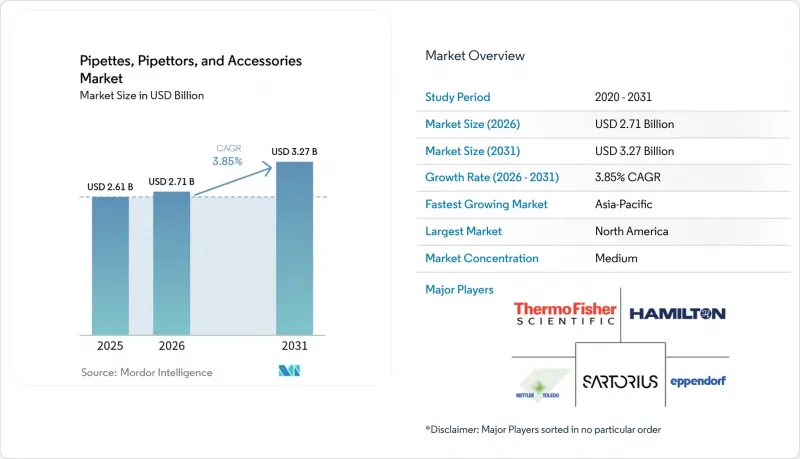
본 보고서는 제품 유형(피펫, 피펫터, 액세서리), 소재(유리, 플라스틱, 스테인리스 스틸), 용량(정용량, 가변 용량, 멀티채널), 최종 사용자(병원, 연구소, 학술 기관, 제약·바이오기술, 기타), 지역(북미, 유럽, 아시아태평양, 기타)별로 분류되어 있습니다. 시장 전망치는 금액(달러) 단위로 제시되어 있습니다.
전 세계 피펫, 피펫터 및 액세서리 시장 동향과 인사이트
생명과학 분야에서 고처리량 액체 핸들링에 대한 수요 증가
피펫, 피펫터 및 액세서리 시장은 현대의 신약 개발, 유전체 스크리닝, 그리고 임상 검체 처리 과정에서 수동식 단일 채널 작업으로는 안정적인 오차 관리를 유지할 수 없을 정도로 많은 양의 검체가 처리되게 된 사실의 혜택을 받고 있습니다. 한 번의 실행으로 수백 개에서 수천 개의 시료를 처리하는 연구소에서는 아주 미세한 편차라도 후속 공정의 데이터 품질에 문제가 발생할 수 있으므로, 반복적인 액체 분주 과정에서 엄격한 일관성을 유지할 수 있는 멀티채널 및 전자 시스템이 필요합니다. 이러한 상황에서 구매자들은 특히 종양학 바이오마커 연구나 ADMET 스크리닝 프로그램의 경우, 공급업체를 비교할 때 광고된 기본 정확도보다는 실제 운영 환경에서 나타나는 재현성을 더 중요하게 여기게 되었습니다. 따라서 피펫, 피펫터 및 액세서리 시장은 과거에는 가장 바쁜 워크플로우에만 국한되었던 고급 제품으로 취급되던 다중 채널 전자 기기가, 시설 내에서 일상적으로 사용되는 방향으로 전환되고 있습니다. 이러한 변화로 인해, 고도의 자동화 플랫폼뿐만 아니라 대규모 인프라 변경 없이 기존 작업대에 설치할 수 있는 중급급 장비에 대한 수요도 증가하고 있습니다. 또한, 처리 능력에 대한 요구 사항이 실험실 계획 단계의 상당히 초기부터 조달 방침에 영향을 미치게 되면서, 개별 장비의 사양보다는 기존 워크플로우와의 적합성이 더욱 중요해졌습니다.
생명공학, 유전체학, 세포 치료 분야의 워크플로우 확대
피펫, 피펫터 및 관련 액세서리 시장에서는 반복적인 액체 이송 공정에서 극히 정밀한 액체량 제어가 필요한 차세대 시퀀싱, 단일 세포 분석 및 세포 치료 워크플로우에 대한 수요가 증가하고 있습니다. 세포 치료제 제조 과정에서 이송 오류는 무균 폐쇄 시스템 처리에 영향을 미칠 가능성이 있으며, 임상 단계 환경에서는 환자를 위한 생산과 관련된 보다 광범위한 품질 요건에도 영향을 미치기 때문에 운영상 그 중요성이 더욱 커집니다. Cellares사는 2026년 6월까지 사우스 샌프란시스코, 브리지워터, 라이덴, 일본에 위치한 자동화 IDMO 스마트 팩토리의 생산 능력을 확대하기 위해 시리즈 D 자금 조달을 통해 3억 2,700만 달러를 확보했으며, 이러한 시설에는 GMP 요건을 충족하는 검증된 액체 처리 인프라가 필요합니다. 또한, 엘리먼트 바이오사이언스도 2026년 6월, 유전체학, 멀티오믹스 및 임상 연구 솔루션 분야의 성장을 가속화하기 위해 1억 7,500만 달러 규모의 투자 유치를 발표했습니다. 이는 시퀀싱 및 관련 워크플로우에 사용되는 정밀 액체 처리 도구에 대한 업스트림 공정에서의 지속적인 수요를 뒷받침하는 것입니다. 그 결과, 피펫, 피펫터 및 액세서리 시장은 광범위한 범용 제품 포트폴리오에만 의존하기보다는 유전체학 및 세포 치료 분야에서 검증된 워크플로우 적합성을 입증할 수 있는 공급업체로 점차 기울고 있습니다. 이러한 경향은 가격보다 적격성 평가의 위험이 더 중시되는 시설의 건설 단계에서 더욱 두드러집니다.
학술 기관 및 공공 연구소의 가격 민감도
피펫, 피펫터 및 관련 액세서리 시장은 학술 기관이나 공공 자금을 지원하는 연구소에서 명확한 수익 한계에 직면해 있습니다. 이러한 구매자 중 상당수는 연간 예산이 정해져 있어 고가의 전자제품을 구입하는 데 제약을 받고 있기 때문입니다. 많은 신흥 시장의 기관에서는 장기적인 운용 효율보다 단가가 여전히 조달에 큰 영향을 미치고 있기 때문에 유리 피펫이 기본 선택지로 자리 잡고 있습니다. 이러한 추세로 인해 인도나 중국의 저가 제조업체들이 보급형 시장 수요를 확보하기가 쉬워지고 있으며, 특히 구매 검토 과정에서 교정 주기나 인체공학적 효과, 총 소유 비용보다 정가가 더 중요하게 여겨지는 경우에 이러한 현상이 두드러집니다. 예산 압박으로 인해 성능 향상이 명백하고 기술 담당자들도 이를 충분히 이해하고 있음에도 불구하고, 네트워크 연결 기능을 갖춘 시스템으로의 전환은 지연되고 있습니다. 따라서 피펫, 피펫터 및 관련 액세서리 시장에서 가치 증가는 더 높은 사양을 충족할 수 있는 예산을 보유한 제약, 생명공학 및 상업 연구소 고객층에 크게 편중되어 있습니다. 학술 기관 수요는 수량 기준으로는 여전히 중요하지만, 구매가 기본적인 사양에 치우쳐 있기 때문에 금액 기준으로는 성장세가 완만해지고 있습니다.
부문별 분석
2025년, 피펫은 제품 유형별 매출의 46.31%를 차지하며, 이 부문에서 피펫, 피펫터 및 액세서리 시장 점유율 1위를 유지했습니다. 이 리드는 피펫이 연구, 시험, 제조 및 임상 검사 현장에서 여전히 기본적인 액체 이송 도구로 자리 잡고 있다는 사실을 반영하고 있습니다. 피펫터는 제품 구성의 핵심을 이루며, 단일 채널, 다중 채널 및 전자식 등 다양한 형태로 제공되어 점점 더 다양해지는 워크플로우 요구 사항을 충족시키고 있습니다. 해당 그룹 내에서는 GMP 및 ISO 인증 환경에서 디지털 추적 가능성과 재현성 있는 조작 제어의 중요성이 커짐에 따라 전자식 모델의 비중이 증가하고 있습니다. 에펜도르프사는 2025년 9월, ISO 8655의 요구 사항을 뛰어넘는 정밀도와 2단계 용량 설정 장치를 갖춘 Research 3 neo를 발매했습니다. 이는 주요 공급업체들이 핵심 제품인 피펫을 단순한 범용 기기가 아닌, 구성 가능한 플랫폼으로 재정의하려 하고 있음을 보여줍니다.
액세서리 시장은 2026년부터 2031년까지 연평균 성장률(CAGR) 4.38%로 확대될 것으로 예상되며, 피펫, 피펫터 및 액세서리 시장에서 가장 빠르게 성장하는 제품 카테고리가 될 것입니다. 이러한 성장은 기기 본체 판매 후에도 장기간에 걸쳐 계속 사용되는 정기적인 소모품, 교정 지원 용품 및 기타 워크플로우 관련 제품의 상업적 가치를 반영한 것입니다. 연구실이 독자적인 칩 규격이나 액세서리 생태계를 채택하면, 그 선택은 대개 몇 차례의 업데이트 주기에 걸쳐 유지되기 때문에 개별 기기 구매보다 고객 유지율을 높이는 데 기여합니다. 또한, 지속가능성에 대한 고려도 액세서리 수요를 뒷받침하고 있습니다. 구매 담당자들은 일상적인 조달 과정에서 리필 시스템, 폐기물이 적은 포장, 대체 소재 등을 점점 더 중요하게 여기고 있기 때문입니다. 이는 공급업체와 고객 간의 수익 관계가, 장비를 일시적으로 교체하는 것보다 이미 도입된 장비를 둘러싼 일상적인 운영 서비스를 통해 형성되고 있음을 의미합니다.
2025년에는 유리가 매출의 45.24%를 차지하며, 같은 해 피펫, 피펫터 및 액세서리 시장 규모에서 점유율 기준으로 가장 큰 소재 카테고리가 되었습니다. 그 위상은 용적 측정, 혈청용 피펫, 그리고 내용제성 및 실험실에서의 실적이 여전히 사양을 좌우하는 분야에서 여전히 가장 확고하게 유지되고 있었습니다. 스테인리스 스틸은 디스펜싱 니들, 캐뉼라, 그리고 반복적인 오토클레이브 처리나 화학 물질에의 노출로 인해 폴리머 사용이 제한되는 기타 부속품 등, 소규모의 특수한 용도에서 계속해서 사용되었습니다. 그렇긴 하지만, 자동화에 대한 대응이나 조달 방침이 비교 기준을 변화시키고 있기 때문에 재료 선택은 더 이상 화학적 성능에만 좌우되는 것이 아닙니다. 연구소에서는 치수의 일관성, 운영 과정에서 발생하는 폐기물, 그리고 고처리량 로봇 및 반자동 공정에 대응할 수 있는 재료 시스템의 능력을 더욱 중시하고 있습니다.
플라스틱은 2026년부터 2031년까지 연평균 성장률(CAGR) 5.52%를 나타낼 것으로 예측되며, 피펫, 피펫터 및 액세서리 시장에서 가장 빠르게 확대될 소재 부문이 될 것입니다. 이러한 성장은 지속가능성 프로그램과, 일관된 폴리머 칩 및 액세서리 형식에 의존하는 자동화 워크플로의 보급 모두와 관련이 있습니다. 해밀턴사의 “GreenLine CO-RE II" 칩은 65%에서 75%가 ISCC PLUS 인증을 획득한 바이오 서큘러 폴리프로필렌으로 제조되었으며, 해당 회사에 따르면 원자재의 탄소 발자국은 화석 유래 대체재에 비해 약 111% 감소했다고 합니다. 비용과 물류에 민감한 시장에서는 유리에서 다른 소재로의 전환이 빠르게 진행되고 있지만, 유럽의 기관들은 재활용 가능성과 규정 준수 관련 우려 사이의 균형을 좀 더 완만한 속도로 모색하고 있습니다. 정밀 측정이나 내용매성이 여전히 결정적인 요소로 작용하는 용도에서는 유리가 계속 사용될 것이지만, 규모, 자동화 적합성, 조달 기준이 점점 더 일치해 가는 분야에서는 플라스틱이 두각을 나타내고 있습니다.
지역별 분석
2025년, 북미는 전 세계 매출의 42.22%를 차지했으며, 지역별로 볼 때 피펫, 피펫터 및 액세서리 시장 점유율에서 1위를 차지했습니다. 이러한 경쟁력은 대규모 바이오의약품 연구 단지의 집중, 연방 정부 자금에 의한 유전체학 연구 활동, 그리고 의약품 외주 업무를 뒷받침하는 탄탄한 CRO(의약품 개발 수탁 기관) 기반을 반영하고 있습니다. 또한, 이 지역에서는 규제 대상 구매자들이 검증된 성능, 문서화 및 디지털 감사에 대한 대응을 매우 중요하게 여기기 때문에 고급 사양이 선호되고 있습니다. 이러한 요인들이 복합적으로 작용하여, 대당 매출액은 다른 많은 지역을 상회하고 있으며, 연구소가 추적 가능성이 높은 전자 형식으로 전환함에 따라 구형 수동식 기기의 교체 수요를 뒷받침하고 있습니다.
유럽은 여전히 두 번째로 큰 지역 시장이며, 특히 독일, 스위스, 덴마크에서는 정밀 액체 핸들링 제품의 제조거점이 매우 탄탄합니다. 이 지역 수요는 엄격한 규정 준수 체계, 품질을 중시하는 연구소가 밀집해 있는 도입 기반, 그리고 교정 대응 현황과 문서화된 성능을 중시하는 조달 프로세스에 의해 뒷받침되고 있습니다. 살토리우스사는 2025년 9월, “Cubis II 단일 채널 피펫 교정 시스템”를 출시하며 그 입지를 한층 더 공고히 했습니다. 이 시스템은 ISO 표준에 부합하는 교정 절차를 신속하게 처리하는 동시에, 해당 회사의 소프트웨어 연동형 품질 솔루션 제공 체계를 강화하기 위한 것입니다. 또한 유럽에서는 다른 많은 지역에 비해 공급업체 선정 시 지속가능성을 더욱 중시하고 있어, 폐기물이 적은 인증된 액세서리를 제공하는 공급업체는 초기 단계부터 경쟁 우위를 점하고 있습니다.
아시아태평양은 2026년부터 2031년까지 연평균 성장률(CAGR) 5.15%를 나타낼 것으로 예측되며, 피펫, 피펫터 및 액세서리 시장에서 가장 두드러진 성장을 보일 것으로 전망됩니다. 중국에서는 종양학, 유전체학, 정밀의료 분야의 역량 강화가 지속되고 있으며, 이는 연구 개발 환경 전반에 걸쳐 신뢰성이 높은 액체 처리 도구에 대한 수요 증가를 뒷받침하고 있습니다. 일본은 임상 검사 및 제약 품질 시험을 안정적인 수요 기반으로 삼고 있어, 정밀 기기 업계에 있어 여전히 중요한 시장입니다. 인도에서는 생산 연계형 인센티브와 의료 인프라에 대한 광범위한 투자를 통해, 단순한 가격적 고려를 넘어선 조달 우선순위의 재검토가 진행되고 있으며, 사양에 대한 관심이 높아지고 있습니다. 남미와 중동 및 아프리카는 여전히 시장 규모가 작지만, 임상 진단, 제약 품질 관리 및 보다 체계적인 실험실 운영 기준의 보급에 따라 두 지역 모두 수요가 서서히 증가하고 있습니다.
기타 혜택:
- 엑셀 형식 시장 예측(ME) 시트
- 3개월간의 애널리스트 지원
자주 묻는 질문
목차
제1장 서론
제2장 조사 방법
제3장 주요 요약
제4장 시장 구도
제5장 시장 규모와 성장 예측
제6장 경쟁 구도
제7장 시장 기회와 향후 전망
JHS 26.07.07According to Mordor Intelligence, the pipettes, pipettors, and accessories market size is projected to be USD 2.61 billion in 2025, USD 2.71 billion in 2026, and reach USD 3.27 billion by 2031, growing at a CAGR of 3.85% from 2026 to 2031.
This report is Segmented by Product Type (Pipettes, Pipettors, Accessories), Material (Glass, Plastic, Stainless Steel), Volume Capacity (Fixed-Volume, Variable-Volume, Multi-Channel), End User (Hospitals, Laboratories, Academic Institutes, Pharma & Biotech, Others), and Geography (North America, Europe, Asia-Pacific, and More). The Market Forecasts are Provided in Value (USD).
Global Pipettes, Pipettors, and Accessories Market Trends and Insights
Rising Demand for High-Throughput Liquid Handling in Life Sciences
The pipettes, pipettors, and accessories market is benefiting from the fact that modern drug discovery, genomic screening, and clinical sample processing now run at sample volumes that manual single-channel work cannot support with stable error control. Laboratories that process hundreds or thousands of samples in one run need multi-channel and electronic systems that can maintain tight consistency across repeated transfers, because even small deviations create downstream data quality issues. In this setting, buyers compare vendors less on basic advertised accuracy and more on repeatability under real operating pressure, especially in oncology biomarker work and ADMET screening programs. The pipettes, pipettors, and accessories market is therefore moving toward routine use of multi-channel electronic tools in facilities that once treated them as premium purchases reserved for only the busiest workflows. This change supports demand across both advanced automated platforms and mid-range instruments that fit existing benches without major infrastructure changes. It also makes installed workflow fit more important than standalone instrument specifications, since throughput needs now shape procurement much earlier in laboratory planning.
Expansion of Biotech, Genomics, and Cell Therapy Workflows
The pipettes, pipettors, and accessories market is seeing stronger demand from next-generation sequencing, single-cell analysis, and cell therapy workflows that require very tight liquid volume control across repeated transfer steps. In cell therapy manufacturing, a transfer error carries greater operational weight because it can affect sterile closed-system processing and, in clinical-stage settings, broader quality expectations tied to patient-facing production. Cellares had secured USD 327 million in Series D financing by June 2026 to expand automated IDMO Smart Factory capacity across South San Francisco, Bridgewater, Leiden, and Japan, and those facilities require validated liquid handling infrastructure that fits GMP expectations. Element Biosciences also announced a USD 175 million investment in June 2026 to accelerate growth across genomic, multiomic, and clinical research solutions, which supports continued upstream demand for precision liquid handling tools used in sequencing and related workflows. As a result, the pipettes, pipettors, and accessories market is tilting toward vendors that can show validated workflow fit in genomics and cell therapy rather than relying only on broad general-purpose product portfolios. That preference becomes more visible during facility buildouts, where qualification risk often matters more than price.
Price Sensitivity In Academic And Public Laboratories
The pipettes, pipettors, and accessories market faces a clear revenue limit in academic and publicly funded laboratories, because many of these buyers work within fixed annual budgets that constrain adoption of higher-priced electronic instruments. In many emerging-market institutions, glass pipettes remain the default option because unit cost still drives procurement more strongly than long-term operating efficiency. That pattern helps lower-cost manufacturers from India and China win entry-level demand, especially where purchase reviews focus more on list price than on calibration intervals, ergonomic effects, or total ownership cost. Budget pressure also slows the transition to connectivity-enabled systems even when performance gains are clear and well understood by technical staff. The pipettes, pipettors, and accessories market therefore sees value growth pulled more heavily toward pharmaceutical, biotechnology, and commercial laboratory accounts where spending can support better specifications. Academic demand remains meaningful in unit terms, but it grows more slowly in value because purchasing skews toward basic formats.
Other drivers and restraints analyzed in the detailed report include:
- Automation-Ready Pipettors Supporting Lab Digitization
- Growth in Specialized Calibration, Traceability, and Compliance Needs
- Calibration Burden And Downtime In Regulated Workflows
For complete list of drivers and restraints, kindly check the Table Of Contents.
Segment Analysis
Pipettes held 46.31% of product type revenue in 2025, giving them the leading position in the pipettes, pipettors, and accessories market share across this segmentation. Their lead reflects the fact that they remain the basic liquid transfer tool across research, testing, manufacturing, and clinical laboratory settings. Pipettors form the middle layer of the product mix, spanning single-channel, multi-channel, and electronic formats that serve increasingly differentiated workflow needs. Within that group, electronic variants are gaining internal weight as digital traceability and repeatable operating controls become more important in GMP and ISO-accredited environments. Eppendorf launched the Research 3 neo in September 2025 with accuracy that exceeds ISO 8655 requirements and a dual-speed volume setting mechanism, which shows how established suppliers are repositioning the core pipette as a configurable platform rather than a simple commodity device.
Accessories are forecast to expand at a 4.38% CAGR from 2026 to 2031, which makes them the fastest-growing product category in the pipettes, pipettors, and accessories market. Their growth reflects the commercial value of recurring consumables, calibration support items, and other workflow-linked products that remain in use long after the original instrument sale. Once a laboratory adopts a proprietary tip format or accessory ecosystem, that choice often remains in place across several refresh cycles, which strengthens retention more than single instrument purchases do. Sustainability preferences are also feeding accessory demand, since buyers increasingly review refill systems, lower-waste packaging, and alternative materials during routine procurement. This means the revenue relationship between supplier and customer is being shaped less by one-time instrument replacement and more by the daily operating products that surround that installed base.
Glass accounted for 45.24% of revenue in 2025, making it the largest material category in the pipettes, pipettors, and accessories market size by share for that year. Its position remained strongest in volumetric measurement, serological pipettes, and settings where solvent resistance and proven lab familiarity still shape specifications. Stainless steel continued to serve smaller specialized applications such as dispensing needles, cannula formats, and other accessory types where repeated autoclaving or chemical exposure limits polymer use. Even so, material choice is no longer guided only by chemical performance, because automation readiness and procurement policy are changing the basis of comparison. Laboratories are looking more closely at dimensional consistency, operational waste, and the ability of a material system to support high-throughput robotic or semi-automated handling.
Plastic is forecast to grow at a 5.52% CAGR from 2026 to 2031, which makes it the fastest-expanding material segment within the pipettes, pipettors, and accessories market. This growth is linked to both sustainability programs and the spread of automated workflows that depend on consistent polymer tips and accessory formats. Hamilton's GreenLine CO-RE II tips are manufactured from 65% to 75% ISCC PLUS-certified bio-circular polypropylene, and the company states that the raw material carbon footprint is nearly 111% lower than fossil-grade alternatives. The move away from glass is progressing faster in cost-sensitive and logistics-sensitive markets, while European institutions are balancing recyclability and compliance concerns more gradually. Glass will retain a place in applications where precision measurement and solvent resistance remain decisive, but plastic is gaining where scale, automation fit, and procurement criteria increasingly converge.
Complete Report Scope:
- By Product Type
- Pipettes
- Air Displacement Pipettes
- Positive Displacement Pipettes
- Micro-Pipettes
- Manual Pipettes
- Digital Pipettes
- Pipettors
- Single-Channel Pipettors
- Multi-Channel Pipettors
- Electronic Pipettors
- Accessories
- Pipettes
- By Material
- Glass
- Plastic
- Stainless Steel
- By Volume Capacity
- Fixed-Volume
- Variable-Volume
- Multi-Channel Capacity Formats
- By End User
- Hospitals
- Laboratories
- Academic and Research Institutes
- Pharmaceutical and Biotechnology Companies
- Other End-Users
- By Geography
- North America
- United States
- Canada
- Mexico
- Europe
- Germany
- United Kingdom
- France
- Italy
- Spain
- Rest of Europe
- Asia-Pacific
- China
- Japan
- India
- Australia
- South Korea
- Rest of Asia-Pacific
- Middle East and Africa
- GCC
- South Africa
- Rest of Middle East and Africa
- South America
- Brazil
- Argentina
- Rest of South America
- North America
Geography Analysis
North America accounted for 42.22% of global revenue in 2025, which gave the region the largest position in the pipettes, pipettors, and accessories market share by geography. Its lead reflects the concentration of large biopharma research campuses, federally funded genomics activity, and a deep CRO base that supports outsourced pharmaceutical work. The region also favors premium specifications, because regulated buyers place strong emphasis on validated performance, documentation, and digital audit readiness. That mix keeps revenue per unit above many other regions and supports replacement demand for older manual fleets as laboratories move toward more traceable electronic formats.
Europe remained the second-largest regional market and carried a particularly strong manufacturing base for precision liquid handling products, especially in Germany, Switzerland, and Denmark. Demand in the region is supported by strict compliance frameworks, a dense installed base of quality-focused laboratories, and procurement processes that reward calibration readiness and documented performance. Sartorius strengthened that position in September 2025 with the launch of the Cubis II Single Channel Pipette Calibration System, which supports faster ISO-compliant calibration and reinforces the company's broader software-linked quality offering. Sustainability is also more visible in European vendor selection than in many other regions, which gives suppliers with certified lower-waste accessories an early advantage.
Asia-Pacific is forecast to grow at a 5.15% CAGR from 2026 to 2031, making it the fastest-growing regional component of the pipettes, pipettors, and accessories market. China continues to build capacity in oncology, genomics, and precision medicine, which supports expanding need for dependable liquid handling tools across research and development settings. Japan remains an important market for precision instruments with clinical laboratory and pharmaceutical quality testing as stable demand anchors. India is becoming more specification-conscious as production-linked incentives and broader healthcare infrastructure investment reshape procurement priorities beyond basic price considerations. South America and the Middle East and Africa remain smaller in scale, but both are adding incremental demand through growth in clinical diagnostics, pharmaceutical quality control, and more formal laboratory operating standards.
- Accumax Lab Devices Pvt. Ltd.
- AHN Biotechnologie GmbH
- BRAND GMBH + CO KG
- CAPP ApS
- Corning
- DWK Life Sciences GmbH
- Eppendorf
- Gilson
- Greiner Bio One International
- Hamilton Company
- Integra Biosciences AG
- Mettler Toledo
- Microlit India Pvt. Ltd.
- Nichiryo Co., Ltd.
- Sartorius
- Scilogex LLC
- Socorex Isba SA
- Thermo Fisher Scientific
Additional Benefits:
- The market estimate (ME) sheet in Excel format
- 3 months of analyst support
TABLE OF CONTENTS
1 Introduction
- 1.1 Study Assumptions & Market Definition
- 1.2 Scope of the Study
2 Research Methodology
3 Executive Summary
4 Market Landscape
- 4.1 Market Overview
- 4.2 Market Drivers
- 4.2.1 Rising Demand for High-Throughput Liquid Handling in Life Sciences
- 4.2.2 Expansion of Biotech, Genomics, and Cell Therapy Workflows
- 4.2.3 Automation-Ready Pipettors Supporting Lab Digitization
- 4.2.4 Growth in Specialized Calibration, Traceability, and Compliance Needs
- 4.2.5 Rising Replacement Cycle for Ergonomic and Electronic Pipettes
- 4.2.6 Sustainability Shift Toward Reusable and Lower-Waste Accessories
- 4.3 Market Restraints
- 4.3.1 Price Sensitivity in Academic and Public Laboratories
- 4.3.2 Calibration Burden and Downtime in Regulated Workflows
- 4.3.3 Consumable Compatibility Lock-In and Vendor Switching Friction
- 4.3.4 Counterfeit and Low-Quality Tip Supply in Cost-Driven Channels
- 4.4 Supply Chain Analysis
- 4.5 Regulatory Landscape
- 4.6 Technological Outlook
- 4.7 Porter's Five Forces Analysis
- 4.7.1 Threat of New Entrants
- 4.7.2 Bargaining Power of Suppliers
- 4.7.3 Bargaining Power of Buyers
- 4.7.4 Threat of Substitutes
- 4.7.5 Industry Rivalry
5 Market Size & Growth Forecasts (Value, USD)
- 5.1 By Product Type
- 5.1.1 Pipettes
- 5.1.1.1 Air Displacement Pipettes
- 5.1.1.2 Positive Displacement Pipettes
- 5.1.1.3 Micro-Pipettes
- 5.1.1.4 Manual Pipettes
- 5.1.1.5 Digital Pipettes
- 5.1.2 Pipettors
- 5.1.2.1 Single-Channel Pipettors
- 5.1.2.2 Multi-Channel Pipettors
- 5.1.2.3 Electronic Pipettors
- 5.1.3 Accessories
- 5.1.1 Pipettes
- 5.2 By Material
- 5.2.1 Glass
- 5.2.2 Plastic
- 5.2.3 Stainless Steel
- 5.3 By Volume Capacity
- 5.3.1 Fixed-Volume
- 5.3.2 Variable-Volume
- 5.3.3 Multi-Channel Capacity Formats
- 5.4 By End User
- 5.4.1 Hospitals
- 5.4.2 Laboratories
- 5.4.3 Academic and Research Institutes
- 5.4.4 Pharmaceutical and Biotechnology Companies
- 5.4.5 Other End-Users
- 5.5 By Geography
- 5.5.1 North America
- 5.5.1.1 United States
- 5.5.1.2 Canada
- 5.5.1.3 Mexico
- 5.5.2 Europe
- 5.5.2.1 Germany
- 5.5.2.2 United Kingdom
- 5.5.2.3 France
- 5.5.2.4 Italy
- 5.5.2.5 Spain
- 5.5.2.6 Rest of Europe
- 5.5.3 Asia-Pacific
- 5.5.3.1 China
- 5.5.3.2 Japan
- 5.5.3.3 India
- 5.5.3.4 Australia
- 5.5.3.5 South Korea
- 5.5.3.6 Rest of Asia-Pacific
- 5.5.4 Middle East and Africa
- 5.5.4.1 GCC
- 5.5.4.2 South Africa
- 5.5.4.3 Rest of Middle East and Africa
- 5.5.5 South America
- 5.5.5.1 Brazil
- 5.5.5.2 Argentina
- 5.5.5.3 Rest of South America
- 5.5.1 North America
6 Competitive Landscape
- 6.1 Market Concentration
- 6.2 Market Share Analysis
- 6.3 Company Profiles (includes Global Level Overview, Market Level Overview, Core Segments, Financials as available, Strategic Information, Market Rank/Share, Products and Services, Recent Developments)
- 6.3.1 Accumax Lab Devices Pvt. Ltd.
- 6.3.2 AHN Biotechnologie GmbH
- 6.3.3 BRAND GMBH + CO KG
- 6.3.4 CAPP ApS
- 6.3.5 Corning Incorporated
- 6.3.6 DWK Life Sciences GmbH
- 6.3.7 Eppendorf SE
- 6.3.8 Gilson, Inc.
- 6.3.9 Greiner Bio-One International GmbH
- 6.3.10 Hamilton Company
- 6.3.11 Integra Biosciences AG
- 6.3.12 Mettler-Toledo International Inc.
- 6.3.13 Microlit India Pvt. Ltd.
- 6.3.14 Nichiryo Co., Ltd.
- 6.3.15 Sartorius AG
- 6.3.16 Scilogex LLC
- 6.3.17 Socorex Isba SA
- 6.3.18 Thermo Fisher Scientific Inc.
7 Market Opportunities & Future Outlook
- 7.1 White-Space and Unmet-Need Assessment


