

|
시장보고서
상품코드
2073043
의료 공급망 BPO 시장 : 점유율 분석, 업계 동향과 통계, 성장 예측(2026-2031년)Healthcare Supply Chain BPO - Market Share Analysis, Industry Trends & Statistics, Growth Forecasts (2026 - 2031) |
||||||
 Mordor Intelligence
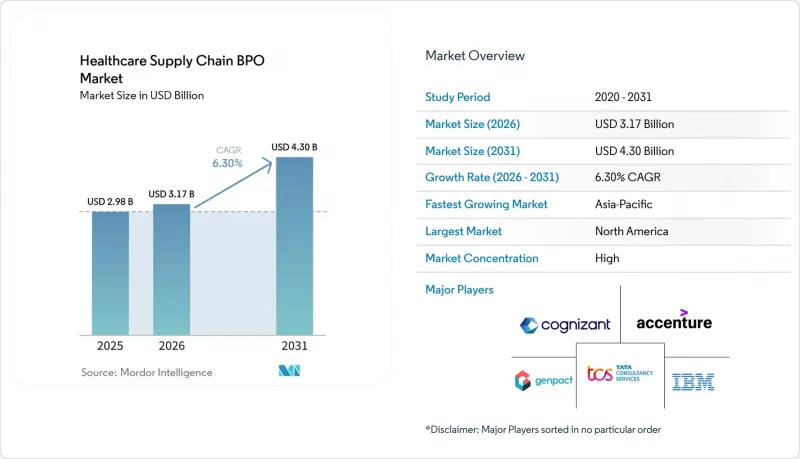
Mordor Intelligence에 의하면, 의료 공급망 BPO 시장 규모는 2025년에 29억 8,000만 달러로 평가되었고 2026년 31억 7,000만 달러에서 2031년까지 43억 달러에 이를 것으로 예측되며, 예측 기간(2026-2031년) CAGR은 6.30%를 나타낼 전망입니다.
본 보고서는 유형, 제품(재고 관리, 조달, 물류, 공급업체 관리, 주문 관리), 서비스, 기술(클라우드 기반, AI, 블록체인, RPA, IoT), 구성 요소, 용도(병원, 제약, 의료기기), 프로세스, 도입 형태, 최종 사용자, 지역(북미, 유럽, 아시아태평양, 중동 및 아프리카, 남미)별로 분류되어 있습니다. 시장 전망(금액, 달러).
세계 의료 공급망 BPO 시장 동향과 인사이트
RNA를 표적으로 하는 의약품의 임상 파이프라인 확대
2026년 중반 현재, 200개가 넘는 기관이 전 세계 올리고뉴클레오티드 임상 파이프라인에 기여하고 있으며, 이는 올리고뉴클레오티드 CDMO 시장에 다양하고 활발한 고객 기반을 제공함으로써 극소수의 후원사에 대한 의존도를 낮추고 있습니다. IND 단계 및 후기 임상시험 단계의 모든 프로그램에는 승인 및 상용화에 앞서 GMP 기준을 준수하는 자재가 필요합니다. 파이프라인은 희귀질환에 중점을 두던 이전의 추세에서 벗어나, 점점 더 대규모의 심혈관 대사 질환 부문으로 기회를 모색하고 있으며, 이로 인해 예상되는 배치 규모가 변화함에 따라 상업적 공급 계획에 대한 압박이 커지고 있습니다. 기존의 합성 체계는 확대되는 만성 질환 적응증군에서 Kg 단위에서 톤 단위로 늘어나는 수요에 대응하도록 설계되지 않았습니다.
복잡한 올리고뉴클레오티드 합성 및 충전·마감 공정에서의 아웃소싱 전환
올리고뉴클레오티드 CDMO 시장에서는 뚜렷한 아웃소싱 추세가 나타나고 있습니다. 이는 많은 혁신 기업들이 복잡한 올리고뉴클레오티드 합성을 상업적 기준에 맞추어 사내에서 관리하는 것이 어렵다고 느끼기 때문입니다. GalNAc 결합 siRNA의 제조에는 조립, 탈보호, 결합, 정제, 불순물 프로파일링에 이르는 세심한 조정이 필요하며, 각 공정에서 ICH 기준에 따라 고유한 기술적 과제가 발생합니다. 2025년 상반기까지 WuXi AppTec의 TIDES 플랫폼은 API 및 제형 서비스 분야에서 총 69종의 분자를 지원하게 되었으며, 이 수치는 불과 2년 만에 2배 이상 증가했습니다. 제품이 피하 투여나 프리필드 형태로 전환됨에 따라, 충전 및 마무리 공정의 중요성이 커지고 있으며, 단순한 API 합성을 넘어선 무균 제조 능력이 요구되고 있습니다.
장쇄 올리고뉴클레오티드의 높은 공정 복잡성과 수율에 대한 민감성
올리고뉴클레오티드 CDMO 시장은 한 번에 하나의 뉴클레오티드를 추가하는 단계적 합성 공정으로 인해 큰 기술적 과제에 직면해 있습니다. 이 방법에서는 배열이 길어질수록 효율 저하가 누적됩니다. 예를 들어, 20-mer ASO의 경우 최소 20회의 커플링 사이클이 필요하며, 단계별 효율이 높더라도 최종 수율은 현저히 떨어질 가능성이 있습니다. 이 문제는 포스포티오에이트 골격, 2'-플루오로 치환 또는 GalNAc 리간드 등의 수정이 가해지면 더욱 두드러집니다. 이는 추가적인 부작용이나 분석상의 복잡성을 초래하기 때문입니다. 펩타이드나 저분자 부문에 진출하는 공급업체들은 일정, 불순물 관리, 배치 실패의 위험을 과소평가하는 경향이 있어, 수요가 활발함에도 불구하고 생산 능력 확대가 지연되는 원인이 되고 있습니다. 그 결과, 상업적 공급은 풍부한 운영 실적을 보유한 경험 많은 기업에 계속 집중되어 있습니다.
부문별 분석
2025년에는 트랜잭션형 BPO가 전체 부문의 41.68%를 차지하며, 현재 가치 기준으로 가장 큰 계약 모델이 되었습니다. 종합적 BPO는 2031년까지 연평균 성장률(CAGR) 8.90%를 기록하며 성장할 것으로 예상되며, 의료 공급망 BPO 시장에서 가장 빠르게 성장하는 유형으로 부상하고 있습니다. 많은 병원, 지역 의료 서비스 제공업체, 유통업체들은 주문 처리나 청구서 처리와 같은 제한된 범위에서 아웃소싱을 시작하여, 표준화된 업무 흐름에 업무량을 집중시키고 있습니다.
구매 담당자들이 조달, 물류, 재고 관리, 분석을 일원화하여 관리할 수 있는 단일 파트너를 찾으면서, 포괄형 BPO 시장이 확대되고 있습니다. 의료 기관들이 서비스 성과 설정 및 공급업체에 대한 책임 추궁에 자신감을 갖게 됨에 따라, 이 모델은 점점 더 많은 지지를 얻고 있습니다. 프로세스 특화형 BPO는 업무의 전면적인 이전을 수반하지 않는 대상을 좁힌 아웃소싱을 위한 중간적인 대안으로서 여전히 존재하고 있습니다. 앞으로 공급망 기능 전반을 보다 엄격하게 관리하기 위해, 엔드투엔드 구조를 채택한 계약이 시장에서 늘어날 것으로 예측됩니다.
2025년 기준으로, 주문 관리는 제품 부문의 36.23%를 차지하며, 금액 기준으로 가장 큰 부문을 형성했습니다. 조달 서비스는 2031년까지 연평균 성장률(CAGR) 9.25%를 기록하며 가장 빠르게 성장하는 제품 부문이 될 것으로 전망됩니다. 병원과 의료 네트워크는 수천 개에 달하는 SKU에 걸친 대량의 주문을 처리하기 위해 주문 관리 시스템에 의존하고 있습니다. 이는 이러한 워크플로가 반복적이며 표준화하기 쉽기 때문입니다.
조달 서비스는 조달, 공급업체 위험 평가, 계약 준수, 지출 분석 분야에서 지원을 원하는 고객 수요가 증가함에 따라 성장하고 있습니다. 이러한 변화로 인해 수요는 부가가치가 높은 업무 지원 분야로 이동하고 있습니다. 또한, 조직이 공급업체의 다각화와 네트워크 회복력 강화를 추진하는 과정에서 물류 및 공급업체 관리 분야도 그 혜택을 누리고 있으며, 거래 중심 기능에서 전략적 기능으로의 점진적인 전환이 진행되고 있습니다.
컨설팅 서비스는 2025년에 이 부문의 36.74%를 차지하며, 매출 기준 최대의 서비스 카테고리가 되었습니다. 도입 서비스는 2031년까지 연평균 성장률(CAGR) 8.55%를 나타낼 것으로 예측되며, 서비스 유형별로는 가장 빠르게 성장할 것으로 전망됩니다. 대부분의 아웃소싱 프로그램은 평가, 설계, 프로세스 매핑, 운영 모델 수립 단계에서 시작되기 때문에 컨설팅 수요는 계속해서 견조한 추세를 보이고 있습니다.
점점 더 많은 조직이 계획 단계에서 실행 단계로 넘어가면서, 설정, 통합, 테스트, 변경 관리가 필요해짐에 따라 구현 서비스에 대한 수요도 확대되고 있습니다. 또한, 도입 후의 지속성을 중시하는 구매자가 늘어남에 따라 지원 및 유지보수 서비스의 중요성도 높아지고 있습니다. 이러한 전체 라이프사이클에 걸친 접근 방식은 디지털 공급망 기술과 관리형 서비스를 결합한 TraceLink나 Genpact와 같은 파트너십에서도 명확하게 드러납니다.
지역별 분석
2025년, 북미는 올리고뉴클레오티드 CDMO 시장에서 39.55%의 점유율을 차지했습니다. 이는 미국과 캐나다에서 RNA를 표적으로 하는 의약품 개발 기업의 강력한 입지와, 성숙한 GMP 시설에 힘입은 결과입니다. Alnylam, Ionis, Arrowhead, Wave Life Sciences와 같은 기업들은 물론, Agilent 및 Thermo Fisher Scientific과 같은 제조 부문의 선도 기업들이 이 지역 시장을 뒷받침하고 있습니다. 애지런트가 2026년에 출범한 ‘ Agilent Advanced Therapeutics”는 캐나다의 BIOVECTRA와 콜로라도주의 Nucleic Acid Solutions를 통합하여 북미의 CDMO 역량을 강화했습니다. FDA 규정에 대한 깊은 이해와 확립된 GMP 실적이 해당 지역의 입지를 더욱 공고히 하고 있지만, 전 세계적인 생산 능력 확대와 납기 측면에서의 우위가 약화됨에 따라 그 선도적 위상은 축소될 가능성이 있습니다.
유럽은 독일과 스위스가 주도하는 올리고뉴클레오티드 CDMO 시장에서 여전히 중요한 기술 거점이며, 고순도 API 제조와 지속적인 설비 투자에 중점을 두고 있습니다. BioSpring은 오펜바흐에 신설하는 핵산 API 시설에 1억 유로(1억 800만 달러) 이상을 투자하고 있으며, 이 시설은 2027년 말까지 완공될 예정입니다. Bachem은 2025년에 네트워크 확장을 위해 3억 3,260만 스위스 프랑을 배정하고, 2026년에 상업 생산을 시작하며, 2026년에는 추가로 4억 스위스 프랑의 설비 투자를 계획하고 있습니다. 론자는 2026년 매출이 11-12% 증가할 것으로 전망하고 있으며, 네덜란드 내 합성 및 항체-올리고뉴클레오티드 복합체 생산 능력을 지속적으로 강화하고 있습니다. 유럽의 강점은 기술적 전문 지식, 엄격한 규제, 까다로운 품질 요건을 충족시키는 능력에 있습니다.
아시아태평양은 올리고뉴클레오티드 CDMO 시장에서 가장 빠르게 성장하고 있는 지역으로, 중국, 한국, 일본의 생산 능력 확대에 힘입어 2031년까지 연평균 성장률(CAGR)이 24.56%를 나타낼 것으로 전망됩니다. 아신켐(Asymchem)의 톈진에 위치한 TJ4 시설은 첨단 가공 설비와 통합된 의약품 제조 시설을 갖추고 있으며, 연간 180몰의 올리고뉴클레오티드 생산 능력을 보유하고 있습니다. WuXi AppTec의 창저우와 타이싱에 위치한 API 생산 거점은 2025년에 FDA 감사를 통과하여 미국으로의 지속적인 공급이 확보되었습니다. 일본의 촉매는 GMP 기준을 준수하는 핵산 API 생산 능력을 10배로 확대되고 있습니다. 남미와 중동 및 아프리카는 여전히 신흥 시장이며, 주로 북미, 유럽, 아시아태평양의 허브에서 수입에 의존하고 있습니다.
기타 혜택
- 엑셀 형식 시장 예측(ME) 시트
- 3개월간의 애널리스트 지원
자주 묻는 질문
목차
제1장 서론
제2장 조사 방법
제3장 주요 요약
제4장 시장 구도
제5장 시장 규모와 성장 예측
제6장 경쟁 구도
제7장 시장 기회와 향후 전망
JHS 26.07.07According to Mordor Intelligence, the healthcare supply chain BPO market size was valued at USD 2.98 billion in 2025 and is estimated to grow from USD 3.17 billion in 2026 to reach USD 4.30 billion by 2031, at a CAGR of 6.30% during the forecast period (2026-2031).
This report is Segmented by Type, Product (Inventory Management, Procurement, Logistics, Supplier Management, Order Management), Services, Technology (Cloud-Based, AI, Blockchain, RPA, IoT), Component, Application (Hospitals, Pharma, Medical Devices), Process, Deployment, End User, and Geography (North America, Europe, Asia-Pacific, MEA, South America). Market Forecasts in Value (USD).
Global Healthcare Supply Chain BPO Market Trends and Insights
Expanding Clinical Pipelines For RNA-Targeted Medicines
As of mid-2026, over 200 organizations contributed to the global oligonucleotide clinical pipeline, providing the oligonucleotide CDMO market with a diverse and active customer base, reducing reliance on a select few sponsors. Every IND-stage and late-stage program requires GMP material prior to approval and commercialization. The pipeline is increasingly leaning towards larger cardiometabolic opportunities, altering expected batch sizes and intensifying the pressure on commercial supply planning, a shift from the previous focus on rare diseases. Legacy synthesis footprints weren't designed to handle demands scaling from kilograms to tonnes across an expanding array of chronic indications.
Outsourcing Shift For Complex Oligonucleotide Synthesis And Fill-Finish
The oligonucleotide CDMO market is witnessing a pronounced outsourcing trend, as many innovators find it challenging to manage complex oligonucleotide synthesis to commercial standards internally. Manufacturing GalNAc-conjugated siRNA demands meticulous coordination across assembly, deprotection, conjugation, purification, and impurity profiling, with each step introducing distinct technical challenges under ICH standards. By the first half of 2025, WuXi AppTec's TIDES platform was servicing 69 molecules for both API and drug product services, a figure that has more than doubled in just two years. The fill-finish phase is gaining prominence as products transition to subcutaneous and prefilled formats, necessitating sterile capacities beyond mere API synthesis.
High Process Complexity And Yield Sensitivity In Long-Chain Oligonucleotides
The oligonucleotide CDMO market faces a significant technical challenge due to the stepwise synthesis process, where one nucleotide is added at a time. This method results in compounded efficiency losses for longer sequences. For example, a 20-mer ASO undergoes at least 20 coupling cycles, and even with high per-step efficiency, the final yield can drop noticeably. The challenge becomes more pronounced with modifications like phosphorothioate backbones, 2'-fluoro substitutions, or GalNAc ligands, which introduce additional side reactions and analytical complexities. Providers transitioning from peptides or small molecules often underestimate timelines, impurity management, and batch failure risks, leading to slower capacity ramp-up despite strong demand. Consequently, commercial supply remains concentrated among experienced companies with extensive operational histories.
Other drivers and restraints analyzed in the detailed report include:
- Rising Demand For Precision Medicine And Rare-Disease Programs
- Scale-Up Pressure From Dual-Route Manufacturing, Clinical And GMP
- Stringent Purity, Impurity, And Potency Control Requirements
For complete list of drivers and restraints, kindly check the Table Of Contents.
Segment Analysis
In 2025, Transactional BPO accounted for 41.68% of the segment, making it the largest contract model by current value. Comprehensive BPO is projected to grow at an 8.90% CAGR through 2031, emerging as the fastest-growing type in the healthcare supply chain BPO market. Many hospitals, regional providers, and distributors start outsourcing with limited scopes like order processing and invoice support, concentrating volume in standardized workflows.
Comprehensive BPO is expanding as buyers seek single partners to manage procurement, logistics, inventory, and analytics. This model gains traction as healthcare organizations grow confident in setting service outcomes and holding vendors accountable. Process-Specific BPO remains a middle-ground option for targeted outsourcing without a full operational shift. Over time, the market is expected to see more contracts adopting end-to-end structures for tighter control across supply chain functions.
Order Management held 36.23% of the product segment in 2025, making it the largest by value. Procurement Services is projected to grow at a 9.25% CAGR through 2031, becoming the fastest-growing product area. Hospitals and healthcare networks rely on Order Management for processing large order volumes across thousands of SKUs, as these workflows are repetitive and easier to standardize.
Procurement Services are growing as clients demand support in sourcing, supplier risk assessment, contract compliance, and spend analysis. This shift moves demand toward higher-value operational support. Logistics and Supplier Management are also benefiting as organizations diversify suppliers and enhance network resilience, driving a gradual shift from transaction-heavy to strategic functions.
Consulting Services held 36.74% of the segment in 2025, making it the largest services category by revenue. Implementation Services is projected to grow at an 8.55% CAGR through 2031, becoming the fastest-growing service type. Consulting remains strong as most outsourcing programs begin with assessment, design, process mapping, and operating model planning.
Implementation is growing as more organizations move from planning to execution, requiring setup, integration, testing, and change management. Support and Maintenance Services are also gaining importance as buyers prefer continuity post-deployment. This full life cycle approach is evident in partnerships like TraceLink and Genpact, combining digital supply chain technology with managed services.
Complete Report Scope:
- By Type
- Transactional BPO
- Process-Specific BPO
- Comprehensive BPO
- By Product
- Inventory Management
- Procurement Services
- Logistics Management
- Supplier Management
- Order Management
- By Services
- Consulting Services
- Implementation Services
- Support and Maintenance Services
- By Technology
- Cloud-Based Solutions
- Artificial Intelligence
- Blockchain
- Robotic Process Automation
- Internet of Things
- By Component
- Software
- Hardware
- Services
- By Application
- Hospitals and Clinics
- Pharmaceutical Companies
- Medical Device Manufacturers
- By Process
- Order Fulfillment
- Demand Planning
- Supplier Relationship Management
- By Deployment
- On-Premise
- Cloud-Based
- Hybrid
- By End User
- Healthcare Providers
- Pharmaceutical Companies
- Medical Device Manufacturers
- By Geography
- North America
- United States
- Canada
- Mexico
- Europe
- Germany
- United Kingdom
- France
- Italy
- Spain
- Rest of Europe
- Asia-Pacific
- China
- India
- Japan
- Australia
- South Korea
- Rest of Asia-Pacific
- Middle East and Africa
- GCC
- South Africa
- Rest of Middle East and Africa
- South America
- Brazil
- Argentina
- Rest of South America
- North America
Geography Analysis
In 2025, North America held a 39.55% share of the oligonucleotide CDMO market, driven by a strong presence of RNA-targeted drug developers and mature GMP sites in the U.S. and Canada. Companies like Alnylam, Ionis, Arrowhead, and Wave Life Sciences, along with manufacturing leaders such as Agilent and Thermo Fisher Scientific, anchor the region's market. Agilent's 2026 launch of Agilent Advanced Therapeutics integrated BIOVECTRA in Canada and Nucleic Acid Solutions in Colorado, enhancing North America's CDMO capabilities. Familiarity with FDA regulations and established GMP track records further strengthen the region's position, though its lead may narrow as global capacity expands and delivery time advantages diminish.
Europe remains a key technical hub in the oligonucleotide CDMO market, led by Germany and Switzerland, with a focus on high-purity API manufacturing and sustained capital investments. BioSpring is investing over EUR 100 million (USD 108 million) in a new nucleic acid API facility in Offenbach, set for completion by late 2027. Bachem allocated CHF 332.6 million in 2025 to expand its network, initiated commercial production in 2026, and plans an additional CHF 400 million in CapEx for 2026. Lonza projects 11-12% sales growth for 2026 and continues to enhance its synthesis and antibody-oligonucleotide conjugate capabilities in the Netherlands. Europe's strength lies in its technical expertise, regulatory rigor, and ability to meet stringent quality demands.
Asia-Pacific is the fastest-growing region in the oligonucleotide CDMO market, with a 24.56% CAGR through 2031, driven by capacity expansions in China, South Korea, and Japan. Asymchem's TJ4 facility in Tianjin offers 180 mol per year of oligonucleotide capacity, supported by advanced processing tools and an integrated drug product facility. WuXi AppTec's API sites in Changzhou and Taixing passed FDA inspections in 2025, ensuring continued U.S. supply. Japan's Nippon Shokubai is expanding its GMP-compliant nucleic acid API capacity tenfold. South America and the Middle East & Africa remain emerging markets, primarily relying on imports from North America, Europe, and Asia-Pacific hubs.
- Accenture
- Capgemini
- Cardinal Health
- Cognizant
- Conduent Incorporated
- Coupa Software Incorporated
- EXLService Holdings, Inc.
- Firstsource Solutions Limited
- GeBBS Healthcare Solutions, Inc.
- Genpact
- Global Healthcare Exchange, LLC
- HCL Technologies Limited
- IBM
- Infosys
- JAGGAER, LLC
- Mckesson
- NTT DATA Group Corporation
- Premier, Inc.
- Sutherland Global Services, Inc.
- Tata Consultancy Services
- Tech Mahindra Limited
- Vizient
- Wipro
- WNS (Holdings) Limited
Additional Benefits:
- The market estimate (ME) sheet in Excel format
- 3 months of analyst support
TABLE OF CONTENTS
1 INTRODUCTION
- 1.1 Study Assumptions and Market Definition
- 1.2 Scope of the Study
2 RESEARCH METHODOLOGY
3 EXECUTIVE SUMMARY
4 MARKET LANDSCAPE
- 4.1 Market Overview
- 4.2 Market Drivers
- 4.2.1 Growing Outsourcing Pressure From Healthcare Procurement Complexity
- 4.2.2 Demand for Inventory Visibility Across Multi-Tier Supplier Networks
- 4.2.3 Shift Toward Cloud-Enabled Process Orchestration and Analytics
- 4.2.4 Regulatory Traceability Requirements for Pharmaceuticals and Medical Devices
- 4.2.5 Provider Need to Reduce Working Capital Locked in Supply Chains
- 4.2.6 Cross-Border Supply Chain Resilience and Nearshoring Programs
- 4.3 Market Restraints
- 4.3.1 Data Privacy and Contractual Risk Concerns in Outsourced Operations
- 4.3.2 Integration Friction With Legacy ERP, EDI, and Warehouse Systems
- 4.3.3 Limited Process Standardization Across Provider and Supplier Networks
- 4.3.4 Talent Dependence for Domain-Specific Healthcare Supply Chain Workflows
- 4.4 Value and Supply Chain Analysis
- 4.5 Regulatory Landscape
- 4.6 Technological Outlook
- 4.7 Porter's Five Forces Analysis
- 4.7.1 Threat of New Entrants
- 4.7.2 Bargaining Power of Suppliers
- 4.7.3 Bargaining Power of Buyers
- 4.7.4 Threat of Substitutes
- 4.7.5 Competitive Rivalry
5 MARKET SIZE AND GROWTH FORECASTS (VALUE, USD)
- 5.1 By Type
- 5.1.1 Transactional BPO
- 5.1.2 Process-Specific BPO
- 5.1.3 Comprehensive BPO
- 5.2 By Product
- 5.2.1 Inventory Management
- 5.2.2 Procurement Services
- 5.2.3 Logistics Management
- 5.2.4 Supplier Management
- 5.2.5 Order Management
- 5.3 By Services
- 5.3.1 Consulting Services
- 5.3.2 Implementation Services
- 5.3.3 Support and Maintenance Services
- 5.4 By Technology
- 5.4.1 Cloud-Based Solutions
- 5.4.2 Artificial Intelligence
- 5.4.3 Blockchain
- 5.4.4 Robotic Process Automation
- 5.4.5 Internet of Things
- 5.5 By Component
- 5.5.1 Software
- 5.5.2 Hardware
- 5.5.3 Services
- 5.6 By Application
- 5.6.1 Hospitals and Clinics
- 5.6.2 Pharmaceutical Companies
- 5.6.3 Medical Device Manufacturers
- 5.7 By Process
- 5.7.1 Order Fulfillment
- 5.7.2 Demand Planning
- 5.7.3 Supplier Relationship Management
- 5.8 By Deployment
- 5.8.1 On-Premise
- 5.8.2 Cloud-Based
- 5.8.3 Hybrid
- 5.9 By End User
- 5.9.1 Healthcare Providers
- 5.9.2 Pharmaceutical Companies
- 5.9.3 Medical Device Manufacturers
- 5.10 By Geography
- 5.10.1 North America
- 5.10.1.1 United States
- 5.10.1.2 Canada
- 5.10.1.3 Mexico
- 5.10.2 Europe
- 5.10.2.1 Germany
- 5.10.2.2 United Kingdom
- 5.10.2.3 France
- 5.10.2.4 Italy
- 5.10.2.5 Spain
- 5.10.2.6 Rest of Europe
- 5.10.3 Asia-Pacific
- 5.10.3.1 China
- 5.10.3.2 India
- 5.10.3.3 Japan
- 5.10.3.4 Australia
- 5.10.3.5 South Korea
- 5.10.3.6 Rest of Asia-Pacific
- 5.10.4 Middle East and Africa
- 5.10.4.1 GCC
- 5.10.4.2 South Africa
- 5.10.4.3 Rest of Middle East and Africa
- 5.10.5 South America
- 5.10.5.1 Brazil
- 5.10.5.2 Argentina
- 5.10.5.3 Rest of South America
- 5.10.1 North America
6 COMPETITIVE LANDSCAPE
- 6.1 Market Concentration
- 6.2 Market Share Analysis
- 6.3 Company Profiles (includes Global Level Overview, Market Level Overview, Core Segments, Financials as available, Strategic Information, Market Rank/Share, Products and Services, Recent Developments)
- 6.3.1 Accenture plc
- 6.3.2 Capgemini SE
- 6.3.3 Cardinal Health, Inc.
- 6.3.4 Cognizant Technology Solutions Corporation
- 6.3.5 Conduent Incorporated
- 6.3.6 Coupa Software Incorporated
- 6.3.7 EXLService Holdings, Inc.
- 6.3.8 Firstsource Solutions Limited
- 6.3.9 GeBBS Healthcare Solutions, Inc.
- 6.3.10 Genpact Limited
- 6.3.11 Global Healthcare Exchange, LLC
- 6.3.12 HCL Technologies Limited
- 6.3.13 IBM Corporation
- 6.3.14 Infosys Limited
- 6.3.15 JAGGAER, LLC
- 6.3.16 McKesson Corporation
- 6.3.17 NTT DATA Group Corporation
- 6.3.18 Premier, Inc.
- 6.3.19 Sutherland Global Services, Inc.
- 6.3.20 Tata Consultancy Services Limited
- 6.3.21 Tech Mahindra Limited
- 6.3.22 Vizient, Inc.
- 6.3.23 Wipro Limited
- 6.3.24 WNS (Holdings) Limited
7 MARKET OPPORTUNITIES AND FUTURE OUTLOOK
- 7.1 White-Space and Unmet-Need Assessment


