|
시장보고서
상품코드
2073047
고순도 구연산 시장 : 점유율 분석, 업계 동향과 통계, 성장 예측(2026-2031년)High-Purity Citric Acid - Market Share Analysis, Industry Trends & Statistics, Growth Forecasts (2026 - 2031) |
||||||
 Mordor Intelligence
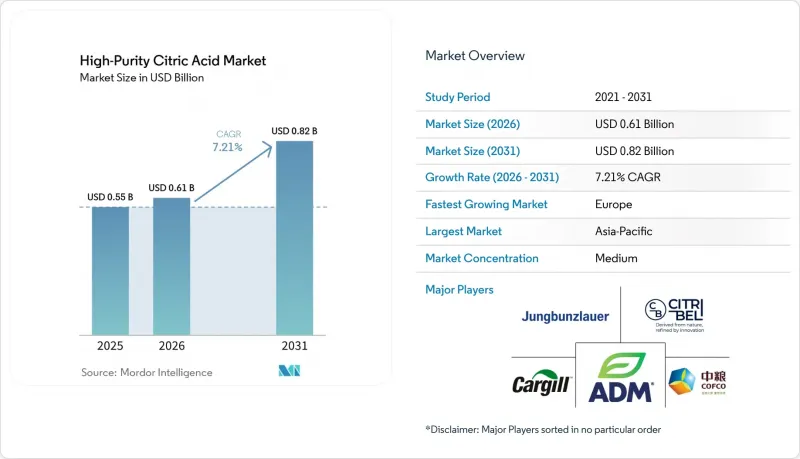
Mordor Intelligence에 의하면, 고순도 구연산 시장 규모는 2025년 5억 5,000만 달러에서 2026년에는 6억 1,000만 달러로 확대되어 2031년까지 8억 2,000만 달러에 이를 것으로 예상되고 있어 2026-2031년까지 CAGR 7.2%로 성장할 전망입니다.
본 보고서는 순도 등급(의약품 등급, 식품 등급, 산업용 등급), 형태(분말/결정, 액체), 용도(식품 및 음료, 의약품, 화장품 및 퍼스널케어, 분석·실험실용, 기타), 지역(북미, 유럽, 아시아태평양, 남미, 기타)별로 분류되어 있습니다. 시장 전망은 금액(달러) 기준으로 제시되어 있습니다.
세계 고순도 구연산 시장 동향 및 인사이트
의약품 첨가제 및 경구 제제에서의 활용 확대
제약 산업에서 구연산은 단순한 산미료에서 벗어나, 더 폭넓고 중요한 기능을 수행하는 존재로 자리매김했습니다. 현재는 킬레이트제로 널리 사용되고 있으며, 정제, 시럽, 경구용 액제에 함유된 민감한 유효 성분을 금속 이온에 의한 열화로부터 효과적으로 보호하고 있습니다. 이러한 역할의 확대는 의약품의 안정성과 유효성을 확보하는 데 있어 구연산의 중요성을 여실히 보여주고 있습니다. 또한, 주요 규제 시장에서는 의약품 허가 신청 시 USP 및 EP 기준을 준수하는 원료의 사용이 의무화되어 있으며, 인증된 고순도 제품과 저등급 대체품 사이에 명확한 구분이 마련되어 있습니다. 고순도 구연산 시장은 용해도가 낮은 의약품의 제형 개선에 활용되면서 성장을 거듭하고 있습니다. 신약 개발의 중요한 과제인 생체이용률 향상을 도모하기 위해, 구연산염을 기반으로 한 시스템이 점점 더 많이 채택되고 있습니다. 규정 준수를 지원하고 제제 성능을 향상시키는 이 두 가지 기능 덕분에, 제약 부문에서 고순도 구연산에 대한 수요는 꾸준하고 지속적이고 있습니다.
생명공학 분야의 발효 배지 및 세포 배양 용도로의 활용 확대
엄격하게 관리되는 원료에 의존하는 생명공학 공정은 고순도 구연산 시장의 성장을 주도하는 데 중요한 역할을 하고 있습니다. 발효 배지나 세포 배양 시스템에서 구연산은 탄소원으로서의 역할, 킬레이트제로서의 작용, pH 수준 안정화 등 여러 가지 중요한 기능을 수행하고 있습니다. 이러한 다기능성 덕분에 대체품을 사용할 가능성은 낮아집니다. 왜냐하면 업스트림 및 하류 바이오의약품 제조 공정에서 비용 관리와 마찬가지로 공정의 일관성을 유지하는 것이 매우 중요하기 때문입니다. 또한, 비전통적 효모에 대한 지속적인 연구와 유기산의 생물학적 생산 분야의 발전으로 인해, 구연산염 기반 첨가제를 효과적으로 활용할 수 있는 시스템의 범위가 확대되고 있습니다. 그 결과, 범용 구연산 가격이 여전히 하락 압력을 받고 있는 상황에서도 고순도 구연산 시장은 생명공학 부문의 급속한 확대로 인해 계속해서 혜택을 보고 있습니다.
높은 제조·정제 비용
고순도 구연산의 제조에는 의약품 등급 및 프리미엄 식품 등급에 대한 엄격한 요건으로 인해 높은 비용이 수반됩니다. 이러한 등급의 제품에서는 다단계 결정화, 이온 교환 정제, 종합적인 중금속 검사 등 고도의 공정이 필수적이며, 이 모든 요소가 저등급 구연산에 비해 제조 비용을 크게 끌어올리고 있습니다. 중국 이외의 생산자들은 원자재 통합이 미흡한 데서 비롯된 구조적인 높은 비용, 에너지 비용의 급등, 더욱 엄격해진 규정 준수 요건 등 추가적인 과제에 직면하는 경우가 많습니다. 그 결과, 시장에서는 더 큰 규모의 생산량을 통해 정제 및 검사 비용을 분산시켜 높은 비용 효율성을 실현할 수 있는 대규모 통합 공급업체들이 점점 더 유리한 입지를 차지하고 있습니다. 소규모 사업자는 여전히 틈새 시장에서 경쟁할 수 있지만, 가격 결정에 미치는 영향력은 사업 규모나 인증 범위에 따라 점차 좌우되고 있으며, 이러한 요소들은 경쟁력을 유지하기 위한 중요한 요소로 자리 잡고 있습니다.
부문별 분석
2025년 기준으로, 의약품 등급은 시장 점유율의 51.38%를 차지하며 고순도 구연산 시장에서 가장 큰 순도 부문이 되었습니다. 이러한 지위는 규제 대상 의약품의 경우 USP, EP, JP 또는 이와 유사한 규격에 부합하는 원료가 요구된다는 사실을 반영하고 있으며, 이로 인해 수요는 비교적 안정적인 임베디드니다. 고순도 구연산 시장은 경구용 및 비경구용 제제에서 부형제의 성능과 복용 순응도가 모두 필수적이기 때문에 계속해서 의약품 용도를 주축으로 하고 있습니다. 여러 약전 인증을 취득한 공급업체는 전 세계 바이어들이 수행하는 적격성 평가의 복잡성을 줄일 수 있으므로 경쟁 우위를 점할 수 있습니다.
식품 등급은 2026년부터 2031년까지 연평균 성장률(CAGR) 8.68%를 나타낼 것으로 예측되며, 고순도 구연산 시장에서 가장 빠르게 성장하는 순도 부문이 될 것입니다. 이러한 성장은 의약품 부문의 우위를 약화시키는 것이 아닙니다. 이러한 성장세의 상당 부분은 규격 기준이 마찬가지로 엄격한 유아용 분유, 임상 영양, 영양 보충제 등의 용도에서 비롯된 것입니다. 따라서 고순도 구연산 산업에서는 고급 식품 용도와 의약품 관련 품질 요건 사이에 더 많은 공통점이 나타나고 있습니다. 산업용 등급은 프리미엄 수요를 결정짓는 순도나 문서화 요건에 대한 최종 용도의 민감도가 낮기 때문에 본 조사 범위 내에서는 여전히 규모가 작은 상태입니다. 부문별 구성을 살펴보면, 수량 기준 성장은 확대되는 추세를 보이고 있는 반면, 가치 창출은 여전히 인증의 심도에 크게 좌우되고 있음을 알 수 있습니다.
지역별 분석
2025년, 아시아태평양은 시장 점유율의 42.64%를 차지하며 고순도 구연산 시장에서 1위를 차지하고 있습니다. 이 지역은 대규모 발효 생산 능력과 의약품 및 식품 가공 부문에서 나오는 견조한 하류 수요를 모두 갖추고 있습니다. 중국은 원료 조달의 용이성, 발효 규모, 비용 효율성을 뒷받침하는 통합적인 제조 체제 등 생산 시스템의 강점을 활용하고 있기 때문에 여전히 핵심적인 위치를 차지하고 있습니다. 인도는 대규모 의약품 제형 기반과 규제 대상 제품에 사용되는 인증된 부형제에 대한 지속적인 수요를 통해 해당 지역 수요를 견인하고 있습니다. 따라서 아시아태평양의 고순도 구연산 시장은 강력한 생산 능력과 확대되는 현지 소비를 모두 반영하고 있습니다.
유럽은 2026년부터 2031년까지 연평균 성장률(CAGR) 8.15%를 기록하며 성장할 것으로 예상되며, 고순도 구연산 시장에서 가장 빠르게 성장하는 지역 부문이 될 전망입니다. 수요는 엄격하게 문서화된 공급 체계와 인증된 등급을 중시하는 의약품, 기능성 식품, 고급 식품, 퍼스널케어 부문의 구매자들에 의해 뒷받침되고 있습니다. 또한, 이 지역에서는 최근 몇 년간의 운송 및 공급 차질로 인해 신뢰할 수 있는 조달처가 더욱 중요시되고 있습니다. 따라서 유럽의 고순도 구연산 시장은 저비용 생산보다는 품질 보증과 조달 전략을 바탕으로 성장하고 있습니다.
북미는 주요 국내 원료 제조업체가 존재하고, 제약 및 식품 부문의 고객 기반도 넓기 때문에 고순도 구연산 시장에서 여전히 중요한 위치를 차지하고 있습니다. 2025년 융분츠라우어사가 일리노이주의 시설 인수를 완료하고, 프리미엄 원료의 미국 내 생산 거점을 구축함에 따라, 전략적 투자가 이 지역의 모습을 새롭게 바꾸고 있습니다. 남미, 중동 및 아프리카는 현재 규모는 작지만, 식품 가공의 확대와 지역 내 의약품 무역 흐름을 통해 수요가 지속적으로 증가하고 있습니다. 이 지역들의 고순도 구연산 시장은 여전히 성숙도가 낮은 편이지만, 수요 증가는 전 세계적으로 더 광범위한 고객 기반을 뒷받침하고 있습니다.
기타 혜택
- 엑셀 형식 시장 예측(ME) 시트
- 3개월간의 애널리스트 지원
자주 묻는 질문
목차
제1장 서론
제2장 조사 방법
제3장 주요 요약
제4장 시장 구도
제5장 시장 규모와 성장 예측
제6장 경쟁 구도
제7장 시장 기회와 향후 전망
JHS 26.07.07According to Mordor Intelligence, the high-purity citric acid market size is expected to increase from USD 0.55 billion in 2025 to USD 0.61 billion in 2026 and reach USD 0.82 billion by 2031, growing at a CAGR of 7.2% over 2026-2031.
This report is Segmented by Purity Grade (Pharma Grade, Food Grade, and Industrial Grade), Form (Powder/Crystalline and Liquid), Application (Food and Beverages, Pharmaceuticals, Cosmetics and Personal Care, Analytical and Laboratory Use, and Others), and Geography (North America, Europe, Asia-Pacific, South America, and More). The Market Forecasts are Provided in Terms of Value (USD).
Global High-Purity Citric Acid Market Trends and Insights
Growing Use in Pharmaceutical Excipients and Oral Drug Formulations
In the pharmaceutical industry, citric acid has transitioned from being merely an acidulant to serving a broader range of critical functions. It is now widely utilized as a chelating agent, effectively protecting sensitive active ingredients in tablets, syrups, and oral liquid formulations from degradation caused by metal ions. This expanded role highlights its importance in ensuring the stability and efficacy of drug products. Additionally, major regulated markets mandate the use of USP and EP-compliant materials in pharmaceutical filings, creating a clear distinction between certified high-purity supplies and lower-grade alternatives. The high-purity citric acid market is also experiencing growth due to its application in reformulating low-solubility drugs. Citrate-based systems are increasingly employed to enhance bioavailability, addressing a key challenge in drug development. This dual capability of supporting regulatory compliance and improving formulation performance ensures a steady and durable demand for high-purity citric acid in the pharmaceutical sector.
Rising Use in Biotechnology Fermentation Media and Cell Culture Applications
Biotechnology processes, which depend on tightly controlled raw materials, play a significant role in driving the high purity citric acid market. In fermentation media and cell culture systems, citric acid performs multiple critical functions, including serving as a carbon source, acting as a chelation aid, and stabilizing pH levels. This multifunctionality reduces the likelihood of substitution, as maintaining process consistency is as crucial as managing costs in both upstream and downstream biologics operations. Furthermore, ongoing research into non-conventional yeasts and advancements in organic acid bioproduction are expanding the range of systems that can effectively utilize citrate-based supplementation. As a result, the high purity citric acid market continues to benefit from the rapid expansion of the biotechnology sector, even in scenarios where commodity citric acid prices remain under pressure.
High Production and Purification Costs
Producing high-purity citric acid involves high costs due to the stringent requirements for pharmaceutical and premium food grades. These grades necessitate advanced processes such as multi-stage crystallization, ion exchange purification, and comprehensive heavy metals testing, all of which substantially increase production expenses compared to lower-grade citric acid. Producers outside China often face additional challenges, including higher structural costs stemming from weaker feedstock integration, elevated energy expenses, and stricter compliance requirements. Consequently, the market increasingly favors larger, integrated suppliers capable of spreading purification and testing costs across higher production volumes, thereby achieving greater cost efficiency. Although smaller players can still compete in niche segments, their ability to influence pricing is progressively determined by their scale of operations and the breadth of their certifications, which are becoming critical factors in maintaining competitiveness.
Other drivers and restraints analyzed in the detailed report include:
- Increasing Use in Premium Confectionery and Sugar-Free Candies
- Growing Use in Effervescent Tablets and Powders
- Supply Chain Disruptions for Feedstocks
For complete list of drivers and restraints, kindly check the Table Of Contents.
Segment Analysis
Pharma Grade held 51.38% of the market in 2025, which made it the largest purity segment in the high-purity citric acid market. This position reflects the fact that regulated drug products require material aligned with USP, EP, JP, or similar standards, which keeps demand relatively captive. The high-purity citric acid market continues to rely on pharmaceutical use as an anchor because excipient performance and compliance are both essential in oral and parenteral formulations. Suppliers with multi-compendial certification hold an advantage because they reduce qualification complexity for global buyers.
Food Grade is projected to grow at an 8.68% CAGR from 2026 to 2031, which makes it the fastest-growing purity segment in the high-purity citric acid market. This rise does not weaken the pharmaceutical premium because much of the momentum comes from applications such as infant formula, clinical nutrition, and nutraceutical products, where specification standards are also strict. The high-purity citric acid industry is therefore seeing more overlap between advanced food applications and pharma-linked quality expectations. Industrial Grade remains smaller within this report's scope because its end uses are less sensitive to the purity and documentation requirements that define premium demand. The segment mix shows that volume growth is broadening, while value capture still depends heavily on certification depth.
Complete Report Scope:
- By Purity Grade
- Pharma Grade
- Food Grade
- Industrial Grade
- By Form
- Powder/Crystalline
- Liquid
- By Application
- Food and Beverages
- Pharmaceuticals
- Cosmetics and Personal Care
- Analytical and Laboratory Use
- Others
- By Geography
- North America
- United States
- Canada
- Mexico
- Rest of North America
- Europe
- Germany
- United Kingdom
- France
- Italy
- Spain
- Netherlands
- Sweden
- Rest of Europe
- Asia-Pacific
- China
- India
- Japan
- Australia
- South Korea
- Rest of Asia-Pacific
- South America
- Brazil
- Argentina
- Rest of South America
- Middle East and Africa
- United Arab Emirates
- South Africa
- Rest of Middle East and Africa
- North America
Geography Analysis
Asia-Pacific held 42.64% of the market in 2025, giving it the leading position in the high-purity citric acid market. The region combines large-scale fermentation capacity with strong downstream demand from pharmaceuticals and food processing. China remains central because its production system benefits from feedstock access, fermentation scale, and integrated manufacturing structures that support cost efficiency. India strengthens the regional demand picture through its large pharmaceutical formulation base and continuing need for certified excipients in regulated products. The high-purity citric acid market in Asia-Pacific therefore reflects both production strength and expanding local consumption.
Europe is projected to grow at an 8.15% CAGR from 2026 to 2031, making it the fastest-growing regional segment in the high-purity citric acid market. Demand is being supported by pharmaceutical, nutraceutical, premium food, and personal care buyers who value tightly documented supply and certified grades. The region also places a higher premium on dependable sourcing after recent years of freight and supply disruption. The high-purity citric acid market in Europe is therefore growing on quality assurance and sourcing strategy rather than on low cost production.
North America remains an important part of the high purity citric acid market because it has major domestic ingredient producers and a large base of pharmaceutical and food customers. Strategic investment is reshaping the region, as Jungbunzlauer closed its Illinois facility acquisition in 2025 to establish a U.S. manufacturing footprint for premium ingredients. South America and the Middle East and Africa are smaller in current scale, but they continue to add demand through food processing expansion and regional pharmaceutical trade flows. The high purity citric acid market across these regions remains less mature, yet their incremental demand supports a broader global customer base.
- Jungbunzlauer Suisse AG
- Cargill, Incorporated
- Archer Daniels Midland Company
- COFCO Biotechnology Co., Ltd.
- TTCA CO., LTD.
- Shandong Ensign Industry Co., Ltd.
- Citribel NV
- Gadot Biochemical Industries Ltd.
- RZBC Group Co., Ltd.
- Huangshi Xinghua Biochemical Co., Ltd.
- Foodchem International Corporation
- Merck KGaA
- Brenntag SE
- Roquette Freres
- Tate and Lyle PLC
- Corbion N.V.
- Xitrical Co., Ltd.
- ECSA Chemicals AG
- Hubei Xingfa Chemicals Group Co., Ltd.
- Jiangsu Guoxin Union Energy Co., Ltd.
Additional Benefits:
- The market estimate (ME) sheet in Excel format
- 3 months of analyst support
TABLE OF CONTENTS
1 INTRODUCTION
- 1.1 Study Assumptions and Market Definition
- 1.2 Scope of the Study
2 RESEARCH METHODOLOGY
3 EXECUTIVE SUMMARY
4 MARKET LANDSCAPE
- 4.1 Market Overview
- 4.2 Market Drivers
- 4.2.1 Growing Use in Pharmaceutical Excipients and Oral Drug Formulations
- 4.2.2 Rising Use in Biotechnology Fermentation Media and Cell Culture Applications
- 4.2.3 Increasing Use in Premium Confectionery and Sugar-Free Candies
- 4.2.4 Growing Use in Effervescent Tablets and Powders
- 4.2.5 Increasing Demand from Infant Formula and Clinical Nutrition Products
- 4.2.6 Nutraceutical Gummies and Dietary Supplements Facing Stronger Demand
- 4.3 Market Restraints
- 4.3.1 High Production and Purification Costs
- 4.3.2 Supply Chain Disruptions for Feedstocks
- 4.3.3 Competition from Alternative Acidulants
- 4.3.4 Stringent Regulatory Compliance Requirements
- 4.4 Supply Chain Analysis
- 4.5 Regulatory Landscape
- 4.6 Technological Outlook
- 4.7 Porter's Five Forces
- 4.7.1 Bargaining Power of Suppliers
- 4.7.2 Bargaining Power of Buyers
- 4.7.3 Threat of New Entrants
- 4.7.4 Threat of Substitutes
- 4.7.5 Competitive Rivalry
5 MARKET SIZE AND GROWTH FORECASTS (VALUE)
- 5.1 By Purity Grade
- 5.1.1 Pharma Grade
- 5.1.2 Food Grade
- 5.1.3 Industrial Grade
- 5.2 By Form
- 5.2.1 Powder/Crystalline
- 5.2.2 Liquid
- 5.3 By Application
- 5.3.1 Food and Beverages
- 5.3.2 Pharmaceuticals
- 5.3.3 Cosmetics and Personal Care
- 5.3.4 Analytical and Laboratory Use
- 5.3.5 Others
- 5.4 By Geography
- 5.4.1 North America
- 5.4.1.1 United States
- 5.4.1.2 Canada
- 5.4.1.3 Mexico
- 5.4.1.4 Rest of North America
- 5.4.2 Europe
- 5.4.2.1 Germany
- 5.4.2.2 United Kingdom
- 5.4.2.3 France
- 5.4.2.4 Italy
- 5.4.2.5 Spain
- 5.4.2.6 Netherlands
- 5.4.2.7 Sweden
- 5.4.2.8 Rest of Europe
- 5.4.3 Asia-Pacific
- 5.4.3.1 China
- 5.4.3.2 India
- 5.4.3.3 Japan
- 5.4.3.4 Australia
- 5.4.3.5 South Korea
- 5.4.3.6 Rest of Asia-Pacific
- 5.4.4 South America
- 5.4.4.1 Brazil
- 5.4.4.2 Argentina
- 5.4.4.3 Rest of South America
- 5.4.5 Middle East and Africa
- 5.4.5.1 United Arab Emirates
- 5.4.5.2 South Africa
- 5.4.5.3 Rest of Middle East and Africa
- 5.4.1 North America
6 COMPETITIVE LANDSCAPE
- 6.1 Market Concentration
- 6.2 Strategic Moves
- 6.3 Market Ranking Analysis
- 6.4 Company Profiles (Includes Global-level Overview, Market-level Overview, Core Segments, Financials, Strategic Info, Market Rank/Share, Products & Services, Recent Developments)
- 6.4.1 Jungbunzlauer Suisse AG
- 6.4.2 Cargill, Incorporated
- 6.4.3 Archer Daniels Midland Company
- 6.4.4 COFCO Biotechnology Co., Ltd.
- 6.4.5 TTCA CO., LTD.
- 6.4.6 Shandong Ensign Industry Co., Ltd.
- 6.4.7 Citribel NV
- 6.4.8 Gadot Biochemical Industries Ltd.
- 6.4.9 RZBC Group Co., Ltd.
- 6.4.10 Huangshi Xinghua Biochemical Co., Ltd.
- 6.4.11 Foodchem International Corporation
- 6.4.12 Merck KGaA
- 6.4.13 Brenntag SE
- 6.4.14 Roquette Freres
- 6.4.15 Tate and Lyle PLC
- 6.4.16 Corbion N.V.
- 6.4.17 Xitrical Co., Ltd.
- 6.4.18 ECSA Chemicals AG
- 6.4.19 Hubei Xingfa Chemicals Group Co., Ltd.
- 6.4.20 Jiangsu Guoxin Union Energy Co., Ltd.