|
시장보고서
상품코드
2073064
R-142b 시장 : 점유율 분석, 업계 동향과 통계, 성장 예측(2026-2031년)R-142b - Market Share Analysis, Industry Trends & Statistics, Growth Forecasts (2026 - 2031) |
||||||
 Mordor Intelligence
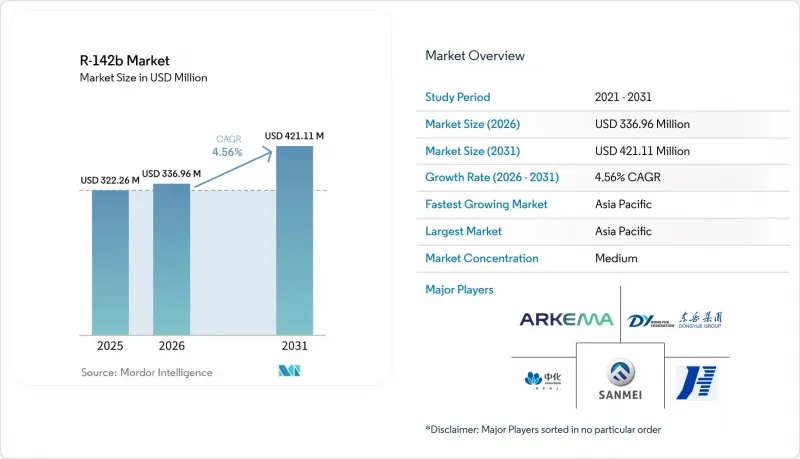
Mordor Intelligence에 의하면, R-142b 시장 규모는 2025년에 3억 2,226만 달러, 2026년에 3억 3,696만 달러되어, 2031년까지 4억 2,111만 달러에 이를 것으로 예측되며, 2026년부터 2031년까지 CAGR 4.56%로 성장할 전망입니다.
본 보고서는 용도별(공조, 냉동, 발포), 순도 등급별(99.9% 이상(고순도) 및 99.9% 미만(공업용)), 지역별(아시아태평양, 북미, 유럽, 남미, 중동 및 아프리카)로 분류되어 있습니다. 시장 전망은 금액(달러) 기준으로 제시되어 있습니다.
전 세계 R-142b 시장 동향 및 분석
리튬 이온 배터리 기가팩토리에서 PVDF 바인더 수요 증가
배터리 기가팩토리 건설은 R-142b 시장의 중요한 촉진요인으로 작용하고 있습니다. 리튬철인산염 배터리의 화학 조성상, 1메가와트시당 1.5-2Kg의 폴리비닐리덴플루오라이드(PVDF) 바인더가 필요하기 때문에 연간 850-1,130톤의 R-142b 원료에 대한 추가 수요가 발생합니다. 알케마사의 칼버트 시티 사업장 확장 및 크레하사의 이와키 신규 생산 라인 가동으로 인해, 2026년 중반까지 PVDF의 정격 생산 능력이 총 2만 3,000톤 이상 증가하게 될 것입니다. 또한, 국제금융공사(IFC)가 2025년 12월 구자라트 플루오로케미컬스 리미티드(GFCL)의 전기차 제품 부문에 대한 투자를 단행한 것은 인도가 배터리 등급 PVDF 공급망에 진출했음을 보여줍니다. 바인더의 사양은 Kynar HSV 900과 같은 불소계 계면활성제를 포함하지 않는 등급으로 점점 더 전환되고 있으며, 이를 통해 에너지 밀도를 높일 수 있어 고가로 판매할 수 있게 됩니다. 그 결과, R-142b 시장의 점점 더 큰 비중이 현물 시장에서의 냉매 판매가 아닌, 장기적인 배터리용 임베디드 계약으로 이어지고 있습니다.
중국과 인도에서의 불소화학물제품 생산 능력 통합 확대
2024년부터 2026년까지 중국과 인도에서 연간 12만 톤을 초과하는 불소화학물제품의 생산 능력이 가동을 시작했으며, 시판 원료 모델과 비교해 전환 비용을 최대 22% 절감했습니다. SRF Limited의 8억 9,400만 달러 규모의 다헤지 콤플렉스나, Gujarat Fluorochemicals Limited의 약 3만 톤 규모의 자사 전용 R-142b 생산 능력 계획과 같은 프로젝트들은 R-142b 시장에서 후방 통합으로의 전환을 여실히 보여주고 있습니다. 중국의 생산자들은 보조금이 지급되는 형석 채굴과 저비용 에너지라는 혜택을 누리고 있으며, 물류비와 관세를 고려한 후에도 경쟁력 있는 수출 우위를 확보하고 있습니다. 또한, 다이킨이 2026년 1월에 "다이킨 케미컬 인디아 프라이빗 리미티드" 회사를 설립한 것은 인도에서 지속적으로 성장하고 있는 반도체 및 배터리 산업을 지원하기 위한 것으로, 향후 R-142b의 현지 수요를 견인할 가능성이 있습니다. 이러한 통합적인 생산 능력의 확대는 전 세계의 비용 구조를 재편하고, 시장 경쟁을 심화시키고 있습니다.
몬트리올 의정서에 따른 비원료 용도의 단계적 폐지
선진국은 2030년까지 HCFC 생산을 중단해야 할 의무가 있으며, 제5조 국가들도 2040년까지 이에 따라야 합니다. 이로 인해 예측 기간 동안 기존 냉매 및 발포제 수요가 35-40% 감소하게 될 것입니다. 중국은 2026년 국내 HCFC 할당량을 1만 2,200톤 감축할 계획이며, 2027년 1월까지 VRF 시스템에서 HCFC-22를 단계적으로 폐지할 예정입니다. 이로 인해, 기존에 R-142b를 흡수하던 주요 혼합 성분이 시장에서 퇴출될 것입니다. 미국에서는 2027년부터 GWP 지수가 높은 HFC를 사용하는 새로운 VRF 기기의 사용이 금지됨에 따라, 최종 시장 수요량이 더욱 제한될 것입니다. 유럽연합(EU) 규정 2024/573에 따르면, 2030년 이후 GWP가 150 이상인 냉매를 사용한 기기의 유지보수가 금지됨에 따라, R-142b를 다량 함유한 혼합 냉매에 의존하는 시스템 내의 재고가 정체될 것입니다. 또한, 누출 수리 기준이 강화됨에 따라 보충량이 감소하여 냉매 수요가 줄어들 것으로 예측됩니다.
부문별 분석
2025년, 냉동 분야는 R-142b 시장 점유율의 47.82%를 차지했습니다. 그러나 2029년 1월부터 슈퍼마켓 시스템에 대해 회수된 냉매만을 사용한 정비를 의무화하는 미국 환경보호청(EPA)의 규제로 인해 그 성장은 제한되고 있습니다. 총 수요의 약 5분의 1을 차지하는 공조 분야는 효율 및 지구온난화지수(GWP) 요건을 충족하기 위해 OEM(주문자 상표 제조업체)이 R-32나 R-454B 등의 대체 냉매로 전환하고 있는 탓에 축소 추세를 보이고 있습니다. 발포제 용도는 규모가 작지만, 중국의 폴리우레탄 제조업체들이 2028년까지 하이드로클로로플루오로카본-141b(HCFC-141b)를 단계적으로 폐지함에 따라 연평균 성장률(CAGR) 4.78%로 가장 빠른 성장이 예상됩니다. 또한, 폴리비닐리덴플루오라이드(PVDF) 및 폴리비닐플루오라이드(PVF) 원료에 대한 수요가 급속히 증가하고 있으며, 이로 인해 고순도 R-142b 분자가 범용 용도에서 다른 용도로 전환되고 있습니다. 2028년까지 예상되는 PVDF 생산 능력 증가에 따라 12,000-1만 5,000톤의 R-142b 원료가 추가로 필요하게 되며, 시장의 관심은 특수 폴리머로 더욱 이동하게 될 것입니다.
원료의 용도가 확대되는 가운데, 각 생산 업체들은 배터리 및 반도체 제조업체와의 장기 공급 계약을 우선시하고 있습니다. 이러한 계약에는 가치를 극대화하기 위해 R-142b와 하류 단계의 폴리머 위탁 생산을 세트로 제공하는 내용이 포함되는 경우가 많습니다. 이러한 전략적 전환은 Chemours사와 SRF사의 합작 사업 등 제휴 관계에서 두드러지게 나타나며, 해당 사업에서는 점점 더 엄격해지는 할당량 제한 하에서 공급을 확보하기 위해 조달 물량을 통합하고 있습니다. 2031년까지 원료 용도에서 R-142b가 차지하는 시장 점유율은 냉매 및 발포제 용도를 넘어설 것으로 예상되며, 이에 따라 수요 패턴과 가격 구조가 재정의될 것입니다.
지역별 분석
아시아태평양은 2025년 예상 시장 가치의 45.76%를 차지하고 있으며, 2031년까지 연평균 성장률(CAGR) 4.66%로 성장할 것으로 전망됩니다. 이러한 성장은 동월(Dongyue), 절강주화(Zhejiang Juhua), 중화란천(Sinochem Lantian) 등 중국의 주요 기업들에 의해 주도되고 있으며, 이들 기업은 합쳐서 전 세계 명목 생산 능력의 약 50%를 차지하고 있습니다. 인도는 가장 빠르게 성장하고 있는 하위 지역으로, SRF사의 8억 9,400만 달러 규모의 불소수지 복합 시설과 구자라트 플루오로케미칼스가 계획 중인, 자사용 폴리비닐리덴플루오라이드(PVDF) 생산을 목적으로 한 3만 톤 규모의 R-142b 제조 설비에 의해 뒷받침되고 있습니다. 일본은 고순도 부문에서 계속해서 중요한 역할을 수행하고 있으며, 크레하와 다이킨 같은 기업들이 차세대 화학물질로의 전환을 추진 중인 한국 및 일본의 배터리 공장에 제품을 공급하고 있습니다.
미국 환경보호청(EPA)의 배출권 제도에 따라, 2026년 생산량은 이산화탄소 환산 기준으로 2억 2,950만 메트릭톤(MTEVe)으로 제한되어 있습니다. 그럼에도 불구하고, 아르케마(Arkema)사의 칼버트 시티 공장에서 PVDF 생산 능력을 확대하고, 케모어스(Chemours)사와 SRF사의 제휴가 원료 수요를 뒷받침할 것으로 전망됩니다. 2029년에 "재활용 소재만" 서비스 규정이 시행되면, 냉동 용도로 사용되던 버진 원료공급이 폴리머 분야로 전환되어 현지 원료 공급량이 부족해질 것이며, 통합 생산 능력의 전략적 중요성이 더욱 높아질 것입니다.
유럽연합(EU) 규정 2024/573은 2027년부터 2029년까지 할당량을 기준 수준의 10%까지 감축할 것을 의무화하고 있으며, 2026년 1월부터 이산화탄소(CO2) 환산 톤당 3유로(3.53달러)의 부과금을 도입함으로써 지구온난화지수(GWP)가 높은 수입품의 비용을 상승시킬 것입니다. 이에 대응하여 유럽의 각 OEM 업체들은 CO2, 탄화수소 및 하이드로플루오로올레핀(HFO)의 도입을 가속화하고 있습니다. 게다가 PVDF 수요는 할당제 적용 대상에서 제외되는 고순도 펠릿을 수출하는 아시아 제조업체들에 의해 점점 더 충당되고 있습니다. 남미와 중동 및 아프리카을 합쳐도 전 세계 매출에서 차지하는 비중은 10% 미만입니다. 그러나 이 지역들에서는 ‘일대일로’ 이니셔티브에 따른 투자의 뒷받침을 받아, 고온 기후 환경에서의 난방·환기·공조(HVAC) 시스템 및 신흥 배터리 산업 분야에서 성장 기회가 예상됩니다.
기타 혜택:
- 엑셀 형식 시장 예측(ME) 시트
- 3개월간의 애널리스트 지원
자주 묻는 질문
목차
제1장 서론
제2장 조사 방법
제3장 주요 요약
제4장 시장 구도
제5장 시장 규모와 성장 예측
제6장 경쟁 구도
제7장 시장 기회와 향후 전망
JHSAccording to Mordor Intelligence, the r-142b market size is projected to be USD 322.26 million in 2025, USD 336.96 million in 2026, and reach USD 421.11 million by 2031, growing at a CAGR of 4.56% from 2026 to 2031.
This report is Segmented by Application (Air Conditioning, Refrigeration, and Foam Blowing), Purity Grade (Greater Than or Equal To 99. 9% (High-Purity) and Less Than 99. 9% (Industrial)), and Geography (Asia-Pacific, North America, Europe, South America, and Middle-East and Africa). The Market Forecasts are Provided in Terms of Value (USD).
Global R-142b Market Trends and Insights
Rising PVDF-Binder Demand from Li-Ion Battery Gigafactories
The construction of battery gigafactories is a significant driver for the R-142b market. Lithium iron phosphate battery chemistries require 1.5-2 kilograms of polyvinylidene fluoride (PVDF) binder per megawatt-hour, resulting in an additional demand of 850-1,130 tons of R-142b feedstock annually. Arkema's expansion in Calvert City and Kureha's new Iwaki production line will collectively add over 23,000 tons of PVDF nameplate capacity by mid-2026. Furthermore, the International Finance Corporation's (IFC) December 2025 investment in Gujarat Fluorochemicals Limited (GFCL) EV Products marks India's entry into the battery-grade PVDF supply chain. Binder specifications are increasingly shifting toward fluorosurfactant-free grades, such as Kynar HSV 900, which enable higher energy density and command premium pricing. Consequently, a growing portion of the R-142b market is now tied to long-term battery offtake agreements rather than spot refrigerant sales.
Expanding Fluorochemical Capacity Integration in China and India
Between 2024 and 2026, over 120,000 tons of annual fluorochemical capacity became operational in China and India, reducing conversion costs by up to 22% compared to merchant-feedstock models. Projects like SRF Limited's USD 894 million Dahej complex and Gujarat Fluorochemicals Limited's plan for approximately 30,000 tons of captive R-142b capacity highlight a shift toward backward integration in the R-142b market. Chinese producers benefit from subsidized fluorspar mining and low-cost energy, providing them with a competitive export advantage even after accounting for logistics and tariff costs. Additionally, Daikin's January 2026 launch of Daikin Chemical India Private Limited aims to support India's growing semiconductor and battery industries, potentially driving future local demand for R-142b. These integrated capacity expansions are reshaping the global cost structure and intensifying market competition.
Montreal Protocol Phase-Out for Non-Feedstock Uses
Developed countries are required to eliminate HCFC production by 2030, while Article 5 countries must follow by 2040. This will reduce legacy refrigerant and foam-blowing demand by 35-40% during the forecast period. China plans to cut its national HCFC quota by 12,200 tons for 2026 and will phase out HCFC-22 in VRF systems by January 2027, removing a key blend component that previously absorbed R-142b. In the United States, new VRF equipment using high-GWP HFCs will be banned starting in 2027, further limiting end-market volumes. The European Union's 2024/573 Regulation prohibits servicing equipment with GWP greater than or equal to 150 from 2030, leaving inventories stranded in systems dependent on R-142b-rich blends. Additionally, stricter leak-repair thresholds are expected to reduce make-up volumes, weakening refrigerant demand.
Other drivers and restraints analyzed in the detailed report include:
- Growing Demand from Refrigeration and Blowing-Agent Blends
- Kigali Allowance for Feedstock Exemptions Sustaining Supply
- Commercial Availability of Ultra-Low-GWP Substitutes
For complete list of drivers and restraints, kindly check the Table Of Contents.
Segment Analysis
In 2025, refrigeration accounted for 47.82% of the R-142b market share. However, its growth is limited due to Environmental Protection Agency (EPA) regulations mandating reclaimed-only servicing for supermarket systems starting January 2029. Air-conditioning, which represents approximately one-fifth of the total demand, is declining as original equipment manufacturers (OEMs) transition to alternatives like R-32 or R-454B to meet efficiency and global warming potential (GWP) requirements. Foam blowing, while a smaller segment, is projected to grow at the fastest rate with a compound annual growth rate (CAGR) of 4.78%, driven by Chinese polyurethane manufacturers phasing out hydrochlorofluorocarbon-141b (HCFC-141b) by 2028. Additionally, demand for polyvinylidene fluoride (PVDF) and polyvinyl fluoride (PVF) feedstock is increasing at a faster pace, diverting high-purity R-142b molecules from commodity applications. Incremental PVDF capacity expected through 2028 will require an additional 12,000-15,000 tons of R-142b feedstock, further shifting the market focus toward specialty polymers.
As feedstock applications expand, producers are prioritizing long-term supply agreements with battery and semiconductor manufacturers. These agreements often include bundling R-142b with downstream polymer tolling to maximize value. This strategic shift is evident in collaborations such as the Chemours-SRF joint venture, which consolidates procurement volumes to secure allocations under tightening quotas. By 2031, the R-142b market share attributed to feedstock applications is expected to surpass refrigerant and foam-blowing uses, redefining demand patterns and pricing structures.
Complete Report Scope:
- By Application
- Air Conditioning
- Refrigeration
- Foam Blowing
- By Purity Grade
- Greater than or equal to 99.9% (High-purity)
- Less than 99.9% (Industrial)
- By Geography
- Asia-Pacific
- China
- India
- Japan
- South Korea
- Rest of Asia-Pacific
- North America
- United States
- Canada
- Mexico
- Europe
- Germany
- United Kingdom
- Spain
- Italy
- France
- Rest of Europe
- South America
- Brazil
- Argentina
- Rest of South America
- Middle-East and Africa
- Saudi Arabia
- South Africa
- Rest of Middle-East and Africa
- Asia-Pacific
Geography Analysis
Asia-Pacific accounted for 45.76% of the projected 2025 market value and is expected to grow at a compound annual growth rate (CAGR) of 4.66% through 2031. This growth is driven by major Chinese companies such as Dongyue, Zhejiang Juhua, and Sinochem Lantian, which collectively control approximately 50% of global nameplate capacity. India is the fastest-growing sub-region, supported by SRF's USD 894 million fluoropolymer complex and Gujarat Fluorochemicals' planned 30,000-ton R-142b unit designed for captive polyvinylidene fluoride (PVDF) production. Japan continues to play a significant role in the high-purity segment, with companies like Kureha and Daikin supplying Korean and domestic battery plants transitioning to next-generation chemistries.
The Environmental Protection Agency's (EPA) allowance system limits production to 229.5 million metric tons of carbon dioxide equivalent (MTEVe) for 2026. Despite this, PVDF capacity expansions at Arkema's Calvert City facility and the Chemours-SRF partnership are expected to support feedstock demand. The implementation of reclaimed-only servicing rules in 2029 will redirect virgin supply from refrigeration applications to polymers, tightening the local commodity pool and emphasizing the strategic importance of integrated production capacity.
The European Union (EU) Regulation 2024/573 mandates a reduction in quotas to 10% of baseline levels by 2027-2029 and introduces a EUR 3 (USD 3.53) per ton carbon dioxide (CO2)-equivalent fee starting January 2026, increasing costs for high-global warming potential (GWP) imports. In response, European original equipment manufacturers (OEMs) are accelerating the adoption of CO2, hydrocarbons, and hydrofluoroolefins (HFOs). Additionally, PVDF demand is increasingly being met by Asian manufacturers exporting high-purity pellets outside the quota system. South America and the Middle East & Africa collectively contribute less than 10% of global revenue. However, these regions present growth opportunities in hot-climate heating, ventilation, and air conditioning (HVAC) systems and emerging battery industries, supported by investments aligned with the Belt and Road Initiative.
- Arkema
- Daikin Industries Ltd.
- DONGYUE GROUP
- Foam Supplies Inc.
- GFL
- Halopolymer OJSC
- Kureha
- Linde plc
- Navin Fluorine Int'l Ltd.
- Quimobasicos S.A.
- Shandong Huaan New Material Co., Ltd.
- Shanghai Huayi Sanaifu New Materials Co., Ltd.
- SINOCHEM LANTIAN CO., LTD.
- Taixing Meilan Chemical Co., Ltd.
- Zhejiang Juhua Co., Ltd.
- Zhejiang Sanmei Chemical Incorporated Company
Additional Benefits:
- The market estimate (ME) sheet in Excel format
- 3 months of analyst support
TABLE OF CONTENTS
1 Introduction
- 1.1 Study Assumptions and Market Definition
- 1.2 Scope of the Study
2 Research Methodology
3 Executive Summary
4 Market Landscape
- 4.1 Market Overview
- 4.2 Market Drivers
- 4.2.1 Rising PVDF-binder demand from Li-ion battery gigafactories
- 4.2.2 Expanding fluorochemical capacity integration in China and India
- 4.2.3 Increasing use as feedstock for fluoropolymers (PVDF, PVF)
- 4.2.4 Growing demand from refrigeration and blowing-agent blends
- 4.2.5 Kigali allowance for feed-stock exemptions sustaining supply
- 4.3 Market Restraints
- 4.3.1 Montreal-Protocol phase-out for non-feedstock uses
- 4.3.2 Commercial availability of ultra-low-GWP substitutes (HFO-1234yf, CO2)
- 4.3.3 Volatile HF and chloroform input costs squeezing margins
- 4.4 Value Chain Analysis
- 4.5 Porter's Five Forces
- 4.5.1 Threat of New Entrants
- 4.5.2 Bargaining Power of Suppliers
- 4.5.3 Bargaining Power of Buyers
- 4.5.4 Threat of Substitutes
- 4.5.5 Competitive Rivalry
5 Market Size and Growth Forecasts (Value)
- 5.1 By Application
- 5.1.1 Air Conditioning
- 5.1.2 Refrigeration
- 5.1.3 Foam Blowing
- 5.2 By Purity Grade
- 5.2.1 Greater than or equal to 99.9% (High-purity)
- 5.2.2 Less than 99.9% (Industrial)
- 5.3 By Geography
- 5.3.1 Asia-Pacific
- 5.3.1.1 China
- 5.3.1.2 India
- 5.3.1.3 Japan
- 5.3.1.4 South Korea
- 5.3.1.5 Rest of Asia-Pacific
- 5.3.2 North America
- 5.3.2.1 United States
- 5.3.2.2 Canada
- 5.3.2.3 Mexico
- 5.3.3 Europe
- 5.3.3.1 Germany
- 5.3.3.2 United Kingdom
- 5.3.3.3 Spain
- 5.3.3.4 Italy
- 5.3.3.5 France
- 5.3.3.6 Rest of Europe
- 5.3.4 South America
- 5.3.4.1 Brazil
- 5.3.4.2 Argentina
- 5.3.4.3 Rest of South America
- 5.3.5 Middle-East and Africa
- 5.3.5.1 Saudi Arabia
- 5.3.5.2 South Africa
- 5.3.5.3 Rest of Middle-East and Africa
- 5.3.1 Asia-Pacific
6 Competitive Landscape
- 6.1 Market Concentration
- 6.2 Strategic Moves
- 6.3 Market Share(%)/Ranking Analysis
- 6.4 Company Profiles (includes Global Overview, Market Overview, Core Segments, Financials, Strategic Information, Products and Services, and Recent Developments)
- 6.4.1 Arkema
- 6.4.2 Daikin Industries Ltd.
- 6.4.3 DONGYUE GROUP
- 6.4.4 Foam Supplies Inc.
- 6.4.5 GFL
- 6.4.6 Halopolymer OJSC
- 6.4.7 Kureha
- 6.4.8 Linde plc
- 6.4.9 Navin Fluorine Int'l Ltd.
- 6.4.10 Quimobasicos S.A.
- 6.4.11 Shandong Huaan New Material Co., Ltd.
- 6.4.12 Shanghai Huayi Sanaifu New Materials Co., Ltd.
- 6.4.13 SINOCHEM LANTIAN CO., LTD.
- 6.4.14 Taixing Meilan Chemical Co., Ltd.
- 6.4.15 Zhejiang Juhua Co., Ltd.
- 6.4.16 Zhejiang Sanmei Chemical Incorporated Company
7 Market Opportunities and Future Outlook
- 7.1 White-space and Unmet-need Assessment