|
시장보고서
상품코드
2073065
아프리카의 사료 결합제 시장 : 점유율 분석, 업계 동향과 통계, 성장 예측(2026-2031년)Africa Feed Binders - Market Share Analysis, Industry Trends & Statistics, Growth Forecasts (2026 - 2031) |
||||||
 Mordor Intelligence
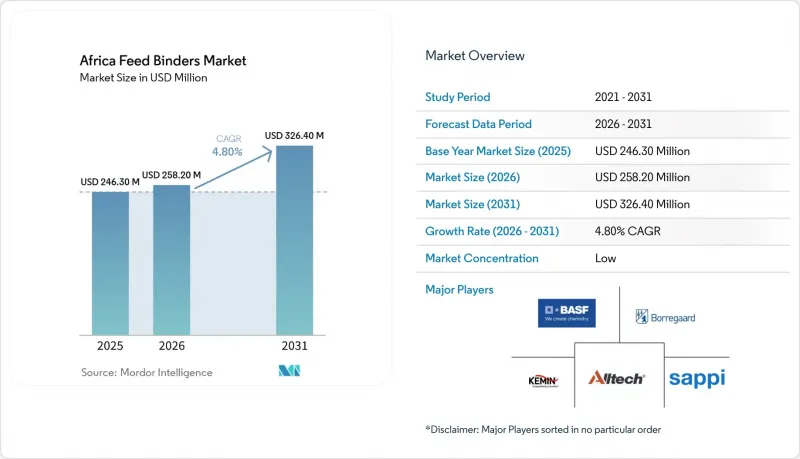
Mordor Intelligence에 의하면, 아프리카 사료 결합제 시장 규모는 2025년 2억 4,630만 달러에서 2026년에는 2억 5,820만 달러로 확대되어 2026-2031년까지 CAGR 4.80%로 성장을 지속하여, 2031년에는 3억 2,640만 달러에 이를 것으로 예측됩니다.
본 보고서는 결합제 유형(천연 결합제 및 합성 결합제), 동물 유형(수산물 양식, 가금류, 반추동물, 돼지, 기타 동물), 지역(남아프리카, 나이지리아, 이집트, 케냐, 모로코, 아프리카의 기타 중동 및 아프리카)별로 분류되어 있습니다. 시장 전망은 금액(달러)과 수량(톤)으로 제시되어 있습니다.
아프리카 사료 결합제 시장 동향 및 분석
아프리카의 배합사료 생산량 증가
사료 생산량 증가는 아프리카 사료 결합제 시장에서 가장 뚜렷한 수요 요인 중 하나로 계속해서 자리 잡고 있습니다. 상업적인 사료 생산에서는 펠릿화된 사료의 내구성, 미분 감소, 안정적인 처리 능력이 요구되므로 결합제에 대한 직접적인 수요가 발생합니다. 반면, 농장에서의 방목 사료에는 그러한 요건이 없습니다. 아프리카의 사료 생산량은 배합 사료를 포함해 2025년까지 연간 6,420만 톤에 달할 것으로 추정됩니다. 남아프리카, 나이지리아, 이집트, 케냐는 더 많은 결합제를 처리할 수 있는 사료 공장 설비 용량 측면에서 시장을 주도할 것으로 예측됩니다. 나이지리아의 정부 주도 계획과 이집트의 규제 기반 검사 활동 역시 사료 생산이 보다 체계적인 체제로 조직화되고 있음을 보여주고 있으며, 첨가물의 인증 및 지속적인 조달에 적용되는 조건이 개선되고 있습니다. 표준화된 사료 공장 시스템을 통해 처리되는 사료량이 증가함에 따라, 아프리카의 사료 결합제 시장은 새로운 펠릿화 라인 도입, 사료 공장 설비 현대화, 비공식적 혼합에서 산업적 생산으로의 전환이 이루어질 때마다 혜택을 받게 될 것입니다.
가금류 사료의 펠릿화 수요
가금 사료는 규모, 상업적 구조, 사료 효율에 대한 엄격한 요구 사항이 복합적으로 작용하고 있기 때문에 아프리카 사료 결합제 시장에서 여전히 가장 신뢰할 수 있는 수요 기반을 형성하고 있습니다. 육계와 산란계의 사육은 펠렛의 일관성에 크게 좌우되므로, 결합제는 펠렛의 강도뿐만 아니라 사료 전환율, 취급 편의성, 운송 중 영양소 손실 감소 측면에서도 중요한 역할을 합니다. 미국 농무부(USDA)에 따르면, 2025년 남아프리카공화국의 닭고기 생산량은 164만 5,000톤에 달했습니다. 부흥을 위한 노력과 나이지리아의 사료 및 목초 정책 체계 강화에 대한 집중이, 해당 지역에서 가장 많은 사료 소비량을 자랑하는 가축 생산 시스템에서 펠렛용 첨가제의 지속적인 사용을 뒷받침하고 있습니다.
수입된 특수 결합제의 원가와 환율 변동
수입 의존도는 아프리카 사료 결합제 시장에 여전히 큰 제약 요인으로 작용하고 있습니다. 해당 지역에서 사용되는 합성 및 프리미엄 광물계 결합제의 대부분은 여전히 유럽이나 북미에서 조달되고 있으며, 이는 운임, 관세, 통화 약세가 도착 가격에 직접 반영된다는 것을 의미합니다. 아프리카의 일부 시장에서는 2024년과 2025년에 현지 통화가 달러 대비 크게 하락할 것으로 전망되고 있습니다. 이러한 통화 약세로 인해 사료 제조업체들은 구매 주기를 단축하고 재고 수준을 낮추고 있습니다. 그 결과, 프리미엄 결합제의 도입이 더욱 어려워지고 있습니다. 왜냐하면 기술적 성능뿐만 아니라, 환율 변동에 영향을 받는 급변하는 예산 환경 속에서도 그 가치를 입증해야 하기 때문입니다. 남아프리카의 Sappi와 같이 현지 생산 거점을 보유하고 있거나, 유통업체이 재고를 보유하고 있는 공급업체는 아프리카 사료 결합제 시장에서 통화 관련 문제를 해결하는 데 있어 더 유리한 입장에 있습니다.
부문별 분석
천연 결합제는 2025년 아프리카 사료 결합제 시장에서 62%를 차지하고 있으며, 2026년부터 2031년까지 연평균 성장률(CAGR) 4.8%로 성장하여 가금류, 반추동물, 수산 양식 등 각 용도 분야에서 주도적인 위치를 유지할 것으로 전망됩니다. 이러한 우위는 효과적인 결합 성능, 사료 제조업체들 사이에서 높은 인지도, 규제 측면에서의 폭넓은 수용성에 기인합니다. 남아프리카에서는 사피(Sappi)사의 투게라 공장에서 생산되는 펠릿인이 경쟁 우위를 확보해 주고 있습니다. 해당 공장은 다른 많은 아프리카 시장에서 여전히 수입에 의존하고 있는 결합제 제품을, 신뢰할 수 있는 현지 공급을 확보하고 있기 때문입니다. 이러한 국내 조달 가능성을 통해 공급 안정성이 향상되고, 특수 사료 첨가제와 관련된 환율 변동 및 운송 비용에 대한 노출이 줄어듭니다. 전분, 덱스트린, 당밀 기반 제품은 천연 결합제 부문의 핵심으로 자리 잡고 있으며, 특히 남아프리카의 반추동물사료 배합에서 당밀은 기호성 향상 및 사료 섭취량 증대에 기여하는 등 매우 중요한 역할을 수행하고 있습니다.
합성 결합제는 아프리카 사료 결합제 시장에서 특히 사료 공장이 뛰어난 수분 안정성, 더 견고한 펠릿 강도, 혹은 더 엄격한 공정 관리를 필요로 하는 부문에서 계속해서 특수 용도로 활용되고 있습니다. 그러나 높은 비용과 대륙의 대부분 지역에서 여전히 수입에 의존하고 있다는 점 때문에 합성 결합제의 사용은 여전히 제한적인 수준에 머물러 있습니다. 한편, 케냐, 우간다, 탄자니아 등의 국가에서는 벤토나이트, 카올린, 세피올라이트 등의 광물계 결합제가 주목을 받고 있습니다. 이는 이들 국가에서 사료 제조업체들이 펠릿의 내구성과 미코톡신 관리에 점점 더 중점을 두고 있기 때문입니다. 그 결과, 시장의 전반적인 점유율 분포가 시사하는 것보다 시장은 점차 다양화되고 있지만, 천연 결합제는 여전히 수요의 대부분을 차지하고 있으며, 아프리카 사료 결합제 산업의 주요 성장 동력으로 자리 잡고 있습니다.
기타 혜택
- 엑셀 형식 시장 예측(ME) 시트
- 3개월간의 애널리스트 지원
자주 묻는 질문
목차
제1장 서론
제2장 조사 방법
제3장 주요 요약
제4장 시장 구도
제5장 시장 규모와 성장 예측
제6장 경쟁 구도
제7장 시장 기회와 향후 전망
JHS 26.07.07According to Mordor Intelligence, the africa feed binders market size is anticipated to grow from USD 246.30 million in 2025 to USD 258.20 million in 2026 and is forecast to reach USD 326.40 million by 2031 at 4.80% CAGR over 2026-2031.
This report is Segmented by Sub Additives (Natural Binders and Synthetic Binders), by Animal Type (Aquaculture, Poultry, Ruminants, Swine, and Other Animals), and by Geography (South Africa, Nigeria, Egypt, Kenya, Morocco, and Rest of Africa). The Market Forecasts are Provided in Terms of Value (USD) and Volume (Metric Tons).
Africa Feed Binders Market Trends and Insights
Rising Compound Feed Output in Africa
Rising compound feed output remains one of the clearest demand anchors for the Africa feed binders market. Commercial feed production creates a direct need for binding chemistry because pelleted output depends on durability, lower fines, and stable throughput, whereas on-farm loose feed does not. Africa's feed production is estimated to reach 64.2 million metric tons annually by 2025, including compound feed. South Africa, Nigeria, Egypt, and Kenya are projected to lead in terms of installed mill capacity capable of accommodating higher binder volumes. Government-backed plans in Nigeria and regulatory testing activity in Egypt also indicate that feed production is being organized more formally, improving the conditions for additive qualification and repeat procurement. As more feed volume moves into standardized mill systems, the Africa feed binders market gains from every new pelleting line, every mill upgrade, and every shift from informal mixing to industrial production.
Poultry Feed Pelletization Demand
Poultry remains the most dependable volume base for the Africa feed binders market because it combines scale, commercial structure, and tight pressure on feed efficiency. Broiler and layer operations depend heavily on pellet consistency, which makes binders important not only for pellet integrity but also for feed conversion, handling performance, and reduced nutrient loss during transport. According to the United States Department of Agriculture (USDA), South Africa's poultry chicken meat production reached 1,645 thousand metric tons in 2025. Recovery efforts and Nigeria's emphasis on stronger feed and fodder policy frameworks have supported the continued use of pellet-oriented additives in the region's largest feed-consuming livestock system.
Imported Specialty Binder Costs and Currency Volatility
Import dependency continues to be a significant constraint on the African feed binders market. The majority of synthetic and premium mineral binders used across the region still come from Europe and North America, which means freight costs, tariffs, and currency weakness feed directly into landed prices. Local currencies in several Africa markets are projected to depreciate significantly against the United States dollar in 2024 and 2025. This depreciation has led mills to shorten their purchasing cycles and reduce stock levels. As a result, the adoption of premium binders becomes more challenging, as they must demonstrate value not only through technical performance but also within a rapidly changing budgeting environment influenced by fluctuating exchange rates. Suppliers with local production facilities or distributor-held stock, such as Sappi in South Africa, are better positioned to navigate currency-related challenges in the African feed binders market.
Other drivers and restraints analyzed in the detailed report include:
- Aquaculture Feed Expansion and Water-Stability Needs
- Fines Reduction and Nutrient Retention Gains
- Grain-Quality Variability and Mycotoxin-Heavy Raw Materials
For complete list of drivers and restraints, kindly check the Table Of Contents.
Segment Analysis
Natural binders accounted for 62% of the Africa feed binders market in 2025 and are projected to grow at a CAGR of 4.8% between 2026 and 2031, maintaining their leading position across poultry, ruminant, and aquaculture applications. Their dominance is attributed to effective binding performance, familiarity among feed manufacturers, and broader regulatory acceptance. In South Africa, Sappi's Pelletin production at the Tugela Mill provides a competitive advantage by ensuring a reliable local supply of binder products, which are still imported in many other African markets. This domestic availability enhances supply security and reduces exposure to currency fluctuations and freight-related costs associated with specialty feed additives. Starches, dextrins, and molasses-based products remain the cornerstone of the natural binder segment, with molasses playing a particularly significant role in Southern African ruminant feed formulations, contributing to palatability and feed intake.
Synthetic binders continue to serve specialized applications within the Africa feed binders market, particularly where feed mills require enhanced water stability, stronger pellet integrity, or tighter process control. However, the adoption of synthetic binders remains limited due to higher costs and continued reliance on imports across much of the continent. Meanwhile, mineral-based binders such as bentonite, kaolin, and sepiolite are gaining traction in countries like Kenya, Uganda, and Tanzania, where feed producers are increasingly focusing on pellet durability and mycotoxin management. Consequently, the market is becoming more diversified than the overall share distribution suggests, although natural binders continue to dominate volume demand and remain the primary growth driver of the Africa feed binders industry.
Complete Report Scope:
- By Binder Type
- Natural binders
- Synthetic binders
- By Animal
- Poultry
- By Sub Animal
- Broiler
- Layer
- Other Poultry Birds
- Ruminants
- By Sub Animal
- Beef Cattle
- Dairy Cattle
- Other Ruminants
- Aquaculture
- By Sub Animal
- Fish
- Shrimp
- Other Aquaculture Species
- By Sub Animal
- Swine
- Other Animal
- By Geography
- South Africa
- Nigeria
- Egypt
- Kenya
- Morocco
- Rest of Africa
List of Companies Covered in this Report:
- Sappi Limited
- Borregaard ASA
- Kemin Industries, Inc.
- Roquette Freres
- Bentoli, Inc.
- Uniscope, Inc.
- Cargill, Incorporated
- Nutreco N.V.
- BASF SE
- Ingredion Incorporated
- Tereos SCA
- Alltech, Inc.
- Amlan International
- Royal De Heus
- Nutreco N.V.
Additional Benefits:
- The market estimate (ME) sheet in Excel format
- 3 months of analyst support
TABLE OF CONTENTS
1 Introduction
- 1.1 Study Assumption and Market Definition
- 1.2 Scope of the Study
2 Research Methodology
3 Executive Summary
4 Market Landscape
- 4.1 Market Overview
- 4.2 Market Drivers
- 4.2.1 Rising compound feed output in Africa
- 4.2.2 Poultry feed pelletization demand
- 4.2.3 Aquaculture feed expansion and water-stability needs
- 4.2.4 Fines reduction and nutrient retention gains
- 4.2.5 Shift toward natural lignin-based binders
- 4.2.6 Energy-cost savings from stronger pellets
- 4.3 Market Restraints
- 4.3.1 Imported specialty binder costs and currency volatility
- 4.3.2 Price sensitivity among small and mid-sized feed mills
- 4.3.3 Unstable power and steam availability
- 4.3.4 Grain-quality variability and mycotoxin-heavy raw materials
- 4.4 Regulatory Landscape
- 4.5 Technological Outlook
- 4.6 Porter's Five Forces Analysis
- 4.6.1 Bargaining Power of Suppliers
- 4.6.2 Bargaining Power of Buyers
- 4.6.3 Threat of New Entrants
- 4.6.4 Threat of Substitute Products
- 4.6.5 Intensity of Competitive Rivalry
5 Market Size and Growth Forecasts (Value and Volume)
- 5.1 By Binder Type
- 5.1.1 Natural binders
- 5.1.2 Synthetic binders
- 5.2 By Animal
- 5.2.1 Poultry
- 5.2.2 By Sub Animal
- 5.2.2.1 Broiler
- 5.2.2.2 Layer
- 5.2.2.3 Other Poultry Birds
- 5.2.3 Ruminants
- 5.2.4 By Sub Animal
- 5.2.4.1 Beef Cattle
- 5.2.4.2 Dairy Cattle
- 5.2.4.3 Other Ruminants
- 5.2.5 Aquaculture
- 5.2.5.1 By Sub Animal
- 5.2.5.1.1 Fish
- 5.2.5.1.2 Shrimp
- 5.2.5.1.3 Other Aquaculture Species
- 5.2.5.1 By Sub Animal
- 5.2.6 Swine
- 5.2.7 Other Animal
- 5.3 By Geography
- 5.3.1 South Africa
- 5.3.2 Nigeria
- 5.3.3 Egypt
- 5.3.4 Kenya
- 5.3.5 Morocco
- 5.3.6 Rest of Africa
6 Competitive Landscape
- 6.1 Market Concentration
- 6.2 Strategic Moves
- 6.3 Market Share Analysis
- 6.4 Company Profiles (Includes Global Level Overview, Market Level Overview, Core Business Segments, Financials, Headcount, Key Information, Market Rank, Market Share, Products and Services, and Analysis of Recent Developments)
- 6.4.1 Sappi Limited
- 6.4.2 Borregaard ASA
- 6.4.3 Kemin Industries, Inc.
- 6.4.4 Roquette Freres
- 6.4.5 Bentoli, Inc.
- 6.4.6 Uniscope, Inc.
- 6.4.7 Cargill, Incorporated
- 6.4.8 Nutreco N.V.
- 6.4.9 BASF SE
- 6.4.10 Ingredion Incorporated
- 6.4.11 Tereos SCA
- 6.4.12 Alltech, Inc.
- 6.4.13 Amlan International
- 6.4.14 Royal De Heus
- 6.4.15 Nutreco N.V.