|
시장보고서
상품코드
2073091
자발적 탄소 시장 : 점유율 분석, 업계 동향과 통계, 성장 예측(2026-2031년)Voluntary Carbon - Market Share Analysis, Industry Trends & Statistics, Growth Forecasts (2026 - 2031) |
||||||
 Mordor Intelligence
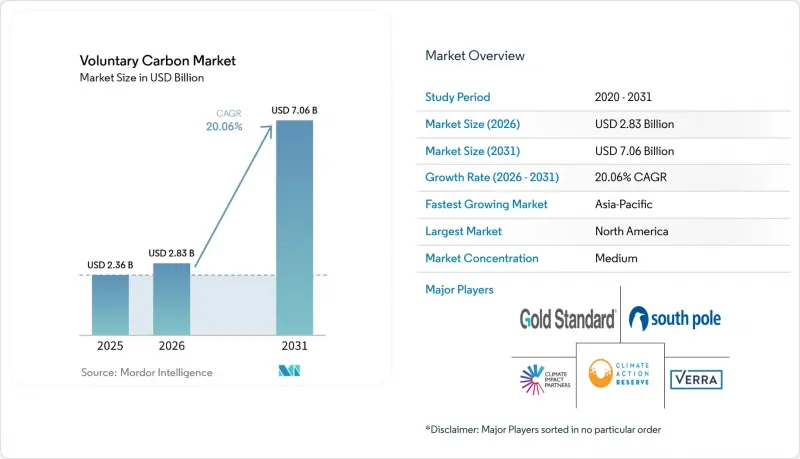
Mordor Intelligence에 의하면, 자발적 탄소 시장 규모는 2025년에 23억 6,000만 달러로 평가되었고 2026년 28억 3,000만 달러에서 2031년까지 70억 6,000만 달러로 확대되어 2026-2031년까지 예측 기간에서 CAGR 20.06%로 성장한다고 추정되고 있습니다.
본 보고서는 크레딧 유형(회피·감축 프로젝트, 제거 프로젝트), 프로젝트 범주(재생에너지 프로젝트, 임업·토지 이용 프로젝트, 폐기물 관리·메탄 회피 프로젝트, 기타), 거래 유형(현물 거래, 기타), 최종 사용자 산업(에너지 및 유틸리티, 기타), 지역별로 분류되어 있습니다. 시장 전망은 금액(달러) 기준으로 제시되어 있습니다.
세계 자발적 탄소 시장 동향과 인사이트
기업의 탄소중립 공약과 스코프 3 목표
2025년에는 1만 2,000개 이상의 기업이 SBTi 인증 목표를 제시하고 있으며, 이에 따라 자발적 탄소 시장은 재량적인 지출이 아닌, 공식적인 탈탄소화 계획과 연계된 광범위하고 지속 가능한 수요 기반을 확보하고 있습니다. 2030년이라는 이정표가 다가옴에 따라, 이러한 약속들은 탄소 크레딧 조달을 공급망, 제품 표시, 투자자와의 소통과 관련된 경영상의 의사결정으로 이끌고 있습니다. 스코프 3 배출량에 대한 압박은 더욱 커지고 있습니다. 이는 정보 공개에 대한 기대가 직접적인 사업 활동을 넘어섰기 때문이며, 구매자가 업스트림 및 하류 활동에 걸친 잔여 배출량에 주목할 수밖에 없기 때문입니다. 이것이 바로 자율적 탄소 시장에서 연간 보고 주기에만 연동된 일회성 크레딧 소각이 아닌, 여러 해에 걸친 구매 구조에 대한 관심이 높아지고 있는 이유입니다. 또한, 구매자가 신뢰할 수 있는 미래 공급에 대한 접근을 단기적인 지속가능성 비용이 아닌 전략적 과제로 인식하는 이유도 이를 통해 설명할 수 있습니다.
신뢰도가 높은 신용으로의 전환 및 구매자의 면밀한 검토
자발적 탄소 시장은 공적 주장을 뒷받침할 수 있는 프리미엄 등급의 배출권과, 추가성 및 지속성에 대한 심사가 엄격해지고 있는 저가 등급의 배출권으로 양분되고 있습니다. VCMI는 2026년 1월 이후 기후 변화와 관련된 주장을 할 때 CCP 승인 크레딧 또는 제6조 제4항에 따른 크레딧을 의무화했습니다. 이로 인해 기관 투자자들에게 실질적인 자금 조달 장벽이 높아졌습니다. ICVCM은 2026년 4월까지 9개의 탄소 크레딧 프로그램을 승인하여 약 1억 700만 개의 CCP 적격 크레딧을 포괄하고 있으며, 이를 통해 보다 엄격한整合性 심사를 충족하는 이용 가능한 크레딧의 풀이 확대되고 있습니다. 또한 ICVCM의 보고서에 따르면, CCP 라벨이 부착된 신용상품에는 평균 약 25%의 프리미엄이 붙고 있는 것으로 나타나, 품질이 가격 형성에 그 어느 때보다 뚜렷한 영향을 미치고 있음을 보여줍니다. 자발적 탄소 시장에서 이는 기존 방식의 ‘회피형”개발 사업자에 대한 압박을 강화하는 한편, 감사 가능하고 지속가능성이 높은 포트폴리오를 보유한 공급업체의 입지를 강화하게 될 것입니다.
신용의 질, 추가성, 영속성에 관한 논쟁
자발적 탄소 시장은 현재 학계와 규제 당국의 면밀한 검토가 구매자의 행동과 조달 규칙에 직접적인 영향을 미치고 있기 때문에 여전히 신뢰성 문제에 직면해 있습니다. 2026년 『Nature Communications』지에 게재된 연구에서는 산림 탄소 크레딧 분야에서 체계적인 과잉 크레딧 발행의 위험이 지적되었으며, 기준선의 인플레이션이 발행된 크레딧의 실질적인 기후 효과를 약화시키는 메커니즘이 제시되었습니다. 또한, 『Nature Climate Change』지 역시 2026년 1월, UNFCCC의 탄소 거래 제도 설계에 남아 있는 미해결 결함이 기후 변화 대책을 저해할 우려가 있다고 경고했습니다. 여기에는 독립적인 분석을 통해 심각한 신용 과다 부여 위험이 지적된 사례도 포함됩니다. VCMI 규정에 따르면, 기후 변화와 관련하여 공식적인 주장을 하는 기업은 상각된 크레딧이 나중에 무결성 테스트를 통과하지 못할 경우 법적 위험 및 평판 위험에 노출될 가능성이 높아집니다. 자발적 탄소 시장에서 이러한 위험은 취약한 배출 감축 수요를 억제하는 한편, 구매자들의 선호를 지속가능성 완충 장치가 더 견고하고 검증 절차가 더 투명한 크레딧으로 전환시키고 있습니다.
부문별 분석
2025년, 회피·감축 프로젝트는 자발적 탄소 시장의 69.43%를 차지했습니다. 이는 현재의 거래량이 여전히 재생에너지, 임업, 폐기물, 산업 효율화 크레딧에 크게 의존하고 있음을 보여줍니다. 자발적 탄소 시장이 계속해서 이러한 광범위한 공급 기반에 의존하고 있는 이유는 이러한 크레딧이 구하기 쉽고 조달하기도 용이하며, 즉시 크레딧을 상각해야 하는 구매자들에게 익숙하기 때문입니다. 일관성 심사가 엄격해짐에 따라, 공적인 주장을 뒷받침할 수 있는 기존 크레딧의 선택지가 줄어들고 있어, 가격 환경이 변화하고 있습니다. 그 결과, 자발적 탄소 시장에서 회피형 프로젝트 공급업체들은 품질 심사, 조사 방법의 변경, 이익률 압박에 대해 더 큰 위험에 노출되고 있습니다.
제거 프로젝트는 2026년부터 2031년까지 연평균 성장률(CAGR) 23.71%를 나타낼 것으로 예측되며, 이는 자발적 탄소 시장에서 가장 차별화된 성장 부문으로 꼽히고 있습니다. 직접적인 배출 감축만으로는 신속하게 줄일 수 없는 잔여 배출량에 대해, 지속 가능한 제거의 중요성이 커지고 있기 때문에 구매자들은 이러한 방향으로 전환하고 있습니다. Carbon Direct에 따르면, 현재 CDR 시장 규모는 800만 톤에 그치고 있어, 장기적인 탈탄소화 경로에 필요한 규모에는 여전히 한참 못 미치는 상황입니다. 2026년 1분기에는 상각된 CDR 크레딧의 95%가 자연 기반 솔루션에서 비롯된 반면, 내구성이 높은 인공적 방법을 통한 공급은 고작 5%에 그쳐, 검증된 내구성 있는 공급원이 얼마나 제한적인지를 여실히 보여주고 있습니다. 따라서 자발적 탄소 시장은 탄소 제거에 중점을 두는 방향으로 전환되고 있지만, 수요 창출보다는 규모 확대가 여전히 주요 제약 요인으로 남아 있습니다.
2025년 자발적 탄소 시장 규모 중 재생에너지 프로젝트가 39.72%를 차지했으며, 크레딧 발행량이 방대하고 등록 기관에서의 인지도도 높아, 계속해서 주요 프로젝트 범주로서의 위상을 유지했습니다. 이러한 프로젝트들은 특히 발행 비용이 낮고, 구매자들이 지속적인 탄소 배출권 소각 프로그램을 위해 확보하기 쉬운 공급원을 필요로 하는 상황에서 여전히 자발적 탄소 시장의 현재 유동성을 뒷받침하고 있습니다. 그러나 태양광이나 풍력 프로젝트가 이미 보조금 없이도 상업적으로 성사되고 있는 시장에서는 추가성 논거가 약해지기 때문에 이러한 프로젝트의 중기적 입지는 불안정합니다. 이에 따라, 기후 영향이 보다 명확하고 검증 논리가 보다 탄탄한 범주로 프로젝트 선정 방향이 바뀌기 시작하고 있습니다.
폐기물 관리 및 메탄 배출 저감 프로젝트는 2026년부터 2031년까지 연평균 성장률(CAGR) 21.83%를 나타낼 것으로 예측되며, 자발적 탄소 시장에서 가장 빠르게 성장하는 프로젝트 부문이 될 전망입니다. 메탄 제거는 보다 즉각적인 기후 효과를 가져오며, 기존 프로젝트 유형에 비해 구매자가 그 영향을 설명하기 쉽기 때문에 그 매력이 높아지고 있습니다. 2026년 1분기에는 매립지 메탄 크레딧의 상각 비중이 사상 최고치인 10%(총 상각량의 10%)에 달했으며, 이는 이 부문에 대한 구매자들의 관심이 높아지고 있음을 보여줍니다. 농업 및 블루 카본은 여전히 소규모 범주에 머물러 있지만, 2026년 1분기에는 재생형 농업 크레딧이 연율 환산 기준 500만 크레딧을 돌파했고, 해양 및 맹그로브 탄소 크레딧은 530만 크레딧에 달했습니다. 또한, 2026년 1분기 신규 발행량의 약 50%를 CORSIA 적격 크레딧이 차지하고 있어, 항공 관련 품질 기준이 프로젝트 범주 수요에 광범위한 영향을 미치고 있음을 시사하고 있습니다.
지역별 분석
북미는 2025년에도 37.61%의 시장 점유율을 유지할 것으로 보이며, 현재의 거래 환경에서 이 지역은 여전히 가장 깊이가 있고 유동성이 높은 자발적 탄소 시장으로 자리매김하고 있습니다. 북미의 프로젝트 개발자들은 전 세계 투자 적격 등급인 ‘BBB+”의 발행량의 57%를 공급하고 있으며, 이는 해당 지역이 높은 신용등급의 채권 창출 및 수요 측면에서 강점을 가지고 있음을 보여줍니다. 미국은 자국 기업 구매자들이 오프테이크, 구조화 금융, 대규모 퇴직 프로그램 등 각 부문에서 활발히 활동하고 있기 때문에 여전히 주요 수요 동력으로 작용하고 있습니다. CO280과 JP모건 체이스는 2025년 5월, 13년까지 톤당 200달러 이하로 45만 톤의 CDR을 임베디드하기로 합의했습니다. 이는 펄프·제지 산업 부문에서 인위적 제거에 대한 보다 구체적인 기준을 수립하는 데 기여했습니다. 또한, 앨버타주의 저장 인프라와 새로운 직접 공기 포집(DAC) 공동 프로젝트에 힘입어, 캐나다 역시 인공 제거의 생산 거점으로 주목받고 있습니다.
2026년, 품질을 중시하는 수요의 대부분을 유럽이 차지했으며, EU와 EEA의 구매자들이 높은 평가를 받은 배출권의 51%를 보유했습니다. 이는 유럽의 자발적 탄소 시장이 단순한 거래량보다는 주장, 신용등급, 공시 위험에 대한 보다 엄격한 심사를 통해 형성되고 있음을 보여줍니다. 또한, 핀란드 라우마에서 메차 그룹이 추진 중인 상업용 목재 기반 탄소 포집 플랜트 계획 작업에서 알 수 있듯이, 해당 지역에서는 기술적 제거 방식공급 기반도 점차 확대되고 있습니다. 이러한 움직임은 유럽이 지역 내 수요 동향과 신뢰성이 더 높은 국내 제거 파이프라인 간의 조화를 도모하기 시작했음을 시사합니다.
아시아태평양은 2031년까지 연평균 성장률(CAGR) 22.19%를 나타낼 것으로 예측되며, 이는 자발적 탄소 시장에서 지역별 성장률 중 가장 높은 수치입니다. 해당 지역은 수요의 중심지로 부상한 데 더해, 프로젝트 발굴 기회와 향후 신뢰도가 높은 단위의 국경을 초월한 승인 과정에서 그 역할이 확대됨에 따라 점점 더 중요한 위치를 차지하고 있습니다. 남미는 공급 측면에서 특히 REDD+ 및 ARR 채널을 통해 여전히 필수적인 역할을 하고 있으며, 실베라사는 남미의 REDD+ 크레딧 상각량이 이미 신규 공급량 발행량을 초과하고 있다고 지적했습니다. 중동 및 아프리카 역시 여전히 중요한 공급 지역으로 남아 있으며, 아프리카는 높은 평가를 받는 조리용 가스레인지와 폐기물 배출권을 더 많이 공급하고 있는 반면, 걸프 지역 국가들의 구매자들은 국가 차원의 기후 변화 대응 공약이나 양자 간 탄소 협정을 통해 더욱 활발한 움직임을 보이기 시작하고 있습니다.
기타 혜택
- 엑셀 형식 시장 예측(ME) 시트
- 3개월간의 애널리스트 지원
자주 묻는 질문
목차
제1장 서론
제2장 조사 방법
제3장 주요 요약
제4장 시장 구도
제5장 시장 규모와 성장 예측
제6장 경쟁 구도
제7장 시장 기회와 향후 전망
JHS 26.07.07According to Mordor Intelligence, the voluntary carbon market was valued at USD 2.36 billion in 2025 and is estimated to grow from USD 2.83 billion in 2026 to USD 7.06 billion by 2031, at a CAGR of 20.06% during the forecast period 2026-2031.
This report is Segmented by Credit Type (Avoidance and Reduction Projects, and Removal Projects), Project Category (Renewable Energy Projects, Forestry and Land Use Projects, Waste Management and Methane Avoidance Projects, and More), Transaction Type (Spot Transactions, and More), End-User Industry (Energy and Utilities, and More), and Geography. The Market Forecasts are Provided in Terms of Value (USD).
Global Voluntary Carbon Market Trends and Insights
Corporate Net-Zero Commitments and Scope 3 Targets
More than 12,000 companies had SBTi-approved targets in 2025, which gives the voluntary carbon market a broad and durable demand base tied to formal decarbonization plans rather than discretionary spending. As 2030 milestones approach, these commitments are pushing carbon credit procurement into operational decisions involving supply chains, product claims, and investor communication. The pressure is greater for Scope 3 emissions because disclosure expectations now reach beyond direct operations and force buyers to look at residual emissions across upstream and downstream activities. This is why the voluntary carbon market is seeing more interest in multi-year purchasing structures instead of one-time retirements linked only to annual reporting cycles. It also helps explain why buyers are treating access to credible future supply as a strategic issue rather than a short-term sustainability expense.
Shift Toward High-Integrity Credits and Buyer Scrutiny
The voluntary carbon market is separating into a premium tier of credits that can support public claims and a lower-priced tier that faces rising scrutiny on additionality and permanence. VCMI required CCP-approved or Article 6.4 credits for climate claims from January 2026, which raised the practical procurement threshold for institutional buyers. ICVCM had approved 9 carbon-crediting programs and covered around 107 million CCP-eligible credits by April 2026, which is expanding the addressable pool of credits that meet stronger integrity screens. ICVCM also reported that CCP-labeled credits were earning an average premium of around 25%, which shows that quality is influencing price formation in a more visible way. In the voluntary carbon market, this raises pressure on legacy avoidance developers while strengthening the position of suppliers with auditable and higher-durability portfolios.
Credit Quality, Additionality, and Permanence Controversies
The voluntary carbon market continues to face trust issues because academic and regulatory scrutiny is now directly affecting buyer behavior and procurement rules. A 2026 Nature Communications study highlighted systematic over-crediting risks in forest carbon credits and showed how baseline inflation can weaken the real climate effect of issued units. Nature Climate Change also warned in January 2026 that unresolved flaws in UNFCCC carbon trading design could undermine climate action, including cases where independent analysis pointed to major over-crediting risk. Under VCMI rules, companies making public climate claims now face greater legal and reputational exposure if retired credits later fail integrity tests. In the voluntary carbon market, that risk is suppressing weaker avoidance demand while shifting buyer preference toward credits with stronger permanence buffers and more transparent verification.
Other drivers and restraints analyzed in the detailed report include:
- Demand for Durable Carbon Removal for Hard-to-Abate Sectors
- Expansion of Digital MRV, Registry Interoperability, and Traceability Tools
- Fragmented Standards, Registry Rules, and Legal Recognition
For complete list of drivers and restraints, kindly check the Table Of Contents.
Segment Analysis
Avoidance and Reduction Projects captured 69.43% of the voluntary carbon market share in 2025, which shows how strongly current trading volumes still depend on renewable energy, forestry, waste, and industrial efficiency credits. The voluntary carbon market continues to rely on this broad supply base because these credits remain more available, easier to source, and more familiar to buyers with immediate retirement needs. Even so, the pricing environment is changing as stronger integrity screens narrow the pool of legacy credits that can support public claims. That is making avoidance suppliers more exposed to quality reviews, methodology changes, and margin pressure in the voluntary carbon market.
Removal Projects are projected to grow at a 23.71% CAGR from 2026 to 2031, which makes them the most differentiated expansion track in the voluntary carbon industry. Buyers are moving in this direction because durable removal is becoming more important for residual emissions that cannot be reduced quickly enough through direct abatement. Carbon Direct stated that the current CDR market stood at 8 million tonnes, which remains far below the scale required for long-term decarbonization pathways. In Q1 2026, 95% of retired CDR credits came from nature-based solutions while high-durability engineered approaches made up only 5% of supply, which underlines how constrained verified durable supply still is. The voluntary carbon market is therefore shifting in favor of removal, but scale-up remains the main constraint rather than demand formation.
Renewable Energy Projects accounted for 39.72% of the voluntary carbon market size in 2025, which kept them in the leading project category because of large credit volumes and broad registry familiarity. These projects still support current liquidity in the voluntary carbon market, especially where issuance costs are lower, and buyers need an accessible supply for ongoing retirement programs. Their medium-term position is less secure because additionality arguments weaken in markets where solar and wind projects are already commercially viable without subsidy. That is starting to reshape project selection toward categories that can show clearer climate impact and stronger verification logic.
Waste Management and Methane Avoidance Projects are projected to grow at a 21.83% CAGR from 2026 to 2031, making them the fastest-growing project category in the voluntary carbon market. Their appeal is rising because methane destruction delivers a more immediate climate effect and is easier for buyers to explain in impact terms than some older project types. Landfill methane credits reached their highest-ever retirement share at 10% of total retirements in Q1 2026, which points to stronger buyer traction for this category. Agriculture and Blue Carbon remained smaller categories, but regenerative agriculture credits surpassed 5 million annualized credits in Q1 2026 and marine and mangrove carbon credits reached 5.3 million. CORSIA-eligible credits also represented nearly 50% of new issuances in Q1 2026, which suggests that aviation-linked quality filters are influencing project category demand more broadly.
Complete Report Scope:
- By Credit Type
- Avoidance and Reduction Projects
- Removal Projects
- By Project Category
- Renewable Energy Projects
- Forestry and Land Use Projects
- Waste Management and Methane Avoidance Projects
- Agriculture Projects
- Blue Carbon Projects
- Other Project Categories
- By Transaction Type
- Spot Transactions
- Forward Transactions
- Long-Term Offtake Agreements
- By End User Industry
- Energy and Utilities
- Manufacturing and Industrial
- Consumer Goods and Retail
- Transportation and Logistics
- Financial Services
- Technology and Telecommunications
- Government Agencies
- Non-Governmental Organizations
- Individuals
- Other End User Industries
- By Geography
- North America
- United States
- Canada
- Mexico
- South America
- Brazil
- Argentina
- Chile
- Rest of South America
- Europe
- Germany
- United Kingdom
- France
- Italy
- Spain
- Rest of Europe
- Asia-pacific
- China
- Japan
- India
- Australia
- South Korea
- Singapore
- Rest of Asia-pacific
- Middle East
- Saudi Arabia
- United Arab Emirates
- Turkey
- Rest of Middle East
- Africa
- South Africa
- Egypt
- Nigeria
- Rest of Africa
- North America
Geography Analysis
North America retained 37.61% market share in 2025, and the region remained the deepest and most liquid voluntary carbon market in current trading conditions. North American project developers supplied 57% of global investment-grade BBB+ issuances, which shows the region's strength in higher-rated credit generation as well as demand. The United States remains the main demand engine because corporate buyers there are active across removal offtake, structured finance, and large retirement programs. CO280 and JPMorganChase agreed in May 2025 on a 450,000 metric tonne CDR offtake over 13 years at under USD 200 per tonne, which helped establish a more concrete benchmark for engineered removals from the pulp and paper pathway. Canada is also gaining visibility as a production hub for engineered removal, supported by Alberta's storage base and new direct air capture collaboration efforts.
Europe accounted for a large share of quality-sensitive demand in 2026, with EU and EEA buyers holding 51% of high-rated retirements. This signals that the voluntary carbon market in Europe is shaped less by raw volume and more by stronger screening of claims, ratings, and disclosure risks. The region is also building more supply-side depth in engineered removal, as shown by Metsa Group's planning work for a commercial wood-based carbon capture plant in Rauma, Finland. That development suggests Europe is starting to align local demand preferences with a more credible domestic removal pipeline.
Asia-Pacific is projected to grow at a 22.19% CAGR through 2031, which gives it the fastest regional expansion rate in the voluntary carbon market. The region is increasingly relevant because it combines rising demand centers with project origination opportunities and a greater role in future cross-border recognition of high-integrity units. South America remains essential on the supply side, especially for REDD+ and ARR pathways, and Sylvera noted that South American REDD+ retirements were already outpacing new supply issuance. Middle East and Africa also remain important supply regions, with Africa contributing more high-rated cookstove and waste credits while Gulf buyers are becoming more active through sovereign climate commitments and bilateral carbon arrangements.
- Verra
- Gold Standard Foundation
- Climate Action Reserve
- South Pole
- Climate Impact Partners
- American Carbon Registry
- 3Degrees
- CBL Xpansiv
- Climate Impact X
- CEEZER
- Carbonfuture
- Patch
- Carbonplace
- Sylvera
- Nori
- KlimaDAO
- Allcot Group
- Everland
- Rubicon Carbon
- AirCarbon Exchange
Additional Benefits:
- The market estimate (ME) sheet in Excel format
- 3 months of analyst support
TABLE OF CONTENTS
1 INTRODUCTION
- 1.1 Study Assumptions and Market Definition
- 1.2 Scope of the Study
2 RESEARCH METHODOLOGY
3 EXECUTIVE SUMMARY
4 MARKET LANDSCAPE
- 4.1 Market Overview
- 4.2 Market Drivers
- 4.2.1 Corporate Net-Zero Commitments and Scope 3 Targets
- 4.2.2 Shift Toward High-Integrity Credits and Buyer Scrutiny
- 4.2.3 Expansion Of Digital MRV, Registry Interoperability, and Traceability Tools
- 4.2.4 Demand for Durable Carbon Removal for Hard-to-Abate Sectors
- 4.2.5 Structured Finance for Forward Offtake and Credit Inventory
- 4.2.6 Emerging Cross-Border Recognition of High-Integrity Carbon Units
- 4.3 Market Restraints
- 4.3.1 Credit Quality, Additionality, and Permanence Controversies
- 4.3.2 Fragmented Standards, Registry Rules, and Legal Recognition
- 4.3.3 Volatile Prices And Weak Forward Visibility for Avoidance Credits
- 4.3.4 Counterparty and Delivery Risk in Long-Dated Offtake Contracts
- 4.4 Regulatory Landscape
- 4.5 Industry Value-Chain Analysis
- 4.6 Technological Outlook
- 4.7 Porter's Five Forces Analysis
- 4.7.1 Bargaining Power of Buyers
- 4.7.2 Bargaining Power of Suppliers
- 4.7.3 Threat of New Entrants
- 4.7.4 Threat of Substitutes
- 4.7.5 Industry Rivalry
- 4.8 Impact of Macroeconomic Factors on the Market
5 MARKET SIZE AND GROWTH FORECASTS (VALUE)
- 5.1 By Credit Type
- 5.1.1 Avoidance and Reduction Projects
- 5.1.2 Removal Projects
- 5.2 By Project Category
- 5.2.1 Renewable Energy Projects
- 5.2.2 Forestry and Land Use Projects
- 5.2.3 Waste Management and Methane Avoidance Projects
- 5.2.4 Agriculture Projects
- 5.2.5 Blue Carbon Projects
- 5.2.6 Other Project Categories
- 5.3 By Transaction Type
- 5.3.1 Spot Transactions
- 5.3.2 Forward Transactions
- 5.3.3 Long-Term Offtake Agreements
- 5.4 By End User Industry
- 5.4.1 Energy and Utilities
- 5.4.2 Manufacturing and Industrial
- 5.4.3 Consumer Goods and Retail
- 5.4.4 Transportation and Logistics
- 5.4.5 Financial Services
- 5.4.6 Technology and Telecommunications
- 5.4.7 Government Agencies
- 5.4.8 Non-Governmental Organizations
- 5.4.9 Individuals
- 5.4.10 Other End User Industries
- 5.5 By Geography
- 5.5.1 North America
- 5.5.1.1 United States
- 5.5.1.2 Canada
- 5.5.1.3 Mexico
- 5.5.2 South America
- 5.5.2.1 Brazil
- 5.5.2.2 Argentina
- 5.5.2.3 Chile
- 5.5.2.4 Rest of South America
- 5.5.3 Europe
- 5.5.3.1 Germany
- 5.5.3.2 United Kingdom
- 5.5.3.3 France
- 5.5.3.4 Italy
- 5.5.3.5 Spain
- 5.5.3.6 Rest of Europe
- 5.5.4 Asia-pacific
- 5.5.4.1 China
- 5.5.4.2 Japan
- 5.5.4.3 India
- 5.5.4.4 Australia
- 5.5.4.5 South Korea
- 5.5.4.6 Singapore
- 5.5.4.7 Rest of Asia-pacific
- 5.5.5 Middle East
- 5.5.5.1 Saudi Arabia
- 5.5.5.2 United Arab Emirates
- 5.5.5.3 Turkey
- 5.5.5.4 Rest of Middle East
- 5.5.6 Africa
- 5.5.6.1 South Africa
- 5.5.6.2 Egypt
- 5.5.6.3 Nigeria
- 5.5.6.4 Rest of Africa
- 5.5.1 North America
6 COMPETITIVE LANDSCAPE
- 6.1 Market Concentration
- 6.2 Strategic Moves
- 6.3 Market Share Analysis
- 6.4 Company Profiles (includes Global Level Overview, Market Level Overview, Core Segments, Financials as available, Strategic Information, Market Rank/Share, Products and Services, Recent Developments)
- 6.4.1 Verra
- 6.4.2 Gold Standard Foundation
- 6.4.3 Climate Action Reserve
- 6.4.4 South Pole
- 6.4.5 Climate Impact Partners
- 6.4.6 American Carbon Registry
- 6.4.7 3Degrees
- 6.4.8 CBL Xpansiv
- 6.4.9 Climate Impact X
- 6.4.10 CEEZER
- 6.4.11 Carbonfuture
- 6.4.12 Patch
- 6.4.13 Carbonplace
- 6.4.14 Sylvera
- 6.4.15 Nori
- 6.4.16 KlimaDAO
- 6.4.17 Allcot Group
- 6.4.18 Everland
- 6.4.19 Rubicon Carbon
- 6.4.20 AirCarbon Exchange
7 MARKET OPPORTUNITIES AND FUTURE OUTLOOK
- 7.1 White-Space And Unmet-Need Assessment