|
시장보고서
상품코드
2116469
칸나비디올(CBD) 시장 : 점유율 분석, 업계 동향과 통계, 성장 예측(2026-2031년)Cannabidiol (CBD) - Market Share Analysis, Industry Trends & Statistics, Growth Forecasts (2026 - 2031) |
||||||
 Mordor Intelligence
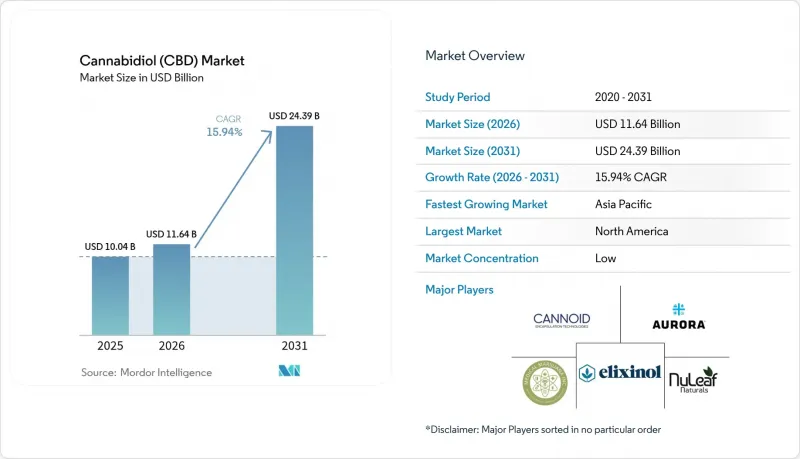
Mordor Intelligence에 의하면, 칸나비디올(CBD) 시장 규모는 2025년에 100억 4,000만 달러로 평가되었고 2026년 116억 4,000만 달러에서 2031년까지 243억 9,000만 달러에 이를 것으로 예측되며, 예측 기간(2026-2031년) CAGR은 15.94%를 나타낼 전망입니다.
본 보고서는 원료별(헴프 및 마리화나), 용도별(의약품, 웰니스·개인용, 기타),제품 형태별(오일·팅크제, 캡슐·소프트젤, 기타), 유통 채널별(병원·전문 약국, 소매점, 기타), 지역별(북미, 유럽, 아시아태평양, 중동 및 아프리카, 남미)로 분류되어 있습니다. 시장 예측은 금액(미 달러) 기준으로 제시되어 있습니다.
전 세계 칸나비디올(CBD) 시장 동향 및 인사이트
만성 통증 관리가 처방용 CBD 보급을 주도
CBD가 난치성 신경 질환에 효과적임이 입증됨에 따라, 처방약으로서의 채택이 진행되고 있습니다. 재즈 파마슈티컬스(Jazz Pharmaceuticals)는 여러 유형의 간질에서 발작 횟수가 중앙값 기준으로 46-87% 감소했다고 보고했으며, 간병인의 89%가 에피디오렉스(Epidiolex) 치료를 계속할 의사를 나타냈습니다. 간호사의 기록에 따르면, 치료를 받은 사례의 85%에서 발작 감소가 확인되었으며, 결절성 경화증 환자에서는 행동 개선도 관찰되었습니다. 이러한 결과에 따라 만성 통증에 대한 보다 광범위한 임상시험이 필요해졌으며, 제약 기업의 칸나비노이드 연구 개발에 대한 투자가 촉진되고 있습니다. 미국 내 스케줄 III로의 재분류는 FDA 승인과 약국 유통을 촉진하여, 그 결과 칸나비디올 시장에서 보험 적용 대상의 접근성을 확대하게 될 것입니다.
약국 체인에서 일반의약품 CBD 제품에 대한 규제적 길이 열리다.
2024년 12월 일본의 ‘대마 단속법’ 개정에 따라 의료용 대마 제품이 허용되고, 단계적인 재배 허가 제도가 도입되어 수십 년에 걸친 ‘드럭 래그(drug lag)’가 해소되었습니다. 미국에서는 FDA가 현재의 건강보조식품 규제만으로는 CBD를 관리할 수 없음을 인정하고 있으며, 이에 따라 입법안이 제출되는 한편, 각 주에서는 캘리포니아주가 검출 가능한 THC를 함유한 헴프 식품을 긴급 금지하는 등 제각각의 조치를 취하고 있습니다. 이에 따라 주요 약국 그룹들은 연방 정부의 규제가 명확해질 때를 대비해, 규정을 준수한 SKU를 OTC(일반의약품) 진열대에 배치할 준비를 진행 중이며, 칸나비디올 시장을 확대되고 있습니다.
칸나비디올 제품에 대한 엄격한 규제
일본은 세계에서 가장 낮은 THC 허용치를 적용하고 있으며, 수입되는 CBD 제품에 대해서는 검출 한계 이하의 수준을 요구하고, 원료를 성숙한 줄기와 씨앗으로 한정함으로써 공급 경로를 엄격하게 관리하고 있습니다. 미국에서는 FDA가 현재의 건강기능식품 규제가 ‘불충분’하다는 입장을 취하고 있어 연방 차원의 규제 공백이 지속되고 있지만, 캘리포니아주에서는 THC가 검출 가능한 대마 식품의 소매 판매가 금지되어 있습니다. 규제의 불일치로 인해 규정 준수 비용이 증가하고, 전국적인 확장이 지연되고 있습니다.
부문 분석
헴프 유래 제품은 유리한 법규와 확립된 농업 공급망 덕분에 안정적인 원료 품질이 확보됨에 따라 2025년 매출의 55.12%를 차지했습니다. 헴프 제품 중 CBD 시장 규모는 섭취용 제품 및 화장품이 소비자층을 확대함에 따라 연평균 성장률(CAGR)이 10%대 중반으로 확대될 것으로 전망됩니다. 한편, 마리화나 유래 추출물에 대한 수요는 엔토우라지 효과가 임상적으로 입증되고, 미국에서 스케줄 III 지정 여부가 검토되면서 연구 장벽이 완화됨에 따라 2026년부터 2031년까지 연평균 18.35%의 성장률을 보일 것으로 예측됩니다. CBD 시장에서는 연기에 포함된 테르펜을 포집하는 ‘스모케놀(Smokenol)’과 같은 하이브리드 추출법이 환영받고 있으며, 이를 통해 기존 원료의 구분이 모호해져 제제 개발자가 칸나비노이드 비율을 자유롭게 조정할 수 있게 됩니다.
헴프에 대한 법적 명확화는 특히 유럽과 아시아 일부 지역에서 THC가 포함되지 않은 재고를 필요로 하는 다국적 소매업체에 힘을 실어주고 있습니다. 마리화나 유래 CBD는 약전 기준에 따라 미량의 THC 함유가 허용되는 처방전 시장에서 수요가 있습니다. 의약품 임상시험이 간질에서 통증 및 불안으로 확대됨에 따라, 헴프와 마리화나 양쪽의 라이선스를 보유한 수직 통합형 재배업체는 다양한 원료를 대규모로 공급하는 데 있어 가장 유리한 입장에 있습니다.
의약품 용도는 2025년 매출의 40.91%를 차지했습니다. 이는 에피디오렉스(Epidiolex)의 2024년 1분기 매출이 1억 9,870만 달러에 달한 점과, 결절성 경화증 및 레녹스-가스토 증후군과 같은 적응증으로의 지속적인 확장에 힘입은 결과입니다. 이러한 우위를 바탕으로 CBD 시장에서 최종 용도별 점유율 1위를 차지하고 있으며, 보험사의 칸나비노이드 처방 환급도 증가 추세에 있습니다. 한편, 반려동물 케어 분야의 CBD 시장 규모는 반려인들이 반려동물의 관절염, 불안, 수술 후 회복을 위해 기능성 츄어블 및 오일을 채택함에 따라 연평균 성장률(CAGR) 31.28%로 확대될 것으로 예측됩니다. 수의사들은 개의 퇴행성 관절염으로 인한 통증 완화에 관한 동료 심사를 거친 증거가 증가하고 있다고 지적하고 있으며, 이것이 GMP 등급 팅크에 대한 수요를 뒷받침하고 있습니다.
웰니스 및 개인용 SKU는 특정 효능을 중시하는 방향으로 계속 진화하고 있습니다. ‘Stay Asleep’이라는 CBN과 CBD가 함유된 구미는 수면 문제를 호소하는 성인의 67%를 대상으로 하며, 칸나비노이드 프로파일의 확대가 소비자의 추가적인 요구를 어떻게 반영하고 있는지를 보여줍니다. 이러한 기능적 다각화는 원자재 공급 과잉으로 인한 충격에 대한 카테고리의 회복력을 높입니다.
지역별 분석
북미는 2025년에도 CBD 시장의 중심지로 남아 매출의 46.55%를 차지했습니다. 임박한 연방 차원의 약물 분류 재검토로 인해 불법 유통 경로가 축소되고, 소지 관련 체포 건수가 감소하며, 임상시험에 대한 두 자릿수 투자가 촉진될 것으로 예측됩니다. 또한, 업계 재편도 시장 구조를 변화시키고 있습니다. Cresco Labs가 Columbia Care를 20억 달러에 인수한 것은 자본 시장이 위축되는 가운데 규모 확대를 추구한 상징적인 사례입니다. 캐나다는 계속해서 GMP 기준의 칸나비노이드 연구 거점 역할을 할 것이며, 한편 멕시코에서 검토 중인 2차 규제가 제정되면 라틴아메리카에서 가장 인구가 많은 시장이 개방될 가능성이 있습니다.
아시아태평양은 의료용 칸나비노이드 제품의 합법화라는 일본의 획기적인 개혁에 힘입어 2031년까지 연평균 성장률(CAGR) 19.74%를 나타낼 것으로 예측됩니다. 중국의 뷰티 업계는 크로스보더 전자상거래를 통해 CBD의 보급을 주도하고 있으며, 고급 세럼은 프리미엄 가격에 판매되고 있습니다. 호주의 ‘특별 접근 제도(Special Access Scheme)’는 불안 및 불면증에 대한 CBD 처방전 발급을 용이하게 하여, 의사의 인지도 제고와 환자 충성도 구축에 기여하고 있습니다.
독일이 성인용 대마초 비범죄화를 향해 움직이기 시작함에 따라 유럽에는 큰 상승 여력이 예상되며, 투자자 심리가 개선되고 캐노피 그로스(Canopy Growth)사의 유럽 내 사업 재편이 다시 활기를 띠고 있습니다. 유럽 마약·약물 의존 모니터링 센터(EMCDDA)는 무역의 걸림돌이 되고 있는 현재의 제각각인 규제를 해결하기 위해, 통일된 CBD 안전성 체계를 마련 중입니다. 영국은 신규 식품 승인을 중시하며, 화이트 라벨 공급망을 촉진하고 있습니다. 프랑스와 이탈리아는 의료용 대마의 임상시험을 가속화하고 있어, GMP 기준을 준수하는 아이솔레이트 및 디스틸레이트에 대한 제약 수요를 자극하고 있습니다.
기타 혜택:
- 엑셀 형식 시장 예측(ME) 시트
- 3개월간의 애널리스트 지원
자주 묻는 질문
목차
제1장 서론
제2장 조사 방법
제3장 주요 요약
제4장 시장 구도
제5장 시장 규모와 성장 예측
제6장 경쟁 구도
제7장 시장 기회와 향후 전망
JHS 26.08.28According to Mordor Intelligence, the cannabidiol market size was valued at USD 10.04 billion in 2025 and estimated to grow from USD 11.64 billion in 2026 to reach USD 24.39 billion by 2031, at a CAGR of 15.94% during the forecast period (2026-2031).
This report is Segmented by Source (Hemp and Marijuana), End Use (Pharmaceuticals, Wellness & Personal Use, and More), Product Form (Oils & Tinctures, Capsules & Softgels, and More), Distribution Channel (Hospital & Specialty Pharmacies, Retail Stores, and More), and Geography (North America, Europe, Asia-Pacific, Middle East & Africa, South America). The Market Forecasts are Provided in Terms of Value (USD).
Global Cannabidiol (CBD) Market Trends and Insights
Chronic Pain Management Driving Prescription CBD Uptake
Prescription adoption is climbing as CBD proves effective for refractory neurological disorders. Jazz Pharmaceuticals reported 46-87% median seizure reductions in multiple epilepsy types, and 89% of caregivers intend to continue Epidiolex therapy. Nurses documented seizure declines in 85% of treated cases, and behavioral improvements were observed in patients with tuberous sclerosis complex. These outcomes necessitate broader clinical trials for chronic pain, prompting pharmaceutical investment in cannabinoid research and development. United States rescheduling to Schedule III would facilitate FDA approval and pharmacy distribution, thereby expanding reimbursable access in the cannabidiol market.
Regulatory Pathways Opening for Over-the-Counter CBD in Pharmacy Chains
Japan's December 2024 Cannabis Control Law revision permits medical cannabis products and introduces a tiered cultivation license, ending a decades-long "drug lag".In the United States, the FDA acknowledges that present supplement rules cannot govern CBD, prompting legislative proposals while states enact divergent measures, such as California's emergency ban on hemp foods with detectable THC.Mainstream pharmacy groups are therefore preparing OTC shelves for compliant SKUs once federal clarity emerges, expanding the cannabidiol market.
Strict Regulation on Cannabidiol Products
Japan enforces the world's lowest THC threshold, demanding zero-detectable levels in imported CBD and limiting raw material to mature stalk and seed, thereby tightening supply channels.In the United States, FDA's stance that current supplement rules are "inadequate" sustains a federal vacuum, while California bans retail hemp foods with detectable THC. Unaligned rules raise compliance costs and delay nationwide rollouts.
Other drivers and restraints analyzed in the detailed report include:
- Adoption of CBD-Infused Functional Foods Among Aged Population
- Increasing Awareness among Consumers Regarding Health
- Price Compression from Oversupply of Hemp Biomass
For complete list of drivers and restraints, kindly check the Table Of Contents.
Segment Analysis
Hemp-derived products captured 55.12% of 2025 revenue as favorable legislation and established farming supply chains ensured consistent input quality. The CBD market size for hemp formats is projected to expand at a mid-teens CAGR as ingestibles and cosmetics widen consumer reach. Demand for marijuana-derived extracts, however, is forecast to climb 18.35% annually between 2026 and 2031 as the entourage effect gains clinical backing and potential U.S. Schedule III status relaxes research barriers. The CBD market welcomes hybrid extraction methods such as Smokenol that capture smoke-borne terpenes, blurring traditional source distinctions and enabling tailored cannabinoid ratios for formulators.
Hemp's legal clarity supports multinational retailers that require THC-free inventory, especially in Europe and parts of Asia. Marijuana-sourced CBD appeals to prescription channels where trace THC content is permissible under pharmacopoeia standards. As pharmaceutical trials broaden beyond epilepsy to pain and anxiety, vertically integrated cultivators with both hemp and marijuana licenses are best positioned to supply diversified APIs at scale.
Pharmaceutical applications generated 40.91% of 2025 sales, buoyed by Epidiolex's USD 198.7 million Q1 2024 revenue and continued expansion into tuberous sclerosis and Lennox-Gastaut syndrome indications. This dominance translates into the highest CBD market share across end uses, with payers increasingly reimbursing cannabinoid prescriptions. The CBD market size for pet care, however, is forecast to advance at 31.28% CAGR as owners adopt functional chews and oils for arthritis, anxiety, and postoperative recovery in companion animals. Veterinary practitioners cite growing peer-reviewed evidence for canine osteoarthritis pain reduction, underpinning demand for GMP-grade tinctures.
Wellness and personal-use SKUs continue evolving toward targeted benefits. "Stay Asleep" CBN plus CBD gummies address the 67% of adults reporting sleep issues, illustrating how broadened cannabinoid profiles capture additional consumer need states. Such functional diversification boosts category resiliency against raw-material oversupply shocks.
Complete Report Scope:
- By Source
- Hemp
- Marijuana
- By End Use
- Pharmaceuticals
- Wellness & Personal Use
- Food & Beverages
- Cosmetics & Skin Care
- Pet Care
- Nutraceuticals & Supplements
- By Product Form
- Oils & Tinctures
- Capsules & Softgels
- Gummies & Confectionery
- Topicals / Skin Care
- Vape Products
- Others
- By Distribution Channel
- Hospital & Specialty Pharmacies
- Retail Stores
- E-commerce
- Medical Dispensaries
- By Geography
- North America
- United States
- Canada
- Mexico
- Europe
- Germany
- United Kingdom
- France
- Italy
- Spain
- Rest of Europe
- Asia-Pacific
- China
- Japan
- India
- Australia
- South Korea
- Rest of Asia-Pacific
- Middle East & Africa
- GCC
- South Africa
- Rest of Middle East & Africa
- South America
- Brazil
- Argentina
- Rest of South America
- North America
Geography Analysis
North America remained the epicenter of the CBD market with 46.55% revenue in 2025. Imminent federal rescheduling is expected to shrink illicit channels, reduce possession arrests, and catalyze double-digit investment in clinical trials. Consolidation is also reshaping the landscape; Cresco Labs' USD 2 billion acquisition of Columbia Care exemplifies scale pursuit under tightening capital markets. Canada remains the hub for GMP-grade cannabinoid research, while Mexico's pending secondary regulations could open Latin America's most populous market.
Asia-Pacific is projected to post a 19.74% CAGR through 2031, propelled by Japan's landmark reforms that legalize medical cannabinoid products. China's beauty sector leads CBD adoption via cross-border e-commerce, with luxury serums commanding premium pricing. Australia's Special Access Scheme facilitates prescription CBD for anxiety and insomnia, building physician familiarity and patient loyalty.
Europe presents sizable upside as Germany moves to decriminalize adult-use cannabis, lifting investor sentiment and reviving Canopy Growth's European restructuring. The European Monitoring Centre for Drugs and Drug Addiction is drafting a harmonized CBD safety framework, addressing current patchworks that hamper trade. The UK emphasizes novel-food authorizations, fostering white-label supply chains. France and Italy accelerate medical-cannabis trials, stimulating pharmaceutical demand for GMP isolate and distillate.
- Canopy Growth
- Charlotte's Web Holdings Inc.
- Jazz Pharmaceuticals plc (GW Pharmaceuticals)
- Tilray Brands Inc.
- Aurora Cannabis Inc.
- CV Sciences
- Medical Marijuana
- Elixinol Wellness Ltd.
- Endoca BV
- NuLeaf Naturals
- Pharmahemp d.o.o.
- Isodiol International Inc.
- Medterra CBD
- Green Roads LLC
- Cannoid
- Pet Releaf
- Lazarus Naturals
- HempMeds Brasil
- Holistic Hound
- Kazmira LLC
Additional Benefits:
- The market estimate (ME) sheet in Excel format
- 3 months of analyst support
TABLE OF CONTENTS
1 Introduction
- 1.1 Study Assumptions & Market Definition
- 1.2 Scope of the Study
2 Research Methodology
3 Executive Summary
4 Market Landscape
- 4.1 Market Overview
- 4.2 Market Drivers
- 4.2.1 Chronic Pain Management Driving Prescription CBD Uptake
- 4.2.2 Regulatory Pathways Opening for Over-the-Counter CBD in Pharmacy Chains
- 4.2.3 Adoption of CBD-Infused Functional Foods Among Aged Population
- 4.2.4 Increasing Awareness among Consumers Regarding Health
- 4.2.5 Rising Integration of CBD in Cosmetic and Skincare Formulations
- 4.2.6 Expansion of Online Retail Platforms and E-Commerce Penetration
- 4.3 Market Restraints
- 4.3.1 Strict Regulation on the Cannabidiol Products
- 4.3.2 Price Compression from Oversupply of Hemp Biomass
- 4.3.3 Banking & Insurance Restrictions on CBD Start-ups in Developing Countries
- 4.3.4 Lack of Uniform Global Regulatory Frameworks and Labeling Standards
- 4.4 Regulatory Landscape
- 4.5 Porter's Five Forces Analysis
- 4.5.1 Threat of New Entrants
- 4.5.2 Bargaining Power of Buyers
- 4.5.3 Bargaining Power of Suppliers
- 4.5.4 Threat of Substitutes
- 4.5.5 Intensity of Competitive Rivalry
5 Market Size & Growth Forecasts (Value in USD)
- 5.1 By Source
- 5.1.1 Hemp
- 5.1.2 Marijuana
- 5.2 By End Use
- 5.2.1 Pharmaceuticals
- 5.2.2 Wellness & Personal Use
- 5.2.3 Food & Beverages
- 5.2.4 Cosmetics & Skin Care
- 5.2.5 Pet Care
- 5.2.6 Nutraceuticals & Supplements
- 5.3 By Product Form
- 5.3.1 Oils & Tinctures
- 5.3.2 Capsules & Softgels
- 5.3.3 Gummies & Confectionery
- 5.3.4 Topicals / Skin Care
- 5.3.5 Vape Products
- 5.3.6 Others
- 5.4 By Distribution Channel
- 5.4.1 Hospital & Specialty Pharmacies
- 5.4.2 Retail Stores
- 5.4.3 E-commerce
- 5.4.4 Medical Dispensaries
- 5.5 By Geography
- 5.5.1 North America
- 5.5.1.1 United States
- 5.5.1.2 Canada
- 5.5.1.3 Mexico
- 5.5.2 Europe
- 5.5.2.1 Germany
- 5.5.2.2 United Kingdom
- 5.5.2.3 France
- 5.5.2.4 Italy
- 5.5.2.5 Spain
- 5.5.2.6 Rest of Europe
- 5.5.3 Asia-Pacific
- 5.5.3.1 China
- 5.5.3.2 Japan
- 5.5.3.3 India
- 5.5.3.4 Australia
- 5.5.3.5 South Korea
- 5.5.3.6 Rest of Asia-Pacific
- 5.5.4 Middle East & Africa
- 5.5.4.1 GCC
- 5.5.4.2 South Africa
- 5.5.4.3 Rest of Middle East & Africa
- 5.5.5 South America
- 5.5.5.1 Brazil
- 5.5.5.2 Argentina
- 5.5.5.3 Rest of South America
- 5.5.1 North America
6 Competitive Landscape
- 6.1 Market Concentration
- 6.2 Market Share Analysis
- 6.3 Company Profiles (includes Global Level Overview, Market Level Overview, Core Segments, Financials as Available, Strategic Information, Market Rank/Share for Key Companies, Products & Services, and Recent Developments)
- 6.3.1 Canopy Growth Corporation
- 6.3.2 Charlotte's Web Holdings Inc.
- 6.3.3 Jazz Pharmaceuticals plc (GW Pharmaceuticals)
- 6.3.4 Tilray Brands Inc.
- 6.3.5 Aurora Cannabis Inc.
- 6.3.6 CV Sciences Inc.
- 6.3.7 Medical Marijuana Inc.
- 6.3.8 Elixinol Wellness Ltd.
- 6.3.9 Endoca BV
- 6.3.10 Nuleaf Naturals LLC
- 6.3.11 Pharmahemp d.o.o.
- 6.3.12 Isodiol International Inc.
- 6.3.13 Medterra CBD
- 6.3.14 Green Roads LLC
- 6.3.15 Cannoid LLC
- 6.3.16 Pet Releaf
- 6.3.17 Lazarus Naturals
- 6.3.18 HempMeds Brasil
- 6.3.19 Holistic Hound
- 6.3.20 Kazmira LLC
7 Market Opportunities & Future Outlook
- 7.1 White-space & Unmet-Need Assessment