

|
시장보고서
상품코드
2073127
아프리카의 사료용 효모 시장 : 점유율 분석, 업계 동향과 통계, 성장 예측(2026-2031년)Africa Feed Yeast - Market Share Analysis, Industry Trends & Statistics, Growth Forecasts (2026 - 2031) |
||||||
 Mordor Intelligence
Mordor Intelligence에 의하면, 아프리카 사료용 효모 시장 규모는 2025년 6,685만 달러에서 2026년에는 6,942만 달러로 확대되어 2026년부터 2031년까지 CAGR 3.14%로 성장을 지속하여, 2031년에는 804만 달러에 이를 것으로 예측됩니다.
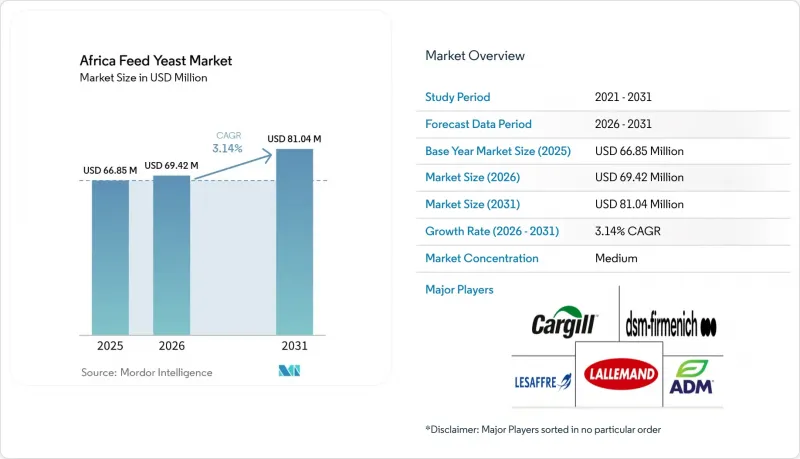
본 보고서는 부첨가물별(생효모, 셀레늄 효모, 사용 후 효모 등), 대상 동물별(수산물 양식, 가금류 등), 그리고 지역별(남아프리카, 케냐, 이집트 및 기타 아프리카 국가들)로 분류되어 있습니다. 시장 전망은 금액(달러) 및 수량(미터톤) 단위로 제시되어 있습니다.
아프리카 사료용 효모 시장 동향과 인사이트
가금 사료의 산업화
가금류 생산의 확대에 따라 아프리카의 사료용 효모 시장은 점차 체계화되고 있습니다. 이는 대규모 농장이나 통합형 사료 시스템이 농장에서 그 자리에서 혼합하는 방식이 아니라 일관된 배합에 의존하기 때문입니다. 이러한 변화는 중요한 의미를 지닙니다. 왜냐하면 효모는 배합 비율이 안정적이며, 장 건강, 사료 전환율, 군의 회복력, 생산량의 균일성 등 측정 가능한 생산 목표와 연계되어 있을 때 최고의 성능을 발휘하기 때문입니다. 이러한 상황에서도 사용 후 효모는 여전히 중요한 위치를 차지하고 있습니다. 이는 사료 마진이 좁은 구매자에게 적절한 가격대에서 단백질, 뉴클레오티드 및 베타글루칸을 공급할 수 있기 때문입니다. 또한, 아프리카의 사료용 효모 시장은 상업용 사료 생산 능력이 확대될 때 가금류가 가장 먼저 체계화되는 동물 부문이라는 사실로부터도 혜택을 받고 있습니다. 이로 인해 가금류는 첨가제의 지속적인 도입을 위한 가장 빠른 경로가 되고 있습니다. 남아프리카, 이집트, 나이지리아, 에티오피아에서 배합 사료 시스템이 정착됨에 따라, 아프리카의 사료용 효모 시장은 조달 체계 정비, 기술 지원 강화, 그리고 밸류 그레이드와 퍼포먼스 그레이드 효모 솔루션 간의 명확한 제품 차별화를 통해 혜택을 보고 있습니다.
효모 기반 복원력 솔루션을 통한 아플라톡신 위험 완화
많은 축산 시스템에서 아플라톡신 오염은 더 이상 우발적인 품질 문제로 간주되지 않기 때문에 아플라톡신 노출은 아프리카 사료용 효모 시장에서 더욱 강력한 구매 동기로 자리 잡고 있습니다. 『Tropical Animal Health and Production』지에 게재된 2024년 연구에 따르면, Pichia manshurica를 첨가함으로써 아플라톡신 B1에 오염된 사료의 반추위 발효 및 영양소 분해성이 개선된 것으로 밝혀졌으며, 이는 기본적인 영양 공급을 넘어선 기능성 효모의 사용을 뒷받침하는 결과입니다. 또한, 『World Journal of Microbiology and Biotechnology』지에 게재된 2025년 연구에 따르면, 육계 사료에 Pichia kudriavzevii를 첨가함으로써 아플라톡신 스트레스와 관련된 악영향이 완화된 것으로 나타났으며, 이는 균주 특이적인 효모 제품의 상업적 가치를 뒷받침하는 것입니다. 에티오피아에서는 2025년 연구에서 표본으로 채취한 젖소용 농축 사료의 85.4%에서 아플라톡신 B1이 검출된 것으로 보고되었으며, 이는 사료 안전성에 대한 우려로 인해 효모 세포벽 및 결합제 제품의 용도가 “임의적 사용”에서 “일반적인 사용”로 전환될 가능성이 있음을 여실히 보여주고 있습니다. 따라서 아프리카의 사료용 효모 시장은 효모가 규정 준수, 사료 안전성, 생산 안정성을 동시에 지원한다는 더 광범위한 가치 제안을 통해 혜택을 받고 있습니다.
통화 변동성과 수입 원자재의 인플레이션
통화 불안정은 여전히 아프리카의 사료용 효모 시장을 제약하고 있습니다. 이는 많은 특수 원료, 발효 재료 및 수입된 완제품 첨가제의 가격이 경화통화를 기준으로 책정되어 있기 때문입니다. 현지 통화가 하락하면 유통업체는 이익률 압박에 직면하게 되며, 사료 공장은 기술적 근거가 여전히 유효한 경우에도 고부가가치 효모 형태로의 전환을 미루는 경우가 많습니다. 이러한 영향이 가장 큰 곳은 소규모 상업용 사료 공장입니다. 이러한 공장들은 대개 헤지 능력이나 충분한 재고, 혹은 단기적인 비용 충격을 흡수하는 데 필요한 재무 기반이 부족하기 때문입니다. 이 때문에 아프리카 사료용 효모 시장의 일부는 저가 제품 선택에 얽매인 채로 남아 있어, 생효모, 셀레늄 효모 및 고부가가치 파생 제품으로의 전환이 더딘 양상을 보이고 있습니다. 지역 내 생산 거점이 늘어나면 이러한 압박은 점차 완화될 전망이지만, 단기적인 가격 민감도는 여전히 아프리카 사료용 효모 시장의 결정적인 제약 요인으로 남아 있습니다.
부문별 분석
2025년, 아프리카 사료용 효모 시장에서 사용 후 효모는 24%라는 가장 큰 점유율을 차지했습니다. 이는 비용에 민감한 상업용 사료 구매자들과 잘 어울린다는 점을 반영하고 있습니다. 보다 전문적인 효모 제품에 따르는 가격 프리미엄 없이 단백질, 뉴클레오티드, 베타글루칸을 첨가할 수 있기 때문에 현재도 널리 사용되고 있습니다. 아프리카의 사료용 효모 시장에서 가금류 및 반추동물용 배합 사료에 기능적 지원이 필요하지만 예산 관리가 여전히 엄격한 경우, 사용 후 효모가 실용적인 대안이 되는 이유입니다. 셀레늄 효모는 유기 셀레늄의 가치가 동물의 건강, 제품 품질 및 프리미엄 사료 프로그램과 점점 더 밀접하게 연관되면서, 보다 본격적인 젖소 및 산란계 사육 시스템에서 그 입지를 넓혀가고 있습니다. 토루라 건조 효모, 유청 효모 및 효모 유도체는 현재 시장 규모는 작지만, 각각 기호성 향상, 반추위 안정성, 장 건강 및 사료 안전성 등의 용도에서 명확한 역할을 수행하고 있습니다.
아프리카 사료용 효모 시장 규모에서 생효모는 2031년까지 연평균 성장률(CAGR) 3.5%라는 가장 빠른 속도로 확대될 것으로 예상되며, 이는 성능을 중시하는 구매 경향으로의 더욱 강력한 전환을 반영하고 있습니다. 이 부문은 항생제 사용 감축에 대한 감시가 강화되고, 루멘 조절에 대한 활용이 확대되며, 육계 및 젖소를 위한 장 건강 솔루션에 대한 관심이 높아짐에 따라 혜택을 보고 있습니다. 2025년 『Frontiers in Veterinary Science』지에 게재된 연구에 따르면, 유기 셀레늄 공급원이 무기 형태보다 셀레늄의 생체 이용률이 높은 것으로 나타나, 유기 셀레늄 공급원의 우수한 위상이 입증되었습니다. 이는 체계화된 사업 운영 속에서 셀레늄 효모의 장기적인 성장 잠재력을 설명하는 한 가지 요인이 되고 있습니다. 따라서 아프리카의 사료용 효모 시장은 더욱 다층적인 제품 구성으로 전환되고 있습니다. 그곳에서는 사용 후 효모가 시장 규모를 유지하는 한편, 생효모 및 그 파생 제품이 가치의 더 큰 부분을 차지하게 되었습니다. 이러한 경향은 급격한 대체라기보다는 점진적인 프리미엄화를 시사하고 있으며, 따라서 예측 기간 동안 저비용이면서도 고기능성을 갖춘 제품들이 공존할 가능성이 높다고 볼 수 있습니다.
기타 혜택:
- 엑셀 형식 시장 예측(ME) 시트
- 3개월간의 애널리스트 지원
자주 묻는 질문
목차
제1장 서론
제2장 개 보고서의 내용
제3장 주요 요약 및 주요 조사 결과
제4장 주요 업계 동향
제5장 시장 규모와 성장 예측
제6장 경쟁 구도
제7장 CEO에 대한 주요 전략적 질문
JHS 26.07.09According to Mordor Intelligence, the africa feed yeast market size is anticipated to grow from USD 66.85 million in 2025 to USD 69.42 million in 2026 and is forecast to reach USD 8.04 million by 2031 at 3.14% CAGR over 2026-2031.
This report is Segmented by Sub Additive (Live Yeast, Selenium Yeast, Spent Yeast, and More), by Animal (Aquaculture, Poultry, and More), and by Geography (South Africa, Kenya, Egypt, and the Rest of Africa). The Market Forecasts are Provided in Terms of Value (USD) and Volume (Metric Tons).
Africa Feed Yeast Market Trends and Insights
Poultry Feed Industrialization
Poultry production is making the Africa feed yeast market more structured because larger farms and integrated feed systems depend on consistent formulations rather than variable on-farm mixing. That shift matters because yeast performs best when inclusion rates are stable and tied to measurable production targets such as gut integrity, feed conversion, flock resilience, and output uniformity. In this setting, spent yeast has remained relevant because it delivers protein, nucleotides, and beta-glucans at a price point that works for buyers managing narrow feed margins. The Africa feed yeast market also benefits from the fact that poultry is the first animal segment to formalize when commercial feed capacity expands, which makes it the earliest route for repeat additive adoption. As compound feed systems deepen across South Africa, Egypt, Nigeria, and Ethiopia, the Africa feed yeast market gains from better procurement discipline, stronger technical support, and clearer product differentiation between value-grade and performance-grade yeast solutions.
Aflatoxin-Risk Mitigation Through Yeast-Based Resilience Solutions
Aflatoxin exposure is becoming a stronger purchase driver in the Africa feed yeast market because contamination is no longer treated as an occasional quality issue in many livestock systems. A 2024 study in Tropical Animal Health and Production found that Pichia manshurica supplementation improved rumen fermentation and nutrient degradability in aflatoxin B1-contaminated diets, which supports the case for functional yeast use beyond basic nutrition. A 2025 study in World Journal of Microbiology and Biotechnology also showed that Pichia kudriavzevii supplementation in broiler feed reduced the adverse effects linked with aflatoxin stress, which strengthens the commercial case for strain-specific yeast products. In Ethiopia, a 2025 study reported aflatoxin B1 contamination in 85.4% of sampled dairy concentrates, which underlines how feed safety concerns can shift yeast cell wall and binder products from optional use toward standard use. The Africa feed yeast market therefore gains from a broader value proposition where yeast supports compliance, feed safety, and production stability at the same time.
Currency Volatility and Imported-Input Inflation
Currency instability still limits the Africa feed yeast market because many specialty inputs, fermentation materials, and imported finished additives are priced against hard currencies. When local currencies weaken, distributors face margin pressure and feed mills often postpone upgrades to higher-value yeast formats even if the technical case remains intact. The impact is strongest on smaller commercial mills because they usually lack hedging capacity, deep inventories, or the balance sheet needed to absorb short-term cost shocks. This keeps part of the Africa feed yeast market tied to low-cost product choices and slows the move into live yeast, selenium yeast, and advanced derivatives. The pressure should ease gradually where more in-region manufacturing comes online, but near-term pricing sensitivity remains a defining restraint in the Africa feed yeast market.
Other drivers and restraints analyzed in the detailed report include:
- Aquaculture Feed Expansion
- Feed-Efficiency Optimization Under High Feed-Cost Pressure
- Soybean and Protein-Meal Deficits in East Africa
For complete list of drivers and restraints, kindly check the Table Of Contents.
Segment Analysis
Spent yeast held the largest Africa feed yeast market share at 24% in 2025, which reflects its strong fit with cost-conscious commercial feed buyers. It remains widely used because it adds protein, nucleotides, and beta-glucans without the price premium attached to more specialized yeast formats. In the Africa feed yeast market, this makes spent yeast the practical choice where poultry and ruminant formulas need functional support, but budget discipline remains strict. Selenium yeast is gaining ground in more formal dairy and layer systems because organic selenium positioning is increasingly tied to animal health, product quality, and premium feeding programs. Torula dried yeast, whey yeast, and yeast derivatives remain smaller today, but each plays a defined role in palatability support, rumen stability, gut health, and feed safety applications.
In Africa feed yeast market size terms, live yeast is set to expand at the fastest 3.5% CAGR through 2031, reflecting a stronger shift toward performance-led buying. The segment benefits from tighter scrutiny of antibiotic reduction, broader use in rumen modulation, and stronger interest in gut integrity solutions for broilers and dairy cattle. In 2025, Research published in Frontiers in Veterinary Science also supported the premium positioning of organic selenium sources by showing greater selenium bioavailability than inorganic forms, which helps explain the longer-term upside for selenium yeast in structured operations. The Africa feed yeast market is therefore moving toward a more layered product mix, where spent yeast keeps scale, but live yeast and derivatives take a larger part of the value. That pattern points to gradual premiumization rather than rapid replacement, which is why lower-cost and higher-function products are likely to coexist through the forecast period.
Complete Report Scope:
- By Sub Additive
- Live Yeast
- Selenium Yeast
- Spent Yeast
- Torula Dried Yeast
- Whey Yeast
- Yeast Derivatives
- Animal
- Aquaculture
- Fish
- Shrimp
- Other Aquaculture Species
- Poultry
- Broiler
- Layer
- Other Poultry Birds
- Ruminants
- Beef Cattle
- Dairy Cattle
- Other Ruminants
- Swine
- Other Animals
- Aquaculture
- Country
- South Africa
- Kenya
- Egypt
- Rest of Africa
List of Companies Covered in this Report:
- Lesaffre et Compagnie
- Angel Yeast Co., Ltd.
- Lallemand Inc.
- Archer Daniels Midland Company
- Cargill, Incorporated
- Alltech, Inc.
- Nutreco N.V.
- Novonesis A/S
- Leiber GmbH
- Kemin Industries, Inc.
- Royal Agrifirm Group
- DSM-Firmenich AG
- Novus International, Inc.
- Adisseo France S.A.S.
- Evonik Industries AG
Additional Benefits:
- The market estimate (ME) sheet in Excel format
- 3 months of analyst support
TABLE OF CONTENTS
1 INTRODUCTION
- 1.1 Study Assumptions & Market Definition
- 1.2 Scope of the Study
- 1.3 Research Methodology
2 REPORT OFFERS
3 EXECUTIVE SUMMARY & KEY FINDINGS
4 KEY INDUSTRY TRENDS
- 4.1 Animal Headcount
- 4.1.1 Poultry
- 4.1.2 Ruminants
- 4.1.3 Swine
- 4.2 Feed Production
- 4.2.1 Aquaculture
- 4.2.2 Poultry
- 4.2.3 Ruminants
- 4.2.4 Swine
- 4.3 Regulatory Framework
- 4.3.1 Africa
- 4.4 Value Chain & Distribution Channel Analysis
- 4.5 Market Drivers
- 4.5.1 Poultry feed industrialization
- 4.5.2 Aquaculture feed expansion
- 4.5.3 Commercial feed penetration gains
- 4.5.4 Feed-efficiency optimization under high feed-cost pressure
- 4.5.5 Faster feed registration and licensing in Egypt
- 4.5.6 Aflatoxin-risk mitigation through yeast-based resilience solutions
- 4.6 Market Restraints
- 4.6.1 Currency volatility and imported-input inflation
- 4.6.2 Low compound-feed penetration in informal channels
- 4.6.3 Soybean and protein-meal deficits in East Africa
- 4.6.4 Uneven storage hygiene and additive quality assurance
5 Market Size and Growth Forecasts (Value and Volume)
- 5.1 By Sub Additive
- 5.1.1 Live Yeast
- 5.1.2 Selenium Yeast
- 5.1.3 Spent Yeast
- 5.1.4 Torula Dried Yeast
- 5.1.5 Whey Yeast
- 5.1.6 Yeast Derivatives
- 5.2 Animal
- 5.2.1 Aquaculture
- 5.2.1.1 Fish
- 5.2.1.2 Shrimp
- 5.2.1.3 Other Aquaculture Species
- 5.2.2 Poultry
- 5.2.2.1 Broiler
- 5.2.2.2 Layer
- 5.2.2.3 Other Poultry Birds
- 5.2.3 Ruminants
- 5.2.3.1 Beef Cattle
- 5.2.3.2 Dairy Cattle
- 5.2.3.3 Other Ruminants
- 5.2.4 Swine
- 5.2.5 Other Animals
- 5.2.1 Aquaculture
- 5.3 Country
- 5.3.1 South Africa
- 5.3.2 Kenya
- 5.3.3 Egypt
- 5.3.4 Rest of Africa
6 COMPETITIVE LANDSCAPE
- 6.1 Key Strategic Moves
- 6.2 Market Share Analysis
- 6.3 Market Share Analysis
- 6.4 Company Profiles (Includes Global Level Overview, Market Level Overview, Core Business Segments, Financials, Headcount, Key Information, Market Rank, Market Share, Products and Services, and Analysis of Recent Developments).
- 6.4.1 Lesaffre et Compagnie
- 6.4.2 Angel Yeast Co., Ltd.
- 6.4.3 Lallemand Inc.
- 6.4.4 Archer Daniels Midland Company
- 6.4.5 Cargill, Incorporated
- 6.4.6 Alltech, Inc.
- 6.4.7 Nutreco N.V.
- 6.4.8 Novonesis A/S
- 6.4.9 Leiber GmbH
- 6.4.10 Kemin Industries, Inc.
- 6.4.11 Royal Agrifirm Group
- 6.4.12 DSM-Firmenich AG
- 6.4.13 Novus International, Inc.
- 6.4.14 Adisseo France S.A.S.
- 6.4.15 Evonik Industries AG


