|
시장보고서
상품코드
2073250
중동의 사료용 마이코톡신 해독제 시장 : 점유율 분석, 업계 동향과 통계, 성장 예측(2026-2031년)Middle East Feed Mycotoxin Detoxifiers - Market Share Analysis, Industry Trends & Statistics, Growth Forecasts (2026 - 2031) |
||||||
 Mordor Intelligence
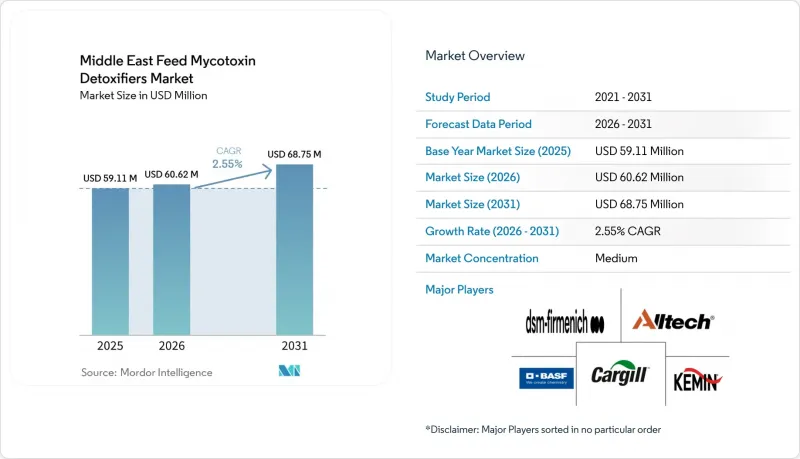
Mordor Intelligence에 의하면, 중동 사료용 마이코톡신 해독제 시장 규모는 2025년 5,911만 달러, 2026년 6,062만 달러에서 2031년까지 6,875만 달러로 확대한다고 예측되고 있어 2026년부터 2031년까지 연평균 복합 성장률(CAGR)은 2.55%를 나타낼 전망입니다.
본 보고서는 부가물(결합제 및 생체전환제), 대상 동물(수산물 양식, 가금류, 반추동물, 돼지, 기타 동물) 및 지역(사우디아라비아, 이란, 기타 중동 국가)별로 분류되어 있습니다. 시장 전망은 금액(달러) 및 수량(미터톤) 단위로 제시되어 있습니다.
중동 사료용 마이코톡신 해독제 시장 동향 및 인사이트
폭염 속 가금류 및 젖소 생산의 집약화
가금류 및 젖소의 생산 확대는 중동의 사료용 마이코톡신 해독제 시장에 안정적인 수요 기반을 마련해 주고 있습니다. 이는 생산성이 높은 농장에서 사료 품질의 지속적인 저하를 계속 용인할 경우, 헤아릴 수 없는 손실을 입게 되기 때문입니다. 사우디아라비아의 식량 안보 정책은 계속해서 국내 가금류 생산 확대를 주도하고 있습니다. 2025/26 마케팅 연도의 사료용 옥수수 사용량은 460만-490만 메트르톤에 달했습니다. 이는 2024/25년도 470만 메트르톤에 비해 증가한 수치로, 해당 왕국의 배합사료 수요가 급속히 증가하고 있음을 반영하고 있습니다. 고온 환경에서는 곡물이나 완제품 사료의 안전한 보관 기간이 짧아지기 때문에 대규모 가금·낙농 사업자들은 눈에 띄는 생산 손실이 발생하기를 기다리기보다는 예방 조치로 해독제를 배합하는 경향이 강해지고 있습니다. 또한, 사료에 포함된 아플라톡신 B1이 우유에서 아플라톡신 M1로 변환될 가능성이 있으므로, 낙농 분야에서는 잔류 위험도 발생할 수 있어 위험 관리의 중요성이 강조되고 있습니다. 조직화된 낙농 공급망에서 이루어지는 공식 검사가 점점 더 보편화되고 있습니다. 수직 통합형 시스템에서는 이러한 상업적 합리성이 더욱 두드러지게 작용합니다. 이러한 시스템에서는 단 한 번의 오염 사고만으로도 사료 전환율, 가축의 건강 상태, 우유의 품질, 그리고 브랜드 제품의 평판에 동시에 영향을 미칠 가능성이 있기 때문입니다. 이러한 상황으로 인해 중동의 사료용 마이코톡신 해독제 시장에는 오염 수준뿐만 아니라 현대 축산 경영 모델과도 연계된 수요 기반이 형성되고 있습니다.
고온 기후와 수입 의존으로 인한 사료 공급망의 마이코톡신 위험
중동의 사료용 마이코톡신 해독제 시장은 해당 지역이 수입 사료 원료에 구조적으로 의존하고 있다는 점에서도 혜택을 보고 있습니다. 이는 긴 운송 시간, 반복되는 취급, 도착 후의 고온 보관 조건으로 인해 오염 부담이 증가하기 때문입니다. 2025년 1월 『Toxins』지에 게재된 연구에 따르면, 리야드, 알하사, 카심, 제다에서 채취한 가금류 사료 원료 샘플 100점을 조사한 결과, 모든 샘플에서 여러 유형의 마이코톡신에 의한 오염이 확인되었으며, 84%에서 아플라톡신, 56%에서 푸모니신이 검출되었습니다. 해당 연구에서는 분리된 아플라톡신 생성 균 중 아스페르길루스 플라바스가 우점종으로 확인되었다고 보고되었으며, 원산지에서의 오염뿐만 아니라 보관 조건과 취급 방법의 중요성이 부각되었습니다. 이는 시판 사료에서 여러 유형의 독소가 동시에 검출되는 사례가 증가하고 있어, 단일 표적만을 대상으로 한 제한적인 해결책의 유용성이 떨어지고 있기 때문에 중요한 의미를 지닙니다. 그 결과, 중동 사료용 마이코톡신 해독제 시장의 구매자들은 특히 가금 사육이 주를 이루는 시스템에서 사후 대응형 구매에서 완제품 사료에 대한 일상적인 배합 프로그램으로 점차 전환하고 있습니다. 이러한 변화는 해독제 수요를 일시적인 시정 조치가 아닌 지속적인 운영 비용으로 전환시킨다는 점에서 중요합니다.
가격에 대한 민감성과, 가공되지 않은 사료 또는 지역산 사료에 대한 선호도
중동의 사료용 마이코톡신 해독제 시장에서 가격 민감도가 주요 상업적 제약 요인으로 작용하고 있습니다. 이는 소규모 축산 사업자들이 해독제를 필수품으로 여기지 않는 경향이 있기 때문입니다. 이러한 문제는 이란이나 지역 전체의 소규모 사업체에서 특히 두드러지는데, 그곳에서는 구매 결정 시 하류 단계에서 발생할 수 있는 손실을 방지할 가능성보다 당장의 사료 비용이 우선시됩니다. 신속 검사가 제한된 지역에서는 동물의 생산성 저하 징후가 나타나야 비로소 오염이 확인되는 경우가 빈번합니다. 그런 경우에도 문제는 다른 영양적 요인이나 관리상의 요인에 기인한 것으로 간주되는 경우가 많아, 그 결과 해독제 투여가 지연되곤 합니다. 정기적인 진단이나 종합적인 기록 관리가 이루어지지 않고 있어, 예방적 해독 조치의 경제적 이점을 입증하기 어렵습니다. 이로 인해 생물학적 위험과 해독제의 상업적 도입 사이에 격차가 발생하여, 오염 확산률로 예상되는 수준보다 시장 성장세가 더뎌지고 있습니다. 검사 접근성이 개선되거나 보다 일관된 규제가 시행되지 않는 한, 저가의 미처리 사료가 시장 침투를 계속 제한할 것입니다.
부문별 분석
2025년, 중동의 사료용 마이코톡신 해독제 시장에서 흡착제는 66.3%의 점유율을 차지하며, 가금류, 유우, 반추동물의 전체 사료 프로그램에서 가장 큰 하위 첨가제 부문이 되었습니다. 이러한 우위는 배합 담당자들에게 친숙하고 비용 대비 효과가 높으며, 공정을 대폭 변경하지 않고도 사료에 쉽게 배합할 수 있는 점토계 솔루션에 대한 오랜 선호도를 반영한 것입니다. 많은 상업용 시스템에서 아플라톡신 관리는 여전히 경제적·규제적 측면에서 중요한 우선순위이므로, 결합제는 주요 방어 메커니즘으로 기능하고 있습니다. 이는 기술적 복잡성을 최소화하면서도 대량의 사료에 적용할 수 있는 저비용 솔루션을 구매자가 요구하는 국가들에서 특히 중요한 의미를 지닙니다. 그 결과, 중동의 사료용 마이코톡신 해독제 시장은 일상적인 마이코톡신 관리의 기본적인 접근 방식으로서 여전히 광물성 흡착제에 크게 의존하고 있습니다.
중동의 사료용 마이코톡신 해독제 시장에서 생체 변환제 시장 규모는 2031년까지 연평균 성장률(CAGR) 2.6%로 확대될 것으로 예상되며, 기반 규모는 작지만 첨가제 하위 부문 중 가장 빠르게 성장하는 분야가 될 전망입니다. 이러한 증가는 해당 지역의 다양한 오염 상황에 기인합니다. 이는 특정 푸사리움 유래 독소에 대해서는 결합제가 효소적 또는 생물학적 분해법에 비해 효과가 낮기 때문입니다. DSM-Firmenich AG가 2024년에 튀르키예 및 중동의 완제품 사료를 대상으로 실시한 조사에서 표본으로 채취된 로트의 93%에서 푸모니신이, 83%에서 제아라레논이 검출되어, 광물 흡착을 넘어서는 해결책의 필요성이 부각되었습니다. 상업용 사료 조달 과정에서 여러 가지 독소에 노출되는 문제가 일반적인 과제로 대두되는 가운데, 영양 담당 팀은 하이브리드형 및 다중 기전형 프로그램을 점점 더 많이 도입하고 있습니다. 흡착제의 중요성은 앞으로도 지속될 것으로 예상되지만, 중동의 사료용 마이코톡신 해독제 시장의 성장은 더 광범위한 독소 스펙트럼에 대응하고 기술적 정밀도를 높인 제품의 영향력을 점점 더 크게 받고 있습니다.
기타 혜택:
- 엑셀 형식 시장 예측(ME) 시트
- 3개월간의 애널리스트 지원
자주 묻는 질문
목차
제1장 서론
제2장 개 보고서의 내용
제3장 주요 요약 및 주요 조사 결과
제4장 주요 업계 동향
제5장 시장 규모와 성장 예측
제6장 경쟁 구도
제7장 CEO에 대한 주요 전략적 질문
JHS 26.07.07According to Mordor Intelligence, the middle east feed mycotoxin detoxifiers market size is projected to expand from USD 59.11 million in 2025 and USD 60.62 million in 2026 to USD 68.75 million by 2031, registering a CAGR of 2.55% between 2026 and 2031.
This report is Segmented by Sub-Additive (Binders and Biotransformers), by Animal (Aquaculture, Poultry, Ruminants, Swine, and Other Animals), and by Geography (Saudi Arabia, Iran, and the Rest of the Middle East). The Market Forecasts are Provided in Terms of Value (USD) and Volume (Metric Tons).
Middle East Feed Mycotoxin Detoxifiers Market Trends and Insights
Poultry and Dairy Intensification Under Extreme Heat Conditions
Poultry and dairy expansion is creating a steady volume base for the Middle East feed mycotoxin detoxifiers market, as high-output farms cannot absorb repeated disruptions to feed quality without measurable losses. Saudi Arabia's food security agenda continues to drive increased local poultry production. Corn usage in feed has reached a range from 4.6 to 4.9 million metric tons in the marketing year 2025/26, compared to 4.7 million metric tons in 2024/25, reflecting the rapid growth in ration demand within the kingdom. In hot environments, grain and finished feed face a shorter safe storage window, so larger poultry and dairy operators are more willing to include detoxifiers on a preventive basis rather than wait for visible production losses. Dairy also introduces residue risk, as aflatoxin B1 in feed can be converted to aflatoxin M1 in milk, underscoring the importance of risk management. Formal testing in organized dairy chains is becoming more common. The commercial logic is stronger in vertically integrated systems, where a single contamination event can simultaneously affect feed conversion, flock health, milk quality, and the branded product's reputation. That dynamic gives the Middle East feed mycotoxin detoxifiers market a demand base that is tied not only to contamination levels but also to the operating model of modern livestock production.
Hot-Climate and Import-Driven Mycotoxin Risk in Feed Supply Chains
The Middle East mycotoxin detoxifiers market also benefits from the region's structural dependence on imported feed materials, as contamination burdens are shaped by long transit times, repeated handling, and warm storage conditions after arrival. A January 2025 study in Toxins examined 100 poultry feedstuff samples from Riyadh, Al-Hassa, Qassim, and Jeddah and found multi-mycotoxin contamination in every sample, with aflatoxins detected in 84% and fumonisins in 56%. The same study reported that Aspergillus flavus was the dominant aflatoxigenic species isolated, underscoring the importance of storage conditions and handling practices, not just contamination at origin. This matters because commercial feed lots increasingly exhibit multiple toxin classes simultaneously, which undermines the usefulness of narrow, single-target solutions. As a result, buyers in the Middle East feed mycotoxin detoxifiers market are gradually moving from event-based purchases toward more routine inclusion programs for finished feed, especially in poultry-heavy systems. The shift is important because it turns detoxifier demand into a recurring operating cost instead of an occasional corrective response.
Price Sensitivity and Preference for Untreated or Locally Sourced Feed
Price sensitivity is the primary commercial restraint in the Middle East feed mycotoxin detoxifiers market, as smaller livestock operators often view detoxifiers as non-essential. This challenge is particularly evident in Iran and among smaller-scale operations across the region, where purchasing decisions prioritize immediate feed costs over the potential to prevent downstream losses. In areas with limited rapid testing, contamination is frequently identified only after signs of reduced animal performance emerge. Even then, the issue is often attributed to other nutritional or management factors, delaying the adoption of detoxifiers. The lack of regular diagnostics and comprehensive recordkeeping makes it difficult to demonstrate the economic benefits of preventive detoxification. This creates a gap between biological risks and the commercial adoption of detoxifiers, slowing market growth beyond what contamination prevalence would suggest. Without improved testing access or more consistent regulatory enforcement, low-cost, untreated feed will continue to limit market penetration.
Other drivers and restraints analyzed in the detailed report include:
- Stronger Feed Safety and Residue Oversight Across GCC Markets
- Expansion of Industrial Feed Milling and Commercial Livestock Farming
- Red Sea and Gulf Shipping Disruptions Affecting Additive Supply Chains
For complete list of drivers and restraints, kindly check the Table Of Contents.
Segment Analysis
Binders accounted for 66.3% of the Middle East feed mycotoxin detoxifiers market share in 2025, making them the largest sub-additive segment across poultry, dairy, and ruminant feed programs. This dominance reflects a long-standing preference for clay-based solutions, which are familiar to formulators, cost-effective, and easy to incorporate into feed without significant process modifications. In many commercial systems, binders serve as the primary defense mechanism, as aflatoxin control remains a critical economic and regulatory priority. This is particularly significant in countries where buyers require low-cost solutions that can be applied across large feed volumes with minimal technical complexity. Consequently, the Middle East feed mycotoxin detoxifiers market continues to rely heavily on mineral adsorbents as the foundational approach for routine mycotoxin management.
The Middle East feed mycotoxin detoxifiers market size for biotransformers is projected to grow at a 2.6% CAGR through 2031, making them the fastest-growing sub-additive segment despite starting from a smaller base. This growth is driven by the region's diverse contamination profile, as binders are less effective against certain Fusarium-derived toxins compared to enzymatic or biological degradation methods. A 2024 survey by DSM-Firmenich AG of finished feed in Turkey and the Middle East revealed fumonisins in 93% of sampled lots and zearalenone in 83%, highlighting the need for solutions beyond mineral adsorption. As multi-toxin exposure becomes a common challenge in commercial feed procurement, nutrition teams are increasingly adopting hybrid and multi-mechanism programs. While binders are expected to remain relevant, the growth of the Middle East feed mycotoxin detoxifiers market is increasingly influenced by products capable of addressing a broader toxin spectrum with enhanced technical precision.
Complete Report Scope:
- Sub Additive
- Binders
- Biotransformers
- Animal
- Aquaculture
- By Sub Animal
- Fish
- Shrimp
- Other Aquaculture Species
- By Sub Animal
- Poultry
- By Sub Animal
- Broiler
- Layer
- Other Poultry Birds
- By Sub Animal
- Ruminants
- By Sub Animal
- Beef Cattle
- Dairy Cattle
- Other Ruminants
- By Sub Animal
- Swine
- Other Animals
- Aquaculture
- Country
- Saudi Arabia
- Iran
- Rest of Middle East
List of Companies Covered in this Report:
- DSM-Firmenich AG
- Kemin Industries, Inc.
- Alltech, Inc.
- Cargill, Incorporated
- BASF SE
- Bluestar Adisseo Company
- Archer Daniels Midland Company
- EW Nutrition GmbH
- Clariant AG
- Nutreco N.V.
- Novus International, Inc.
- Phibro Animal Health Corporation
- Special Nutrients, LLC
- Impextraco NV
- Bentoli, Inc.
Additional Benefits:
- The market estimate (ME) sheet in Excel format
- 3 months of analyst support
TABLE OF CONTENTS
1 INTRODUCTION
- 1.1 Study Assumptions & Market Definition
- 1.2 Scope of the Study
- 1.3 Research Methodology
2 REPORT OFFERS
3 EXECUTIVE SUMMARY & KEY FINDINGS
4 KEY INDUSTRY TRENDS
- 4.1 Animal Headcount
- 4.1.1 Poultry
- 4.1.2 Ruminants
- 4.1.3 Swine
- 4.2 Feed Production
- 4.2.1 Aquaculture
- 4.2.2 Poultry
- 4.2.3 Ruminants
- 4.2.4 Swine
- 4.3 Regulatory Framework
- 4.3.1 Middle East
- 4.4 Value Chain & Distribution Channel Analysis
- 4.5 Market Drivers
- 4.5.1 Poultry and dairy intensification under extreme heat conditions
- 4.5.2 Hot-climate and import-driven mycotoxin exposure risk in feed supply chains
- 4.5.3 Stronger feed safety and residue oversight across GCC markets
- 4.5.4 Expansion of industrial feed milling and commercial livestock farming
- 4.5.5 Multi-mycotoxin contamination requiring broader-spectrum solutions
- 4.5.6 Use of alternative feed ingredients raising contamination risks
- 4.6 Market Restraints
- 4.6.1 Price sensitivity and preference for untreated or locally sourced feed
- 4.6.2 Limited diagnostic and formulation availability in smaller markets
- 4.6.3 Efficacy variability under complex toxin co-contamination profiles
- 4.6.4 Red Sea and Gulf shipping disruptions affecting additive supply chains
5 Market Size and Growth Forecasts (Value and Volume)
- 5.1 Sub Additive
- 5.1.1 Binders
- 5.1.2 Biotransformers
- 5.2 Animal
- 5.2.1 Aquaculture
- 5.2.1.1 By Sub Animal
- 5.2.1.1.1 Fish
- 5.2.1.1.2 Shrimp
- 5.2.1.1.3 Other Aquaculture Species
- 5.2.1.1 By Sub Animal
- 5.2.2 Poultry
- 5.2.2.1 By Sub Animal
- 5.2.2.1.1 Broiler
- 5.2.2.1.2 Layer
- 5.2.2.1.3 Other Poultry Birds
- 5.2.2.1 By Sub Animal
- 5.2.3 Ruminants
- 5.2.3.1 By Sub Animal
- 5.2.3.1.1 Beef Cattle
- 5.2.3.1.2 Dairy Cattle
- 5.2.3.1.3 Other Ruminants
- 5.2.3.1 By Sub Animal
- 5.2.4 Swine
- 5.2.5 Other Animals
- 5.2.1 Aquaculture
- 5.3 Country
- 5.3.1 Saudi Arabia
- 5.3.2 Iran
- 5.3.3 Rest of Middle East
6 COMPETITIVE LANDSCAPE
- 6.1 Market Concentration
- 6.2 Key Strategic Moves
- 6.3 Market Share Analysis
- 6.4 Company Profiles (Includes Global Level Overview, Market Level Overview, Core Business Segments, Financials, Headcount, Key Information, Market Rank, Market Share, Products and Services, and Analysis of Recent Developments).
- 6.4.1 DSM-Firmenich AG
- 6.4.2 Kemin Industries, Inc.
- 6.4.3 Alltech, Inc.
- 6.4.4 Cargill, Incorporated
- 6.4.5 BASF SE
- 6.4.6 Bluestar Adisseo Company
- 6.4.7 Archer Daniels Midland Company
- 6.4.8 EW Nutrition GmbH
- 6.4.9 Clariant AG
- 6.4.10 Nutreco N.V.
- 6.4.11 Novus International, Inc.
- 6.4.12 Phibro Animal Health Corporation
- 6.4.13 Special Nutrients, LLC
- 6.4.14 Impextraco NV
- 6.4.15 Bentoli, Inc.