

|
시장보고서
상품코드
2073255
방부제 시장 : 점유율 분석, 업계 동향과 통계, 성장 예측(2026-2031년)Preservatives - Market Share Analysis, Industry Trends & Statistics, Growth Forecasts (2026 - 2031) |
||||||
 Mordor Intelligence
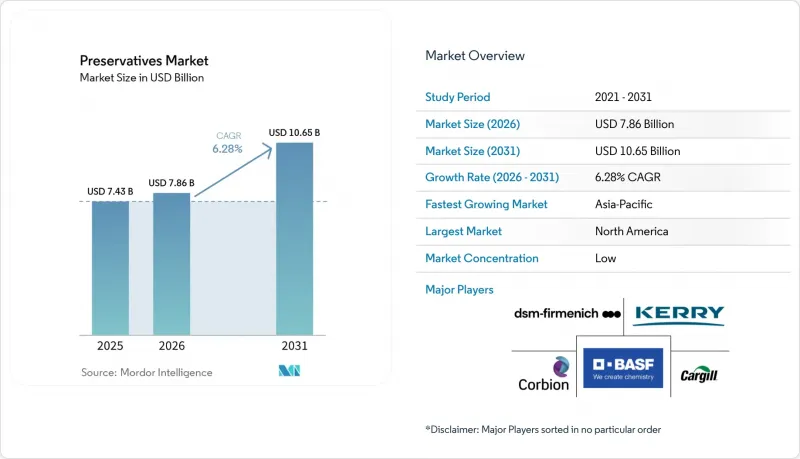
Mordor Intelligence에 의하면, 세계의 방부제 시장 규모는 2025년 74억 3,000만 달러에서 2026년에는 78억 6,000만 달러로 확대되어 2026년부터 2031년까지 CAGR 6.28%로 성장을 지속하여, 2031년에는 106억 5,000만 달러에 이를 것으로 예측됩니다.
본 보고서는 제품 유형(합성 및 천연), 기능(항균 및 항산화), 형태(액체 및 분말), 용도(식품 및 음료, 의약품, 반려동물사료 등) 및 지역(북미, 유럽, 아시아태평양, 남미, 중동 및 아프리카)별로 분류되어 있습니다. 시장 전망은 금액(달러) 및 수량(톤) 단위로 제시되어 있습니다.
세계 방부제 시장 동향과 인사이트
가공식품 및 편의점 식품의 성장에 따라, 유통기한 연장에 대한 수요가 높아지고 있습니다.
세계 방부제 시장은 가공식품 및 편의식품에 대한 수요 증가에 힘입어 꾸준한 성장을 이어가고 있습니다. 공급망이 길어지고 복잡해짐에 따라, 기업들은 미생물학적 안전성을 유지하고 생산 단계부터 소매점 진열대에 이르기까지 제품의 안정성을 확보하기 위해 효과적인 보존 시스템에 의존하고 있습니다. 냉장 즉석식, 식물성 육류 대체품, 상온 보관이 가능한 유제품 음료 등, 기존에는 “신선식품"이라고 여겨지던 제품 카테고리조차도 정교한 보관 전략이 채택되고 있습니다. 이러한 전략에서는 대개 항균제와 항산화제를 함께 사용하여 유통기한을 연장하고 품질을 유지하고 있습니다. 유제품 대체품의 경우, 귀리, 완두콩, 견과류를 사용한 제품은 동물성 단백질에서 볼 수 있는 천연 항균 특성이 없기 때문에 특유의 과제에 직면해 있습니다. 이로 인해 더욱 정교한 기술적 해결책에 대한 필요성이 커지고 있습니다. 코비온(Corbion)과 같은 업계 선도 기업들은 발효를 기반으로 한 보존 솔루션의 중요한 역할을 강조하고 있습니다. 이러한 솔루션은 고객의 요구를 충족시킬 뿐만 아니라, 협업을 통한 혁신을 바탕으로 다양한 제조 환경에서 효과적으로 규모를 확대할 수 있습니다. 전반적으로 볼 때, 이러한 요인들은 현대 식품 시스템에서 방부제가 없어서는 안 될 역할을 하고 있음을 여실히 보여주고 있습니다. 방부제 덕분에 기업들은 점점 더 까다로워지는 시장 환경 속에서 업무 효율을 높이고, 소비자의 기대에 부응하며, 제품의 품질을 유지할 수 있게 됩니다.
식품 폐기물 감축 노력이 방부제 사용을 촉진하고 있습니다.
식품 폐기물 감축을 위한 노력은 전 세계 방부제 시장을 재편하고 있으며, 이러한 성분들을 단순한 기능성 첨가물이 아닌 지속가능성을 위한 필수적인 수단으로 자리매김하고 있습니다. 유엔 식량농업기구(FAO)의 보고서에 따르면, 식품 손실과 폐기물은 전 세계 온실가스 배출량의 8-10%를 차지하고 있습니다. 이에 따라 각국 정부와 기업들은 환경·사회·지배구조(ESG) 목표를 달성하기 위한 실질적인 전략의 일환으로, 보존 기간 연장을 최우선 과제로 삼고 있습니다. 이러한 노력은 운송 및 보관 과정에서 막대한 식품 손실이 발생하는 신흥 시장에서 특히 중요합니다. 그 결과, 주곡의 품질을 안정적으로 유지하기 위해 합성 방부제와 바이오 방부제 모두에 대한 수요가 증가하고 있습니다. FAO가 2025년에 정한 ‘식량 손실 및 폐기물 인식 제고의 날”에서는 첨단 보존 기술에 대한 투자의 중요성이 강조되며, 방부제가 전 세계적 지속가능성 체계에 더욱 깊이 통합되고 있습니다. 이 변화는 소비자용 용도에 그치지 않고, 정부 주도의 식량 안보 프로그램을 통해 새로운 기회도 창출하고 있습니다. 이러한 추세는 시장의 범위를 넓히고, 오늘날 공급망에서 방부제가 수행하는 중요한 역할을 더욱 공고히 하고 있습니다.
인공 식품 첨가물에 대한 소비자들의 반발 고조
인공 식품 첨가물에 대한 소비자들의 반발은 전 세계 방부제 시장에 있어 중대한 과제가 되고 있습니다. 한때는 틈새 전략에 불과했던 제품의 재조성은 이제 비즈니스에 있어 필수적인 조치가 되었습니다. 북미와 유럽에서는 “인공 방부제 무첨가”를 내세우는 제품의 출시가 늘어나고 있으며, 이는 소비자의 기호가 조달 및 혁신 전략을 어떻게 변화시키고 있는지를 반영하고 있습니다. “천연 유래 방부제”를 내세우는 제품은 다양한 제품 카테고리에서 인기를 끌고 있습니다. 그러나 인공 첨가물에 대한 반발은 대개 광범위하고 무차별적이며, 안전성이 입증된 정평이 나 있는 합성 방부제 시스템조차도 표적으로 삼고 있습니다. 이로 인해 규제 당국의 승인 여부와 관계없이 이러한 시스템을 폐지해야 한다는 압력이 커지고 있습니다. 천연 유래 대체품은 매력적이지만, 복잡한 용도의 경우 합성 방부제의 성능이나 비용 대비 효과에 미치지 못하는 경우가 종종 있습니다. 그 결과, 각 제조업체는 냉장 관리 강화 및 제품 회전율 향상과 같은 업무상 조정을 통해 이러한 과제에 대처하고 있습니다. 이러한 변화로 인해 특정 시장 부문에서는 방부제 수요가 감소하고 있으며, 기술적 성능보다 소비자의 인식이 시장 동향을 점점 더 좌우하고 있다는 사실이 부각되고 있습니다.
부문별 분석
2025년, 합성 방부제는 세계 시장 점유율의 64.84%를 차지하고 있으며, 식품 가공, 의약품, 개인 위생 용품 등의 산업 분야에서 그 중요한 역할이 부각되고 있습니다. 이러한 우위는 높은 비용 대비 효과, 구하기 쉬움, 그리고 규제 기준 준수에 의해 뒷받침되고 있습니다. 이러한 방부제는 미생물로 인한 안전성 확보와 유통기한 연장이 필수적인 제빵 제품, 가공육, 주사제 등의 분야에서 특히 필수적입니다. 합성 방부제는 점점 더 엄격한 감시를 받고 있지만, 많은 용도에서 여전히 없어서는 안 될 존재입니다. 예를 들어, 소르빈산염이나 프로피온산염은 여전히 널리 수용되고 있는 반면, 부틸화 하이드록시톨루엔(BHT)이나 질산염 등의 화합물에 대해서는 규제 당국과 소비자들의 우려가 커지고 있습니다. 이러한 과제가 있음에도 불구하고, 배합 재검토라는 추세가 경쟁 구도를 변화시키고 있는 상황 속에서도 합성 방부제는 시장에서 확고한 입지를 유지하고 있습니다.
한편, 천연 방부제는 가장 빠르게 성장하는 부문으로 부상하고 있으며, 2026년부터 2031년까지 연평균 성장률(CAGR) 8.02%를 나타낼 것으로 전망됩니다. 토코페롤, 로즈마리 추출물, 나이신, 나타마이신, 젖산계 시스템 등의 성분은 제빵, 유제품, 음료, 퍼스널케어 등의 프리미엄 제품 카테고리에서 큰 주목을 받고 있습니다. 이러한 성장은 클린 라벨 제품에 대한 수요 증가와 FAO/WHO 합동 식품첨가물 전문가위원회(JECFA)의 2025년 로즈마리 추출물 평가와 같은 규제 측면의 지원에 크게 힘입은 것입니다. 게다가, 배양 덱스트로스나 완충 식초와 같은 발효 유래 화합물들이 분류의 경계를 재정의하고 있습니다. 이러한 화합물은 미국 식품의약국(FDA) 및 유럽연합(EU)의 기준에 따른 ‘일반적으로 안전하다고 인정되는(GRAS)”라는 틀 아래에서 “천연”로 인정받고 있으며, 이에 따라 천연 방부제 부문의 상업적 잠재력이 확대되고 있습니다. 투명성에 대한 소비자 수요가 지속적으로 증가하는 가운데, 합성 방부제와 천연 방부제의 재조성이라는 두 분야의 접점에서 사업을 전개하는 기업은 이러한 성장세를 최대한 활용할 수 있는 유리한 위치에 있습니다. 천연 방부제 시스템은 경쟁 구도를 점점 더 형성하고 있으며, 끊임없이 진화하는 방부제 시장에서 큰 우위를 점하고 있습니다.
2025년에는 항균성 방부제가 시장을 주도하며 67.56%라는 높은 점유율을 차지하고 있는데, 이는 식품 및 제약 업계에서 이 성분이 수행하는 매우 중요한 역할을 여실히 보여주고 있습니다. 이러한 방부제는 제빵 제품이나 델리 매장의 육류 제품부터 다회 투여용 주사제에 이르기까지 폭넓은 용도에서 필수적입니다. 벤조산염, 소르빈산염, 아질산염 등의 합성 방부제와 나이신, 나타마이신, 유기산 혼합물 등의 천연 대체재가 모두 이러한 우위에 기여하고 있습니다. 업계가 천연 및 합성 솔루션 간 전환기를 겪고 있음에도 불구하고, 항균 보호에 대한 근본적인 수요는 변함없이 유지되고 있으며, 이 부문은 시장의 핵심으로 자리매김하고 있습니다.
한편, 항산화제는 2026년부터 2031년까지 연평균 성장률(CAGR) 7.12%를 기록하며 가장 빠르게 성장하는 기능성 카테고리가 될 것으로 전망됩니다. 이러한 성장은 식용유, 스낵, 식물성 식품 등의 제품에 대한 수요 증가에 힘입어 이루어지고 있습니다. 이러한 제품의 경우, 지질의 산화로 인해 산패, 불쾌한 풍미, 변색 등이 발생할 수 있으며, 이 모든 것이 상업적 성공에 부정적인 영향을 미칠 가능성이 있습니다. FAO/WHO 합동 식품첨가물 전문가위원회(JECFA)가 2025년에 실시한 아스코빌 팔미테이트 및 로즈마리 추출물에 대한 평가와 같은 규제 당국의 승인을 통해 천연 항산화 시스템의 신뢰성이 강화되었으며, 다양한 시장에서 이를 도입하는 움직임이 활발해지고 있습니다. 또한, 시장에서는 항균 작용과 항산화 작용을 겸비한 다기능 보존 시스템으로의 전환이 진행되고 있습니다. 이러한 시스템은 제품의 배합을 간소화하고 사용되는 원료의 수를 줄여주기 때문에 미생물에 의한 부패와 지질 산화라는 두 가지 문제가 동시에 발생하는 육류 제품 및 육류 대체 식품 분야에서 큰 가치를 제공합니다.
지역별 분석
2025년, 북미는 가공식품, 의약품, 퍼스널케어 제품 분야에서 확고한 산업 기반을 바탕으로 33.21%라는 높은 시장 점유율을 차지했습니다. 미국 식품의약국(FDA)의 “일반적으로 안전하다고 인정되는(GRAS)”인증 절차는 천연 방부제의 상품화를 가속화하고 있으며, 북미에 다른 지역에 비해 규제상의 우위를 제공합니다. 이 시장 수요를 주도하고 있는 것은 미국이지만, 캐나다와 멕시코도 특히 제빵, 육류, 음료 생산 분야에서 미국·멕시코·캐나다 협정(USMCA)에 기반한 통합 공급망을 통해 기여하고 있습니다. 이 지역은 두 가지 과제에 직면해 있습니다. 식품 분야의 ‘클린 라벨”에 대한 재배합 수요가 높아지는 반면, 의약품 분야에서 고순도 합성 방부제에 대한 수요가 증가하고 있는 점이 대조적이기 때문입니다.
아시아태평양은 급속한 성장을 거듭하고 있으며, 2026년부터 2031년까지 연평균 성장률(CAGR) 7.34%를 나타낼 것으로 전망됩니다. 중국, 인도, 인도네시아, 베트남 등 여러 국가에서 진행되고 있는 도시화는 식품 공급망을 변화시키고 있으며, 소비자들의 선호도를 전통적인 신선 식품 시장에서 포장 식품이나 상온 보관이 가능한 식품으로 전환시키고 있습니다. 이러한 변화로 인해 방부제 시장은 크게 확대되고 있습니다. 중국에서는 유제품 및 육가공 산업이 급속히 성장하고 있으며, 나타마이신의 조달은 연안 지역에 집중되어 있습니다. 인도에서는 첨가물 표시에 관한 규제가 강화되고 있어, 제조업체들은 보다 깨끗하고 투명한 시스템의 도입을 촉진하고 있습니다. 일본과 한국에서는 투명성을 매우 중요시하는 세련된 소비자들 수요가 나타나고 있습니다. 동남아시아는 외식 산업의 확대와 포장 식품 소비 증가에 힘입어 고성장 지역으로 부상하고 있습니다. 호주 및 뉴질랜드에서는 유럽에서 나타나는 추세를 반영하여, 클린 라벨 제품과 천연 방부제에 대한 선호도가 높게 나타나고 있습니다.
유럽에서는 규제 환경이 시장 역학을 형성하는 데 있어 매우 중요한 역할을 하고 있습니다. 유럽식품안전청(EFSA)의 종합적인 재평가 프로그램과 식품 첨가물 승인에 관한 최신 지침에 따라 과학적 기준이 강화됨에 따라, 탄탄한 데이터 분석 역량을 갖춘 기업이 유리한 입장에 서게 되었습니다. 독일, 영국, 프랑스, 네덜란드 등 주요 시장은 강력한 식품·의약품 및 화장품 산업의 뒷받침을 받아 수요를 주도하고 있습니다. 중동 및 아프리카에서는 식품 가공에 대한 투자 확대에 따라 포장 식품의 소비가 증가하고 있습니다. 만안협력회의(GCC) 회원국들은 국내 생산 능력을 확충함으로써 수입 의존도를 적극적으로 낮추고 있습니다. 또한 이집트, 남아프리카공화국, 나이지리아 등에서는 산업용 방부제에 대한 수요가 증가하고 있습니다. 이러한 지역 전체를 살펴보면, 규제 체계, 소비자 선호도, 산업 투자가 방부제 사용과 관련된 세계적 동향을 어떻게 형성하고 있는지 알 수 있습니다.
기타 혜택:
- 엑셀 형식 시장 예측(ME) 시트
- 3개월간의 애널리스트 지원
자주 묻는 질문
목차
제1장 서론
제2장 조사 방법
제3장 주요 요약
제4장 시장 구도
제5장 시장 규모와 성장 예측
제6장 경쟁 구도
제7장 시장 기회와 향후 전망
JHS 26.07.07According to Mordor Intelligence, the global preservatives market size is expected to grow from USD 7.43 billion in 2025 to USD 7.86 billion in 2026 and is forecast to reach USD 10.65 billion by 2031 at 6.28% CAGR over 2026-2031.
This report is Segmented by Product Type (Synthetic and Natural), Function (Antimicrobial and Antioxidant), Form (Liquid and Powder), Application (Food and Beverages, Pharmaceuticals, Pet Food, and More), and Geography (North America, Europe, Asia-Pacific, South America, and Middle East and Africa). The Market Forecasts are Provided in Terms of Value (USD) and Volume (in Tons).
Global Preservatives Market Trends and Insights
Rising demand for longer shelf life amid growth of processed and convenience foods
The global preservatives market is experiencing robust growth, driven by the increasing demand for processed and convenience foods. As supply chains become longer and more complex, businesses are relying on effective preservation systems to maintain microbial safety and ensure product stability from production to retail shelves. Even traditionally "fresh" product categories, such as chilled ready meals, plant-based meat alternatives, and ambient dairy beverages, are adopting advanced preservation strategies. These strategies often integrate antimicrobial agents and antioxidants to extend shelf life and maintain quality. In the case of dairy alternatives, formulations using oats, peas, and nuts face unique challenges due to the absence of natural antimicrobial properties found in animal proteins. This has created a need for more sophisticated technical solutions. Industry leaders like Corbion emphasize the critical role of fermentation-based preservation solutions. These solutions not only address customer needs but also scale effectively across diverse manufacturing environments through collaborative innovation. Overall, these factors underscore the indispensable role of preservatives in modern food systems. They enable businesses to achieve operational efficiency, meet consumer expectations, and maintain product integrity in an increasingly demanding market landscape.
Food waste reduction initiatives accelerating preservative adoption
Initiatives to reduce food waste are reshaping the global preservatives market, positioning these ingredients as essential tools for sustainability rather than just functional additives. The Food and Agriculture Organization (FAO) reports that food loss and waste contribute 8-10% of global greenhouse gas emissions. In response, governments and businesses are prioritizing shelf-life extension as a practical strategy to achieve Environmental, Social, and Governance (ESG) goals. This focus is particularly critical in emerging markets, where significant food losses occur during transportation and storage. As a result, demand for both synthetic and biopreservatives is rising to stabilize staple foods. The FAO's International Day of Awareness of Food Loss and Waste 2025 emphasized the importance of investing in advanced preservation technologies, further integrating preservatives into the global sustainability framework. Beyond consumer-facing applications, this shift is also unlocking new opportunities through government-led food security programs. These developments are broadening the market's reach and reinforcing its vital role in today's supply chains.
Growing consumer backlash against artificial food additives
Consumer resistance to artificial food additives has emerged as a significant challenge for the global preservatives market. What was once a niche strategy, reformulating products, has now become a business necessity. In North America and Europe, the rise of product launches featuring "no artificial preservatives" claims reflects how consumer preferences are reshaping procurement and innovation strategies. Natural preservative claims are gaining popularity across various product categories. However, the backlash against artificial additives is often broad and indiscriminate, targeting even well-established synthetic systems with proven safety records. This creates pressure to remove these systems, regardless of their regulatory approval. While natural alternatives are appealing, they frequently fail to match the performance or cost-effectiveness of synthetic preservatives in complex applications. As a result, manufacturers are adopting operational adjustments, such as enhanced refrigeration or faster product turnover, to address these challenges. These shifts have led to a reduction in preservative demand in certain market segments, highlighting how consumer perception is increasingly driving market trends over technical performance.
Other drivers and restraints analyzed in the detailed report include:
- Clean-label reformulation accelerating demand for natural preservation systems
- Fermentation-derived preservatives gaining commercial acceptance across multiple sectors
- High cost of natural and clean-label preservation solutions
For complete list of drivers and restraints, kindly check the Table Of Contents.
Segment Analysis
In 2025, synthetic preservatives accounted for 64.84% of the global market share, emphasizing their critical role in industries such as food processing, pharmaceuticals, and personal care products. Their dominance is driven by their cost-effectiveness, widespread availability, and compliance with regulatory standards. These preservatives are particularly essential in categories like bakery products, processed meats, and injectable formulations, where ensuring microbial safety and extending shelf life are non-negotiable. Although synthetic preservatives face increasing scrutiny, they remain indispensable in many applications. For instance, while sorbates and propionates continue to be widely accepted, compounds such as Butylated Hydroxytoluene (BHT) and nitrates are encountering growing regulatory and consumer concerns. Despite these challenges, synthetic preservatives maintain a strong foothold in the market, even as reformulation trends begin to reshape the competitive dynamics.
Conversely, natural preservatives are emerging as the fastest-growing segment, with a projected CAGR of 8.02% between 2026 and 2031. Ingredients like tocopherols, rosemary extract, nisin, natamycin, and lactic acid-based systems are gaining significant traction in premium product categories, including bakery, dairy, beverages, and personal care. This growth is largely driven by increasing demand for clean-label products and regulatory support, such as the Joint FAO/WHO Expert Committee on Food Additives' (JECFA) 2025 evaluation of rosemary extract. Furthermore, fermentation-derived compounds like cultured dextrose and buffered vinegar are redefining classification boundaries. These compounds qualify as "natural" under the Generally Recognized as Safe (GRAS) framework by the United States Food and Drug Administration (FDA) and European Union (EU) standards, thereby expanding the commercial potential of the natural preservatives segment. As consumer demand for transparency continues to rise, companies operating at the intersection of synthetic and natural preservative reformulations are well-positioned to capitalize on this growth. Natural preservative systems are increasingly shaping the competitive landscape, offering a significant advantage in the evolving preservatives market.
In 2025, antimicrobial preservatives led the market, holding a significant 67.56% share, which highlights their critical importance in the food and pharmaceutical industries. These preservatives are essential for applications ranging from bakery products and deli meats to multi-dose injectable medications. Both synthetic options, such as benzoates, sorbates, and nitrites, and natural alternatives, including nisin, natamycin, and organic acid blends, contribute to this dominance. Even as the industry transitions between natural and synthetic solutions, the fundamental need for antimicrobial protection remains constant, establishing this segment as the backbone of the market.
Meanwhile, antioxidants are projected to be the fastest-growing functional category, with a CAGR of 7.12% from 2026 to 2031. This growth is driven by increasing demand in products like fats, oils, snacks, and plant-based foods, where lipid oxidation can cause rancidity, unpleasant flavors, and color changes, all of which can negatively impact commercial success. Regulatory approvals, such as the Joint FAO/WHO Expert Committee on Food Additives (JECFA)'s 2025 evaluation of ascorbyl palmitate and rosemary extract, have strengthened the credibility of natural antioxidant systems, encouraging their adoption across various markets. Additionally, the market is witnessing a shift toward multi-functional preservative systems that combine antimicrobial and antioxidant benefits. These systems simplify product formulations and reduce the number of ingredients, offering significant value in meat and meat alternatives, where both microbial spoilage and lipid oxidation pose simultaneous challenges.
Complete Report Scope:
- By Product Type
- Synthetic
- Phosphates
- Benzoates
- Sorbates
- Propionates
- Nitrites and Nitrates
- Sulfites
- Butylated hydroxytoluene (BHT)
- Other Synthetic Preservatives
- Natural
- Tocopherols
- Rosemary Extract
- Nisin
- Natamycin
- Vinegar
- Green Tea Extract
- Lactic acid
- Acetic acid
- Other Natural Preservatives
- Synthetic
- By Function
- Antimicrobial
- Antioxidant
- By Form
- Powder
- Liquid
- By Application
- Food and Beverages
- Bakery
- Confectionery
- Dairy and Dairy Alternatives
- Beverages
- Meat and Meat Alternatives
- Snacks and Cereals
- Sauces, Dressings, and Condiments
- Fats and Oil
- Other Applications
- Pharmaceuticals
- Personal Care and Cosmetics
- Pet Food
- Animal Feed
- Others
- Food and Beverages
- By Geography
- North America
- United States
- Canada
- Mexico
- Rest of North America
- Europe
- Germany
- United Kingdom
- Italy
- France
- Spain
- Netherlands
- Poland
- Belgium
- Sweden
- Rest of Europe
- Asia-Pacific
- China
- India
- Japan
- Australia
- Indonesia
- South Korea
- Thailand
- Singapore
- Rest of Asia-Pacific
- South America
- Brazil
- Argentina
- Columbia
- Chile
- Peru
- Rest of South America
- Middle East and Africa
- South Africa
- Saudi Arabia
- United Arab Emirates
- Nigeria
- Egypt
- Morocco
- Turkey
- Rest of Middle East and Africa
- North America
Geography Analysis
In 2025, North America held a significant 33.21% market share, driven by its well-established industries in processed food, pharmaceuticals, and personal care products. The United States Food and Drug Administration's (FDA) Generally Recognized as Safe (GRAS) pathway is accelerating the commercialization of natural preservatives, providing North America with a regulatory advantage over other regions. The United States leads the demand in this market, while Canada and Mexico contribute through integrated United States-Mexico-Canada Agreement (USMCA) supply chains, particularly in bakery, meat, and beverage production. The region faces a dual challenge: the growing demand for clean-label reformulation in food products contrasts with the increasing need for high-purity synthetic preservatives in pharmaceuticals.
The Asia-Pacific region is experiencing rapid growth, with a projected CAGR of 7.34% between 2026 and 2031. Urbanization in countries such as China, India, Indonesia, and Vietnam is transforming food supply chains, shifting consumer preferences from traditional wet markets to packaged and shelf-stable foods. This shift is significantly expanding the market for preservatives. In China, the dairy and processed meat industries are growing rapidly, with natamycin procurement concentrated in coastal areas. In India, stricter regulations on additive labeling are encouraging manufacturers to adopt cleaner and more transparent systems. Japan and South Korea demonstrate sophisticated consumer demand, with a strong emphasis on transparency. Southeast Asia is emerging as a high-growth area, driven by the expansion of the foodservice industry and increased consumption of packaged foods. Australia and New Zealand, reflecting trends seen in Europe, are showing a strong preference for clean-label products and natural preservatives.
In Europe, the regulatory environment plays a critical role in shaping market dynamics. The European Food Safety Authority's (EFSA) comprehensive re-evaluation programs and updated guidelines for additive authorizations are raising scientific standards, favoring companies with robust data capabilities. Key markets such as Germany, the United Kingdom, France, and the Netherlands drive demand, supported by their strong food, pharmaceutical, and cosmetics industries. In the Middle East and Africa, the consumption of packaged foods is on the rise, accompanied by growing investments in food processing. Gulf Cooperation Council (GCC) countries are actively reducing their reliance on imports by developing domestic manufacturing capabilities. Additionally, countries like Egypt, South Africa, and Nigeria are increasing their demand for industrial-scale preservatives. Collectively, these regions illustrate how regulatory frameworks, consumer preferences, and industrial investments are shaping the global landscape of preservative adoption.
- Corbion N.V.
- Givaudan S.A.
- Kerry Group plc
- Ita Food Improvers
- DSM-Firmenich AG
- Redox Industries Ltd.
- Rejoice Life Ingredients
- BASF SE
- Tate & Lyle plc
- Brenntag SE
- Kemin Industries, Inc.
- International Flavors & Fragrances Inc. (IFF)
- Novonesis
- Brenntag
- LANXESS
- Cargill, Incorporated
- Archer-Daniels-Midland Company
- Celanese
- Galactic
- Jungbunzlauer
Additional Benefits:
- The market estimate (ME) sheet in Excel format
- 3 months of analyst support
TABLE OF CONTENTS
1 INTRODUCTION
- 1.1 Study Assumptions and Market Definition
- 1.2 Scope of the Study
2 RESEARCH METHODOLOGY
3 EXECUTIVE SUMMARY
4 MARKET LANDSCAPE
- 4.1 Market Overview
- 4.2 Market Drivers
- 4.2.1 Rising Demand for Longer Shelf Life Amid Growth of Processed and Convenience Foods
- 4.2.2 Food Waste Reduction Initiatives Accelerating Preservative Adoption
- 4.2.3 Clean-Label Reformulation Accelerating Demand for Natural Preservation Systems
- 4.2.4 Pharmaceutical and Biologic Product Growth Supporting Demand for High-Purity Preservatives
- 4.2.5 Rising Adoption of Natural Preservation in Personal Care Formulations
- 4.2.6 Fermentation-Derived Preservatives Gaining Commercial Acceptance Across Multiple Industries
- 4.3 Market Restraints
- 4.3.1 Growing Consumer Backlash Against Artificial Food Additives
- 4.3.2 Stringent Regulatory Scrutiny on Synthetic Preservatives
- 4.3.3 High Cost of Natural and Clean-Label Preservation Solutions
- 4.3.4 Rising Adoption of Alternative Preservation Technologies
- 4.4 Supply Chain Analysis
- 4.5 Regulatory Outlook
- 4.6 Porter's Five Forces
- 4.6.1 Threat of New Entrants
- 4.6.2 Bargaining Power of Buyers/Consumers
- 4.6.3 Bargaining Power of Suppliers
- 4.6.4 Threat of Substitute Products
- 4.6.5 Intensity of Competitive Rivalry
5 MARKET SIZE AND GROWTH FORECASTS (VALUE AND VOLUME)
- 5.1 By Product Type
- 5.1.1 Synthetic
- 5.1.1.1 Phosphates
- 5.1.1.2 Benzoates
- 5.1.1.3 Sorbates
- 5.1.1.4 Propionates
- 5.1.1.5 Nitrites and Nitrates
- 5.1.1.6 Sulfites
- 5.1.1.7 Butylated hydroxytoluene (BHT)
- 5.1.1.8 Other Synthetic Preservatives
- 5.1.2 Natural
- 5.1.2.1 Tocopherols
- 5.1.2.2 Rosemary Extract
- 5.1.2.3 Nisin
- 5.1.2.4 Natamycin
- 5.1.2.5 Vinegar
- 5.1.2.6 Green Tea Extract
- 5.1.2.7 Lactic acid
- 5.1.2.8 Acetic acid
- 5.1.2.9 Other Natural Preservatives
- 5.1.1 Synthetic
- 5.2 By Function
- 5.2.1 Antimicrobial
- 5.2.2 Antioxidant
- 5.3 By Form
- 5.3.1 Powder
- 5.3.2 Liquid
- 5.4 By Application
- 5.4.1 Food and Beverages
- 5.4.1.1 Bakery
- 5.4.1.2 Confectionery
- 5.4.1.3 Dairy and Dairy Alternatives
- 5.4.1.4 Beverages
- 5.4.1.5 Meat and Meat Alternatives
- 5.4.1.6 Snacks and Cereals
- 5.4.1.7 Sauces, Dressings, and Condiments
- 5.4.1.8 Fats and Oil
- 5.4.1.9 Other Applications
- 5.4.2 Pharmaceuticals
- 5.4.3 Personal Care and Cosmetics
- 5.4.4 Pet Food
- 5.4.5 Animal Feed
- 5.4.6 Others
- 5.4.1 Food and Beverages
- 5.5 By Geography
- 5.5.1 North America
- 5.5.1.1 United States
- 5.5.1.2 Canada
- 5.5.1.3 Mexico
- 5.5.1.4 Rest of North America
- 5.5.2 Europe
- 5.5.2.1 Germany
- 5.5.2.2 United Kingdom
- 5.5.2.3 Italy
- 5.5.2.4 France
- 5.5.2.5 Spain
- 5.5.2.6 Netherlands
- 5.5.2.7 Poland
- 5.5.2.8 Belgium
- 5.5.2.9 Sweden
- 5.5.2.10 Rest of Europe
- 5.5.3 Asia-Pacific
- 5.5.3.1 China
- 5.5.3.2 India
- 5.5.3.3 Japan
- 5.5.3.4 Australia
- 5.5.3.5 Indonesia
- 5.5.3.6 South Korea
- 5.5.3.7 Thailand
- 5.5.3.8 Singapore
- 5.5.3.9 Rest of Asia-Pacific
- 5.5.4 South America
- 5.5.4.1 Brazil
- 5.5.4.2 Argentina
- 5.5.4.3 Columbia
- 5.5.4.4 Chile
- 5.5.4.5 Peru
- 5.5.4.6 Rest of South America
- 5.5.5 Middle East and Africa
- 5.5.5.1 South Africa
- 5.5.5.2 Saudi Arabia
- 5.5.5.3 United Arab Emirates
- 5.5.5.4 Nigeria
- 5.5.5.5 Egypt
- 5.5.5.6 Morocco
- 5.5.5.7 Turkey
- 5.5.5.8 Rest of Middle East and Africa
- 5.5.1 North America
6 COMPETITIVE LANDSCAPE
- 6.1 Market Concentration
- 6.2 Strategic Moves
- 6.3 Market Ranking Analysis
- 6.4 Company Profiles (includes Global-level Overview, Market-level Overview, Core Segments, Financials (if available), Strategic Information, Market Rank/Share, Products and Services, Recent Developments)
- 6.4.1 Corbion N.V.
- 6.4.2 Givaudan S.A.
- 6.4.3 Kerry Group plc
- 6.4.4 Ita Food Improvers
- 6.4.5 DSM-Firmenich AG
- 6.4.6 Redox Industries Ltd.
- 6.4.7 Rejoice Life Ingredients
- 6.4.8 BASF SE
- 6.4.9 Tate & Lyle plc
- 6.4.10 Brenntag SE
- 6.4.11 Kemin Industries, Inc.
- 6.4.12 International Flavors & Fragrances Inc. (IFF)
- 6.4.13 Novonesis
- 6.4.14 Brenntag
- 6.4.15 LANXESS
- 6.4.16 Cargill, Incorporated
- 6.4.17 Archer-Daniels-Midland Company
- 6.4.18 Celanese
- 6.4.19 Galactic
- 6.4.20 Jungbunzlauer


