

|
시장보고서
상품코드
2072806
동물 사료 방부제 시장 : 시장 점유율 분석, 업계 동향 및 통계, 성장 예측(2026-2031년)Animal Feed Preservatives - Market Share Analysis, Industry Trends & Statistics, Growth Forecasts (2026 - 2031) |
||||||
 Mordor Intelligence
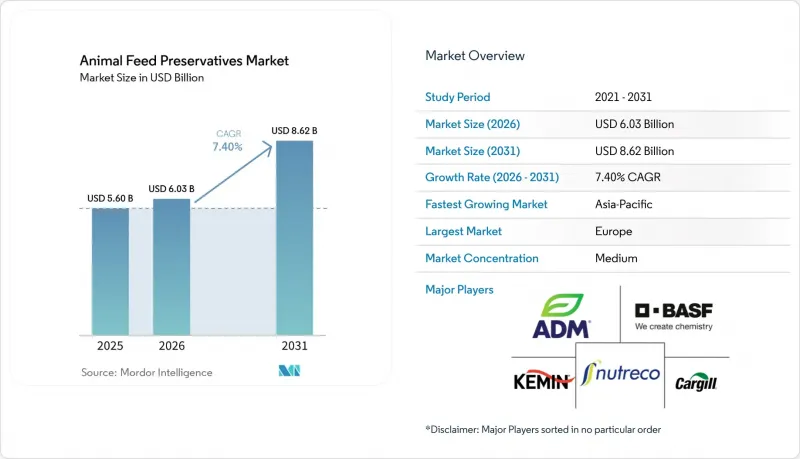
Mordor Intelligence에 의하면, 동물 사료 방부제 시장 규모는 2025년 56억 달러로 평가되었고, 2026년에는 60억 3,000만 달러로 추정되고, 2031년까지 86억 2,000만 달러에 이를 것으로 예측되며, 2026-2031년 CAGR 7.40%를 나타낼 전망입니다.
본 보고서는 제품 유형별(산미제, 방균제, 산화방지제, 결합제, 기타), 가축별(가금류, 돼지, 반추동물, 수산 양식, 반려동물), 제형별(건조 및 액체), 지역별(북미, 남미, 유럽, 아시아태평양, 중동 및 아프리카)로 분류되어 있습니다. 시장 전망은 금액(달러) 기준으로 제시되어 있습니다.
세계의 동물 사료 방부제 시장 동향 및 분석
집약형 축산에서의 배합사료 수요 증가
집약적인 축산 시스템을 뒷받침하기 위해, 집중형 사료 공장에서는 더 많은 양의 배합 사료가 생산되고 있으며, 장기 보관 기간 동안 효과적인 보존에 대한 수요가 높아지고 있습니다. 『Alltech 2025 Agri-Food Outlook』에 따르면, 2024년 전 세계 사료 생산량은 1.2% 증가하여 13억 9,600만 메트르톤에 달했습니다. 이 정도 규모의 산업적 사료 생산은 저장 및 운송 과정에서 부패, 곰팡이 번식, 미코톡신 오염의 위험을 높입니다. 그 결과, 사료 제조업체들은 사료의 품질을 유지하고 대규모 공급망에서 발생하는 손실을 줄이기 위해 산성화제나 방균제 등의 보존제 솔루션을 점점 더 많이 활용하고 있습니다.
유럽 및 북미의 엄격한 미코톡신 및 곰팡이 대책 규정
식품 안전을 확보하고 동물의 건강을 보호하기 위해, 엄격한 규제 체계를 통해 동물용 사료 내 오염 물질의 허용 한도치가 더욱 상향 조정되고 있습니다. 예를 들어, 캐나다 식품검사청은 '2024년 사료 규제'에 따라, 가축 사료 전체의 아플라톡신 허용 상한치를 20 parts per billion으로 설정하고 있습니다. 이는 북미의 미코톡신 관리 기준이 점점 더 엄격해지고 있음을 반영하고 있습니다. 이러한 규제 요건으로 인해 사료 제조업체들은 고비용이 드는 오염 후 처리 방식에 의존하기보다는 유기산이나 곰팡이 억제제 등의 방부제를 사용하는 등, 저장 중 발생하는 오염을 관리하기 위한 예방 조치를 취해야 하는 상황에 놓여 있습니다.
발효 원료에서 유래한 유기산의 가격 변동
발효 원료에서 유래한 유기산의 가격 변동은 동물 사료 방부제 시장에 있어 여전히 큰 과제로 남아 있습니다. 2025년, 유럽 사료 제조업체 연합(FEFAC)은 특히 에너지 가격과 원자재 가격의 변동으로 인해 유기산 및 사료 첨가제의 원가 변동이 심화되어, 유럽 전역의 사료 배합 업체들에 계속해서 압박을 가하고 있다고 보고했습니다. 프로피온산과 포름산은 미생물의 증식을 억제하고 사료의 저장 기간을 연장하기 위한 사료 보존제로 널리 사용되고 있기 때문에 이들의 가격 변동은 사료 제조업체의 배합 비용과 조달 전략에 직접적인 영향을 미칩니다. 이러한 지속적인 비용 변동성은 동물용 사료 방부제 시장의 이익률과 가격 책정의 일관성을 계속해서 제약하고 있습니다.
부문별 분석
2025년, 동물 사료 방부제 시장에서 산성화제가 41%라는 가장 높은 점유율을 차지했습니다. 이러한 장점은 광범위한 항균 특성과 저장 사료 내 곰팡이 증식을 억제하는 효과에 기인합니다. 산성화제는 다양한 유형의 사료와 잘 어울리며, 서로 다른 환경 조건에서도 안정성을 유지하기 때문에 모든 축산 시스템에서 일관되게 사용할 수 있습니다. 또한, 습도가 높고 대규모 사료 저장 시설이 운영되는 지역에서 이 방식의 도입이 활발히 이루어지고 있다는 점도 사료 보존 전략에서 이 방식이 차지하는 주도적인 역할을 더욱 공고히 하고 있습니다.
곰팡이 억제제 시장은 2026-2031년 10.3%라는 가장 높은 연평균 성장률(CAGR)을 기록하며 성장할 것으로 전망됩니다. 이러한 성장은 사료 안전성에 대한 관심이 높아지고, 미코톡신 오염 위험에 대한 인식이 개선됨에 따라 주도되고 있습니다. 생산자들은 사료의 품질을 향상시키고 규제 기준을 충족하기 위해, 특정 분야에 초점을 맞춘 보존 솔루션을 점점 더 많이 도입하고 있습니다. 예방적 사료 관리 방식으로의 전환에 따라, 세계 시장의 선진국과 신흥국 모두에서 곰팡이 억제제에 대한 수요가 증가하고 있습니다.
지역별 분석
2025년, 유럽은 동물용 사료 방부제 시장에서 29%라는 최대 점유율을 차지했습니다. 이러한 우위는 사료의 안전성과 오염 관리를 규정하는 엄격한 규제 체계에서 비롯된 것입니다. 마이코톡신 및 첨가제 사용에 대한 엄격한 제한으로 인해, 사료 제조 시스템에 방부제 솔루션이 꾸준히 도입되고 있습니다. 또한, 이 지역은 확립된 사료 생산 인프라와 가축 건강 관리에 대한 높은 의식을 바탕으로 하고 있어, 가금류, 돼지, 수산 양식 각 부문에서 보존 기술에 대한 안정적인 수요가 확보되어 있습니다.
아시아태평양 시장은 2026-2031년 9.9%라는 가장 높은 연평균 성장률(CAGR)을 기록하며 성장할 것으로 전망됩니다. 이러한 성장은 가축 및 수산 양식 생산의 급속한 확대와 더불어 사료 제조의 산업화가 진행되고 있는 것이 원동력이 되고 있습니다. 동물성 단백질 수요 증가와 축산 방식의 집약화가 사료 소비를 촉진하고 있습니다. 이러한 요인들로 인해, 특히 기후가 온화하거나 공급망이 긴 지역에서 사료의 품질을 유지하기 위한 방부제에 대한 수요가 크게 증가하고 있습니다.
남미 및 기타 신흥 지역에서는 사료 생산 시스템의 강화가 진행되고 있어, 보존 솔루션에 대한 수요가 증가하고 있습니다. 미국 농무부(USDA) 해외농업국이 인용한 전국사료산업연합회(Sindiracoes)의 보고서에 따르면, 브라질의 사료 생산량은 2026년까지 9,300만 메트르톤에 달할 것으로 예상되며, 이는 전년 대비 3.4% 증가한 수치에 해당합니다. 생산량 증가에 따라 사료용 방부제 시장에서 유기산계 방부제 및 사료 안정화 솔루션의 사용이 확대되고 있습니다.
기타 혜택 :
- 엑셀 형식 시장 예측(ME) 시트
- 3개월간의 애널리스트 지원
자주 묻는 질문
목차
제1장 서론
제2장 조사 방법
제3장 주요 요약
제4장 시장 구도
제5장 시장 규모 및 성장 예측
제6장 경쟁 구도
제7장 시장 기회 및 향후 전망
AJY 26.07.07According to Mordor Intelligence, the animal feed preservatives market size is projected to grow from USD 5.60 billion in 2025 to USD 6.03 billion in 2026 and is projected to reach USD 8.62 billion by 2031, registering a CAGR of 7.40% during 2026-2031.
This report is Segmented by Product Type (Acidifiers, Mold Inhibitors, Antioxidants, Binders, and Other Products), by Livestock (Poultry, Swine, Ruminants, Aquaculture, and Companion Animals), by Form (Dry and Liquid), and by Geography (North America, South America, Europe, Asia-Pacific, Middle East, and Africa). The Market Forecasts are Provided in Terms of Value (USD).
Global Animal Feed Preservatives Market Trends and Insights
Rising Demand for Compound Feed in Intensive Livestock Production
Centralized feed mills are producing larger volumes of compound feed to support intensive livestock systems, leading to a growing need for effective preservation during extended storage periods. According to the Alltech 2025 Agri-Food Outlook, global feed production increased by 1.2%, reaching 1.396 billion metric tons in 2024 . This scale of industrial feed production heightens the risk of spoilage, mold growth, and mycotoxin contamination during storage and transportation. As a result, feed manufacturers are increasingly utilizing preservative solutions, such as acidifiers and mold inhibitors, to maintain feed quality and reduce losses in large-scale supply chains.
Stringent Mycotoxin and Mold-Control Regulations in Europe and North America
Stringent regulatory frameworks are enforcing stricter contaminant limits in animal feed to ensure food safety and protect animal health. For instance, the Canadian Food Inspection Agency, under the Feeds Regulations, 2024, has set the maximum allowable level of aflatoxins in total livestock diets at 20 parts per billion . This reflects the increasing stringency of mycotoxin control standards in North America. These regulatory requirements drive feed manufacturers to implement preventive measures, such as using preservatives like organic acids and mold inhibitors, to manage contamination during storage instead of relying on expensive post-contamination treatments.
Price Volatility of Organic Acids Derived from Fermentation Feedstocks
Price volatility of organic acids derived from fermentation feedstocks remains a significant challenge for the animal feed preservatives market. In 2025, the European Feed Manufacturers' Federation (FEFAC) reported that increasing volatility in the costs of organic acids and feed additives continued to exert pressure on feed compounders across Europe, particularly due to fluctuating energy and raw material prices. As propionic acid and formic acid are extensively used as feed preservatives to inhibit microbial growth and prolong feed shelf life, fluctuations in their prices directly impact formulation costs and procurement strategies for feed manufacturers. This persistent cost instability continues to constrain profit margins and pricing consistency within the animal feed preservatives market.
Other drivers and restraints analyzed in the detailed report include:
- Rapid Commercialization of Natural and Clean-Label Preservative Chemistries
- Digital Quality-Sensing Technologies Enabling Dosage Optimization
- Growing Preference for Antibiotic-Free Production Limiting Chemical Preservatives
For complete list of drivers and restraints, kindly check the Table Of Contents.
Segment Analysis
Acidifiers accounted for the largest share of 41% of the animal feed preservative market in 2025. Their dominance is attributed to broad-spectrum antimicrobial properties and effectiveness in controlling mold growth in stored feed. Acidifiers are compatible with various feed types and remain stable under different environmental conditions, ensuring consistent use across livestock production systems. Additionally, their strong adoption in regions with high humidity and large-scale feed storage further solidifies their leading role in feed preservation strategies.
The mold inhibitors market is projected to grow at the fastest CAGR of 10.3% from 2026 to 2031. This growth is driven by an increasing emphasis on feed safety and heightened awareness of mycotoxin contamination risks. Producers are increasingly adopting targeted preservation solutions to enhance feed quality and meet regulatory standards. The shift toward preventive feed management practices is boosting demand for mold inhibitors in both developed and emerging feed across the global markets.
Complete Report Scope:
- By Product Type
- Acidifiers
- Mold Inhibitors
- Antioxidants
- Binders
- Others
- By Livestock
- Poultry
- Swine
- Ruminants
- Aquaculture
- Companion Animals
- By Form
- Dry
- Liquid
- By Geography
- North America
- United States
- Canada
- Mexico
- Rest of North America
- South America
- Brazil
- Argentina
- Rest of South America
- Europe
- Germany
- France
- United Kingdom
- Netherlands
- Rest of Europe
- Asia-Pacific
- China
- India
- Japan
- Australia
- Rest of Asia-Pacific
- Middle East
- Saudi Arabia
- United Arab Emirates
- Rest of Middle East
- Africa
- South Africa
- Kenya
- Rest of Africa
- North America
Geography Analysis
Europe accounted for the largest 29% share of the animal feed preservative market in 2025. This dominance is attributed to stringent regulatory frameworks governing feed safety and contamination control. Strict limits on mycotoxins and additive usage promote the consistent adoption of preservative solutions in feed manufacturing systems. Additionally, the region benefits from a well-established compound feed production infrastructure and high awareness of livestock health management, ensuring steady demand for preservation technologies across poultry, swine, and aquaculture sectors.
The Asia-Pacific market is projected to grow at the fastest CAGR of 9.9% from 2026 to 2031. This growth is driven by the rapid expansion of livestock and aquaculture production, coupled with increasing industrialization of feed manufacturing. Rising demand for animal protein and the intensification of farming practices are boosting the consumption of compound feed. These factors create a strong demand for preservatives to maintain feed quality, particularly in regions with warm climates and extended supply chains.
South America and other emerging regions are enhancing feed production systems, increasing the need for preservation solutions. According to the National Union of the Animal Feed Industry (Sindiracoes), as cited by the United States Department of Agriculture (USDA) Foreign Agricultural Service, Brazil's animal feed production is forecasted to reach 93 million metric tons by 2026, representing a 3.4% increase compared to the previous year . The rising production volumes are encouraging the increased use of organic acid-based preservatives and feed stability solutions within the animal feed preservatives market.
- Cargill, Incorporated
- BASF SE
- Archer-Daniels-Midland Company
- Kemin Industries, Inc.
- Nutreco N.V.
- Novus International, Inc.
- DSM-Firmenich AG
- Alltech, Inc.
- Evonik Industries AG
- Lallemand Inc.
- Anpario plc
- Impextraco N.V.
- Norel, S.A.
- Orffa International Holding B.V.
- Bentoli, Inc.
Additional Benefits:
- The market estimate (ME) sheet in Excel format
- 3 months of analyst support
TABLE OF CONTENTS
1 Introduction
- 1.1 Study Assumptions and Market Definition
- 1.2 Scope of the Study
2 Research Methodology
3 Executive Summary
4 Market Landscape
- 4.1 Market Overview
- 4.2 Market Drivers
- 4.2.1 Rising demand for compound feed in intensive livestock production
- 4.2.2 Stringent mycotoxin and mold-control regulations in Europe and North America
- 4.2.3 Rapid commercialization of natural and clean-label preservative chemistries
- 4.2.4 Expansion of aquaculture feed manufacturing capacity in Asia-Pacific
- 4.2.5 Digital quality-sensing technologies enabling dosage optimization
- 4.2.6 Feed-to-farm carbon-footprint reduction incentives
- 4.3 Market Restraints
- 4.3.1 Price volatility of organic acids derived from fermentation feedstocks
- 4.3.2 Growing preference for antibiotic-free production limiting chemical preservatives
- 4.3.3 Hazardous-substance classification for certain synthetic antioxidants
- 4.3.4 Supply-chain disruption risk for specialty chelating agents
- 4.4 Regulatory Landscape
- 4.5 Technological Outlook
- 4.6 Porter's Five Forces Analysis
- 4.6.1 Threat of New Entrants
- 4.6.2 Bargaining Power of Buyers
- 4.6.3 Bargaining Power of Suppliers
- 4.6.4 Threat of Substitutes
- 4.6.5 Intensity of Competitive Rivalry
5 Market Size and Growth Forecasts (Value)
- 5.1 By Product Type
- 5.1.1 Acidifiers
- 5.1.2 Mold Inhibitors
- 5.1.3 Antioxidants
- 5.1.4 Binders
- 5.1.5 Others
- 5.2 By Livestock
- 5.2.1 Poultry
- 5.2.2 Swine
- 5.2.3 Ruminants
- 5.2.4 Aquaculture
- 5.2.5 Companion Animals
- 5.3 By Form
- 5.3.1 Dry
- 5.3.2 Liquid
- 5.4 By Geography
- 5.4.1 North America
- 5.4.1.1 United States
- 5.4.1.2 Canada
- 5.4.1.3 Mexico
- 5.4.1.4 Rest of North America
- 5.4.2 South America
- 5.4.2.1 Brazil
- 5.4.2.2 Argentina
- 5.4.2.3 Rest of South America
- 5.4.3 Europe
- 5.4.3.1 Germany
- 5.4.3.2 France
- 5.4.3.3 United Kingdom
- 5.4.3.4 Netherlands
- 5.4.3.5 Rest of Europe
- 5.4.4 Asia-Pacific
- 5.4.4.1 China
- 5.4.4.2 India
- 5.4.4.3 Japan
- 5.4.4.4 Australia
- 5.4.4.5 Rest of Asia-Pacific
- 5.4.5 Middle East
- 5.4.5.1 Saudi Arabia
- 5.4.5.2 United Arab Emirates
- 5.4.5.3 Rest of Middle East
- 5.4.6 Africa
- 5.4.6.1 South Africa
- 5.4.6.2 Kenya
- 5.4.6.3 Rest of Africa
- 5.4.1 North America
6 Competitive Landscape
- 6.1 Market Concentration
- 6.2 Strategic Moves
- 6.3 Market Share Analysis
- 6.4 Company Profiles (Includes Global Level Overview, Market Level Overview, Core Segments, Financials as Available, Strategic Information, Market Rank/Share for Key Companies, Products and Services, and Recent Developments)
- 6.4.1 Cargill, Incorporated
- 6.4.2 BASF SE
- 6.4.3 Archer-Daniels-Midland Company
- 6.4.4 Kemin Industries, Inc.
- 6.4.5 Nutreco N.V.
- 6.4.6 Novus International, Inc.
- 6.4.7 DSM-Firmenich AG
- 6.4.8 Alltech, Inc.
- 6.4.9 Evonik Industries AG
- 6.4.10 Lallemand Inc.
- 6.4.11 Anpario plc
- 6.4.12 Impextraco N.V.
- 6.4.13 Norel, S.A.
- 6.4.14 Orffa International Holding B.V.
- 6.4.15 Bentoli, Inc.


