

|
시장보고서
상품코드
2073284
급여세 규정 준수 자동화 : 시장 점유율 분석, 업계 동향 및 통계, 성장 예측(2026-2031년)Payroll Tax Compliance Automation - Market Share Analysis, Industry Trends & Statistics, Growth Forecasts (2026 - 2031) |
||||||
 Mordor Intelligence
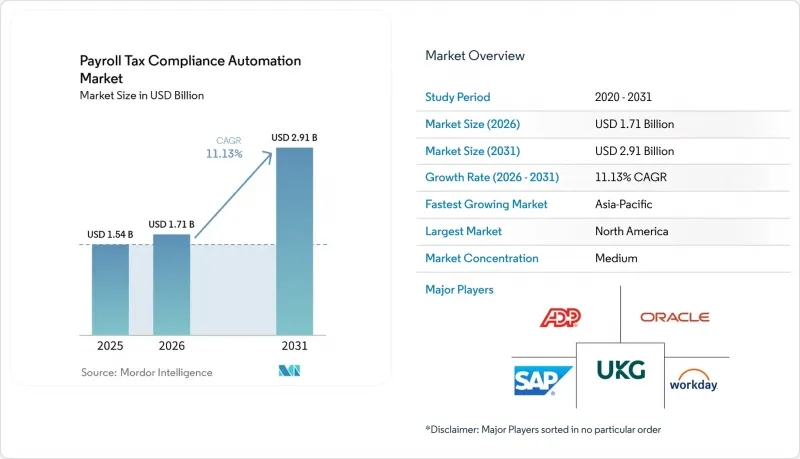
Mordor Intelligence에 의하면, 급여세 규정 준수 자동화 시장 규모는 2025년 15억 4,000만 달러로 평가되었습니다. 2026년에는 17억 1,000만 달러로 확대되어 2031년까지 29억 1,000만 달러에 이를 것으로 예상되며 2026년부터 2031년에 걸쳐 CAGR 11.13%로 성장할 전망입니다.
본 보고서는 구성 요소(소프트웨어 및 서비스), 솔루션 유형(급여세 계산 엔진, 세무 신고·납부 자동화 등), 도입 형태(클라우드 및 On-Premise), 조직 규모(중소기업 및 대기업), 업종(BFSI 등), 그리고 지역별로 분류되어 있습니다. 시장 전망은 금액(달러) 기준으로 제시되어 있습니다.
세계의 급여세 규정 준수 자동화 시장 동향 및 인사이트
전 세계 규제 환경의 복잡성이 가속화되고 있습니다.
7,000개가 넘는 미국 세무 당국, EU의 임금 투명성 지침, 그리고 인도의 4개 노동법에 따라 고용주가 추적, 검증, 보고해야 하는 급여 데이터 항목이 동시에 확대되고 있습니다. “One Big Beautiful Bill Act”는 2025년 이후의 이행 조치를 폐지하고, 시스템에 대해 FLSA(공정근로기준법)에서 의무화한 초과근무 수당과 계약상 할증 임금을 구분할 것, 직업 코드별로 팁을 받는 직원을 추적할 것, 그리고 주별 가산 논리를 관리할 것을 의무화하고 있습니다. EU 회원국들이 2026년까지 EU 지침 2023/970을 국내법에 반영함에 따라, 유럽의 고용주들도 이와 유사한 압박에 직면하고 있습니다. 한편, 인도의 BFSI(은행 및 금융 및 보험) 기업들은 기본급과 물가 수당의 합계가 보수의 최소 50%를 차지하도록 보수 체계를 재설계해야 합니다. 규제가 세분화되는 가운데, 조직은 실시간 데이터를 수집하고, 관할 구역별 로직을 적용하며, 감사에 적합한 감사 추적을 생성하는 규칙 기반 엔진을 도입해야 할 필요성에 직면해 있습니다.
클라우드 기반 급여 계산 플랫폼의 급속한 도입
조직들은 자체 인프라를 유지 관리할 필요 없이 지속적인 규정 준수 업데이트 및 AI 기반 검증 기능을 활용할 수 있도록 클라우드로의 전환을 가속화하고 있습니다. UKG One View Direct와 같은 솔루션은 실시간 다국적 데이터를 제공하며, Symmetry Tax Logic AI는 150개국에 걸친 관할 구역 매핑을 자동화합니다. 클라우드의 연평균 성장률(CAGR)은 14.32%에 달하지만, 데이터 주권에 관한 규제와 맞춤형 요구 사항으로 인해 On-Premise 환경이 여전히 주류를 이루고 있습니다. 그 결과, 기밀 데이터를 로컬에 보관하면서 분석에는 클라우드를 활용하는 하이브리드 아키텍처가 채택되었습니다. 중소기업들은 벤더를 통한 규정 준수 업데이트 관리 및 유지보수 부담 경감을 이유로 클라우드 도입을 적극적으로 추진하고 있습니다.
클라우드 도입에 따른 데이터 보안 및 개인정보 보호에 대한 우려
사회보장번호나 급여 데이터를 일원적으로 관리하는 저장소는 정교한 수법을 사용하는 사이버 범죄자들의 표적이 됩니다. 2026년 4월에 발생한 ‘"Storm-2755" 이번 캠페인에서는 세션을 탈취하여 캐나다의 급여 이체 자금을 부정하게 유용함으로써, 기본적인 다단계 인증의 취약점이 드러났습니다. GDPR(EU 개인정보보호규정)에 따른 정보 유출 통지 의무로 인해 비용 위험이 높아짐에 따라, 기업들은 SOC 2 Type II 인증을 취득한 시설, 저장 데이터의 암호화, 특권 액세스 모니터링 및 로컬 호스팅 옵션을 요구하고 있습니다. 이 모든 요소들은 도입 과정을 더욱 복잡하게 만드는 요인이 되고 있습니다.
부문별 분석
2025년에도 급여세 규정 준수 자동화 시장에서 소프트웨어의 점유율은 57.45%로 여전히 지배적이었으나, 고용주들이 설정 및 규정 준수 모니터링을 외부 전문가에게 위탁하는 경향이 강해짐에 따라, 서비스 부문은 2031년까지 연평균 성장률(CAGR) 14.01%를 나타낼 것으로 예측됩니다. 관리형 서비스 제공업체는 “One Big Beautiful Bill Act”세부적인 초과근무 시간 추적 요건, 인도의 노동법 감사, 브라질의 FGTS 디지털 제출 등을 활용하여 자문, 변경 관리, 신고 지원을 구독형 패키지로 제공합니다.
신흥 시장에서는 현지 언어로 된 문서 작성, 전자 급여 명세서, 세무 당국과의 데이터 연동 등에 현지 전문 지식이 요구되기 때문에 서비스 도입이 더욱 빠르게 진행되고 있습니다. 코어 엔진이 여전히 트랜잭션 처리의 기반을 담당하고 있는 반면, 수익은 벌칙 위험 감소, 도입 신속화, 온디맨드 감사 지원을 제공하는 부가가치 서비스로 전환되고 있습니다.
2025년 지출 중 세무 신고 및 납부 엔진이 33.62%를 차지했으나, 고용주들이 사후 대응형 신고에서 지속적인 검증으로 전환함에 따라 규정 준수 모니터링 플랫폼은 연평균 성장률(CAGR) 12.89%로 확대되고 있습니다. 각 공급업체는 제출 전에 이상을 감지하는 규제 피드를 도입하여, 납부 지연에 대한 과태료가 2%에서 15%로 단계적으로 인상되는 제도에 대응하고 있습니다.
OBBBA의 초과근무 기준을 해석하고, 적격한 팁을 분류하며, 직종 코드를 검증하는 플랫폼이 이러한 변화를 뒷받침하고 있는 한편, AI 에이전트는 내부 및 외부 감사인의 요건을 충족하는 감사 추적을 생성하고 있습니다. SAP의 4가지 AI 급여 계산 에이전트는 규정 준수 모니터링과 신고 자동화의 통합을 구현하고 있으며, PostNL사는 일상적인 문의를 자동화하고 관할 구역별 규정에 따라 데이터를 검증함으로써 급여 계산 관련 문의에 소요되는 비용을 약 80% 절감할 수 있을 것으로 기대하고 있습니다. 거래별 신고는 여전히 필수적이지만, 자율적인 모니터링이 다국적 기업의 급여 계산 업무에서 차별화 요인으로 부상하고 있습니다.
지역별 분석
북미는 2025년 매출의 36.18%를 차지했는데, 그 배경에는 미국 내 7,000개가 넘는 세무 관할 구역, 엄격한 벌칙 규정, 그리고 2026년 2월로 예정된 OBBBA 시행 기한이 있습니다. Paychex의 Paycor 41억 달러 인수와 Intuit의 GoCo 통합과 같은 대규모 인수는 규모 확대와 AI 기반 규정 준수 도구의 교차 판매를 목적으로 한 해당 지역의 업계 재편 동향을 여실히 보여주고 있습니다. Storm-2755와 같은 사이버 위협은 경영진이 급여 계산의 보안에 대한 관심을 더욱 높이며, 제로 트러스트 아키텍처에 대한 투자를 촉진하고 있습니다.
아시아태평양은 인도의 노동법, 중국의 전자 청구서 확대, 싱가포르의 플랫폼 근로자법에 힘입어 2031년까지 연평균 성장률(CAGR) 13.26%를 기록하며 성장할 것으로 전망됩니다. 조사에 따르면, 해당 지역의 고용주 중 80%가 인력 부족 속에서 복잡한 규제 대응에 직면해 있으며, 이로 인해 AI를 활용한 검증 및 관리형 규정 준수 서비스 도입이 가속화되고 있습니다. 인도의 "e-Shram" 그리고 브라질의 "eSocial" 이러한 정부 포털은 클라우드 네이티브 통합을 권장하고 있으며, 이는 현지 서비스 제공업체에 구조적인 호재가 되고 있습니다.
유럽에서는 2026년 EU 임금 투명성 지침의 국내법 반영, GDPR(EU 개인정보보호규정)에 따른 국경을 넘는 데이터 전송의 장벽, 그리고 기한을 엄수해야 하는 신고에 대한 단속 강화에 직면해 있으며, 이로 인해 고용주의 53%가 급여 계산 업무를 외부에 위탁하고 있습니다. 남미에서는 브라질의 ‘ "FGTS Digital" 또는 아르헨티나의 '디지털 급여 장부' 등, 새로운 디지털화 의무가 시행되고 있습니다. 한편, 중동 및 아프리카의 당국은 임금 보호 및 전자 청구서 관련 규정을 강화하고 있습니다. 나이지리아의 단계적 전자 세무 시스템과 UAE의 급여 지급 기한은 법적으로 의무화된 디지털화가 급여세 규정 준수 자동화 시장 전체에서 대상 수요를 어떻게 확대하고 있는지를 보여줍니다.
기타 혜택 :
- 엑셀 형식 시장 예측(ME) 시트
- 3개월간의 애널리스트 지원
자주 묻는 질문
목차
제1장 서론
제2장 조사 방법
제3장 주요 요약
제4장 시장 구도
제5장 시장 규모 및 성장 예측
제6장 경쟁 구도
제7장 시장 기회 및 향후 전망
KTH 26.07.07According to Mordor Intelligence, the payroll tax compliance automation market size is expected to increase from USD 1.54 billion in 2025 to USD 1.71 billion in 2026 and reach USD 2.91 billion by 2031, growing at a CAGR of 11.13% over 2026-2031.
This report is Segmented by Component (Software, and Services), Solution Type (Payroll Tax Calculation Engines, Tax Filing and Remittance Automation, and More), Deployment Mode (Cloud, and On-Premises), Organization Size (Small and Medium Enterprises, and Large Enterprises), Industry Vertical (BFSI, and More), and Geography. The Market Forecasts are Provided in Terms of Value (USD).
Global Payroll Tax Compliance Automation Market Trends and Insights
Escalating Global Regulatory Complexity
Over 7,000 U.S. tax authorities, the EU Pay Transparency Directive, and India's four Labour Codes have simultaneously expanded payroll data points employers must track, validate, and report. The One Big Beautiful Bill Act removes transition relief after 2025, compelling systems to distinguish FLSA-required overtime from contractual premiums, trace tipped employees by occupation code, and manage state add-back logic. European employers face similar pressure as member states transpose EU 2023/970 by 2026, while BFSI firms in India must redesign compensation to ensure basic pay and dearness allowance equal at least 50% of remuneration. Heightened fragmentation is pushing organizations toward rule-based engines that ingest real-time feeds, apply jurisdiction-specific logic, and generate audit trails fit for inspection.
Rapid Adoption of Cloud-Based Payroll Platforms
Organizations are accelerating cloud migration to access continuous compliance updates and AI-driven validation without maintaining their own infrastructure. Offerings such as UKG One View Direct deliver real-time multi-country data, whereas Symmetry Tax Logic AI automates jurisdiction mapping across 150 countries.Despite cloud's 14.32% CAGR, on-premises instances remain prevalent due to data-sovereignty rules and customization needs, resulting in hybrid architectures that keep sensitive data local and leverage cloud for analytics. Small businesses lead cloud uptake, citing vendor-managed compliance updates and reduced maintenance overhead.
Data Security and Privacy Concerns in Cloud Deployments
Centralized repositories of Social Security numbers and wage data attract sophisticated cybercriminals. The Storm-2755 campaign in April 2026 diverted Canadian payroll deposits by hijacking sessions, exposing weaknesses in basic multifactor authentication. Breach notification mandates under GDPR intensify cost exposures, prompting enterprises to demand SOC 2 Type II facilities, encryption at rest, privileged-access monitoring, and local hosting options, all of which elevate implementation complexity.
Other drivers and restraints analyzed in the detailed report include:
- Expansion of Cross-Border Remote Workforces
- Integration of AI and Machine Learning for Real-Time Compliance
- High Switching Costs From Legacy Payroll Systems
For complete list of drivers and restraints, kindly check the Table Of Contents.
Segment Analysis
The payroll tax compliance automation market share for software remained dominant at 57.45% in 2025, yet the services segment is projected to grow at a 14.01% CAGR through 2031 as employers outsource configuration and regulatory monitoring to external specialists. Managed-service providers are capitalizing on the One Big Beautiful Bill Act's granular overtime tracking requirements, India's Labour Code audits, and Brazil's FGTS Digital submissions, packaging advisory, change management, and filing support in subscription bundles.
Services uptake is even faster in emerging markets where local-language documentation, electronic payslips, and data integration with revenue authorities demand on-the-ground expertise. Although core engines continue to underpin transaction processing, revenue is shifting toward value-added services that reduce penalty risk, accelerate deployment, and offer on-demand audit support.
Tax filing and remittance engines accounted for 33.62% of 2025 spending, yet compliance monitoring platforms are scaling at a 12.89% CAGR as employers pivot from reactive filing to continuous validation. Vendors embed regulatory feeds that flag anomalies before submission, meeting penalty regimes that escalate from 2% to 15% for late deposits.
Platforms that interpret OBBBA overtime criteria, segregate qualified tips, and validate occupation codes underpin this shift, while AI agents generate audit trails that satisfy internal and external auditors. SAP's four AI Payroll Agents exemplify the integration of compliance monitoring with filing automation, enabling PostNL to anticipate approximately 80% cost reduction for payroll questions by automating routine inquiries and validating data against jurisdiction-specific rules.Transactional filing remains essential, but autonomous monitoring is emerging as the differentiator for multinational payroll operations.
Complete Report Scope:
- By Component
- Software
- Services
- By Solution Type
- Payroll Tax Calculation Engines
- Tax Filing and Remittance Automation
- Compliance Monitoring and Regulatory Updates Platforms
- Withholding and Deduction Management Systems
- Multi-Jurisdictional Payroll Compliance Modules
- Other Solution Types
- By Deployment Mode
- Cloud
- On-Premises
- By Organization Size
- Small and Medium Enterprises
- Large Enterprises
- By Industry Vertical
- BFSI
- Healthcare
- IT and Telecommunication
- Retail
- Manufacturing
- Government
- Other Industry Verticals
- By Geography
- North America
- United States
- Canada
- Mexico
- South America
- Brazil
- Argentina
- Rest of South America
- Europe
- Germany
- United Kingdom
- France
- Italy
- Spain
- Russia
- Rest of Europe
- Asia-Pacific
- China
- India
- Japan
- South Korea
- Australia
- Rest of Asia-Pacific
- Middle East
- Saudi Arabia
- United Arab Emirates
- Turkey
- Rest of Middle East
- Africa
- South Africa
- Nigeria
- Rest of Africa
- North America
Geography Analysis
North America generated 36.18% of 2025 revenue, anchored by the United States' 7,000-plus tax jurisdictions, stringent penalty schedules, and the February 2026 OBBBA enforcement deadline. Large acquisitions, such as Paychex's USD 4.1 billion purchase of Paycor and Intuit's integration of GoCo, underscore the region's consolidation trend aimed at scale and cross-selling AI-enabled compliance tools. Cyber threats such as Storm-2755 further sharpen board-level focus on payroll security, driving investments in zero-trust architectures.
Asia-Pacific is forecast to grow at a 13.26% CAGR to 2031, propelled by India's Labour Codes, China's e-invoice expansion, and Singapore's Platform Workers Act. Surveys reveal 80% of regional employers confront regulatory complexity with fewer staff, spurring adoption of AI validation and managed compliance. Government portals such as India e-Shram and Brazil eSocial favor cloud-native integrations, giving a structural lift to local service providers.
Europe grapples with the 2026 transposition of the EU Pay Transparency Directive, GDPR cross-border data-transfer hurdles, and rising enforcement of on-time filing, prompting 53% of employers to outsource payroll. South America enforces new digital mandates, including Brazil's FGTS Digital and Argentina's Libro de Sueldos Digital, while Middle East and Africa authorities tighten wage-protection and e-invoicing rules. Nigeria's phased electronic fiscal system and UAE's salary-payment deadlines illustrate how statutory digitization is expanding addressable demand across the broader payroll tax compliance automation market.
- Automatic Data Processing, Inc.
- Paychex, Inc.
- Intuit Inc.
- Workday, Inc.
- Ceridian HCM Holding Inc.
- Sage Group plc
- Oracle Corporation
- SAP SE
- Gusto, Inc.
- Zenefits Global, Inc.
- Paycor HCM, Inc.
- Rippling People Center Inc.
- BambooHR LLC
- UKG Inc.
- Patriot Software Company, Inc.
- Paylocity Holding Corporation
- TriNet Group, Inc.
- Papaya Global Ltd.
- Justworks, Inc.
- CloudPay Inc.
Additional Benefits:
- The market estimate (ME) sheet in Excel format
- 3 months of analyst support
TABLE OF CONTENTS
1 INTRODUCTION
- 1.1 Study Assumptions and Market Definition
- 1.2 Scope of the Study
2 RESEARCH METHODOLOGY
3 EXECUTIVE SUMMARY
4 MARKET LANDSCAPE
- 4.1 Market Overview
- 4.2 Market Drivers
- 4.2.1 Escalating Global Regulatory Complexity
- 4.2.2 Rapid Adoption of Cloud-Based Payroll Platforms
- 4.2.3 Expansion of Cross-Border Remote Workforces
- 4.2.4 Integration of AI and Machine Learning for Real-Time Compliance
- 4.2.5 Government Digitalization Initiatives in Emerging Economies
- 4.2.6 Rising Penalties Driving Demand for Error-Free Tax Filing
- 4.3 Market Restraints
- 4.3.1 Data Security and Privacy Concerns in Cloud Deployments
- 4.3.2 High Switching Costs From Legacy Payroll Systems
- 4.3.3 Shortage of Specialized Payroll Compliance Talent
- 4.3.4 Fragmented Local Tax Jurisdictions Hindering Standardization
- 4.4 Industry Value Chain Analysis
- 4.5 Regulatory Landscape
- 4.6 Technological Outlook
- 4.7 Impact of Macroeconomic Factors on the Market
- 4.8 Porter's Five Forces Analysis
- 4.8.1 Bargaining Power of Suppliers
- 4.8.2 Bargaining Power of Buyers
- 4.8.3 Threat of New Entrants
- 4.8.4 Threat of Substitutes
- 4.8.5 Intensity of Competitive Rivalry
5 MARKET SIZE AND GROWTH FORECASTS (VALUE)
- 5.1 By Component
- 5.1.1 Software
- 5.1.2 Services
- 5.2 By Solution Type
- 5.2.1 Payroll Tax Calculation Engines
- 5.2.2 Tax Filing and Remittance Automation
- 5.2.3 Compliance Monitoring and Regulatory Updates Platforms
- 5.2.4 Withholding and Deduction Management Systems
- 5.2.5 Multi-Jurisdictional Payroll Compliance Modules
- 5.2.6 Other Solution Types
- 5.3 By Deployment Mode
- 5.3.1 Cloud
- 5.3.2 On-Premises
- 5.4 By Organization Size
- 5.4.1 Small and Medium Enterprises
- 5.4.2 Large Enterprises
- 5.5 By Industry Vertical
- 5.5.1 BFSI
- 5.5.2 Healthcare
- 5.5.3 IT and Telecommunication
- 5.5.4 Retail
- 5.5.5 Manufacturing
- 5.5.6 Government
- 5.5.7 Other Industry Verticals
- 5.6 By Geography
- 5.6.1 North America
- 5.6.1.1 United States
- 5.6.1.2 Canada
- 5.6.1.3 Mexico
- 5.6.2 South America
- 5.6.2.1 Brazil
- 5.6.2.2 Argentina
- 5.6.2.3 Rest of South America
- 5.6.3 Europe
- 5.6.3.1 Germany
- 5.6.3.2 United Kingdom
- 5.6.3.3 France
- 5.6.3.4 Italy
- 5.6.3.5 Spain
- 5.6.3.6 Russia
- 5.6.3.7 Rest of Europe
- 5.6.4 Asia-Pacific
- 5.6.4.1 China
- 5.6.4.2 India
- 5.6.4.3 Japan
- 5.6.4.4 South Korea
- 5.6.4.5 Australia
- 5.6.4.6 Rest of Asia-Pacific
- 5.6.5 Middle East
- 5.6.5.1 Saudi Arabia
- 5.6.5.2 United Arab Emirates
- 5.6.5.3 Turkey
- 5.6.5.4 Rest of Middle East
- 5.6.6 Africa
- 5.6.6.1 South Africa
- 5.6.6.2 Nigeria
- 5.6.6.3 Rest of Africa
- 5.6.1 North America
6 COMPETITIVE LANDSCAPE
- 6.1 Market Concentration
- 6.2 Strategic Moves
- 6.3 Market Share Analysis
- 6.4 Company Profiles (includes Global Level Overview, Market Level Overview, Core Segments, Financials as available, Strategic Information, Market Rank/Share, Products and Services, Recent Developments)
- 6.4.1 Automatic Data Processing, Inc.
- 6.4.2 Paychex, Inc.
- 6.4.3 Intuit Inc.
- 6.4.4 Workday, Inc.
- 6.4.5 Ceridian HCM Holding Inc.
- 6.4.6 Sage Group plc
- 6.4.7 Oracle Corporation
- 6.4.8 SAP SE
- 6.4.9 Gusto, Inc.
- 6.4.10 Zenefits Global, Inc.
- 6.4.11 Paycor HCM, Inc.
- 6.4.12 Rippling People Center Inc.
- 6.4.13 BambooHR LLC
- 6.4.14 UKG Inc.
- 6.4.15 Patriot Software Company, Inc.
- 6.4.16 Paylocity Holding Corporation
- 6.4.17 TriNet Group, Inc.
- 6.4.18 Papaya Global Ltd.
- 6.4.19 Justworks, Inc.
- 6.4.20 CloudPay Inc.
7 MARKET OPPORTUNITIES AND FUTURE OUTLOOK
- 7.1 White-space and Unmet-need Assessment


