
|
시장보고서
상품코드
2122175
회계 소프트웨어 : 시장 점유율 분석, 업계 동향과 통계, 성장 예측(2026-2031년)Accounting Software - Market Share Analysis, Industry Trends & Statistics, Growth Forecasts (2026 - 2031) |
||||||
 Mordor Intelligence
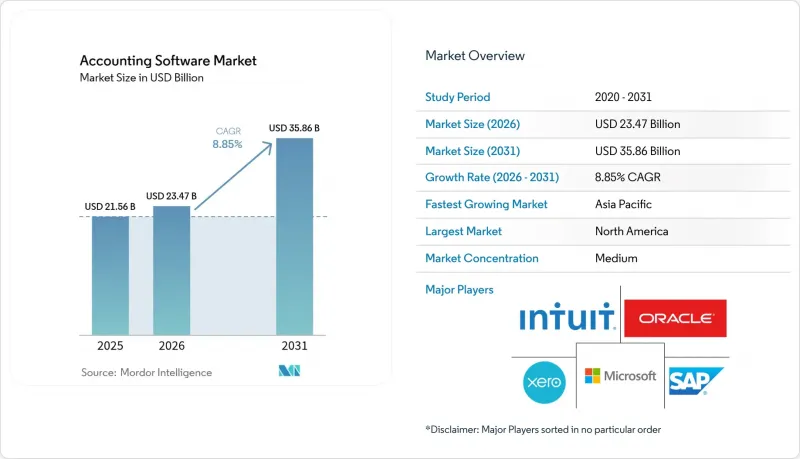
Mordor Intelligence에 따르면 회계 소프트웨어 시장 규모는 2025년에 215억 6,000만 달러로 평가되며, 2026년 234억 7,000만 달러에서 2031년까지 358억 6,000만 달러에 달할 것으로 예측되고 있으며, 예측 기간(2026-2031년)에 CAGR은 8.85%에 달할 전망입니다.
이 보고서는 배포 유형(온프레미스 및 클라우드 기반), 조직 규모(대기업 및 중소기업(SME)), 최종사용자 산업(금융·보험·증권(BFSI),제조, 소매·E-Commerce, 전문 서비스, IT·통신, 의료), 용도(급여 관리, 청구·청구서 발행 등) 및 지역별로 분류되어 있습니다. 시장 예측은 금액(달러) 기준으로 제시되어 있습니다.
글로벌 회계 소프트웨어 시장의 동향 및 인사이트
클라우드 우선 재무 스택의 도입
기업은 온프레미스형 시스템에서 회계, 재무, 업무 데이터를 실시간으로 동기화하는 클라우드 아키텍처로 전환하고 있으며, 이를 통해 인프라 비용 절감과 현금 흐름 가시성 향상을 도모하고 있습니다. 이러한 전환을 통해 기존 시스템에서는 실현할 수 없었던 결제, 경비 카드, 단기 유동성 등의 핀테크 기능과의 원활한 통합도 가능해집니다.
기장 워크플로우의 하이퍼 자동화
머신러닝을 통한 데이터 추출과 로봇 프로세스 자동화(RPA) 덕분에 거래 분류, 은행 계좌 대조, 청구서 처리를 98%의 정확도로 수행할 수 있게 되어, 회계 법인은 인력을 비례적으로 늘리지 않고도 더 많은 고객을 수용할 수 있게 되었습니다. 그 결과로 초래하는 생산성 향상은 중소기업의 총 소유 비용을 절감하고, 업계 전반의 인력 부족을 해소하는 데 기여하고 있습니다.
데이터 주권 및 개인정보 보호 규제
GDPR 등의 규제로 인해 데이터의 현지 보관이 의무화되어, 벤더는 다중 리전 클라우드 환경을 유지할 수밖에 없어 도입 예산이 증가하고 있습니다. 기업은 계약 조항에서 암호화, 접근 제어 및 국내 저장 옵션이 보장될 때까지 기밀성이 높은 장부 데이터의 이전을 주저하고 있으며, 프로젝트 일정이 지연되고 있습니다.
부문 분석
2025년에는 클라우드 솔루션이 매출의 68.08%를 차지하며, 연평균 성장률(CAGR) 10.15%는 온프레미스형 점유율이 계속해서 축소될 것임을 시사합니다. 이 모델의 ‘사용량 기반 과금’ 방식은 설비 투자를 불필요하게 하며, 보안 체계를 강화하는 자동 갱신 기능을 포함하고 있습니다. 은행 및 급여 계산 서비스 제공업체와의 원활한 API 연동이 도입을 더욱 확고히 하고 있습니다. 레거시 ERP에 의존하고 있는 대기업은 지연에 민감한 워크플로우에서 여전히 하이브리드 전략을 선호하고 있지만, 결산 주기 단축을 위해 자회사에서는 클라우드를 시범 도입하고 있습니다. 데이터 저장 위치의 선택지 확대와 지역별 데이터센터의 증가로 인해 기존의 규정 준수 관련 우려는 완화되고 있으며, 회계 소프트웨어 시장에서 클라우드의 점유율은 향후 10년이 끝날 무렵 포화 상태에 가까워질 것으로 예상됩니다.
온프레미스형 플랫폼은 오프라인 처리가 의무화되어 있거나, 맞춤형 커스터마이징으로 인해 시스템이 경직된 규제가 엄격한 분야에서 여전히 틈새 시장으로서의 중요성을 유지하고 있습니다. 그러나 유지보수 부담과 메인프레임 기술자 부족으로 인해 CFO들은 현대화를 위한 예산을 확보할 수밖에 없는 상황입니다. 각 벤더사는 과거 원장 데이터를 멀티테넌트 아키텍처에 매핑하는 마이그레이션 툴키트을 제공함으로써 이러한 전환의 흐름을 활용하여 시스템 전환 기간을 몇 주로 단축하고 있습니다. 그 결과, 업계 전체가 확대되는 가운데서도 온프레미스 도입과 관련된 회계 소프트웨어 시장의 규모는 축소될 것으로 예측됩니다.
대기업은 다중 통화·다중 법인 보고서 작성이 가능한 글로벌 연결 결산 제품군을 도입함으로써 2025년 매출의 54.10%를 차지했습니다. 반면, 중소기업(SME)은 직관적인 클라우드 모듈과 AI를 활용한 데이터 수집으로 전담 IT 인력에 대한 의존도가 낮아짐에 따라 연평균 성장률(CAGR) 10.85%라는 가장 높은 성장률을 이끌고 있습니다. 구독형 요금제는 비용이 거래량에 따라 조정되므로, 성장 초기 단계에서도 합리적인 가격으로 이용할 수 있습니다.
아시아태평양 및 라틴아메리카의 창업 생태계는 전자 청구서 의무화가 디지털화를 촉진하는 가운데, 중소기업의 수요를 더욱 가속화하고 있습니다. 챗봇 기능을 탑재한 스타터 패키지를 출시하는 벤더들은 도입 장벽을 낮추고, 수동 스프레드시트 사용자를 구독자로 전환시키고 있습니다. 그 결과, 중소기업이 차지하는 회계 소프트웨어 시장 점유율은 꾸준히 상승하고 있으며, 대기업 도입과의 역사적인 격차는 점차 줄어들 것입니다.
지역별 분석
북미는 클라우드 배포에 대한 높은 준비 태세, 성숙한 결제 인프라, 그리고 넉넉한 기술 예산을 배경으로 2025년에는 매출의 38.35%를 차지했습니다. 미국 기업은 재무 애플리케이션에 대한 직원 1인당 지출액이 세계 평균을 상회하고 있으며, 이는 공급업체의 급속한 혁신과 파트너십 생태계를 촉진하고 있습니다. 캐나다도 유사한 추세를 보이고 있으며, 국경을 초월한 도입을 간소화하는 조화로운 세제 체계에 힘입고 있습니다.
이어 유럽에서는 GDPR 준수 및 지속가능성 보고 의무화가 플랫폼 개편을 촉진하고 있습니다. 다국어 인터페이스와 Peppol 등 유럽의 전자 청구서 발행 기준이 제품의 현지화를 주도하고 있습니다. 그러나 의사결정 주기가 길어 아시아태평양에 비해 성장세가 둔화되고 있습니다.
아시아태평양은 인도 및 인도네시아의 전자 청구서 의무화, 그리고 일본의 장부 전자 보관에 관한 ‘소프트 의무화’에 힘입어 10.45%라는 가장 높은 연평균 성장률(CAGR)을 기록하고 있습니다. 중소기업은 데스크톱 소프트웨어를 건너뛰고, 국내 전자 지갑 및 QR코드 결제를 통합한 ‘모바일 퍼스트’ 클라우드 제품군을 채택하고 있습니다. 글로벌 벤더들의 현지 데이터센터 투자는 데이터 주권에 대한 우려를 완화하고, 공공 부문의 조달을 촉진하고 있습니다.
라틴아메리카에서는 브라질과 멕시코에서 성장세가 두드러집니다. 이 국가들에서는 오랫동안 실시간 청구서 결제가 이루어져 왔기 때문에 기업은 세무 보고에 그치지 않고 완전한 ERP 및 재무 클라우드로 자동화를 확대하고 있습니다. 중동 및 아프리카에서는 경제 다각화 노력과 핀테크 생태계 확장에 힘입어 꾸준한 성장을 보이고 있으나, 통신 환경 및 인력 부족으로 인해 도입 속도는 완만해지고 있습니다.
기타 혜택:
- 엑셀 형식의 시장 예측(ME) 시트
- 3개월간의 애널리스트 지원
자주 묻는 질문
목차
제1장 서론
제2장 조사 방법
제3장 개요
제4장 시장 인사이트
제5장 시장 규모와 성장 예측
제6장 경쟁 구도
제7장 시장 기회와 향후 전망
KSA 26.09.04According to Mordor Intelligence, the accounting software market size was valued at USD 21.56 billion in 2025 and estimated to grow from USD 23.47 billion in 2026 to reach USD 35.86 billion by 2031, at a CAGR of 8.85% during the forecast period (2026-2031).
This report is Segmented by Deployment Type (On-Premise, and Cloud-Based), Organization Size (Large Enterprises, and Small and Medium Enterprises (SMEs)), End-User Industry (BFSI, Manufacturing, Retail and E-Commerce, Professional Services, IT and Telecom, and Healthcare), Application (Payroll Management, Billing and Invoicing, and More), and Geography. The Market Forecasts are Provided in Terms of Value (USD).
Global Accounting Software Market Trends and Insights
Cloud-First Finance-Stack Adoption
Organizations are abandoning on-premise installations in favor of cloud architectures that synchronize accounting, treasury and operational data in real time, cutting infrastructure costs and improving cash-flow visibility. The shift also unlocks seamless fintech integrations-payments, expense cards and short-term liquidity-once unattainable on legacy systems.
Hyper-Automation of Bookkeeping Workflows
Machine-learning extraction and robotic process automation now classify transactions, reconcile banks and process invoices with 98% accuracy, allowing accounting firms to absorb more clients without proportional head-count increases. The resulting productivity gains lower total ownership costs for small businesses and offset the industry-wide talent deficit.
Data-Sovereignty and Privacy Regulations
Rules such as GDPR compel local data residency, forcing vendors to maintain multi-region clouds and inflating implementation budgets. Enterprises hesitate to migrate sensitive ledgers until contractual clauses guarantee encryption, access controls and in-country storage options, delaying project timelines .
Other drivers and restraints analyzed in the detailed report include:
- AI-Led Anomaly Detection and Compliance
- Mobile-First Accounting Experience Demand
- Scarcity of AI-Ready Accounting Talent
For complete list of drivers and restraints, kindly check the Table Of Contents.
Segment Analysis
Cloud solutions generated 68.08% revenue in 2025, and their 10.15% CAGR signals that the on-premise share will continue to erode. The model's pay-as-you-grow pricing eliminates capital expenditure and embeds automatic updates that strengthen security posture. Seamless API connectivity with banks and payroll providers further cements adoption. Large enterprises wedded to legacy ERPs still favor hybrid strategies for latency-sensitive workflows, yet even they pilot cloud subsidiaries to reduce close cycles. Growing data-residency options and regional datacenters mitigate prior compliance objections, suggesting that the cloud slice of the accounting software market will near saturation by decade-end.
On-premise platforms retain niche relevance in highly regulated sectors where offline processing is mandatory or where bespoke customizations lock systems in place. However, maintenance overhead and scarce mainframe skills push CFOs to earmark modernization budgets. Vendors exploit this transition by offering migration toolkits that map historical ledgers into multi-tenant architectures, shortening cut-over periods to weeks. As a result, the accounting software market size tied to on-premise deployments is projected to contract despite overall industry expansion.
Large organizations captured 54.10% of 2025 revenue by deploying global-consolidation suites capable of multi-currency and multi-entity reporting. Yet SMEs drive the fastest 10.85% CAGR because intuitive cloud modules and AI-driven data capture reduce the need for dedicated IT staff. Subscription tiers align costs with transaction volume, ensuring affordability even during early growth stages.
Entrepreneurial ecosystems in Asia-Pacific and Latin America further catalyze SME demand as mandatory e-invoicing forces digital upgrades. Vendors releasing starter packages with embedded chatbot support lower adoption barriers and convert manual spreadsheet users into subscribers. Consequently, the accounting software market share commanded by SMEs will steadily rise, narrowing the historic gap with enterprise deployments.
Complete Report Scope:
- By Deployment Type
- On-premise
- Cloud-based (SaaS)
- By Organization Size
- Large Enterprises
- Small and Medium Enterprises (SMEs)
- By End-user Industry
- BFSI
- Manufacturing
- Retail and E-commerce
- Professional Services
- IT and Telecom
- Healthcare
- By Application
- Payroll Management
- Billing and Invoicing
- Expense Tracking
- Tax Management
- By Geography
- North America
- United States
- Canada
- Mexico
- South America
- Brazil
- Argentina
- Colombia
- Rest of South America
- Europe
- Germany
- United Kingdom
- France
- Italy
- Spain
- Russia
- Netherlands
- Rest of Europe
- Asia-Pacific
- China
- Japan
- South Korea
- India
- Australia
- Singapore
- Rest of Asia-Pacific
- Middle East and Africa
- Middle East
- Saudi Arabia
- United Arab Emirates
- Rest of Middle East
- Africa
- South Africa
- Egypt
- Rest of Africa
- Middle East
- North America
Geography Analysis
North America contributed 38.35% revenue in 2025 on the back of high cloud readiness, mature payments rails and well-funded technology budgets. United States enterprises allocate larger per-employee spend on finance applications compared with global averages, spurring rapid vendor innovation and partnering ecosystems. Canada mirrors this trend, supported by harmonized taxation frameworks that simplify cross-border deployment.
Europe follows, where GDPR compliance and sustainability-reporting mandates stimulate platform refreshes. Multi-lingual interfaces and European e-invoicing standards such as Peppol drive product localization. However, slower decision cycles temper growth relative to Asia-Pacific.
Asia-Pacific charts the fastest 10.45% CAGR, propelled by India's and Indonesia's compulsory e-invoicing rollouts and by Japan's soft-mandate for electronic preservation of ledgers. SMEs leapfrog desktop software, adopting mobile-first cloud suites that integrate domestic e-wallets and QR code payments. Local datacenter investments by global vendors mitigate data-sovereignty hesitance and unlock public-sector procurements.
Latin America sees momentum in Brazil and Mexico, where real-time invoice clearance has existed for years, leading businesses to extend automation beyond tax reporting to full ERP-finance clouds. Middle East and Africa post steady gains aligned to economic diversification drives and expanding fintech ecosystems, though connectivity and talent shortages moderate adoption pace.
- Intuit Inc.
- The Sage Group plc
- SAP SE
- Oracle Corporation (subsidiary: NetSuite Inc.)
- Microsoft Corporation
- Xero Limited
- Infor, Inc. (a.k.a. Infor Global Solutions, Inc.)
- Epicor Software Corporation
- Unit4 N.V. (parent Unit4 Holding B.V.)
- Zoho Corporation Private Limited
- MYOB Group Pty Ltd
- 2ndSite Inc. (doing business as FreshBooks)
- Wave Financial Inc.
- KashFlow Software Limited
- FreeAgent Holdings plc (operating entity: FreeAgent Central Ltd)
- Patriot Software Company, LLC
- Odoo SA
- Saasu Pty Ltd
- Red Wing Software, Inc.
- Reckon Limited
Additional Benefits:
- The market estimate (ME) sheet in Excel format
- 3 months of analyst support
TABLE OF CONTENTS
1 INTRODUCTION
- 1.1 Study Assumptions and Market Definition
- 1.2 Scope of the Study
2 RESEARCH METHODOLOGY
3 EXECUTIVE SUMMARY
4 MARKET INSIGHTS
- 4.1 Market Overview
- 4.2 Market Drivers
- 4.2.1 Cloud-first finance-stack adoption
- 4.2.2 Hyper-automation of book-keeping workflows
- 4.2.3 AI-led anomaly detection and compliance
- 4.2.4 Mobile-first accounting experience demand
- 4.2.5 Real-time A/R-A/P financing via open-banking rails
- 4.2.6 ESG-grade audit trails driving software refresh
- 4.3 Market Restraints
- 4.3.1 Data-sovereignty and privacy regulations
- 4.3.2 Legacy-system switching costs
- 4.3.3 Scarcity of AI-ready accounting talent
- 4.3.4 Fragmented e-invoicing mandates across borders
- 4.4 Value Chain Analysis
- 4.5 Regulatory Landscape
- 4.6 Technological Outlook
- 4.7 Porter's Five Forces Analysis
- 4.7.1 Bargaining Power of Suppliers
- 4.7.2 Bargaining Power of Buyers
- 4.7.3 Threat of New Entrants
- 4.7.4 Threat of Substitutes
- 4.7.5 Competitive Rivalry
- 4.8 Industry Ecosystem Analysis
- 4.9 Key Use Cases and Case Studies
- 4.10 Assessment of Macroeconomic Trends
- 4.11 Investment Analysis
5 MARKET SIZE AND GROWTH FORECASTS (VALUE)
- 5.1 By Deployment Type
- 5.1.1 On-premise
- 5.1.2 Cloud-based (SaaS)
- 5.2 By Organization Size
- 5.2.1 Large Enterprises
- 5.2.2 Small and Medium Enterprises (SMEs)
- 5.3 By End-user Industry
- 5.3.1 BFSI
- 5.3.2 Manufacturing
- 5.3.3 Retail and E-commerce
- 5.3.4 Professional Services
- 5.3.5 IT and Telecom
- 5.3.6 Healthcare
- 5.4 By Application
- 5.4.1 Payroll Management
- 5.4.2 Billing and Invoicing
- 5.4.3 Expense Tracking
- 5.4.4 Tax Management
- 5.5 By Geography
- 5.5.1 North America
- 5.5.1.1 United States
- 5.5.1.2 Canada
- 5.5.1.3 Mexico
- 5.5.2 South America
- 5.5.2.1 Brazil
- 5.5.2.2 Argentina
- 5.5.2.3 Colombia
- 5.5.2.4 Rest of South America
- 5.5.3 Europe
- 5.5.3.1 Germany
- 5.5.3.2 United Kingdom
- 5.5.3.3 France
- 5.5.3.4 Italy
- 5.5.3.5 Spain
- 5.5.3.6 Russia
- 5.5.3.7 Netherlands
- 5.5.3.8 Rest of Europe
- 5.5.4 Asia-Pacific
- 5.5.4.1 China
- 5.5.4.2 Japan
- 5.5.4.3 South Korea
- 5.5.4.4 India
- 5.5.4.5 Australia
- 5.5.4.6 Singapore
- 5.5.4.7 Rest of Asia-Pacific
- 5.5.5 Middle East and Africa
- 5.5.5.1 Middle East
- 5.5.5.1.1 Saudi Arabia
- 5.5.5.1.2 United Arab Emirates
- 5.5.5.1.3 Rest of Middle East
- 5.5.5.2 Africa
- 5.5.5.2.1 South Africa
- 5.5.5.2.2 Egypt
- 5.5.5.2.3 Rest of Africa
- 5.5.5.1 Middle East
- 5.5.1 North America
6 COMPETITIVE LANDSCAPE
- 6.1 Market Concentration
- 6.2 Strategic Moves
- 6.3 Market Share Analysis
- 6.4 Company Profiles (includes Global level Overview, Market level overview, Core Segments, Financials as available, Strategic Information, Market Rank/Share for key companies, Products and Services, and Recent Developments)
- 6.4.1 Intuit Inc.
- 6.4.2 The Sage Group plc
- 6.4.3 SAP SE
- 6.4.4 Oracle Corporation (subsidiary: NetSuite Inc.)
- 6.4.5 Microsoft Corporation
- 6.4.6 Xero Limited
- 6.4.7 Infor, Inc. (a.k.a. Infor Global Solutions, Inc.)
- 6.4.8 Epicor Software Corporation
- 6.4.9 Unit4 N.V. (parent Unit4 Holding B.V.)
- 6.4.10 Zoho Corporation Private Limited
- 6.4.11 MYOB Group Pty Ltd
- 6.4.12 2ndSite Inc. (doing business as FreshBooks)
- 6.4.13 Wave Financial Inc.
- 6.4.14 KashFlow Software Limited
- 6.4.15 FreeAgent Holdings plc (operating entity: FreeAgent Central Ltd)
- 6.4.16 Patriot Software Company, LLC
- 6.4.17 Odoo SA
- 6.4.18 Saasu Pty Ltd
- 6.4.19 Red Wing Software, Inc.
- 6.4.20 Reckon Limited
7 MARKET OPPORTUNITIES AND FUTURE OUTLOOK
- 7.1 White-space and Unmet-Need Assessment